
This blog was written by guest blogger Carla Barefoot who is an intern at SEEC’s office of engagement. She graduated from the University of Virginia with a major in Youth and Social Innovation and a minor in Global Studies in Education. Her passion for incorporating inclusive and equitable practices in community spaces has led her to strive to increase diverse and accurate representation in museums and youth work more generally.
As a 12-week intern at SEEC’s Office of Engagement, I had the amazing opportunity to dive head-first into contributing to the center’s anti-bias education journey. Although the approach is intentionally being integrated into every component of SEEC, from lesson plan creation to professional development opportunities, my particular focus was on ensuring that there is authentic and diverse representation of identities in the center’s books.
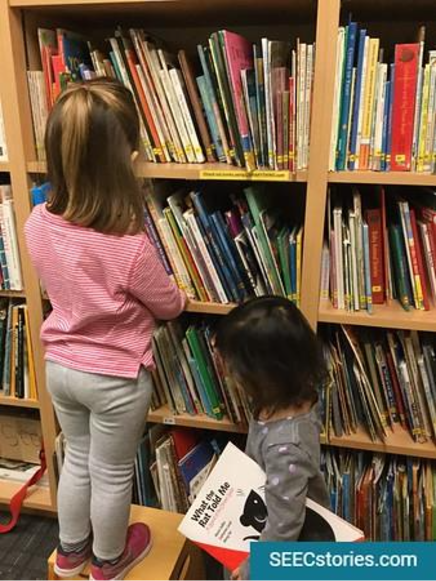
As this previous SEEC blog explores, it is developmentally important that early learners see a broad diversity of individuals in the media they are exposed to. This provides young learners with the opportunity to gain more confidence in who they are, as they may see someone who they find to be similar to themselves in a way. That said, it also allows them to familiarize themselves with people from different communities. In this way, books can support SEEC’s use of language that promotes the idea that people can be “the same and different” in many ways.
My contribution to this journey consisted of four major phases: evaluation, perspective-taking, analysis, and creation.
Evaluation
The beginning of the journey, evaluation, consisted of going through around 370 books at SEEC’s east court library. From here, the books were categorized as either red books, green books, or books to be weeded. If the book had content that stereotyped communities of people, was not developmentally appropriate, used inappropriate language, or was harmful in any way, they were classified as a red book. On the other hand, if the book had good representation of diverse communities and centered a developmentally supportive lesson or skill, they were classified as a green book that is highlighted for educators to use for their lessons, if applicable. Finally, weeded books are either damaged or have lower-quality stories that could be replaced by other books.
Perspective-Taking
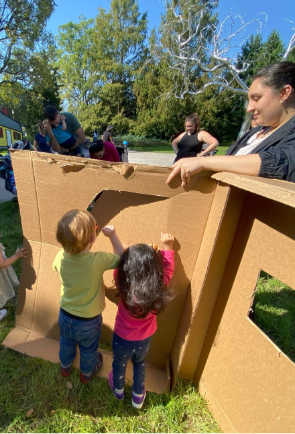
This evaluation period served to build the foundation of my understanding of SEEC’s library – the books they had, the types of books they wanted, and those that did not lend to the overall purpose or values of SEEC. That said, I also wanted to look past the theoretical and gage what books were actually being used within the classrooms and how. To do this, I assisted with the weekly classes of the Smithsonian Early Explorer program, conducted informal observations within different classrooms, and asked to interview a few SEEC educators that work with different age groups. Through these experiences, I was both able to directly note how the youth themselves engaged with books when in their classes and gain insight into the thought-processes of educators when deciding when and how to use a book. I could then analyze the information provided from these two sources and draw some overall conclusions.

Analysis
I began by identifying some common themes across the interviews. Some of these include:
- Role of books to normalize diverse representation
- Importance of developmentally appropriate content
- Using books to…
- Connect to approaching site visits
- Support skill-building
- Dig into topics of interest to the class
- Prepare for classroom transitions
These themes served as a jumping-off point to then scope out possible Smithsonian objects to center in the books that I would create for educators to use in their lessons.
Creation
When entering the creation phase of the project, there were a few priorities I kept in mind. Firstly, I wanted the content to focus on Latine culture and community, as these topics are authentic to my voice and desired contribution to SEEC’s library collection. Secondly, it was important that the books could be used for years to come, which limited my object search to either permanent exhibits or objects that were frequently rotated into display. Lastly, I found it important to provide educators with a variety of accompanying craft and/or activity choices they could engage their class in after reading the book. In fact, the primary reason why I chose to have such a heavy focus on exploring artist Verónica Castillo’s Tree of Life sculpture was because a SEEC class expressed a substantial interest in the object.
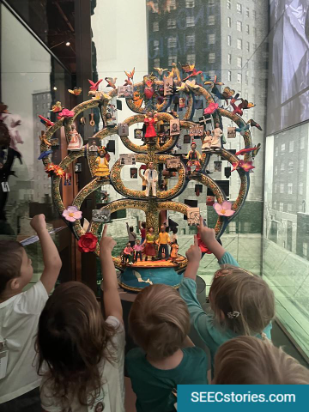
Now that it is the end of my time here, I look at the five books I created and hope that they highlight the importance of telling Latine stories through museum objects. That said, the topics of these books range from community and justice to clothing and identity. You can explore the digital adaptations of these books by clicking on any of the topics below:
- Verónica Castillo’s Tree of Life
- Introducing Verónica Castillo’s Tree of Life (Book 1)
- Branch 1: Community and Identity (Book 2)
- Branch 2: Fighting for Justice (Book 3)
- Branch 3: Breaking Boundaries (Book 4)
- The Clothes We Wear to Go Somewhere
Although there is still much to do, I hope the work that I have done at SEEC will lend to one overarching goal: for early learners to make healthy connections between the diverse stories they hear, their sense of self, and the communities with which they are familiar and unfamiliar.
 seecstories.com