Teacher Feature: Four Year Old Classroom Explores Seed Dispersal

As part of our upcoming partnership with the National Academy of Sciences. We are re-posting this blog. SEEC will be exploring seeds at their upcoming Family Day on Saturday, April 13. Learn more.


Today we’re featuring the four-year-old Cinnamon Bear class, led by Krystiana Kaminski and John Fuller. The class is currently learning about plants and food through a Seed to Table unit. On this particular day the groups explored seed dispersal with a visit to the Mary Livingston Ripley Garden located between the Arts and Industries building and the Hirshhorn Museum and Sculpture Garden. Below you will find images from the lesson, as well as reflections from the teachers. 

Cover Photo

We chose to embark on this unit for several reasons. Throughout the year we have observed how fascinated the children are with the natural world. They love to dig in the soil on the playground and often ask to play in the grass on The Mall after one of our museum visits. It’s amazing how much they enjoy playing amongst the trees for long periods of time without any other equipment! This topic came up last year as our previous class had similar interests, and we thought there were ways we could improve upon it the lessons and tailor it to this class ‘particular interests.

teacher feature seed disposal 1

Krystiana began the lesson by reminding the children of a book they had read earlier in the morning about seeds.  The children were already familiar with the concept that seeds are what new plants are born from. Krystiana asked the children what would happen if seeds just fell to the ground and stayed where the original plant was. To explore this question further, several children pretended to be apple seeds that dropped from the same apple tree. They grew up into big tall trees and noticed how close they were together. They realized that their close proximity might make it hard for them to all get sunlight and nutrients.

The week before this lesson we did an introduction to the unit and talked a little about how most plants grow from seeds. We also read a few books about seeds as a sneak peek to get them ready for our week-long exploration of seeds.

I like to introduce our topics through multiple methods and then, when possible, integrate them into all parts of the day. For example, I like to have a few books that I’ll read to them throughout the week. Sometimes when teaching a topic that is more complex, I’ll use lots of different books. Often times I’ll prefer the way one book explains one thing but how another is clearer or has better pictures and I’ll mix and match. I also like to include video clips, songs, and actions into a lesson, as I believe it’s beneficial for young children to receive information in multiple ways.

teacher feature seed disposal elephant

Now that the children understood the importance of seeds’ need to travel, they talked about how this might happen. The first way Krystiana shared was through animals. To illustrate this, two children pretended to be elephants eating fruit. They wandered away and Krystiana told them that the elephants needed to poop. They had great fun making the elephants poop, and Krystiana told the group that while it might seem silly, the elephant poop had the seeds from the fruit they ate, so the seeds had successfully traveled!

This particular class LOVES to tell stories and act things out. We did a whole unit called Myths and Legends after observing how much they loved telling stories to each other at lunch. They were also given the opportunity to act out a story they wrote during our Performing Arts unit. We wanted to be thoughtful about how we could make this unit accessible and one idea was to integrate acting into the lessons, hence the props. This was a fun challenge for us teachers, as it made us think outside the box in regards to our planning. For this lesson, I did some research and was inspired by the forest elephants found in the Congo Basin. As the largest frugivores on Earth, they play a huge role in seed dispersal and are an important part of the eco-system. I then got some toy elephants, a green table cloth, and some real pieces of fruit to use as props. Whenever possible I like to use actual materials for props, as it helps make the lesson more concrete. Pictures can also work well but actually having something the children can hold in their hands helps bring a lesson to life. In this case, we were able to cut open the apple to look at the seeds inside. We then had the elephants “poop” out the seeds as they were travelling across the Congo Basin (green table cloth).

I knew the children would get really silly when I mentioned elephant poop, so I did a quick reminder beforehand. I told them that we are thinking like scientists and instead of getting really silly we can say, “How interesting”. Of course, they still got pretty silly for a bit. I then said I was going to count down from five to let them get their sillies out but then it was all done. After the countdown I did a sing-song, “It’s all done. It’s all done.” They joined in that chant and then we were able to continue the lesson.

CORNER TAB (2).png

Seeds are usually quite small so I wanted to have some blown up images that clearly demonstrate the outer part of the seeds that use spikes to catch on to fur or clothing. I matched them to the pictures of the flowers they came from in the hope that we would find some on our garden walk. I think it’s important to use real-life pictures of things, especially things in nature, as children this age can have trouble with transference, so they benefit from seeing real-life pictures.

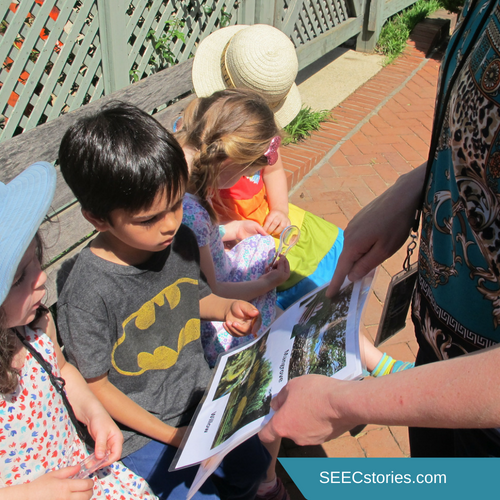
Ensuring that each child gets a turn with the images, while still listening to myself and others can be challenging, as oftentimes the children will get so hung up on who is passing to who that they stop listening to the lesson. Because I wanted them to look closely at the pictures and observe the interesting shape of these seeds I had them pass it around. Later on in the garden, I did not have them pass, as they were seated in a configuration that would have made it unsuccessful. Instead, I showed the pictures as I walked past them.
teacher feature seed dispersal hunt 4

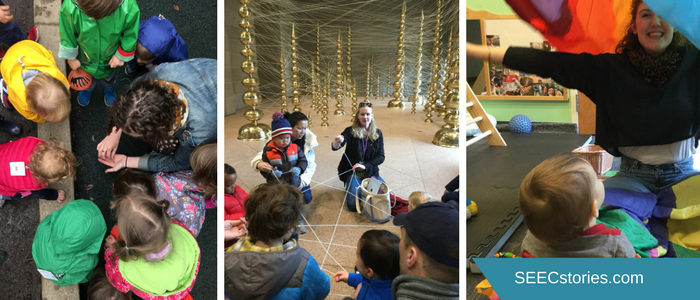
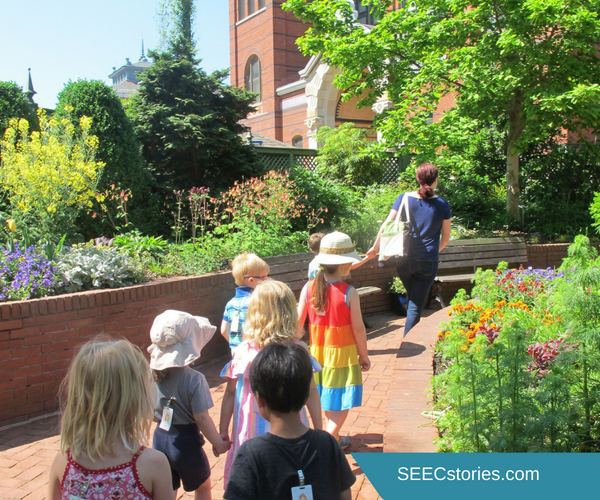
Krystiana explained that there are four other ways that seeds disperse, and that they would learn about them in a garden. The class was very excited to get into the garden and were eagerly pointing out flowers that looked similar to the ones they had seen in the classroom. 

I love this garden and the layout of it is ideal for individual exploration, as it is relatively enclosed. A wide variety of flowers grow there and I was hoping that some of the flowers I chose for the lesson would be in the garden. We are lucky to have access to these amazing places and I try to utilize them as much as possible. However, if I did not have this access, I would still have tried to teach parts of this lesson outside. They were so excited to search for seeds and the conversations they were having amongst themselves would not have taken place if we remained in the classroom.

Children at this age learn through sensory experiences, not just abstract information. They need to be able to categorize it in their head and much of their previous knowledge has been sensory. By giving them real things we are also making them active participants’ of their environment, which is crucial for concept development.
teacher feature seed disposal wind

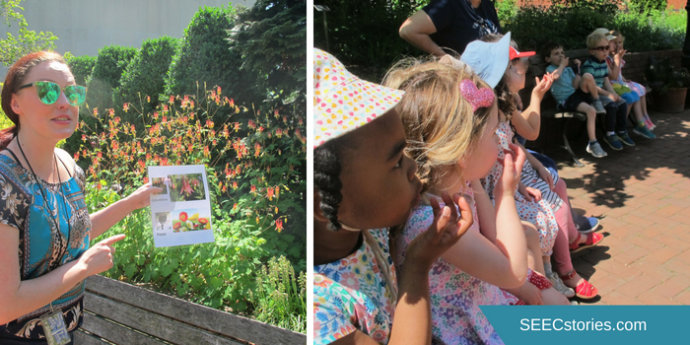
The group sat down on a couple of benches, and Krystiana shared another way that seeds travel: wind. She showed images of flowers that utilize wind for seed dispersal and they noticed the physical characteristics that help seeds travel in the wind, such as small, light seeds and cup shaped flowers that dump out the seeds when they blow in the wind.  The children pretended to hold a flower and blow like the wind, imagining the seeds traveling on the gusts.

A colleague of mine introduced to me to the Total Physical Response (TPR) method of teaching language or vocabulary concepts. One of the main concepts is attaching movements to actions. I’ve found it to be very effective with young children. In my experience, they remember concepts better when attached to a movement especially if it’s a fun way to move their body. A few weeks after this lesson, when we were reviewing what we learned, one of the children talked about how the poppy seeds are stored in a cup that needs to be tipped over by the wind in order to disperse. As she was explaining this she was using the same motions we did as a class.
teacher feature seed disposal force

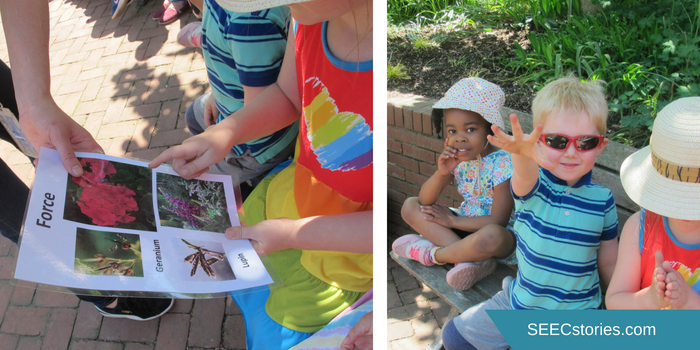
Next, Krystiana shared images of flowers that use force for seed dispersal. She described how some flowers’ seeds dry out in the sun and then bursts or launches out of the flower. The children enjoyed pretending that their hands were seeds and launching them.
teacher feature seed dispersal hunt 2

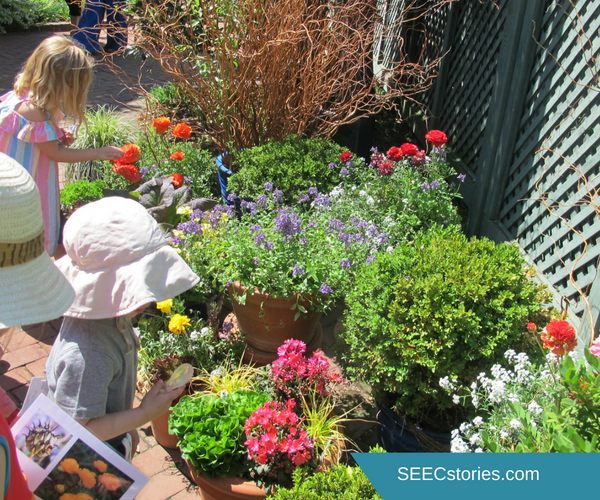
Then it was time to search for seeds and make observations.

This group of children are very respectful when given non-visual boundaries in the environment so we are able to let them explore either independently or in a small group quite often. We are big on personal responsibility in our room and one way we practice this is by giving them opportunities to show us they can handle responsibilities.
teacher feature seed dispersal hunt 1

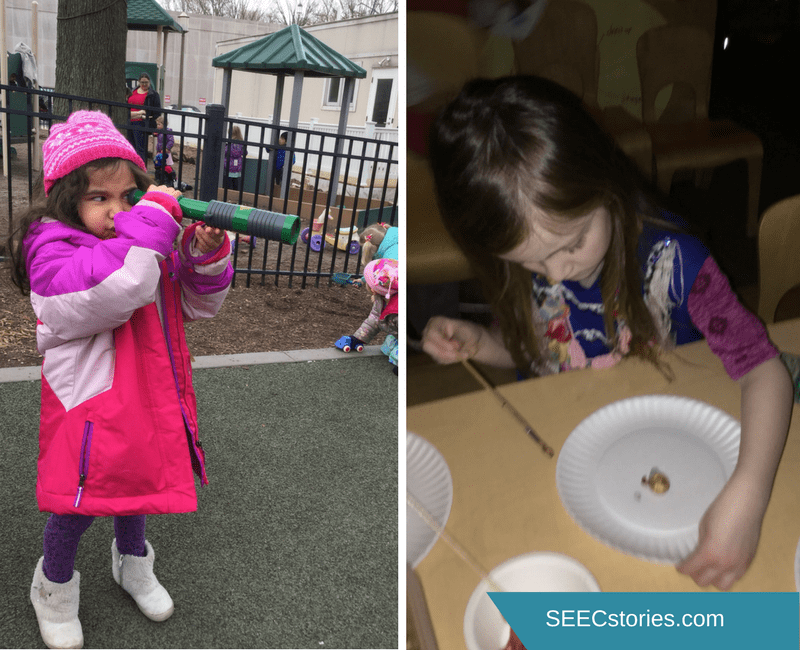
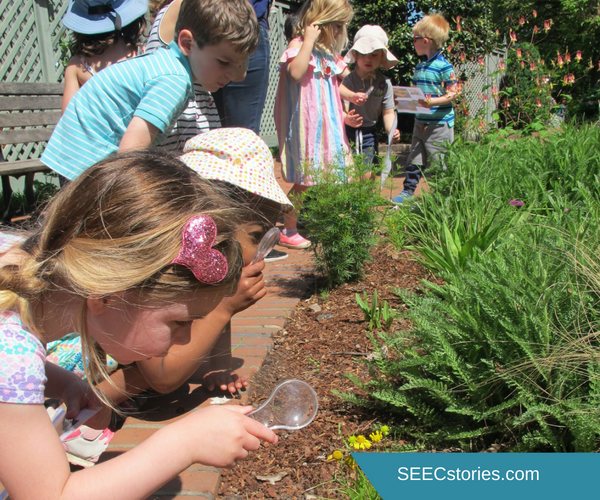
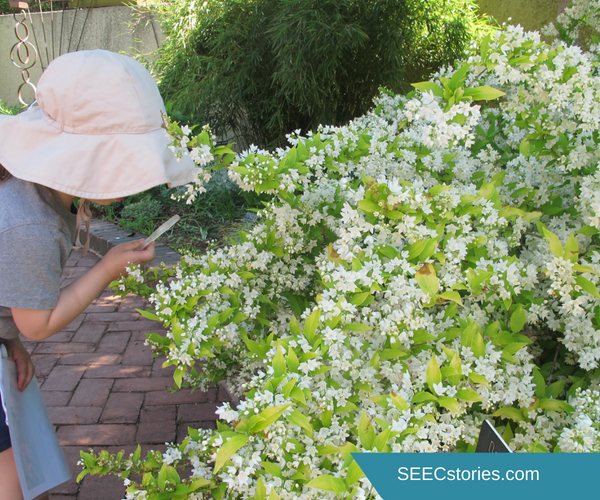
Each child received a magnifying glass, as seeds can be very small. 

The magnifying glasses were a last minute touch as I brainstormed the lesson on my way to work. I think they were helpful in that they were something they could hold which made them less likely to touch the actual flowers.
teacher feature seed dispersal hunt 3

The group spent a long time examining the flowers in the garden and predicting how the seeds spread from each flower. 

There were lots of seeds on the ground and the children were really excited about those. The flower seeds were pretty difficult to spot due to their size. The children asked some questions I did not know the answer to and I reminded them that we can always do more research when we get back to school.

I think allowing the children independent exploration time gave them an opportunity to talk amongst themselves about the things they were looking for and many of them were using the language I had used in the lesson. On the other hand, some children were frustrated when they couldn’t find a lot of seeds and I had to remind them that they are very small and they may not be able to find them.
Teacher Feature Seed Dispersal water

To end their time in the garden, Krystiana shared that water is the last way that seeds disperse. She showed images of mangrove seeds and noticed that they were large and boat shaped – a great shape to float on the water and travel!

I broke up the different seed dispersal methods, as there were quite a few and I didn’t want them sitting for too long. I was considering taking them to an area that had a small body of water to discuss the role of water in seed dispersal but realized the lesson would get too long. I was actually planning on doing that part later in the day but the children were still engaged and focused so I added it to the end. I try to be flexible in my lessons as there have been times when nothing seems to be working and I’ll realize that we are better off cutting a lesson short. Or, the children may get really interested in one part of a lesson and then I will extend that part. Luckily, we are an emergent curriculum school and are given the flexibility to base our lessons on their interests.
SEECstories.com (16)

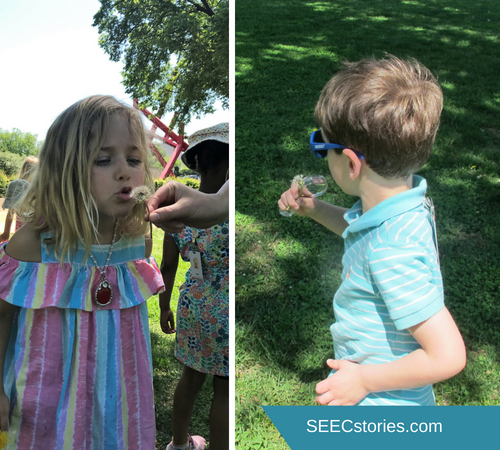
Before heading back to school, the class went across the street to the National Mall in search of dandelions. Everyone found at least one to blow on and watched as the seeds floated away. The class determined that dandelions use the wind method for seed dispersal.

We had not talked about dandelions prior to this lesson, but they are such a familiar, easy to find flower so I really wanted to add them to the lesson. Also, they are the perfect example of the wind dispersal method!

If I were to do this lesson again, I would have liked to have had some actual seeds the children could hold as it would show them how they are often very small. It also would have been great to have different sized seeds that they could observe and do observational drawing of later in the classroom.


After learning more about seeds, the class continued with their Seed to Table unit, exploring pollination, fruits, vegetables, and grains. For more ideas, visit our food Pinterest board!

Summer Museum Highlights for Families

Summer is here and it’s the perfect time to head downtown and explore the museums with your family! There are many exhibits and events throughout the summer that will engage your family while learning something new.

SEECstories.com (21)

No Spectators: Art of Burning Man at the Renwick Gallery

Renwick Gallery’s current exhibition, No Spectators: Art of Burning Man shares many whimsical artworks from the annual Burning Man art festival. From moving mushrooms to scintillating shadows, there is sure to be something that your family will find fascinating. There’s also a fairly unique aspect of this show compared to most museum exhibitions – visitors are allowed to touch most of the artworks.

Extend It: Play with color, light and shadows! With a flashlight, create shadows with various objects. What objects make the most interesting shadows? If your child is older, cut paper into various shapes and see what shadows they create.

Alexander Hamilton: Soldier, Secretary, Icon at the National Postal Museum

If you have any Hamilton fans at home, then this exhibit is for you. The exhibit, on view until March 3, 2019, features original letters written by Alexander Hamilton. While you’re at the National Postal Museum, check out their permanent exhibit, Moving the Mail which highlights different vehicles that have carried the mail over the years.

Extend It: Practice writing letters of your own and mailing them! Choose a family member or friend (near or far) and write a letter to them. If your child is pre-literate, encourage them to draw a picture or dictate a letter. Choose a stamp, and deliver it to a local post office or mailbox together.

IMG_2067.JPG

Blind Whino Southwest Arts Club

The Blind Whino Southwest Arts Club is an arts and cultural nonprofit located in South West DC. Originally a church, their building is completely painted by artist, Hense, whose colorful murals are perfect to spot colors, lines and shapes. Blind Whino also has an art annex with rotating exhibitions that are open to the public on Wednesdays from 4 PM to 8 PM and on Saturdays from 12 PM to 6 PM. Be sure to stop by before July first to see Le Bon Voyage: Across teh Omo Valley and take in the portraits, homes, and culture of the Surma people.

Extend It: Take a photo of your house or another familiar building. Print it out and trace the outline on a piece of construction paper. Encourage your child to paint your house’s outline in anyway they wish.

Smithsonian Folklife Festival 

Head to the Mall between June 27 and July 8 (closed July 2 and 3) for the annual Smithsonian Folklife Festival. This year, the cultures of Armenia and Catalonia will be celebrated through performances, talks, workshops, and more! Check the schedule for specific times of various activities such as weaving carpets, making clay jewelry, and creating mosaic street art.

Bound to Amaze at the National Museum of Women in the Arts

You and your family will see books in a whole new light after visiting this exhibit, which opens July 20. The show features books that are more sculptural in design than average books.

Extend It: Create your own uniquely designed book. Use one of the techniques showcased in the exhibit, such as curling or pleating, to make your book one of a kind.

Endangered: From Glaciers to Reefs at the National Academy of Sciences

The Cultural Programs of the National Academy of Sciences exhibit explores the relationship between art and science. Opening on August 15, Endangered: From Glaciers to Reefs will feature paintings and photographs by Diane Burko that document climate change.

Extend It: Gain an appreciation and respect for the glacier and coral reef environments by reading stories about animals that live in each (for example, North: The Amazing Story of Arctic Migration by Nick Dowson or On Kiki’s Reef by Carol L. Malnor), or researching more information about them. Look online to see what steps you can take to help these environments and make a family plan to implement one thing that will help the Earth.


Celebrating Play

In anticipation of this year’s Play: Engaging Children in Object Rich Environments  seminar, we spent this past week exploring the all-important concept of play. We delved into why play is important for children, and adults too. We thought about the many different types of play, and how play can be incorporated into structured experiences to make learning more meaningful and engaging.

Melinda Bernsdorf Erica Collins Why Play is Important Teacher Truths.jpg

Importance of Play

While some caregivers, school administrators, and policy makers are skeptical that a play-based curriculum can achieve academic learning, the educators who utilize play to teach developmental skills and content (listen to SEEC educators Melinda Bernsdorf and Erica Collins reflect on their use of play during an episode of Teacher Truths) can attest to the power of play in a child’s learning.

SEEC Teachers Play.png

Adult Play

Play isn’t just important for children! With the advent and popularity of escape rooms, city scavenger hunts, sip and paints, social sports leagues, trivia nights, adult coloring books, and more, it seems that adults are embracing their need for play. Peter Gray, researcher at Boston College, likens a person’s need for play to their need for sleep; our minds and bodies will notice if we aren’t getting enough play.  Taking time out of the day to engage in playful activities, in which we lose track of time, is essential to our well-being. With this in mind, our SEEC faculty participated in a survey to see how we play when not at work.

SEECstories.com (20).png

Types of Play

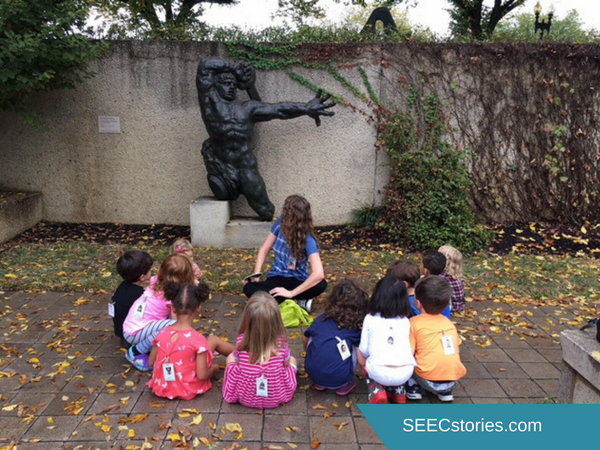
As evidenced by the survey above, everyone has different preferences for the type of play they enjoy. Some children (and adults) gravitate towards solo play, while others prefer to play with a group. Being outside and playing in nature is favored by some, and others prefer construction play indoors. Some love to get messy and really dive into sensory play, while some choose to participate in dramatic play, and still others will always engage in physical play. No matter what type of play children choose to engage in, we know that it’s all important to a child’s development.  At SEEC, we recognize that every child learns in their own unique way, and thus, we offer many play opportunities for every type of learner, so that all children will find an activity that speaks to them. For example, during a family workshop on sculptures, the educators provided varied play opportunities to provide context for the concept, while allowing something for every child, no matter their preferred way of learning.

CORNER TAB (1).png

Playful Teaching

Unstructured, child-directed play is very important to a child’s development, and should be part of every child’s day. However, adult-facilitated, playful learning experiences make learning more meaningful and engaging for young children. Abstract concepts can become concrete through play, while children also build important developmental skills such as social competence. At SEEC, we incorporate play into lessons, encouraging children to be an active participant in their own learning. Whether they are learning about the anatomy of a sea star by becoming one, pretending to eat like a duck to learn about a duck’s life, becoming the parts of a wrecking ball,  or pretending to row a crew boat after learning about all its parts, our children and educators engage in play in the museums and community every day to bring concepts to life.


Want to learn more through playing with colleagues at the Smithsonian? Join us for our Play seminar on July 9 and 10!

Teacher Feature: Pre-K Class Explores Treasure

SEEC Teacher Feature PreK Treasure Pirate.jpg

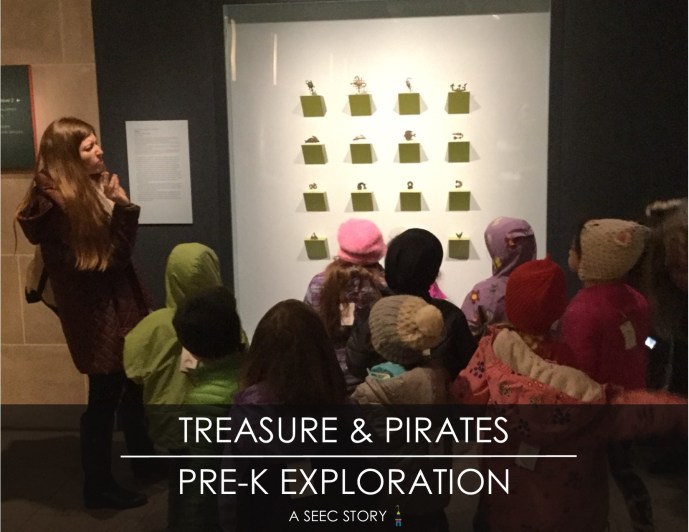
This week’s Teacher Feature highlights a four-year-old class’ exploration of treasure and pirates at the National Museum of African Art.  Over the past few months, the class, led by Jessie Miller and Will Kuehnle, has been creating a film written and starred in by the children. The teachers created lessons to learn about the aspects of the story that the children wrote. Without spoiling the film too much, pirates who steal treasure was a plot development, so they spent a week exploring pirates and treasure. This particular lesson explored what treasure actually is and how pirates steal it. The lesson included objects, play, literature, and even their puppet friend, Pirate Pete, and challenged their beliefs about treasure and pirates. Below you will find images from the lesson, as well as reflections from the teachers. 

1

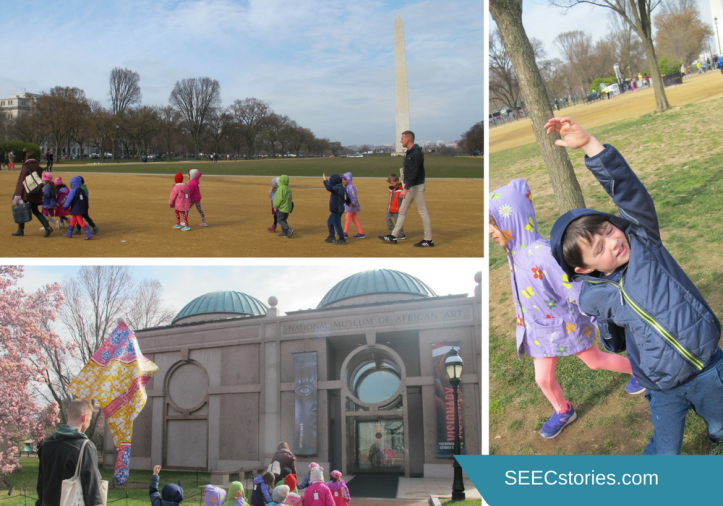
On their way to the museum, the class remembered the parts of a ship that they had learned about the previous day. The sail seemed to be of particular interest to the children, and one child even “flew his flag” the whole way to the museum. Before entering the National Museum of African Art, the children noticed Wind Sculpture VII by Yinka Shonibare and commented that it looked like a sail blowing in the wind.

During our walks to and from visits, we like to observe and discuss the environment we are in. It is exciting to see the topics that arise just from looking around! This is also a great time to build upon concepts we have already learned about. For example, when we were crossing the National Mall, some children remembered the time we made and flew our own kites, after learning about the letter “K”. This topic came up moments later when the children spotted Wind Sculpture VII and described how it looked as if it was blowing in the wind like a kite. This helped reinforce previous knowledge and can sometimes bring up new questions we didn’t have before. It is important to address these inquiries when they arise so the child feels his or her thoughts and opinions are valued. Asking questions and knowing how to find the answers is a crucial skill to build at this age and it can guide our lessons and curriculum in new and exciting ways.

2

Upon entering the Currents: Water exhibit in African Art, Jessie told the class to search for something that looked gold. When the group reached the weights by Akan artists from Ghana and Côte d’Ivoire, the children took some time to look closely at the weights. Jessie narrated what she noticed and wondered about the objects.

When using museum spaces with young children, there are many obstacles that can arise. The objects we decided to visit on this day were small and placed high up from the ground, making it difficult for the children to see. For this reason, I encouraged the class to get close and observe the objects for a few minutes before we sat down for circle time. This gave them a chance to casually chat and ask questions before we began the formal lesson.

Modeling how to do things is an important tool when helping children develop problem-solving skills. When they hear me asking questions and sharing my ideas about the objects, they get a sense of what observation and reflection are. Even basic descriptions such as “that looks like a shell” and “I wonder what that is made of?” give the children a chance to chime in with their ideas and creates a space for them to feel comfortable sharing.

I chose to use the Akan weights for this lesson for a few reasons. When the class decided to make a movie, we brainstormed all of the places we wanted to go and characters we wanted to include. Boats, pirates, and treasure were all topics of interest to the class. I felt it was important to explore these subjects in a realistic way through books, objects, and definitions that the children could understand and relate to. It is common for a child to think a pirate is a person who sails around and steals treasure. One of the big goals of this lesson was to challenge the students’ ideas about who pirates are and have been throughout history. The Akan weights allowed us to have a discussion about what treasure is and the other lesson materials we brought gave us an opportunity to ask the big question “do pirates only steal treasure?”

SEECstories.com (7).png

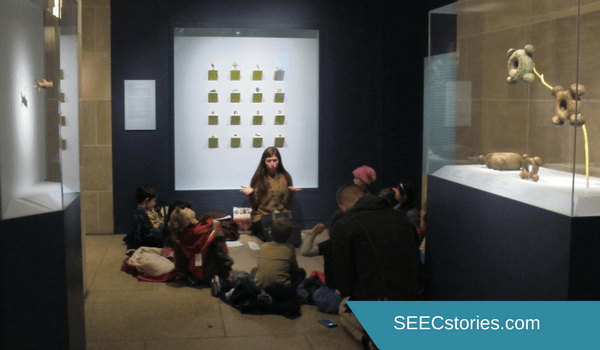
After making a seated circle in front of the weights, Jessie asked, “What do you think these objects are?” Responses included, “they’re treasure from a chest” and “it’s animals that are now dead and someone painted them.” Jessie thanked the children for sharing their predictions and observations, and said they would talk more deeply about the weights in a few minutes. 

Although it is important to address questions that arise organically in the moment, it is also beneficial to let children have time to think about and reflect on things they are curious about before handing them an answer. After we shared some of our questions, we dove into the lesson with a variety of other materials. This left the kids curious about the unfamiliar objects we had observed and challenged them to try to figure out what they were as we navigated through the lesson. Throughout our circle time, you could see them start to make connections and by the time we brought our attention back to the museum objects, they had even more ideas and questions.

33.png

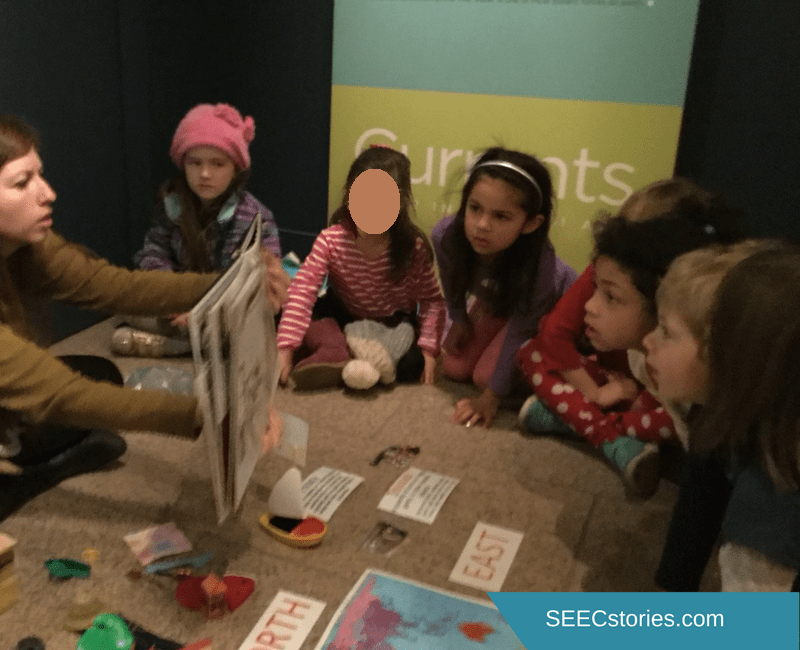
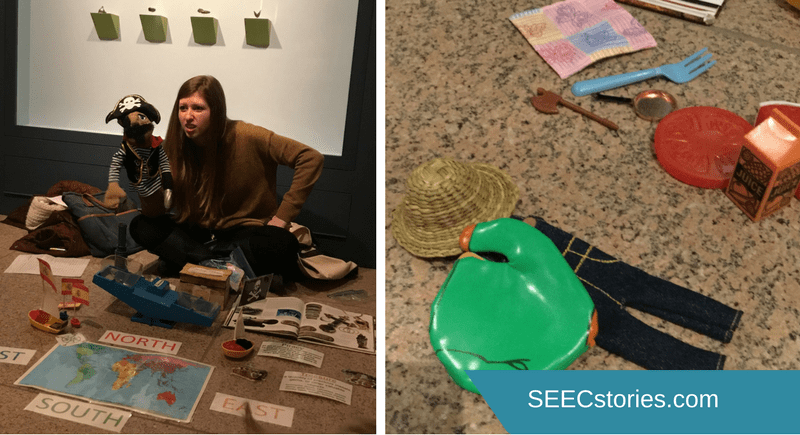
Jessie brought out a world map, and the class reviewed the directions and continents through the “7 Continents” song. Next, Jessie asked the children to tell her what they knew about pirates. Many children focused on physical characteristics that a pirate might have including an eye patch, a hook or peg leg. One child pointed out that pirates are people who take treasure. Jessie said that pirates don’t have to have a hook, peg leg or eye patch, but they do all steal things. She read the definition of piracy and then read from the book Treasure by Philip Steele to learn about real pirates in the Spanish Main.

Songs are a great way to recall information and the “7 Continents” song is one we like to use every year. Throughout the movie the class was making, we “traveled” to many places throughout the world and consistently used maps and songs to reinforce their understanding of geography and the world around them. A song is also a great way to get the children involved during a lesson and spark their attention.

Definitions are a valuable tool for the students, as well as the teachers. It gives us a topic (sometimes complex) that we then need to break down and try to figure out what it really is. For example, when we read the definition of piracy, it said nothing about eye patches or peg legs like the children had mentioned. This challenged us to look closely at the words used in the definition so we could begin to unpack the true meaning of the word pirate. The definitions also give the class a chance to match the words we are talking about with the written words. We can sound out and point to letters to figure out the words as well. All of this strengthens literacy skills and engages the children in learning new concepts. We also often bring other materials such as books and large printed words we use frequently such directional words, North, South, East, and West. Bringing a white board and sounding out a word as we write it down is another way to get them engaged in the lesson with a literacy activity.

6

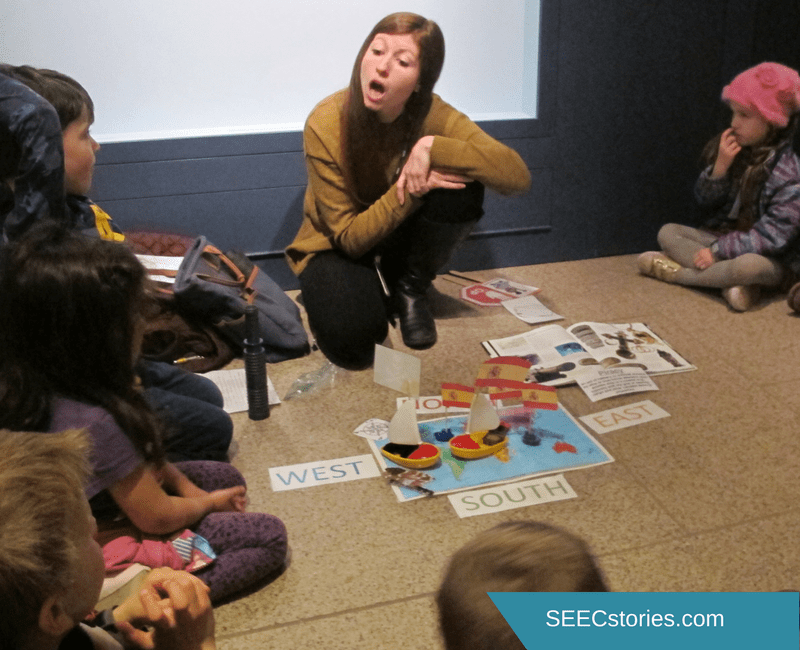
To illustrate what they read in the book about pirates in the Spanish Main, Jessie brought out a toy ship with a Spanish flag, and sailed it across the map in search of gold. She then brought out a pirate ship and asked how pirates could get to the Spanish ship to steal. The children talked about the use of guns, swords, and cannon balls. Jessie explained that the Spanish wouldn’t want their ships attacked, so they would bring lots of smaller boats to protect them called a fleet or convoy.

Using visual aids during lessons helps young children make sense of concepts that might normally be difficult for them to understand. I could describe a boat sailing to Spain and running into pirates, but this information becomes more concrete and accessible to children when they are able to see it. We used our pirate book to enhance their understanding of piracy, but giving them objects they can manipulate and play with gives them a deeper understanding. Many of the objects we use in lessons are from our school and the children have used them before. This creates opportunities for reflection and scaffolding later when they use the same materials during play back in the classroom.

Although it was not the main goal of the lesson, weapons are a part of piracy, so when the subject came up I felt it was important to address it. A weapon is an object. It is only until a person uses this object that it becomes dangerous. By ignoring sensitive topics such as guns and weapons, we leave a child feeling confused and curious about the unknown. In order to navigate safely and efficiently through their world, it is important that children have the tools to keep themselves and those around them safe. Once the children thought more carefully about the idea that the person with the weapon is the one that caused the harm, they began to think about their own opinions on the topic. I expressed to the children that I would never want to hurt anyone so I would not use a weapon in a way that might cause harm to someone. The children responded enthusiastically about feeling the same way. A sensitive subject turned into a teachable moment that left the children feeling empowered rather than confused and fearful.

I think it is important for children to experience every emotion, even if it may feel scary or uncomfortable at times. Feeling these emotions at school allows them to grow and understand themselves in a safe environment. Ignoring sensitive or frightening topics sends a message to the children that you don’t want to talk about something and just perpetuates their fears. We as teachers must educate the children, give them validation that it is ok to feel these emotions, and remind them that they are safe and loved.

11

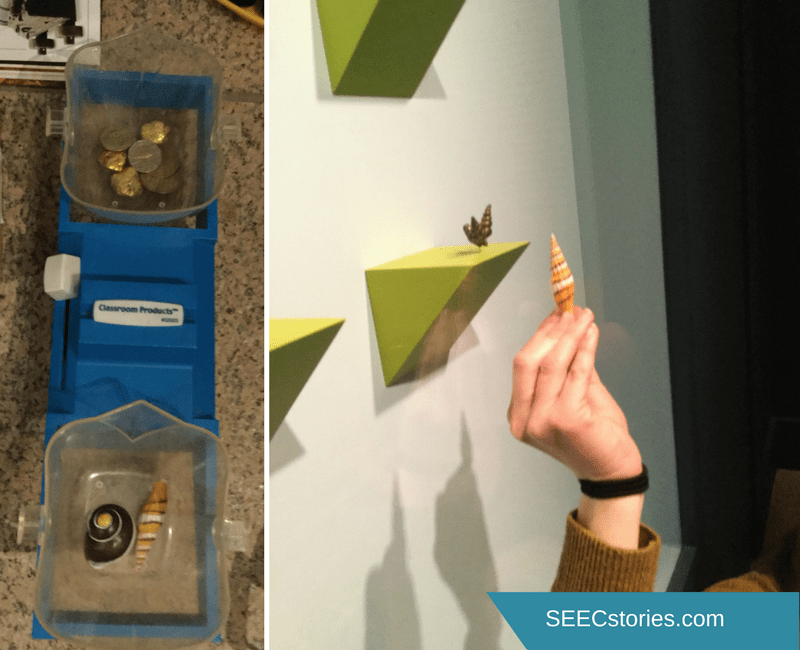
The discussion about pirates stealing a ship led to the children talking about treasure, so Jessie asked, “What is treasure?” Responses included gold coins, chocolate coins, jewels, crystals, and anything special. Jessie read the definition of treasure, “something of great value or worth”.  At this point, Jessie refocused the class back to the weights. She explained that they were created by Akan artists from Ghana and Côte d’Ivoire and pointed these places out on the map. She said that the weights are not actually gold, but copper and were used to weigh gold to decide how much items cost. Jessie shared some objects she brought that were similar to the weights, and showed how gold can be measured against the weights to determine worth.

The children have had some experience with weighing objects, but a scale has not been available to them on a regular basis. Concepts such as weight and value can be difficult for young children to grasp. Using scales is a great way to help make sense of these topics. It is also a tool for math and counting. Although the Akan people would use the weights to measure gold dust, we decided to use coins so the materials were more familiar to the children. Understanding one weight was equal to a certain amount of coins helped them understand what value is, which was part of the definition for treasure. Pirates wanted the treasure because it was considered valuable. This created the question, “can different things be valuable to different people?”, which lead to our discussion about pirates stealing more than just treasure.

SEECstories.com (6).png

Next, Jessie brought out their puppet friend, Pirate Pete. One of the children asked Pirate Pete what treasure he steals. Pirate Pete brought out some objects including food, clothes, and blankets. Jessie asked the class if these objects look like treasure, and they all gave a resounding, “no!” Jessie explained that pirates love when they find treasure like gold, but often they would steal other things that they needed to live like food and clothing.

If I were to do this lesson again I would split it into two different lessons. There was a lot of material to review, new concepts to learn, and questions to discuss. I liked the idea of asking questions about an object and then coming back to learn about it later in the lesson. However, because there were a lot of concepts and material to cover I would prefer to have two separate lessons on piracy and treasure/value.

SEECstories.com (9).png

Before leaving the museum, Jessie provided the opportunity for children to share their comments and questions. The first question asked was, “Do pirates kill?” Jessie responded “yes, pirates have killed”, which then prompted Jessie to ask, “Is it a good thing to be a pirate or steal?” The children emphatically said no. Some children shared some connections they made to the lesson, including, “pirates going to another ship is like in the third movie of Star Wars when Luke jumped off his ship to another”, and “cannons are kind of like fur balls in PJ Mask!” One child even said she sees pirates in boats in Old Town Alexandria. Jessie assured her that sometimes people dress up and pretend to be pirates, just like we do sometimes, but they aren’t real pirates.

Lessons can sometimes create more questions than they answer, and I consider this a good thing! It is important for the children to walk away with information they may not have known before but it is also important for them to be curious and want to learn more. During my circles, I like to offer time for comments and questions at the beginning and the end. I use a sign with a picture of a person raising their hand on one side and a line crossed through the same picture on the other side. This indicates to the children when it is time for questions and when it is time for me to talk with no interruptions. This helps us stay on topic during the lesson but still gives the children time to express their thoughts and feelings when the time is appropriate. Allowing questions at the end also allows me to gauge which areas of the lesson they were interested in and what topics they may want to explore more.

4

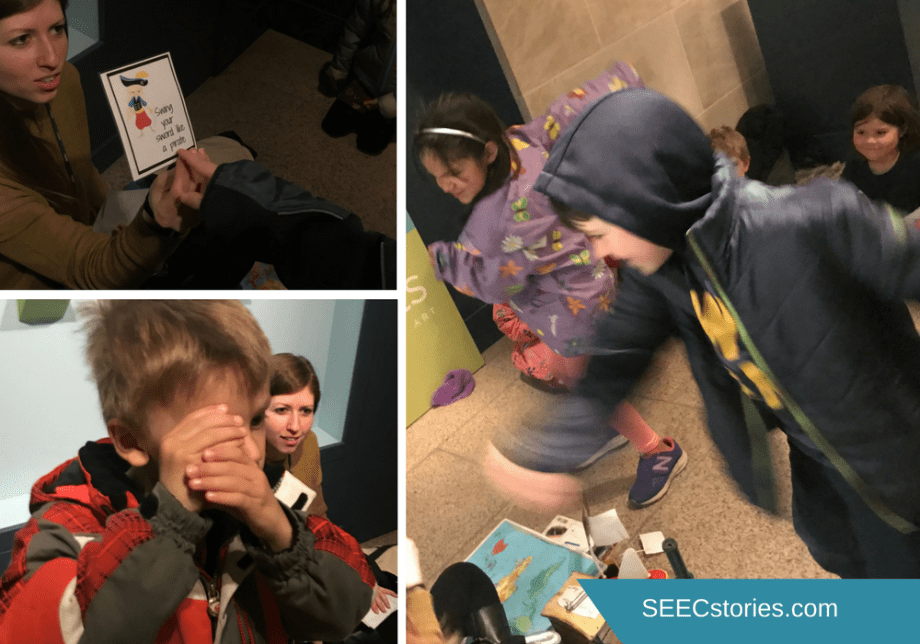
To conclude their lesson, Jessie played a movement pirate game with the children. She called two children at a time and showed them a card that showed a pirate movement to perform. The pair of children acted these out as they got back in line to leave the museum.

The teachers in our school community are always willing to share ideas and materials with one another. A different class had been learning about pirates earlier in the year and was gracious enough to let our class borrow some of their materials, including these pirate movement cards.

To transition back to our line, I wanted to incorporate something related to the topic that would get them up and moving their bodies. Because there was so much content during the lesson, using the game as a way of lining up allowed it to be a transition activity rather than lengthening the time the students had to sit and wait.

3

On the way back to school, Jessie pretended to be a pirate and looked through the spyglass to see if the class was using safe walking feet to cross the street.

We incorporate lots of play throughout our entire day. Any topic can be interesting to a child if you present it in a playful way. It is important for children to have a routine to follow but adding playful moments that they can engage with and connect to helps enhance their learning experience. My students have crossed streets a million times but when you add an exciting new twist like a spyglass watching them and making sure they are ready, it sparks their attention and reinforces their knowledge about a new object we learned about that week.

22.png

 Back on the playground, the children used the spyglass in their play. That afternoon the class painted their own “gold nuggets” that will be used as props in their film.

After all of my lessons, I like to have the materials I used out for the children to explore back in the classroom. I gave them the opportunity to create their own spyglass out of paper towel rolls and we collected rocks on the playground to paint gold, silver, and bronze. Later that afternoon, we filmed the pirate scene for our movie. To create our “script” I asked the students what things they wanted to say about boats, pirates, and treasure. Many of the things we had discussed that morning and throughout the week came up. This reinforced all the material we had learned about and then gave them a chance to actually act it out. Now that our movie is finished, the children will have it forever and can always reflect back on the learning experiences they had here at school.


After their week on pirates, the class continued to learn about the other concepts included in their movie such as oceans, rain forests, and Antarctica. They premiered their movie last month to overwhelming acclaim from fellow SEEC children and families.

Teacher Appreciation Week 2018: Looking to the Future

Earlier this week we discussed the educational experiences from our past that influenced who we are as people and educators. Today, we’ll be looking into the future and sharing our hopes and dreams for our students, and the early childhood field ten years from now.

SEECstories.com (14).png

What do you hope your students will remember about their time in your class in 10 years?

Among all questions that we asked our faculty, this question had overwhelmingly similar responses. All our teachers shared that they hope, above everything else, that SEEC children will have a continued love of learning and knowledge of how much they were loved at SEEC:

I hope they will feel that they were valued and accepted. I hope something in my class will have sparked an interest in them that they pursue or value later in life.

Honestly, most of the children I work with are so young that they will not be able to remember or link words to those memories. This does not bother me because I believe that what they have experienced my class will have lasting impacts on their life. I hope that some of these impacts include a love for learning, the belief and freedom to explore and wonder, and the courage to keep going when things become difficult.

I would hope beyond the visits and amazing lessons that they would remember all of the love that was flowing throughout our experience at SEEC.

I want my student to remember being explorers, to remember being curious. My kids are very young so I know they will not remember all the content so I want them to remember that school is fun, they are capable of trying anything, and teachers are their partners in accomplishing their goals.

That learning doesn’t have to be filled with tests or arduous concepts but that learning is a place to ask questions, to embrace new knowledge and most importantly a place where we can laugh and learn at the same time.

I would love for my students (and/or their families) to remember the holistic approach to education and child development. Practices for empathy building, growth mindset, and resilience. I would hope that their experiences of learning through their community establishes a strong sense of advocacy and the importance of belonging/uplifting their community. “We are all the same, we are all different”

That we created a space for them to be themselves! That asking questions is always okay; and that finding ways to express yourself in your work and classroom choices is always important. That showing emotion is completely okay. Learning can be fun and creative. We are different but we are all the same.

The feeling of wonder, the fascinating experiences on our visits that they won’t get much of in later years, the memory of how much I loved them and hopefully made them feel good about themselves

2

What would you like Teacher Appreciation to look like in 10 years?

Several educators hope that more teachers get the recognition and appreciation that we do at SEEC:

I hope teachers are appreciated all year round by being paid more and getting lots of support from their administrations, like we do here at SEEC 🙂

I would hope teacher appreciation would be monumentally recognized (not just at SEEC but globally).

If it [teacher appreciation week] looked like it did today at SEEC everywhere in the world, I think teachers would feel much more appreciated.

Many teachers hope for more recognition for their skills through higher salaries and respect for the early childhood field:

Honestly I would appreciate a better salary for the work we do, nothing would make me feel more appreciated year round. More respect and recognition for the work we put into children’s education.

I hope that teachers are appreciated year round through increased pay and the acknowledgement that teaching takes true skill.

Continually pushing forward what the idea of education looks like. Having teacher voices elevated to the same audible levels as CEO’s at Fortune 500 companies. Celebrating teachers and other community caretakers with increased dedication (money & attention) to their fields.

More than just a flower or a card and having caregivers and professionals truly recognize the impact of a successful teacher.

Some mentioned their hope that more people will gain a better understanding of what it means to be a teacher:

Appreciation is defined as the recognition and enjoyment of the good qualities of someone or something; a full understanding of a situation. In 10 years I’d like to see parents spend a day with a SEEC class. I know parents value the work that we do daily and know that SEEC is a very special place. I think by spending a day with a SEEC class, parents will have a chance to see what educators do on a daily basis. Or parents could even volunteer to come in to help at lunch or snack or go on a visit. I believe that appreciation is more than something tangible and that doing things like visiting to get a better understanding of the work educators do daily is the highest form of appreciation.

I would teacher appreciation to encompass educating those who are not teachers of all the things we actually do.

In ten years, I hope teacher appreciation could involve parents stepping into volunteer roles to further create a home school connection.

1

What would you like to see changed in the educational field in 10 years?

Creating a more diverse, inquisitive educational field that is inclusive of all learning styles was a common thread among educator responses:

I would like to have more effective and nurturing standards for behavior management and classroom control. I would like more research and guidance on how to teach different subjects to children of different learning styles and developmental stages. I would like to have more information on how children learn language.

So much….but mostly an educational system that supports all types of learners and offers opportunities for growth based on a student’s strengths and interests.

Less focus on test results, more exploration and curiosity in all classrooms.

I’d like to see a bit more diversity in ALL schools and a much smaller achievement gap. We’re getting there, but it’s a slow process.

What was our faculty’s other hope for the field in 10 years? More value placed on education and teachers in our society:

I believe that educators are not respected, paid or cared for enough. Educators have the daunting task of meeting standards while still managing to extend themselves to care for and about the students that they teach all while being creative. They work beyond their scheduled time and often times will use their personal funds to make sure all of their students have the materials needed for a productive and successful school year. With the emotional, financial and mental strains, I’d like to see teachers celebrated as being important professionals in our society who can earn $100,000 per year with access to quality and affordable mental health.

I would obviously like to see pay better match the skills, education, time and effort teachers put into their work. I would like to see in general more value put the work we do. An investment banker makes a hundred times what a teacher makes but they are definitely not 100 times as important.

For early education: I would like to see a lot of change in the benefits and importance of learning at a young age (even pre verbal) For all of education: (there’s a lot) overall, I would love to see it held to a societal value that it deserves.

I would like for teachers to be more respected and acknowledged for their dedication and hard work. I don’t ever want to hear the saying “If you can’t do, teach” EVER! Teaching is something that not everyone can do and it really takes special people to do it well! I hope that in 10 years we are respected as education professionals and not just people who couldn’t do something else, but CHOSE this profession.

Education elevated to a stature that it is viewed is a linchpin for our economic and diplomatic success. Less bombs and more books.

Greater appreciation for the importance of early childhood education to the extent that pay is equivalent with other levels of teaching.


What are your hopes for the future of education? Share with us in the comments!

Teacher Appreciation Week 2018: Reflecting on our own Learning

This year to mark Teacher Appreciation Week we, at SEEC, decided to reflect on our past educational experiences as students, our present self-care practices, and our future hopes for our students and the early childhood field.  

Today, we’ll begin by sharing memories from our past experiences in school in hopes they will shed light on who we are as people and educators today. During Teacher Appreciation Week, we value being recognized as educators but also wanted to take time to appreciate and remember the educators in our lives who helped us become who we are today. Below are questions and responses from our SEEC educators.

SEECstories.com (13).png

SEEC teachers as children.

Many reflected on how a teacher empowered them as students, and how that influences their own teaching philosophy:

One of my math teachers in high school set up the class so we as students taught each other. He would assign us homework on a completely new topic without lecturing on it first. At class the next day, each student would list the problems that confused them and other students would go up to the board and explain how they solved the problem. Sometimes two different students solved the problems in completely different ways and both were given the opportunity to “teach” their way. Some students found this technique frustrating. They just wanted the teacher to teach them. But I discovered that I loved math when it was taught this way. It became my favorite class. I even looked forward to tests because I saw them as fun puzzles and I gained confidence when teaching the other students in my class.
Now as a preschool teacher, I notice myself focusing on social emotional learning. I encourage my class to solve their own peer to peer problems and I believe in the ability of very young children (even those who cannot talk yet) to learn from each other. I have come to embrace social learning as a key component of learning!

My second grade teacher helped us make bird houses out of wood and I remember him giving us such great responsibility with tools and our safety, that’s what I want to impart to the kiddos… the ability to use the tools they have in a safe way to empower themselves. Small but mighty!

Others shared negative experiences that never-the-less influenced how they teach their students:

My anecdote has a slightly negative feeling, but it has influenced how I have come to grow as both a person and an educator. When I was in my junior year in high school, we were “required” to go to the Junior Ethics Seminar. I did not want to go. Not because I was just some kid who wanted a day off from school, but because I didn’t think my teacher or my school had any place in teaching me about ethics-beyond what they are-that was my mother’s job.
When I brought this to the attention of my teacher, my view and how I felt, he responded that I would “go to the seminar or go to in-school suspension and have to write a 10-page college level APA style paper about ethics.” Well, I’ve never been one to anything by half measures and to show how serious I was-I wrote that paper. I didn’t just regurgitate definitions and anecdotes, I went to people and asked questions. I confronted strangers and friends asking: “How do you feel about teaching children ethics in schools?” I made sure to pull from as diverse a group of people as possible. From a single mother, to a Catholic father of five, to a professor at George Mason University. I wrote about as many points of views as I could find.
I turned in my paper, proud of what I had seen in my research. Maybe my opinion hadn’t entirely changed, but learning how others felt, opened my eyes a bit more. When I received my grade for the assignment, there was a giant red F in the center of it. My teacher had torn it apart based solely on the opinions of these people I had interviewed, and not a single red mark was there about the myriad of facts on which I had expounded. I swore to myself at the time I would never become a teacher.
Fast-forward almost 20 years later and here I am teaching toddlers. Every single day I think about how I am presenting information to my students and how what I will say can impact them and their families and their future ambitions. I work hard to give them the vocabulary they need to be able to question everything.

Several SEEC educators recalled specific activities from their time in school that has stuck with them throughout the years:

I always remember a science experiment I did in third grade about decomposition. One day at the start of the school year the class set aside some of their lunch, and we put the food in some panty hose and let it rot underground for a year. It was so cool digging it up later in the spring!

I remember working in teams to move around Mesopotamia in a history class. The activity was coordinated by the teacher, but our decisions facilitated the way the play happened. Also, it was a play driven history activity.

SEECstories.com (12)

SEEC teachers as children.

Many shared memories of teachers that helped build their confidence to follow their interests:

I remember a language arts teacher who encouraged my writing in a very positive way and helped me enter writing contests that year. I won the short story contest for the whole junior high and I think that is what made me start truly believing that I could be an author someday and started me down that path. Not there yet, but here’s hoping.
When I was in 3rd grade I had an art teacher, Mr. Leobroski, who had a passion for art and teaching people about how important art is to growing the mind. He always welcomed us into his huge art studio ready to introduce us to artists like Elizabeth Catlett, Romer Bearden and Van Gogh just to name a few. I will never forget when we spent a few weeks learning about sculptures and Alexander Calder.
When we had a chance at the end of the unit to create our own sculptures with various media, I remember feeling really upset because my cat didn’t look like a cat to my classmates. Mr. L (as we lovingly called him) took notice and came over to see why I seemed unfocused. When I shared my frustration with him, he reminded me that with art it’s all about perspective; that my idea of a cat might not be the same as others but that doesn’t mean that it’s not a cat. It’s my work and it’s not about acceptance from others but about expressing myself. He was the reason I feel in love with art 28 years ago.

Others remembered teachers for their passion:

My music instructor during my middle school years, stands as one of my most memorable educators throughout my life. Her level of passion, care, and determination remains an inspiration for my approach to teaching and learning.

A few SEEC educators listed their colleagues as some of the most influential teachers in their careers, highlighting the importance of peer support and collaboration:

When I was in my first year of teaching, an experienced teacher who was about to retire reached out to me with support and resources. She invited me to her school, gave me supplies for my Title I classroom, and even invited me over for dinner. It was just one of the countless times a fellow teacher reached out to me when I was learning how to adjust to my first year of teaching! This has influenced me to make sure I am always doing the same for others!

Being constantly surrounded by educators who produce great work (in various ways) but also love what they do has impacted me as a teacher. It allows me the chance to stop and think through lessons I’m teaching, ways I can manipulate it, and how much love I’m giving back to each individual student.


Do you have a memorable experience from your time in school? Please share with us in the comments and be sure to check back for our continued celebration of Teacher Appreciation Week!

How to Take Care of a Baby Shark (and Baby Human)

This week’s blog is written by Phoebe Cos.  Phoebe is a preschool educator at the Smithsonian Early Enrichment Center. 


Baby shark (doo, doo, doo, doo, doo, doo), Mama shark (doo, doo, doo, doo, doo, doo), Daddy shark (doo, doo, doo, doo, doo, doo)Preschool Song

The first time I sang this song in my three-year-old class this year, one child cut into the song halfway through and said, “We missed brother shark! What about him?” This question made perfect sense. We were singing about a shark family and the child is a brother in his family. This child, like many children, felt very strongly about their responsibility and place in their family and wanted that role to be acknowledged. When a child gains a new sibling, their family dynamic changes and it is understandable if that change can be hard to cope with.

This winter, my class showed an interest in babies during our ocean unit. Many of the kids in our class have younger siblings and were concerned when they learned some ocean animals are never taken care of by their parents. To further discuss this concern, my colleague, Katie, and I ventured over with our class to the National Museum of Natural History’s Nature’s Best Photography exhibit to meet and learn from some great white sharks.

We chose to first talk about sharks, as it engaged with the larger topic of familial care through a topic the children were familiar with discussing: ocean animals. The sharks made their appearance as three vivid photographs by nature photographers. We started by looking at the photographs and two toy sharks. Using these objects, we briefly explained that sharks take care of their babies primarily before they are born like finding hidden places to lay their eggs or (for sharks that give live births) feeding their babies through umbilical cords. We learned that humans also feed their babies before birth by umbilical cords and found our belly buttons where our umbilical cords used to be.

preschool families SEEC

For comparison, we next turned to human babies. Drawing a baby doll out of my backpack, I asked, “What do we need to do as humans to take care of our babies?” Many of the older siblings and cousins in our class quickly raised their hands, wanting to share their life experiences: “We need to rock them, like this (cradling arms)”; “Don’t yell around them”; “Sing them songs”; “Feed them milk”; “Change their diapers”; “Not throw them”. We noticed how a lot of these human care practices happen after a baby is born and how some can be done by brothers and sisters, as well as by parents. The children noted that many of these practices existed, because babies had a hard time moving or communicating on their own yet. The children each took a turn cradling the baby doll gently, adding a physical element to their cognitive and social emotional learning. Many children took great care passing off the baby to their neighbor and were proud when a teacher or friend noticed how gentle they were being.

We are lucky enough to be part of a school that includes infant classes and thought we might be able to discover some more ways that humans take care of their young by visiting one of the classes. Our first stop was to the infant director’s office to ask some questions about how she sees teachers helping out the infants in our community everyday. After the hands-on engagement and listening portion upstairs, the class was excited to ask her questions. From my experience, children get excited and inquisitive when they are able to have a special conversation with an expert. More voices and sources for children to access allow for a greater exploration of a topic. An expert does not need to be exclusive to a certain academic field; experts that we have talked to here at SEEC include geographers, curators, construction workers, dentists, Metro workers and librarians to name a few.

SEEC preschool babies new


After discussing how we can take care of the babies in our school with quiet voices and calm bodies, the director led us to the infant classroom, where we met them at the doorway. Children noticed that the teachers talked to the babies and that when some babies fell, the teachers would check on them. At SEEC, our preschool center is not connected to the center that houses the infants and twos, so after half a year of being in the preschool center, many children enjoyed visiting their old school. “I’m not a baby anymore,” said one child as we walked back to school. “Now I’m the big kid.” The feeling of responsibility that comes with being older in a room of younger humans carried great importance around our classroom when we came back to school. One child said that if he ever gets a baby sister, he will rock her so softly and gently and sing her to sleep. Another child said he helps his mom with his brother.

preschool SEEC venn diagram

To recap the day, we set out a large Venn Diagram on the floor and compared what was the same and different between how sharks and humans take care of their babies. This exercise gathered all of the information found throughout the morning and prompted the class to use their cognitive and language skills to compare and contrast the different traits we’d learned about.

A baby doesn’t need to be coming into a family to have conversations about taking care of younger humans. Children encounter children that are younger than them all the time, be it at family reunions, story hours or on the playground. It is valuable to create an awareness of how humans take care of each other at different ages. And if a baby is joining a child’s life in the future, these discussions and physical practicing can prepare a child to take on their new role as brother or sister shark in their family with pride and a feeling of importance.

Recommended Books We Love About Taking Care of Babies

Peter’s Chair by Ezra Jack Keats

The Baby Sister by Tomie DePaola

Mr. Seahorse by Eric Carle

Waiting for May by Janet Stoeke

Julius, Baby of the World by Kevin Henkes


Guiding the Development of Positive Body Images in Young Children

This blog is authored by museum Museum and Early Learning Specialist, Brooke Shoemaker. Brooke has been at SEEC since 2011, and holds a BA in Theatre Performance from the University of Maryland with a minor in Human Development, and a M.Ed. in Early Childhood Education form Towson University.  Brooke loves bringing traditional gallery spaces to life with young children through playful theatrical techniques.


Did you know that 30 million people in the United States suffer from an eating disorder during their lifetime? I am just one of these 30 million people, and over the last five years I’ve been on a personal journey to a feeling of self-worth that is not dependent on my appearance. About six years ago I developed anorexia at a time in my life when I felt like I couldn’t control many things, but I could control whether I went to the gym and “ate healthy”. I began to tie my success and worthiness to numbers: the number of miles I ran, the number of calories consumed in a day, and the number on the scale. I realized fairly quickly that my exercise and eating habits had veered away from healthy and had become obsessive and restrictive, and sought help from professionals, family, and friends. While I never thought that I would be dealing with this in my late twenties, the road to recovery from my eating disorder has led me to reflect deeply on body image, relationships with food, self-worth, and where it all begins.

Do you remember when you first had a sense of your body and what it could do? How old were you? Did you have positive or negative feelings toward your body? Children begin to develop their identities at a very young age, and this includes body image. A 2010 study found that almost a third of children age five to six would prefer a body that is thinner than their current size. Five and six. Think about that. What have children been exposed to, or influenced by, that leads them to these feelings of body dissatisfaction? My personal experience has led me to reflect on strategies adults can utilize to help foster a positive body image and healthy relationship with food in young children so that we can hopefully guide the next generation to feel positive about their bodies. Please note that body image and disordered eating are very complex issues, and there’s no set of circumstances to prevent or ensure they occur, however these tips are a step in the right direction.

SEECstories.com (8).png

Reflect on how you Talk about your Body and Relationship with Food

Expressing dissatisfaction with your own body or food habits can affect children’s body image and relationship with food. This was illustrated to me clearly when I overheard a four-year-old say, “When your stomach sticks out you need to exercise, that’s what my mom does.” I’m sure that the child’s mother would never say anything negative about her daughter’s body, but children absorb these messages from adults, and what happens if this child observes her own stomach sticking out? Will she conclude that she must work out until she reaches a certain standard of acceptability? Children learn from what others do and say, and negative comments about our own bodies are no exception. By contrast, modeling body comfort encourages children to have acceptance and appreciation for their bodies. For example, “Exercising made my body feel really good and now I have more energy”, or after coming back from a long walk: “Wow, thank you feet! You helped me walk such a long way today.” If negative body talk is ingrained in your everyday language, Dove has some great tips in recognizing and curbing it.

Recognizing Biases

We all have biases, but recognizing our negative biases regarding body image and food is the first step in countering those biases and ensuring that we don’t pass them on to children. During my own recovery, I’ve recognized how many “should” and “should not” beliefs I held about my body and food. Try to catch yourself when you think or say something about your body or food and question why you think that. If you’re not sure where to begin, try taking the Weight Implicit Association Test from Harvard’s Project Implicit. The results might surprise you and spur your reflection.

Commenting on Children’s Appearance

While I don’t remember any of my early childhood teachers commenting on my appearance, I do remember multiple teachers in middle and high school making comments about my lanky frame. One high school teacher made a comment that I must not eat very much because I was so skinny. Other teachers made comments about how thin I was. I’m sure these teachers believed their comments were innocuous. Upon reflection, however, I see how these comments began to ingrain themselves into my identity. Being skinny was part of who I was, and what I was recognized for, so what happens if I lose that identity?

When I started this journey, I became more aware of the way I talked to children about their appearance. As an early childhood educator, I knew that I often commented on children’s bodies in terms of their function. For example, “Your feet help you run on the playground” or “Your stomach breaks down your food, which gives you energy.” However, I started to notice that I also often remarked on children’s clothes, partly because I really did enjoyed the pattern, colors, or designs of their clothes, and partly because it’s an easy and quick way to engage with a child. But what did the children learn when I remarked on their clothing, often as soon as they arrived at school? Probably that their clothing and appearance is important and garners approval. Children’s identities should be built on their inner qualities, not their outer appearance, which changes by the day. I now immediately recognize when I say something about a child’s clothing, and instead follow up with a comment about them as a person, not their appearance.

3

Celebrating the Body

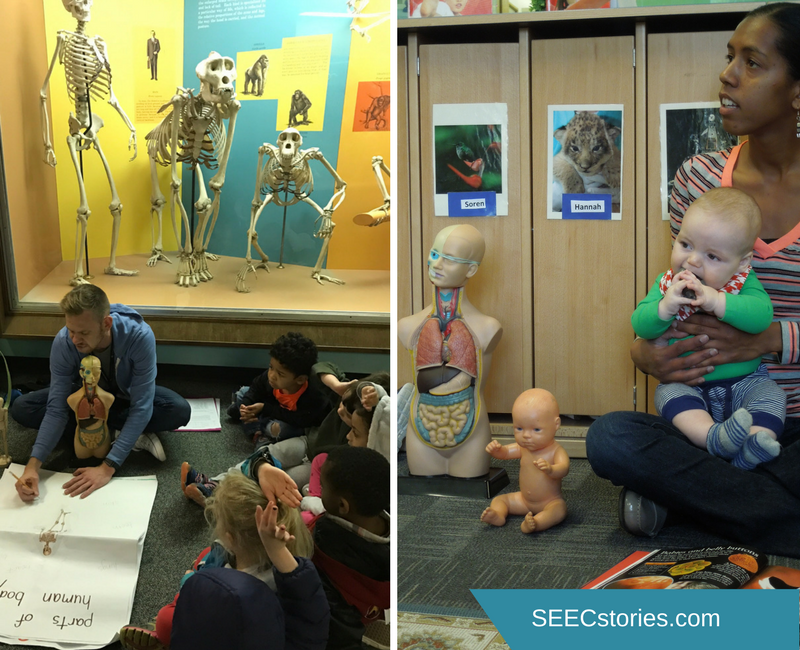
Our bodies are amazing! They hold intricate systems that help us do things like running, jumping, dancing, climbing, hugging, and more. At SEEC we follow an emergent curriculum, but embarking on a Human Body unit is a common occurrence in our classrooms. Young children’s bodies develop so many new skills in such a short amount of time, from growing teeth and chewing, to crawling, to running, to controlling bowel movements. There are many exciting milestones. Children are often curious about this and want to learn more, which has led to lessons about blood, hair, and more. Learning about the body creates an appreciation, respect, and love for all it can do.

4

Identity Work That Goes Beyond the Physical Characteristics

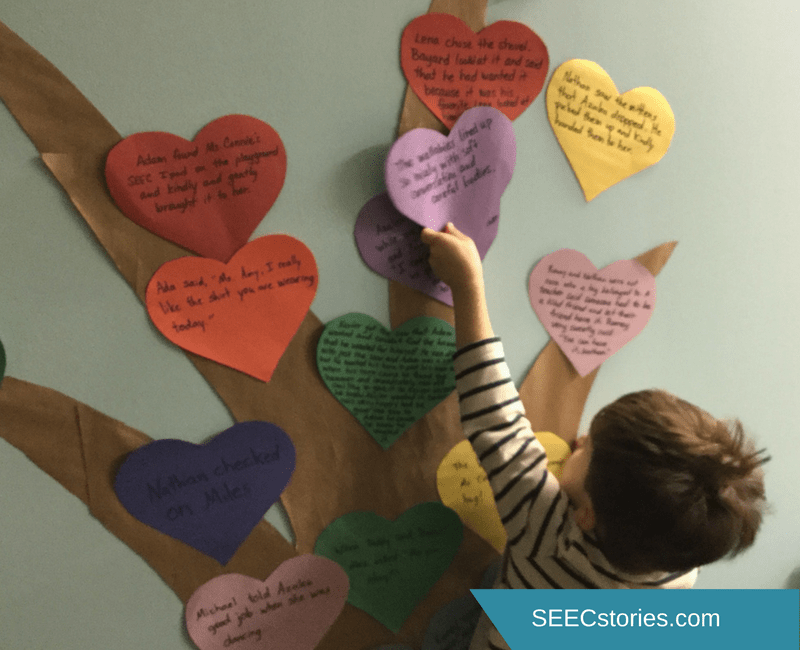
A common topic explored in our classrooms is “All About Me” which encourages children to think about their identity. While we focus in part on outward appearances, we also delve deeper into what makes each of us, “us.” We value those traits and preferences that make us each unique, and those that make us similar. Some of this work happens at the start of a new school year when teachers and children are getting to know each other. We share favorite things and talk about our home and family lives. However, this topic of building our identities does not end in September. Our classes explore this topic through all of their units. For example, during a unit on sports, our preschoolers considered the character traits athletes must have including perseverance, teamwork, and integrity. The class discussed how each child also had these traits and how they help us as people. Another way to value children’s characteristics throughout the year is making note of their actions that exhibit these traits and celebrating them. For example, one of our three-year-old classes has a paper tree in which they add notes to the tree limbs to recognize moments that exhibit character traits. Children are able to celebrate the fact that they are kind, helpful, persistent, brave, etc., which builds their sense of identity.

2

Discussing Media Influences

Even if all the adults in a child’s life speak positively about their and other people’s bodies, we unfortunately cannot escape the media. Children receive messages from books, TV, games, advertisements, and even politicians. Although we cannot control the media, we can have conversations with children that combat stereotypes and negative body talk.

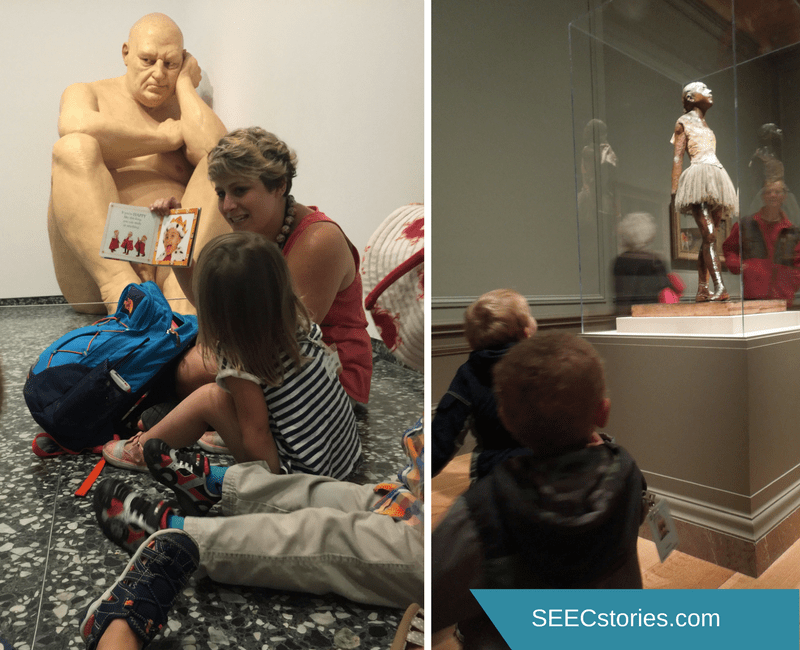
In addition to conversations, adults can provide positive media, such as images and books, that represent the world around them with bodies of all shapes and sizes. At SEEC, we are lucky to be surrounded by the amazing collections of the Smithsonian, including artwork and objects that showcase variety in bodies. However, even if you’re not located near the Smithsonian or other such resources, you can access them online via Smithsonian’s Learning Lab. I’ve created a collection of artwork and objects from the Smithsonian and beyond that reflect a variety of bodies that can be used with young children in the home or school.


As educators, parents, caregivers, grandparents, older siblings, etc., we have the big and important job to guide young children as they are beginning their own journey with developing their self-worth and body image. With this foundation, when children get older and encounter negative body stereotypes and talk, they will have the tools to think critically and reject it.

Changes: Talking with Young Children about Death

This blog is authored by our Director of Infant and Toddler Programs, Melody Passemante Powell. Melody graduated from James Madison University with a BS in Early Childhood Education and earned her MEd in Education Management from Strayer University. She has been working with and for young children for nearly two decades in a variety of roles. In her down time, she enjoys having fun with her two-year-old daughter, wife, and dog Jack.

TRIGGER WARNING: This blog explores the ways in which young children process death and how adults can support them through such a difficult time. The author reflects on her own experience with the death of her mother at a young age and may be triggering to some.


As the philosopher Heraclitus so aptly stated, change is the only constant. Some changes are simple and easy to adapt to, while others might be more complex and can evoke mixed emotions. As our previous blog explored, moving to a new house, welcoming a new sibling, or starting at a new school are changes that would likely cause feelings of nervousness mixed with excitement. Then there are other changes that are incredibly hard and complicated to adapt to, like death. Unlike many other changes in life, death is one change that is often very hard to talk about because it is such a big and complex concept that even many adults have a hard time processing. It can be even more daunting to be tasked with talking to children about death, especially when we ourselves may be dealing with the situation, and potentially grieving at the same time.

SEECstories.com (4).png

I have always felt drawn to this topic because I have a unique perspective as I lost someone very close to me when I was a young child. I went back and forth about sharing my personal experience, not because I have trouble sharing, but because I worried about making others uncomfortable. As I processed these feelings, I realized they were connected to a norm in my culture: to avoid making others feel sad and uncomfortable. I decided that sharing my experience felt relevant and important. Although like most stories associated with death, it may be hard to read.

SEECstories.com (5)

When I was three, my mother died. The situation was even more complicated by the fact that my mother died by suicide. On the day that it happened I had been to play therapy in the morning, where my therapist had told me my mother might try to kill herself again. Unfortunately my mother had tried before and I was aware since I was in the house. On the day my mother died, my Grandma had been tasked with telling me what had happened. After school my Grandma held me on her lap and asked if I had remembered my therapist telling me my mother might try to kill herself again. She let me know that sadly she did today and she died. My Grandma told me that my mother loved me very much, but that she was very sick. She stressed that she had needed grownup help but sadly even that wasn’t enough. My Grandma answered all my questions succinctly without elaboration and took her lead from me.

Later at home in a room of adults I said something to the effect of, “I am sad that mommy killed herself.” My family replied that they were all sad too. I was given space to process and while I do recall being sad, I also remember having a pretty solid understanding that this was permanent and I would not be seeing my mother anymore, likely because this is what I was told. I wasn’t confused because even though it was a very complex concept to grasp, I was given honest, age-appropriate answers about what was going on. My questions were welcomed and I was given a safe space to talk through anything I was feeling or wondering about.

I recognize that my experience is not the same as any other child going through the difficult change of losing someone close to them. Death and grief are deeply personal topics, often connected to our cultures and belief systems. Even within cultures, no two people experience death and grief in the exact same ways. So how do you talk to children about death? Of course it will depend on your personal beliefs, but here are some tips based on my experience, what we know about child development and how young children understand the world around them.

Be honest

Although it can be incredibly hard, being honest with children helps to avoid any confusion. Often what children think about in their own heads may be worse than the actual situation. It is hard to know exactly what to say because every child and situation is different, but here are a few examples of wording you could use in various situations:

Death of an older person or pet: “Sometimes very old living things, people and animals, die because they are very old and their bodies have worn out.”

Sudden death due to illness: “Sometimes people who seem healthy get sick very suddenly. It doesn’t happen very often, but it does happen sometimes.”

Sudden death due to accident: “Our bodies are very strong but there are some things that can hurt our bodies so badly that we die.”

These phrases would be used within a larger, ongoing conversation, but might be helpful as a starting point for honest, age appropriate communication. Young children are better able to understand complex topics when they are able to make personal connections to things in their life. It can be helpful to reference something they are already familiar with to make a comparison such as a plant that was old and died, a pet that died, or a character in a book or movie.

Welcome questions and follow the child’s lead

2

Children are curious by nature, working to understand the world around them. Young children think in concrete terms, so it is best to use clear language and avoid euphemisms that may cause confusion. Phrases like “her body stopped working” or for a child a little older, “her heart stopped pumping blood through her body to keep her alive” are concrete and honest. Phrases like “he is sleeping forever” and “he is up in the clouds now” can cause confusion for children because they will take these literally. Children might worry they may never wake up if they go to sleep. It is normal that children might become nervous or fearful in general when learning about and processing a complex topic like death. When answering questions, be honest, but avoid elaborating unnecessarily. We might think that children need lots of information or we are being dishonest by withholding, but in this case sometime less is more.

Talk about how you are feeling

Everyone grieves in different ways, and talking about your feelings when you are grieving may not be the way you process your emotions, but talking with young children about our feelings is critical for young children. A good rule of thumb is to find times to simply narrate out loud about your feelings. For example, “I am feeling sad about our dog Francis dying. Sometimes when I feel sad, I cry with someone. Other times I just want to be alone.” Mentioning that people grieve in different ways, and even the same person can work through grief in a variety of ways helps children feel safe to feel whatever it is they might be feeling, and safe to talk about those feelings if they wish to. Although it can be difficult at times, not saying anything sends a powerful message to young children that these topics are taboo, and not to be discussed.  over time children begin to make their own assumptions about death and grieving, which may or may not be true. Children as young as infants use social referencing, looking to those they trust in uncertain situations to decide how to act and feel. Showing children that having feelings is a normal, human process, is incredibly important. Some cultures are often taught to suppress emotions, and many children think that crying or feeling sad is not okay, when actually these feelings and expressions are completely normal and healthy ways of coping.

Validate the child’s feelings

www.SEECstories.com (6).png

Validation goes hand in hand with talking about our own feelings. When a child has been sent the message from the important adults in his or her life that grieving, and expressing feelings is okay, they will likely feel safe to express their own feelings. There are no right or wrong feelings and there are no right or wrong ways to process complex situations like death. Remind yourself and your child that grief is a non-linear process. Some days we might feel okay, even happy, and other days we might find it unmanageable to get out of bed.

None of this is easy, especially if you have to talk with a young child when you yourself might be grieving. My personal silver lining from my experience with my mother’s death, is that I am able to remember how I felt when I was younger, and to be able to say that when given honest information, and a safe supportive space to work through their feelings, young children can be quite capable of processing big changes like death. Of course as an adult dealing with these topics when we ourselves are stricken with grief is easier said than done. Remember that you are not alone in dealing with this and there are lots of resources out there to use as support.

Resources:

Related Articles & Book Reviews:

Dealing with Death from the Fred Rogers Company

How to Talk to Kids about Death from the Child Development Institute

Saying Goodbye: Talking to Kids about Death by Christina Frank 

5 Books to Help Kids Understand Death by Heather Feldstein

Top 10 children’s books on death and bereavement by Holly Webb

64 Children’s Book to Talk about Death and Grief from What’s Your Grief?

Books to Help You Explain Death to Children from Aha! Parenting

Books:

1.png

In a Nutshell by Joseph Anthony – This book is about the life of a tree, and the ways it changes, grows and impacts the nature and earth around it, even after it grows old and dies. This book is more abstract and does not deal with the death of a person or a pet. It is a good conversation starter, and a good reference point to look back to when the time comes that you do need to talk about the death of someone or something close to you and your child. The images are beautiful and very eye catching.

A Mama for Owen by Marion Dane Bauer – Luckily, I have not had to talk with my two year old about the loss of someone we know yet, but I know the time will eventually come. We have a lovely book called “A Mama for Owen” and in the story a baby hippo, Owen, is separated from his mother during a tsunami and he is understandably sad. Eventually he is rescued by humans who take him to a zoo, and he bonds with a very old turtle named Mzee, who basically takes Owen in as his own. My daughter talks frequently about this book. “Owen no Mama” she says in a sad tone, “Owen sad”. I will ask her what happens next, and she enthusiastically says, “Finds turtle Mama! Owen happy!”

No Matter What by Debi Mori – My daughter loves this book as well. This is great book to reinforce that our love for our children persists, no matter what. Dealing with death and loss is hard, and it is important that children are sent the message that they are safe and loved even when things are sad, scary, and confusing.

SEEC Speak

Every community, whether it be a neighborhood, family, school, etc., has a unique culture with its own language. Schools typically have common phrases, as it is helpful for children to hear consistent messages from the adults around them. Here at SEEC we call the phrases that are unique to our school “SEEC Speak”. We often hear from parents that when their child first uses these phrases at home they’re not sure what they mean, but as one parent said, they soon “just become so much a part of our lives I don’t even remember that they are SEEC speak!” We have detailed some of our most common SEEC Speak phrases below in hopes that they might be useful in your setting, whether it be your home or classroom!

Dip and Flip

Dip and flip is a trick that even the youngest of children can master and allows them to put on their coat independently. To dip and flip, place your coat on the floor in front of you with the hood or collar in front of your feet. Dip your arms into the sleeves and flip the coat over your head.

Walking On Trains

As we travel to our museum and community visits safety is our priority, therefore we stay safe by “walking on trains”. This means that there’s a teacher at the front or engine, with one to two children holding hands on either side of them. There is also a teacher at the end or caboose with one to two children holding hands on either side. There are also trains in between the “teacher trains”. These train cars can be teacher trains with a teacher and children, or “free trains”, meaning children holding hands without a teacher. In our toddler and twos classes, we generally only have teacher trains, and begin to have free trains in our preschool and kindergarten classes.

Gobble Up

As you can imagine, sometimes our trains slow down and we need to speed up. A teacher will give this cue to our students by saying “gobble up!”, and the children speed up to connect the train once again. Legend has it that the phrase “gobble up” came from a reference to the video game Pac-Man, meaning to gobble up the space between your train and the next just like Pac-Man gobbles up pellets. Whatever the origin, if you’re with a SEEC class on any given day you’re sure to hear “gobble up”, and many of our parents report using the phrase at home as well.

Hands Up, Bubbles In

While we encourage children to talk on our walks and share observations, we want to ensure they are very focused when crossing streets.  To achieve this, we say “hands up, bubbles in”.  The “hands up” refers to putting their free hands up high to ensure that cars see them. “Bubbles in” or “catch a bubble” means that it’s time to be quiet and attentive to the teachers. Children pretend to catch a bubble in their mouth and know that the teacher will let them know when it’s time to talk again.

Friday Song

Our Friday Song was brought to SEEC from a teacher who left several years ago, but it can still be heard throughout our school on Fridays. Teachers love it, children love it and it’s a great way to celebrate a Friday.

Lyrics:

It’s Friday, it’s Friday, it’s the end of the week, it’s the last day, so ___________ it’s on you, so what’re you gonna do? Go _______, go __________, go ___________, go _____________!

Stop, Drop, Hands Up Top!

This phrase is a new one to SEEC, and was picked up by one of our preschool classes from another school who was visiting the same exhibit as they were. The children love it and it’s a great cue that it’s time to clean up and transition to a new activity.


To see all the SEEC Speak phrases in one video, visit our YouTube page. Keep a look out for another installment of SEEC Speak where we’ll outline the language we use to guide children in their interactions with their peers that help build social emotional skills.