Teacher Feature: Two Year Old Classroom Explores Trains

It’s Teacher Feature Thursday!

This week we are featuring John Fuller, Brittany Brown, and Brittany Leavitt in the Firefly classroom. Their two year old class was all about transportation so they decided to make it their next unit. I joined John for his introduction to trains. Below you will find a reflection from John, Brittany, and Brittany and images from John’s lesson.
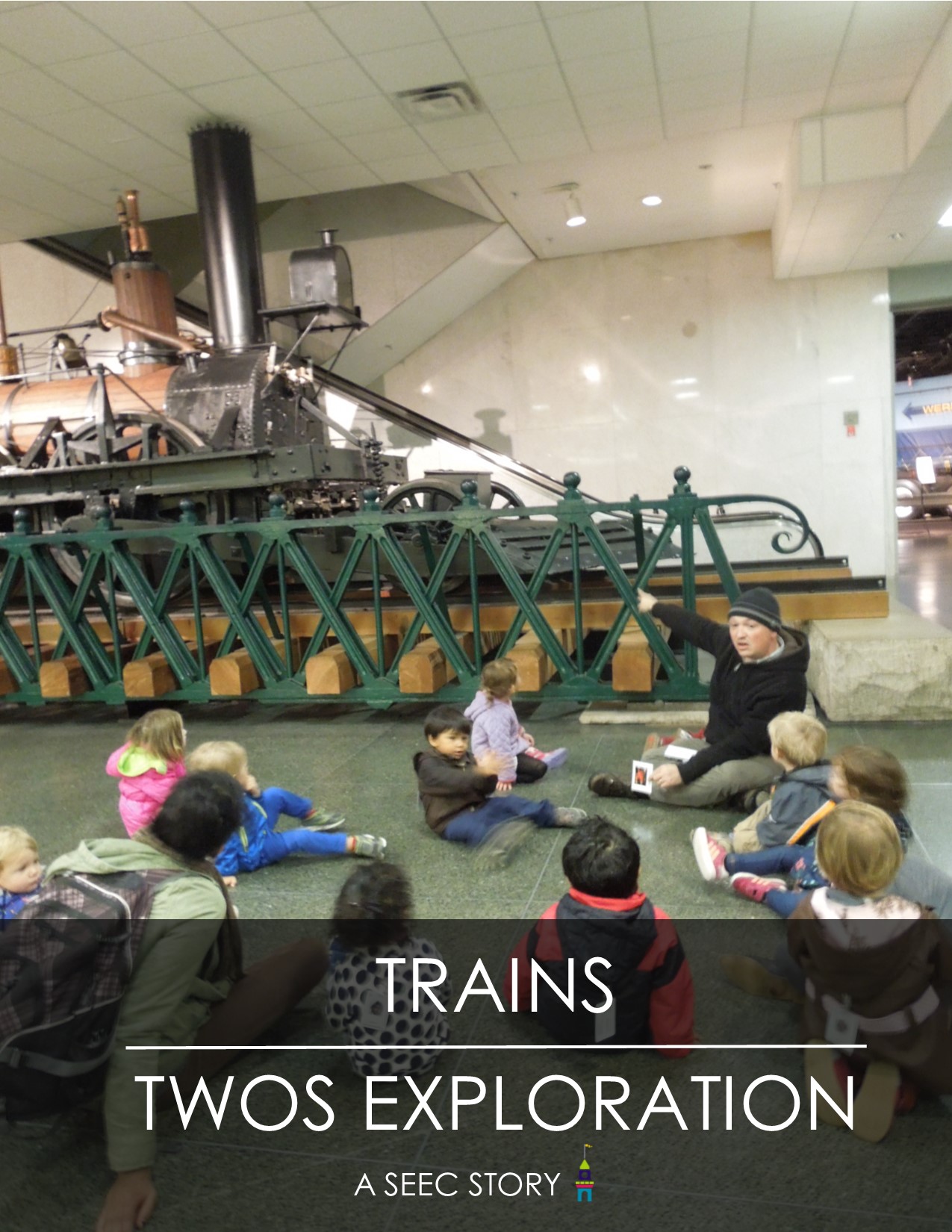
FF Cover

What were your topics of exploration? Why did you choose them? Where did they come from?

This week the Firefly classroom started a unit on transportation. We began by exploring a favorite subject of most two year olds; trains! We had noticed a definite interest in playing with trains from a number of our children in the classroom, and decided that this would be a good way to introduce the theme of transportation in general. We also were aware of feedback on some of our surveys that were handed out at the beginning of the year that this was a favorite thing to do at home.

Why and how did you choose the visit?

We were aware of the John Bull engine from previous visits to the American History museum, and saw how excited our children became when we passed by it. Children at this age seem to have a love for trains in general, but we also noticed a special fascination with the steam engine, and decided to focus on that theme for a while. Since they usually don’t get to see steam engines in their day to day lives, we thought seeing one that was already somewhat familiar would be a good way to kick things off.

What were your learning objectives? (What did you want your children to take away from the lesson?)

The day before, and that morning, we had presented a set of picture cards to the children, first with the names of different cars and engines on a train (including the steam engine), and then with the names of different parts of a steam engine (chimney, cowcatcher, wheels, etc…). We had also identified the parts on a model steam engine that the children passed around. Repetition of information in different contexts is a powerful learning tool, so looking at these same parts on a real steam engine was a way to reinforce the vocabulary words the children were learning in a fun new way!

What was most successful about your lesson? How did the lesson reach your objectives to expand the topic? What was successful in terms of your preparation and logistics?

We wanted the children to have fun and continue to learn the parts of the engine, and both of these goals were achieved. It also let the children see that although steam engines may look different (size, shapes and colors), they share the same parts. This helped when we took another trip to American History later in the week. By the time we got to look at paintings of trains the next week at the Museum of American Art, the kids were finding the parts and telling us about them independently!

In terms of logistics, because it was earlier in the week, we tried to make the trip short and sweet. We find that our class is ready for longer, more involved lessons later in the week, and keeping things brief and to the point (at least initially) sets them up for full successful engagement in the experience. We also made sure to bring along the picture cards, so the children could have a central point of reference for the parts/vocabulary words.

What could you have done differently to better achieve your objectives and expand the topic? What was challenging regarding logistics? What recommendations would you have for another teacher trying out this lesson?

Looking back, there are a number of things we could have done to make the visit even more successful. We could have made more cards once the kids had learned the first parts, and continued learning about the parts of the train. We could have given these cards to each child individually and asked that child to find the part on the John Bull, to personalize the experience even more. We could have done a vignette where the children acted out the parts of the train and then moved as one through the room (this probably would have required some practice beforehand).

Logistically, we didn’t realize until we got there that there was a fence around the engine that made certain parts hard to see. If we had prepared better, we might have thought about a specific way to move around the exhibit, or even taking turns holding children up to see parts that were more hidden.

If others were to do this lesson, I would recommend having a few different paths to follow, based on the children’s interest. For example, if they had a lot of questions about the smoke that comes from the chimney, having some kind of follow up visit prepared that could address that specific question, or if the wheels caught their interest, being ready to show a variety of other vehicles with wheels for comparison.

Here are a few images from their unit on trains:
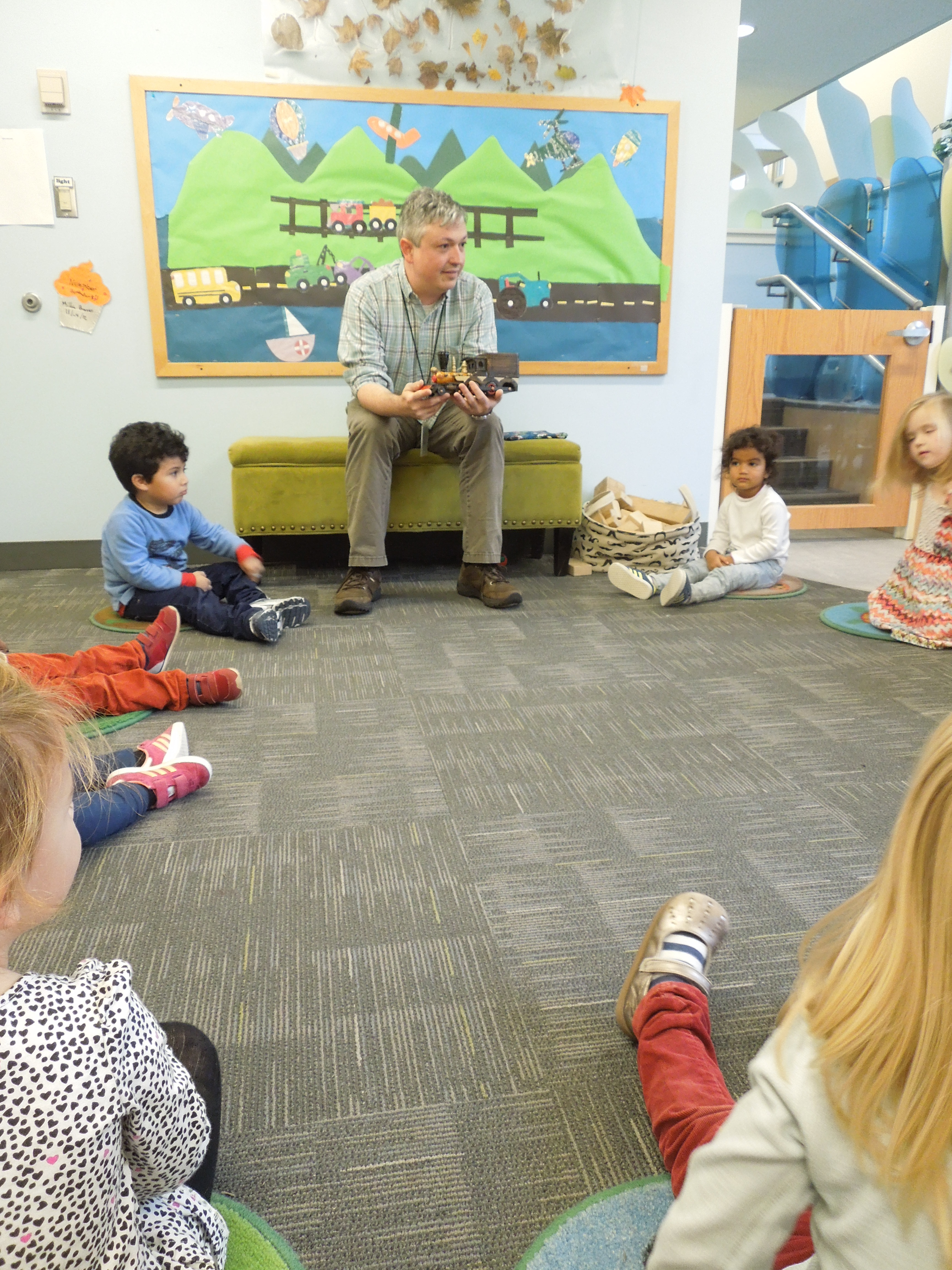
DSCN4147

John began his lesson by introducing the steam engine to the class. He explained that they would be learning about the different parts of the train and then visiting an actual steam engine at the National Museum of American History.

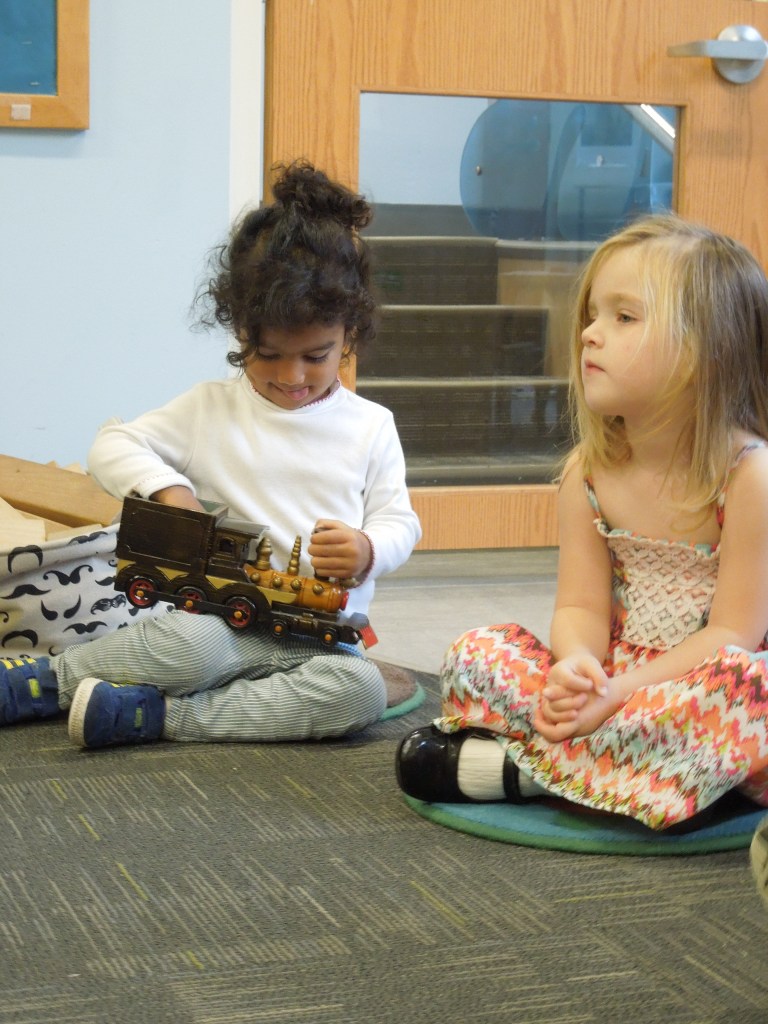
DSCN4148DSCN4158

John passed around a model steam engine for the children to handle. They enjoyed making the wheels turn and exploring the smokestack.
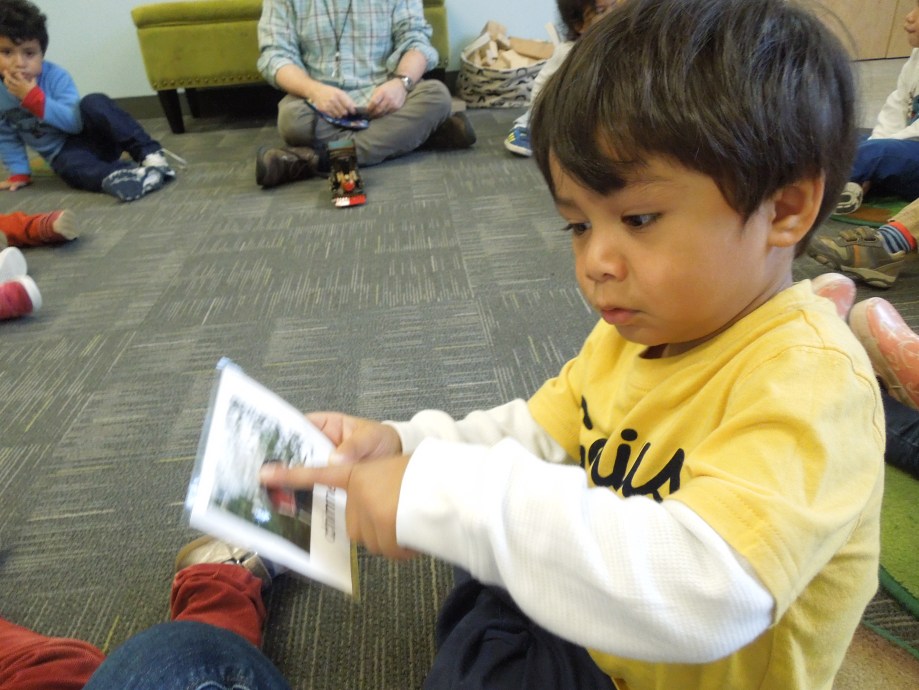
DSCN4163

They were next handed laminated cards with labeled images of different parts of the train. John pointed out the different elements on the model train. The children were fascinated by the cow catcher and John demonstrated with a plastic cow how the front of the train would gently nudge the cow to get off the tracks.

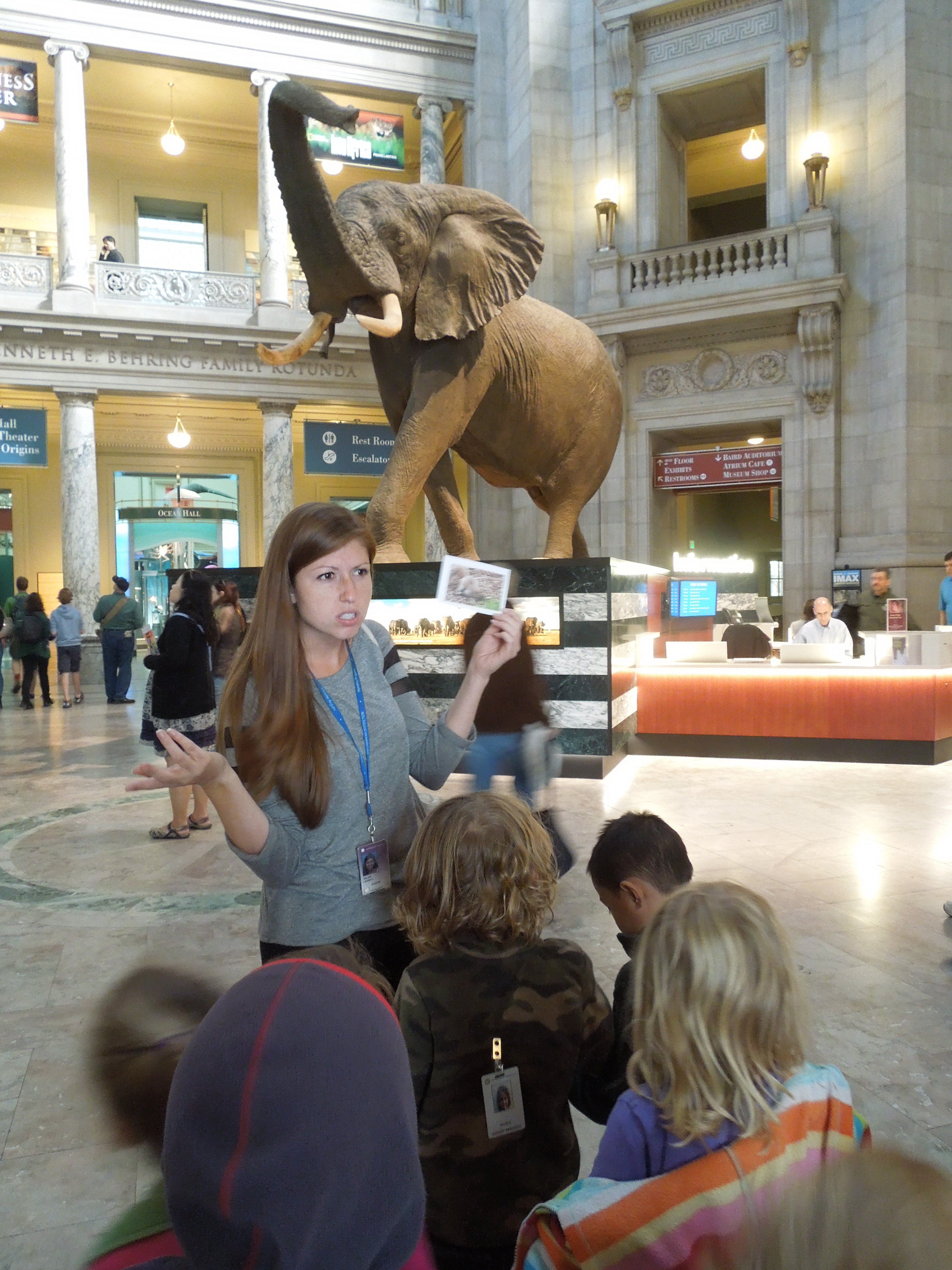
DSCN4171Then it was time to head to the National Museum of American History to see the John Bull Train. John brought along the same laminated cards and worked with the group to match them to the steam engine.

John, Brittany, and Brittany finished up their unit on winter and started exploring holiday traditions. Check out our Facebook, Twitter, Instagram, and Pinterest for more ideas from their unit on trains! See you in two weeks with our next Teacher Feature!

History Isn’t Just for Adults!

When people think of history museums they often think of places that are geared toward adults and older children but that absolutely does not have to be the case! Young children are fascinated by objects, and spaces that are designed with young children in mind can become big pretend play opportunities that bring history to life for them! On December 9th the National Museum of American History (NMAH) will open Wegmans Wonderplace, a space designed for the museum’s youngest visitors– children under 6 years of age. I was fortunate enough to be part of the amazing team that designed this space and I am here to tell you that it breaks new ground for early childhood and history museums! The space combines developmentally appropriate play opportunities that mirror some of the exhibitions found around the NMAH, with real objects from their collection displayed in ways that are both accessible to children and interesting to adults. A mini Julia Child’s kitchen is reminiscent of the one found in the museum. An interactive wall of portraits allows children to carefully look at pictures of other people while putting themselves in the picture.

WP4                    WP3


There is a space for babies not yet walking and an area for building with different types of blocks that features a sensory wall of building materials for little ones to touch. But the central feature is a large tugboat climbing structure with a clock tower that mimics the Smithsonian castle!

WP1


All of these play experiences do much more than give children a place to play—they introduce children to the world of museums at the same time. Each area has real objects placed at the children’s levels to allow them to explore them not only from the front, but from the back, from underneath, and from over the top of them! Signage that hangs in each area will help parents know what their infant, their toddler and their preschooler are each getting from the experience.


WP2


Museums can provide young children and their families with rich learning experiences from the very beginning. For babies, there is a kaleidoscope of color and objects to catch their eyes and the opportunity for adults to name objects and characteristics of objects, exposing their babies to language that is rich and deep. Toddlers can be directed to look carefully at objects—to find the eyes on the Kermit puppet, to look for the wheels on the train, or to count the pans in the kitchen. Preschoolers can go deeper – sharing what they see, what they think about what they see, and what questions they have about what they see. And places like the new Wegmans Wonderplace introduce families to the idea of coming to the museum in ways that are gentle and non-threatening. This early introduction can lead to a lifelong love of museums and to seeing museums as a place to search for information in ways that are fun and interactive—even when there are a lot of things behind cases.

If you are in the DC area and have a young child please come visit Wegmans Wonderplace and share in their delight and curiosity as they explore. Afterwards go visit one piece of the larger museum and watch what your child does as you guide their explorations! You will be developing a sense of curiosity, a love for learning and a connection to the world around them. As the sign hanging in the entrance to Wegmans Wonderplace states—“Knowledge begins with Wonder.”


Teacher Feature: Three Year Old Classroom Explores Frankenstein

It’s Teacher Feature Thursday!

This week we are featuring Erin Pruckno and Dana Brightful in the Wallaby classroom. While this class of three year olds were exploring the galleries they noticed their children being hesitant of some of the darker spaces and talking about being afraid of different things. This, combined with Halloween quickly approaching, inspired Erin and Dana to take on the topic of monsters. I joined their class for a lesson on Frankenstein. Below you will find a reflection from Erin and Dana and images from a lesson Erin led.


W Cover

Teacher Feature

What were your topics of exploration? Why did you choose them? Where did they come from?

This fall we focused on exploring monsters! The decision to learn about monsters came from many different places. For one, our students were playing many imaginative monster games together on the playground and in the classroom. It was also October, so it seemed a fun way to embrace the Halloween season! However, one of the most meaningful reasons we chose this unit was because we had noticed that some of our students had expressed ideas of being scared during different experiences. We push our children everyday going into museums–spaces that can be dark, crowded, or noisy– so we wanted to help them develop the social-emotional skills they need to address the fears they might feel at school or at home. Conquering our monsters was a great way to introduce those concepts and push our imaginations!

Why and how did you choose the visit?

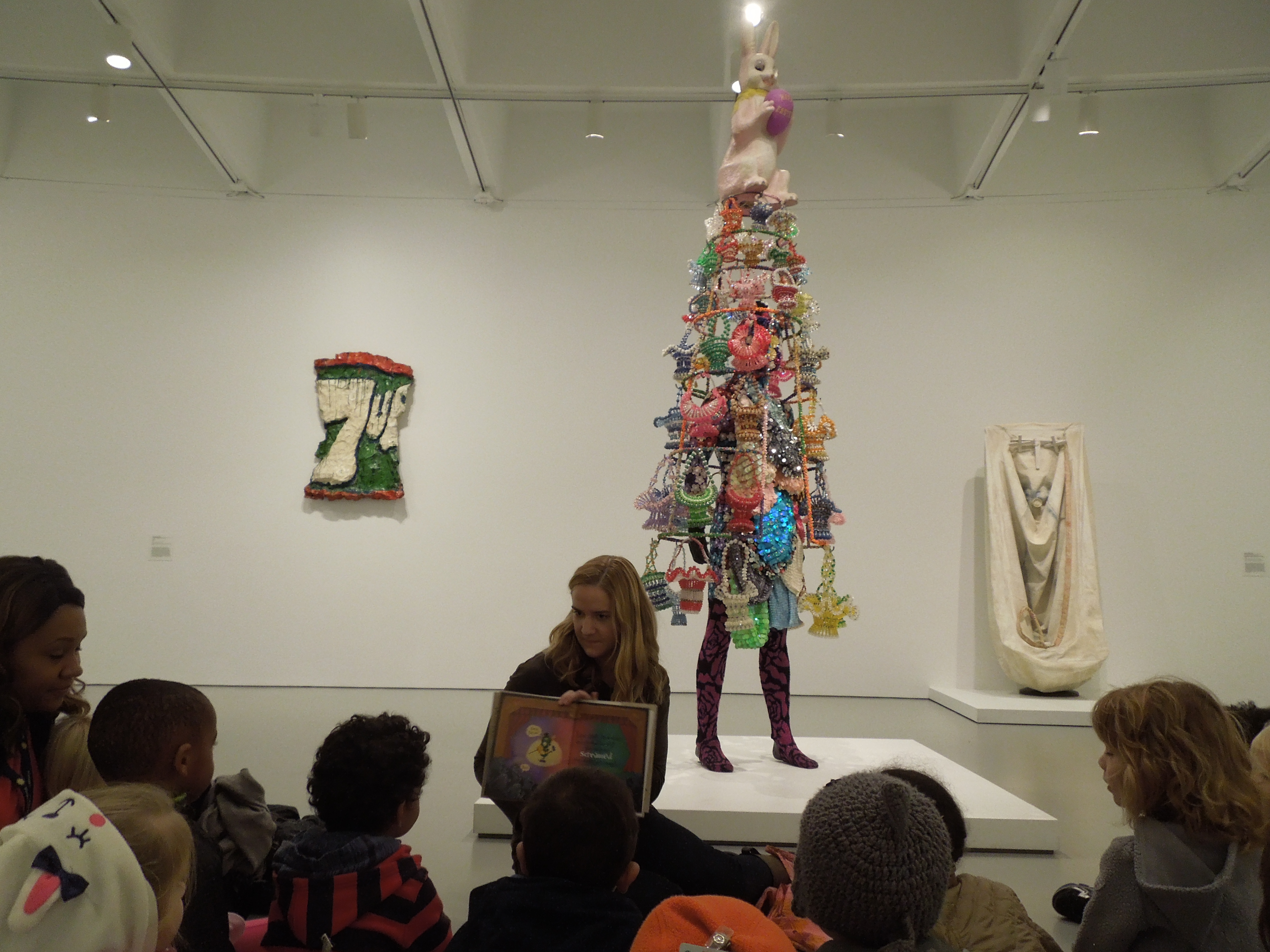
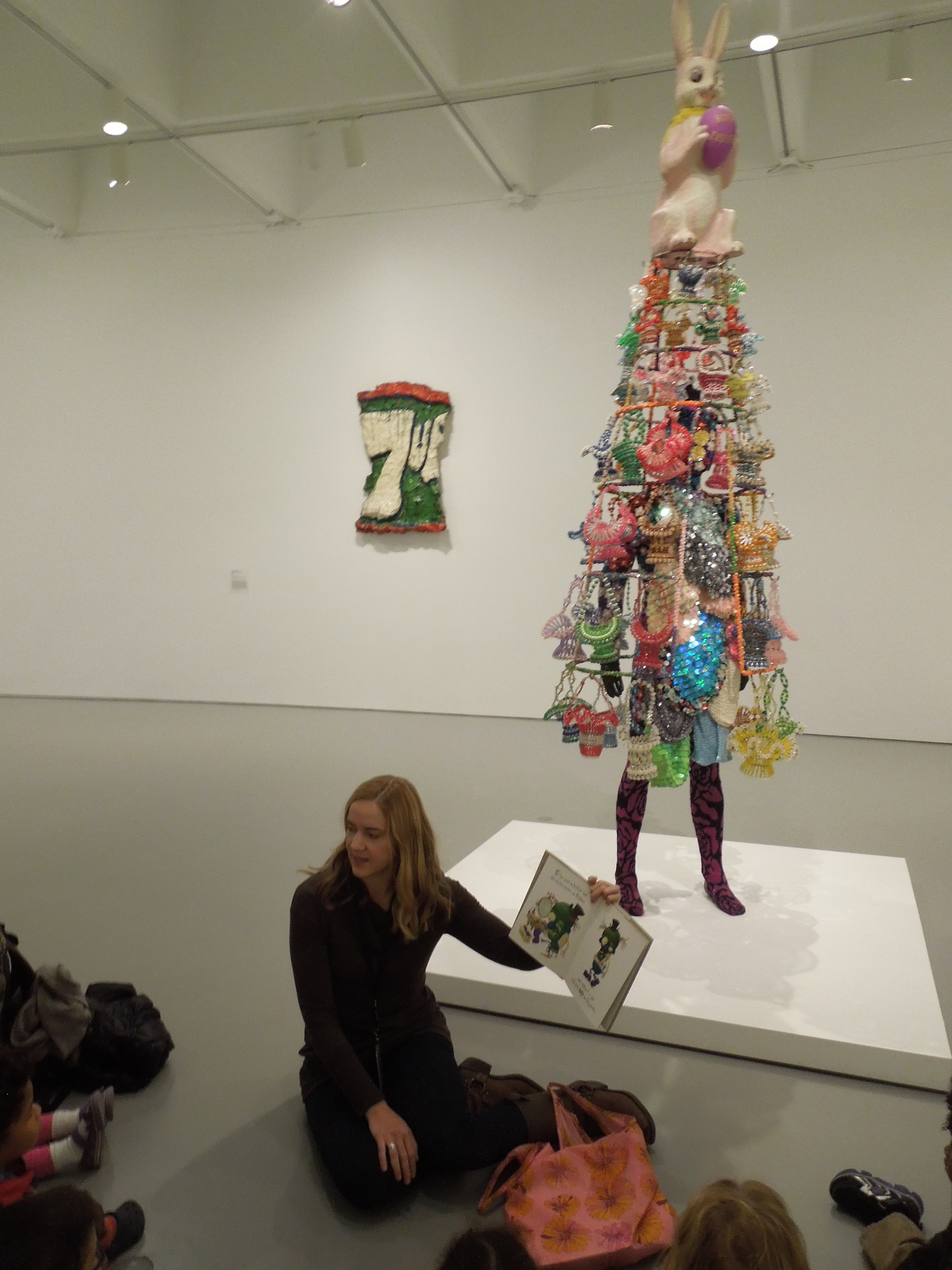
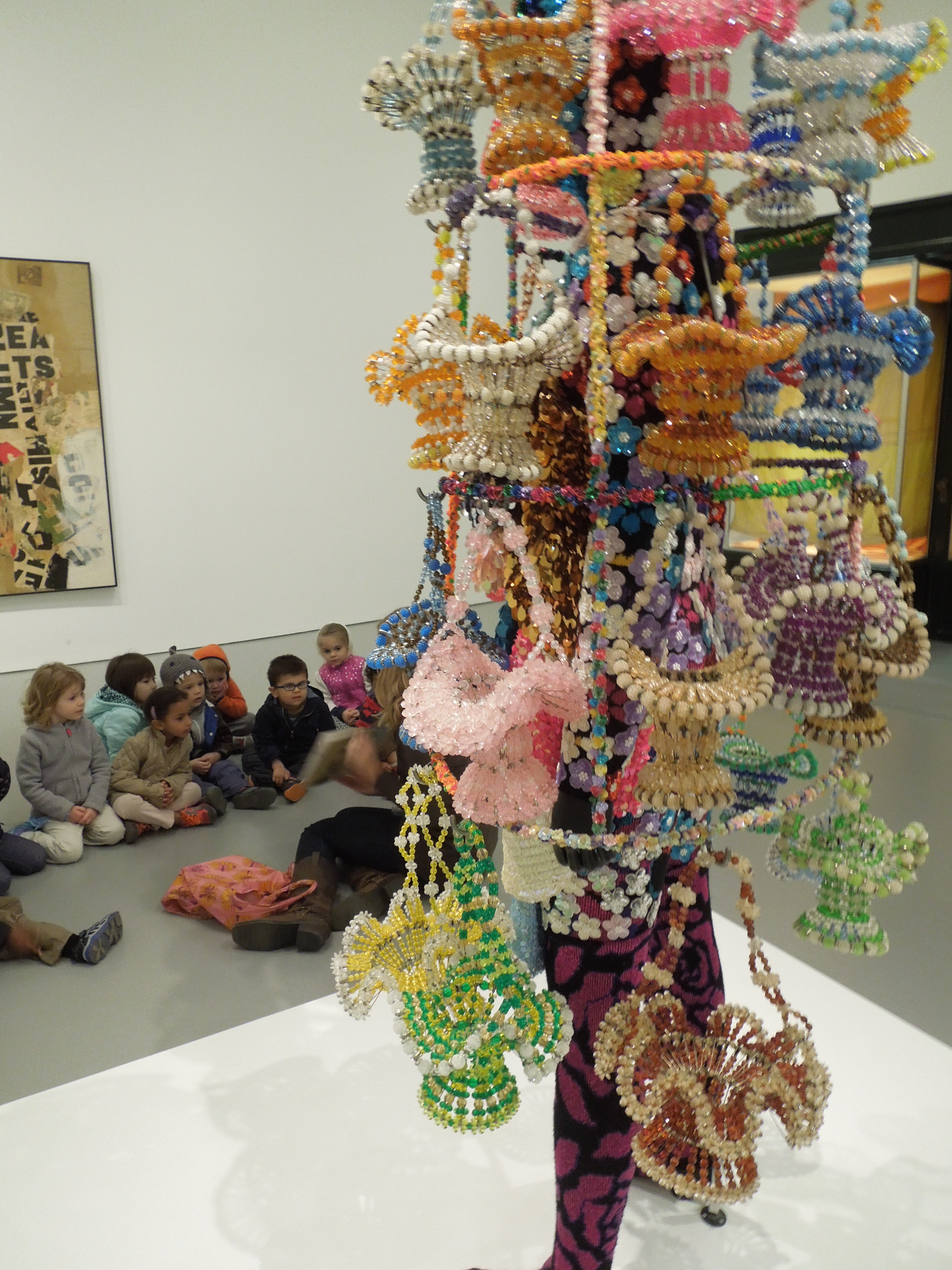
We have approached this unit by learning about different monsters in ways that have meaningful connections for 3- and 4-year-olds and make things that are scary or monster-like approachable. I chose visiting Nick Cave’s sound suit because I felt there would be great parallels between his technique (compiling all sorts of cast-off odds-and-ends in a sculptural suit) and the story of Frankenstein, a monster also made of many different pieces put together. It’s also a very eye-catching piece, with sequins and sparkles guaranteed to draw a preschooler’s attention!

What were your learning objectives? (What did you want your children to take away from the lesson?)

In this lesson, I was continuing with our unit’s theme of trying to make what was unapproachable—scary monsters—into the approachable. By taking a monster and breaking it down into smaller pieces, I hoped it gave them opportunity to realize there is less to be afraid of than they realized, as well as pushing their imaginations to think about how objects can be used in new and different ways. Finally, I hoped they gained a sense of how it takes many parts to make a whole.

What was most successful about your lesson? How did the lesson reach your objectives to expand the topic?

In guiding their looking and letting the students describe to the group what they saw, I was happy to hear how drawn my class was to the piece, as I had hoped, helping us reach our objective of making things more approachable. While the suit may seem daunting or scary at first, close looking showed them that it was made of beads and a bunny, not so scary of things!

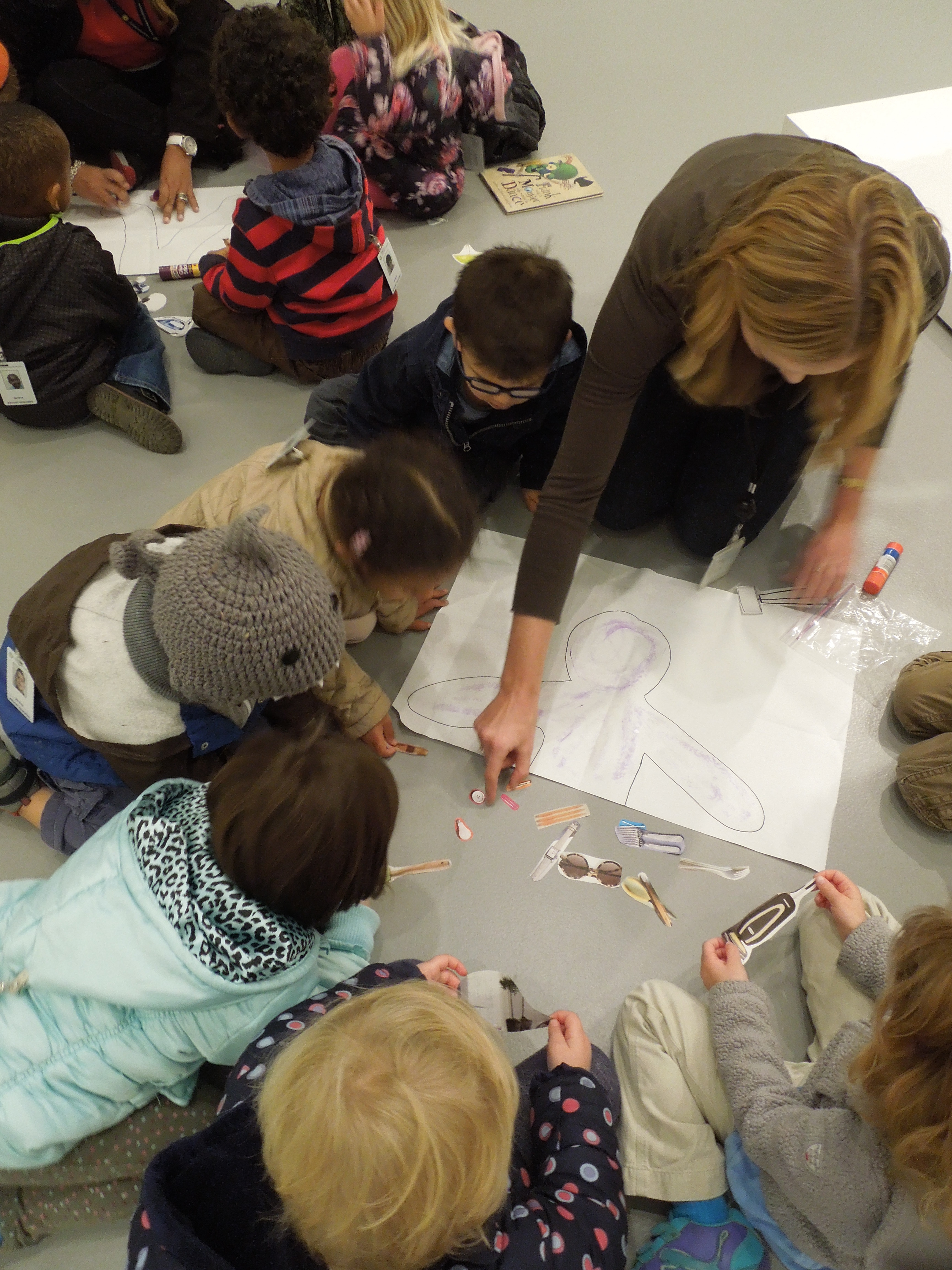
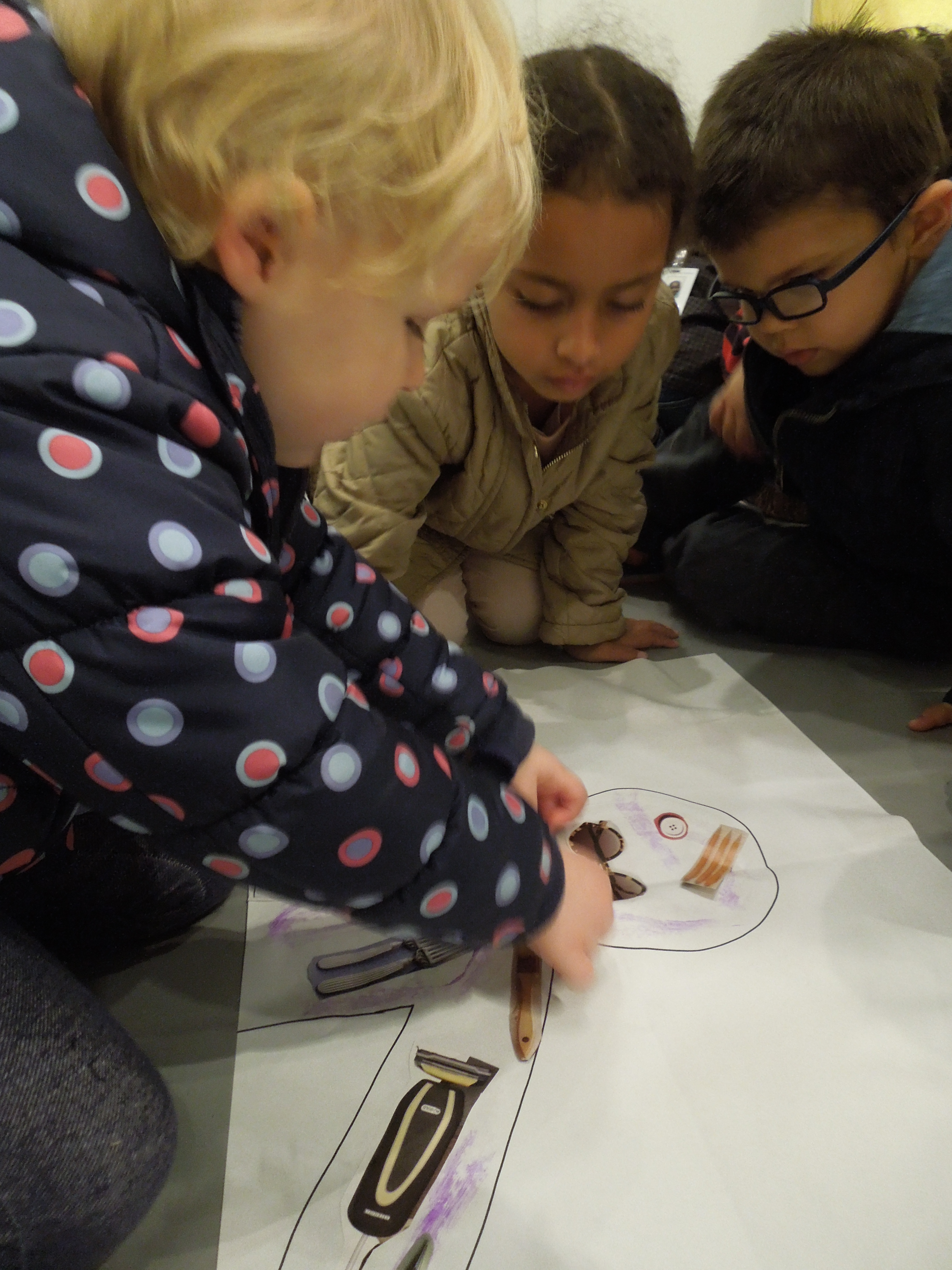
During the activity, the students collaged the different pictures, describing what the object was on the monster’s body. For example, a watch became a mouth, or pencils were eyebrows. Listening to these conversations showed me they also understood the concept of using different parts to make a new whole.

What was successful in terms of your preparation and logistics?

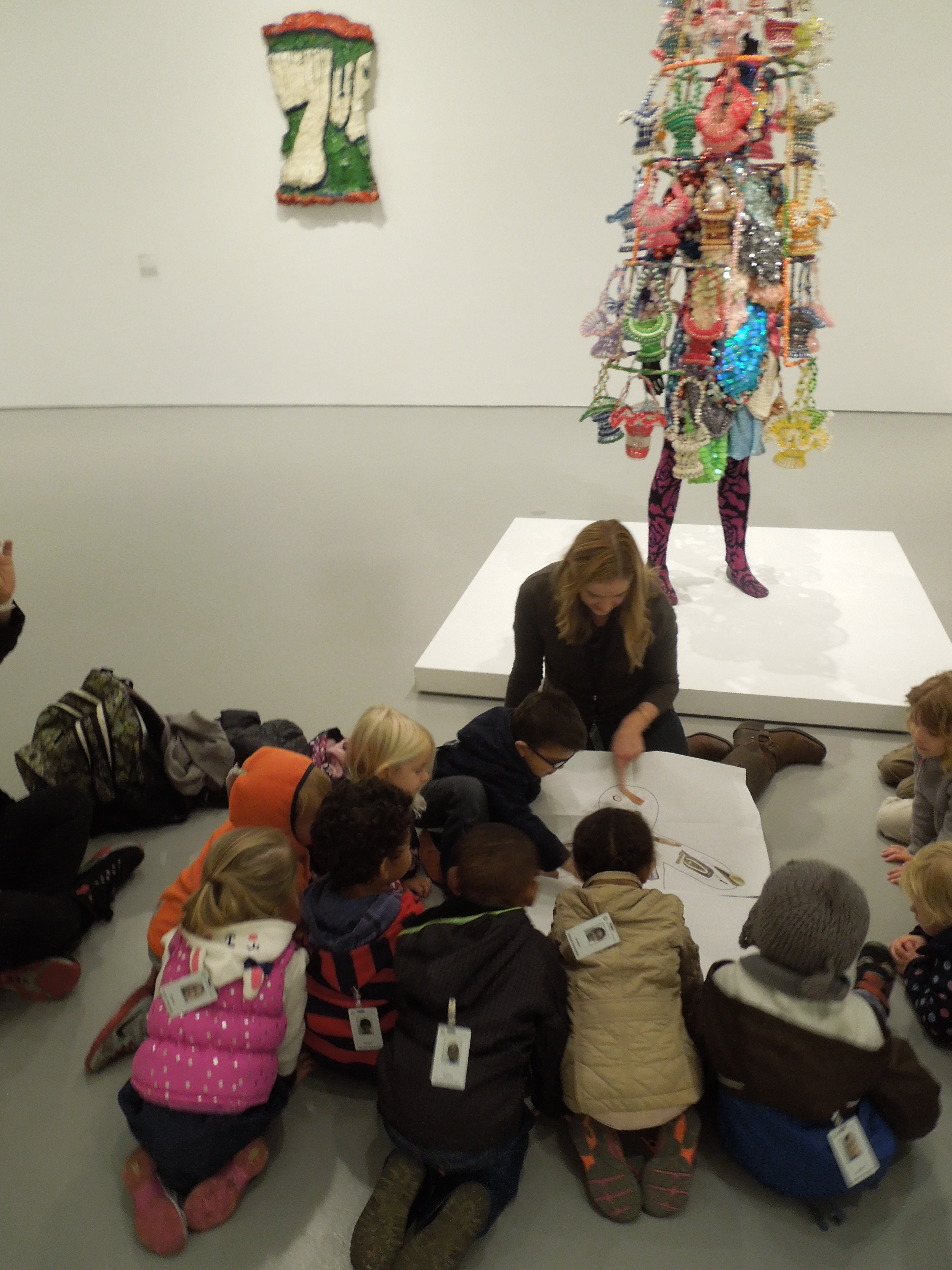
I think it was a lesson that was easy to prepare and plan. The key parts for me were an engaging story about Frankenstein, many prepped cut-out pictures of objects, and a template for making the monster and adding the objects. I had planned ahead to assemble our monsters in two small groups. Our class works well in smaller groups instead of a large circle, so I had prepped materials so we were ready to work in two groups. Thinking one step ahead like that made a big difference in the lesson’s execution and helps us stay focused on the task. As we work on developing our students’ attention spans, we try techniques for keeping them engaged such as making sure there is a hands-on component, working in smaller groups, and keeping lessons short and sweet!

What could you have done differently to better achieve your objectives and expand the topic? What was challenging regarding logistics?

I had really hoped to use our class tablet to share a video of the artist making his sound suit out of different objects, but we had technical problems with accessing it. I think it would have made a nice addition to further draw the connection to many parts making a whole. Working in a museum environment also means you have to be careful about what materials you bring in, so I didn’t feel comfortable with my students using drawing materials on the monster template as I had hoped. Instead, those will be fun to use later in an extension activity back in the classroom!

Here are a few images from their unit on Frankenstein:

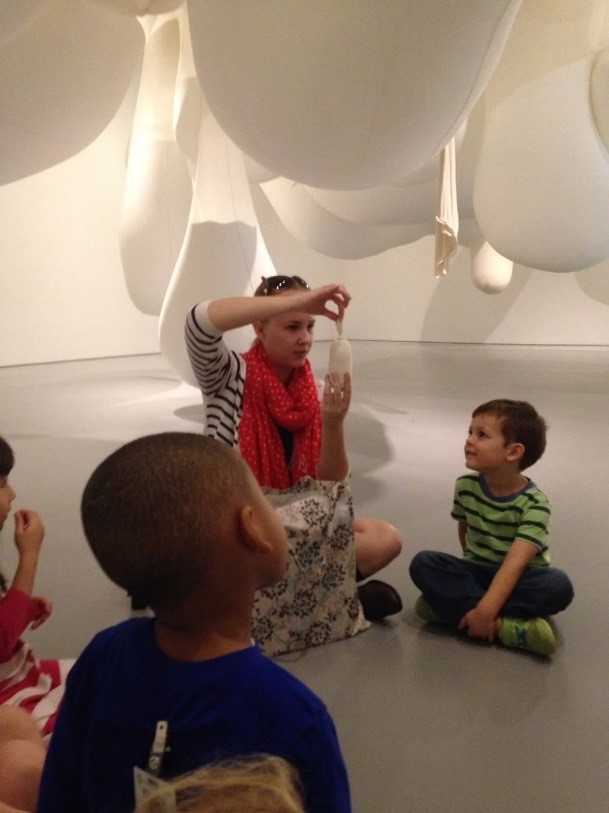
DSCN4015For their Frankenstein lesson, Erin took the group straight to the Hirshhorn Museum to see Nice Cave’s Soundsuit.  She decided to use this object because the artist used many different objects to make one sculpture similar to how Frankenstein was also pieced together.

DSCN4029The Soundsuit  is very bright and colorful, which makes it visually enticing to all audiences. The children were especially mesmerized and very excited to describe what they saw! Erin listened to the comments and explained how the artist used different objects to piece together the suit similar to how Frankenstein was created. She then read the class Frank the Monster That Wanted to Dance by Keith Graves which is a wonderful story that makes Frankenstein seem very approachable. 

DSCN4045 DSCN4065 DSCN4070Then it was time to create their own monster! Erin had pre-drawn an outline of a person and divided it in half. The class was split into two groups and given images of house hold items to collage their monster! Erin concluded by putting the two halves together and having the groups describe the different items they used to create their monster.

Erin and Dana continued to explore real and pretend monsters for a few more weeks. Check out our Facebook, Twitter, Instagram, and Pinterest for more ideas from their unit on monsters! See you in two weeks with our next Teacher Feature!

Teacher Feature: Three Year Old Classroom Explores Sea Stars

It’s Teacher Feature Thursday!

This week we are featuring Tina Brimo and Brooke Shoemaker in the Koala classroom. This class of three year olds took a walk through the Sant Ocean Hall at National Museum of Natural History at the beginning of the year and could not get enough of the undersea life on exhibit. This inspired Tina and Brooke to do a unit on Oceans. They decided to divide the unit into the different ocean zones and explore the sea life found at each level. I joined Tina for a lesson on sea stars as part of their exploration of the sunlit zone. Below you will find a reflection from Tina and Brooke and images from a lesson Tina led.


K Cover 1

What were your topics of exploration? Why did you choose them? Where did they come from?

We decided to study the ocean after seeing how enthusiastic our class was when we walked through the Sant Ocean Hall at the National Museum of Natural History to visit other areas of the museum. The children would stop and gaze at the fish and ask lots of questions. One day we asked them if they wanted to study the ocean and they eagerly shouted, “YES!!”  We explored the ocean by zones: sunlit, twilight and midnight. For each zone we learned about the animals that live there.

Why and how did you choose the visit?

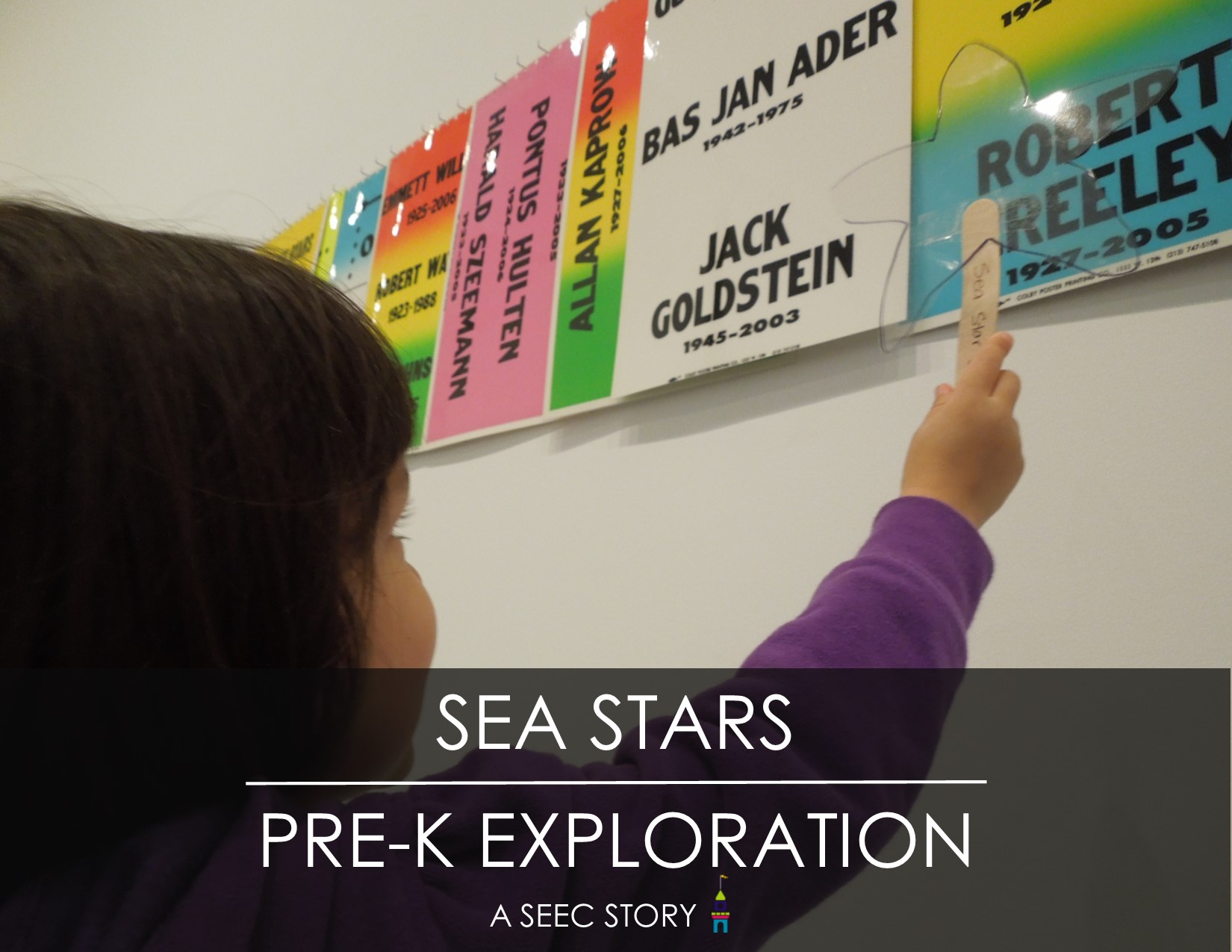
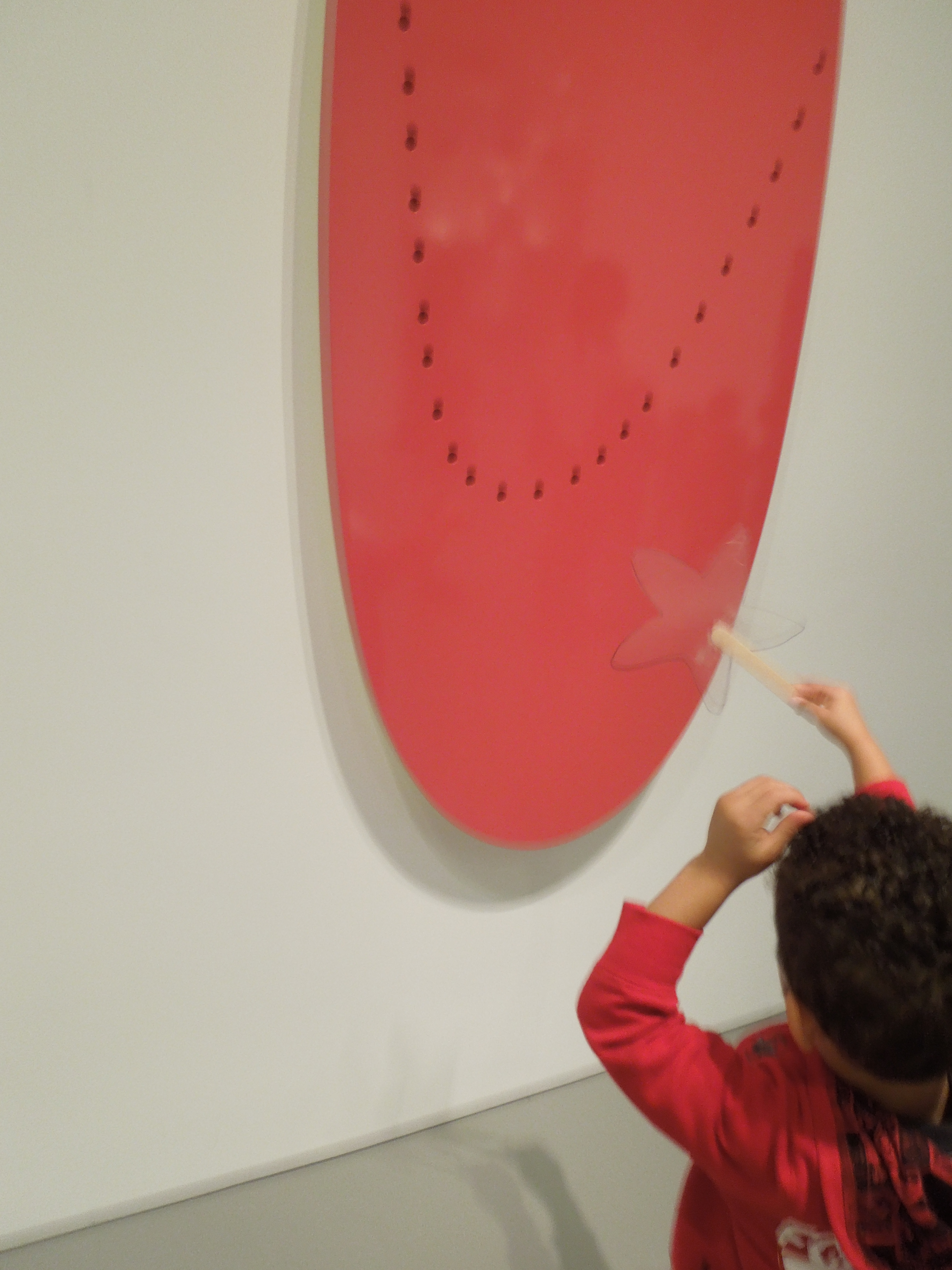
We brainstormed together and decided that we wanted to branch out to other museums for this lesson. We chose the Hirshhorn because of the colorful art. Since sea stars come in all different colors, we had the idea to ask the children to use art to “color in” blank sea stars. We made sea stars out of transparent paper and attached them to popsicle sticks.  The children took turns holding the sea star cutout up to a piece of art they liked, filling it with a variety of colors and patterns.


What were your learning objectives? (What did you want your children to take away from the lesson?)

We have been building  conversation skills, as well as early math and literary skills with our class. We incorporated turn taking, using a quiet hand to be called on, and various other fundamental skills, in addition to the learning about the sea star and its life in the ocean.  On this particular day, we wanted them to appreciate the art around them, and the boundaries of visiting a museum. We also wanted them to learn that it is incorrect to say starfish, instead, say sea stars because they are not fish as they do not have gills or fins.

What was most successful about your lesson? How did the lesson reach your objectives to expand the topic? What was successful in terms of your preparation and logistics?


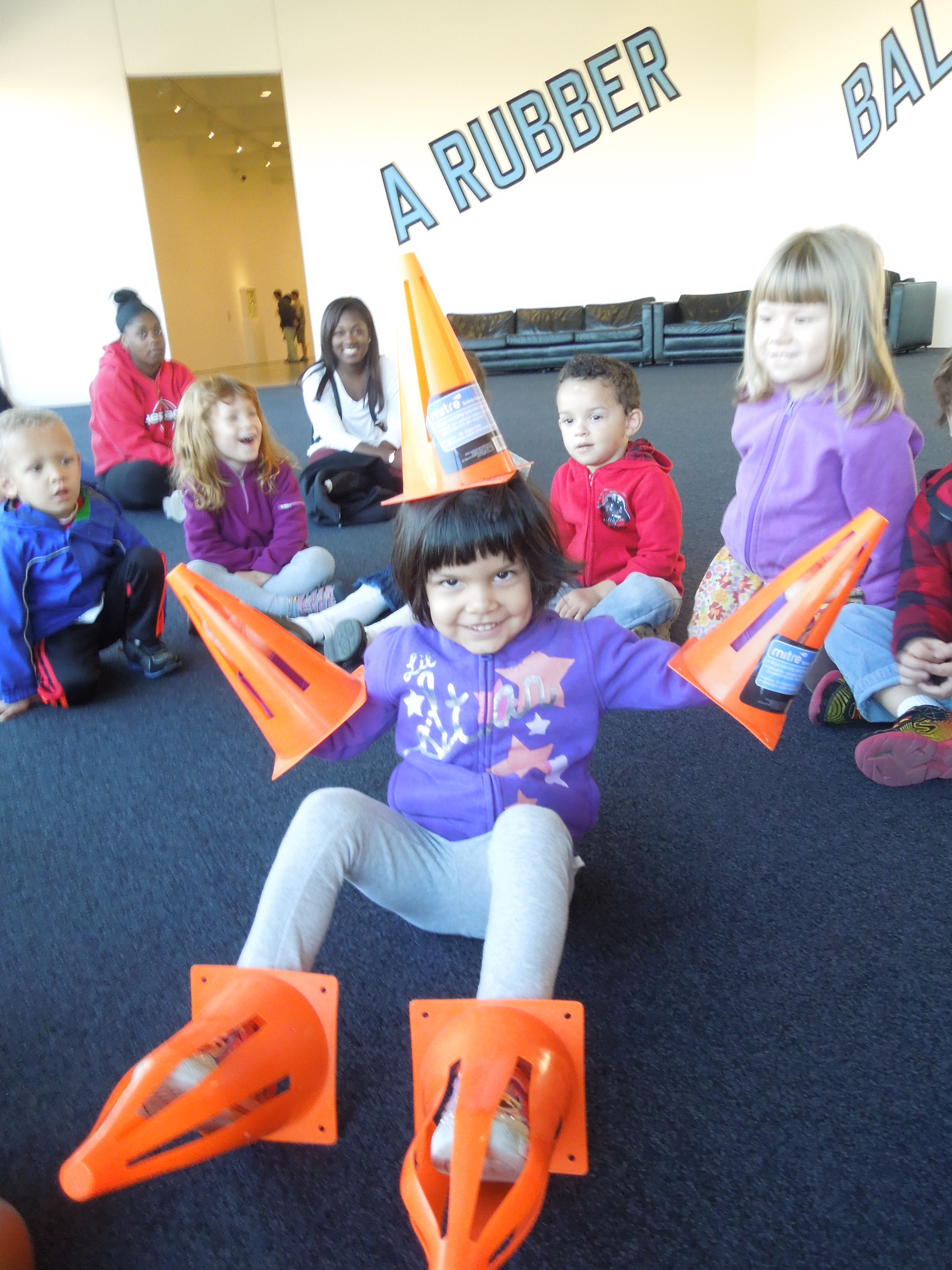
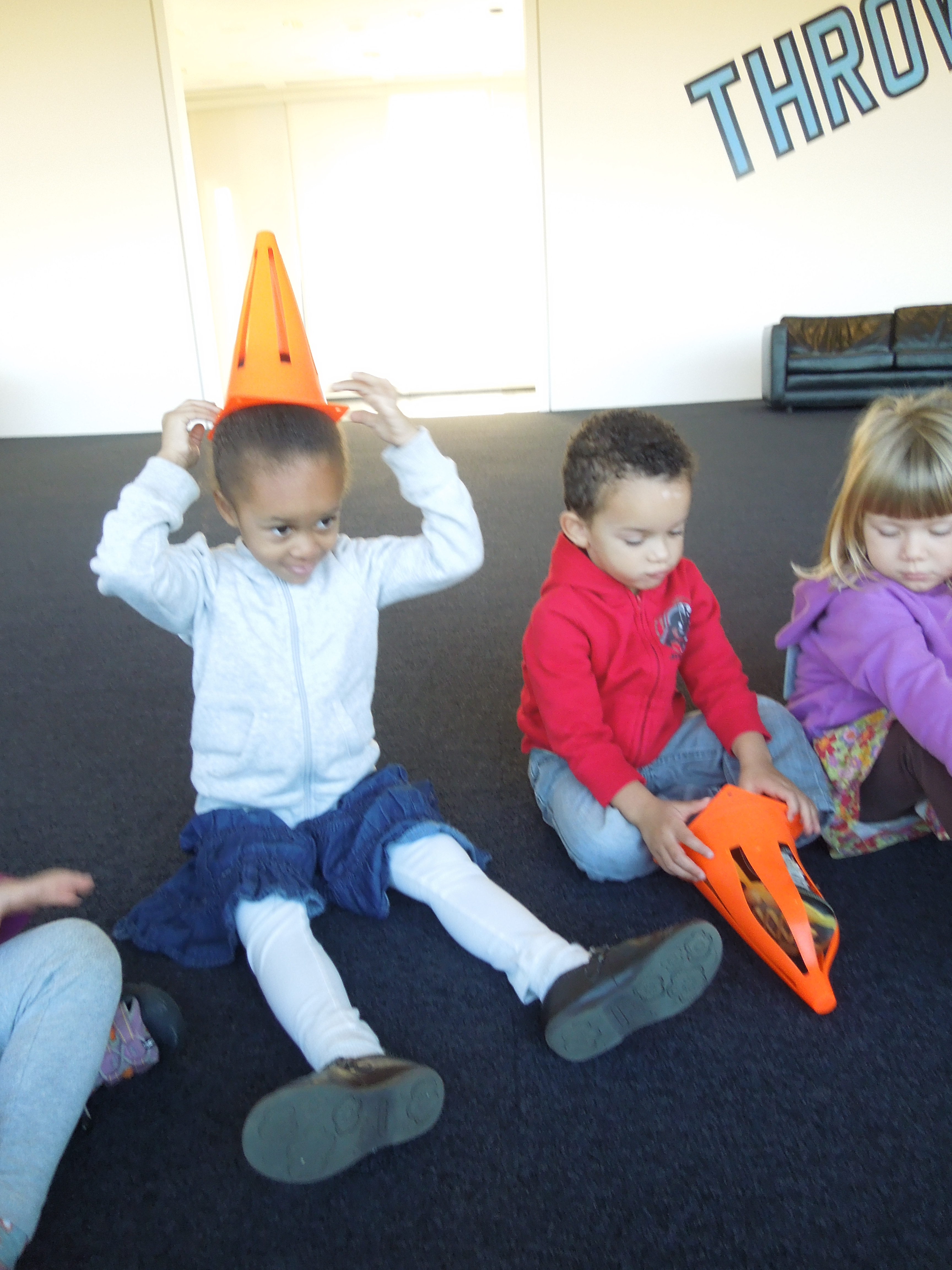
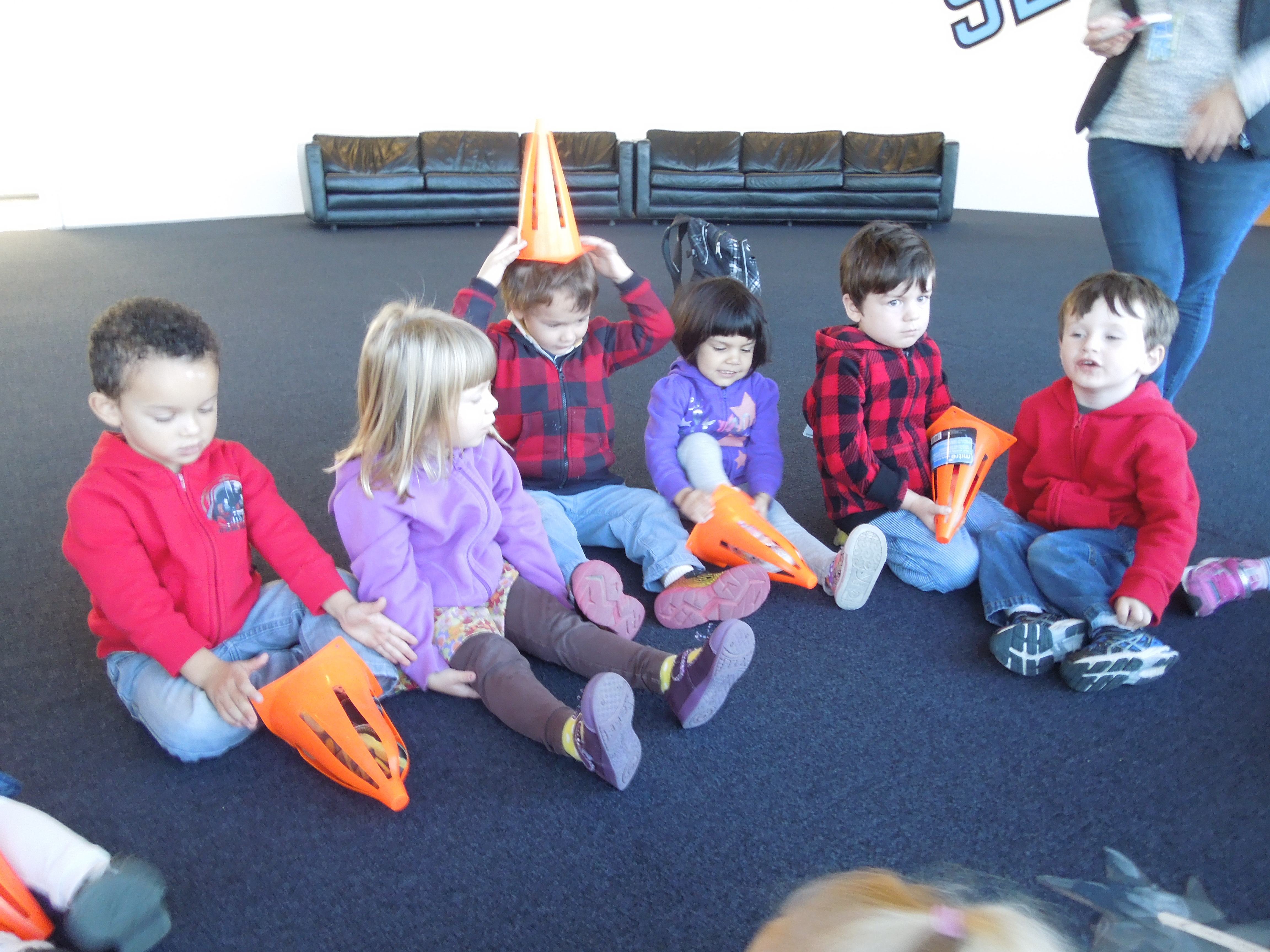
The most successful take away from our lesson was how well the children worked together and how understanding they were when we took out cones to represent the rays of a sea star. We asked one friend to demonstrate the movement and were sure to tell the class that we did not have enough time for everyone to have a turn in the museum but that they would each have a turn back in the classroom.


What could you have done differently to better achieve your objectives and expand the topic? What was challenging regarding logistics?  What recommendations would you have for another teacher trying out this lesson?

When we gave the children the transparent starfish at the museum, it was a bit challenging for them to each take a turn. We also had to keep giving them reminders not to get too close to the art. My recommendation to another educator trying this lesson would be to talk to the children first about not getting too close. I think that being a museum school, I assumed that the children would just know not to get close because on other visits they are always careful to not touch the art. I would also make a transparent starfish for each child instead of having them share.

Here are a few images from their unit on questions:

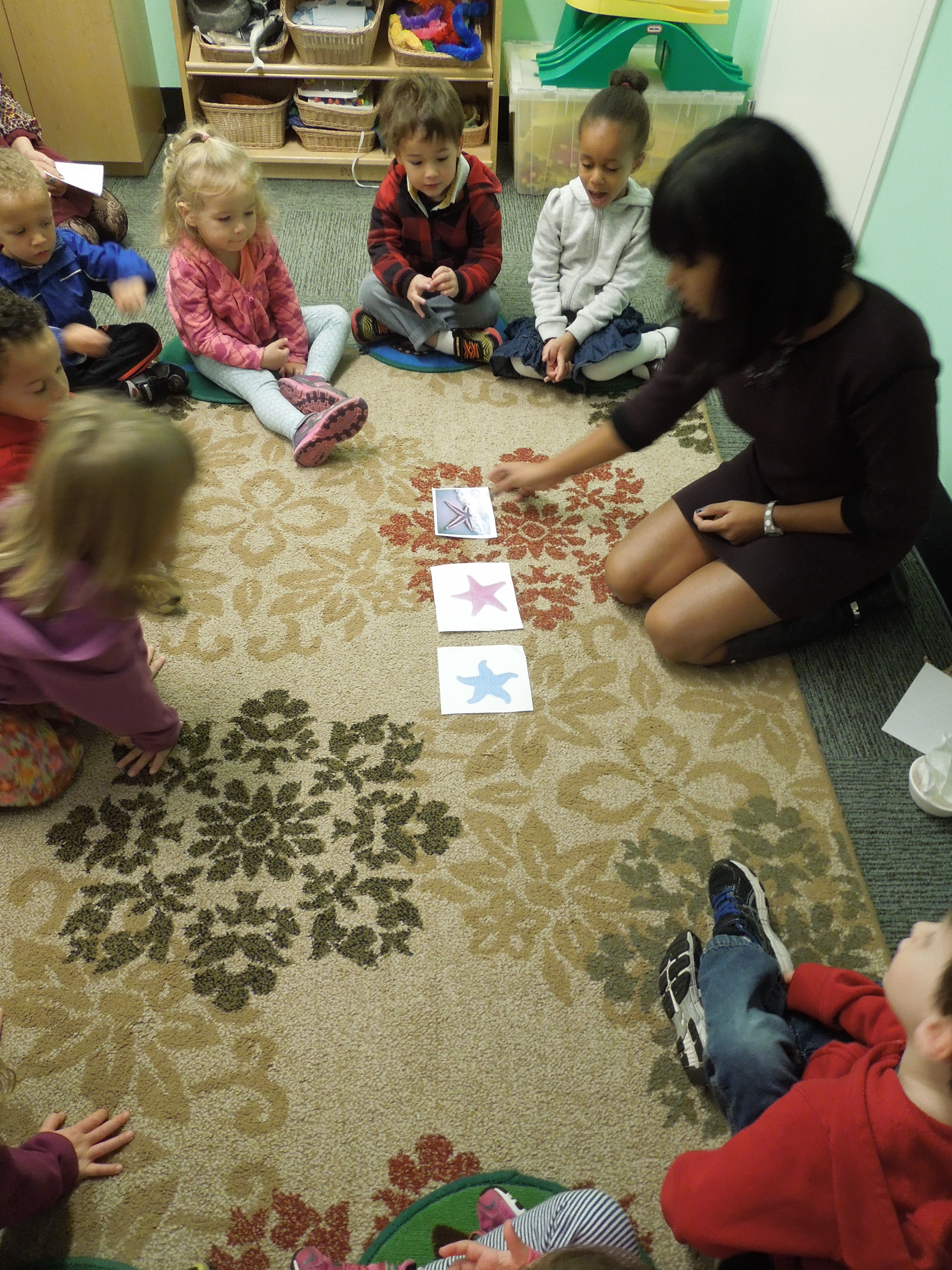
DSCN3947Tina began the lesson by reminding the children of the different ocean zones and introducing sea stars.
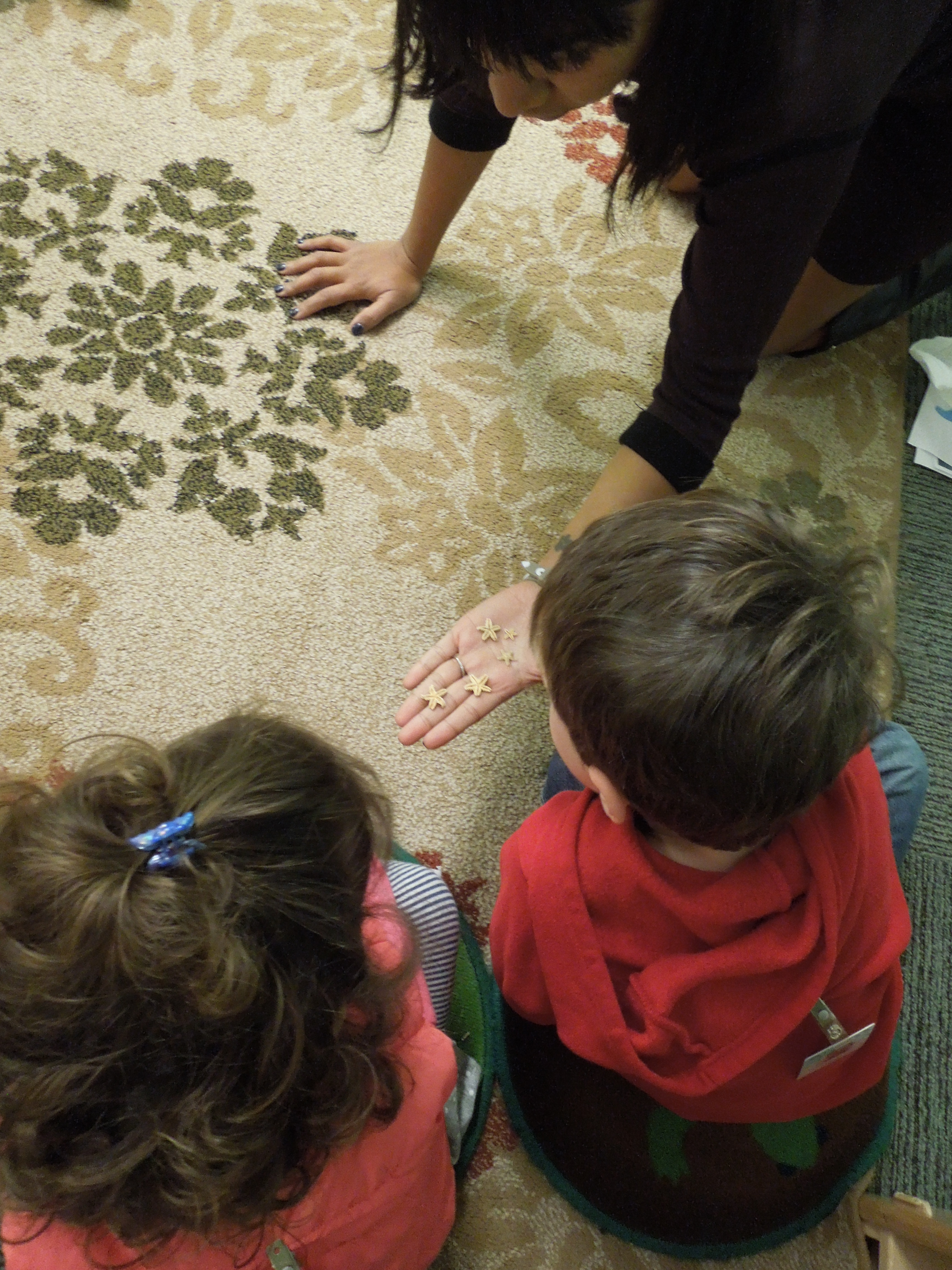
DSCN3950Tina showed the group actual examples and images of different sea stars in a variety of color and sizes.
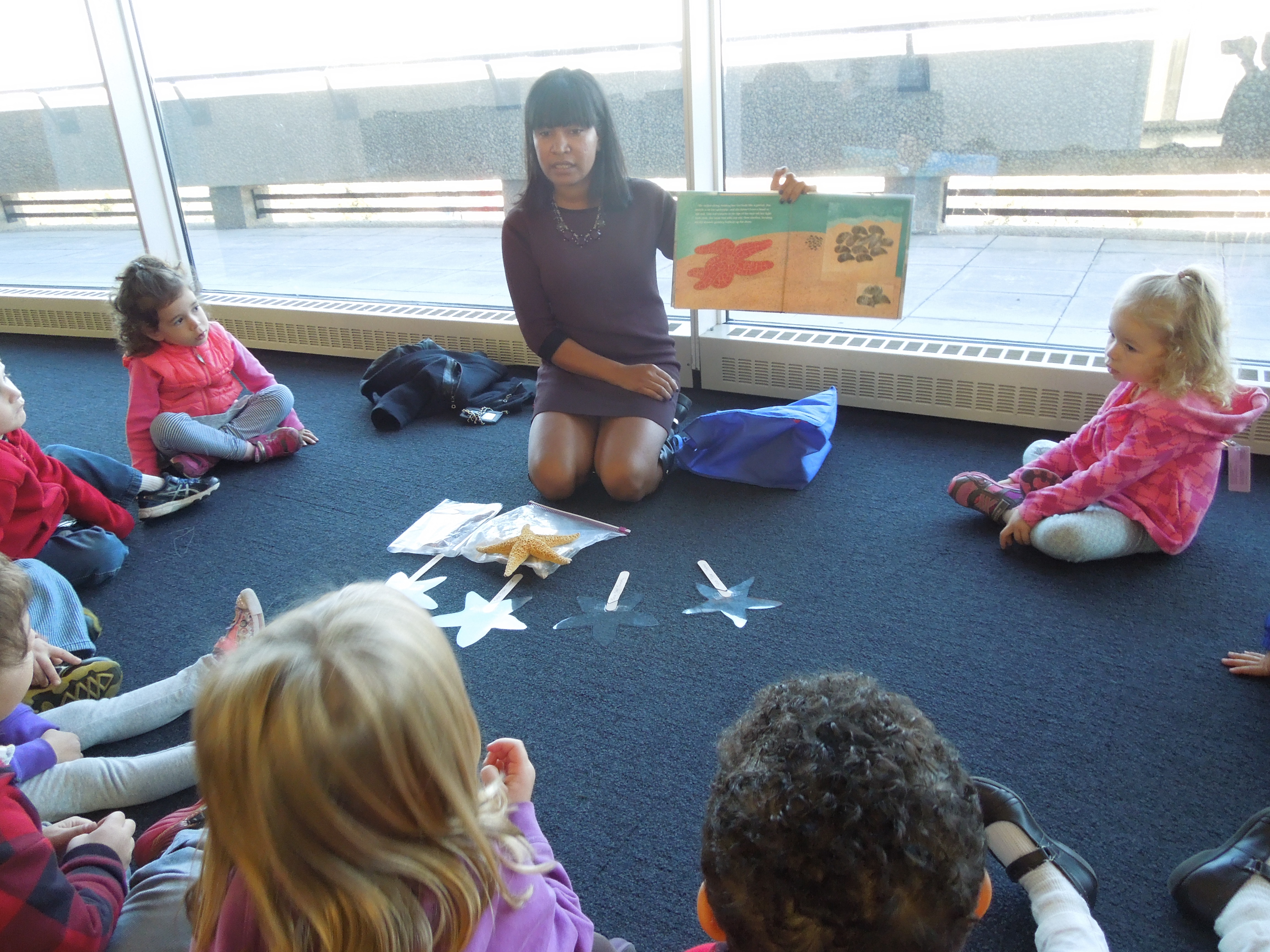
DSCN3970For their museum visit, Tina brought the group to the Hirshhorn Museum and Sculpture Garden. She found a quiet space in the gallery for the group to gather and begin their discussion. Tina brought along several real sea stars for the class to handle as well as the clear sea stars she made out of transparency sheets. They compared the starfish and made observations.

DSCN3979Tina also read the group Star of the Sea: A Day in the Life of a Starfish by Janet Hoffman to further introduce them to sea stars and their different characteristics.
DSCN3986Then it was time to try out being a sea star. The group counted the rays of the starfish and decided they would need 5 cones in order to become one. Tina invited one friend to be their sea star model by putting cones on their head, hands, and feet. They observed she could not really use their hands to grab things or their feet to walk. Tina invited their sea star “model” to try moving around the floor to reinforce the way sea stars get around the ocean floor.
DSCN3999DSCN4001The group loved this activity and couldn’t wait to try it out themselves.  They observed that could not really use their hands to grab things or their feet to walk. Tina invited their sea star “model” to try moving around the floor to reinforce the sea star movement. DSCN4006DSCN4009After learning all about sea stars it was time to fill their clear stars with art from the Hirshhorn collection. Tina had pre-cut clear star shapes out of transparency paper and attached them to popsicle sticks. They then wandered through the gallery picking pieces of art to fill their star.

DSCN4013When they returned to the classroom, Tina showed the group a video of sea stars moving across the ocean floor reinforcing the experience in the gallery.

Tina and Brooke continued to take their class deeper in the ocean as the unit progressed and just finished a study of bio-luminescence. Check out our Facebook, Twitter, Instagram, and Pinterest for more ideas from their unit on oceans! See you in two weeks with our next Teacher Feature!

How Toddlers “Do” Friendship

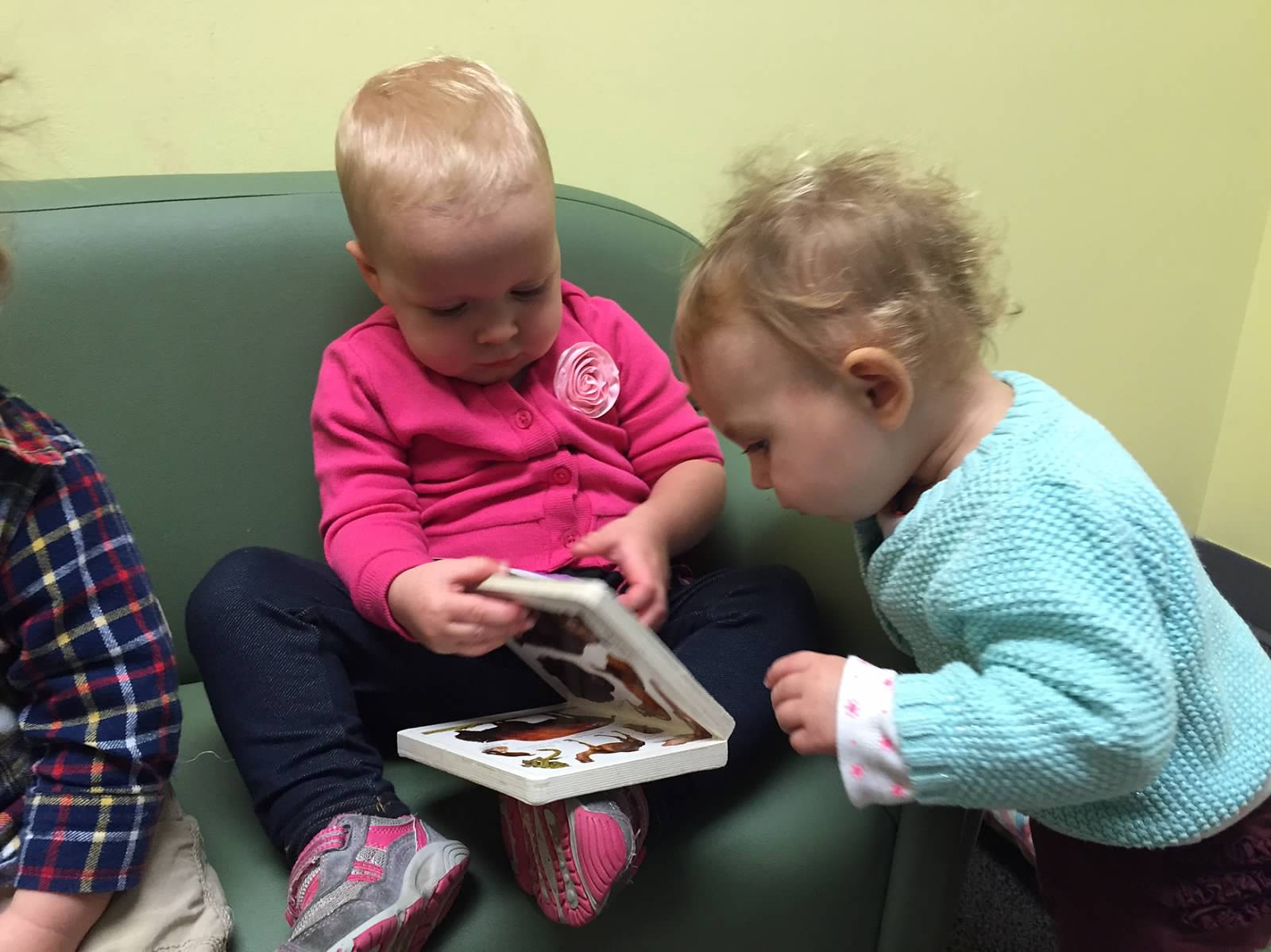
i spent ten years as a tenured faculty member at The Ohio State University and one of my lines of research was how toddlers, children between 18 months and 3 years of age, make friends, keep friends, and interact with their friends. What I discovered doing that research was both surprising and heartwarming. I found that not only do toddlers form very close friendships, but they maintain these friendships over time, and interact with their friends in ways that are very different from the way they interact with other children who are not friends. We have long known that friendships play an important role in the lives of adults and teens, but only recently have we come to see that even the youngest children can form strong friendships that have as much meaning to them as ours do for us. The following are a few of the things I discovered while doing that research and that teachers and parents of young children should keep in mind.

  • Toddlers need time to form friendships
    • While you may meet a person and know pretty quickly that you will be friends, toddlers need time to form their friendships. This means that they need to have many opportunities to interact with the same children to really get to know them. Further, they need unstructured time to play together. This also means that it may be more difficult for a child who attends a program part time to form strong friendships at early ages. If your child is not in an early childhood setting going someplace like a museum on a regular day of the week with another group of parents/caregivers can help your child begin to form friendships.

IMG_2841

  • Toddlers choose their own friends
    • Time with others by itself will not automatically lead to a friendship for toddlers. Just because you and your best adult friend get your toddlers together to play every day does not mean that they will become friends too. In my research toddlers chose their friends the same way you do–through shared interests during play and personal qualities that appealed to them. While adults can certainly encourage a friendship you can’t force children to be friends.
  • Toddlers demonstrate their friendship by imitating each other
    • Of all the things I discovered in my research this was perhaps the most surprising and exciting! Toddler friends imitated each other in play, with one friend performing a behavior and the other doing the same or a very similar behavior immediately after. In addition, friends signaled their relationship by using identical objects. For example, if one of the friends had a blue ball in her right hand the other friend in the pair would have (or find) one as well—same ball, same hand! Up until this point I had always seen imitation as just copying each other—it was not until I watched hours of video very carefully that I saw that imitating each other was the signal for friendship. This should not have been surprising, after all, we choose our friends because we have something in common with them—an advanced form of imitation. But toddlers can’t look at their peers and thing “Hey! We both like Cheerios, let’s be friend!” so they create similarity through imitation.

IMG_2319

  • Toddlers miss their friends when they are gone
    • Common wisdom suggests that when a toddler’s friend moves away he simply forgets about the friend and moves on, but my research, and our experiences here at SEEC, suggest something very different. Years of careful observation of toddler friends showed that they actually went through a grieving process when a friend moved to another town or just to another classroom in an early childhood setting.We observed behaviors such as regression back to diapers, changes in behavior in the classroom and at home, and a general sadness when a friend left. At SEEC we have seen several children leave our school to move to other states or even other countries and we know that our children here still talk about those children and those children still talk about their SEEC friends. We even have children Skype with their old friends once they have moved!
  • Toddlers vary in how they interact with others
    • While some toddlers are outgoing and make friends easily, others are more quiet and tend to need to watch others before they make a friend. Parents and teachers often worry if a child is shy and hangs back, but our research found that these children were just as likely to make friends, they just made them more slowly and more deliberately. Once they were ready the children who hung back and watched often formed their friendships more quickly as they had watched the other children and knew exactly how and what to imitate to get into the action!
  • Toddler friendships should be respected and honored
    • Perhaps the most important lesson I learned through this research was that toddler friendships deserve the same amount of attention and respect that the friendships of older children and adults get. A toddler’s friends are just as important to him as your friends are to you and they deserve the same amount of care. Let friends sit together in the classroom, let them make choices to play on their own, and honor the emotional connection that they have.

DF7

Regardless of your age, friends are an important part of life. Encourage and support children as they make friends and talk to them about what it means to be a good friend from the earliest ages. These are the lessons that will last a lifetime and that will make for a happy and fulfilling life.

Teacher Feature: Four Year Old Classroom Explores Questions

It’s Teacher Feature Thursday!

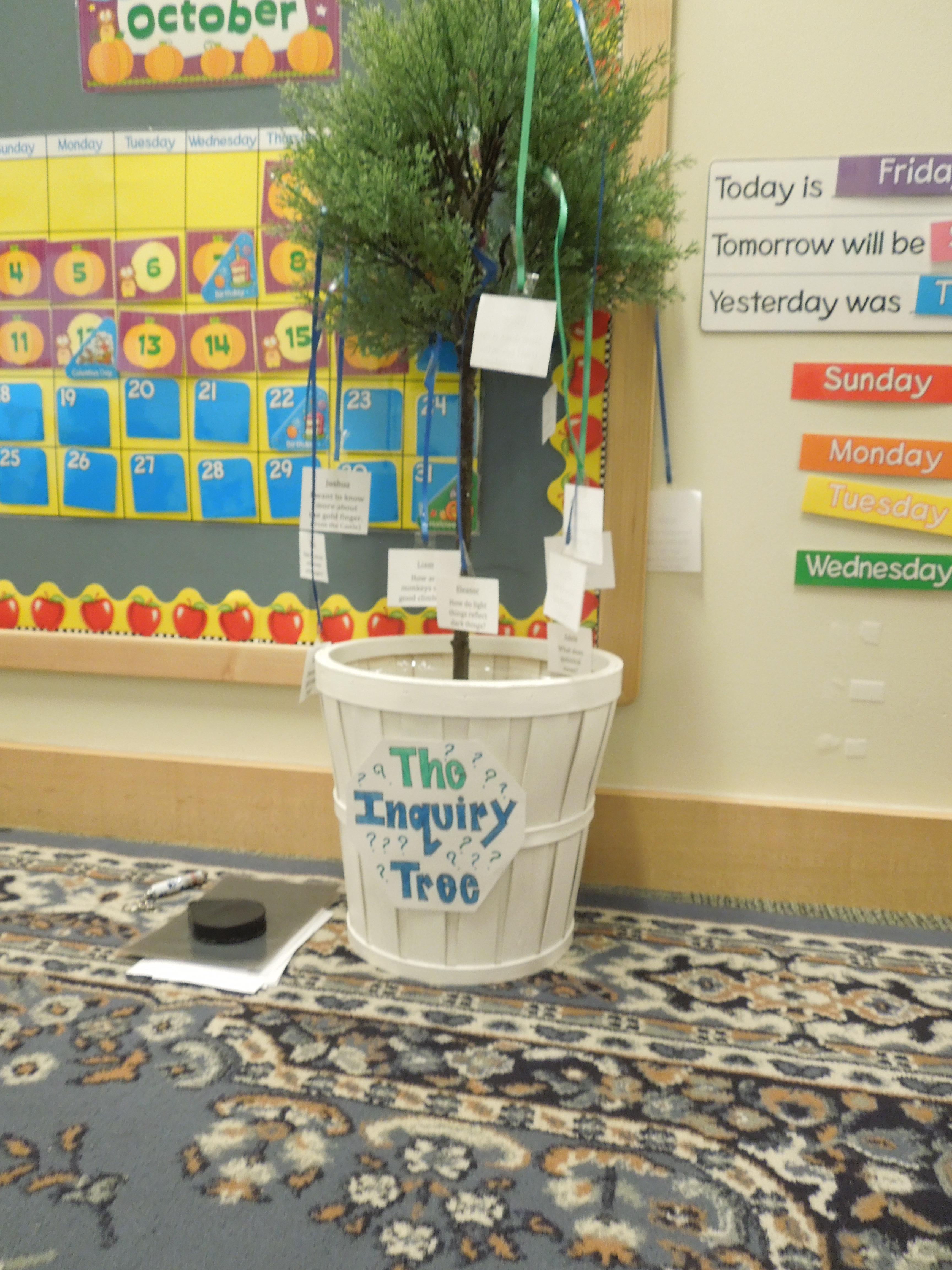
This week we are featuring Jessie Miller and Will Kuehnle in the Honey Bear classroom. This class of four year olds began the year with a unit on inquiry and question asking.  Will and Jessie used this unit as a way to introduce the museums and their vast collections and also get to know their children and gauge their interests. As they visited the different institutions around the National Mall, Will and Jessie carefully recorded their questions and hung them on their class “Inquiry Tree” as a creative display. They noticed a lot of the questions could be answered by visiting the Natural History Museum collection and could be connected through the theme of digging. Will and Jessie collaborated to develop their next unit. I was able to join their class as Jessie led the group through Natural History and gave them hints about what they would study next.  Below you will find a reflection from Jessie and images from her lesson.

HB Cover

Teacher Feature

What were your topics of exploration? Why did you choose them? Where did they come from?

The Honey Bears had two weeks focused on inquiry and curiosity. We began with a lesson about what a question is and how we can use questions to express what we want to know more about. We created an “inquiry tree” in the classroom where the children could hang their questions and we revisited them throughout the weeks. The Honey Bears used their new found curiosity to explore places such as the Botanic Gardens, the Martin Luther King Jr. Memorial Library, the National Gallery of Art’s Sculpture Garden, and the National Museum of Natural History.

Why and how did you choose the visit?

As the Honey Bears conducted observations and gathered questions about the topics they wanted to know more about, Will and I determined what areas held most of their interests. This led us to the Natural History Museum where we went on a scavenger hunt looking for clues that would lead us to our next unit of study. Many of the children’s questions over the weeks had to do with things like dinosaurs, jewels and gold, bones, rocks, and other topics related to digging. The picture clues we used on our scavenger hunt led us to different exhibits in Natural History where we could explore these things and introduce the next thematic unit of “Can you dig it?” to the Honey Bears.

What were your learning objectives? (What did you want your children to take away from the lesson?)

I wanted this lesson to be a culmination of the inquiry weeks. It would be a way to review everything we had learned about how to ask questions and touch on some of the questions we had shared over the weeks. I wanted the Honey Bears to be free to explore the different exhibits at Natural History related to our next unit and come up with new questions. I wanted the children to see how their curiosity and questions control where our themes go.

What was most successful about your lesson?  How did the lesson reach your objectives to expand the topic? What was successful in terms of your preparation and logistics?

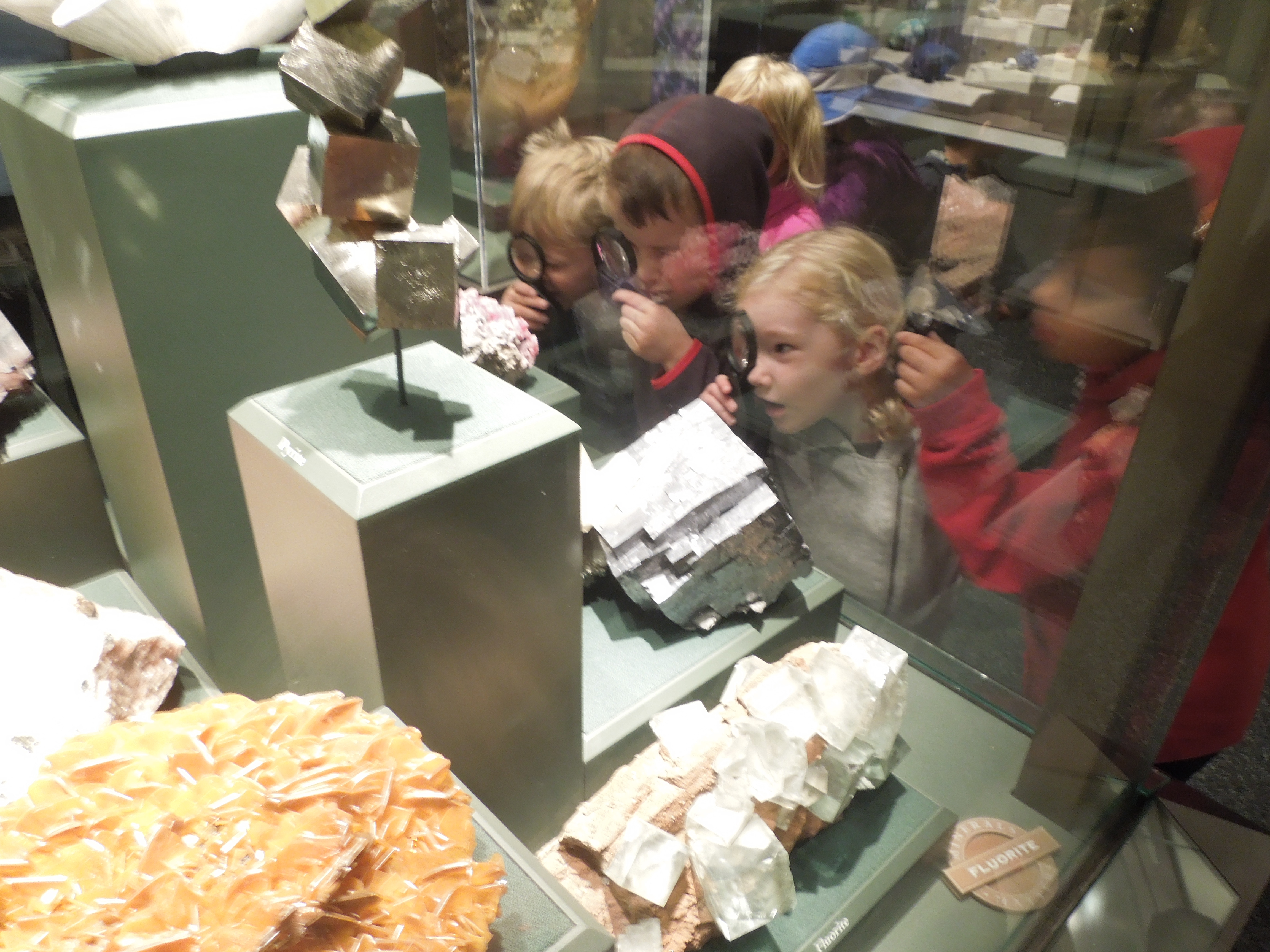
Most of the Honey Bears have been to the Natural History Museum many times before. However, by giving them magnifying glasses to hold and picture clues to follow, it gave them a different way of exploring the exhibits. They had to use the picture clues to really think about where we were going next and it added an extra layer of excitement to our exploration. In preparation for the lesson, I sifted through all of the Honey Bears questions and comments to determine where their main interests were. As I ventured through Natural History with the children, I brought up some of their previous questions to spark their curiosity and reflect on their previous experiences.

What could you have done differently to better achieve your objectives and expand the topic? What was challenging regarding logistics? What recommendations would you have for another teacher trying out this lesson?

I think the experience could have gone more smoothly if we had gone to the museum at a quieter time of day, perhaps before it opened so there was less of a crowd. I also felt like I was having good conversations with the children close to me in the front of our train but it was harder for me to communicate with the children in the caboose of the train. We were moving from place to place and there were a lot of people around so next time I would prefer to get there early and have specific spots to stop at so we could all share and discuss our thoughts and questions with the group as a whole.

Here are a few images from their unit on questions:


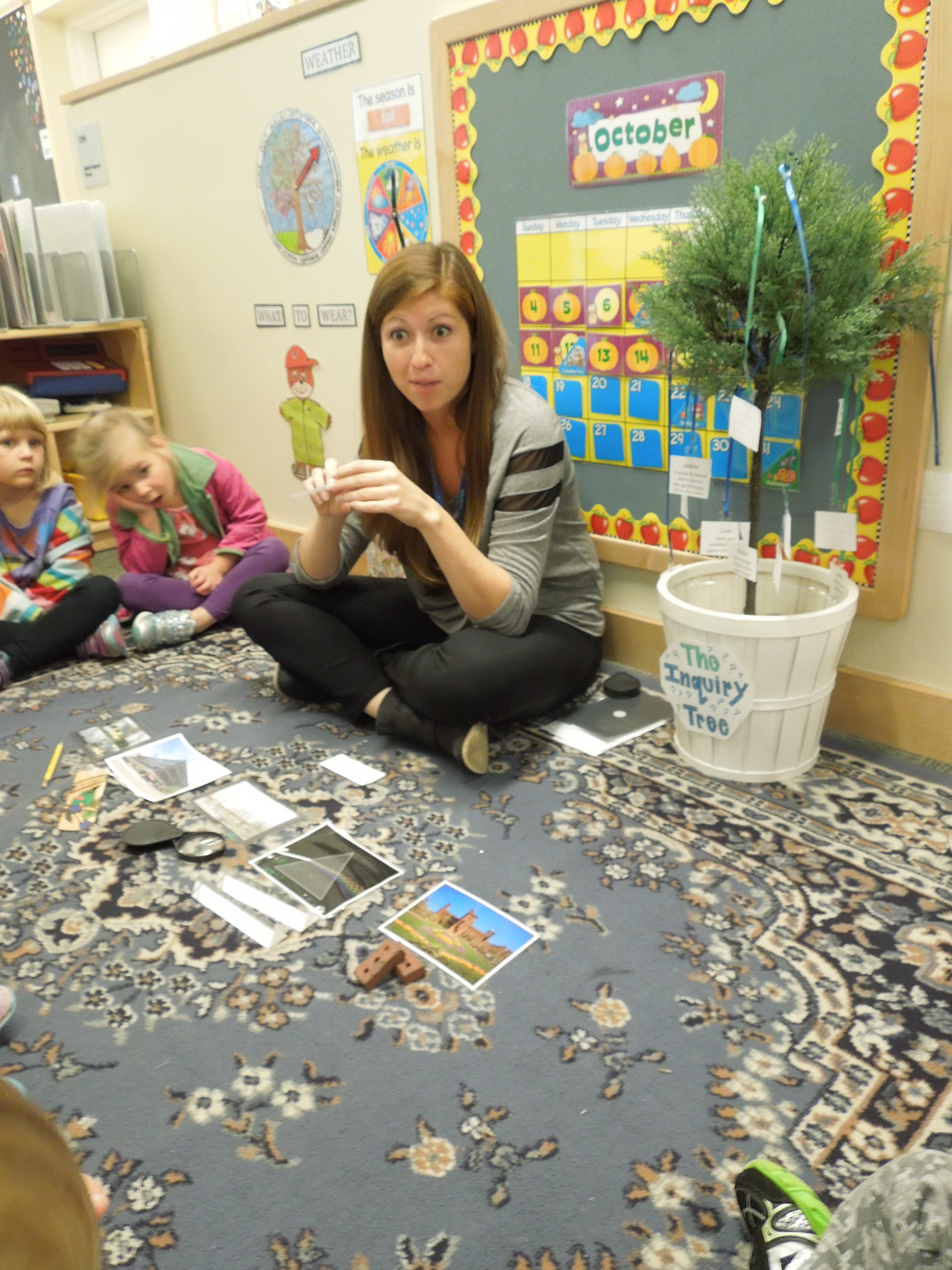
DSCN3825Jessie began the lesson by reminding the children of the different museums they visited around the mall. Will and Jessie used a token object to remind the children of the Museum collection and asked the children to reflect on their visits.   

DSCN3813Jessie then reminded the children that they had asked a number of really great questions and read some of the questions off of The Inquiry Tree that related to the Museum of Natural History. She explained that a lot of the questions they had could be answered at Natural History so today they were going to go on a hunt for answers at the museum.
DSCN3839Jessie created a modified “scavenger hunt” using images that connected to the children’s digging questions and to different exhibits in the Natural History Museum. She began the visit by  showing the children an image of a squirrel digging in the dirt. Jessie asked the group where they might learn more about her image. The group enthusiastically replied “Mammal Hall!”

DSCN3856After locating their squirrel and looking at the other digging mammals,  Jessie revealed the next image, a crown! The group discussed the different locations in the museums where they might find a crown and the materials that they are made of. The children decided to go up to the Gems and Mineral Hall to investigate.

DSCN3864The students did some close looking with the magnify glasses and found crowns, gold and uncut gems.

DSCN3895Their next clue took them to the Live Insect Zoo to see insect digging in action.

DSCN3919Their final stop was  to the Last American Dinosaur Exhibit to learn about paleontologists and what they are able to dig up. One of the paleontologists came out and talked to the children about his job and brought out a real fossil for the children to examine.

DSCN3939The students all took turns looking very closely at the fossil.

During the next week Will and Jessie formally introduced the class to their new theme: “Can you dig it?” They will be spending a few weeks doing in depth explorations in digging tunnels, archaeologists, and so much more! Check out our Facebook, Twitter, Instagram, and Pinterest for more ideas from their unit on inquiry and digging! See you in two weeks with our next Teacher Feature!

Teacher Feature: Four Year Old Classroom Explores Newspapers

It’s Teacher Feature Thursday!

This week we are featuring Emma Cowan-Young and Amy Schoolcraft  in the Cinnamon Bear classroom. This class of four year olds began the year with a unit on stories and the different ways they can be communicated. I was able to join them during their lesson on true and factual stories. Emma and Amy decided to explore this topic through newspapers and a visit to the National Gallery. Below you will find a reflection from the team and images from their lesson.

CB Cover


What were your topics of exploration? Why did you choose them? Where did they come from?

Currently we are exploring stories and all the different ways they can be told (books, storytelling, plays, movies, etc.).  I chose the topic of newspapers for this lesson so we could learn about how not all stories are pretend; some stories are about true events. I also thought it would be a great opportunity to expose the class to newspapers, because unfortunately, they are becoming more scarcely used as people switch to receiving their news digitally.

Why and how did you choose the visit?

I chose to visit Cezanne’s portrait of his father reading the newspaper, because it illustrates the topic of study and offers the opportunity for the children to interpret what he is reading about. I also knew the painting was large and easy to see, which is always a deciding factor in my visits. If the object is difficult to view the kids will be preoccupied with craning their necks rather than listening to what you have to say about the object.

What were your learning objectives? (What did you want your children to take away from the lesson?)

My learning objectives for this lesson were to introduce my class to newspapers and the true stories found within. I wanted the class to be able to distinguish between real and pretend stories and the different mediums they can be written. An additional objective I had for this lesson was to communicate that you can learn a lot about the topic being written about through visual literacy. Since the vast majority of the class is not reading yet, I wanted to empower them to “read” the newspaper through the images.

What was most successful about your lesson?  How did the lesson reach your objectives to expand the topic? What was successful in terms of your preparation and logistics?

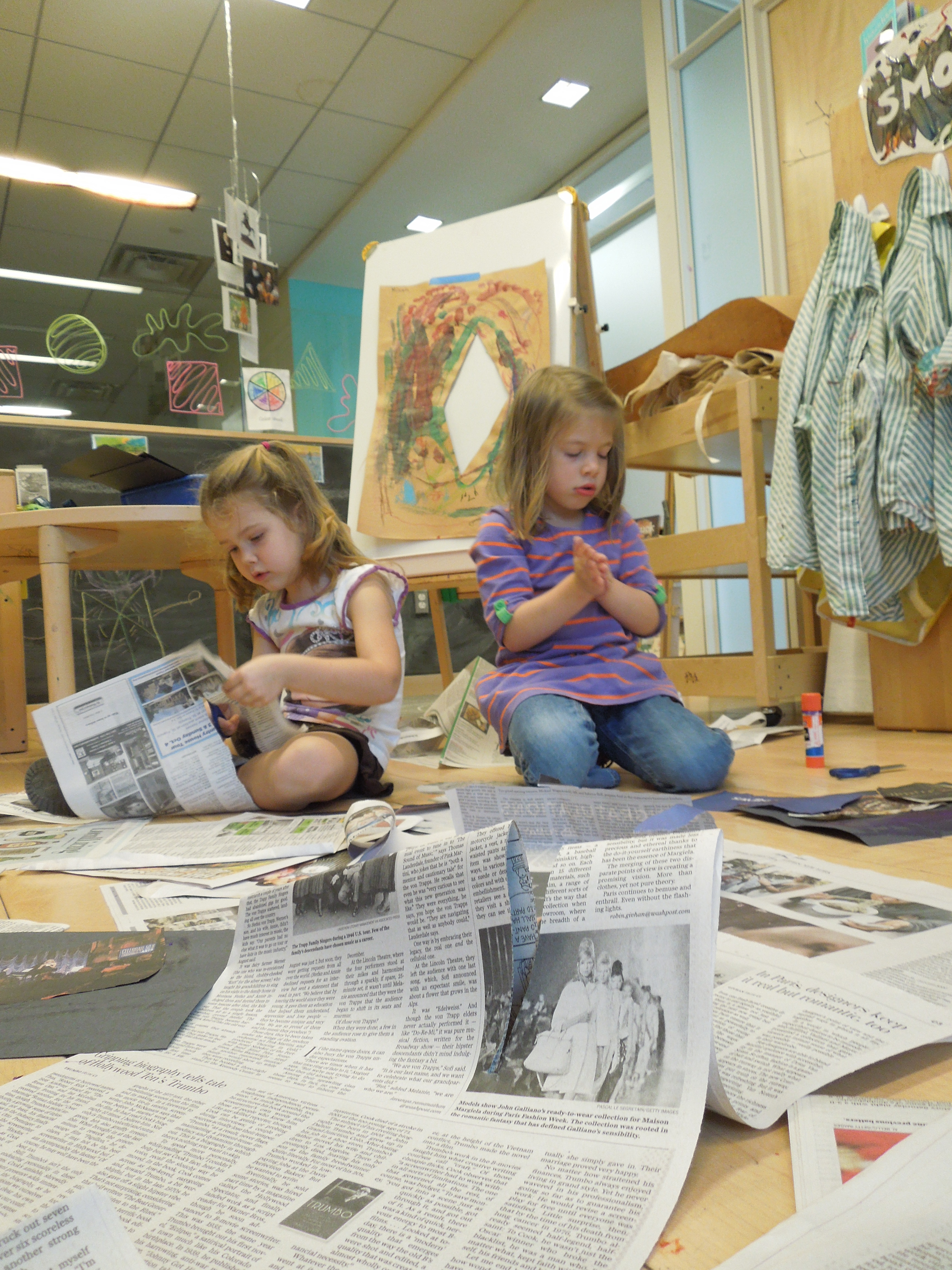
I thought overall the lesson was a success. I think the most successful part of the lesson was the follow-up activity where the class sorted through actual newspapers to cut out headlines and pictures they found compelling to make a collage. Because newspapers are not a format they are usually exposed to, I think looking through the pages of the newspapers made them feel a like “adults.” As I watched my class sort through the newspapers, they were conversing with each other about what they thought the articles were about based on the pictures, and saying things such as, “that really happened!” I feel as though they truly grasped the objectives I was trying to communicate for this lesson. My hope going forward is that they will be interested in newspapers outside the classroom (on the Metro, on the weekends with mom and dad, etc.), and they will not be intimidated by them because they are usually a format used by adults.

What could you have done differently to better achieve your objectives and expand the topic? What was challenging regarding logistics? What recommendations would you have for another teacher trying out this lesson?

An afterthought I had for this lesson was that I could have taken my class to see archived newspapers stored in the Smithsonian. I feel like this would have offered up an opportunity to compare a decades old newspaper to its contemporary and see what stories were included then versus now.

A recommendation I have for a teacher trying out this lesson is to take a quick peek through the newspapers before unleashing them to your class. As much as I am for exposing children to the newsprint format, there are some news stories that they do not need exposure to just yet.


Here are a few images from their unit on newspapers:

DSCN3789

Their lesson began at the National Gallery of Art. Emma gathered the group in front of The Artist’s Father, Reading “L’Événement”  by Cézanne, Paul. She asked the group to start by looking at the painting and talking about what they noticed. The group immediately identified the newspaper and Emma passed around a newspaper she brought along for the visit. She asked the group what type of stories could be found in a newspaper. The children had lots of great thoughts including “stories from around the world.” Emma explained that stories in newspapers are true. She also explained that there are often pictures that go with the stories to help people get a more complete idea about the what the author is trying to explain. Emma had the group look at an image in the newspaper and try to speculate what they thought the story was about. They then tried to hypothesize what the man in the painting was reading about in his newspaper. To conclude the museum experience she read the group The True Story of the Three Little Pigs by Jon Scieszka. The children loved the story and had a lengthy conversation about which version of the story was really true.

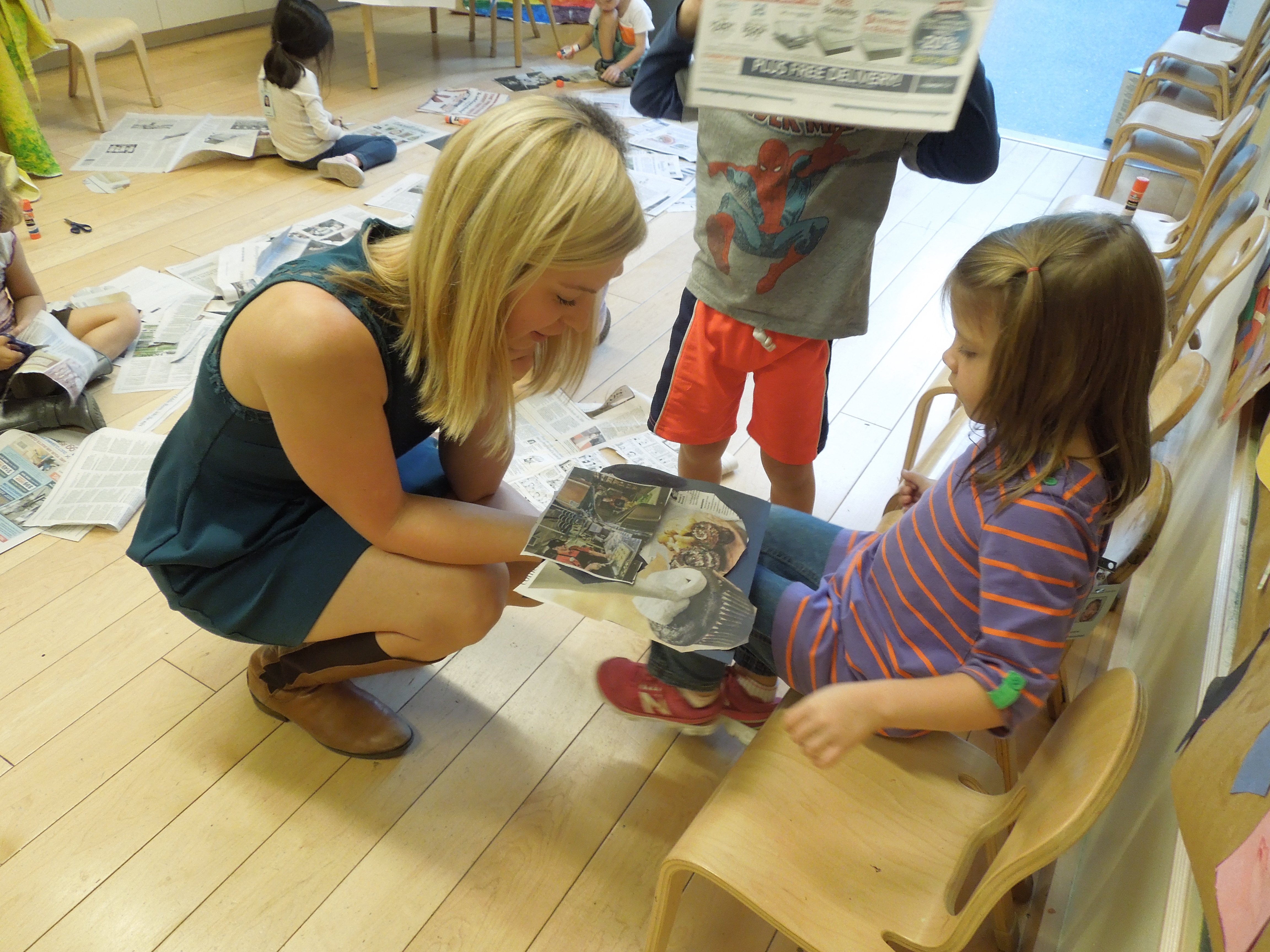
DSCN3796When they returned to the classroom, Emma brought out stacks of newspapers for the children to cut up and create a collage.

DSCN3800The children had a great time practicing their cutting skills and describing the different shapes, letters, and images they found during the process. 
DSCN3807
Some children were very careful to cut out individual articles and boxes of text.
DSCN3803

Emma spent time talking with each child about their collage. She asked them why they selected certain items and what someone could “read” from their selection of images.

This class had a wonderful time learning about newspapers. Check out our Facebook, Twitter, Instagram, and Pinterest for more ideas from their unit on stories! See you next week!

Why Should We Care About the Arts? (or Let’s Create “Both/And” Schools)

I have been thinking about education–both in early childhood and beyond, both in school and out of school–for most of my career. Most recently I have been doing a lot of thinking about what we are, and are not, teaching in early childhood school settings and beyond.

It seems that we live in what I call an “either/or” world of education. Phonics or whole language? STEM or STEAM? Project-based or scripted curriculum? We sway back and forth from year to year on what we are focused on and what we believe is important. At the moment the arts (and sometimes the humanities) often seem to be getting lost in the shuffle. They aren’t part of the common core of what we have decided children need to learn in school. They are often viewed as things that children should pursue out of school, in private lessons, or on their own time. But what if we stopped the “either /or” conversations and started to talk more about how we can create “both/and” schools for children of all ages and all socioeconomic levels?

I spent the morning at the White House today talking about the importance of the arts and listening to youth tell their stories–stories of how writing gave them someone to talk to when nobody seemed to care, how poetry kept them from a life of incarcerations, how dance awakened a passion that they didn’t know they had. Don’t get me wrong, I love STEM—I used to be the COO of a large science museum– and I absolutely believe in the importance of providing a strong STEM curriculum to all children, in all schools. But I don’t think it should come at the expense of the arts. While it is important to have children memorize the times tables, it may be just as important to give them the opportunity to memorize lines for a play. While it is important to learn the composition of the solar system, it is just as important to learn the composition of a great piece of art. While it is vital to learn to decode the letters and words on a piece of paper, it may be just as important to learn to look carefully at a piece of art, a sculpture, or an artifact from history and decode its’ story.

Education should create a passion for learning that lasts a lifetime. For some, STEM evokes that passion. But for others there is a human passion awakened only though the arts, a passion that we often forget about in education. And many of us love, and need, both in our lives. I write to work through things that I am struggling with, but I also love the beauty and concreteness of doing math. I am fascinated by the stories of science, but I want to be exposed to the stories of the great artists as well. Good writing touches me in a way that is different from the way solving a tough math problem does. I cried when I saw Michelangelo’s statue of David for the first time because the absolute beauty of it moved me in a way that is different from the way the beauty of the solar system moves me. Other people have the exact opposite reactions to these very same things and that is exactly my point—we need education systems that support and nurture both/and. These kinds of schools will have a much higher possibility of engaging all children, not just some.

Perhaps the arts are often ignored because they are not seen to be something that teaches “content” that will make you successful in life. But the arts teach you communication when you try to write your thoughts so someone else can connect to them. They teach you perspective taking when you create a painting to look like reality or when you imagine what the artist was thinking. They teach you to take on a challenge as you write and rewrite, create and recreate, or practice a dance until you get it right. They teach you focus and self-control as you work to complete something you started and care deeply about finishing. Perhaps most importantly, they can be the thing that best encourages self-directed and engaged learning for those children who are not engaged by the more traditional “school subjects”. Better yet, what if the arts can be used to engage children in these more traditional subjects?

At SEEC last year our four-year-olds learned about light, invisibility and the electromagnetic spectrum while exploring the adventures of The Invisible Man by H.G. Wells. Another class explored concepts of gravity and its effects on your muscles at the Hirshhorn museum using a piece by artist Ernesto Neto titled, The Dangerous Logic of Wooing and old panty hose full of rice.

carrie

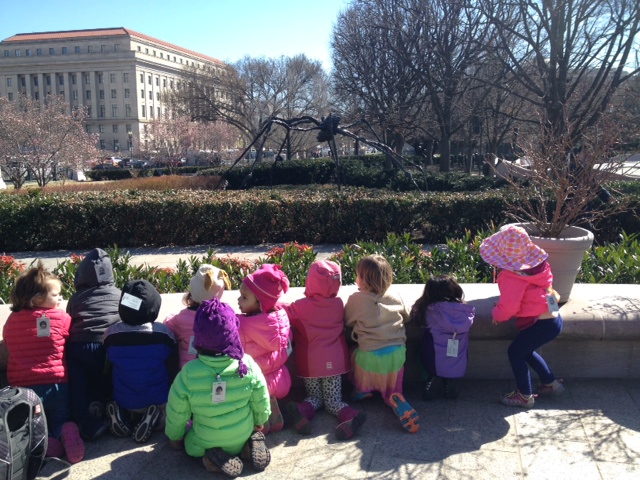
A class of our three-year-olds talked about inventing while studying the Teenage Mutant Ninja Turtles and the artists they were named after. When they studied the turtle “Leo”, they studied the artist Leonardo da Vinci and visited the National Air and Space Museum to see da Vinci’s Flying Man, followed by the students coming up with their own inventions using blocks, magnet tiles and other materials from their classroom. A class of two-year-olds began and ended a six week study of bugs by visiting Louise Bourgeois’  Maman spider sculpture at the National Gallery of Art’s Sculpture Garden, as well as by examining real collections of various bugs from the National Museum of Natural History’s collection.

photo 2

Our weekend workshops for preschool children and their families studied the movement of the sun by looking at the sun and the sky on their walk to the National Gallery where they then looked carefully at Monet’s Rouen Cathedral, West Faҫade and Rouen Cathedral, West Faҫade, Sunlight to see the difference in the sun and the light on the landscape.

We clearly take a “both/and” approach here at SEEC and we believe our children are better for it. I hope that our conversations around education in this country can move in this direction so we can engage more children, more often and in more ways. After all, isn’t that the point?

Living and Learning Spaces

At SEEC we have been making changes to our classroom environments over the last three years. There is no question the environment influences everything from behavior to feelings. Think about the difference between how you feel in a busy urban city vs by a stream in the woods (what will feel better to you is very individual!). The environment in our spaces are not just the “third teacher”, giving the children cues about how to behave and making visible what we believe about educating them, they are also the physical representation of the time we spend together in that space. I believe that these spaces should represent the teachers as people, that they should reflect the daily lives of the children and the adults spending time there, and that they should respect the needs of everyone, children and adults.


These classrooms are our “living rooms” — they are the places we live together for many hours a day. They should look more like spaces of living, of wonder, of curiosity than like spaces of instruction. They should have color that warms, softness that calms, spaces where both children and adults can be comfortable, and stories of their time together beautifully displayed in ways that show respect for wonder and curiosity and that reflect the voices of the children. We are working to make our spaces “living and learning” rooms rather than “classrooms” because this is what we do together every day!


A Intern’s Reflection: Hayon Park

This summer we had a wonderful team of interns who were involved in a variety of projects around SEEC. Hayon Park, our Art Enrichment Intern, had the pleasure of spending time with a number of our children doing art inspired activities. She assisted with the Smithsonian Early Explorer Program (our two day a week toddler class for child and caregiver), developed in-class experiences for infant, toddler, and twos classes upon request, and led afternoon art studio experiences for the pre-K classes. Below you will find Hayon’s reflection and favorite projects from her time at SEEC.

Internship Reflection 1: SEE Program

Every Smithsonian Early Explorer (SEE) class was an insightful moment for me to see how children engage with the museum resources in their own playful way. Although I only joined the last classes of the year, I sincerely enjoyed getting to know the children and their caregivers. One girl’s grandmother told me that she asked “Is Miss Hayon going to be there today?” I was amazed at how she remembered my name and was anticipating playing with me despite our limited interactions in class. I am grateful for every moment I experienced within the SEE program and hope to join the class again soon.

The image above I designed for the SEE program was printed on the end-of-the-year gifts for the family, and on SEEC’s gala brochure.


Internship Reflection 2: Art with Infant and Toddler Friends

For the last half of my internship, I had the opportunity to do something I absolutely love: making art with young friends. I visited the infant, toddler, and twos classrooms classes twice during the month of July.

I began every class reading a book that would trigger some ideas for the activity. A short discussion time followed, where children shared their brilliant observations. Then I introduced the main activity and gave a quick demonstration on how to use the materials. Most of the projects were sensory based and open-ended. I was quite nervous if the children would be interested in the activities, but each artwork turned out to be fun and unique. To me, just being there with the children was a joyful moment. 

Art with the Infants

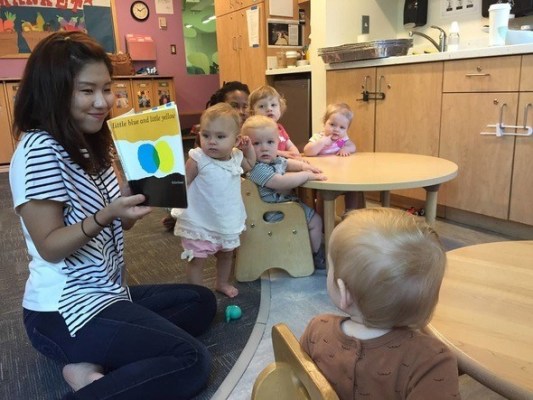
With the youngest friends of the center, I explored ice painting. I first read a short storybook called “Little Blue and Little Yellow” to introduce the color-mixing activity. Then, I demonstrated how they could roll the frozen paint ice cubes on paper. As the ice cubes melted, the primary colors naturally mixed together, making an abstract piece of work. More importantly, our little friends enjoyed the sensory experience of touching and exploring the cold ice cubes.


Art with the Toddlers

With the toddler classes, I introduced the activity with a book called “Mouse Paint”, a story in which three white mice explore color-mixing by diving into primary color paint jars. We imagined that a white piece of yarn was a mouse and dipped it into red, yellow, and blue paint bowls. The children then made the yarn dance on the white paper. As the yarn playfully danced on the surface, curvy lines and dots appeared and created a Jackson Pollock-like abstract piece of art. They had so much fun with the yarn painting and I loved playing with the little artists as well.

Art with the Twos

I started off by reading one of my favorite children’s books, “Matthew’s Dream”. I emphasized that ANYTHING could be art, including food, landscape, and even ourselves. I briefly introduced Robert Rauschenberg, an artist who used everyday objects in his artworks, blurring the border between 2-dimension and 3-dimension works. In order to encourage children to explore different objects, I brought in small objects, such as pasta shells, beads, short straws, yarn, stickers, pieces of paper, and pompoms. I handed out cardboard pieces to each student and encouraged them to use glue to attach the different objects to the surface. Some friends were very creative and experimental.  For example, one friend glued the straws to stand on the surface, which made a sculptural piece. There were also friends who showed interest in only using particular materials such as stickers or pasta shells. Overall, everyone spent a lot of time working on their art piece, and each one of them was absolutely fun and artistic.


Internship Reflection 3: Studio time

Upon starting the internship, I acquired permission to do research for my Master’s thesis at SEEC. I obtained consent from the parents of the children in the four year old classes. My research focuses on how young children’s environment affect everyday art activities and creativity, especially their drawings and narratives.


Sketchbook Time

We started art with drawing in our own sketchbooks. I kept the sketchbooks on a shelf, so that kids could  grab theirs as they were coming in to the studio. Amazing conversations emerged during this time while friends gathered around the table and drew.


Snow covered studio

One morning, we had a stack of Styrofoam donated to the school. As soon as children saw the Styrofoam, they began working together to make an igloo. Some friends worked on making windows for the igloo, and some just playfully drew on the surface. The Styrofoam broke into smaller and smaller pieces, and the whole studio space became a snow land!

Homemade play dough

With some simple ingredients, I made a big chunk of play dough and brought in to the studio. The kids loved the texture of the sticky dough. They created imaginative figures by adding other materials and color to the dough and paper plates with markers. It turned out to be pretty awesome.


pic7


Egg Carton Ideas

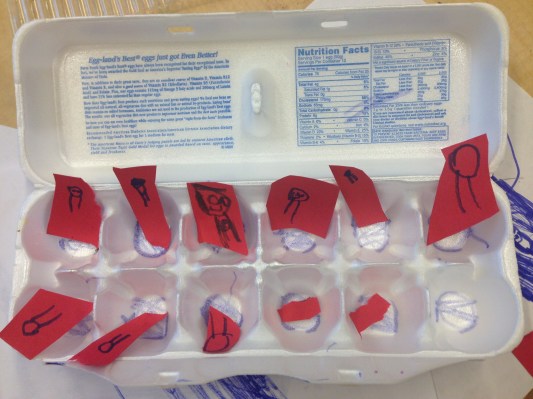
A family donated a number of egg cartons from home. The kids loved making stuff with the cartons and used them in ways I never would have imagined. Some of them used other objects like yarn to create a container for spaghetti others created vehicles like trucks and metro trains. I loved watching them explore an everyday object in their own creative way.


Thank you Hayon for all of your hard work this summer! To read the full story and learn more about Hayon’s work visit here and keep an eye out for future artistic endeavors at SEEC with our new, full-time art educator, Carolyn Eby.