It’s Teacher Feature Thursday!
This week we are featuring Amy Schoolcraft and Emma Cowan-Young in the four year old Cinnamon Bear classroom. Our teachers were inspired by the children’s interest in music and spent several weeks exploring musical instruments prior to this lesson led by Amy on music composition and sheet music. Below you will find a reflection from Amy and Emma, and images from the lesson.
What were your topics of exploration? Why did you choose them? Where did they come from?
Over the past several weeks our class has been studying musical instruments. They have had a great time learning why and how instruments play different notes but we wanted to find a way to extend their understanding of the role that notes have in creating music. So, learning about composers and sheet music seemed like a natural avenue to explore, and a great starting point for our week-long study on music composition.
Why and how did you choose the visit?
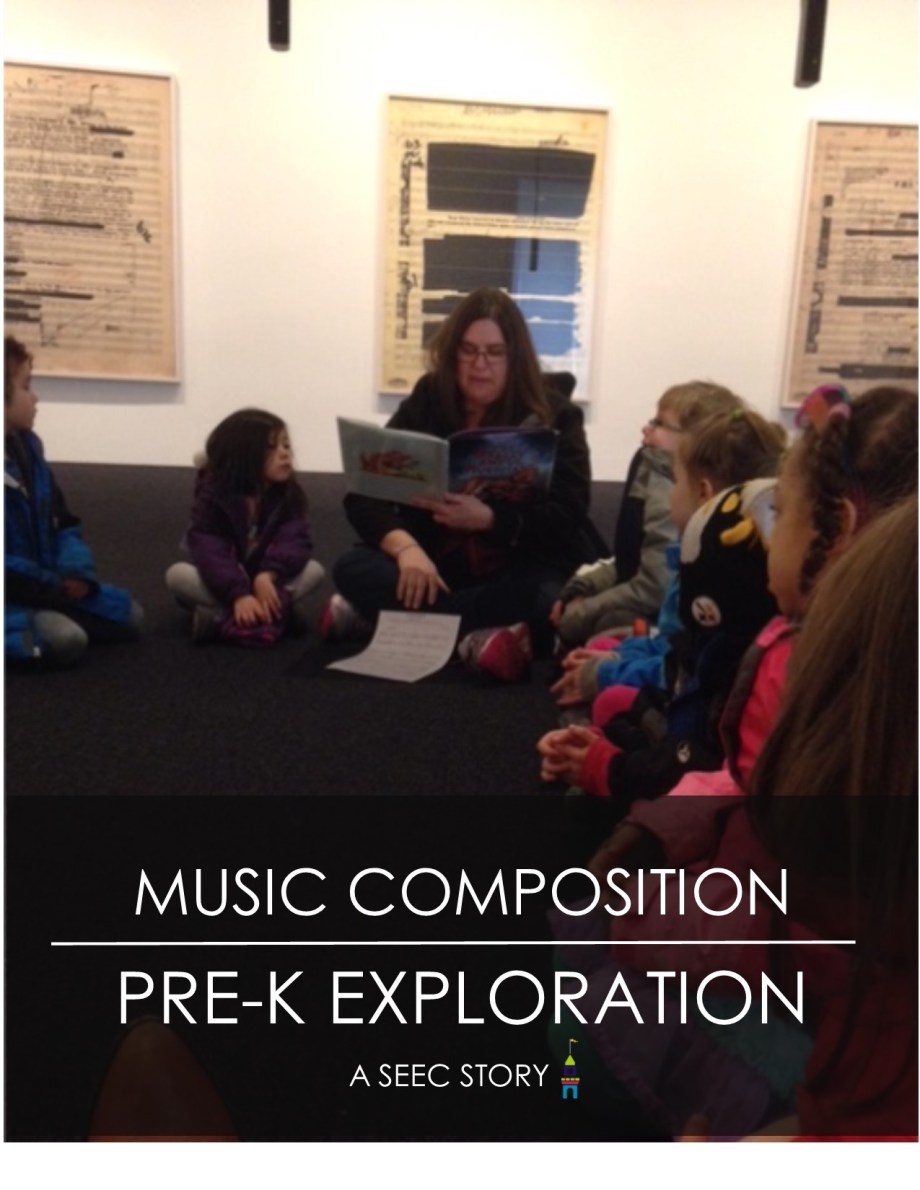
We wanted to select a visit that would reinforce the idea of sheet music as a product of a composer. While there were a few great choices among the Smithsonian museums, the installation Part File Score by Susan Philipsz at the Hirshhorn was too perfect to pass up. I loved the space because of the large sheets of music that are prominent, and the music that was being played through speakers, allowing the students to explore the music in two ways.
What were your learning objectives? (What did you want your children to take away from the lesson?)
I wanted the students to understand what a composer is and why they are important. This lesson was also intended to be an introduction to written musical notes for us to build upon throughout our week-long study of basic music theory.
What was most successful about your lesson?
To introduce the idea of a composer, we first discussed what a composer is and then listened to a few musical selections. As they listened, I asked for them to try to figure out what story the composer was trying to tell. For example in Flight of the Bumblebee by Nikolay Rimsky-Korsakov, what was the bee doing? Where was it going? Was it moving fast or slow? The last song we listened to was a known favorite of our class, Star Wars (Main Theme) by John Williams. This was a song they knew well and could relate to, giving the students a personal connection to the music and its composer. They were very excited to learn more about John Williams and even try to follow along with a section of the sheet music while listening to the song.
How did the lesson reach your objectives to expand the topic?
This introduction to composers helped to establish what a composer is and made it meaningful to the students by introducing John Williams, the composer of one of the class’ favorite songs. The lesson also provided a basic understanding of sheet music, and how writing notes creates music.
What was successful in terms of your preparation and logistics?
We typically reserve the “meat” of the lessons for our museum circle, but we knew that it would be difficult to play the selections of music within the exhibit. So, we had the bulk of our lesson in our classroom instead, using the Hirshhorn exhibit to reinforce the concepts we had learned about in the classroom. Because we were having two circle times, one in the classroom and one in the museum, we knew that we would not have time for our follow up activity in the morning and so we prepared for our class to complete the follow up activity later in the afternoon.
What could you have done differently to better achieve your objectives and expand the topic? What was challenging regarding logistics? What recommendations would you have for another teacher trying out this lesson?
This exhibit was largely chosen because of its display of sheet music, but upon reading the description of the artwork, we realized that the artist had intended a much deeper meaning, [“Based on the life and work of film composer Hanns Eisler, a German Jew who immigrated to the United States after his music was banned by the Nazis, only to become an early victim of the infamous Hollywood blacklist of supposed Communist sympathizers”]. While we did not go into great detail about this new information with our class, we were able to add a layer to our lesson since the book we read was about musicians who were also banned from playing their music. Our program utilizes artwork and artifacts from a variety of sources in the many museums of the Smithsonian and this visit served as a reminder of the importance of being informed and sensitive to the intent and meaning of the items we use in our lessons.
The follow up activity asked the kids to use Picasso’s Three Musicians, shape cutouts, and Star Wars sheet music as inspiration in creating their own musician collages. While the results were great, it turned into a mini-lesson by trying to relate these inspiration objects to the morning’s lesson. In hindsight we think it would have been best to select a different follow-up activity and save the one we did for its own lesson down the road, perhaps a lesson on music-inspired art.
Here are a few images from their lesson on Music Composition:
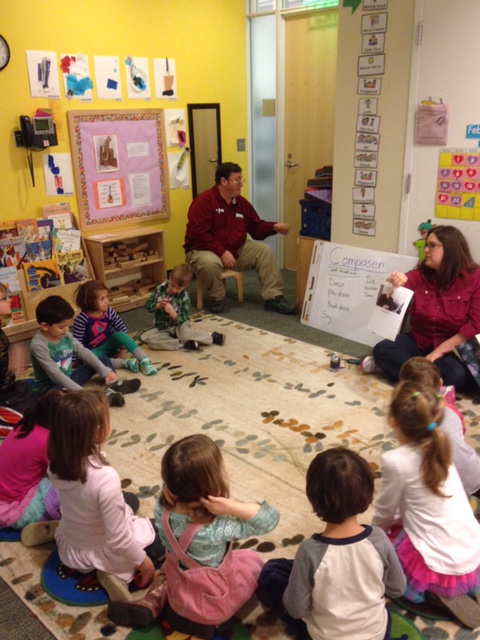
Amy began the lesson in the classroom with a conversation about composers and why music is written down. She asked the children what they knew about composers and wrote down their ideas as they shared. Many children knew that composers write music, but Amy asked them, “Why do they write their music down?” Amy told the class that composers write music so musicians know what to play!
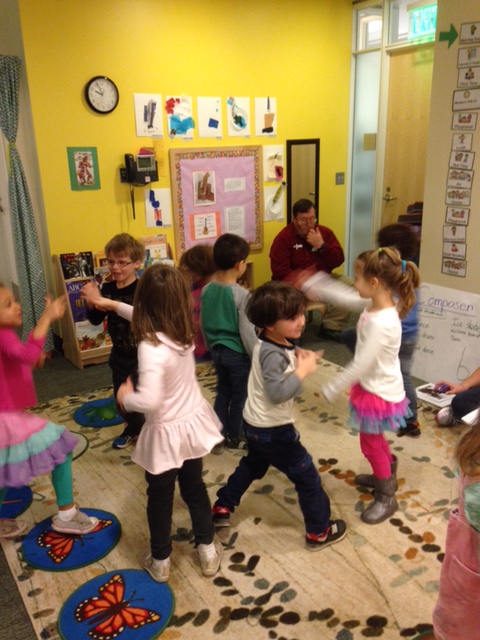
Next, Amy played several songs and each time she asked the students to listen and imagine what the composers were thinking about or what story they were trying to tell when they composed the song. During each song they got up and let the music inspire the way they moved, and then shared what story they thought the composer was trying to tell. “Flight of the Bumblebees” by Nikolai Rimsky-Korsakov made the class think of people walking fast. “The Carnival of the Animals, Movement VII Aquarium” by Camille Saint-Saëns made the class think of spooky, scary things like monsters and ghosts. “Comic Duet for Two Cats” by Gioacchino Rossini made all the children laugh and meow, and reminded them of “Cinderella” and “The Lion King”.
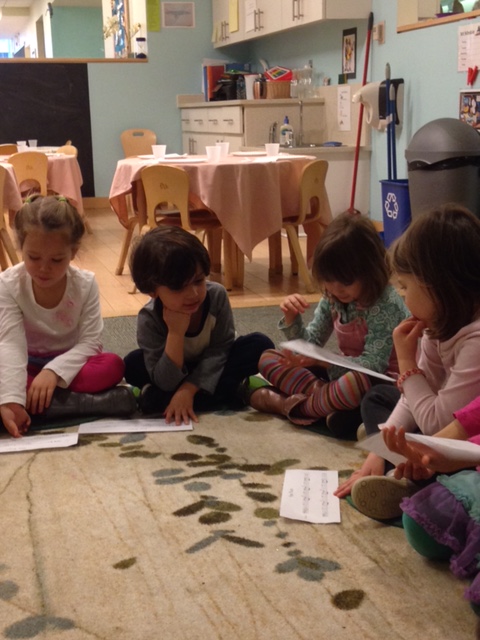
After moving to the music, the kids sat back down and Amy played one of the class’ favorite songs – The Star Wars theme song. The class instantly recognized it and got very excited. Amy showed the class a picture of its composer John Williams, and the sheet music to the song. The class noticed the title of the song on the top, just like books have titles. They listened to the song and were able to identify lots of different instruments, and Amy told them that each musician will each get their own sheet music, specifically for their instrument.
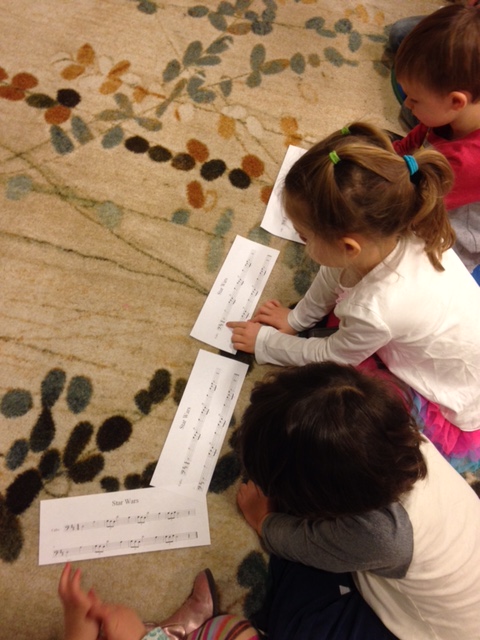
As the kids listened to the music they tried to follow the notes on their sheet music with their fingers, noticing all the different types of notes on the page. Amy pointed out the staff, and shape of the notes. They noticed how the notes go up and down the staff, which indicates the pitch of the note.

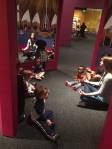
Next, the class went to the Hirshhorn Museum to see the installation Part File Score by Susan Philipsz. This large space was perfect for their visit as the class was surrounded by music that they could both see as sheet music and hear through speakers. Immediately the class spotted music notes on the large sheets of music that were framed on the walls, and stopped to listen to the music floating from the speakers. Amy asked the class what they heard, and they named instruments as they listened. They compared the sheet music in the piece to the Star Wars sheet music and noticed that the sheet music in Part File Score was much larger, and it had marks on top, but both had music bars and notes.
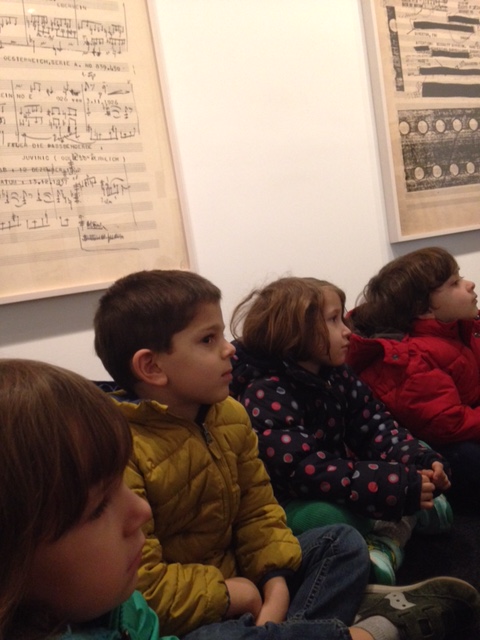
Amy read the class Really Awful Musicians by John Manders, about how musicians first learned to play together through composition and writing down notes. The story illustrated why sheet music is important when musicians play together in order to play a cohesive song. After the story, the class walked around the installation, and practiced their careful looking skills, noticing where notes were on the staff, and what the notes looked like.
Amy and Emma ended their Music unit with a concert for family and friends. Check out our Facebook, Twitter, Instagram, and Pinterest for more ideas from their unit on Music! See you in two weeks with our next Teacher Feature!
 What were your topics of exploration? Why did you choose them? Where did they come from?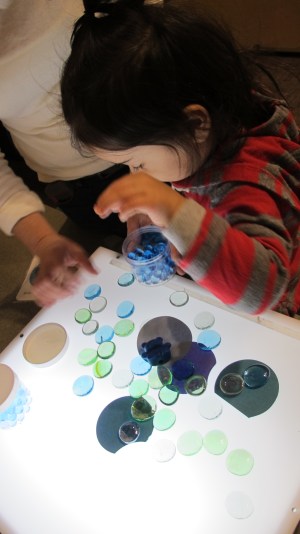
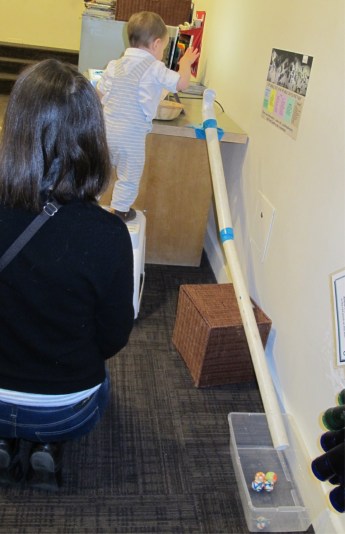 Children had lots of choices to explore. A light table lit up different water colored objects including glass marbles and water beads. Children rolled bouncy balls down a PVC pipe to illustrate how water runs down a mountain.
 They also experimented with this concept by pouring water down empty water bottles, and watching as the water zoomed back and forth as it slid down into a pan.
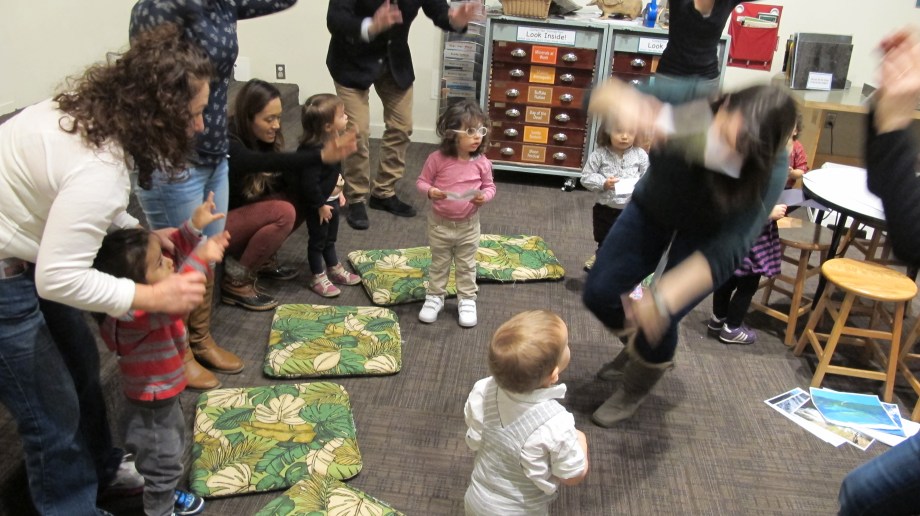 After learning centers, Allison called the group together for their morning meeting. First, she reinforced the concept that rivers flow down a mountain from high to low by demonstrating with her body. The students and their caregivers jumped in and also moved their bodies from high to low, like a river traveling down a mountain.
 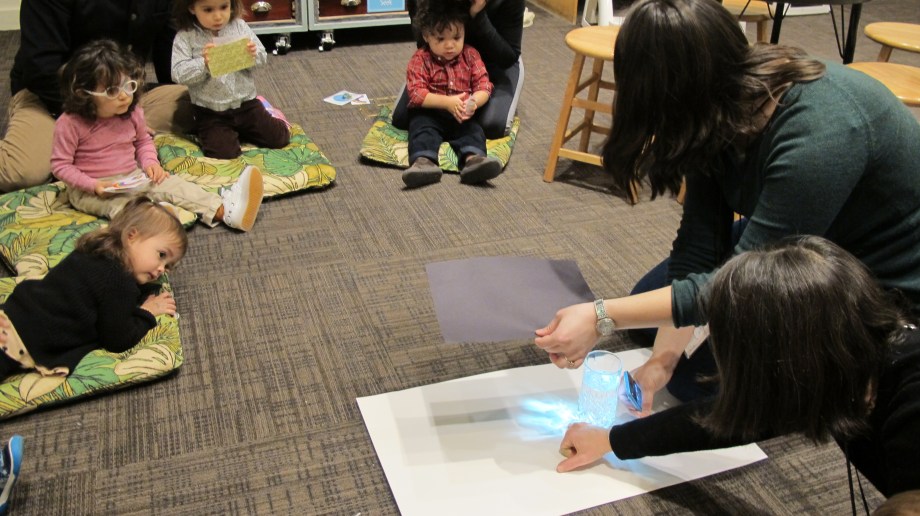 Then it was on to the focus of the day – waterfalls and rainbows. Allison explained that waterfalls are a part of rivers, and that sometimes you can see rainbows at waterfalls. Allison told the group about refraction, the interaction between water and light. She illustrated this by demonstrating what happens when light penetrates water- sometimes there’s a rainbow!
 Once in the museum, the class searched for waterfalls and rainbows, and found both in the painting The Great Horseshoe Fall, Niagra by Alvan Fisher. The group observed the painting and compared the rainbow in the painting to the one they were holding. They noticed that all the colors were present and sang a rainbow song.
  Allison used a felt sun to reinforce the concept that rainbows appear because of refraction; the sun is shining on the waterfall, which causes the rainbow.
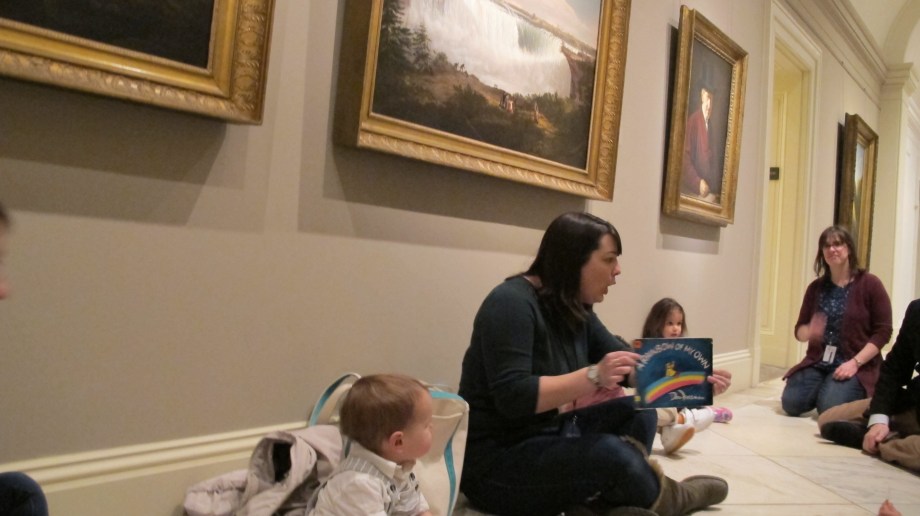 Next the class read
  Allison then reminded the class that bears catch fish in rivers and waterfalls, showing them a picture of a bear catching salmon in a waterfall.
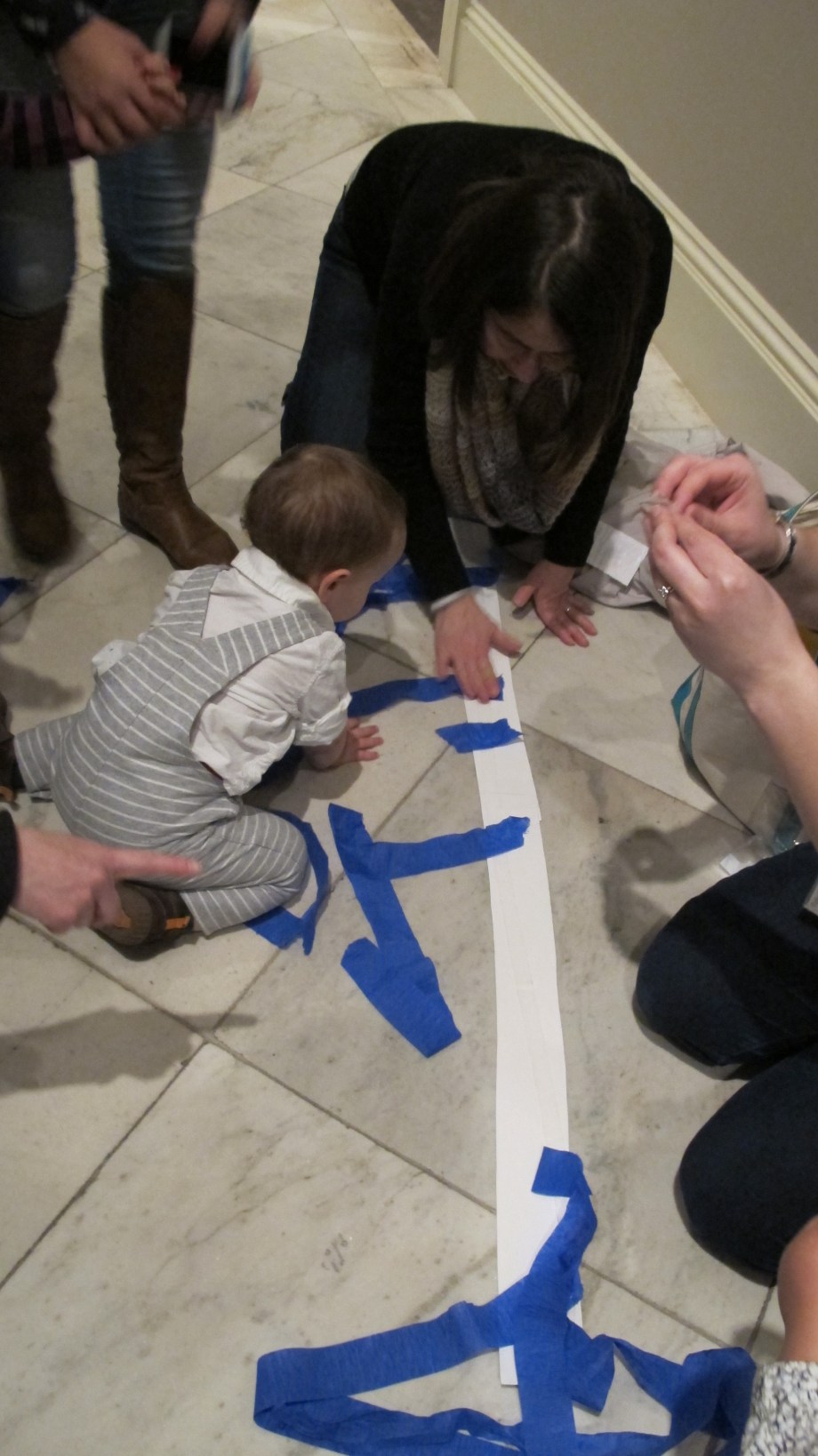 Then it was time to make their own waterfall by sticking blue crepe streamers to a long, narrow piece of poster board.
  When they were finished Allison held up the waterfall and shook it, making the crepe paper wiggle. The class made the whooshing sound of a waterfall.
  Then the group moved down to the Kogod Courtyard to play in their waterfall. They got into bear mode and jumped through the waterfall to go fishing.
 The kids put on a paper bear paw and used the velcro to capture fish. Then they brought the fish back through the waterfall to the appropriate color bucket.
 Lastly, the group loved playing in the water feature in the courtyard of museum. They experimented walking over the flowing water, and feeling it run over their fingers.
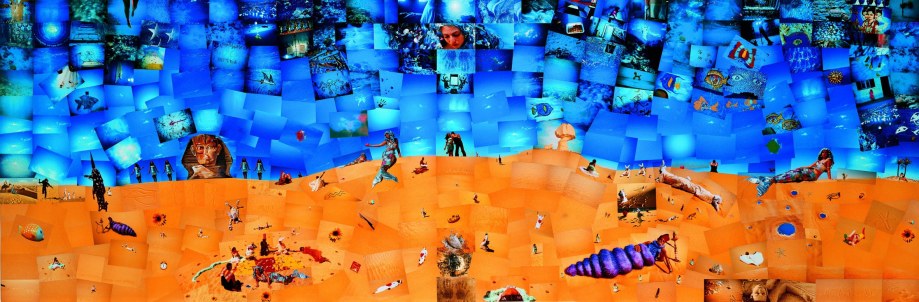 Will began the lesson by heading straight to the Arthur M. Sackler Gallery to see Lara Baladi’s Oum el Douna (The Mother of the World) as part of the museum’s Perspective series (Photo courtesy of the Arthur M. Sackler Gallery.) This large piece is located in the far end of the gallery lobby, which provided a large, quiet area for the class to sit in a semicircle and become absorbed in Oum el Douna.
 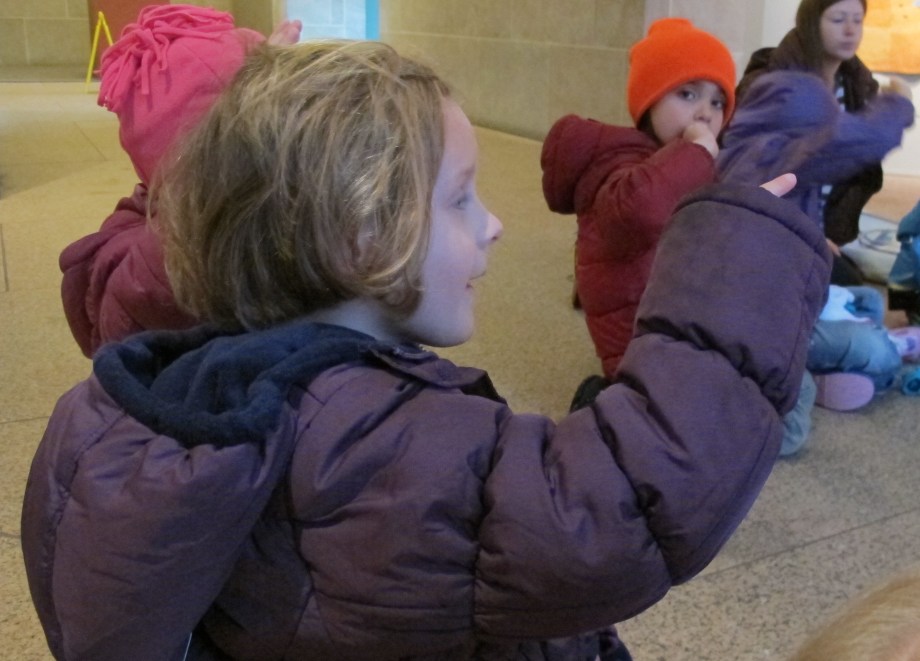 Will asked the children what they noticed about the piece. Oum el Douna is so large, with so many aspects that the children had many observations to share. Several children spotted the Sphinx immediately, and many others mentioned the two bright colors, and how they believed this represented the sandy desert and blue sky or water (“maybe it’s the Nile River!” said one child).
 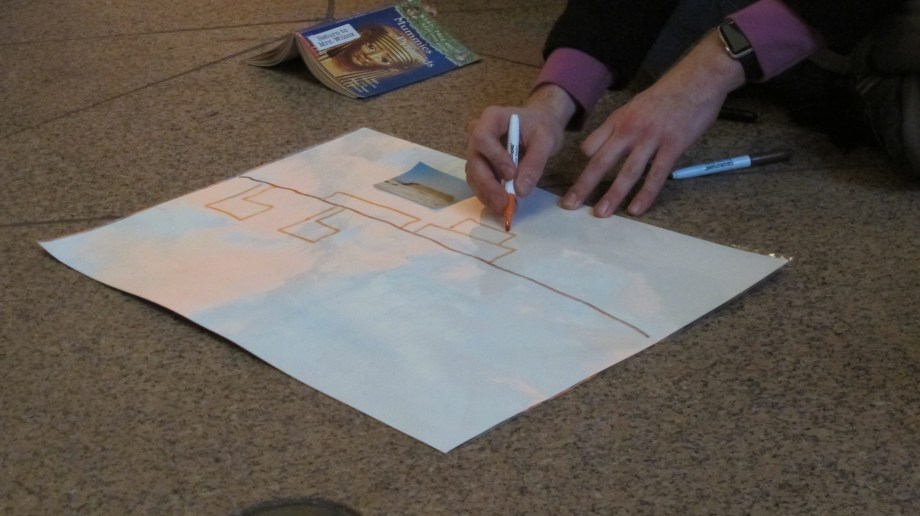 The class decided that the piece was most likely depicting Egypt due to the Sphinx and the desert. Will asked the class what might be missing from the piece if it was Egypt. Many students said, “pyramids!”, and when asked what pyramids are they said, “tombs”. To learn more about the evolution of tombs, Will read an excerpt from
  Will explained that tombs in pyramids became targets for tomb robbers due to their size and promise of treasure, so Pharaohs began building their tombs underground in the Valley of the Kings to keep them secret and protected from tomb robbers.

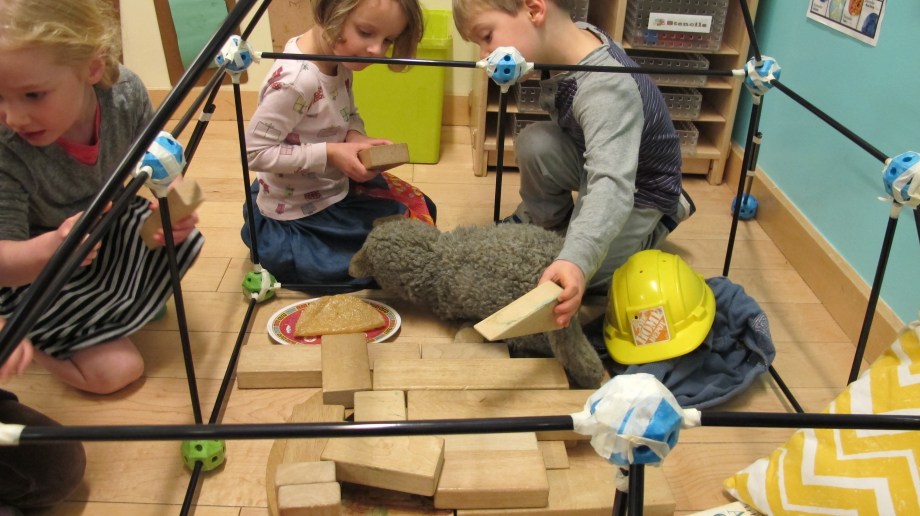 Once the objects were in place they built a podium for their sarcophagus.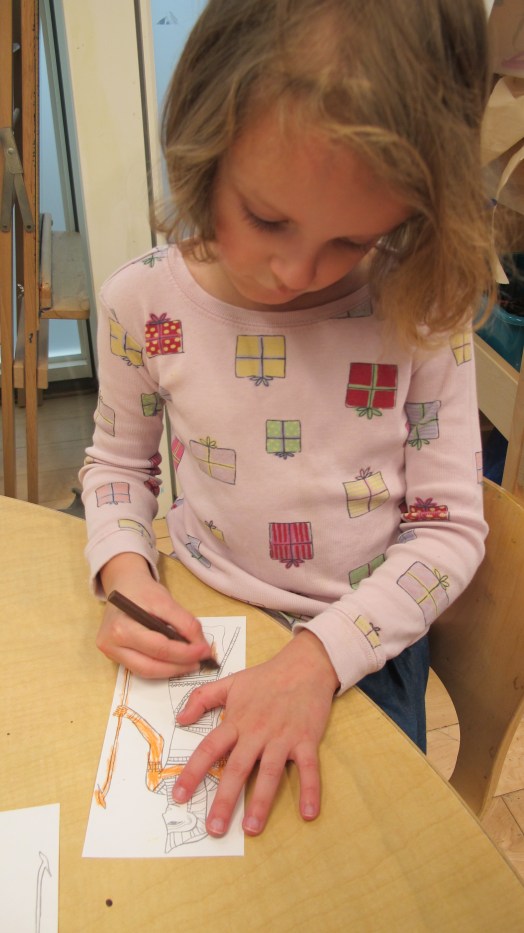
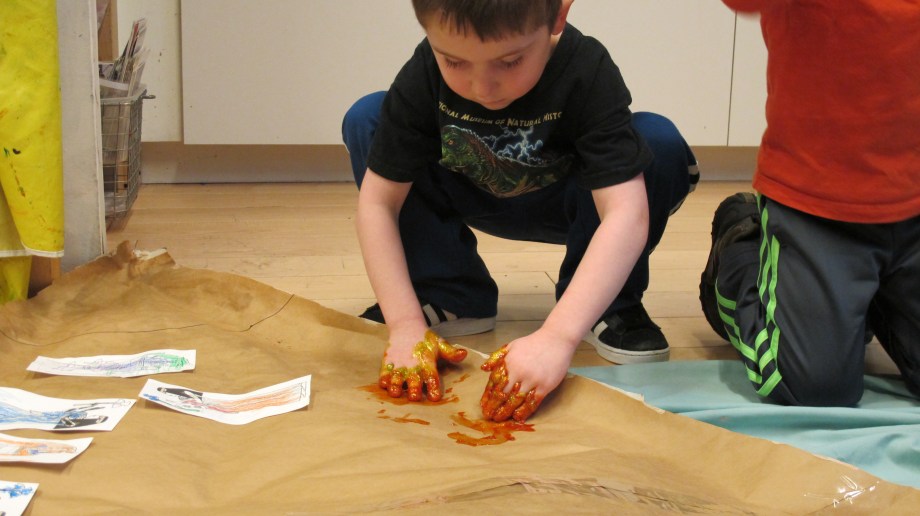 Then it was time for the groups to switch so they each had an opportunity to gather objects, and decorate the tomb walls. Will helped the children color hieroglyphs, paint with glitter paint, and add hieroglyphic stamps to the inside of the pyramid walls so that Claudia’s tomb would be colorful.

 Lastly, the class laid Claudia in the tomb and touched her mouth for the “Opening of the Mouth Ceremony” so that Claudia could live on in the afterlife. They wished her safe journey and put the final wall on their tomb.







 seecstories.com