What happened to Kindergarten?

This blog was originally posted February 18, 2016 by our former executive director Kim Kiehl. To learn more about SEEC’s kindergarten, please come to our Kindergarten Open House on Thursday, February 9, 2017 from 10:15 to 11:30. Check out our event page for more information.


When I went to Kindergarten it was the place where I learned about being in school. Nobody expected me to be reading by the time the year was over. I had music and art and recess. It was a gentle transition into school and one that made me love learning and be excited to go to school, a feeling that is still with me to this very day.

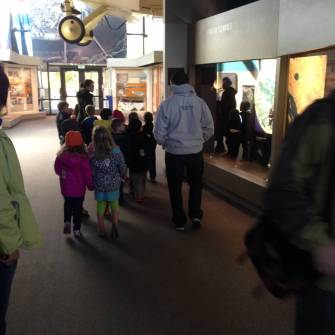
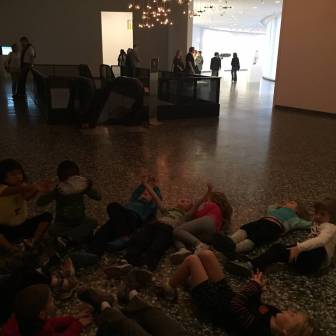
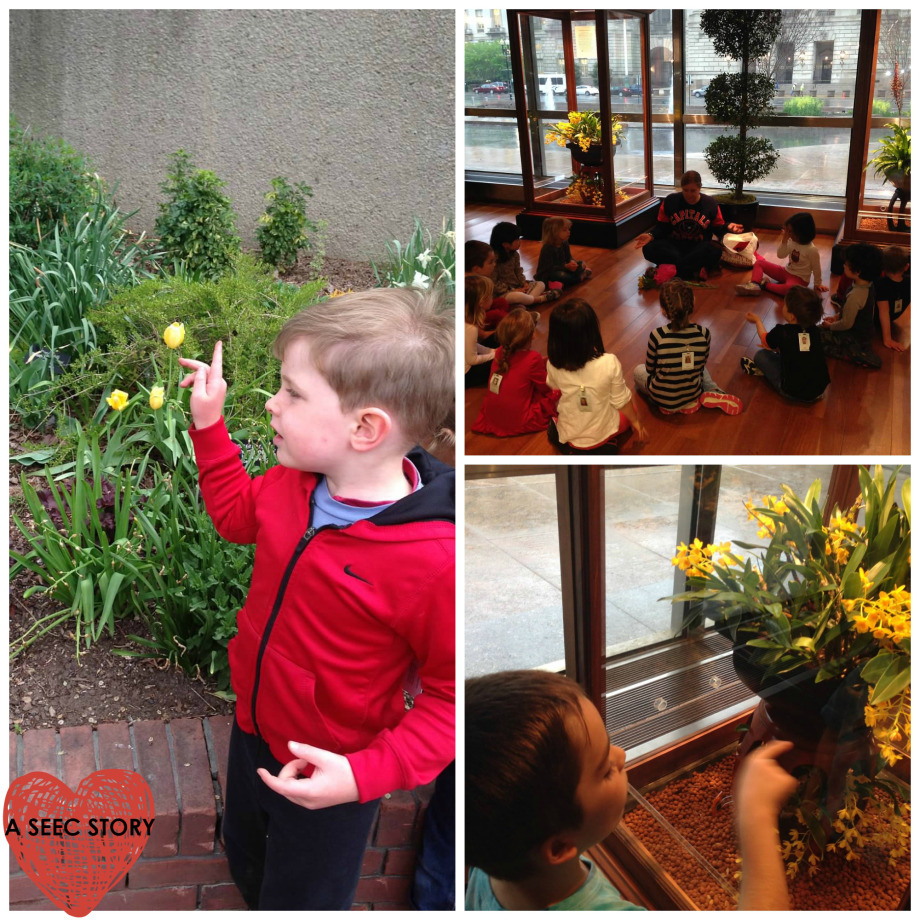
Sadly, the same is not true for many children today. For them, Kindergarten is a place of high stress and pressure. Stories and questions have been replaced with worksheets and testing. Rugs and shared round tables have been replaced by individual desks. But none of this is true in our Kindergarten at SEEC. Sure, our morning is spent learning math and reading but not in a high pressure, “you have to learn this by the end of the year” way. Instead, it is done in large circles on a rug with conversation, at shared tables with the children discussing what they are learning, and in ways that introduce concepts connected to things the children care deeply about. In the afternoon they head out on their daily trip to the museums of the Smithsonian to more deeply explore some of their ideas, to ask questions and search for answers, and to learn to look carefully at the world around them.

Let me give you and example of how this works. During the fall months our Kindergarten teachers noticed the children had a strong interest in Star Wars. For months they used that interest to teach everything from reading to appropriate behavior, from marketing strategies to the elements of a fiction story. Some of the activities that happened during these months included the following…

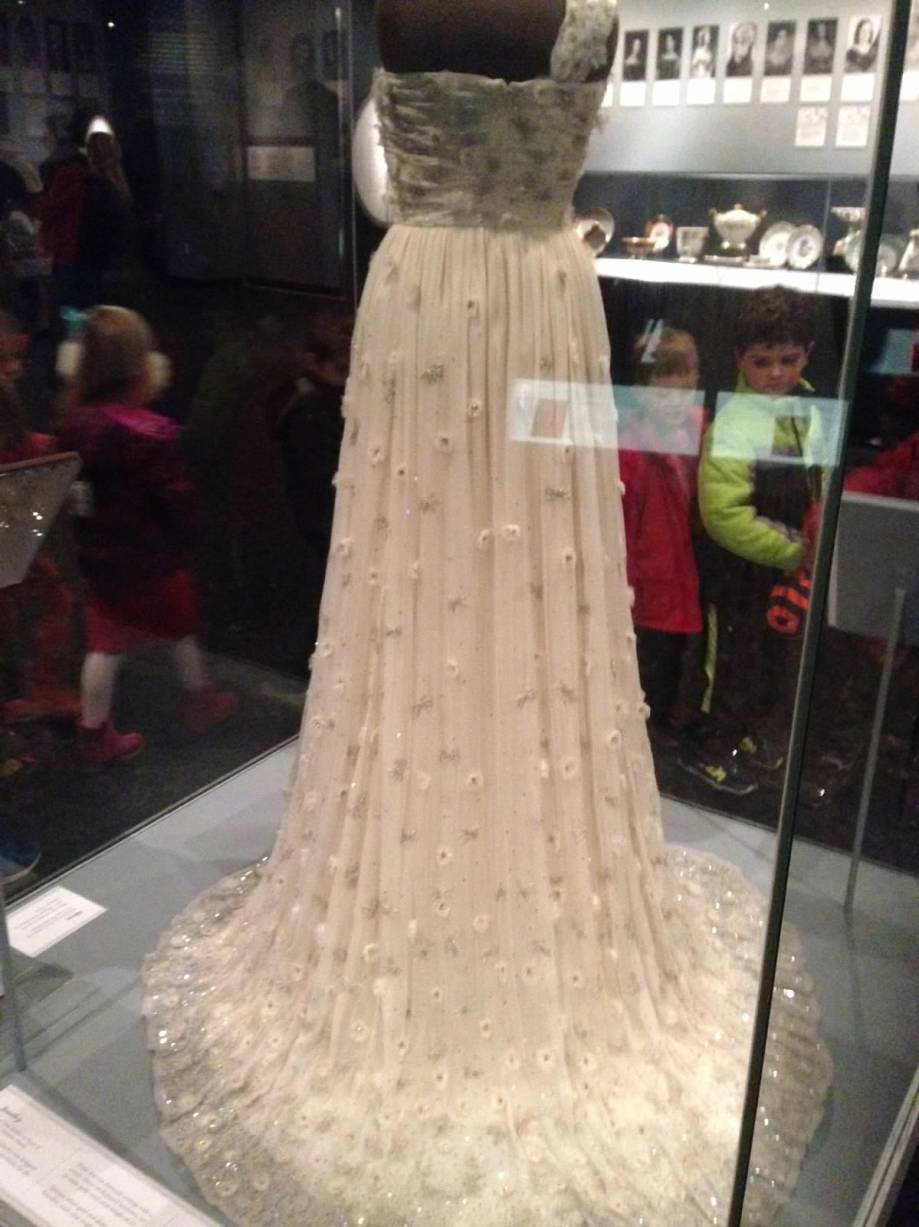
The classroom made connections between the women of Star Wars and the First Ladies of our country, exploring everything from their clothing to their characteristics. They explored the First Ladies exhibit in the National Museum of American History and through careful looking noticed that Michelle Obama’s dress looked very similar to the dress worn by Princess Leia!

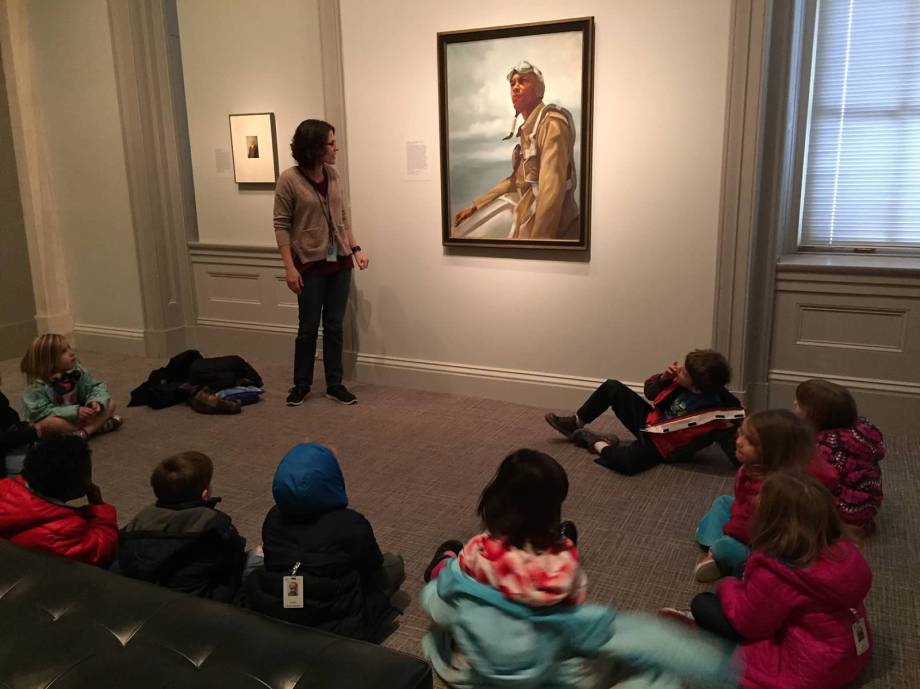
IMG_1407They talked about Luke Skywalker and then visited the National Portrait Gallery to look at a painting of William Campbell, a fighter pilot who flew more than 100 missions across three different wars. They talked about the characteristics of a hero and what makes a person brave and what courage looks like.

IMG_5570They learned math and compared their own heights to the height of C3PO, learning to measure and compare.

IMG_0527

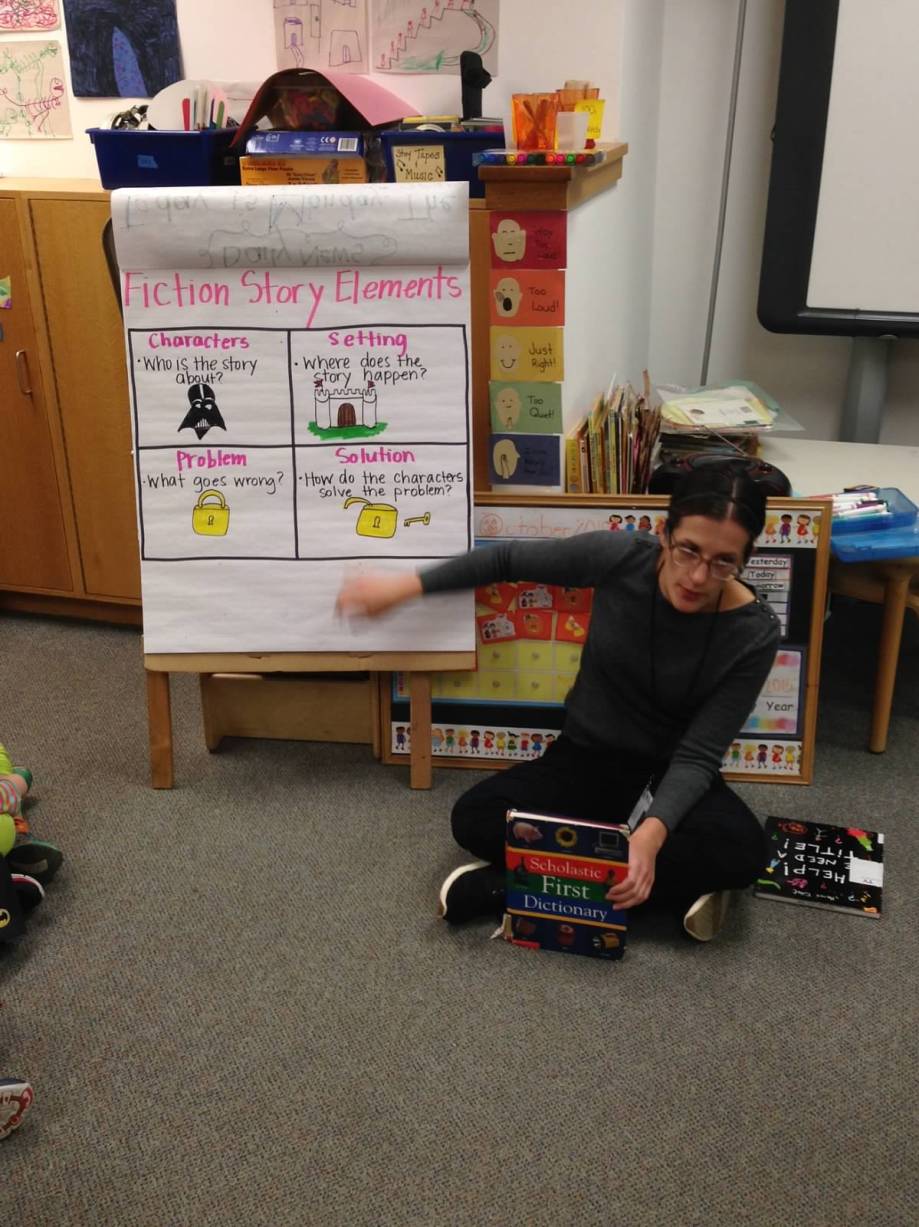
They learned about the elements found in fiction stories as they explored the Star Wars story.IMG_0529

And, of course, there was a lot of learning about space and the stars!

IMG_0533  IMG_4700

At SEEC we also believe that art and music are vital parts of the curriculum and we have playground time every day. We have a Spanish teacher who comes several times each week and a researcher from the Smithsonian who comes to teach science as well. All of this is done in ways that are engaging and fun—no high pressure, no testing. But there is a lot of conversation, a lot of questions being asked by both the teachers and the children, and a lot of curiosity. Do our children learn to read by the end of the year? Those of them who are ready to read absolutely do, the rest leave us with the skills they need to make that leap in first grade. Do they do well when they leave us for “regular” school? Absolutely. The biggest concern we hear from parents is that when their child gets to their new school they get in trouble for asking so many questions. If that’s the biggest issue that comes up we’ll take it because ultimately the best learning comes from asking questions. So we will keep encouraging questions, helping children learn to look at the world around them carefully and with great curiosity and allowing them to explore their own ideas and search for their own answers to things that interest them.  Because we believe that is what Kindergarten should be– a gentle transition into school that leaves you hungry to learn more.

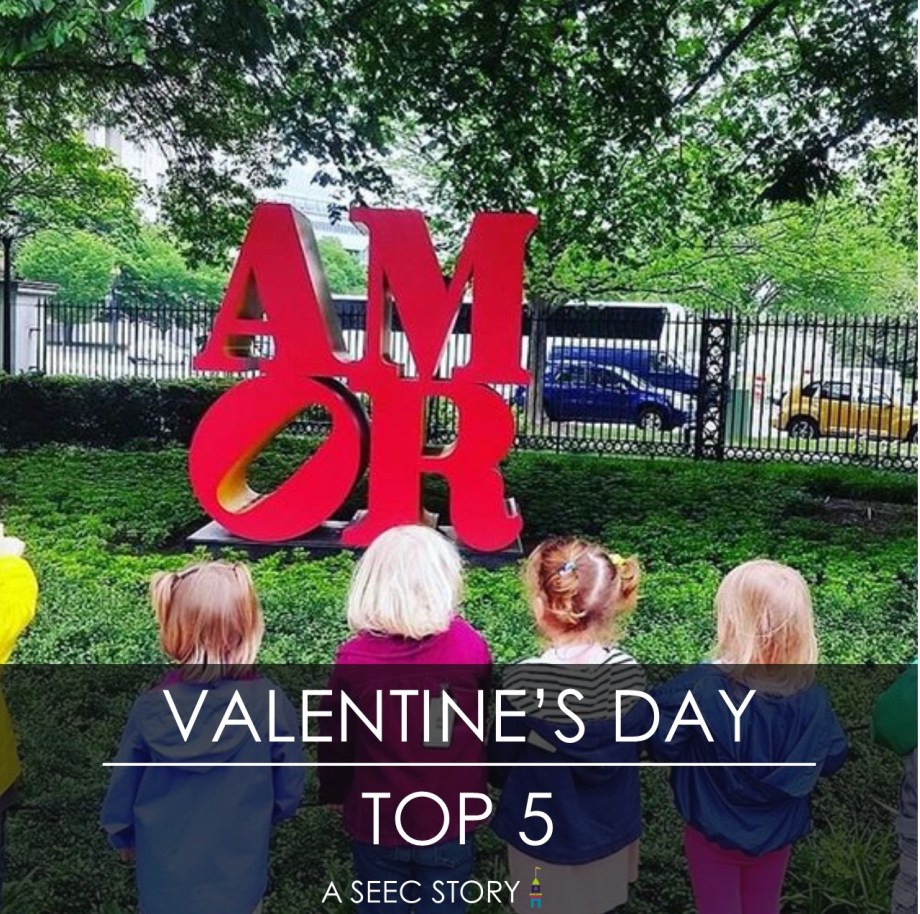
Top 5 – Valentine’s Day

Cover.jpg(Pictured Sculpture: AMOR by Robert Indiana at the National Gallery of Art Sculpture Garden.)

We’re back with a new Top 5 all about Valentine’s Day!  Of course it’s a fun day filled with  hearts, the color pink, and candy, but there’s lots of learning that can happen as well.  We’ve rounded up some fantastic ideas on how to celebrate Valentine’s Day with young children in ways that incorporate museums, science, art, movement, and more!

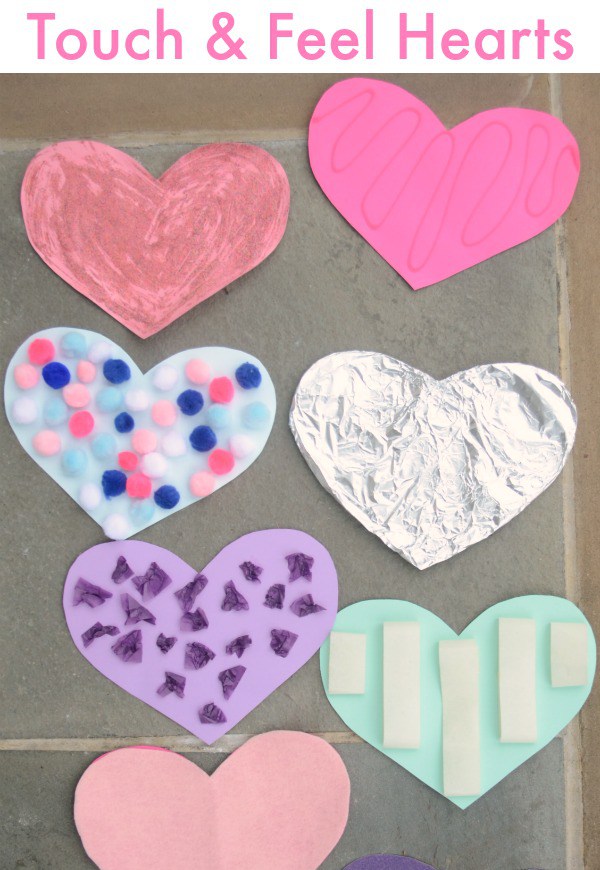
1. Touch and Feel Hearts.  These Touch and Feel Hearts from Simple Play Ideas are easy to make and there are so many different materials you can use to make a variety of textured hearts.  Infants through preschool aged children will enjoy exploring the soft, smooth, grainy, bumpy, sticky, and rough textures. We also love how they’ve paired these hearts with a book as well to incorporate literacy.

sensory-activity-hearts

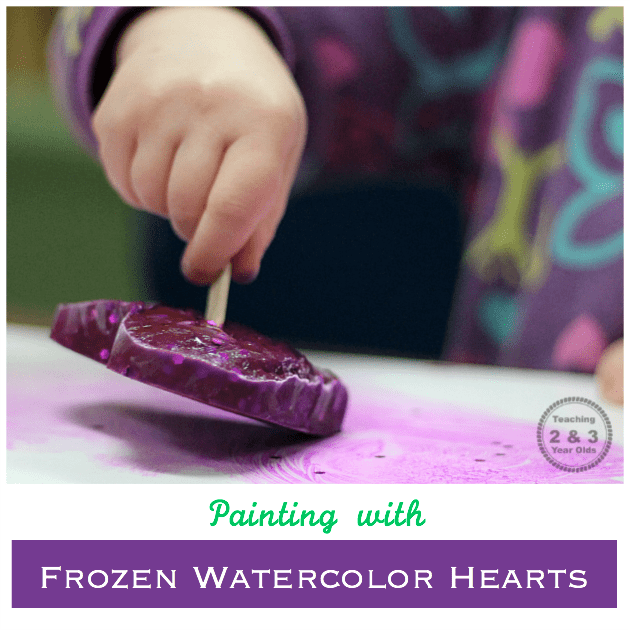
2. Painting with Frozen Watercolor Hearts. This idea from Teaching 2 and 3 Year Olds looks like a ton of fun!  These frozen heart watercolors are simple to make (you just need watercolors, Popsicle sticks, heart cookie cutters, and a freezer), and combine science and art for a unique painting experience.

Painting-with-Frozen-Watercolor-Hearts.png

3. Explore Valentine’s Day Themes in the Classroom and/or the Museums. Check out our 7 Valentine’s Day Ideas for Your Classroom blog for inspiration in ways to explore Valentine’s Day themes such as baking, the color red, communication, flowers, and hearts in the classroom, and the museums. flowers.jpg

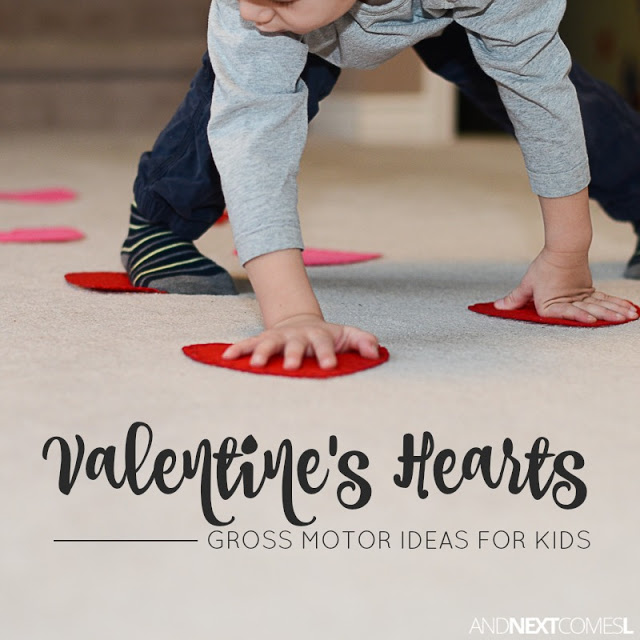
4. Valentine’s Hearts Gross Motor.  How do you make Valentine’s Day fun active?  Try out this gross motor game from And Next Comes L.  She provides lots of variations to this game to keep it exciting for young children time after time.

valentines-day-gross-motor-boredom-busters-for-kids

5. Valentine’s Day Oil and Water Science.  This activity from Little Bins for Little Hands offers great opportunities to make observations, predictions, and explore, not to mention it’s aesthetically pleasing.

Valentines-Oil-and-Water-Science-Density-Experiment-680x1020.jpg

For more Valentine’s Day ideas, visit our Pinterest board here.  You’ll find more ideas from SEEC, around the web, and additional objects within the Smithsonian museums that are perfect for visiting in relation to Valentine’s Day.  Happy Valentine’s Day everyone!

Teacher Feature: Infant Class Explores Frogs

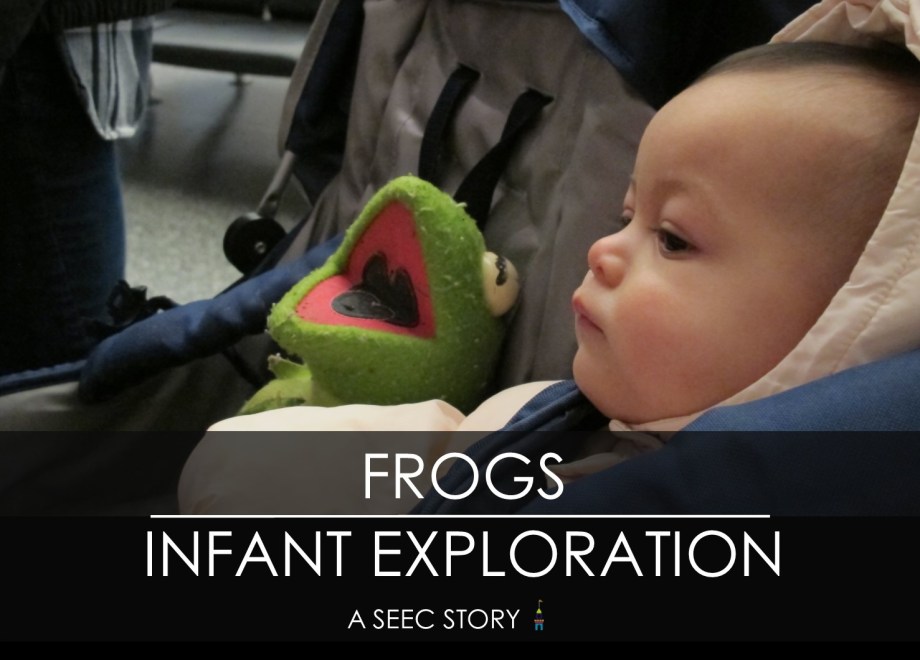
This week we are featuring a museum lesson from our infant teachers, Logan Crowley, Jill Manasco, and Rosalie Reyes. The infant class had been particularly interested in reading Brown Bear, Brown Bear, What do You See? by Bill Martin Jr. and Eric Carle. Logan, Jill, and Rosalie noticed the interest and decided to build a unit around their class’s intrinsic interests. They began by looking at the brown bear who saw the red bird who saw the yellow duck who saw the blue horse who saw the green frog. The class focused on each animal and then they moved on to the next. When they arrived at green frog, I joined the class for a lesson at the National Museum of American History. Below is a reflection from Logan, Jill, and Rosalie as well as images from the lesson. cover-image_frogs

 Here are some images from their lesson:

seecstories-com

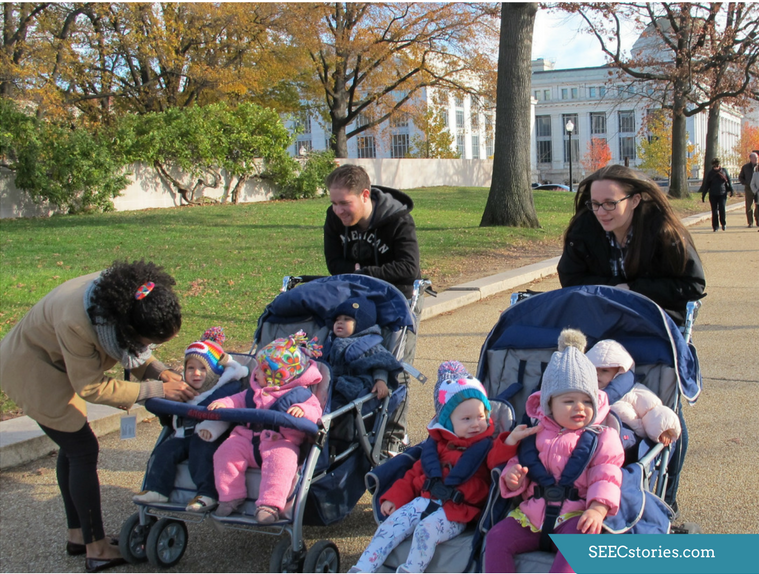
Sometimes getting the class to the museum is one of the most challenging aspects of the trip. The class made frequent stops to check in with the children and make sure that they were physically comfortable as well as mentally stimulated. See the teachers reflections below for more.

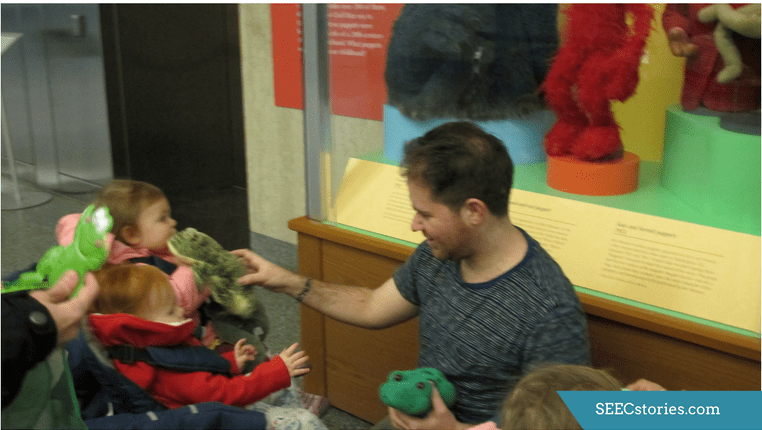
seecstories-com-1Since Kermit the Frog was displayed at a height where adults were able to view it easily, the infant teachers picked the children up and held them closer to the Kermit the Frog.

seecstories-com-2

While holding a child up, Rosalie was able to engage the child by pointing and paying close attention to the child’s nonverbal ques. She watched the child’s facial expressions and was aware of where the child’s eyes were looking.

seecstories-com-3

The class was not able to touch the Kermit the Frog on display. Luckily, Jill was able to bring in her childhood version of Kermit. Touching Jill’s childhood Kermit played an important role in the lesson, since touch plays such a crucial role in brain development.

seecstories-com-4

The class had other examples of frogs to compare to Kermit the Frog including puppets, rubber frogs, green scarves, and musical frogs.

seecstories-com-5The infants were able to touch and explore all the tangible examples of frogs that their teachers brought with them.

A reflection from Logan, Jill, and Rosalie:

What were your topics of exploration? Why did you choose them? Where did they come from?

We had noticed that our infants really loved to read the book Brown Bear, Brown Bear, What Do You See? by Bill Martin Jr. and Eric Carle, so we decided to do a unit on it, focusing on the different types of animals featured in the book. We had already learned about several animals in the book and during this week we focused on the frog.

Why and how did you choose the visit?

I was scouring the websites of nearby museums for ideas and noticed that the National Museum of American History has a Puppets and Muppets display that included the original Kermit the frog puppet. As it so happened, Jill had a stuffed version of Kermit from her childhood at home and so we decided she would bring in her Kermit and we would head over to see the original Kermit in all his glory.

 What were your learning objectives? (What did you want your children to take away from the lesson?)

With infants, museum visits tend to be a short and focused experience. While older children may be ready to spend more time talking about the history of Kermit or the detailed characteristics of real frogs, infants take in and process information differently. With this in mind, our main objective was to introduce Kermit the frog to our infants and then to help them make connections between Kermit and the frogs that they’d been learning about in the classroom. The more that infants are exposed to, the more points of reference they will have, so they will begin to understand that there are many different types of frogs. This is how a baby begins to make sense of the world around them. It gives them the ability to think flexibly, which is an essential skill for future success in school.

 What was most successful about your lesson? How did the lesson reach your objectives to expand the topic? What was successful in terms of your preparation and logistics?

Since our main goal was to help our infants make a connection between Kermit (a fictional frog) and real-life frogs, we brought along not only a stuffed Kermit, but a variety of examples of frogs. The examples varied from very realistic (photographs of real frogs), semi-realistic (stuffed frogs), to more cartoonish depictions of frogs. We also had a video of Kermit the frog singing “The Rainbow Connection” for the children to watch, noting as they watched that he was sitting in a swamp, an environment where frogs are often found. The children remained largely engaged throughout the lesson and showed a great deal of interest in the various objects and in the Puppets and Muppets display.

Having all three teachers interacting with the children and showing them objects can feel a little chaotic in the moment, but these one-on-one interactions are key to keeping the children engaged and enjoying the experience. We spend a lot of time in the classroom building relationships with the children and establishing trust. These relationships are instrumental for meaningful learning to take place and we find they are key to successful museum experiences for our children. Our relationships with them help us to pick destinations that we know will engage them and also help us to connect with the children as we visit and explore what we see.

 What could you have done differently to better achieve your objectives and expand the topic? What was challenging regarding logistics? What recommendations would you have for another teacher trying out this lesson?

The most challenging logistic in any museum visit with our infants is simply getting out the door. Between making sure that the class has clean diapers, is fed, has had their bottles, and has napped, it can be tricky just finding a time to make it out. But we know how important it is for our children to explore, get some fresh air, and see the museums, so we make it work. The other major challenge is that infants attention is easily diverted so visits are typically short and sweet. I would recommend bringing tangible objects for infants to explore that will hold their attention. Most of all, when doing any sort of lesson with infants, the main thing is to be flexible and to be open to changing your plans if you find something doesn’t work. I constantly remind myself that the most important part is that the children have a positive experience and that as long as I can make that happen, it’s okay if a lesson doesn’t turn out exactly like I envisioned. I think the main takeaway is to have fun with it. If you are enjoying yourself and focusing on making a connection, the children will almost certainly enjoy themselves too.


The class continued to looked at frogs for the rest of the week. They explored many green objects and played in water to gain a better understanding of the habitat of frogs. When the class felt ready to move on from frogs, they continued learning about Brown Bear, Brown Bear, What do you See? by exploring colors and color mixing. Be on the lookout for our Roundup on the unit Brown Bear, Brown Bear, What do you See? 

Teacher Feature: Four Year Old Classroom Explores Questions

This Teacher Feature was originally posted November 5, 2015, and provides a great example of how question asking can be a powerful tool for young children’s learning.  Want to learn more about question asking techniques?  Join us for The Art of Asking Questions Webinar on February 8!


It’s Teacher Feature Thursday!

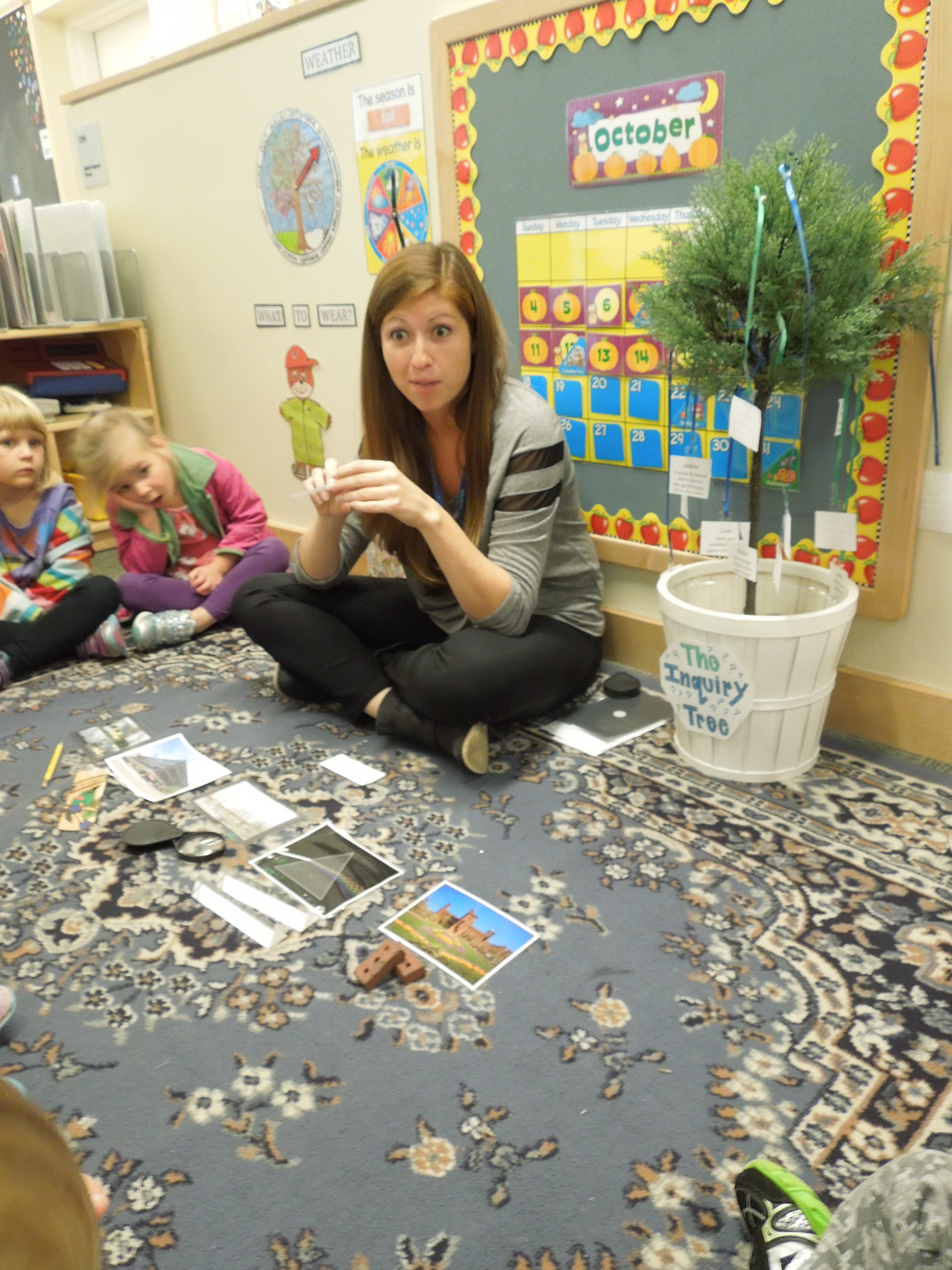
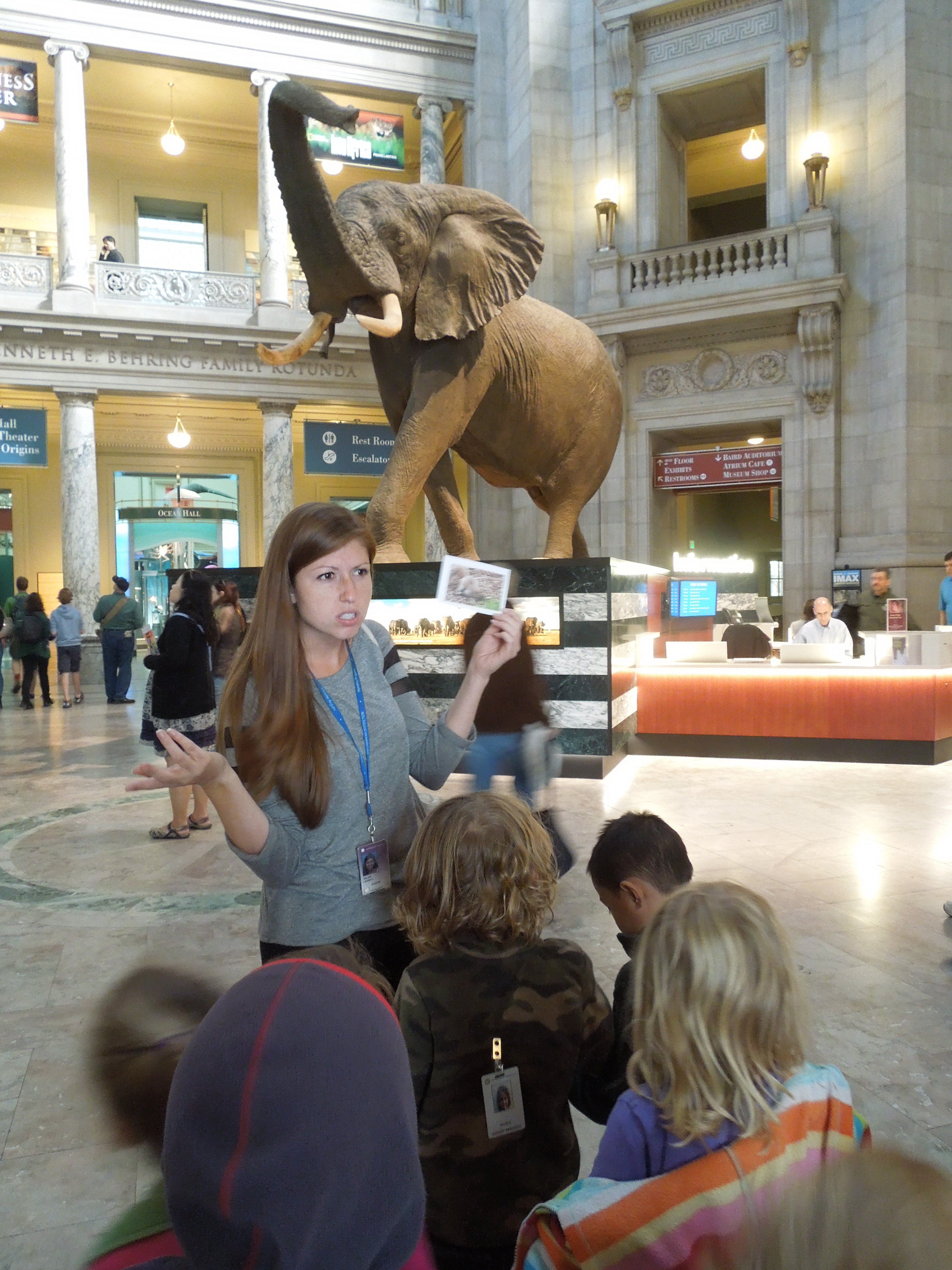
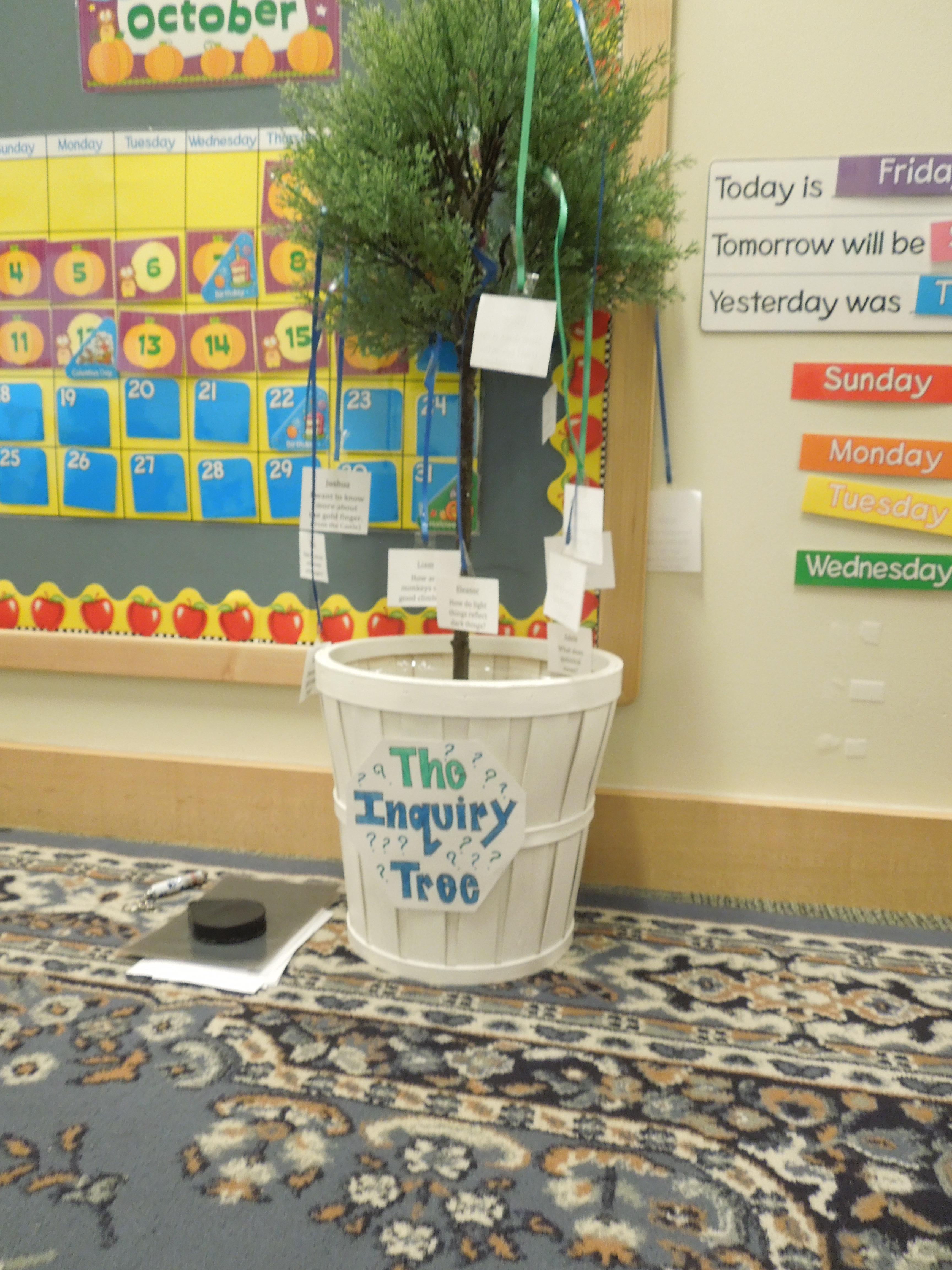
This week we are featuring Jessie Miller and Will Kuehnle in the Honey Bear classroom. This class of four year olds began the year with a unit on inquiry and question asking.  Will and Jessie used this unit as a way to introduce the museums and their vast collections and also get to know their children and gauge their interests. As they visited the different institutions around the National Mall, Will and Jessie carefully recorded their questions and hung them on their class “Inquiry Tree” as a creative display. They noticed a lot of the questions could be answered by visiting the Natural History Museum collection and could be connected through the theme of digging. Will and Jessie collaborated to develop their next unit. I was able to join their class as Jessie led the group through Natural History and gave them hints about what they would study next.  Below you will find a reflection from Jessie and images from her lesson.

HB Cover

Teacher Feature

What were your topics of exploration? Why did you choose them? Where did they come from?

The Honey Bears had two weeks focused on inquiry and curiosity. We began with a lesson about what a question is and how we can use questions to express what we want to know more about. We created an “inquiry tree” in the classroom where the children could hang their questions and we revisited them throughout the weeks. The Honey Bears used their new found curiosity to explore places such as the Botanic Gardens, the Martin Luther King Jr. Memorial Library, the National Gallery of Art’s Sculpture Garden, and the National Museum of Natural History.

Why and how did you choose the visit?

As the Honey Bears conducted observations and gathered questions about the topics they wanted to know more about, Will and I determined what areas held most of their interests. This led us to the Natural History Museum where we went on a scavenger hunt looking for clues that would lead us to our next unit of study. Many of the children’s questions over the weeks had to do with things like dinosaurs, jewels and gold, bones, rocks, and other topics related to digging. The picture clues we used on our scavenger hunt led us to different exhibits in Natural History where we could explore these things and introduce the next thematic unit of “Can you dig it?” to the Honey Bears.

What were your learning objectives? (What did you want your children to take away from the lesson?)

I wanted this lesson to be a culmination of the inquiry weeks. It would be a way to review everything we had learned about how to ask questions and touch on some of the questions we had shared over the weeks. I wanted the Honey Bears to be free to explore the different exhibits at Natural History related to our next unit and come up with new questions. I wanted the children to see how their curiosity and questions control where our themes go.

What was most successful about your lesson?  How did the lesson reach your objectives to expand the topic? What was successful in terms of your preparation and logistics?

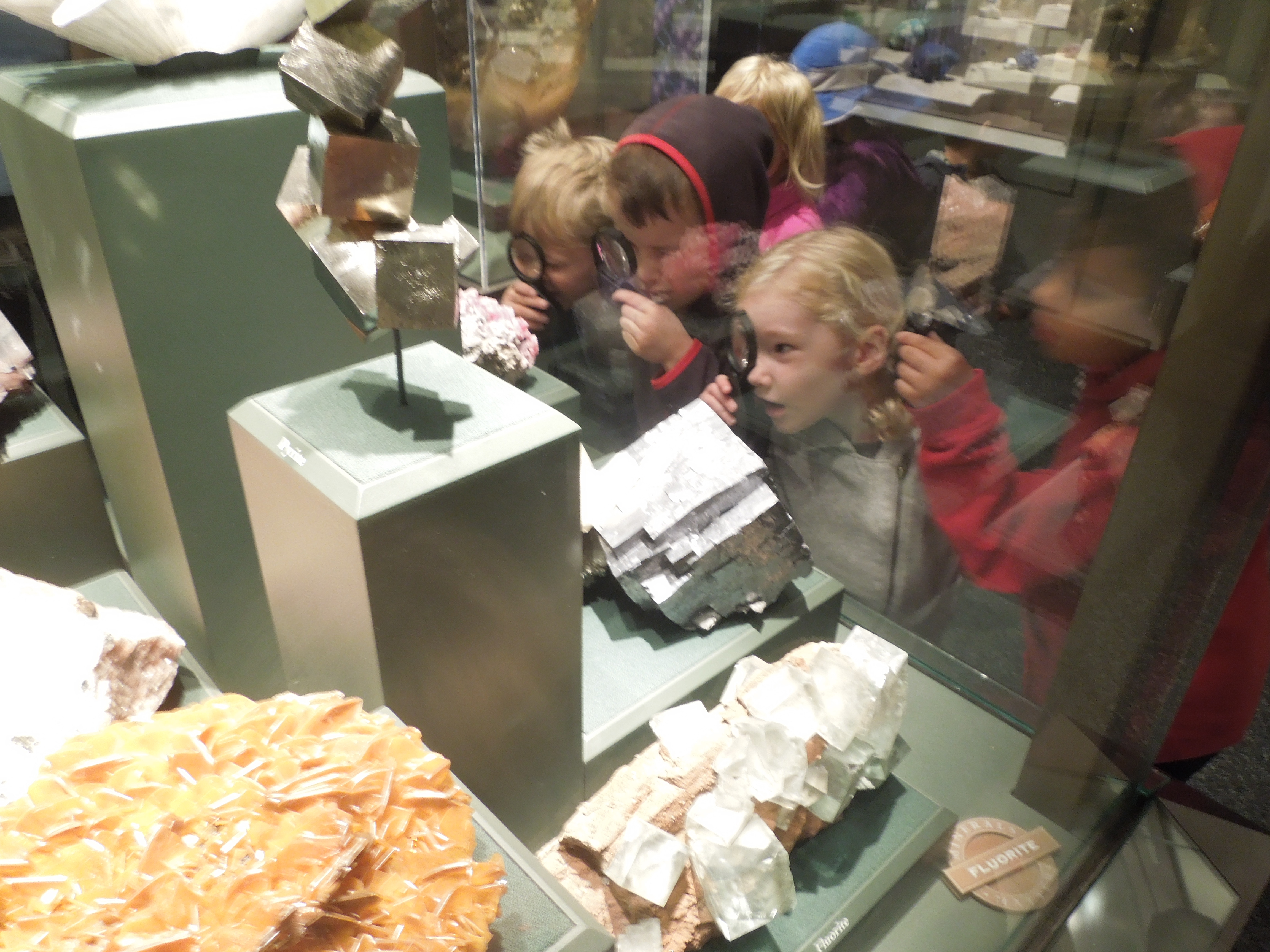
Most of the Honey Bears have been to the Natural History Museum many times before. However, by giving them magnifying glasses to hold and picture clues to follow, it gave them a different way of exploring the exhibits. They had to use the picture clues to really think about where we were going next and it added an extra layer of excitement to our exploration. In preparation for the lesson, I sifted through all of the Honey Bears questions and comments to determine where their main interests were. As I ventured through Natural History with the children, I brought up some of their previous questions to spark their curiosity and reflect on their previous experiences.

What could you have done differently to better achieve your objectives and expand the topic? What was challenging regarding logistics? What recommendations would you have for another teacher trying out this lesson?

I think the experience could have gone more smoothly if we had gone to the museum at a quieter time of day, perhaps before it opened so there was less of a crowd. I also felt like I was having good conversations with the children close to me in the front of our train but it was harder for me to communicate with the children in the caboose of the train. We were moving from place to place and there were a lot of people around so next time I would prefer to get there early and have specific spots to stop at so we could all share and discuss our thoughts and questions with the group as a whole.

Here are a few images from their unit on questions:


DSCN3825Jessie began the lesson by reminding the children of the different museums they visited around the mall. Will and Jessie used a token object to remind the children of the Museum collection and asked the children to reflect on their visits.   

DSCN3813Jessie then reminded the children that they had asked a number of really great questions and read some of the questions off of The Inquiry Tree that related to the Museum of Natural History. She explained that a lot of the questions they had could be answered at Natural History so today they were going to go on a hunt for answers at the museum.
DSCN3839Jessie created a modified “scavenger hunt” using images that connected to the children’s digging questions and to different exhibits in the Natural History Museum. She began the visit by  showing the children an image of a squirrel digging in the dirt. Jessie asked the group where they might learn more about her image. The group enthusiastically replied “Mammal Hall!”

DSCN3856After locating their squirrel and looking at the other digging mammals,  Jessie revealed the next image, a crown! The group discussed the different locations in the museums where they might find a crown and the materials that they are made of. The children decided to go up to the Gems and Mineral Hall to investigate.

DSCN3864The students did some close looking with the magnify glasses and found crowns, gold and uncut gems.

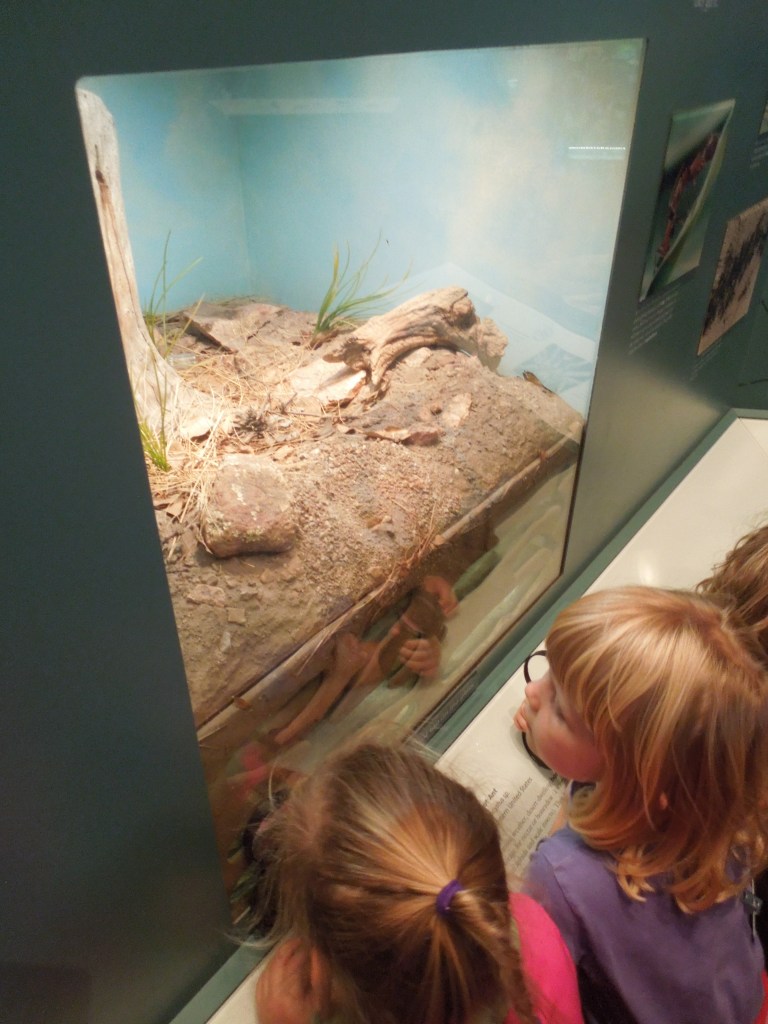
DSCN3895Their next clue took them to the Live Insect Zoo to see insect digging in action.

DSCN3919Their final stop was  to the Last American Dinosaur Exhibit to learn about paleontologists and what they are able to dig up. One of the paleontologists came out and talked to the children about his job and brought out a real fossil for the children to examine.

DSCN3939The students all took turns looking very closely at the fossil.

During the next week Will and Jessie formally introduced the class to their new theme: “Can you dig it?” They will be spending a few weeks doing in depth explorations in digging tunnels, archaeologists, and so much more! Check out our Facebook, Twitter, Instagram, and Pinterest for more ideas from their unit on inquiry and digging! See you in two weeks with our next Teacher Feature!

10 Things You Can Do Right Now on the Metro

3

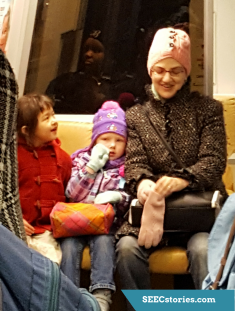
Finding things to entertain you and your child on public transportation can be daunting. Try out some of these activities now or on your next commute!

  1. 2Count: There are innumerable categories of things to count on public transportation. You could start by counting the number of doors, windows, or chairs and then ask your child what they would like to count next. If you are on a bus or if the Metro goes above ground, you can also include those objects you can see outside the train.
  2. Seek for Shapes: Just like counting, there are a large variety of shapes to discover on public transportation. Start by selecting a shape to look for and see how many different places it can be discovered.
  3. Check yourself out!: Often the train will speed through tunnel after tunnel. Use this time to make some faces at each other. Choose an emotion to portray and talk about how you and your child’s expressions are different or similar.
  4. Play Mystery Object: If you’re with your child, chances are that you have a big bag of stuff! Have your child reach their hand into your bag and pick up an object but not pull it out of the bag. Ask them to describe it (smooth, cold, small, etc.) and try guessing what the object might be.
  5. Look for Letters: Practice pre-literacy by looking for letters in all the signage (at least those ads are good for something!)
  6. Explore Newton’s First Law of Motion: Ok, at first glance this seems out of your seecstories-com-13child’s league but really this is an easy concept to take on! Newton’s First Law of Motion is that an object in motion will stay in motion until affected by an external force. This is why you lean forward when the train car comes to a stop. Your child probably has already started exploring this when they want to stand and “surf” on the train. A safe and easy way to explore this concept to sit on the edge of your seat leaning away from the back of the chair. You and your child will feel the pull forward as the train comes to a stop!
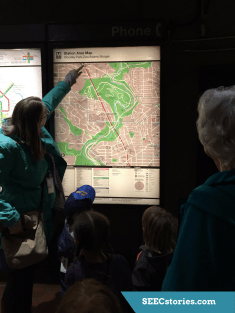
  7. Give Directions: Sit near the map of the Metro system on the train (or use a pocket version) and take turns giving directions to different stops. Select a stop and have your child tell you which color line the stop is on or if you want to get really tricky, see if they can figure out the transfer station. This will develop their visual literacy and knowledge of their surroundings – this can help keep them safe in case you were ever separated.
  8. Read or Draw on a Newspaper: Pick up a free seecstories-com-14paper and share some of the appropriate stories with your child. If you have a pen you could also use it as a doodle-pad for you and your child.
  9. Play What’s That Noise?: Public transportation is full of sounds. Use this time as a way to practice listening. Pick a sound (something that is isolated: a loud speaker announcement, a shoe tapping, a door opening, etc.) and have your child try to identify it by pointing and describing.4
  10. Time something: Children loved to be timed. Use a watch, smartphone, or count to measure how long it takes you or your child to do something. This could be something as simple as taking gloves off, tying a shoe, or, if you are traveling at off peak times, getting from one end of the train car to the other (only if this can be done safely).

How did it go? Share your thoughts about these activities and suggest others below!

Museum Round Up

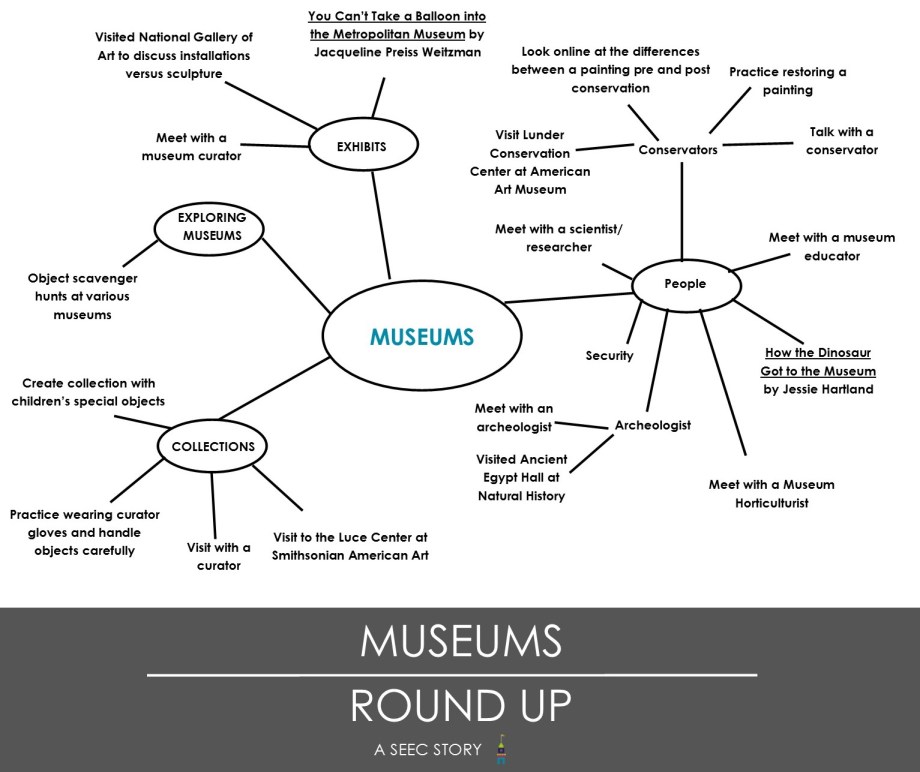
Last week we brought you a Teacher Feature from our kindergarten class where they learned about art conservation.  This lesson was part of a larger unit on museums in which the class learned what museums are, who works in them, and how they run.  The web below displays the aspects of museums the class, led by Cathryn Prudencio and Silvana Oderisi, learned about during this unit to gain a better understanding and appreciation for all the people and work that goes into the museums that the students visit daily.  Following the web are photos highlighting some of their experiences from the unit.

museumrolesweb

Collections

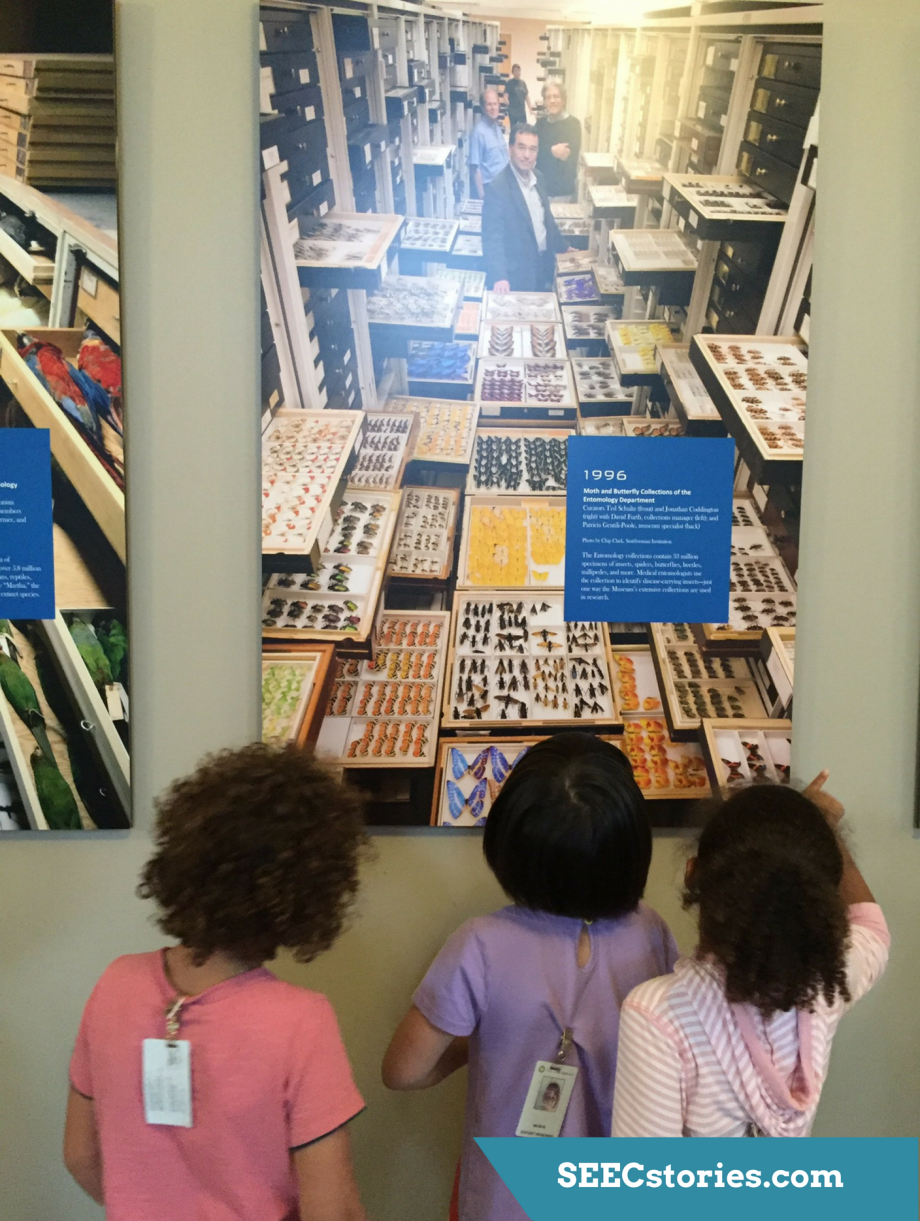
1After exploring many of the museums on the National Mall, the class focused their attention on collections.  They visited the third floor of the National Museum of Natural History to look at photographs of collections housed in the Museum.  The class learned how collections are used for educational purposes as well as, research.

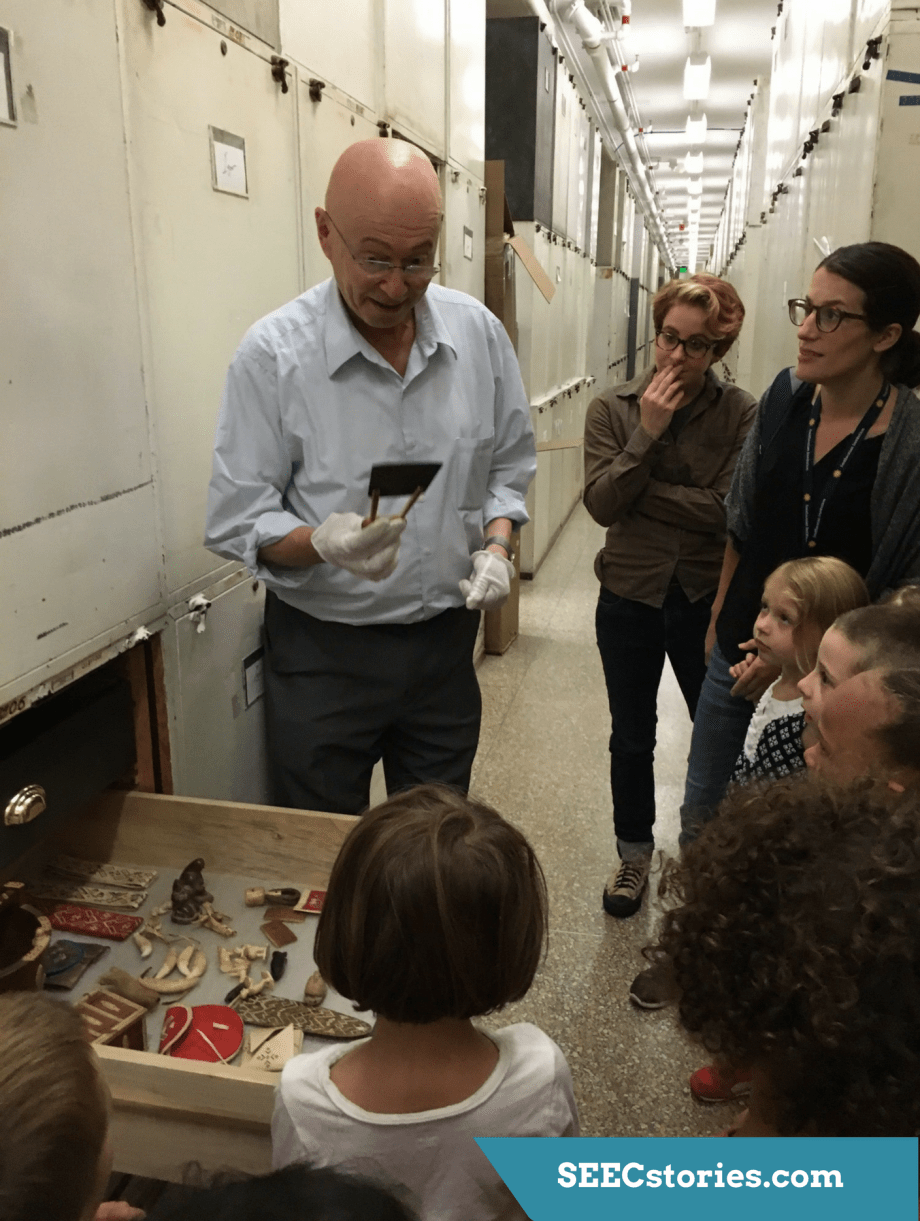
2The kindergartners were in for a surprise when Igor Krupnik, a curator from Anthropology Department happened to walk by, and invited them to view his collection from Greenland.  The children were able to see firsthand how the objects in a collection are stored safely while not on display.  He also talked about how some of  the objects are used by people.  He is holding  a woman’s knife called an ulu, which is used to scrape animal skins and cut food.

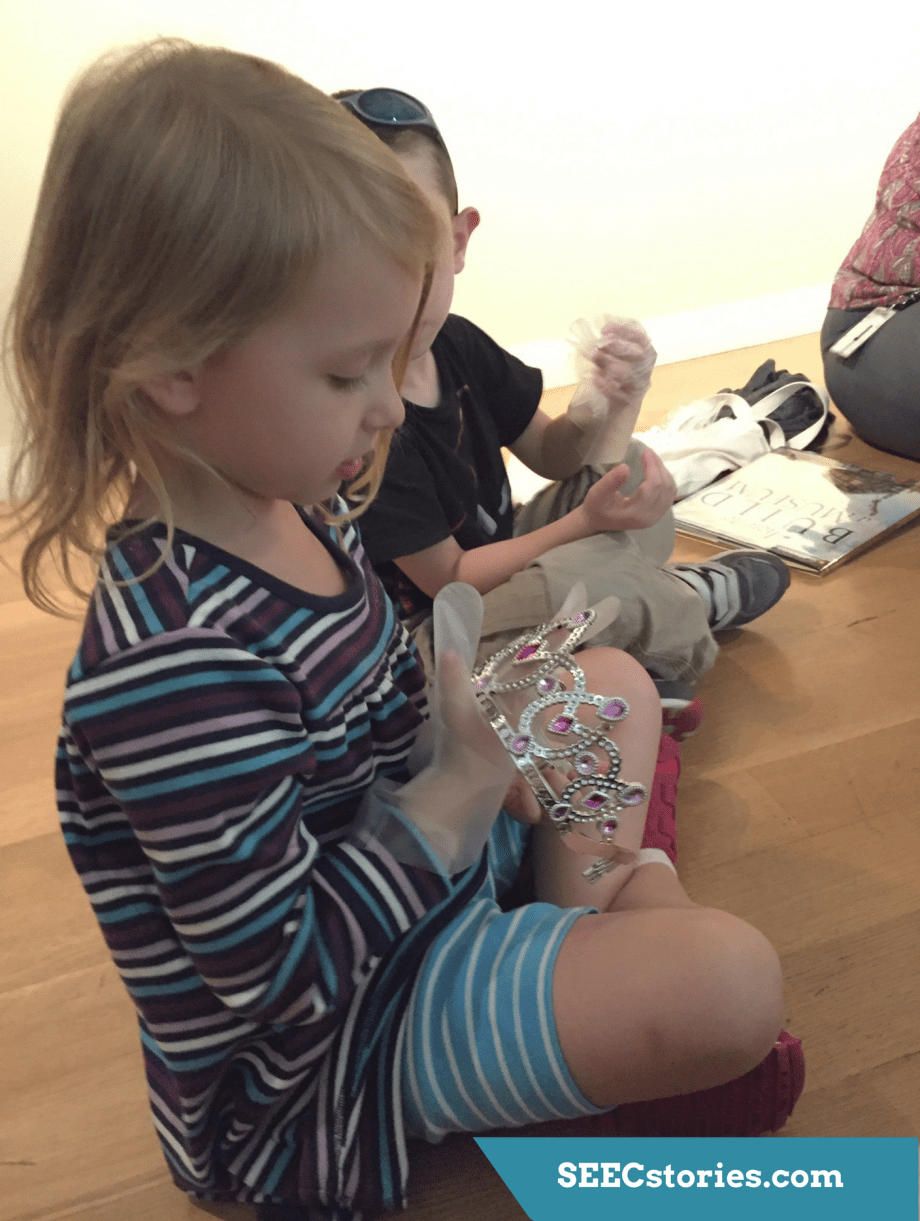
5.pngTo further understand collections, the class worked in teams and sorted a variety of objects into categories.  As they touched the objects they wore gloves and handled them gently, reminding them that objects in a museum’s collection need to be protected and preserved so people can view them for years to come.

Exhibits

Now that the class understood the concept of collections, they began to explore how the are displayed in exhibits.1The class met with Tim Winkle, a museum curator at the National Museum of American History.  Mr. Winkle explained that he is in charge of the firefighting collection, and walked the class through an exhibit he curated: Always Ready: Fighting Fire in the 19th Century.  Winkle offered a glimpse into how exhibits are created by explaining how and why he chose each object. He also discussed how he collaborated with the exhibit designer to create the finished product.


People

During the unit, the class met with many people who work in museums, all performing very different jobs, but all vital to the museum running smoothly.4Ann Caspari, a museum educator at the National Air and Space Museum, and former SEEC teacher, met with the class to talk about what museum educators do.  She explained how she meets with many children from around the area and teaches them about flight and space through stories, objects, and hands-on activities.  They even got to participate in one of these activities – the children made their own air crafts and tested them in a wind tunnel, modifying them if need be.

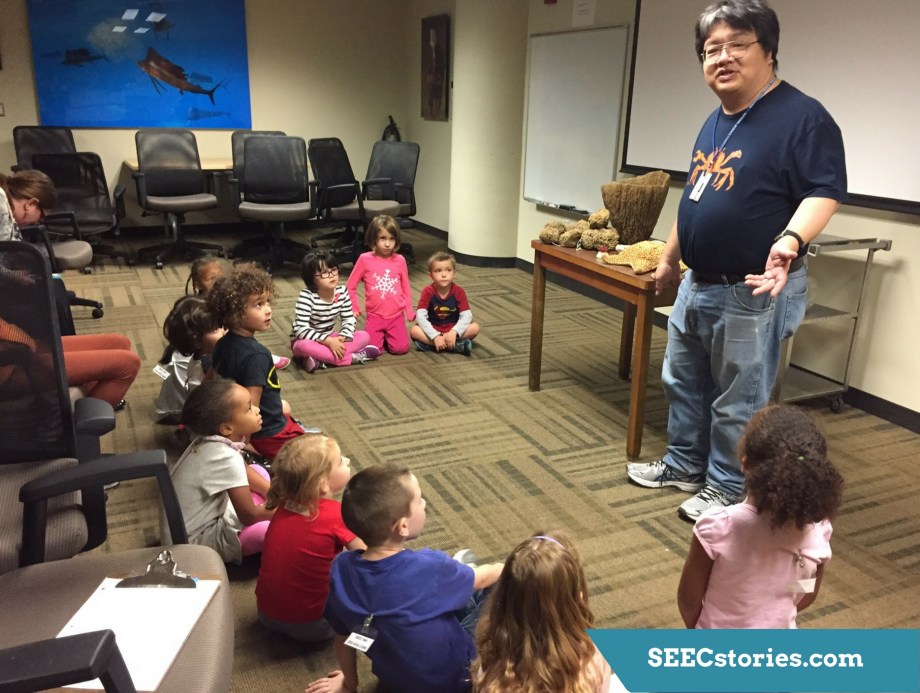
4The children met with Chris Mah, a marine biologist who studies at the National Museum of Natural History. He shared invertebrate specimens with the children and explained how scientists use questions to classify objects. Two important questions to his work are about shape and symmetry.

2The class also met with Alexander Nagel, an archaeologist who worked in Persepolis in Iran.  He showed the children how he restores objects back to their original colors, and took them through the Eternal Life in Ancient Egypt exhibit at the National Museum of Natural History to find artifacts that have been restored to look how they did when they were originally created.

We hope you enjoyed getting a bigger picture of our Kindergarten class’ unit on Museums! We’ll see you soon with our next Teacher Feature.

Teacher Feature: Kindergarten Explores Art Conservation

It’s Teacher Feature Thursday!

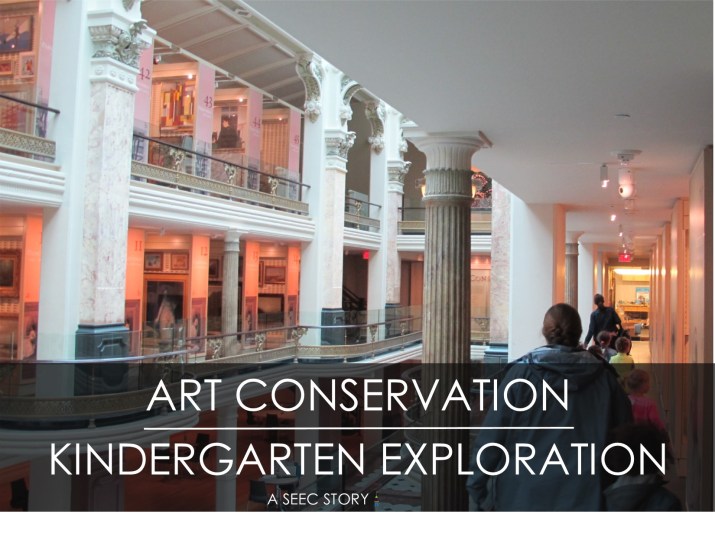
This week we are featuring Silvana Oderisi and Cathryn Prudencio of our Kindergarten classroom.  To begin their school year Silvana and Cathryn wanted to provide the children with a foundation of what museums are, who works in them, and how they run.  To do this they met with many people who hold very different roles, but who are all responsible for ensuring the Smithsonian museums run smoothly, and that the objects in the collections are cared for. I joined their class for a lesson on Art Conservation. Below you will find a reflection from Silvana and Cathryn, and images from the lesson.
Cover.jpg

A reflection from Silvana and Cathryn:

In the beginning of the school year, our kindergarten class explored museums as a topic. Our purpose of this unit was to really delve into what happens behind the scenes of the museums that we visit on a daily basis, so that we can understand all of the work that goes into the different exhibits, installations, and artwork on display.  After spending some time exploring what collections, exhibits and installations are, we decided to learn about the people who take care of the objects that go into these museum spaces, one being art conservators. We visited the Lunder Conservation Center at the Smithsonian American Art Museum to talk about what the conservators do in the Paintings Lab (restoring the structure of a painting by examining the damage, fixing tears, cracks, and the like) and the Paintings Studio (cleaning and in-painting to fill in the missing parts of the painting to match the surrounding areas), as well as the tools they use to accomplish those tasks (magnifying visors, cotton swab, brushes, heated micro-spatula, etc.). This lesson did require a great amount of research on their website, which described what they do in each portion of the Lunder Conservation Center.

The Lunder Conservation Center website and the facility itself, both proved very useful in creating a rich understanding of art conservation for the children.  The website includes videos with interviews of actual conservators and examples of paintings that had undergone the conservation process, and these helped demonstrate for the children the changes that conservators make in a painting, and why.  After viewing and discussing the videos, our class was able to walk around the Center, which has glass walls so you are able to see conservators hard at work- researching, painting, and restoring, which was very exciting.  This lesson was a great way of making concrete connections between science and the arts. Another successful part of the lesson, was allowing the children a hands-on experience in restoring their own painting.  The children were very excited and invested in going back to our playground to become conservators and “fix” a painting we had bought at a thrift store.

An area of the lesson that we will rethink if we do it again, is the amount of time the kids were sitting watching the videos and listening to an explanation of the work conservators do.  We sat for a long time, and some of the children were getting fidgety, however, we were very lucky to have an actual conservator walk up to us and show some of his tools, which refocused our attention. If we were to do this lesson again, we would make the lesson more effective by starting with the videos and pictures as an introduction, then go for a walk through the Center, and conclude with a debrief of what we saw, discussing the importance and significance of the work they do. Another area of the lesson we might rethink is the amount of materials that we wanted to use. We had a computer, a bag with the materials and “tools” for conserving our own painting, a book with some information of a restored painting at the National Gallery of Art, and an anchor chart. Because we had so many materials,  we ended up accidentally leaving the anchor chart in the classroom.  We believe the anchor chart is a valuable visual, and perhaps we would not have left it behind if we had organized the materials better or been more mindful about which we really needed.  One last recommendation we have for this lesson, is to ensure there is some sort of context for a lesson like this- we really believe one of the reasons the children were so excited to learn about the job of a conservator was because they had a firm grasp on the concept of objects in a museum. Art conservation would definitely not be something to teach without context because then it might fall flat.

This lesson was really fun for us as educators as well, because it helped us to better understand all of the work that goes into putting the different pieces of artwork on display in the museums- from the paintings and even to the frames! All in all, we were very surprised by how enthusiastic the children were about the topic. What might seem like a dull topic (even to some adults) was completely absorbed and taken in by the children and they really enjoyed it! After this lesson we continued to learn more about the people who work behind the scenes in museums like archaeologists that restore artifacts at Natural History, scientists who research animals at Natural History, security officers, horticulturists, and more!

Here are a few images from their lesson on Art Conservation:9To learn about art conservation the class visited the Luce Conservation Center, a visible art storage and study center located within the Smithsonian American Art Museum. With the view of conservation labs, it was the perfect place to visit to learn about art conservation.
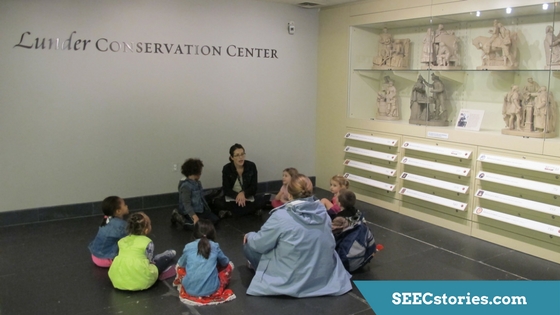
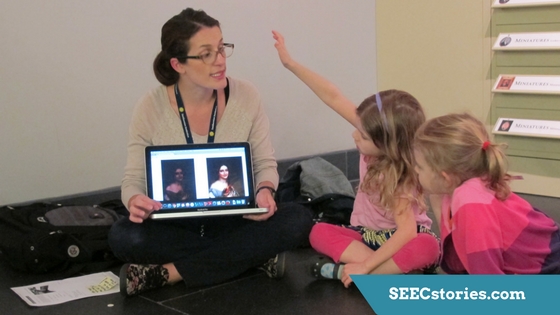
7To begin the conversation, Silvana pulled up two photos of Charles Bird King’s Miss Satterlee– a before and after of the painting’s restoration work.  Silvana asked the class to look at the first photo and explained that the photo shows how the painting looked when the museum received it.  She asked if they could tell what the painting showed, and the children said they had a hard time seeing what it is, and that it looked like it was from a long time ago.  Then they looked at the second photo and noticed that it looked much clearer.  Silvana explained that the second photo was of the painting after an art conservator restored it – to make the painting look like it did when it was first painted.
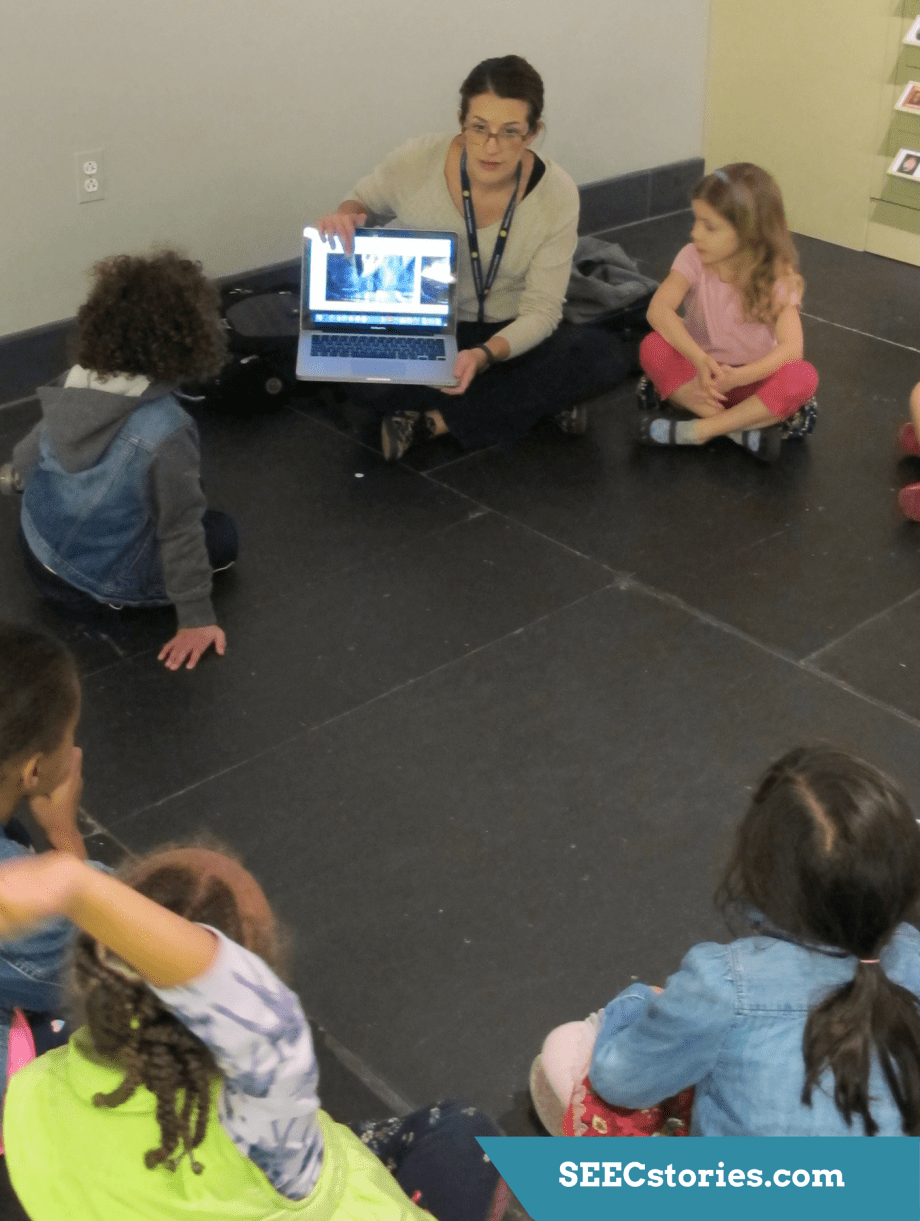
SEECstories.com (11).pngSilvana explained that painting restoration is done in two different places – the Paintings Lab, and the Paintings Studio.  While looking at photos and viewing examples of conservator’s work from the Lunder Conservation Center website, the children learned that the Paintings Lab is where  structural damage, tears, flaking paint, and ripples in the canvas are repaired, while the Paintings Studio cleans and restores areas of lost paint.
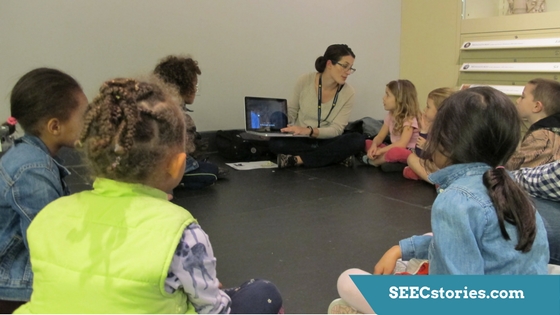
8 Lastly, Silvana used her computer to show photos of the tools that conservators use, and brought some along, including a q-tip and a magnifying glass.  She showed the class how conservators use these tools to look for tears, wrinkles, dirt, etc., and fix them before they go on display in the museum.
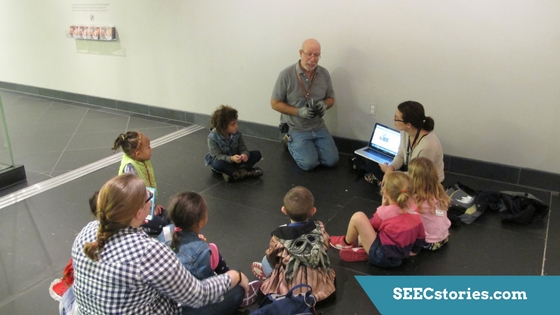
6Then the kindergartners were in for an exciting surprise.  Martin Kotler, a frame conservator at the Smithsonian American Art Museum walked by, heard the conversation and stopped to talk about his job.
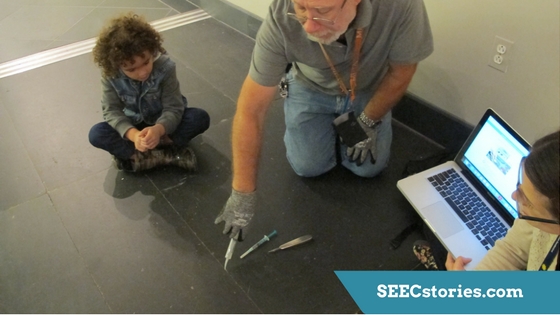
SEECstories.com (7).jpg He brought out some of his tools to share with the class.  He explained that he makes a special batch of glue every day that gives flexibility, and he uses a syringe to apply it.
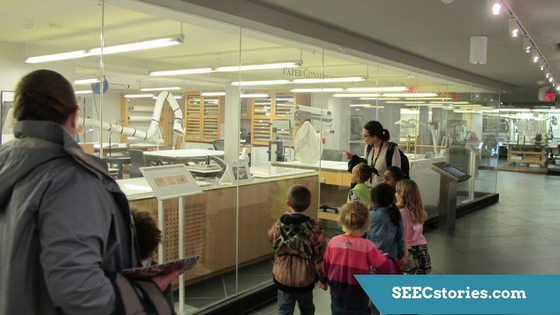
5After learning about the elements of art conservation, the class walked through the Center and looked at the conservation labs to see tools they had just learned about.
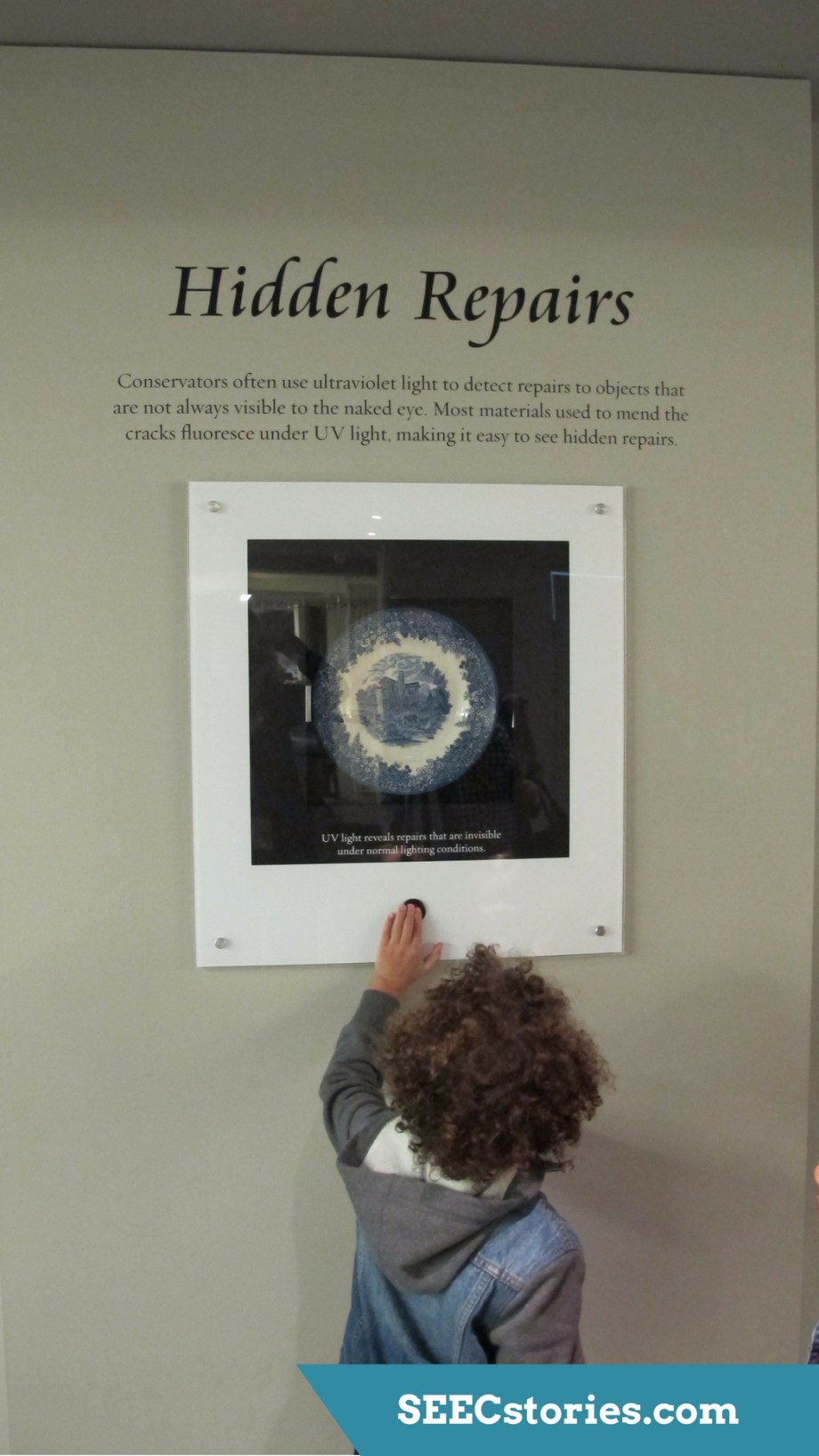
12The children also enjoyed seeing the interactive exhibit pieces that display how artwork and objects are conserved and restored.
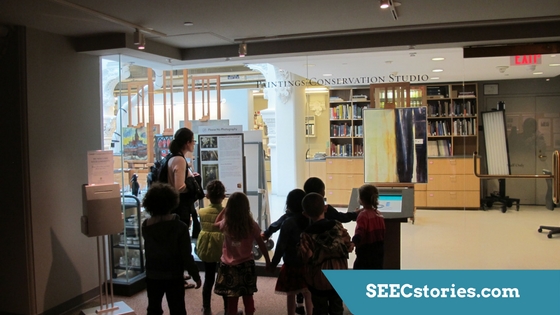
3They even went upstairs to see another section of the lab and to get a better idea of all the work that goes into art conservation.
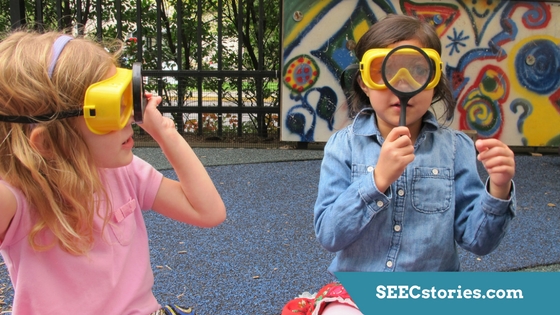
4After their museum visit, it was their turn to conserve some artwork!  The class went back to the playground, and split into two groups: the Paintings Lab and the Paintings Studio.
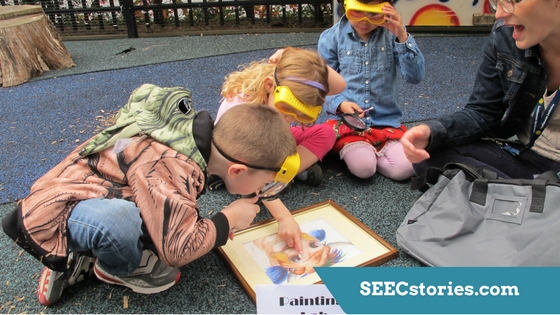
2The Paintings Lab group used magnifying glasses to look for structural damage like tears, ripples and flaking paint.  They also noticed some dirt and used a q-tip to scrub it off.
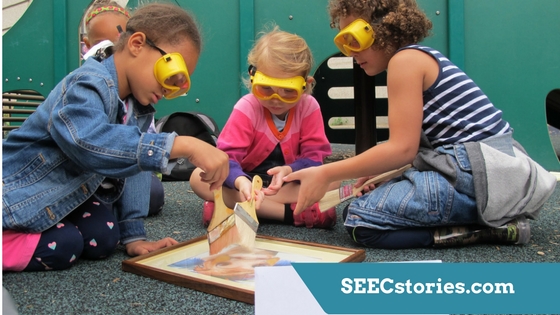
SEECstories.com (2).jpgOnce the Paintings Lab were done, the Paintings Studio group took over.  They pretended to touch up paint that had lost its color.
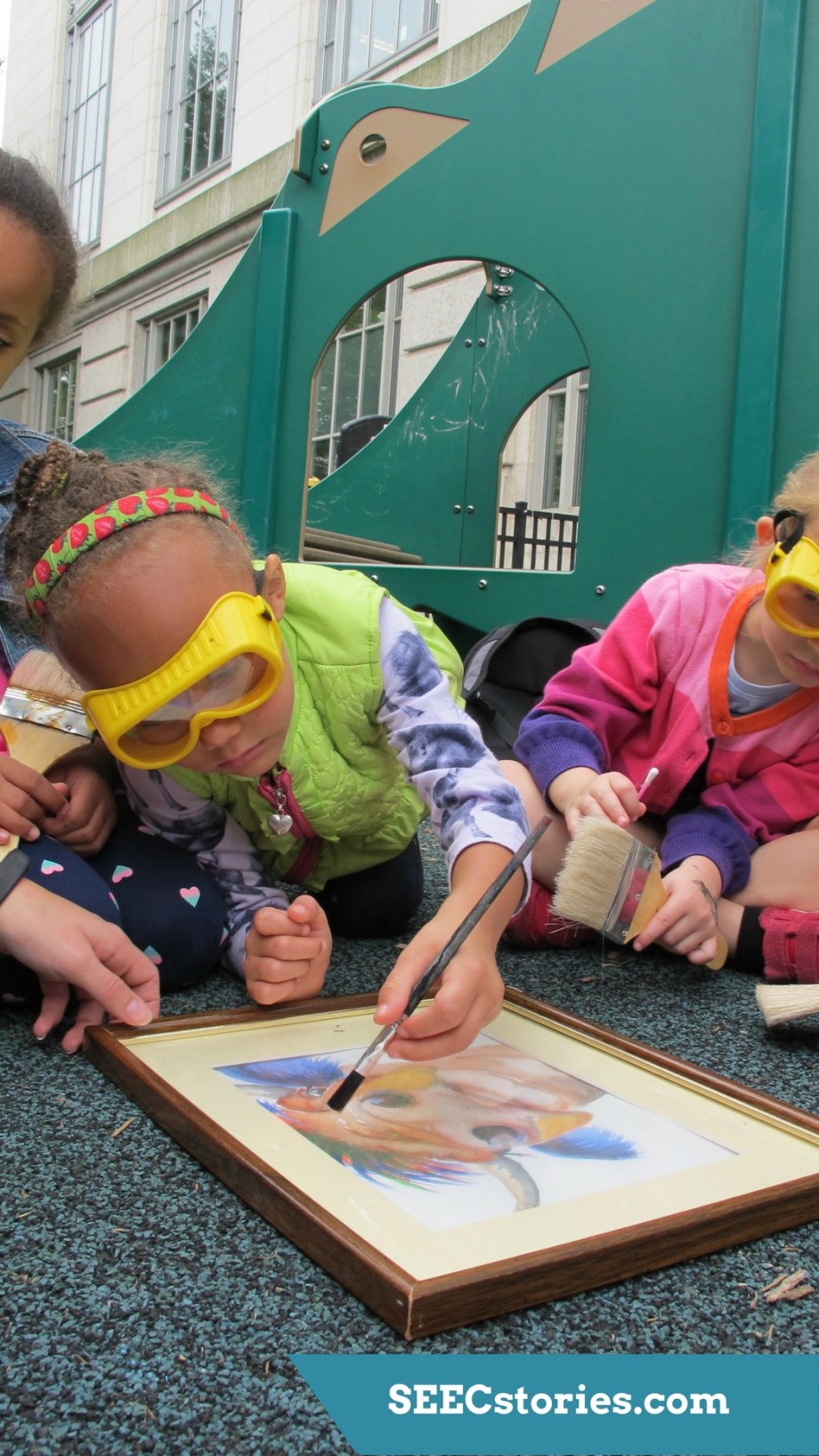
11They even spotted some white patches and pretended to do some inpainting, which is the process of restoring areas of lost paint.

Silvana and Cathryn continued to explore the roles and responsibilities of museum employees for a few more weeks. Stay tuned for the Museum Round Up for more ideas from their unit!

Roll Up Your Sleeves, It’s Learning Time! (Part 2)

Think Like a Teacher: Integrating Learning into Everyday Routines

seecstories-com-10

This blog series aims to highlight how you can simply and easily enhance your child’s learning and development through everyday routines. In our previous post, we explored the developmental growth that occurred when a child gets dressed. Today we will focus on opportunities for learning extensions and fun activities that center around clothing and weather.

Weather Learning Extensions

Weather Report

Since clothes are so closely tied to weather, we recommend giving your child time to explore and learn more about their environment. One easy way to do this is to have your child provide a weather report! Ask your child to look outside or even feel the window to describe the weather conditions. A simple brush can act as a microphone and voila, you have a future meteorologist on your hands.

Feeling adventurous? Choose a weekend, mix in some dress-up options, and film the report. Sharing a weather video is a great way to stay connected with family and also provide your child with a sense of accomplishement!

Books

Some of our favorite weather books are:  The Snowy Day by Ezra Jack Keats, Little Cloud by Eric Carle, What Will the Weather Be? by Lynda DeWitt.

1

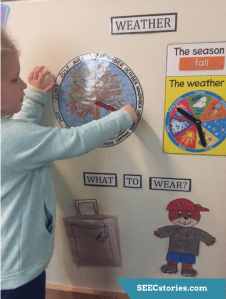
During their morning gathering, a SEEC class decides as a group how to dress their class bear. 

Weather Bear

Using a paper or stuffed bear is a great way for your child to feel empowered. Once you’ve determined the type of weather, ask your child how they think Teddy should be dressed. If the child suggests a heavy coat on a hot day, it is a great opportunity for you to discuss how Teddy will feel after being out in the hot sun for awhile. This can avoid a power struggle between you and your child later when they are choosing their own clothes.

Seasonal Changes

As the seasons change, so do our daily wardrobes. Point out these changes to your child by observing the changes in their environment during a walk or car ride. Notice together how those changes impact your clothing choices.  Emphasize this change by establishing labeled tubs or boxes of clothing for each season. Have your child partake in the sorting of clothing (gloves go in the winter box and bathing suits go into the summer container, etc.)! Make this a philanthropic exercise by allowing your child to decide which clothes no longer fit and have them assist you with donating them to a local charity. If after this sort your child is low on a particular type of clothing have them work with you to create a list of needed items. This will also provide them with a greater sense of respect and ownership over their clothing.

Clothing Collection Boards

You could also create collection boards for each season by gathering items from outside and clipping images of events, holidays, and clothing particular to that season.

Books about the Seasons

As the seasons change, grab some weather appropriate books from your local library. Some of our favorites are: Leaf Man by Lois Ehlert, The Mitten by Jan Brett, and Caps, Hats, Socks, and Mittens: A Book About the Four Seasons by Louise Borden.

History and Culture

For young children, the concept of time is hard to grasp. Using the changing trends of clothing as a way to mark the passage of time can be a fun and concrete way to illustrate this tricky concept. Put up a few photos in your child’s room depicting clothing over the decades. Make sure to include photos of family members – it will make it more meaningful.

seecstories-com-10You may also consider posting a few images of how people dress around the world. You will want to be thoughtful about not perpetuating stereotypes. For example, along side a photo of Indian woman in a sari, you might want to also include an Indian man/woman wearing jeans and a t-shirt.

Pictures of children wearing different clothing can also provide infants and young toddlers the opportunity to learn how things belonging to the same category can look drastically different. For example, they may learn that there are many different types of head gear that fall into the category of items that we call “hats.” They do this type of inventory by labeling a diverse set of examples in the same way. Check out Smithsonian’s Learning Lab for an easy way to build a collection of Smithsonian objects to share with your little one.

Fabric

Explore the fabric of the item your child is wearing. This simple act is a concrete exercise that will help a child practice observational skills and build vocabulary. Take this exercise a step further and ask  “I wonder where your XXX came from?” or “I wonder how it was made?” Use images and real objects to demonstrate that clothing doesn’t just magically appear. Use a photo of a cotton plant or pull your sewing kit out from the closet. Either way, this will help give your child some perspective on where and how they get their clothing.

Extra Time = Extra Opportunities

We hope you feel empowered to turn getting dressed into a fun and enriching experience for you and your child. Remember, incorporate one or two of these ideas and don’t feel pressured to do everything or get too elaborate. If you can give yourself that ten extra minutes one or two mornings a week, you will be surprised how you can enrich your routines. Let us know if you tried any of the ideas out! Until next time, Happy Learning!


Beyond Stereotypes: Teaching about Native Peoples in Practice

We take a look back at a blog that we published last year around Thanksgiving, hoping it will help educators think about ways they might consider talking about other cultures all year around.


As we discussed in our previous blog, the National Museum of the American Indian (NMAI) and the Smithsonian Early Enrichment Center have teamed up to provide teachers with a framework for exploring culturally diverse topics in their classrooms. We believe that early childhood educators are in a unique position to craft experiences for young children that will help them appreciate the diverse world around them. We also feel that it is important for children to see themselves reflected in their classroom in order to develop a positive sense of self.

Though we published the first blog just before the Thanksgiving holiday, we specifically wanted to post the follow-up afterwards as a reminder that teachers can explore American Indian culture throughout the school year.

Before we look at the lesson, it is important to note that I had only a week to implement it and I struggled with how to use the limited time frame best with the students. Ultimately, I decided that it was important to begin the lesson with what was familiar to the students and build on that.  Had I had the opportunity to continue the lesson, I would have most certainly spent more time exploring Wampanoag culture and ensuring that the children were introduced to the Wampanoags in a contemporary context.

Lesson Objectives

  • observe natural materials and weather in our own environment and how these elements vary in other environments
  • demonstrate that not all homes look the same, but all homes do have the job of protecting us.
  • introducing three different types of American Indian homes and explore the natural materials out of which they are made.
  • investigate the materials used to construct wetus and how those materials serve as protection against their environment

Day 1

We began our morning with a visit to the National Mall where we used our senses to explore what was part of our environment. I wrote down the children’s responses and then we headed to the National Gallery of Art where we sat in front of Albert Bierstadt’s Mount Corcoran. Together, we recreated the landscape with representative objects and worked as a group to create a “soundscape.” To create the soundscape, we identified a sound for each element of the landscape. Once complete, we assigned a sound to small groups and then produced our soundscape all-together.

Day 2

When we were on the Mall, I observed the children were noticing elements of their environment that were man-made, so I thought it was important to use day two’s lesson to distinguish between the natural environment and human-made environment. This discussion transitioned nicely into a conversation about weather, which was another natural component of our environment. We identified different types of weather by making a list and then creating our own weather movements. We watched a weather report and read Sky Tree by Thomas Locker. While we read the book, we paused to use our weather movements when they were mentioned.

Day 3

Before heading out for the morning, we reviewed the different types of weather and discussed the weather that day. We walked to the National Gallery of Art’s Sculpture Garden to visit Roy Lichtenstein’s House I. We spent a few minutes walking around the house and then I asked the students to share what they noticed. Following their observations, I asked them if they thought that the house was a good one. There was a consensus that it would not be a good house to live in because it wasn’t real – it was open on the backside. I agreed that I didn’t think the house was doing what a house or home needed to do. I asked them what homes were for, to which I heard responses like: “to play in, eat in, sleep in.” I agreed and pulled out a blanket – I said the blanket was a lot like a home – it could keep me warm when it was cold, it would keep me dry if it rained. I concluded that both the blanket and the home could protect me from things in my environment.

I asked the group whether they thought that everyone lived in the same type of home. We had a short discussion about what our homes were like, the other educators with us shared that they lived in an apartment. We then began to make a home collage. Students shared photos of their homes and we placed them on large sized paper. I also brought photos of homes from around the world and as we placed them on our collage. When we finished, we discussed the similarities and differences.

Day 4

I began this class by asking the students about the Thanksgiving holiday that was coming up. Each child excitedly shared what they were planning to do for the holiday. I shared was formed around the idea that two groups of people came together to have a meal.   One group had come to America from a place called Europe and another had lived on the land we call America for a very long time. I explained that these people who had been living here for a long time were often referred to as American Indians and that in fact, there are many groups of American Indians. I shared a map and said that each group has their own language, clothing, traditions, and of, course, homes. I also pulled out our sensory bins that were representative of a Eastern coastal environment, a desert environment, and an Arctic environment.  We looked at the bins and discussed their physical features and imagined what the weather would feel like.  We wondered together whether the homes in these environments would be the same or different.

We then walked to the ImagiNATIONS Activity Center at NMAI and invited them to play in the Native homes area.  When we sat down, I asked them what they noticed about the different homes. After sharing their own observations, we talked about how each of these homes came from a different type of environment – a lot like our sensory bins. I brought objects that demonstrated the connection between these homes and their environment. For the iglu, I had a simple bottle of water; for the tipi, I had a photo of a buffalo, and for the adobe house, I had some mud and straw. I shared my objects with each student in the circle and left them with the reminder that Native peoples live in many places throughout the country and their homes tell us a lot about their environment.

Day 5

On our last day together,  I reminded them about that Thanksgiving meal. I said that many people assume that the American Indians who ate with the Europeans during that meal lived in tipis. We paused to recall the tipi we had seen the day before and then I shared with them that the Native peoples who were at the meal so long ago actually lived in wetus and they are called Wampanoags.  Using 1621: A New Look at Thanksgiving by Catherine O’Neill Grace, we explored some of the photos of what life for the Wampanoags looked a long time ago. I was careful to note that the photographs were of people pretending to be from a long time. They were helping teach people today about what life was like in the past.

We proceeded to watch parts of this video. We looked at the materials of the winter and summer wetu. We decided that all of the materials were from nature and we took a closer look at cattail reed mat provided by NMAI that would have covered the roof of the summer wetu. We talked about how the rain water would slide off the reeds and keep the house dry. We also blew through the mat so we could feel the way the breeze could come through and help keep the space cool.

We ended our morning by taking a nature walk and collecting materials. We broke out into smaller groups and built houses out of our materials.

In addition to the lessons, the teachers planned the following learning centers for the children to interact with during free-time.

  • Dramatic Play – Kitchen, office, or playing house
  • Fine motor – blocks or other loose parts for building (include photos of different types of houses from all over the world)
  • Environment – This sensory station recreates three different types of environment
    • North Eastern – Wampanoag – inland/coastal environment with forest, ponds, grass, sand, and water
    • Choose two others.
  • Dramatic Play – weatherman
  • Puzzles and Maps – United States

By no means is the lesson an all-encompassing study of Native Peoples or the Wampanoags, but it is a realistic snapshot of how with a little planning we, as educators, can begin to develop lessons that share more accurate information that help our students see that the world from multiple perspectives. Let us know what you are doing in your classroom to help combat stereotypes and create an inclusive environment.

Never Too Young

Opening

This blog was first published last spring during NAECY”s Week of the Young Child. We decided to re-post it as we so often get ask the question, “What do you do with babies in a museum?” We hope this answers some of your questions. If you are interested in seeing our work in action, families are welcome to join us for one of our Infant Investigators  classes that occur most first Saturday and Sundays of the month.

When I first discovered that the theme for NAEYC’s 2016 Week of the Young Child™ was “Celebrating Our Youngest Learners,” I was excited by how clearly it related to my work as an infant and toddler teacher. Most people who read the phrase “Celebrating Our Youngest Learners” would immediately think of children older than the ones I work with every day. Even among the early childhood community, the term “young learners” often refers to Pre-K and Kindergarten students. I believe that we should include infants and toddlers in our celebration of the youngest learners. In my mind this is something that is both natural and necessary. In fact, it has so permeated my life that I sometimes forget that not everyone feels the same way that I do.

As an infant and toddler teacher at the Smithsonian Early Enrichment Center, I take my class on daily outings into the museums that line the National Mall. Upon seeing a group of infants or toddlers in a museum, visitors often remark on how amazing it is to see so many young children or how engaged my class seems. But far too often we get another response; people will come up to my class and say “Aren’t they too young for a museum?”

While I understand that a class of infants and toddlers may be an unusual sight in a museum, I can’t help but be baffled by the very premise of their question. My audible response to this accusation is a cheery “Never too young,” but my inner dialogue consists of wondering “Too young for what? Too young for learning?” I believe that museums make ideal places for self-directed learning. For an infant or toddler to be considered too young for a museum, then the extension of that logic is that the child is too young to learn, which cannot be further from the truth.

Infant’s and toddler’s brains are ripe for learning and processing. In fact, they are learning at a faster rate than at any other time in their life. They are learning language, how to move their bodies, pre-literacy skills, how to interact with others, and whether or not their world is a safe and secure place. Beyond that infants and toddlers are discovering what interests and motivates them. All of these things and more can be learned in museums. Below are a couple of examples:


Hirshhorn

We visited Shirin Neshat’s The Book of Kings, My House is Burning Down (2012) at a recent Hirshhorn Museum and Sculpture Garden exhibit as part of a unit of Eric Carle’s From Head to Toe. We were looking at the parts of the body and a favorite movement came from the line “I am a gorilla and I thump my chest. Can you do it?”


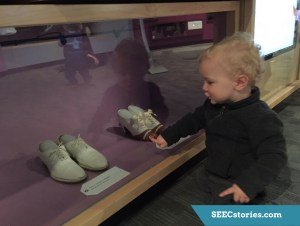
NGA

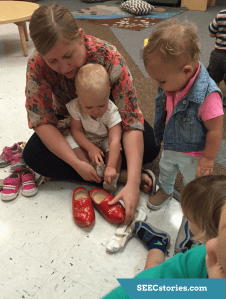
To discover more about different types of shoes, such as wooden clogs and ballet slippers, we went to the National Gallery of Art to see Paul Gauguin’s Breton Girls Dancing, Pont-Aven (1888)For a toddler, shoes represent a way for them to start creating a sense of autonomy. In my class, my students often come dressed in pink cowboy boots or purple rain boots that they picked out themselves. They are expressing their new found independence by choosing what shoes or clothes they want to wear.


Infants and toddlers expend much of their energy discovering how they can move. Here my class of mobile infants visited a termite mound, which they were able to crawl through.

Infants and toddlers expend much of their energy discovering how they can move. Here my class of mobile infants visited a termite mound at the O. Orkin Insect Zoo in the National Museum of Natural History, which they were able to crawl through.


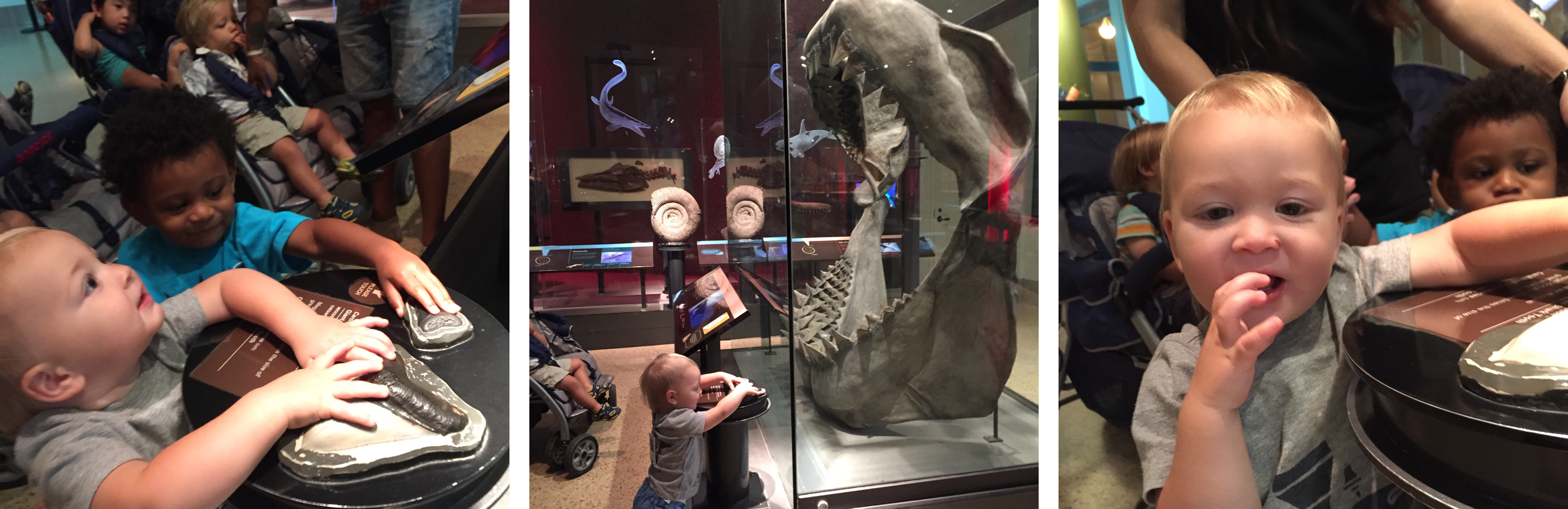
Getting new teeth impacts so many aspects of the lives of infants and toddlers. It allows them to transition to eating solid food, affects their mood, and is often detrimental to their sleep. What better way to learn about what is happening inside their own bodies, than to examine the jaw of a great white shark and touch a replica of some of the shark’s teeth?

Getting new teeth impacts so many aspects of the lives of infants and toddlers. It allows them to transition to eating solid food, affects their mood, and is often detrimental to their sleep. What better way to learn about what is happening inside their own bodies, than to examine the jaw of a great white shark and touch a replica of some of the shark’s teeth in the Sant Ocean Hall at the National Museum of Natural History.

Great strides have recently been made in explaining the importance of Pre-K and Kindergarten to the public. People across the nation now believe in the importance of these early learning experiences. While there is more work to be done, it is important that do not waver from celebrating and supporting the youngest of the young learners — infants and toddlers.

Infants and toddlers are active learners, so the environment and the people they interact with impact their learning. Infant and toddler educators need extra support and should be encouraged to see the myriad of possibilities for learning that occur with infant and toddlers every day. I hope that one day everyone who hears the term “youngest learner” will automatically include infants and toddlers in that group. I am excited for the day that I am greeted with “What are they learning about?” when I am walking in the museum with the infants and toddlers in my class.


BioMeredith Osborne is the infant and toddler specialist at the Smithsonian Early Enrichment Center. She received her Master’s in museum education from The George Washington University and studied history and psychology at Ohio Wesleyan University. She has experience working with both children and adults including positions at Playgroup in the Park, the Children’s Museum of Cleveland, teaching adults literacy classes, and interning at the Supreme Court of the United States.