
This teacher feature focuses on the older infant (Duckling) class’s exploration of Bubbles and the development of their classroom exhibit: HOME during the month of May. At this point of the year, students in the Duckling class were between the ages of 14-20 months old.
Preparation:
Why and how did you choose the visit?
The Ducklings were showing their teachers an increased interest in helping clean the classroom throughout the day. After each meal at school, the Ducklings would ask to help with a “Task,” such as wiping down the table, carrying dirty dishes to the kitchen, and putting the laundry in the laundry room. The students were excited to help and to mimic what their teachers were doing. The Duckling educators decided to follow that interest.
What were your topics of exploration?
This month-long exploration was all about Bubbles. Each week focused on a different way to encounter bubbles: Laundry, Dishes, and Bathtime. The class then spent the last week of the month discussing how we can take care of the spaces and things in our home. The unit concluded with the classroom Exhibit entitled HOME to show off all their hard work.
What were your learning objectives? (What did you want your children to take away from the lesson?)
There were a few learning objectives for the Bubbles unit. A major focus was for the Ducklings to gain a sense of autonomy and independence in their space. Throughout the month, the students had opportunities to decide how they wanted to interact with the lesson. For example, there were spare clothes available to the students during the week on Laundry. They could then decide if they wanted to practice putting on and taking off the clothes, pretend to wash them in the model washer and dryer, or work on hanging them up on the clothesline set up in the classroom. Having these options available allowed the students to decide for themselves where their interests lay and to work on a variety of gross and fine motor skills.

Caption: Two infants practice hanging clothes on a pretend clothesline in their classroom

Caption: Duckling infant class explores spare clothes and laundry baskets on the floor with their educator.
Another goal was to create a positive association with cleaning as it can be a difficult part of a child’s daily routine. By allowing them to create a mess and then have them help clean it up, the teachers could show the students that cleaning up after ourselves (a skill they will continue to develop later in life) is just as engaging as the mess making.
Implementation:
What was most successful about your lesson?
The most successful part of the whole month was watching the Ducklings get objects dirty and then get excited to clean them. It was a real full circle moment for the class. Over the course of the month, they would return to this cycle a number of times. First, they painted with dishes and utensils and when they were done painting, they cleaned them in soapy water. The class repeated this activity with toy cars in “mud” (brown paint) and then, again, using their full bodies. By the end it was clear to the teachers that the students understood that something gets messy and then it gets clean.

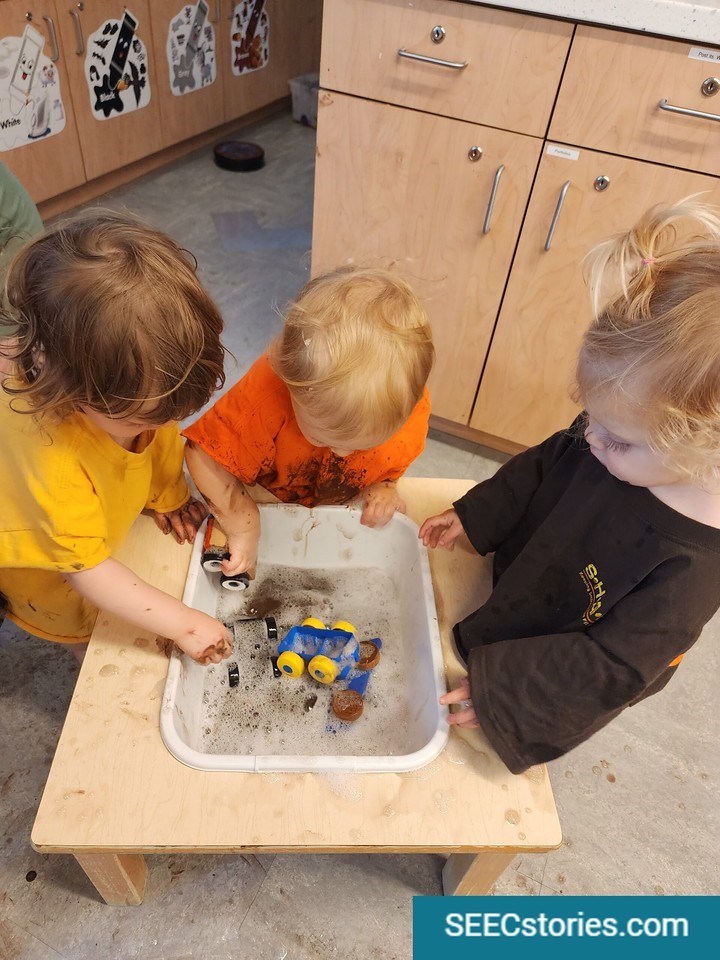
Caption: Duckling students painted with their toys cars in “mud” (brown paint) and later washed the cars clean at a “car wash.”
Another successful element was the cardboard washer and dryer Calla and Kevon built prior to the unit. The Ducklings quickly learned that they could move clothes from one machine to another and that the washer and dryer were only meant for clothes. It was great to see their gross and fine motor skills as well as their spatial reasoning skills in action as they moved clothes and turned the dials.

Caption: Duckling student shows off her laundry and coordination skills by moving the clothes from the washing machine to the dryer
How did the lesson reach your objectives to expand the topic?
Each week the Ducklings got to focus on a different way they could clean and interact with bubbles. They would have similar experiences, such as painting and then cleaning up, but the methods would be different enough to expand their understanding of cleaning.
The Ducklings were able to build on their prior knowledge of what it means to clean in order to understand how to clean with the new objects in front of them. For example, they were used to seeing their teachers clean the table with washcloths and liked to help rub down the table. The teachers took the class to Within These Walls at American History to discuss laundry. When presented with a washboard, typically used for cleaning clothes, they talked about how they could “rub, rub, rub” their washcloths on the board just like they would on the table. When their teacher placed a modern washboard basin in front of them, the Ducklings quickly associated that washboard with the one they had seen in the museum.


Caption: Ducklings went to visit the laundry portion of the Within These Walls exhibit before returning to their classroom to do some washing of their own. They took their washcloths and got them clean in their soapy water buckets.
What was successful in terms of your preparation and logistics?
What made this lesson so successful was having everything prepared in advance. The Duckling educators knew that they wanted to spend an entire month talking about bubbles and cleaning, so they spent time thinking about how to break that down into smaller topics. This enabled the team to dive deeper into each topic but still create a cohesive lesson as the month progressed.
The Duckling team also intentionally revisited spaces and concepts. They took more than one visit to Inside These Walls during their month-long unit. This allowed the Ducklings to become a little more familiar with the space and more comfortable engaging with the exhibit. They followed a similar thought process for their art lessons during the month. By using a similar formula for their art projects, they allowed their art making to become a routine. The children were able to know what to expect and, therefore, they spent more time exploring and engaging with their projects.
Reflection:
How did you document the lesson in order to reflect back on the work?
The Duckling’s month-long exploration on Bubbles culminated in their classroom exhibit entitled HOME. The students spent so much time exploring bubbles and cleaning that it felt like the perfect topic for an exhibit and to have their adults come and see their hard work. While not every project was displayed for the exhibit, the Duckling team chose to focus on displaying work that showed the process of getting things dirty and then getting things clean. The art around the classroom was the biproduct of that exploration.


Caption: Ducklings students made bubble art by making bubbles with colored water and transferring the bubbles onto paper. Once dry, those art works were hung on a pretend clothesline for their classroom exhibit.
The teachers also decided to bring back out the different cleaning stations they learned about during the month. There was a pretend bathtub, a toy kitchen, the washer and dryer, the laundry line, as well as brooms and dust pans. These stations were in place for the Ducklings to show their adults all the new gross and fine motor skills they developed over the month.
Each station was brought out because it spoke to the interests of the children. There was a way for each child to engage, and work samples were present for each student.

Caption: During the exhibit, one Duckling was exciting to show off her fine motor skills back at the clothesline.
What could you have done differently to better achieve your objectives and expand the topic?
There is always room for improvement in lesson planning, and if the Duckling team were to do this lesson over, one thing that they’d like to do is to scaffold some of their exploration out a little differently. For example, instead of putting up a clothesline, hanging clothes on it, and just letting the children explore, the team would have liked to break it down into smaller experiences first. Like just practicing pinching the clothes pins open and shut, then trying to balance clothes on a more solid clothes line, then transitioning to a string line. This slower introduction would have helped the students make their own connections.
What was challenging regarding logistics?
One challenge was finding the balance between experiencing getting messy and ensuring that the students are safe. Water play, and full-body paint exploration, can get slippery if the educators aren’t keeping a close eye on the situation. It can be a fine line between letting the children explore as they want to and making sure they keep their bodies safe. The Duckling team did their best to let the children explore freely by working to mitigate the mess before it happened. During water play, for example, they covered the floor with towels ahead of the play.
What recommendations would you have for another teacher trying out this lesson?
The biggest recommendation is to let the children experience the real thing, whenever possible. If the class is discussing how clothes get laundered when they get dirty, spend a day doing just that! Let the children get their clothes dirty, have them change, and then walk them through the steps of washing their clothes and take the time to investigate each step. The Ducklings loved being involved in the many steps of keeping themselves and their classroom clean.




 seecstories.com