Play: Getting Dirty

Pollinators Event_PlantingOver the weekend SEEC hosted a program about pollinators for the National Museum of Natural History. Included in our offerings was a planting station. I wanted children to think beyond the pretty butterflies they see outside and connect how pollination impacts our everyday lives. I was excited when I was given the green light to include real dirt as part of our activities but I’ll admit to being concerned about how caregivers would respond to their children getting dirty.

As a mom, I didn’t think twice about my girls getting dirty. But awhile after I started working at SEEC, a colleague gently reminded me that I should not assume that all caregivers felt the same as me. Since then, I always put out smocks and kept wipes nearby. I also try to provide a variety of options for play so that caregivers and children have a choice in the type of activities in which they engaged.mud, gardening, touching dirt,

While we want to be respectful of caregivers and their feelings, SEEC also feels it is important to share the benefits of play and especially playing in dirt. If we can share information with caregivers in a thoughtful manner, we hope to educate them about our methodology without making them feel like their perspective doesn’t matter.

So what are the benefits of getting dirty? For one, getting your hands into the dirt can be great sensory input. Many children delight in the feeling as dirt falls through their hands. This input allows them to relax and engage in their environment naturally. Playing in the dirt also offers children infinite imaginative possibilities. I know many of us have memories of making mud pies outside – dirt and nature can supply so many opportunities for play.  Getting dirty also allows a child to connect with nature and these early experiences provides a foundation for a future appreciation and connection to the environment. Not only does playing in the dirt help child develop a conservationist attitude, it also encourages their sense of exploration and wonder. (Read more about the benefits of nature play.) There is also evidence that dirt can be good for us and actually strengthen your child’s immune system.
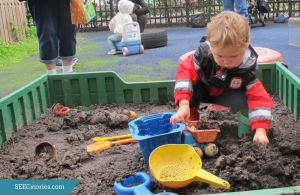
mud box, dirt, playIn the end, I was pleased that so many caregivers embraced our planting activity. Even though we were inside, many families embraced the experience. My personal highlights were an older child who reveled in the feeling of placing the dirt on her lap and a toddler who focused for close to 20 minutes on moving the dirt out of the container and onto the tarp.  I so enjoyed watching how they both engaged with this playful work.

As we come up on our seminar about Play: Engaging Young Learners in Object Rich Environments, we wanted to take the opportunity to look at how our classes are playing with dirt.  As always, we would love to hear your dirt stories too.
mud, messy, sensory,

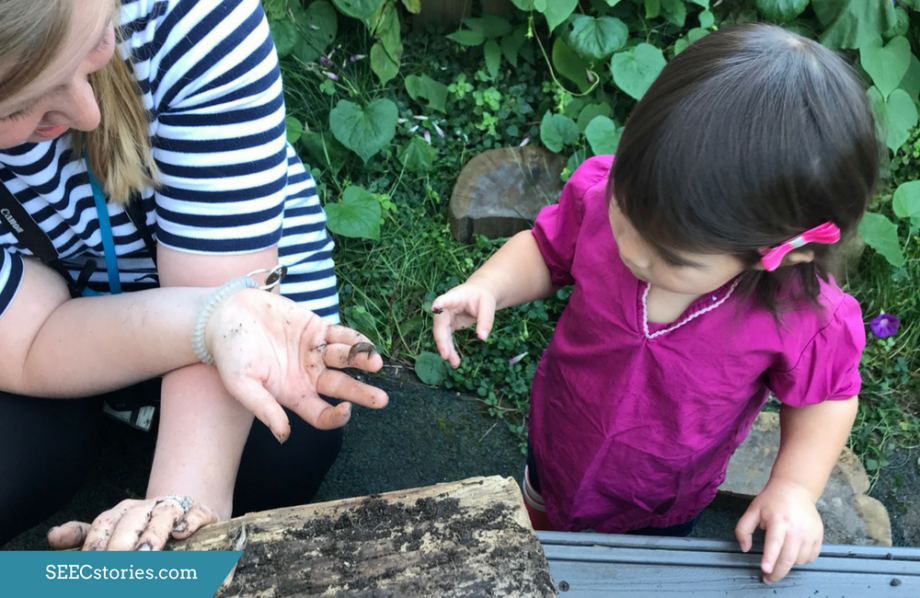
Look what I found!!

mud, sensory, exploration

Testing it out, is this something I want to play with?

mud, construction, stem

Add a toy and the possibilities multiply!

mud, sensory, play, exploration.png

Exploring the dirt after a rain adds a new element to the play!

Summer Museum Highlights for Families

Summer is here and it’s the perfect time to head downtown and explore the museums with your family! There are many exhibits and events throughout the summer that will engage your family while learning something new.

SEECstories.com (21)

No Spectators: Art of Burning Man at the Renwick Gallery

Renwick Gallery’s current exhibition, No Spectators: Art of Burning Man shares many whimsical artworks from the annual Burning Man art festival. From moving mushrooms to scintillating shadows, there is sure to be something that your family will find fascinating. There’s also a fairly unique aspect of this show compared to most museum exhibitions – visitors are allowed to touch most of the artworks.

Extend It: Play with color, light and shadows! With a flashlight, create shadows with various objects. What objects make the most interesting shadows? If your child is older, cut paper into various shapes and see what shadows they create.

Alexander Hamilton: Soldier, Secretary, Icon at the National Postal Museum

If you have any Hamilton fans at home, then this exhibit is for you. The exhibit, on view until March 3, 2019, features original letters written by Alexander Hamilton. While you’re at the National Postal Museum, check out their permanent exhibit, Moving the Mail which highlights different vehicles that have carried the mail over the years.

Extend It: Practice writing letters of your own and mailing them! Choose a family member or friend (near or far) and write a letter to them. If your child is pre-literate, encourage them to draw a picture or dictate a letter. Choose a stamp, and deliver it to a local post office or mailbox together.

IMG_2067.JPG

Blind Whino Southwest Arts Club

The Blind Whino Southwest Arts Club is an arts and cultural nonprofit located in South West DC. Originally a church, their building is completely painted by artist, Hense, whose colorful murals are perfect to spot colors, lines and shapes. Blind Whino also has an art annex with rotating exhibitions that are open to the public on Wednesdays from 4 PM to 8 PM and on Saturdays from 12 PM to 6 PM. Be sure to stop by before July first to see Le Bon Voyage: Across teh Omo Valley and take in the portraits, homes, and culture of the Surma people.

Extend It: Take a photo of your house or another familiar building. Print it out and trace the outline on a piece of construction paper. Encourage your child to paint your house’s outline in anyway they wish.

Smithsonian Folklife Festival 

Head to the Mall between June 27 and July 8 (closed July 2 and 3) for the annual Smithsonian Folklife Festival. This year, the cultures of Armenia and Catalonia will be celebrated through performances, talks, workshops, and more! Check the schedule for specific times of various activities such as weaving carpets, making clay jewelry, and creating mosaic street art.

Bound to Amaze at the National Museum of Women in the Arts

You and your family will see books in a whole new light after visiting this exhibit, which opens July 20. The show features books that are more sculptural in design than average books.

Extend It: Create your own uniquely designed book. Use one of the techniques showcased in the exhibit, such as curling or pleating, to make your book one of a kind.

Endangered: From Glaciers to Reefs at the National Academy of Sciences

The Cultural Programs of the National Academy of Sciences exhibit explores the relationship between art and science. Opening on August 15, Endangered: From Glaciers to Reefs will feature paintings and photographs by Diane Burko that document climate change.

Extend It: Gain an appreciation and respect for the glacier and coral reef environments by reading stories about animals that live in each (for example, North: The Amazing Story of Arctic Migration by Nick Dowson or On Kiki’s Reef by Carol L. Malnor), or researching more information about them. Look online to see what steps you can take to help these environments and make a family plan to implement one thing that will help the Earth.


Celebrating Play

In anticipation of this year’s Play: Engaging Children in Object Rich Environments  seminar, we spent this past week exploring the all-important concept of play. We delved into why play is important for children, and adults too. We thought about the many different types of play, and how play can be incorporated into structured experiences to make learning more meaningful and engaging.

Melinda Bernsdorf Erica Collins Why Play is Important Teacher Truths.jpg

Importance of Play

While some caregivers, school administrators, and policy makers are skeptical that a play-based curriculum can achieve academic learning, the educators who utilize play to teach developmental skills and content (listen to SEEC educators Melinda Bernsdorf and Erica Collins reflect on their use of play during an episode of Teacher Truths) can attest to the power of play in a child’s learning.

SEEC Teachers Play.png

Adult Play

Play isn’t just important for children! With the advent and popularity of escape rooms, city scavenger hunts, sip and paints, social sports leagues, trivia nights, adult coloring books, and more, it seems that adults are embracing their need for play. Peter Gray, researcher at Boston College, likens a person’s need for play to their need for sleep; our minds and bodies will notice if we aren’t getting enough play.  Taking time out of the day to engage in playful activities, in which we lose track of time, is essential to our well-being. With this in mind, our SEEC faculty participated in a survey to see how we play when not at work.

SEECstories.com (20).png

Types of Play

As evidenced by the survey above, everyone has different preferences for the type of play they enjoy. Some children (and adults) gravitate towards solo play, while others prefer to play with a group. Being outside and playing in nature is favored by some, and others prefer construction play indoors. Some love to get messy and really dive into sensory play, while some choose to participate in dramatic play, and still others will always engage in physical play. No matter what type of play children choose to engage in, we know that it’s all important to a child’s development.  At SEEC, we recognize that every child learns in their own unique way, and thus, we offer many play opportunities for every type of learner, so that all children will find an activity that speaks to them. For example, during a family workshop on sculptures, the educators provided varied play opportunities to provide context for the concept, while allowing something for every child, no matter their preferred way of learning.

CORNER TAB (1).png

Playful Teaching

Unstructured, child-directed play is very important to a child’s development, and should be part of every child’s day. However, adult-facilitated, playful learning experiences make learning more meaningful and engaging for young children. Abstract concepts can become concrete through play, while children also build important developmental skills such as social competence. At SEEC, we incorporate play into lessons, encouraging children to be an active participant in their own learning. Whether they are learning about the anatomy of a sea star by becoming one, pretending to eat like a duck to learn about a duck’s life, becoming the parts of a wrecking ball,  or pretending to row a crew boat after learning about all its parts, our children and educators engage in play in the museums and community every day to bring concepts to life.


Want to learn more through playing with colleagues at the Smithsonian? Join us for our Play seminar on July 9 and 10!

Family Day Celebration

SEECstories.com

As believers in building a robust community, each year we take time to celebrate our community by hosting a Family Day where we invite families from our Smithsonian Early Explorers Program and our Family Workshop Members. These groups vary from the families who see each other everyday as part of the school at the Smithsonian Early Enrichment Center. The idea of gathering this group together and celebrating our personal connections is simple, but frequently overlooked in our busy society. We have found that these Family Day events are one of the best ways to create deeper connections among our families and are crucial to the success of our programs.

SEECstories.com (1)

One of the key components of our Family Day is to highlight the different museums on the National Mall, which we consider to be vital to how we learn. To do this, we organized playful stations that represent the various places that we visited in the hope that they would spark memories and encourage families to discuss their past experiences. For example, we taped bear prints to the ground and added bamboo block to represent the time the class visited the Smithsonian National Zoo and learned about bears. We also put out a toy train set to represent “America on the Move” at National Museum of American History, which is a favorite exhibition.

SEECstories.com (2)

In addition to carefully curating stations that were meant to spark reflections, we encourage causal discussions by having a calm and relaxed atmosphere. We have child-friendly snacks for families to eat and as families ate their snacks they naturally engaged in conversations. Throughout our Family Day, caregivers were able to build deep connections while discussing their families and their hopes, fears, and excitement about the upcoming year. In order to thrive, families need the opportunity to have these types of discussions with each other.

SEECstories.com (3)

Raising young children can be challenging and having a supportive community can help ease these stresses. Over the years, the way we think and define community has shifted and changed, and these changes do not always benefit the family. With this in mind, we take the time and effort to create a space where caregivers and families of all types can come together and feel supported by each other.

These family events take time and effort to plan but are well worth it! Community is one of the cornerstones of our programs and we know that communities need to be nurtured in order to grow. Family Day celebrations are one of the many ways that we try to foster a special and unique community and we are so excited that this Family Day was a success. We are already looking forward to future Family Day celebrations!

10 Things You Can Do Right Now in the Car

2

Stuck in traffic? On a road trip? Or just having a rough morning commute? Here are 10 things you can do right now with your child in the car to help pass the time!

1

  1. Sing

This is always a fun way to pass the time but don’t let them sing alone! Join in on the fun! This will help your child engage with the song longer. You can also make singing a game by trying to match the volume of the song. For example, turn it down really low and suggest that you whisper sing.

  1. Listen to a Book on Tape or Podcast

When singing doesn’t work, try a book on tape or a podcast. We have seen firsthand at SEEC how engaged children are when listening to an audio book. There are a lot of great free options out there, inclduing audio books from your local library that you can check out directly onto your device.

  1. Mystery Bag Object

Pass your child a bag full of miscellaneous items. Tell them to stick their hand into the bag without peaking and describe what they are feeling. Work together to try and guess what the item is.

  1. Zip and Button a Coat

Make car time a productive learning opportunity by having your child practice their fine motor skills on their jacket buttons and zippers. Other people in the car? Let them work on those coats too!

SEECstories.com (18).png

  1. Take Photos

Pass your child your phone so they can take photos of their journey. It is a great way to pass time and also provides you with their view of the world (this activity is best done with a second non-driving adult in the car to ensure phone or camera safety).

  1. Start a Band

Do you have a water bottle? Pens? Or anything that can shake or rattle? Then you have a band! Let your child use a pen to tap on different surfaces and create their own “drum.” Fill an empty water bottle with paper clips or other small items and convert it into a shaker!

3

  1. Draw

No paper? No problem. This is a great chance to let your child explore drawing on new and different materials. An old map, napkin, or even a paper grocery bag can make a great drawing surface! Be sure to keep an eye on your child to make sure their pen doesn’t wander too far!

  1. 5 Question Game

A condensed version of 20 questions is a great way to engage your child. Have them think of something and then use 5 descriptive questions to try to guess what it is. Then switch!

  1. Balance Game

Pass your child an unbreakable object and ask them to balance it on their leg, knee, hand, head, etc. Time them to see how long they can balance each item. This is a great way to invite your child to sit still even if it is just for a few seconds.

SEECstories.com (17)

  1. Stop

When all else fails. Stop. It may take you a little longer to get to your destination but letting your child out of the seat to do some moving may help the ride go much smoother. If possible, find a safe place to park and do some running around the car or jumping jacks! To encourage them back into their seat make it a game to see who can get in the car first.

Have other ideas? Please share!