Japan Round Up

Japan Round Up


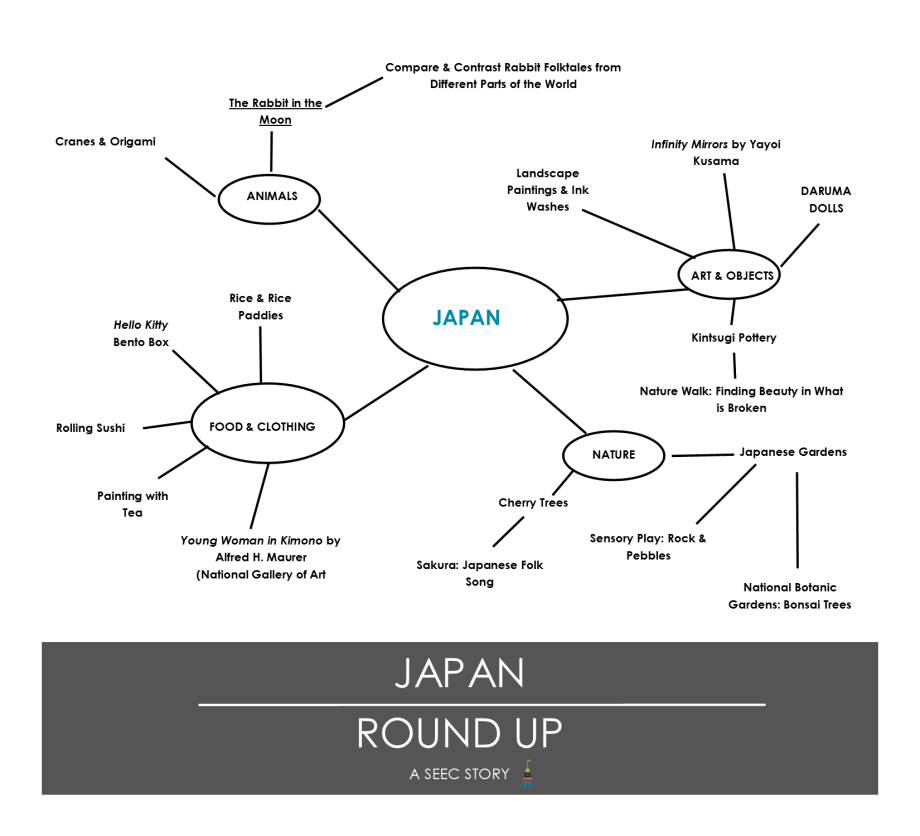
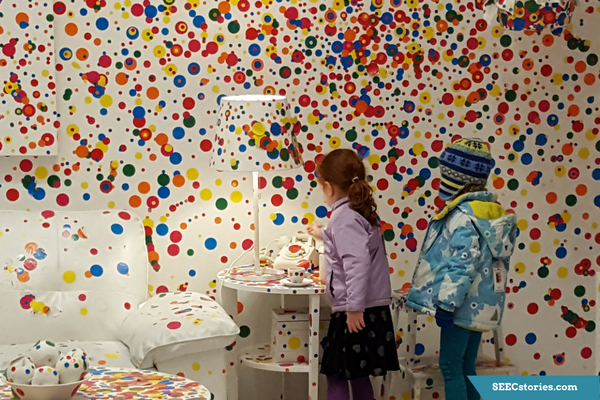
At SEEC, we use an emergent curriculum, so we are always observing our students and taking note of their interests and questions. It came as no surprise to our teachers when their classes began to show interest in Japan. Even with the cold spring temperatures, Washington, D.C. was abuzz with cherry blossom excitement in March and April. Couple that energy with the Hirshhorn’s exhibit of the Japanese artist, Yayoi Kusama, and the children began to take real notice and make inquiries.

3 (2)

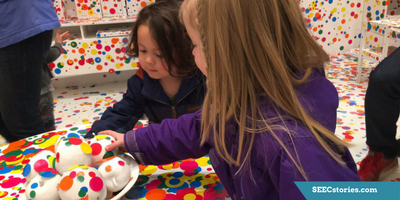
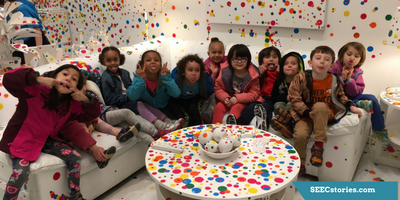
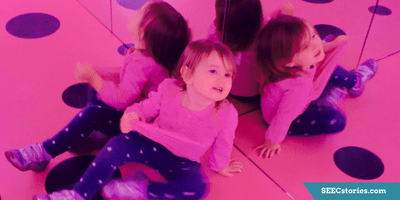
Our PreK class students are making their mark in Kusama’s Obliteration Room.

One of our toddler classes and one of our preschool classes each embarked on a unit featuring Japan. If you haven’t already, take a look at the toddler Teacher Feature on karaoke and the preschool Feature on Japan’s Children’s Day.  Below are some of the highlights from their explorations.

5

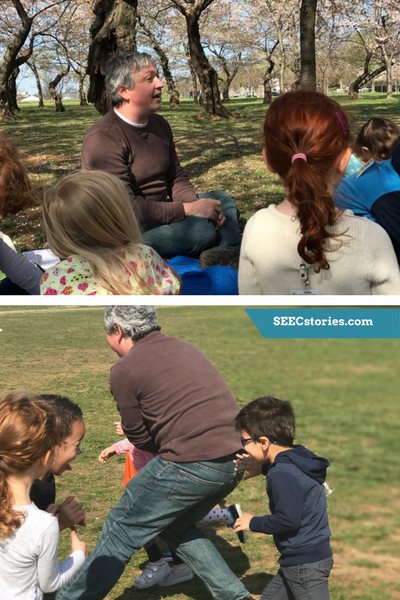
The PreK class got some fresh air and enjoyed an early glimpse of the cherry blossoms. Their teacher, John Fuller, taught them a traditional Japanese folk song entitled, Sakura. The song describes the blossoms in the spring.


2 (2)

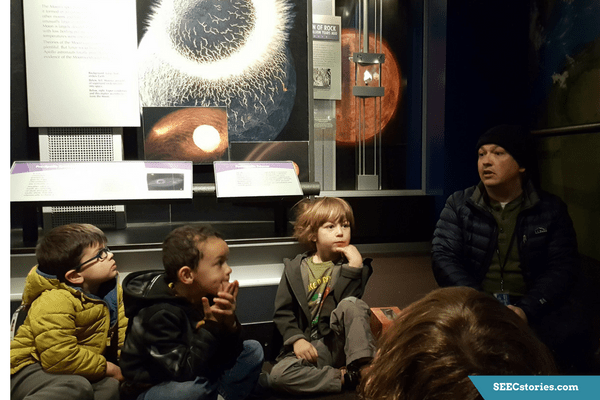
Mr. Fuller took them to the Natural History Museum’s solar system galleries and shared the folktale, The Rabbit in the Moon.

6

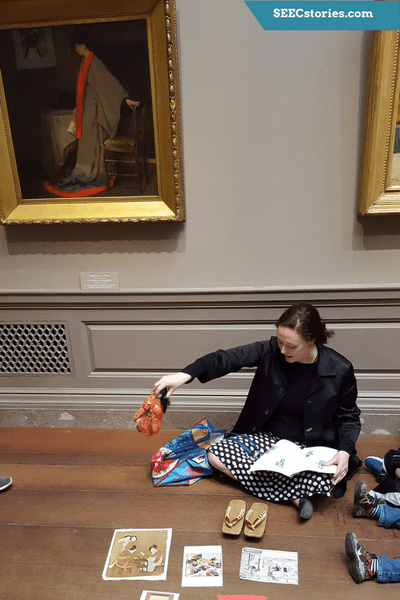
Since the Freer Gallery of Art was closed for renovations, Krystiana Kaminski took the PreK class over to the National Gallery of Art where they explored kimonos, Japanese art, by looking at Alfred Maurer’s Young Woman in a Kimono.

While our PreK was busy with their unit, out toddlers were also exploring Japan. One of their teachers had recently traveled to Japan, so it was a particularly rich experience as she was able to share her personal experiences.

4

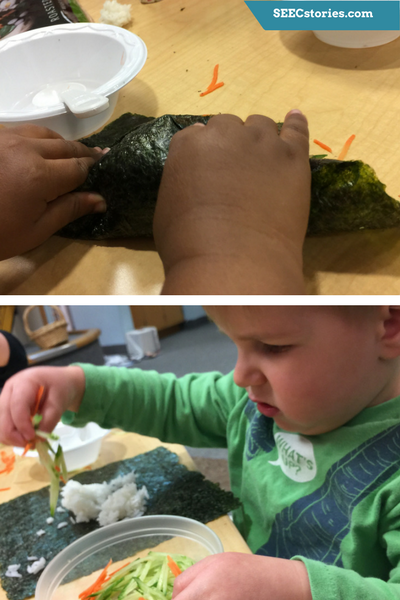
The toddlers got busy making their own veggie sushi. This activity blended new content with sensory exploration and fine motor skill development.

2 (3)

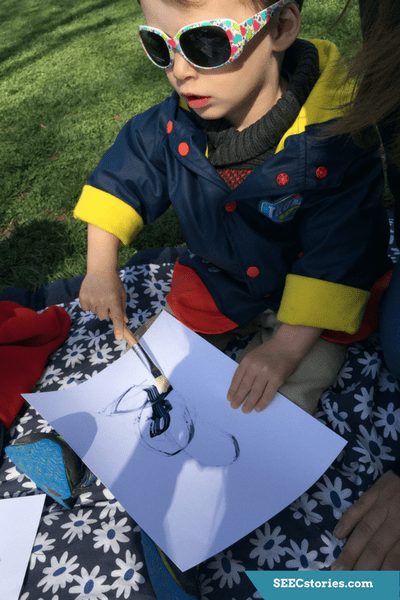
After looking at Japanese ink wash landscapes, the children headed outdoors to create their own  masterpieces.

1 (3)

The toddler’s lesson on tea included a classroom component in which they were able to observe one method of tea preparation. They concluded the experience on our art studio with our art educator who had them explore the physical and visual properties of tea through painting.

Japan Round Up 2

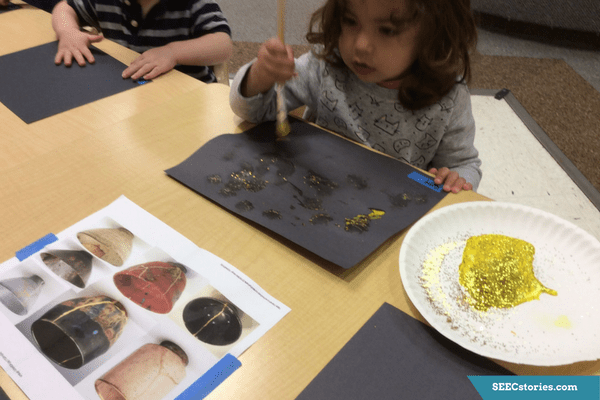
The toddlers had the opportunity to learn about the unique Japanese tradition of  Kintsugi or repairing broken pottery with lacquer, often mixed with gold. This art activity encouraged careful looking and provided them with a creative and open-ended art project.

Technology at SEEC

These days, technology is at the forefront of everyone’s mind. If we look at Forbes’ list of billionaires, one is struck by a preponderance of tech-savvy figures like Mark Zuckerberg, Jeff Bezos, and of course Bill Gates. It is no surprise that technology is now part of almost every facet of our lives, including education.  For those of you who were born in the 70’s and 80’s, you can probably remember lugging home a stack of books and covering them with paper bags. These days, things have changed. As a parent of two, I can’t think of a single instance when my children brought home a text book. For many of America’s schools the text book has been supplanted by tech (it bears noting that this is likely not the case for all schools, and that broader access to technology could help contribute to closing the achievement gap.[i]).  It begs the question, how is tech being used within the educational landscape? And, as both educator and parent, how do I discern between what is worthwhile and what is not?

Tech2

This question is even further muddied when one considers the early childhood audience. The American Association of Pediatrics writes:

For children younger than 2 years, evidence for benefits of media is still limited, adult interaction with the child during media use is crucial, and there continues to be evidence of harm from excessive digital media use, as described later in this statement. [ii]

For preschoolers, AAP states there is some evidence that well-produced apps can help children build literacy skills. The dilemma is that not all apps are created equal, and many of the products categorized today as “educational” do not adhere to strong educational standards. Moreover, many of these apps do not take into consideration one of the most important factors in successful early tech experiences – interactivity. Adult interaction with a child while using technology can make a significant difference in whether a tech experience provides any benefits for young children.[iii]  Having an adult present AND engaged in the activity has many added benefits. Adults can enhance the experience in a variety of ways. For example, they can narrate the experience, thus building vocabulary and helping the child process the information. They can model how to use the device and application, they can model a growth mindset, and they can help children practice executive function skills like patience and problem-solving. Adults can also ask meaningful questions that reflect the child’s interests, and that are open-ended to allow practice in critical thinking. Ultimately, having the adult present can tailor the experience for the child and turn a passive exercise into an active one.

Tech_1

This PreK-3 class considers the height of Mayan pyramids using a combo of tech, literature, inquiry, and objects.

Similarly, making tech part of a well-balanced activity “diet” makes it more likely to be effective.[iv] Young children require a variety of experiences to facilitate their growth and development. At SEEC, our educational approach is varied. Our classrooms incorporate a variety of pedagogical approaches that meet the child where he/she is: object-based, STEM, play, inquiry, Reggio-inspired, tactile, experiential. For us, adding tech is a natural extension of these approaches, one that almost always includes an educator and is a part of a much larger whole.

As educators, we have especially welcomed the inclusion of videos and recordings. Having such resources available while in a museum setting have proven invaluable. Now when we go to the bird hall at the Natural History Museum, we don’t just look at the birds and feel examples of feathers, we also listen to different bird calls. Or when we head over to see the Freer and Sackler’s Shiva Nataraja, we can also show children videos of contemporary religious festivals in India. Our iPads are also tools for STEM learning. In an ideal world, educators have the time and resources to set up an experiment like, ‘what floats and what sinks?’. But what if you have a question like, “Do polar bears communicate?”  Technology can help us answer that question in a way that is robust and concrete – both particularly important for young learners. For example, when preparing a lesson on this very topic I came across this resource that plays the different sounds polar bears make.

Tech3

Those teachers aren’t ON their phones, they are USING their phones so their infant class can listen to Michael Jackson.

Finally, the very acts of asking questions and searching for answers are ones that are particularly important to SEEC. When we use an emergent curriculum, we pay particularly close attention to what our students are doing and asking. With access to tech, we are able to take their questions and explore answers in a multi-dimensional way. We can model for children the choices we make in using reliable sources, how to collect and synthesize information, and most importantly, we can demonstrate that we, the educators, don’t have all the answers.

Our hope is that in coming months, we will continue to collect information about how tech is being used in our classrooms and share that with our audiences. As always, we are welcome your input and ideas too.

[i] “Technology Can Improve Achievement Gaps, Improve Learning.” Stanford Graduate School of Education. Stanford University, September 10, 2014. Web. July 3, 2017.

https://ed.stanford.edu/news/technology-can-close-achievement-gaps-and-improve-learning-outcomes

[ii] “Media and Young Minds.” AAP News. American Association of Pediatrics, November 2016. Web. July 3, 2017.

http://pediatrics.aappublications.org/content/138/5/e20162591

[iii]  “Guiding Principles for Use of Technology with Early Learners.” Office of Educational Technology. U.S. Department of Education, Web. July 3, 2017.

https://tech.ed.gov/earlylearning/principles/

[iv]  “Technology and Interactive Media as Tools in Early Childhood Programs Serving Children from Birth through Age 8.” National Association for the Education of Young Children, Fred Rogers Center for Early Learning, and Children’s Media at Saint Vincent College, National Association for the Education of Young Children, Web. July 3, 2017. p.7

http://www.naeyc.org/files/naeyc/PS_technology_WEB.pdf

Object of the Month: Railway Service Car

2 (2)On a recent trip to the Postal Museum, I was reacquainted with how perfect the National Postal Museum is for young children. Throughout the experience, there were two things that stuck out to me – hands-on objects and imaginative experiences.
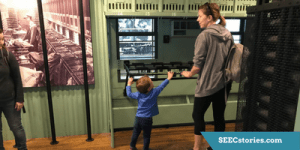
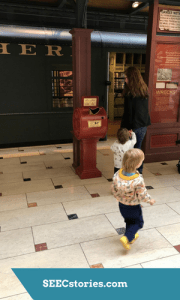
It is too difficult to highlight the whole Museum, so I will focus on the Railway Service Car located in the Atrium. You step into the train car and immediately you are in another world. It is a child friendly space (although at times, you will need to pick your child up to see everything) that allows children to move their bodies and engage in tactile experiences. The car recreates what it would have been like to sort mail on a moving train in America following the Civil War.

2Within this small space there are a lot of opportunities for your child. The letter sorting is a fun way to spy a letter – V is for Virginia or D for DC.  Caretakers can lift up children to allow little hands to practice placing the mail into the slots. It is also a great way for a few young children to build their team working skills. You might want to play a game of passing, sorting, and delivering envelopes from the train. You can even watch this video beforehand for inspiration and it is great for adults who are interested in learning more.
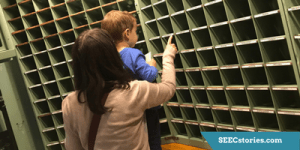
1Though the bags in the exhibit are secured, a clever caretaker might bring a few small bags and give the children a chance to carry the bags or even compare weight — all of the sudden your visit into a STEM lesson!  Those letter bags are also a great place to stop and do a simple sorting activity. You can sort blocks by colors or shapes to explain how the bags were used to sort mail by location. This a simple way to introduce some math too!
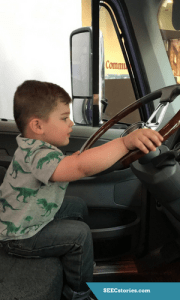
1 (2)Consider using the train as an anchor object to compare with other forms of transportation in the hall. With some Velcro and photos, you can create a visual timeline showing the progression of a carriage, train, plane, and truck. You can actually get inside the truck and steer – they will love it. Of course, you can also introduce your young child to the concept of mail and how it moves from one place to another. Its a great opportunity to have them help you compose a postcard to a loved one and then send it off.
End your visit with a stop to say hello to Owney the dog and read more about his post office travels.

Smithsonian Early Explorers

**Please note that the 2019-2020 school year, SEE will be meeting at the Hirshhorn Museum and Sculpture Garden on Mondays and the National Museum of American Art on Tuesdays.

We are about embark on our fourth year of the Smithsonian Early Explorers program. The upcoming anniversary is a little bittersweet as some of our long-time families are leaving the program and moving on to preschool. The toddlers who began this program have grown into competent three-year-olds who are capable, empathetic, and ready for their next big adventure. The adults will also be missed as they have become part of our SEEC community and really helped us reflect on the overall program.

To celebrate the development and growth of the program and it’s students, I thought it would best to tell the story of SEE through photos in the hopes of capturing what makes this program so unique.1

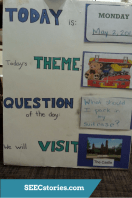
Like many early education programs, we begin our day with a schedule. SEE also includes a “Question of the day.” Our belief is that asking questions can lead to a life-long habit of analysis and critical thinking. These questions also help caretakers who are not present learn about their child’s day.

Each morning we invite our students to play and often include real objects or materials.  This helps create authentic experiences that support a child’s physical, cognitive, and emotional growth. By including real objects, children can have concrete experiences that engage their senses. The photo here shows a lesson in which children explored different types of green as part of a larger study on forests.

We also create imaginative spaces using traditional toys. Our class meets in the Natural History museum’s Q?rius Jr. space and our educators are thoughtful to design a learning environment that encourages imagination and creativity.  We also believe in getting dirty and having fun.


This slideshow requires JavaScript.

Another cornerstone of our program is routine. Each morning the children look forward to ringing the bowl to indicate it is time to gather. Following that, we welcome each other with a our hello song. We often choose books that are regularly reread over the course of the trimester. As the children become familiar with a piece of literature, they delight in knowing what will come next and matching photos to the text. When we depart for snack and our museum visit, the children get on “trains.” They hear the sound of the whistle and know that they need to grab an adult hand and walk safely to their next destination. These routines help the children feel safe, know what to expect, and help the whole group transition.


This slideshow requires JavaScript.

We are a museum school and therefore, regularly visit the museums on the National Mall. Learning in museums can be beneficial to young children especially because they are better able to learn when they connect more concretely with subject matter that they actually experience. SEE does not limit itself though – we see our classroom as extending beyond the National Mall and museums. Some of our highlights this year were the DC Circulator and the National Arboretum. We also take advantage of new exhibitions even when they don’t tie into the curriculum, as was the case with the Kusama show at the Hirshhorn Museum. Really, who could pass up such a fun experience?!


This slideshow requires JavaScript.

We believe in play and we believe it should happen in museums. I know for some that might seem contradictory to museum etiquette, but we believe that play can and should happen in museums. With some forethought it can be done successfully with young children. Below you will observe how bringing some loose parts allowed one child to build a structure of his own. He was no doubt inspired by the house on view in the American History gallery where he was You can also see how we transformed a lesson on maple leaves into a game of placing leaves onto a tree. Finally, and perhaps one of my favorites, watch both the children and adults have fun practicing their penguin walk at the Natural History Museum.


This slideshow requires JavaScript.

SEE is a program that not only supports the child, but the parent/child relationship. Our educators help parents in their role as their child’s first teacher. We try to educate our parents on issues of child development and assist them as they navigate specific situations with their child. Caretaking is hard work and we use daily interactions, weekly emails, and conferences as ways to help parents navigate these early years.


This slideshow requires JavaScript.

It takes a village and SEE is a community which relies on it’s families and staff to help cultivate a diverse learning experience and strong community. Below are just a few examples: one grandmother shares her sticky rice after viewing bowls from the Sackler Gallery, our resident science educator, and retired entomologist, shares his expertise and live specimens, a small potluck marks the end of a trimester, and one child focuses during their monthly visit to our art studio.


This slideshow requires JavaScript.


We are proud of the Early Explorers program for not only its use of museums, but its approach to educating the whole child, supporting families, and creating community. We wish our graduates well and look forward to meeting our new students in the fall!

7

Do you have a child who will be between the ages of 18 – 24 months this fall? You may want to consider joining the SEE program. We are hosting our Prospective Student Day on May 24. During the day, we invite families to participate in the program to experience it for themselves and have the opportunity to talk to other families. Join us by registering here.


Kusama Krazy!

It feels like all of DC is in a frenzy over the new Yayoi Kusama Infinity Mirrors exhibit at the Hirshhorn and SEEC is no exception! This bright, playful, and imaginative exhibit speaks to our students in so many ways. Many of our classes have been lucky enough to visit the exhibit over the course of the past month and a big thank you goes out to the Hirshhorn staff for welcoming us into this magical space.

We will be featuring specific Kusama lessons in upcoming blogs, but it felt appropriate to pause and enjoy some of the moments of wonder that we have observed in this unique space. SEEC believes in the power of imagination and play, and we feel fortunate to be able to interact with a space where these two ideals are so well represented.

Favorite Quotes:

“I think it might smell like bubble gum inside!”  (said a student to a volunteer in the Dots Obsession – Love Transformed into Dots)

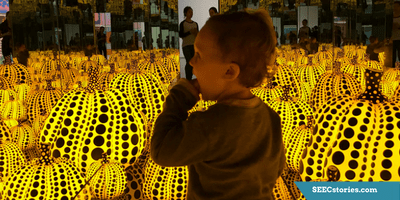
“There were baby pumpkins in there! Bigger ones, medium ones, but the teeny tiny baby ones were so cuuuute!”  (said exiting the Infinity Mirrored Room – All the Eternal Love I Have for the Pumpkins)

“There’s Kusama. Except she has pink hair there. She loves polka dots, see? On her shirt?”  (after learning about Kusama with their art teacher and encountering a photo of her in the exhibit)


4

The Obliteration Room

3

Infinity Mirrored Room – All the Eternal Love I Have for the Pumpkins

2

Life (Repetitive Vision)

1

The Obliteration Room

5

Dots Obsession – Love Transformed into Dots

Making Every Child Matter

For the past few years, SEEC has been offering our Positive Sense of Self workshop, but now, more than ever, we see this work as not just important, but necessary. Politics aside, there is no denying that we have a population of young learners who are diverse and, in order to support them and their academic success we need to help educators learn how to create a supportive and inclusive learning environment.

3Why the early years?

The importance of a child’s early years has become widely accepted. Educators and, more and more, policy makers recognize that providing families with affordable, high quality early education can have profound and lasting impacts on a child’s academic success and overall well-being. Quality early education can mean a lot of things to a lot of people, but one essential component is social emotional learning. The work of early learning professionals today includes helping children communicate their feelings, work successfully as a group, and try to understand and respect others. Embedded in these concepts, is the idea that children should see a variety of perspectives represented – those reflecting their own identity and the identities of others. The Smithsonian is in a unique position to use our objects and resources to support teachers in their own understanding and educational practices about race and culture.

Race and Culture1

Research has proven that even very young children recognize physical and cultural differences and often display their own biases towards these differences. SEEC, and its partners, would posit that it is better to address these factors rather than ignore them. The truth is, young children do notice differences in skin color, clothing, and speech. Celebrating our differences can help children have a broader world view and instill pride in what makes them and their communities unique. At the same time, displaying our commonalities can demonstrate to young children how much we share.

Positive Sense of Self

This workshop that SEEC, the National Museum of African American History and Culture, and the National Museum of the American Indian, hosts will aim to help educators support a positive sense of self in ALL of their students. We know that children benefit by seeing themselves represented throughout their educational experience; through books, objects, art, play, and content educators can create an environment that honors all children.

We will begin our first day by recognizing our own bias in a safe environment and use this understanding of ourselves to help us become better educators. We will also examine the role stereotypes play in education and how, as educators, we can look past those stereotypes and use museums, their objects and resources, to create a more diverse classroom.

2The second day of the workshop will feature several techniques for supporting children in their understanding of the themselves and the world. We will examine how to use objects (both every day and museum objects) to teach and, identify developmentally appropriate ways to talk about race and culture in the classroom. Participants will create collections that encourage children to embrace differences and acknowledge our shared humanity. We will also work in NMAAHC’s art galleries to model how looking and thinking routines can encourage young children to stop, look, think, and inquire. In this section, we will help educators respond to potentially awkward questions and remarks and support the notion that we don’t have to have all the answers – even if we are teachers.  We will conclude the day by examining some common pitfalls used in preschool settings and provide participants with a chance to curate a learning environment using the techniques and resources that we explored during the workshop.
 

We hope you can join us in this important work.


SEEC’s Oscars

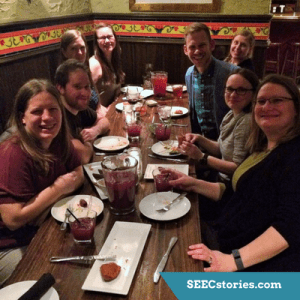
2-2In keeping with the awards season time of year, SEEC held its annual Staff Appreciation dinner recently in order to recognize the hard work and dedication of our entire team. It was also a great opportunity to kick back, relax, and enjoy some time together.
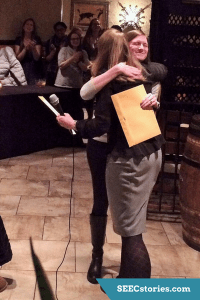
During the course of the evening, we honored six individuals who have really stood out.

Without further ado, the winners are….

Diane Homiak Award

The Diane Homiak Award is a lasting tribute to the memory of SEEC supporter, parent, and employee Diane Homiak. A fund has been established that annually recognizes the commitment, creativity, and contributions made by a teacher to SEEC.sign-me-up

Melinda Bernsdorf, teacher in one of our two-year-old classes, was the 2017 recipient. With numerous nominations from parents, teammates, and colleagues, Melinda was singled out for fostering a creative and inspiring learning environment, her ability to build independence and inquisitiveness in her children, her willingness to share ideas, and the remarkable warmth she brings to everything she does.  Melinda has been at SEEC since 2014 and holds a Bachelors in Psychology. She has a long history of working with children and says she loves how each child has their own individual way of exploring their world.

Rookie of the Year1

First year toddler teacher Elizabeth Kubba was celebrated as this year’s Rookie of the Year!  She, too, was recognized for her creativity in the classroom, her dedication to her children, and her level of communication. As an undergrad, she realized that educating and developing young people was her true passion so she went on to earn her M.Ed. in School Counseling from Liberty University. She has been working in special education at the elementary level for the past three years.

Spirit of SEEC1-3

Brooke Shoemaker was celebrated with the Spirit of SEEC Award.  This award isn’t given out every year – it’s only awarded when an educator who reaches across the entire school really stands out, and Brooke truly fits that bill!  She was recognized for her work supporting teachers in all three of SEEC’s sites, her ability to connect with everyone (big and little), and her outstanding work within the Center for Innovation in Early Learning. Brooke serves as the Education Specialist for Pre-K and Elementary programs. She holds an M.Ed. in Early Childhood Education and you will often find her combining her knowledge of young learners with her love for theater.

Team Player Awards

The Team Player is awarded to staff who is recognized by their peers. Infant Educator, Logan Crowley, and Assistant Educators,  Ace Walton and Phoebe Cos were selected as this year’s award winners – each goes above and beyond to support his/her colleagues, with warmth, willingness to jump in, and a positive outlook! We’re incredibly lucky to have such supportive and dedicated educators across SEEC!

While these 6 individuals were specifically recognized, we also took the time at our dinner to recognize each and every member of SEEC’s team.  We’re so incredibly fortunate to have a community of educators as strong and dedicated as those working here each day – it’s what makes SEEC the special place that it is – and we know you recognize that, too! An incredible 27 individuals were nominated this year, and we received more than 50 nominations for these talented educators!

Bring Your Own Baby

seecstories-com-1

My “babies” and I. 

I remember those days so clearly – having a new baby at home was an extremely special time. It was also a very scary time. For myself and many others, caring for an infant can be overwhelming. I can recall second guessing myself – debating whether my daughter had nursed enough, why she was crying, or if I was getting her on a schedule soon enough. In addition to my parenting doubts, I often felt lonely and can remember seeking out other caretakers who also had infants. It is with these memories in mind, that our outreach team began thinking about a caretaker-centered program. Bring Your Own Baby, or BYOB, is our newest program that launched today, designed for caretakers and their infants, BYOB will begin with some coffee and chance to chat with each other. To help get things started we’ll have some questions to break the ice and build common ground.

corner-tabFollowing our coffee and conversation, the group will head out to a nearby museum where we will explore a topic through an adult lens. These museum visits won’t be tours in the traditional sense. They will be opportunities to look, learn, and exchange ideas. So what does SEEC know about adult programming?  We actually work a lot with adults through our professional development programs.  Not only are we comfortable working with adults, but we find that many of the methods we use with young children work equally as well with this audience. SEEC believes strongly that learning is a lifelong endeavor and we love the idea a of educating caregivers, while at the same time exposing their infants to a new and rich environment.

We’ve chosen five different themes.

What’s Your Impression?
Monet, Degas, Renoir…some of the most well-known artists, and yet when they first exhibited their work it was met with harsh criticism. Explore the distinct characteristics of Impressionist and Post-Impressionist artwork and why it was controversial in its time.

Inspired by Natureseecstories-com
This session will explore the ways in which inventors mimic the natural world to come up with products that improve our everyday lives.

Like Father, Like Son
Papas and patrons in the Italian Renaissance.

Silence is Golden
The art of ancient writing.

Hinduism and Buddhism
Explore the art and iconography of Hinduism and Buddhism.

Throughout the experience, we will aim to make our families feel as comfortable as possible by moving at their pace and being adaptable. During our museum visit, we will engage our adults while peppering in ideas that will inspire them to to return to the museums with their infants. Eventually we hope to build a community that will connect and grow with us.

Hope to see you soon!

BYOB occurs most second and fourth Tuesdays from 10 – 11:30am – Register here


Beyond Stereotypes: Teaching about Native Peoples in Practice

We take a look back at a blog that we published last year around Thanksgiving, hoping it will help educators think about ways they might consider talking about other cultures all year around.


As we discussed in our previous blog, the National Museum of the American Indian (NMAI) and the Smithsonian Early Enrichment Center have teamed up to provide teachers with a framework for exploring culturally diverse topics in their classrooms. We believe that early childhood educators are in a unique position to craft experiences for young children that will help them appreciate the diverse world around them. We also feel that it is important for children to see themselves reflected in their classroom in order to develop a positive sense of self.

Though we published the first blog just before the Thanksgiving holiday, we specifically wanted to post the follow-up afterwards as a reminder that teachers can explore American Indian culture throughout the school year.

Before we look at the lesson, it is important to note that I had only a week to implement it and I struggled with how to use the limited time frame best with the students. Ultimately, I decided that it was important to begin the lesson with what was familiar to the students and build on that.  Had I had the opportunity to continue the lesson, I would have most certainly spent more time exploring Wampanoag culture and ensuring that the children were introduced to the Wampanoags in a contemporary context.

Lesson Objectives

  • observe natural materials and weather in our own environment and how these elements vary in other environments
  • demonstrate that not all homes look the same, but all homes do have the job of protecting us.
  • introducing three different types of American Indian homes and explore the natural materials out of which they are made.
  • investigate the materials used to construct wetus and how those materials serve as protection against their environment

Day 1

We began our morning with a visit to the National Mall where we used our senses to explore what was part of our environment. I wrote down the children’s responses and then we headed to the National Gallery of Art where we sat in front of Albert Bierstadt’s Mount Corcoran. Together, we recreated the landscape with representative objects and worked as a group to create a “soundscape.” To create the soundscape, we identified a sound for each element of the landscape. Once complete, we assigned a sound to small groups and then produced our soundscape all-together.

Day 2

When we were on the Mall, I observed the children were noticing elements of their environment that were man-made, so I thought it was important to use day two’s lesson to distinguish between the natural environment and human-made environment. This discussion transitioned nicely into a conversation about weather, which was another natural component of our environment. We identified different types of weather by making a list and then creating our own weather movements. We watched a weather report and read Sky Tree by Thomas Locker. While we read the book, we paused to use our weather movements when they were mentioned.

Day 3

Before heading out for the morning, we reviewed the different types of weather and discussed the weather that day. We walked to the National Gallery of Art’s Sculpture Garden to visit Roy Lichtenstein’s House I. We spent a few minutes walking around the house and then I asked the students to share what they noticed. Following their observations, I asked them if they thought that the house was a good one. There was a consensus that it would not be a good house to live in because it wasn’t real – it was open on the backside. I agreed that I didn’t think the house was doing what a house or home needed to do. I asked them what homes were for, to which I heard responses like: “to play in, eat in, sleep in.” I agreed and pulled out a blanket – I said the blanket was a lot like a home – it could keep me warm when it was cold, it would keep me dry if it rained. I concluded that both the blanket and the home could protect me from things in my environment.

I asked the group whether they thought that everyone lived in the same type of home. We had a short discussion about what our homes were like, the other educators with us shared that they lived in an apartment. We then began to make a home collage. Students shared photos of their homes and we placed them on large sized paper. I also brought photos of homes from around the world and as we placed them on our collage. When we finished, we discussed the similarities and differences.

Day 4

I began this class by asking the students about the Thanksgiving holiday that was coming up. Each child excitedly shared what they were planning to do for the holiday. I shared was formed around the idea that two groups of people came together to have a meal.   One group had come to America from a place called Europe and another had lived on the land we call America for a very long time. I explained that these people who had been living here for a long time were often referred to as American Indians and that in fact, there are many groups of American Indians. I shared a map and said that each group has their own language, clothing, traditions, and of, course, homes. I also pulled out our sensory bins that were representative of a Eastern coastal environment, a desert environment, and an Arctic environment.  We looked at the bins and discussed their physical features and imagined what the weather would feel like.  We wondered together whether the homes in these environments would be the same or different.

We then walked to the ImagiNATIONS Activity Center at NMAI and invited them to play in the Native homes area.  When we sat down, I asked them what they noticed about the different homes. After sharing their own observations, we talked about how each of these homes came from a different type of environment – a lot like our sensory bins. I brought objects that demonstrated the connection between these homes and their environment. For the iglu, I had a simple bottle of water; for the tipi, I had a photo of a buffalo, and for the adobe house, I had some mud and straw. I shared my objects with each student in the circle and left them with the reminder that Native peoples live in many places throughout the country and their homes tell us a lot about their environment.

Day 5

On our last day together,  I reminded them about that Thanksgiving meal. I said that many people assume that the American Indians who ate with the Europeans during that meal lived in tipis. We paused to recall the tipi we had seen the day before and then I shared with them that the Native peoples who were at the meal so long ago actually lived in wetus and they are called Wampanoags.  Using 1621: A New Look at Thanksgiving by Catherine O’Neill Grace, we explored some of the photos of what life for the Wampanoags looked a long time ago. I was careful to note that the photographs were of people pretending to be from a long time. They were helping teach people today about what life was like in the past.

We proceeded to watch parts of this video. We looked at the materials of the winter and summer wetu. We decided that all of the materials were from nature and we took a closer look at cattail reed mat provided by NMAI that would have covered the roof of the summer wetu. We talked about how the rain water would slide off the reeds and keep the house dry. We also blew through the mat so we could feel the way the breeze could come through and help keep the space cool.

We ended our morning by taking a nature walk and collecting materials. We broke out into smaller groups and built houses out of our materials.

In addition to the lessons, the teachers planned the following learning centers for the children to interact with during free-time.

  • Dramatic Play – Kitchen, office, or playing house
  • Fine motor – blocks or other loose parts for building (include photos of different types of houses from all over the world)
  • Environment – This sensory station recreates three different types of environment
    • North Eastern – Wampanoag – inland/coastal environment with forest, ponds, grass, sand, and water
    • Choose two others.
  • Dramatic Play – weatherman
  • Puzzles and Maps – United States

By no means is the lesson an all-encompassing study of Native Peoples or the Wampanoags, but it is a realistic snapshot of how with a little planning we, as educators, can begin to develop lessons that share more accurate information that help our students see that the world from multiple perspectives. Let us know what you are doing in your classroom to help combat stereotypes and create an inclusive environment.

Color, Color, Everywhere

DSCN6760One of the first things we do with our young children is teach them the colors. As I sit and write this blog, I can hear families arriving for school and parents talking to their children about what they see in their environment and describing how they look – and most often I hear parents describing colors. Color helps us identify, sort, and can even elicit an emotional response. All too often though we, parents and educators, think of color in terms of art. No longer! The Smithsonian Libraries’ exhibit Color in a New Light will open up a whole new world and make you think about color in ways you haven’t before.

To put it in perspective, Sara Cardello, Education Specialist, at the Smithsonian Libraries has provided us with four fun STEM (science, technology, engineering, and math) facts about color that will get you excited to learn more about color with your little one.

Fun Color Facts

Science

Did you know that in 1666, Sir Isaac Newton, an English physicist and mathematician made an important observation? He noticed, when looking through a prism, clear light was not clear after all. In fact, it was made from seven different colors, which we now know as the rainbow. These colors cannot be seen by our eyes all the time, but science has proven that in the right settings we can see that our light is very colorful!

newton_prism

Newton Sir Isaac Newton experimenting with a prism. Engraving after a picture by J.A. Houston, ca. 1870. Courtesy of The Granger Collection, New York

Technology
Did you know that before the 1880s all colors were made from natural dyes? It was not until an accident in 1856 that we got our first synthetic way to make color. William Henry Perkins, an English chemist, was searching for a cure for malaria. While experimenting with coal-tar, he noticed an oily residue left a vibrant purple stain on some silk. While the cure for malaria was not found, a new process to create synthetic dye was discovered and changed the technology of color forever.

Engineering

Henry Ford is credited with creating the affordable and mass produced automobile in America. The Model T was originally sold in red, gray, green, and black. But as demand rose for the car, production was not able to keep up. From 1914 to 1926 Ford only offered the Model T in black, because it dried the quickest. It wasn’t until a more efficient assembly line was engineered by Ford that they could begin producing the car in various colors and keep up with the booming automobile industry.

MathematicsIMG_0950

Robert Ridgeway was the first curator of birds for the Smithsonian in 1880. One of the things he noticed were all of the different colors used to describe the animals, which made it confusing for scientists. In 1886 he created A Nomenclature of Colors for Naturalists which helped count, sort, and order all the different colors and name them, like Warbler Green. His work helped take the mathematical guess-work out of bird watching!

SEEC and the Smithsonian Libraries will host an open Color Studio on Saturday, July 16. Don’t let the name fool you though, our color activities will be STEM inspired. We plan to mix and create our own colors, make our own paint, make rainbows and make a color-inspired mural. Following your studio experience, families will be given a guide to the Color in a New Light exhibit.

Join us for our upcoming Artful Afternoon featuring Color.