Top 5 – Halloween Edition

cover.jpg

Halloween is quickly approaching, and our children are eagerly awaiting the spooky fun.  We’ve compiled a Top 5 list (okay, it’s really a list of about 10, but it’s hard to narrow it down when you’re talking about Halloween!) of Halloween ideas, that will hopefully give you some new ideas about how to celebrate Halloween in a fun, yet educational and meaningful way with young children.

1. Pumpkins.  What’s Halloween without pumpkins?  We love this idea from I Can Teach My Child to let babies explore pumpkins mess free.  Putting pumpkin seeds and guts inside zip lock bags will allow babies to explore the seeds without the risk of eating them, and will help keep things clean,  while also storing the pumpkin for future uses.

mess-free-pumpkin-play-for-babies-500x928

If your school is in a city, like ours, you know it can be difficult to get out to a pumpkin patch.  We’ve found an alternative way to get pumpkins – take a wagon ride or walk to a local Farmer’s Market or grocery store to see the variety of pumpkins on sale, and chose one (or more) together as a class. After bringing them back to the classroom our children use them in a variety of ways from painting to carving them.

2. Spiders.  Put those plastic Halloween spiders to good use!  This Giant Spider Web idea from Clare’s Little Tots is such a fantastic way for children to practice their fine motor skills while engaging in imaginary play.

giant-spider-web-clarestots

Spiders also provide a wonderful topic for exploration.  Our classes at SEEC have visited the Insect Hall at the National Museum of National History, and the Spider by Louise Bourgeois at the National Gallery of Art Sculpture Garden to learn more about these arachnids.

3. Monsters. Monsters are fun because they are so open-ended and the possibilities for imaginary play are endless. This Invitation to Create a Monster from Cutting Tiny Bites allows children to use their imagination to create any kind of monster they want.  We love that it’s process based rather than product oriented, and the results are so varied!

makeamonster15

Last year one of our 3-year-old classes was intrigued by monsters so they went to Nick Cave’s Soundsuit at the Hirshhorn Museum and Sculpture Garden to talk about Frankenstein.  See more about this lesson here.

w-cover

4. Bats.  Sensory activities are always a favorite of our students, and we bet they will love these two play opportunities.  The Bat Slime from Little Bins for Little Hands and the Bat Sensory Bin from Modern Preschool are both easy to create and look like a ton of fun, while also providing sensory input and fine motor skill practice.

Our classes have used the excitement of Halloween to learn more about bats by going to the Mammal Hall and Bone Hall at the National Museum of Natural History to see a bat inside and out.  Teachers of this class also brought along a bat stuffed animal for the children to hold and make connections to.

5. Books. The Girls at Eighteen25 created a list of 15 Awesome Halloween Books for Kids.  We have many of these books on our shelves and can confirm that our kids love them.  We often get requests to read them over and over again – even after Halloween has passed!

15-awesome-halloween-books-for-kids

For more Halloween ideas, visit our Pinterest board here.  Happy Halloween everyone!

Teacher Feature: Kindergarten Class Explores Haboobs

It’s Teacher Feature Thursday!

This week we are featuring Silvana Oderisi and Cathyryn Prudencio in the Kindergarten classroom.  Our teachers noticed that their students had been very interested in weather, especially extreme weather. I joined them during their week on extreme heat for a lesson on haboobs (sandstorms).  Below you will find a reflection from Silvana and Cathryn, and images from the lesson.

Cover

What were your topics of exploration? Why did you choose them? Where did they come from?

Our latest topic has been a unit on extreme weather. We have studied thunderstorms, tornadoes, hurricanes, tsunamis, monsoons, blizzards, and haboobs. We chose this topic based off of the interests of the kids, who had been discussing different types of weather and asking a plethora of questions about weather. One of our students even made his own weather book and brought it in to show the class during a sharing time. His curiosity blossomed into a class-wide interest of weather phenomena and extreme weather.

Why and how did you choose the visit?

We chose to cover haboobs in this particular visit because it is a type of extreme weather that one of our teachers experienced when she lived in Arizona during monsoon season (haboobs occur most frequently during monsoon season in the southwest United States).

What were your learning objectives? (What did you want your children to take away from the lesson?)

The learning objectives for this lesson were to understand what causes a haboob, use our five senses to describe a haboob, and understand how people can prepare and respond to a haboob. The information we wanted the children to take away was that a haboob is caused by an incoming thunderstorm whose winds cause the sand and dust to be blown up and create a domelike sandstorm known as a haboob. We also wanted them to know what people do to protect themselves during a haboob, such as wearing scarves and goggles, or staying inside.

What was most successful about your lesson? How did the lesson reach your objectives to expand the topic?  What was successful in terms of your preparation and logistics?

I think the most successful part of this lesson was engaging all five senses in order to create the experience of a haboob for the children. We discussed what it sounds like, looks like, feels like, smells like, and thought about what it might taste like. This manner of approaching the subject made it much more approachable and meaningful for the children. Through using the five senses it also helped us understand why you would want to protect yourself in the first place. Preparation and logistics were also perfect that day because it was so windy! In addition, on our way to the Hirshhorn we passed by the construction taking place on the National Mall, which kicked up a bunch of dirt and dust creating a haboob of sorts (we really loved using our imagination here).

What could you have done differently to better achieve your objectives and expand the topic?  What was challenging regarding logistics?  What recommendations would you have for another teacher trying out this lesson?

We wanted to find an object in the museums that we could use in an interactive way, but also matched the learning outcomes.   We found a great painting,  Jake Leg by Robert Irwin at the Hirshhorn Museum and Sculpture Garden, that reminded us of what it might look like if we were in a haboob, but it required us to put a lot of thought into how we could bring it to life for the students!  We thought about ways we could encourage the children to use their imagination, how they could use their five senses to describe what they were interacting with, as well as make a connection to a piece of artwork. This was great because it helps the kids connect with artwork in an imaginative way that makes art more approachable. A recommendation we would make for another teacher trying out this lesson is to make sure you think through your students’ interests and learning styles because I think that in the end that is what made this lesson so successful because they were so invested and loved the idea of using their senses to experience what a haboob is like.

Here are a few images from their lesson on Haboobs:

Publication3

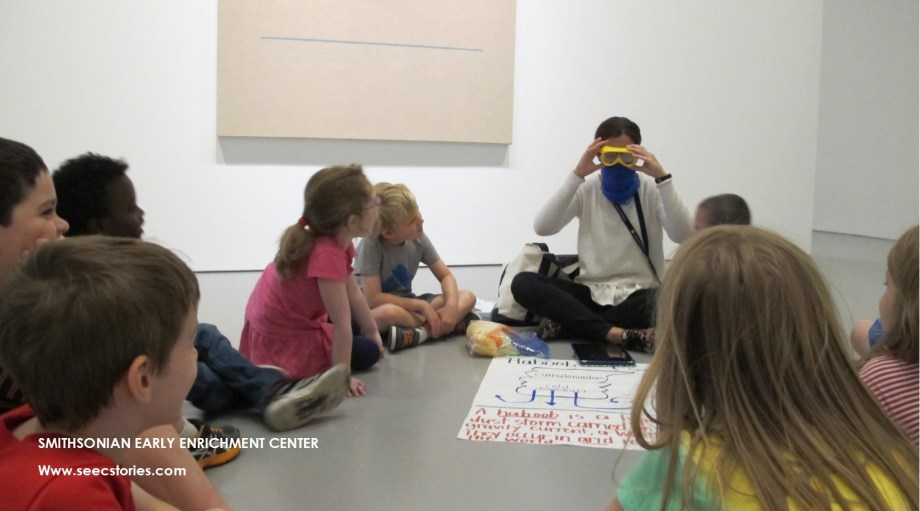
On their walk to the Hirshhorn, the kindergartners felt like they were in a haboob! On this particular day the wind was very strong and it was blowing dirt from the construction area on the National Mall into our faces.  It was not very pleasant, but very appropriate for the day’s lesson. Publication4The class made it to the Hirshhorn and went to the Robert Irwin’s “All the Rules Will Change” exhibit.Publication5They found a piece entitled, “Jake Leg”.  Silvana asked the children to think about what the artwork reminded them of.  Some of the children shared that this piece’s color reminded them of a dust storm, the desert or dust devils. Publication6Next Silvana showed a diagram of a haboob, and pointed out that she had written haboob in arabic, which means, “strong wind”.  She explained what a haboob is and how they form using the diagram and a video of a haboob.

The class used their senses to imagine what it would be like to be in a haboob.  First they explored haboobs with their sense of sight by putting on goggles that were covered in sand (Silvana prepared these by cutting contact paper to fit inside the goggles, and pressed sand onto the contact paper).  The children took turns putting on the goggles and said that they could see shadows, but nothing else.  Looking through the goggles reminded the children of the painting, as they could only see one color. Some of the students said that they might be scared if they could not see anything during a haboob, but Silvana emphasized that while it may feel scary, people have developed ways of protecting themselves during a haboob to stay safe, and they would talk about that more later in the lesson.Publication7Next they focused on what it would sound like to be in a haboob.  They brainstormed sounds they might hear such as crashing noises, gushing winds, sand blowing, footsteps, and people saying, “I want to get inside!”  Then they used their voices and bodies to make these sounds together to make a soundscape of a haboob. Publication2
They explored haboobs through their sense of touch by feeling sand, and imagining how it would feel if it was blowing on their body.Publication11Silvana told the class that haboobs typically happen in the southwest from mid June to the end of September, but they cannot be predicted like a rainstorm.  She said that in order for people to stay safe and protected in case of a haboob, people might carry a scarf and goggles with them.  She put on a scarf and showed the children how this protected her ears, nose and mouth, while the goggles protected her eyes, keeping her body safe.

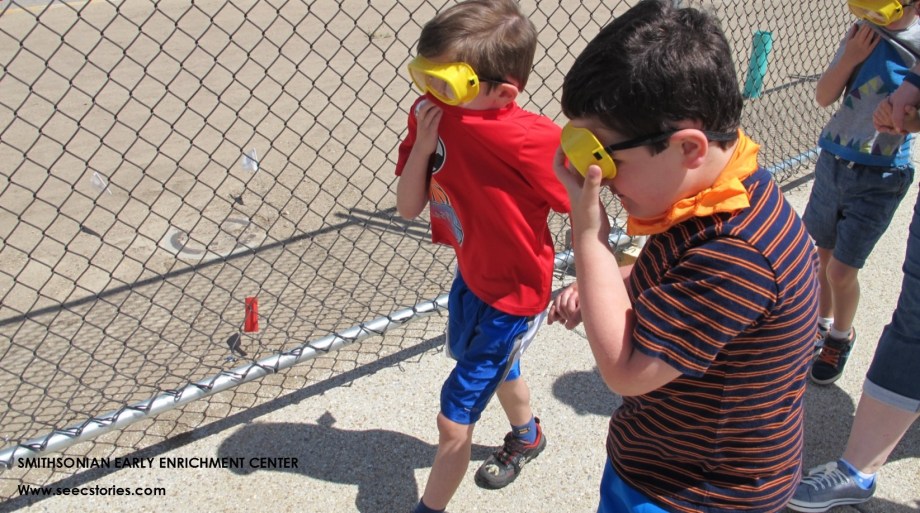
Back outside the kids had a turn to put on goggles and scarves for their walk back to school.Publication9As they crossed the construction site their faces were protected from the dust and dirt by their gear, much like it would be in a haboob.Publication10While the conditions of a haboob are much more intense, the strong wind and blowing dirt helped the children imagine what it would be like to be in a haboob.

After learning about Haboobs, the kindergartners continued learning about weather and meteorology.  Come back next week for more ideas from their unit on Weather! See you in two weeks with our next Teacher Feature!


Objects Teach Us

This blog was originally posted in 2016. Stay tuned for an upcoming blog featuring more staff favorites. Want to learn more about using objects to engage young children? Come to our Learning Through Objects workshop on March 14 and 15.


As I walked through the doors of the National Air and Space Museum (NASM), the four-year-old holding my hand gave a squeeze and whispered, “This is my mommy’s museum.” This was, technically speaking, untrue. Her mother was a scientist who worked with NASM’s meteorite collection – which is an awesome job – but she did not own the museum. But to that four-year-old, the museum where her mommy worked belonged to her mommy – the same way that the toy she played with during morning choices and the seat she sat in on the Metro that morning belonged to her. Children’s concept of ownership is cut and dry. If I am using it, if I care enough for it, if I take it from you, then it is mine. As we grow we learn that this is not the case. Ownership is much more complex and nuanced than possession, but little bits of our childlike tendency to lay claim to the things we love linger.

Think about your favorite bench in the park by your house, the street that makes you smile as you drive past because of its silly name, or the statue you eat lunch next to every year on your anniversary because it is the spot where you and your spouse first kissed. These things are not ours, but they belong to us because we have connected to them in deep and meaningful ways, and we remember them and the stories that go with them long after other memories have faded. In fact, many people pass the most special object stories onto younger generations and the stories and the connections live on past the lives of the people who created them. Objects that evoke these kinds of reactions are all around us, everywhere we go, and we can use them to tell our stories and to teach children how to make their own stories and meaning.

Here at the Smithsonian Early Enrichment Center, the objects we encounter most often are museum objects, and staff and children alike form strong attachments to the objects they see on a regular basis. Some of our staff took the time to tell us about the objects that mean the most to them. Each of their stories is an example of how connecting with objects teach us in a variety of ways.

Objects Teach Us About Our Identities:

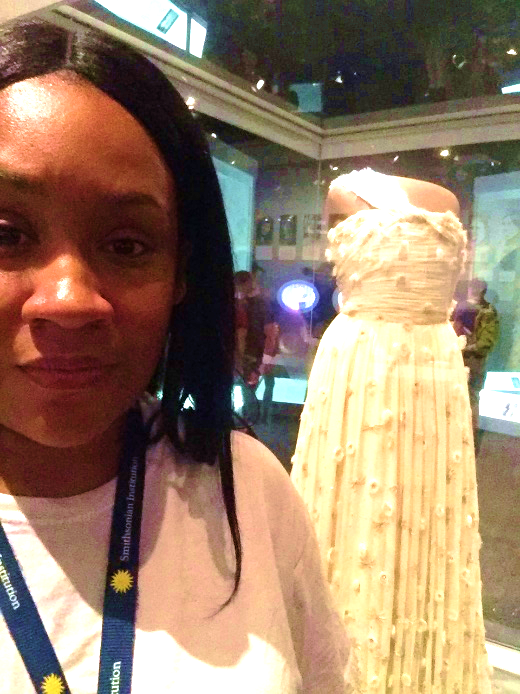
Dana Brightful is an educator who works with three, four, and five-year-olds. Her favorite object is Michelle Obama’s gown from the 2009 Inaugural Ball. Dana says, “Michelle Obama’s Inaugural Ball gown is my favorite object! It speaks not only to my glam side but my African American side as well!”

dana1

Objects Teach Us To Remember:

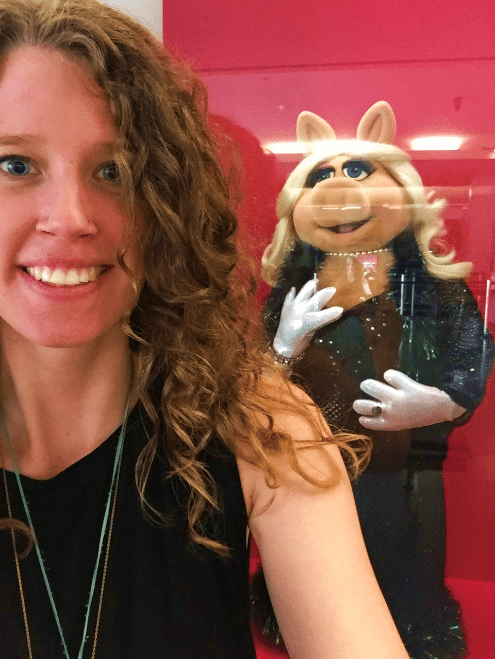
Brooke Shoemaker is a Museum Educator who supports the classrooms for ages three through six. She shared, “I chose Miss Piggy and Elmo, the Muppets that are currently part of a rotating exhibit at the National Museum of American History.  The Muppets are special to me for several reasons.  They remind me of time spent with my family as a child reading Muppet books, and watching Muppet programs (admittedly my family and I still watch “A Muppet Family Christmas” every year).  The creator of the Muppets, Jim Henson, went to my alma mater, University of Maryland. And lastly, the children tend to gravitate towards them too, and I love sharing that connection with them.”

Will.png

Objects Teach Us To Explore:

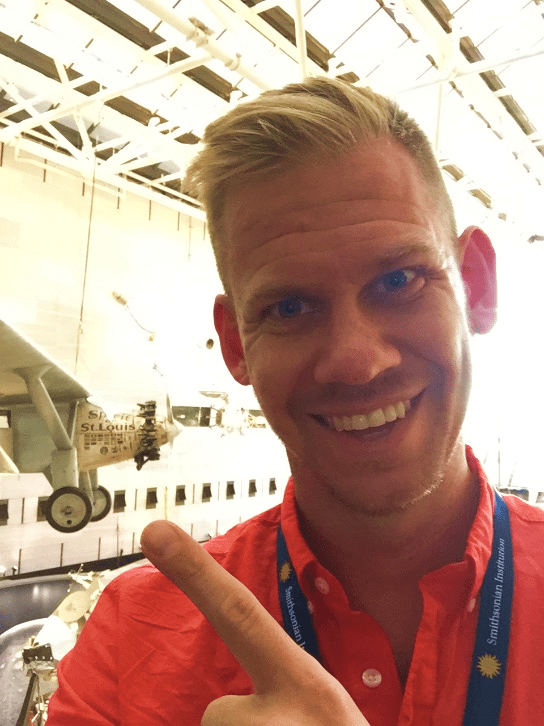
Will Kuehnle is a Classroom Educator currently working with four and five-year-olds. He told us why his favorite object at the Air and Space Museum is special, “A replica of the Spirit of Saint Louis hangs in Lambert International Airport in my hometown of Saint Louis, so every time I went on an air bound adventure growing up I saw it and became inspired by Charles Lindberg’s incredible story. Having the real thing at the Smithsonian is such a treat. Every time I see it I am reminded of the power of curiosity and exploration – from the sails of Columbus to the footprints of Armstrong.”

 brookemisspiggy

What objects do you connect with? Do these stories remind you of your own stories and memories? Are there objects in your community that can provide this kind of connection and these kinds of teaching opportunities for the children in your life? Explore these questions and their sometimes surprising answers with the SEEC team this October 19-20 at Introduction to Objects and Informal Learning Environments.

Art Enrichment Explores: Keith Haring

It’s Teacher Feature Thursday!

This week we are featuring our Art Enrichment educator Carolyn Eby.  Carolyn works with all of our children here at SEEC, and on this particular day I joined her for a lesson with the 4-year-olds about artist Keith Haring and his use of silhouettes. Below you will find images from the lesson, as well as reflections from Carolyn.

COVER1.jpg

What were your topics of exploration? Why did you choose them? Where did they come from?

I chose to study Keith Haring because I love his artwork and I think the topic is fun and interesting for the kids as well. We have been working all year on learning the different elements of art and for our first artist study, I wanted to find an artist that had great appeal and used all of the elements of art in a straight forward way in their artwork.

Why and how did you choose the visit?

The four-year-olds come to the art studio in the afternoon, and due to the timing of the day, we tend to stay in the art studio and utilize images of art, so that we have ample time in the studio to work on our artwork. For this visit I primarily used high quality printed laminated images, and I had enough so that every student had a different image to hold in their hands. It was fun to pass out the images and talk about them one at a time as we held them up.

What were your learning objectives? (What did you want your children to take away from the lesson?)

We have been learning about the elements of art so we looked at Keith’s work from a lot of very different angles. With this lesson in particular, we looked at the beginning of Keith’s career and how he used lines and silhouettes. We took a hard look at what a silhouette is, and how to create a Keith inspired piece mimicking the materials he used earlier in his career (white chalk and a black surface).

What was most successful about your lesson?  

I think the kids loved learning about what a silhouette is by using the overhead projector and tracing each other. I love using collaboration and movement when explaining concepts in the art studio.

How did the lesson reach your objectives to expand the topic?  

Earlier this year we studied lines as an element of art and had a lot of fun doing various projects and activities that touched on the idea of how lines are used in art. After my visit to the National Art Education Association National Conference in Chicago I learned a really fun game from a teacher that uses call and response, but also body movements to learn the names of different lines. The game is now a staple in my classroom and very useful, not only to review types of lines, but also allow children to get their wiggles out!  After we warmed up with the game, we had a lot of fun looking at Keith’s lines.  The kiddos picked up on his use of thick lines to add emphasis and exaggeration to his artwork, as well as how important his lines were in creating simple images.  In a way, it was sort of like a treasure hunt identifying different lines he used!  Building on all their knowledge and looking at it in a different perspective through a group of images from one artist made it easy to work on his use of color the week after. We are also looking forward to looking at his use of shapes, form and space.

What was successful in terms of your preparation and logistics?

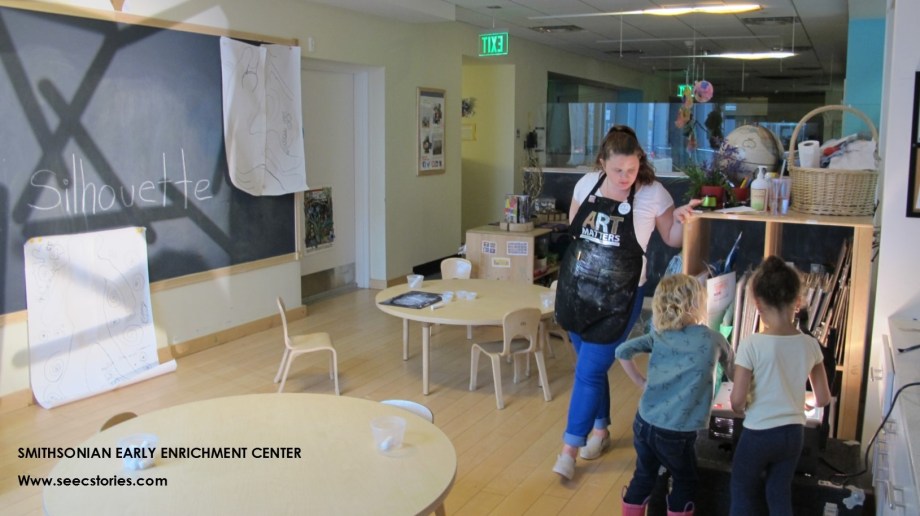
Using the overhead projector in the space I chose worked out really well. The black chalkboard background served as a great backdrop for the kiddos to explore their silhouettes. I also was happy I had enough time to set up the simple materials in an easily accessible manner.

What could you have done differently to better achieve your objectives and expand the topic?

I think I could have spent a little more time introducing Keith before we dove into his artwork. Providing background information about an artist in a narrative form helps children to become interested and connected to that artist. If I had spent more time introducing Keith, the children would have had a better context for his pieces and concepts we learned about during the lesson.

What was challenging regarding logistics?

Overall, I am always working towards creating smooth transitions between lessons, and keeping the kiddos focused as we move from project to project. Since we recognize the importance of the environment on the children’s overall experience, the studio space itself can prove to be a distraction as it has a hallway running through it that happens to be a major artery to the school, and is also very close to the student bathrooms.  I am always trying to redirect and gain focus since there is a lot going on around us. It is also tricky to learn how best to use the space for furniture and activities, and I am always changing things or looking to make them work more to my favor.

What recommendations would you have for another teacher trying out this lesson?

I would recommend that you think carefully about how you are going to introduce Keith. Though his art is fun and delightful to look at, a lot of his work is also very controversial and you have to be ready to answer some difficult questions. A lot of the kids were fascinated by the fact that he had been arrested for putting his artwork on the subway panels of New York City, but we talked about consequences to actions.

Here are a few images from Carolyn’s Keith Haring lesson:

1

Carolyn began her lesson by playing a movement game.  In previous lessons the children learned about types of lines that are used in art.  Carolyn called out different lines and the children made their bodies into line shapes, for example, “vertical”, “zig zag” or “spiral”.

Next, the group looked at images of Keith Haring’s art and made observations.  They first noticed the thick black lines, the movement of the figures, and the lack of details like facial features.  Carolyn told the children that Keith Haring really loved Walt Disney and cartoons, and you can see that inspiration in his art.  She explained that the thick black lines around Keith Haring’s people and objects is called a silhouette.

32

Carolyn turned on an overhead projector and showed the children how you can stand in front of the light and see your silhouette on the board.  Then she split the children into two groups and they each got a turn to play Silhouette Dance Party, where they danced in front of the light until the music stopped and they had to freeze and notice their silhouette. When they froze Carolyn pointed out different parts of their silhouettes, for example, “I can see your hair in your silhouette very clearly” or “the way you are holding your arm above your head makes a very interesting shape.”

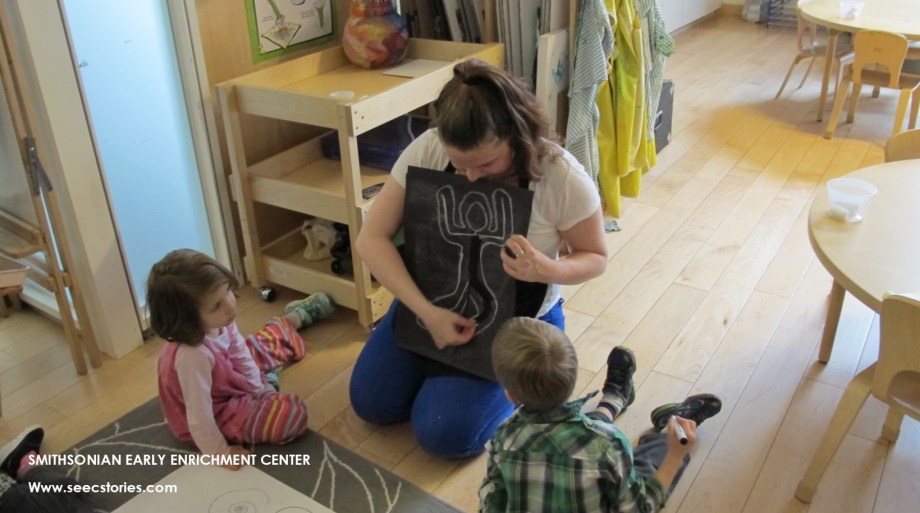
After their Silhouette Dance Party, the group came back to the carpet and took turns drawing a silhouette around one of their classmates.  As they were tracing, Carolyn pointed out that the child’s boots will make the silhouette look a lot like Keith Haring’s art because he drew people with big feet and hands without toes or fingers.  One of the children said to the child they were tracing, “Make fists with your hands so that our outline won’t have any fingers!”  Once they had completed the silhouette the class took turns adding all sorts of lines around the outline to make it look like it was moving.

6

After making their group silhouette, it was time to make their own Keith Haring inspired pieces.  Carolyn showed the group how to get started and the materials they would use – black paper and chalk.  She explained that they are using chalk because that is how Keith Haring got his start.  Since some of his early drawing was with chalk on New York City Subways signs, it also gave the students an opportunity to talk about when and where drawing and painting is appropriate.

7Then the group got busy drawing!

The children drew stick figures, outlined the figure to make a silhouette, and then used a wet cotton ball to erase their figure.  Lastly, they added lines around their silhouette to make it look like it was moving.

1110Before putting their pieces in the rack to dry, Carolyn helped each child spray their work with starch spray so that the chalk would stay in place.

8Once the children completed their artwork, Carolyn invited them to play more with the projector.  She provided popsicle sticks and encouraged the children to arrange them in different shapes, letters or numbers and see how it looked on the wall.

After learning about Keith Haring’s use of lines, Carolyn continued teaching the preschoolers about his use of color and shapes.  Check out our Facebook, Twitter, Instagram, and Pinterest for more ideas from their unit on Artists! See you in two weeks with our next Teacher Feature!

Top 5 – Back to School Edition

Fresh pens, paper and backpacks at all the stores. Heavier traffic in the mornings and afternoons.  Cooler weather.  All tell-tale signs of another school year beginning.  We’ve compiled a Top 5 list of Back to School ideas, which will hopefully inspire you and get your school year off to a great start!

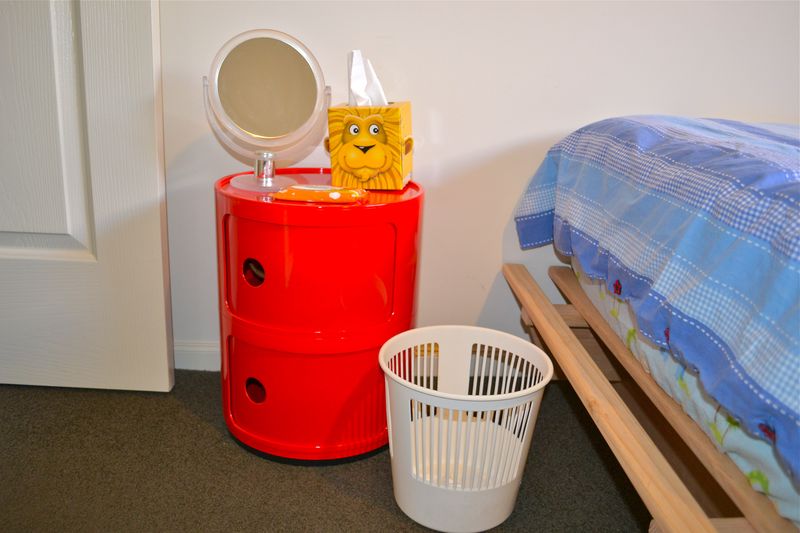
1. Nose wiping station.  The start of fall brings refreshing breezes, but also germs.  We love this idea for a Nose Wiping Station that we found on Montessori Mama and How We Montessori.  Pick a corner of the classroom and set up a shelf with tissues that the children will be able to reach.  Hang a mirror above the shelf so children can see themselves as they wipe their nose to make sure they clean it sufficiently.  Not only will this station keep germs from spreading, it will also encourage self-help and health skills. (Image from How We Montessori).

6a0147e1d4f40f970b015432d37f1f970c-800wi

2. Class collage. This SEEC 3-year-old class made a class collage at the beginning of the year to honor individuality while also creating a classroom culture. Using collages are a great way to talk about multiple, unique parts that make up a whole. The class visited and observed “Dam” by Robert Rauschenberg at the Hirshhorn Museum and Sculpture Garden, and made their own class collage, complete with photos of their faces.

3. Documentation.  Documenting can seem daunting when you’ve got so many other things going on at the beginning of the year, but these ideas could make it easier, while making learning more visible in the classroom. The image on the left is from the TransformationEd blog and features their Rabbit Road, which depicts their learning process during their inquiry on Rabbits. Displaying the journey on a linear road is a concrete way that children can see their work over time as they explore a topic.  The image on the right is from the Science Notebook, Teaching, and Technology blog, which depicts another documentation idea – choose a space in the classroom (that children can see) to display blank sheets representing each month of your school year.  At the conclusion of each month (or throughout) add images or work that share what the class has been doing.  Keep them up all year long, even as you switch out other displays and documentation, to help children see their work and progress over the whole school year.

4. Organizational hacks.  In our opinion, there are few greater feelings than starting a new year with an organized classroom.  This yahoo list has 15 organizational hacks from around the web that will help you feel fresh and ready. (Image on left from Motherhood On a Dime, image on right from Organized Cassroom)

5. Exploring Questions.  Fostering a sense of wonder and curiousity is something we take very seriously here at SEEC.  One of our four-year-old classes spent a considerable amount of time exploring questions last September and October to set them up for an inquisitive year.  To read more about their unit, click here.

For more Back to School ideas, visit our Pinterest board here.  Happy Back to School everyone!

Teacher Feature: Kindergarten Spanish Explores Paraguay

It’s Teacher Feature Thursday!

This week we are featuring Maureen Leary who teaches Spanish in the Kindergarten classroom, which consists of small group lessons two mornings a week, and a connecting museum visit one afternoon a week.  The Kindergarten class has been learning about different countries in South America, and I joined them for a lesson about Paraguay and a common food found there – cornbread.  Below you will find a reflection from Maureen and images from the lesson.
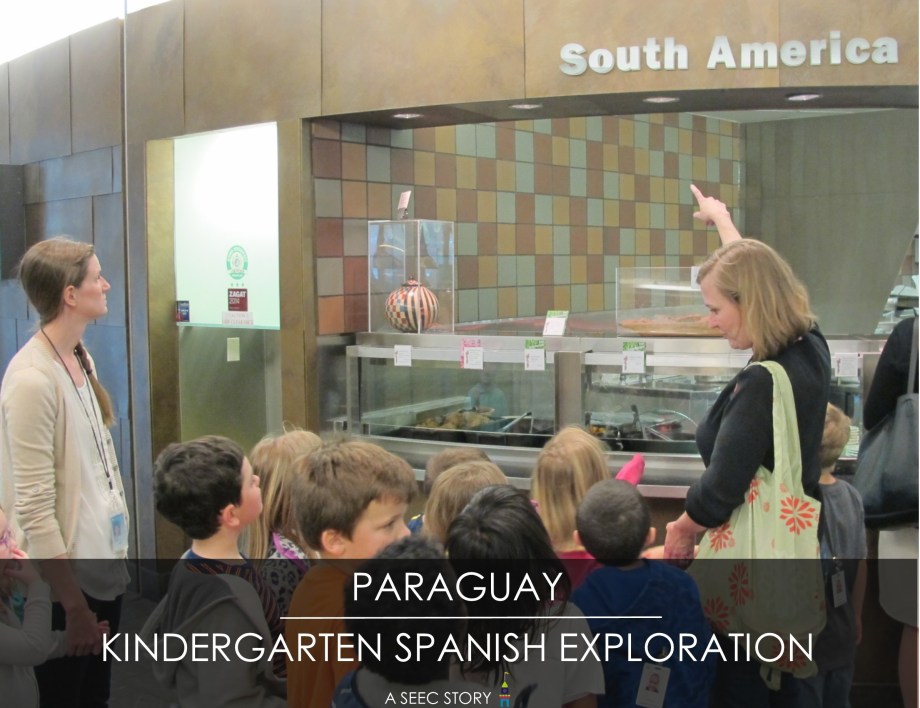
Cover

What were your topics of exploration? Why did you choose them? Where did they come from?

We were exploring the country of Paraguay, and a traditional dish called Sopa Paraguaya. The name means Paraguayan Soup but it’s actually a type of cornbread!

I chose Paraguay because we have been exploring all the countries where Spanish is an official language. We have done this geographically, starting with Spain, where the language originated, and then moving on to Mexico, Central America, the Caribbean, and now South America. For each new country, we take a look at the map to see where it is in relation to the others we’ve learned about. In this way the students can see the connection between all the countries we explore, and the curriculum follows a natural progression.

I try to choose diverse topics from week to week, to keep the students interested and to emphasize that Latin American culture is very rich and has contributed so much to the global community. Over the course of the year we’ve looked at art, music, geography, history, architecture, and of course, cuisine!  For our classroom lesson we learned a bit about the history of Sopa Paraguaya and we followed a recipe to make our own. Cooking with kids is a fantastic way to target numerous learning objectives at once. We covered the cultural piece with the history of the dish, we focused on literacy and vocabulary in both Spanish and English by reading the recipe together, we practiced math concepts by measuring the ingredients, and we learned a little science by observing how the ingredients came together to make the bread.

Why and how did you choose the visit?

We visited the Mitsitam café at the National Museum of the American Indian. We started with a visit to an exhibit case that highlights how traditional Native American foods from both North and South America have become essential to our cuisine. Some of the ingredients we had talked about were included in the case, and we had a couple of food items with us to pass around. We then went into the café to take a look at what types of foods were featured in the South American section.  We purchased some cornbread so that we could all try a taste and compare it to the cornbread we made in the classroom. I chose this visit because it gave the students a chance to see how relevant traditional Paraguayan/South American foods are to US and world culture.

What were your learning objectives? (What did you want your children to take away from the lesson?)

My learning objectives were to introduce the students to some of the staples of Paraguayan food and to show how they might be similar to and/or different from foods the students are familiar with.  We had previously done lessons on Mexican food and Cuban food, so I also wanted to make connections with those lessons, to help the students understand that cuisine can vary quite a bit regionally, but there can also be a lot of overlap and influence of cultures on one another.

What was most successful about your lesson? 

Cooking in the classroom and eating at the museum were definitely the most successful parts of the lesson. The students really enjoyed the cooking experience and they were so excited to try the finished product.

How did the lesson reach your objectives to expand the topic?

Going to the museum and seeing the foods we had talked about highlighted in an exhibit case, and then on sale in the café, helped the students to understand the relevance and importance of the South American contribution to global food practices and traditions. Instead of just taking my word for it, they could see the concept in practice at the museum.

 What was successful in terms of your preparation and logistics?

The preparation of the cornbread in the classroom went really well. I put a lot of time into writing out the recipe in a way that would be visually understandable for the kids (large print, pictures to go with food items, etc). I also thought about how to break up the steps so all the kids got a chance to participate in a hands-on way that they enjoyed (measuring, pouring, mixing, etc).

What could you have done differently to better achieve your objectives and expand the topic?

If I were to do this lesson again I would definitely test the recipe at home before making it with the students. The students and I thoroughly enjoyed making the bread, but when it came time to eat it, it turned out to be pretty bland and not many kids liked it. A different variation on the recipe would have probably been better. Fortunately we also had samples of the cornbread sold by the café, and that was delicious! One way I could have expanded the topic would be to provide more food items for the students to touch, smell, etc., as examples of staples that come from Paraguay. I intended to do this, but had difficulty finding the items at the store. If I had looked for them a bit more in advance I probably could have found them.

 What was challenging regarding logistics?

This lesson required significant time outside of the classroom for preparations. Although I always spend time on research and often on preparing materials, this lesson also required a trip to a specialty grocery store as well as some prep work at home on the ingredients to make the cooking process smoother in the classroom. I also needed to enlist the help of another teacher in pulling the bread out of the oven, as I was out of the center when it was done cooking! We also had one student who was not able to eat the bread due to food sensitivity issues, so we had to make sure to alert the family in advance to provide an alternative when we were sampling the bread.

 What recommendations would you have for another teacher trying out this lesson?

The main recommendation I have is to test the recipe before trying it with the kids. The kids were so excited to make the bread and were really looking forward to trying it, so it was a disappointment that it wasn’t very tasty.

Here are a few images from their lesson on Paraguay:
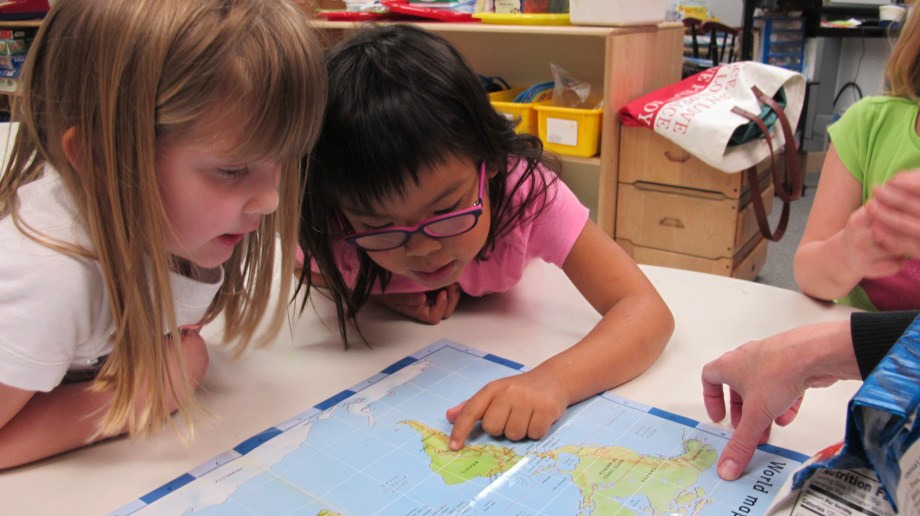
IMG_1978In the morning Maureen met with small groups to introduce the lesson and make cornbread.  First she showed the groups a map of the world and the students were quick to point out the countries they had previously learned about.  Then she showed them where Paraguay is and explained that it is different from the other countries they have learned about so far because it is very flat with no mountains, and that it is sometimes called “the heart of South America” because it is centrally located, with no water around it.IMG_1952Next she introduced a recipe for Sopa Paraguaya, a traditional food in Paraguay.  She told the children the folk story of the dish: a long time ago there was a president of Paraguay who loved a soup made of milk, cheese, egg, and corn flour.  One day the president’s chef accidentally added too much corn flour, and not having the time to make a new dish, decided to bake the mixture, making a “solid soup”.  The president loved it and named it Sopa Paraguaya.

IMG_1959Then it was time to make their own Sopa Paraguaya.  Maureen read the recipe in Spanish and then in English, with the children helping to measure and add the ingredients. IMG_1963Each group helped to add and stir all the ingredients.  Maureen then cooked the cornbread during the children’s afternoon rest time. IMG_1998At SEEC we believe young children need real life experiences in the community to make concrete connections to what they are learning in the classroom.  So, after rest time Maureen took the class to the National Museum of the American Indian to learn more about Paraguay, and its food, through observation of objects and hands-on exploration.IMG_2004The class sat in front of the “American Indian Foods in the Global Pantry” Exhibit Case and Maureen explained that a lot of food we eat today originated from other countries.

The children noticed many familiar foods including corn.  Since the objects were in a case, and could not be handled, Maureen came prepared with an ear of corn and passed it around so the children could examine and feel it.  They ran their fingers over the kernels, smelled the corn, and felt the husk.  Bringing (non-messy) objects along to the museum makes traditional gallery spaces more interactive for children.

IMG_2013The children recognized lots of food in the case and remembered how they had used it in the past (“We used avocados when we made guacamole!”), or were excited to see some of their favorite foods, like peanut butter, and were surprised to learn that items we eat so commonly in the United States actually originated somewhere else.  In this way, the children made personal connections to the objects in the museum and gained a new perspective about where their food comes from.
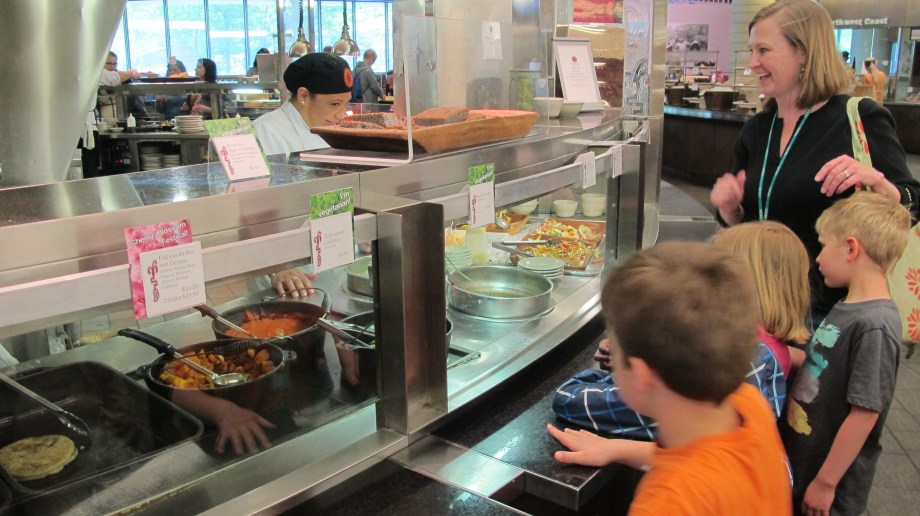
IMG_2025Next they went into the Mitsitam Natives Food café , which offers Native foods from throughout the Western Hemisphere.  Maureen asked where Paraguay is located and the class said, “South America”, so they went to the South America section to see what foods were being prepared.  They noticed blue cornbread, and Maureen explained that it was blue because they used blue corn to make it.  They asked for two pieces of cornbread in Spanish and went to try it.IMG_2033The class sat down and Maureen and the Kindergarten teachers passed out a piece of the cornbread they had purchased, and a piece of the cornbread they had made.  IMG_2034The Kindergartners tried both kinds, discussed the differences between the two, and their preferences.  They preferred

They enjoyed taking a bite out of both and exploring the foods that originated in Paraguay, and South America.

Through this South America unit, the Kindergartners learned about different countries and their unique characteristics. Check out our Facebook, Twitter, Instagram, and Pinterest for more ideas from their Spanish classes! See you in two weeks with our next Teacher Feature!

Playing with Electricity

During our recent seminar, Play: Engaging Children in Object Rich Environments, participants observed a museum or community visit with our classes, who were all exploring electricity.  But how do you make electricity playful?  And how can educators make the same topic developmentally appropriate for infants, all the way up through five-year-olds?  Below are examples from our classes, ranging in age, across downtown DC, all engaging in playful learning about electricity.

Infants

Our youngest class, the Cottontails, love water play so the class chose to explore watermills . Before their visit, their teachers gave them laminated prints of paintings and images of watermills to look at, while describing their shapes and how they move.  Next they visited the Haupt Garden to play with watermill toys in a fountain to see for themselves how water, when poured onto the watermill, makes the wheel turn.  Through their play the children practiced fine motor skills, witnessed cause and effect, and heard new vocabulary.

The older infant class, the Ducklings, went to National Gallery of Art to see MultiVerse by Leo Villareal.  On their way to the museum their teachers talked about lights, and the Ducklings began pointing to lights along the way in hallways and elevators.  Once at the piece, a tunnel with a moving walkway covered in flashing lights, the children were given glow sticks and flashlights to explore on their own.  They used their fine motor skills to turn the lights on and off, waved them around to see their effect, and watched the flashing lights as they practiced new vocabulary.

Toddlers

One of our toddler classes, the Toucans, has been studying the Olympics, so they worked this lesson into their unit by learning about crowd energy.  They talked about why people cheer, and how encouragement and support can make someone feel.  They ventured to the Hirshhorn Museum and cheered on the fountain, which gradually gets higher.  While cheering for the fountain the Toucans practiced their social-emotional skills and also developed literacy skills through the use of songs and chants (“Take Me Out to the Ballgame” and “We Will Rock You”).

The older toddler class, the Dragonflies, focused on light versus dark, and how light gets its energy from different sources.  To illustrate this, the class experimented turning a lamp on and off when it was unplugged versus plugged in.  After their experiment they too went to MultiVerse by Leo Villareal at National Gallery of Art to see the small circular lights go on and off while they played with flashlights and glow sticks. They used their fine motor skills to control their lights and sang, “This Little Light of Mine”, which reinforced the concept while also practicing new vocabulary.

Twos

One of our two’s classroom, the Penguins, also focused on the “on and off” functions of objects that use electricity.  In the classroom they looked at light bulbs, and turned the lights on and off.  The class played musical chairs, which meant paying extra attention to when the radio was on versus off, while also engaging in gross motor play and practicing social-emotional skills.  To extend their learning they went to Lighting a Revolution at the National Museum of American History where they looked at a timeline of light bulbs and made observations about how they have changed in size and shape over the years.

Threes

The three-year-old class, the Wallabies, had been learning about trees, so they merged this with electricity and learned about the impact of lightning on trees.  The group went to the Hirshhorn Sculpture Garden to see Needle Tower by Kenneth Snelson .  The class discussed how storms and lightning can be very damaging to trees and buildings, but they can be protected by lightning rods, like the tall metal sculpture. They built a tower using connector toys, practicing their fine motor and problem solving skills.  Lastly, they played “Rain, Rain, Lightning” (just like “Duck, Duck, Goose”) to reinforce that lighting can be unpredictable, while also working on their turn-taking and gross motor skills.

Fours

The four-year-olds learned about renewable energy, specifically wind energy.  They went to the US Botanic Garden to see wind turbines, but found that the turbines had recently been removed.  When the teachers explained to the class that the turbines had been removed they made connections to their past study of animals and conservation, theorizing that they had most likely been taken down due to their potential harm to birds.

After learning about the parts of a wind turbine, the class split up into groups and used their bodies to create their own wind turbines with each child acting out a key role of either the wind, blade, generator, tower, or electron.  Through their play the children were actively engaged in scientific thinking about the different parts of a wind turbine, how they work together, and their effect. Working in groups to bring their wind turbine to life also gave the students a chance to practice teamwork.

Reflections

Through their observations the Play seminar participants reflected that the play they witnessed not only engaged young children in the concept of electricity, but also strengthened developmental and learning skills.  One participant was struck by the amount of learning the infants were engaged in through their water play, including their careful concentration on pouring water and making the watermills spin.  Participants also  noticed how the play and content of the lessons carried over into the walks back from their visit, for example, pointing out lights in elevators or talking about lightening.  

This day of playful electricity lessons also proved useful for our team. The experience of exploring the same topic on the same day helped us to reflect on the way we use play in the classroom, as well as how topics can be explored in a meaningful and developmentally appropriate way across ages.  We found we were inspired by each other’s unique and creative ideas about how to use the museums and community for playful, object-based, electricity lessons.  We also discussed the standard challenges of taking our students into the communities and museums, such as objects being removed right before our visit, and how we can be flexible to still achieve a successful and engaging lesson in spite of these logistical challenges. We’re already thinking about another all school project to reflect on our practice further, so be sure to keep an eye out for a future blog.

To learn more about SEEC, object-based learning, and play, join us for one of our Professional Development opportunities!


Teacher Feature: Three Year Old Classroom Explores Pirates

It’s Teacher Feature Thursday!

This week we are featuring Dana Brightful and Erin Pruckno in the three year old Wallaby classroom.  Dana and Erin were inspired by the children’s varied interests including mermaids, pirates, dogs, shadows, and fairies, and decided to incorporate them all together in an exploration of Peter Pan.  I joined their class for a visit to the National Gallery of Art where they learned about pirates. Below you will find a reflection from Dana and Erin, and images from their visit.

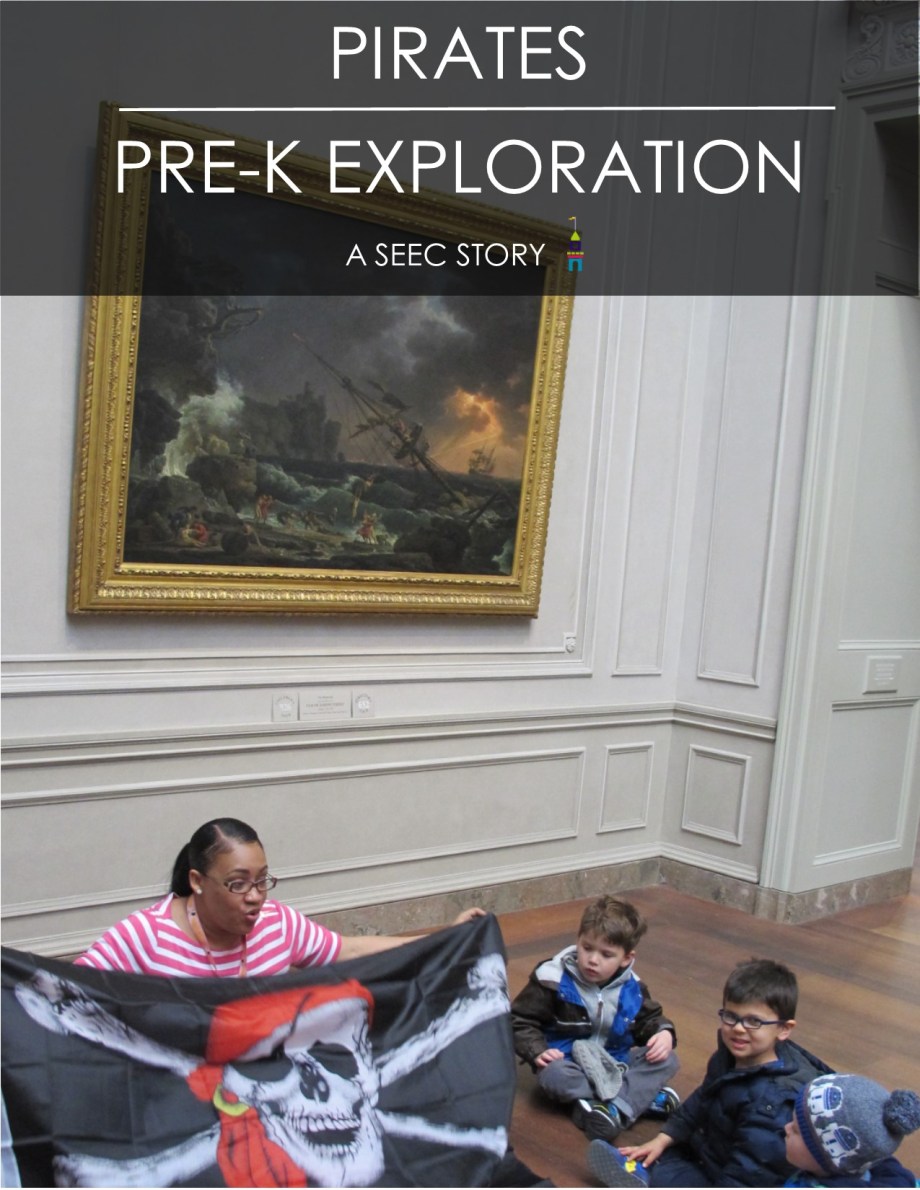
Cover 2.jpg

What were your topics of exploration? Why did you choose them? Where did they come from?

Our topic this particular day was pirates: who they are and what they do in the world. I chose this based on our overarching theme of Peter Pan and the Pirates that are in the story. I wanted to introduce the children to what real pirates do as opposed to what they see on familiar television shows like Jake and the Neverland Pirates. It also was a way to reconnect and build upon previously discussed concepts. Pirates take things that do not belong to them which, according to our lessons on the Golden Rule back in December 2015, is not the right thing to do since we have to treat others the way we want to be treated. The lesson gave me an opportunity to touch on real pirates and respecting others.

Why and how did you choose the visit?

I chose The Shipwreck by Claude Joseph Vernet because it lent itself to the concept of pirates taking over another ship. Since I already knew I wanted to continue practicing visible thinking with the class, I wanted to not only use a painting closely related to pirates, but one that had lots of details for the children to look at and seriously think about what they saw, what they thought and what they wondered about the painting. It’s always amazing how many different thoughts come from one painting when there are many details for the children to pay attention to during the routine. The National Gallery of Art was my first choice of where to find a painting and their site (NGA.gov) is user friendly! After typing in ships and filtering the results to show only paintings on view, I not only found The Shipwreck, but it gave a map of where to find it in the museum, making it easier to find the day of my lesson.

What were your learning objectives? (What did you want your children to take away from the lesson?)

There were three learning objectives for this particular lesson: (1) discover what pirates are and what they do (2) practice their visible thinking skills by utilizing a thinking routine called See, Think, Wonder (Visible Thinking) while looking at The Shipwreck by Claude Joseph Vernet and (3) develop their gross motor, social emotional and cognitive skills by playing Capture the Flag.

What was most successful about your lesson?

The most successful part of my lesson was playing Capture the Flag on the National Mall. The children, already knowing the boundaries of where to keep their bodies on the large outdoor Mall space, all participated. They understood that they needed to capture the flag by catching the teacher that had it, and once captured, to ‘hoist’ up the pirate flag. They used their cognitive skills to stop and assess the best strategy to capture the flag. Instead of running in circles directly behind the teacher, one child stood back and positioned himself to capture the teacher from the front end.

How did the lesson reach your objectives to expand the topic?

By utilizing the thinking routine and documenting their thoughts, I was able to see a thought pattern of what ideas or thoughts needed to be explored in further details in the coming days. For the questions that could be answered, I documented it and planned to answer those questions on the following teaching day.

What was successful in terms of your preparation and logistics?

With preparations, I prepared to have 2 charts to document the children’s thoughts for the thinking routine, had a book to begin our museum circle, a toy boat, small flags, a large flag and a large Pirate flag in a museum bag the week before my lesson. As mentioned above, for logistics, I was able to see on NGA’s website the exact gallery for the painting and knew exactly what part of the mall we would play our game afterwards.

What could you have done differently to better achieve your objectives and expand the topic? 

I could have opted to not play Capture the Flag and instead answer their questions after our thinking routine, but I chose not to, simply because getting out of a space where the children had to be quiet, calm and still was more important at the time. Often I try to plan a lesson that allows me to easily assess where the children are cognitively, which requires them to be focused for long periods of time. So I often try to balance that out with a planned gross motor activity before or after the lesson, which is why I chose not to expand on their questions over the game.

What was challenging regarding logistics?

The only challenge was finding the gallery the day of since it was behind another gallery. This was one of the more easy lessons in terms of logistics since NGA has ample space and it’s easy to find the gallery you want to visit.

What recommendations would you have for another teacher trying out this lesson?

The best piece of advice I can offer is to prepare a chart for the thinking routine  See, Think, Wonder beforehand and do the routine in small groups. It’s a lengthy routine that requires a good amount of wait time for each child’s response. If your classroom has a lot of children that require a lot of gross motor activities, play Capture the Flag first then do the thinking routine if your schedule allows.

Here are a few images from their exploration on pirates:

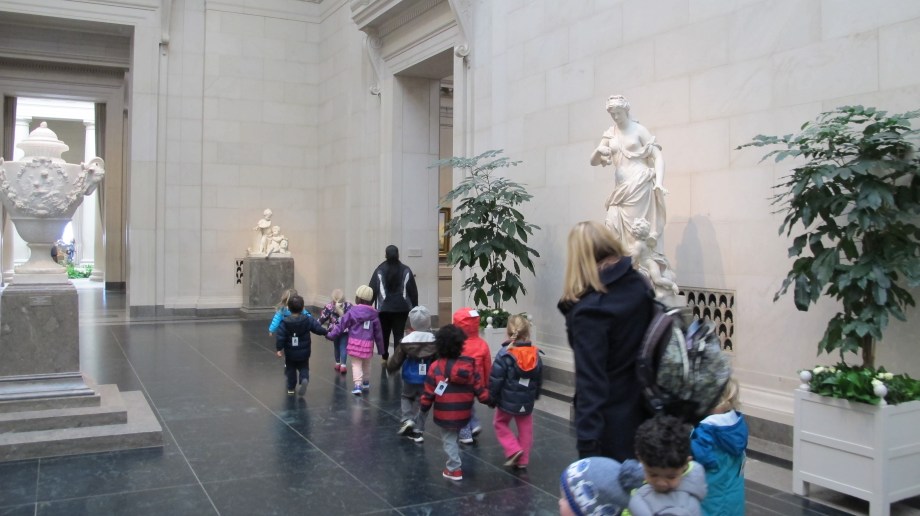
IMG_1568The Wallaby team noticed an interest in pirates among their students, so they thought exploring pirates during their unit on Peter Pan fit perfectly.  The class went to the National Gallery of Art to find The Shipwreck by Claude Joseph Vernet.
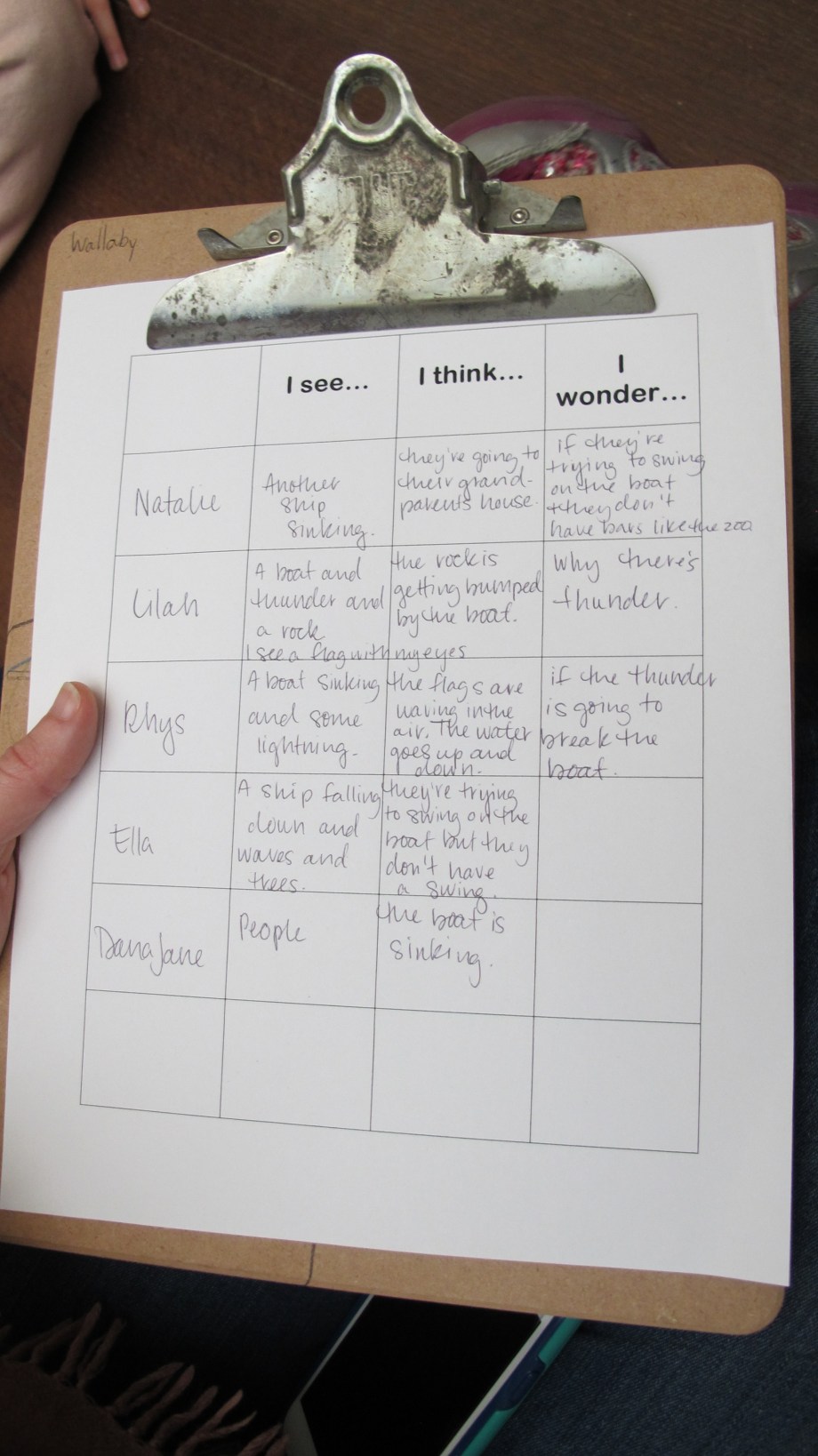
IMG_1587Dana began by reading Sloop John B: A Pirate’s Tale by Alan Jardine to get the children in a piratey mood.  After the story she pointed out the ship’s flag in the painting and brought out many small flags for the class to see.  She explained that flags let people know where a ship is from, and the first thing pirates do when they capture a ship is take down the ship’s flag and hoist up their own.  She asked the students, “is that a nice thing to do?”, to which they all replied, “NO!”  The kiddos said that pirates might take other things like nap items, food, water bottles or money.  IMG_1593 - CopyNext, the class did a “See, Think, Wonder” exercise to practice careful looking of the painting.  (This is a visible thinking routine from Project Zero, and more information can be found here.)  Dana split the class into two groups and had clipboards ready to go with a See, Think, Wonder template to easily record the children’s statements.  IMG_1603IMG_1602First Dana and Erin asked each child in their circle what they saw in the painting and recorded what they said.  Next they went around the circle again and asked each child what they thought about what they saw.  Lastly, they asked each child what they wondered about the painting.  This gave the children time to observe and think about the painting, and also gave them a turn to talk frequently, keeping them engaged in the activity. 
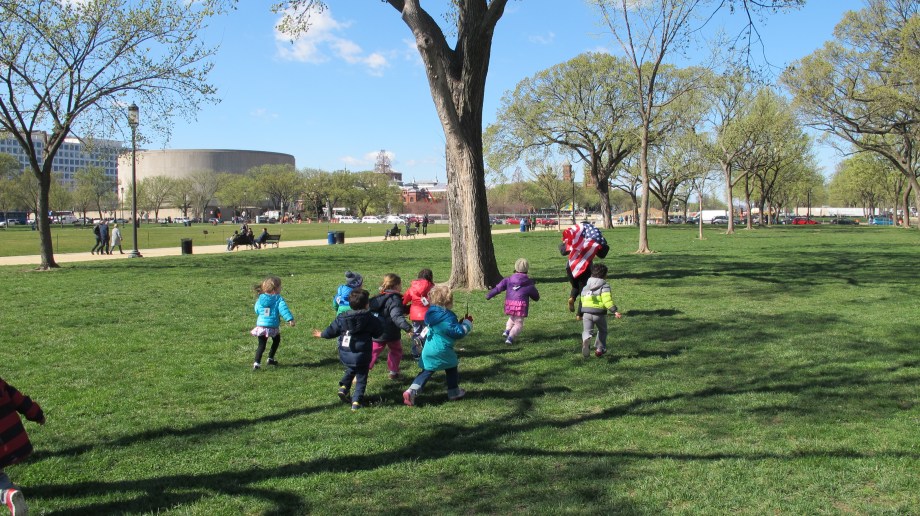
IMG_1605 - CopyIMG_1608Next, Dana pretended to be a pirate and looked through her telescope (really a paper towel roll), and spotted a ship in the distance.  She said she was going to sail up to the ship, get on board, take down the ship’s flag, and put up her own pirate flag.  The class agreed that if they saw a pirate flag on a ship that they would sail away from it!IMG_1611To end their lesson on pirates they went onto the National Mall to play a game of Capture the Flag.  First the children practiced their mean pirate faces and saying, “Arrrr matey!” Untitled.png
Dana gave one child the pirate flag and made sure it was tucked in tight so that it wouldn’t fly away while they were running.IMG_1627Then it was time to RUN!  They chased Dana’s “ship” as she sailed with her flag. IMG_1620When they caught her they excitedly took down the flag and hoisted up their pirate flag!

During their week on pirates the children learned about flags as a way of communication, and boats. Check out our Facebook, Twitter, Instagram, and Pinterest for more ideas from their lesson and their unit on Peter Pan! See you in two weeks with our next Teacher Feature!

Teacher Feature: Three Year Old Classroom Explores Land, Water, and Air

It’s Teacher Feature Thursday!

This week we are featuring Katie Heimsath and Tina Brimo in the three year old Koala classroom.  The class had just ended a unit on Space, but Katie and Tina noticed that the children were asking lots of questions about the Earth, so they wanted to spend some time focusing on the Earth’s ecosystems, creatures, land forms and conservation.  I joined their class for one of their first lessons focused on the Earth. Below you will find a reflection from Katie and Tina, along with images from the lesson.

COVER

What were your topics of exploration? Why did you choose them? Where did they come from?

Our class was wrapping up a long unit on Space and we thought it would be a great idea to take a closer look at Earth.  It was a pretty natural transition between units.  Our kids were eager to compare Earth to other planets in our solar system that they had recently learned about.  We wanted to start our study of Earth with some basic ideas, one being that our planet is made up of a few things: land, water, and air.

Why and how did you choose the visit?

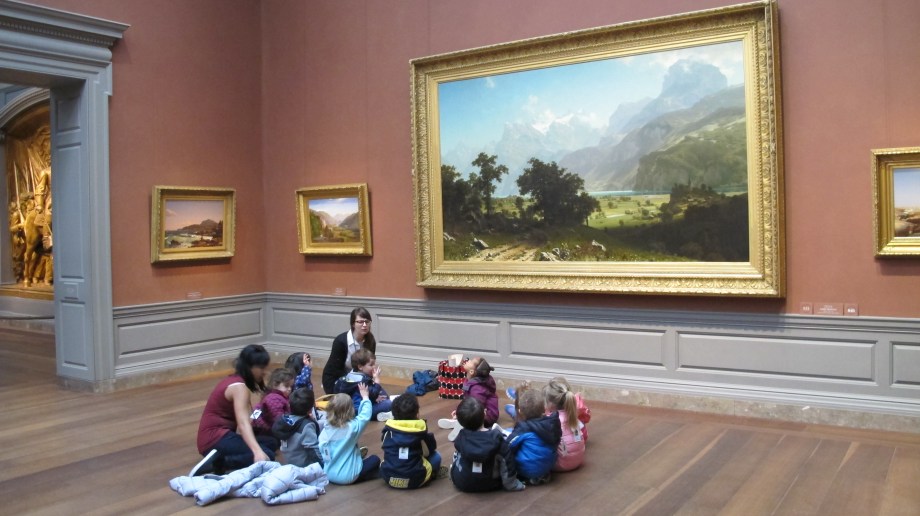
We chose to visit the National Gallery of Art to spend some time in front of their huge landscape paintings.  The one we chose, Lake Lucerne by Albert Bierstadt, is extremely visually appealing and had all the elements we were discussing in the lesson.

What were your learning objectives? (What did you want your children to take away from the lesson?

Since we were starting a new unit, our main objective was to form a foundation for the class to continue to build on.  The end goal of this particular lesson was to convey that Earth is made of some of the same things as other planets, but the way they are combined makes it possible for us to live here.  This lesson was also broad enough for us to gauge the children’s interests and think of ways we could further explore Earth throughout the unit.

What was most successful about your lesson?  How did the lesson reach your objectives to expand the topic?  What was successful in terms of your preparation and logistics?

Our class was so excited to apply what they learned about other planets’ atmospheres and surfaces that the main ideas of the lesson flowed very smoothly and naturally. We didn’t really struggle to make connections with the topics.  We planned several activities that were short and sweet, which included lots of movement, turn-taking, and encouraged the children to share and apply the knowledge they already had about Earth.

The gallery we went to is large and has plenty of room for us to sit comfortably and have a lesson. We were careful to go earlier in the morning so there would be less people visiting the museum; doing this ensured that we didn’t feel rushed or in anyone’s way.

This gallery is also full of other landscape paintings to reinforce the topics we were covering. Later in the week we talked about land forms and bodies of water, which our class was quick to recognize in our later visits to NGA.

What could you have done differently to better achieve your objectives and expand the topic?  What was challenging regarding logistics?  What recommendations would you have for another teacher trying out this lesson?

All in all, the lesson went very smoothly.  After taking turns with the sorting game, our kiddos were feeling a little restless and were having a hard time staying still and respectfully quiet.  We had initially planned to read Earth Dance by Joanne Ryder in the gallery, but attention spans were short.  We made a last minute decision to read the book outside on our playground.  As we left the museum, more inspiration struck, and we made our way over to the NGA Sculpture Garden to read the story there instead.  Fortunately the weather was nice, and there was plenty of space for us to incorporate movement to the book.

Here are a few images from their lesson on Land, Water, Air:

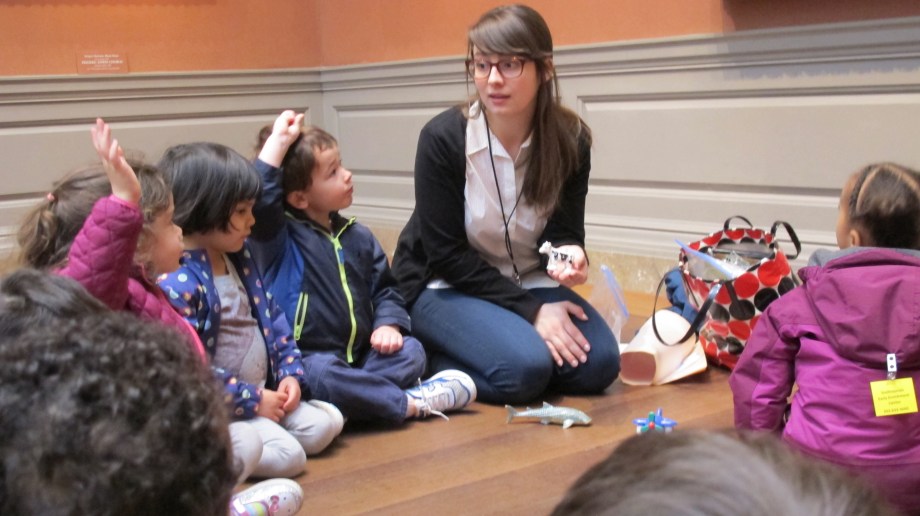
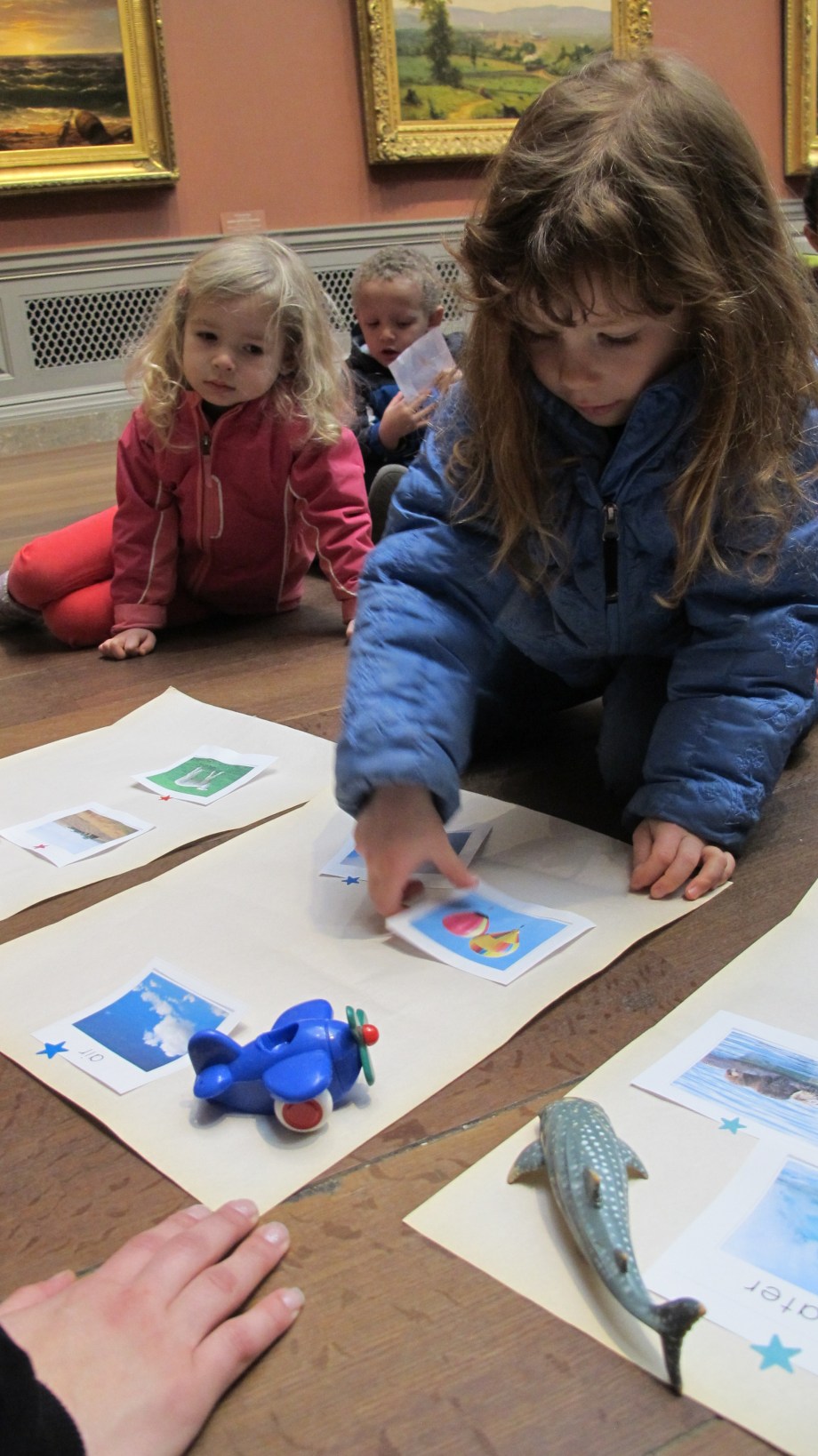
IMG_1393 The Koalas visited the National Gallery of Art to begin their exploration of Earth, specifically what elements it is made of.IMG_1400They found Lake Lucerne by Albert Bierstadt, and sat down for their museum circle. Katie began by explaining that the Earth is made up of land, water, and air, each of which is depicted in Lake Lucerne.  She asked the class to observe the landscape and find something in the land, in the water, and in the air.  The children noticed animals, trees, people, flowers and a castle on the land, boats in the water, and clouds in the air.IMG_1412Next the class played a game to categorize items into where they are found: the land, water or air.  As a group they identified that a shark goes in the water, a plane flies through the air, and a cow belongs on land.IMG_1417Then Katie gave each child a picture of something that belongs either on land, in water or in the air.IMG_1425IMG_1426After carefully looking at the object or animal in their picture, Katie called each child up one by one to stick their picture on the environment where it belongs. IMG_1432Once everyone had had a turn the class had three pages full of objects and animals that are found in the water, air or on land.IMG_1437After completing their sorting game, the class began to head out of the gallery, however they stopped when they spotted more landscape paintings by Thomas Cole, and identified elements of the land, water and air.IMG_1442
After their visit they headed to the National Gallery of Art Sculpture Garden to read Earth Dance by Joanne Ryder, which asks the readers to use their bodies to imagine they are different aspects of Earth.IMG_1469IMG_1459The children spread their hands out wide and spun around like Earth.IMG_1453   IMG_1466
They raised their hands to the sky to be tall mountains, and whispered like breezes through the trees.IMG_1467IMG_1464
They pretended windswept grass was tickling their cheeks and roared like icebergs cracking.  After sitting during the museum circle, the children loved getting up and moving as they used their bodies to pretend to be different parts of the Earth.

After ending their unit on space, the Koala class focused on Earth, and what makes it unique and suitable for life, unlike the other planets in our solar system.  Through their lesson on Land, Water, Air, the class was introduced to Earth’s geography, and why it is important. Check out our Facebook, Twitter, Instagram, and Pinterest for more ideas from their unit on Earth! See you in two weeks with our next Teacher Feature!

And the Winners are…

Each year the Smithsonian Early Enrichment Center honors several of its educators for their outstanding contribution to our school.  Last week we enjoyed a Teacher Appreciation dinner where these awards were announced.

We’re thrilled to share that threes teacher Erin Pruckno was recognized as this year’s Diane Homiak award recipient, an honor that was well-deserved! The Diane Homiak award recognizes the commitment, creativity, and contribution of a stellar educator.   Erin’s dedication to the children in her class, her passion and creativity, and her support of parents were highlighted by those who nominated her.IMG_7003

This year we also recognized a first-year teacher as SEEC’s Rookie of the Year – that honor went to kindergarten teacher Silvana Oderisi!  Silvana was also singled out for her dedication to her students, her ability to reach each one individually, and her communication with parents. She’s made a significant impact in just a short time at SEEC, and we feel lucky to have her here!IMG_2234

Each year we also ask the staff to nominate peers who go out of their way to work collaboratively and support each other. We recognized three teachers as Team Players for their respective parts of the school.  Anne Kearney, Carolyn Eby, and Chris Conroy Smith were recognized by their colleagues as consummate professionals who do so much to support their colleagues.

While we were able to specifically recognize these five teachers, we have many more who were not award recipients – we are so fortunate to have an entire staff of dedicated, talented professionals!  Congratulations to all!