SEEC’s Take on Emergent Curriculum

The following post was authored by Dana Hirsch who has been at SEEC since 2005 and has taught  almost every age group. She is currently the Director for Preschool Programs. Dana studied Child Development and Family Science at North Dakota State University, and has a Masters of Education in Curriculum and Instruction for Early Childhood Education from George Mason University. Her three-year-old daughter is currently a student at SEEC. For this blog she drew upon her experience in the classroom, and intimate involvement with writing SEEC’s current emergent curriculum approach.

dana
Dana teaching a PreK-4 class

During my career as an educator, and now director, I’ve had the pleasure of working with every age from infant to kindergarten.  People often ask me which is my favorite age, and my answer is always the same; “I don’t know, I love different things about each age.” While each stage of development is unique, there is one element that permeates through all ages and is one of my favorite parts of working with young children: the way curiosity leads to connections. It doesn’t matter if you have a classroom full of five-month-olds, or five-year-olds, they are all naturally curious about the world around them and even the youngest children are able to communicate their interests.

The Evolution of Curriculum Development at SEEC

Until the early part of 2013, SEEC followed a curriculum that used museum and community visits as way to explore pre-set monthly themes. This type of curriculum was helpful in allowing educators to plan far in advance and demonstrated how similar topics could be approached in different ways.  However, educators began to realize that they were often competing with the interests and curiosities of their students.  For example, during the month that the school focused on clothes, there was a construction project nearby. We recognized that the vast majority of the children were interested in the site and what was happening.  Such instances encouraged us to wonder, could we focus on the children’s interests and create learning opportunities from that?

1 (2)
This class is looking at setting the table after returning from the Thanksgiving break.

Simultaneously, we were working as a team to reexamine what we believed about children and learning.  This reflection launched us in a new direction that moved away from monthly themes. We began to observe our students more closely in order to understand the emerging interests of individual classrooms. This different approach was still very much steeped in our model of using museums and the community. Essentially, we took many of the guiding principles of our program – hands-on, object based, experiential learning – and used them to support an emergent approach.  Hence, the emergent curriculum we follow today.

At SEEC we believe that children who are encouraged and enabled to explore the things they are curious about will develop a lifelong love for learning.  Children learn best when they are able to make meaningful connections, so we want to foster that natural “emerging” curiosity and desire for knowledge by giving the children every opportunity to ask questions, find answers, and have hands-on, object-based experiences.  We know that all of these things together create meaningful experiences which is at the heart of learning for young children. By blending our museum-based approach with an emergent curriculum, we have seen the curiosity and inquiry of our students soar to new heights.

1
A 2-year old class put on a show about their favorite book, Abiyoyo.

So, What is an Emergent Curriculum?

An emergent curriculum allows educators the freedom to choose a topic that is of interest to the children in their classroom and use that topic as a platform to provide experiences and learning opportunities that naturally foster curiosity and a sense of wonder, two important elements of SEEC’s philosophy.  Educators have the ability to follow the lead of the children because the curriculum is not prescribed and does not follow a set timeline. The exploration into a topic can last as long as there is interest.  As the class explores the topic, new questions or interests may emerge that change the initial direction of exploration or bring in new elements.  Teachers follow the path that the children’s questions and exploration leads them.  The children in turn learn how to ask questions, probe deeper, and find answers they were not expecting.  They are able to make connections that are more meaningful because they are interested and curious about what they are exploring.

The other benefit of the emergent approach is that educators are able to maintain the children’s attention better because they are focusing on that which is interesting to them. The emergent approach allows educators to create lesson plans that target specific areas of development while maintaining a love for learning. For example, a child who needs a little extra support with her fine motor abilities may normally show disinterest in these types of activities. However, if she’s interested in flowers and plants, gluing small pieces of paper petals (or even real petals) may help engage her. Another child might struggle to enter into play with her peers and, as a result, avoids dramatic play with others. However, she’s shown an interest in space and rockets

so her teachers decided to create a rocket themed dramatic play area. This gives her some extra encouragement to explore this kind of play and thus, she is able to work more on developing her social skills.

3
Thinking about emeralds

Emergent Curriculum’s Endless Possibilities

When I was first introduced to the idea of using an emergent curriculum, it took some time for me to figure out what that really looked like in the classroom and how best to implement it.   At first, the idea of having the freedom to choose to any topic at all was both freeing and intimidating.  Where do you start?  How do you choose where to focus?  What do you mean you cannot plan out the next month in advance?! For me, the hardest part was finding the balance between having a plan but being flexible enough with it to follow the interest and curiosity of the children. It took time and practice to notice the children’s interest. I observed them during circle time, at community/museum visits, playing with choices, and on the playground.  I learned to allow myself to spend an extra day or even an extra week on a particular topic because the children just seemed so interested rather than steamrolling ahead with what I had planned. As someone who really likes to plan things out and be organized, this really took some getting used to. However, after some time implementing this type of curriculum, I began to see how much the children’s curiosity and genuine desire to learn and explore blossomed.

2
Dramatic Play

Emergent Curriculum in Practice

When SEEC first transitioned from a theme-based approach to the emergent curriculum we have today, four of our preschool classrooms decided to focus on the same overarching topic: The Wizard of Oz.  At that time there had been a lot of interest in the ruby slippers on display in the National Museum of American History.  Many of the children were interested in the movie and liked to pretend to be the different characters.  Those children who weren’t initially interested picked up on the interest of their peers and gravitated towards it as well, so it seemed like the right area to explore. What was so interesting, though, was how the direction that each classroom took differed from one to the next — each based on the group’s particular areas of interest.

emerald city
Building the Emerald City

One classroom chose to specifically focus on the characters themselves.  Their exploration involved a lot of dramatic play and costume design.  Another classroom choose to think more about the natural elements of the story such as weather, plants and flowers. From there, they even explored human anatomy using the characters as a comparison.  Two classrooms focused on the Emerald City, but in very different ways.  One classroom explored architecture as it related to the buildings in the city and the other on emeralds themselves.  This initial interest in emeralds led to a unit focused on geology – something the educators had never expected.

Using an emergent curriculum approach has transformed the way we think about teaching and learning at SEEC. There are a myriad of possibilities with emergent curriculum implementation and exploration. I think the success of this approach is largely because it supports children at every age in making meaningful connections and developing a lifelong love of learning.  I know adults often pick up on things much more quickly when interested in a topic, why would children be any different?

10 Things You Can with Your Child While Cooking

This post was originally published on July 20, 2017.

2

Making dinner or lunch? Why not include your child in the process! Cooking with your child is a fun way to work on math, fine motor, and gross motor skills. It also allows them to invest in the meal they are about to eat. Here are a few ways to make the experience extra child friendly:

  1. Re-write the Recipe: Go over the recipe you are going to make with your child. If 1possible, add images/drawings of the ingredients needed. Give your child a chance to “write” their own version of the recipe on a separate sheet. Going through this process helps your child build on their understanding of sequencing. Use “first….then…” phrases.
  2. Measure: This is an excellent way to work on math skills. Working with more than one child? Divide up measurements to smaller units to allow for more participation.
  3. Pour: This is a big milestone in a child’s development and requires a lot of practice. If you are worried about a big mess, place a plastic bin lid or plastic table cloth on the floor to create a pouring station.1
  4. Mix: Mixing is a great gross motor activity. Sing a song or count while mixing! If items are spilling out of the bowl, transfer a small portion to another bowl for your child to mix.
  5. Cut: Provide your child with a very blunt knife or a spoon to cut up soft items such as butter or bananas. While not all recipes include a child friendly item to cut, consider providing them with an item to cut that can be served as a side dish/appetizer. They will enjoy mimicking the way that you cut the tougher items.
  6. Cook: Baking, boiling, toasting, grilling, etc. is the magical transformation and the scientific part of cooking. While these steps of the process are the most dangerous for your child, they are also some of the most exciting. Allow your child to observe and “check on food” from a safe distance.2
  7. Serve: Serving the food is a great way to practice their balance and to develop upper arm strength!
  8. Share: Children are working hard on practicing this important social skill. Having them share the food over which they feel ownership provides great practice!
  9. Talk about Nutrition: Sometimes this conversation gets lost in the shuffle and excitement of the cooking process. Take a little extra time to explain to your child why we need different ingredients to make a nutritious and well balanced meal. Work with your child to sort each item on their plate into the different food pyramid categories (grains, fruits, veggies, proteins, etc.)
  10. Wash/Clean up: Ask your child to help clear the table and help with the dishes. Washing the dishes is a fun water play activity! Not ready to have them work at the sink with breakables? Fill a small tub with soapy water for them to wash a selected set of dishes!

Have fun cooking traditions or tips to share? We would love to hear them!


SEEC’s Book Club: Einstein Never Used Flash Cards

In the past year SEEC began a book club to enhance our practice through discussions about books relevant to our field.  As educators (and parents for some of us), it can be hard to find time to read books of interest, but having a dedicated time and place to discuss amongst colleagues has proved to be a valuable incentive. Our most recent meeting was about Einstein Never Used Flash Cards  and our conversation centered around the pressure parents often feel related to parenting and how educators can help to alleviate that pressure.  

Parenting Pressure

For October’s book club, we chose Einstein Never Used Flash Cards by Kathy Hirsh-Pasek, Roberta Michnick Golikoff and Diane Eyer. The book focuses on the pressures that caretakers and educators increasingly feel in regards to young children and achievement.  In the first chapter the authors state, “as parenting itself becomes more competitive, many moms and dads worry that their children could be left behind if they don’t take advantage of every available opportunity” (p. 7).  The book points out that many toy and media companies have capitalized on this fear by producing numerous educational toys that will “give your kids an edge.”  In this day and age, many parents feel anxious to “make the most of these early, finite years.”  During our book club we talked about some of these pressures, and how we can share SEEC’s philosophy and educational experience with caregivers and other educators to help ease these anxieties.

3

Academics vs. Context Learning

Our book club participants ranged from infant to kindergarten educators and each of them shared that they had observed this parenting pressure. They noted that parents’ concerns ranged from academic skills to overall school readiness. One educator noted,

“It makes sense they’re concerned with academics.  It’s human nature to want what’s best for your child, and it’s ingrained in society that you need good test scores and to participate in numerous activities, or you’ll get left behind.”

Thinking about the book and the group’s personal experiences, we began to realize that both caretakers and educators ultimately want what is best for the child. The difference seems to stem from HOW we achieve those results.  The authors of the book observed that many caretakers view worksheets, flashcards, and drills as the means through which children will achieve academically. Many times, caregivers don’t recognize that learning occurs naturally via play.  Adults often don’t understand that when learning is coupled with play (at SEEC, we recognize that there are many types of play), the results are more powerful and long lasting. The group concurred with the book’s notion that learning should be fun and “…unleash the child’s natural curiosity and creativity” (p. 257).

We’ve witnessed this combination of play, creativity and curiosity in our own classrooms.  We view play as a vehicle to teach content and build developmental skills. For example, a few years ago one of our four-year-old classes was interested in digging.  The educators noticed this and they embarked on a three month exploration of the underground world.  The class experimented with pipes, understood mining through play, gardened, learned about animals that dig, and even spent some time talking about ancient civilizations and the clues about them that are hidden underground.  Academic learning was integrated throughout the unit as they learned new vocabulary, drew or wrote about their experiences, counted pipes, read literature, and more.  Instead of learning academic skills in a vacuum, we make learning meaningful and memorable by focusing on what is important and immediate in their lives.

SEECstories.com (51).png

Active Learners

Some parents, understandably, feel that they are solely responsible for their child’s learning and development,  but where does that leave the child? We believe that children are active learners and while adults do have a a role in a child’s learning, the onus isn’t all on them.  The role of an adult, “is to see our children as active learners, to see the world as a virtual school year of interesting lessons, and to find a happy medium that allows us both to teach children and to retain the unprogrammed benefits of childhood” (p. 251).  During our meeting we discussed how we, at SEEC, strive to strike a balance between structured learning opportunities, and unstructured play time.  We want children to leave our doors with a sense of wonder and a love of learning that will motivate them to work hard even when learning becomes difficult.

The authors also provide some perspective stating, “millions of years of evolution have created children who love to learn on their own-it’s how nature has ensured our survival” (p. 21).

4

Being Present 

The book also explored specific ways in which this pressure impacted caregiver/child interactions.  One of the participants echoed the book’s sentiment that parents are often not “in the moment.” She shared that she’s witnessed parents focus solely on the intended outcome of an activity so that the child gets it “right.” It felt, to her, like parents aren’t always able to enjoy the experience. This was echoed in the book as well, “families are apparently so busy stimulating their children, they increasingly have little time just to enjoy one another” (p. 5).  We would also suggest that there is value in the process and that by slowing down and allowing a child to direct the course of their play, they learn valuable skills like problem-solving and perseverance.

The group also discussed how important it is to be present so that adults can learn ABOUT their children. The book remarks that it is worthwhile to take the time to be “be good observers to find out what our children are interested in and … build from there” (p. 130).   Learning experiences are more meaningful and memorable for both the adult and child when it stems from the child and not the adult.

1

General Thoughts on the Book 

During our discussion, we acknowledged that early childhood is a critical time in a child’s life, but we agreed with the book that it is not the time to fit EVERYTHING in.  Instead, it’s a time to foster a love of learning and a sense of wonder that will benefit them throughout their entire lives.

Our only complaint was that tone of the book was heavy handed at times. Ironically, we felt that it might leave parents feeling more pressure, rather than less. At SEEC, we believe that parenting is hard work and we do our best not to be judgmental. While we feel that it is important to educate our parent community, we want to do so in a way that makes them feel comfortable and supported.  Overall though, we  agreed that the research presented was helpful and understandable. The suggestions for parents at the end of each chapter brought these concepts into real life, and provided accessible ideas for all families.  We’ll definitely keep this book handy as a reference down the road.

Read along with us!  Our next book will be Free to Learn by Peter Gray, and see what we’ve read in the past on our Pinterest board.


References:

Hirsh-Pasek, K., Golinkoff, R. M, & Eyer, D. (2003). Einstein never used flash cards: How our children really learn- and why they need to play more and memorize less. New York, NY: Rodale Books.

Object Feature: Freer|Sackler Reopens

Cynthia Teaching

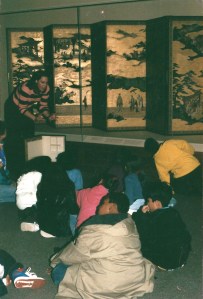
Teaching in the Japanese Screen Galleries in 2001

The Freer and Sackler Galleries, one of the jewels of the National Mall, reopened just a few weeks ago and our faculty is grateful to have it back. For those of you who don’t know, the Freer|Sackler is comprised mostly of Asian art with a small collection of 19th century American art.  I love this museum. I worked here at the beginning of my career and it is still one of my favorite museums in which to teach.  When I began working in early education though, I observed that many of my colleagues struggled using this collection with young children. I can see their perspective — many of the concepts and traditions represented throughout the collection can be complex and unfamiliar.

With the reopening, it felt like the perfect time to explore the Freer|Sackler through the lens of early childhood education. At SEEC, we believe that it is imperative to introduce children to cultures and ideas other than their own. We feel that this exposure helps them develop empathy and perspective and moreover, it prepares them to be global citizens. We also feel strongly that all the children in our school should be represented through our lessons. It is vital that children see themselves reflected in their learning environment.

Over the course of our almost 30 years, SEEC has worked hard to define approaches that engage children and help them make meaning of objects that might have little or nothing to do with their daily life. Because we know that small children connect best with what they know and do regularly, I wanted to highlight a few ways to approach this collection. The following list is by no means complete, it is more of a snapshot of the techniques an educator, or even a parent, can use with children.  If you discover something I haven’t, please leave a comment – we are always looking to learn from our educator community.

Storytelling

Gandharan Frieze


Scenes from the Life of the Buddha; Pakistan or Afghanistan, Kushan Dynasty (late 2nd – early 3rd century); stone, Purchase, Freer Gallery of Art; F1949.9a-d 

Storytelling is a tool for the young and the old alike, and the Freer|Sackler houses its fair share of good stories. The Museum includes stories of Hindu gods, the life of the Buddha, and Chinese folktales – just to name a few.  With some research and dramatic flair, an educator can bring these stories to life. At SEEC, we often make books for our younger students. This helps us gather information and format it in an accessible way for our students.

Key pieces:

Connecting the Familiar with the Unfamiliar

Young children are concrete learners. If you take something with which they are

Bell

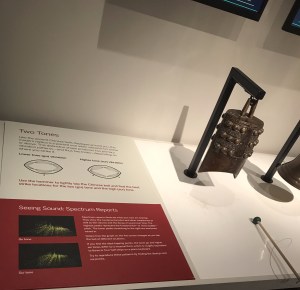
Explore the sounds a Chinese bell makes.

familiar and put it next to something with which they are not familiar, you make a connection.

Here are some connections:

  • Music – Resound: Ancient Bells of China is a great exhibit not just because there are bells, but because there are several hands-on components that allow children to understand sound and to hear the difference between Chinese and western bells. Consider bringing a real bell or shaker on your visit to provide a hands-on experience.
  • Animals – There are many examples from which to choose, but of course one of the most prominent work is the Peacock Room by James McNeill Whistler. When visiting the Peacock Room, bring photos of peacocks and/or peacock feathers. Encourage the children to look closely at both the peacock and the room to notice shapes, colors, similarities, and differences.
  • Seasons – The American art galleries in the Freer have a great collection of paintings depicting different seasons and weather. There are so many contextual objects that you can use when exploring seasons. Educators might consider bringing seasonal clothing and/or photos, ice packs, or sensory bottles containing seasonal colors or natural elements.
  • Writing/Books – In addition to a gallery that explores Buddhist sutras, there are other examples of writing from all across Asia throughout the Museum. Bring examples of your favorite children’s books and/or special books that might be important to you or to one of your student’s families.

    Guardian Figure

    Guardian figure; Japan, Kamakura period (1185–1333); wood; Purchase, Freer Gallery of Art; F1949.21

  • Human Body, Gestures or Movement – There are two galleries devoted to how the human body is depicted on the Indian subcontinent. You can also find other examples, including this Guardian Figure from Japan. Don’t be afraid to encourage children to move their bodies in these spaces. The opportunity to move and explore their own body will enrich the experience and develop their gross motor skills.

Do you ever wonder why babies put things in their mouths? That is how they learn. Young children begin to understand their world by using their five senses (actually there are seven, but that is another blog – vestibular and proprioception). So I was especially excited to see that Freer has a whole room devoted to Islamic art and the senses. Plates, candlesticks, incense burners, and illustrations of music are just a few of the objects you will encounter. While you obviously can’t burn incense or make a meal in the galleries, educators can easily pair these objects with in-classroom activities that might inspire our sense of smell or taste.  It might also be an opportunity to reach out to your classroom families, the objects in these galleries come from a wide geographic area and might help you make some personal connections in your community.

The Sackler  has a Tibetan shrine room that will allow children to be in a space where they will encounter sumptuous images while listening Buddhist chants and watching the flickering of candlelight. The accompanying app, Sacred Spaces, has a lot of information to help inform your visit. If you have the time, you can distill a few key points that can help your students make stronger connections.

Beauty

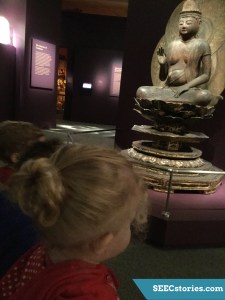
Looking at Buddha

At SEEC, we believe that young children should be introduced to art, begin to develop a visual vocabulary, and embrace their own creativity. The works throughout the museum, but especially in the American galleries, offer young children the opportunity to explore and notice similarities and differences.

Charles Lang Freer’s taste in collecting art was influenced by the Aesthetic Movement in the late 1800’s, which advocated for “art for art’s sake.”  The artists associated with this movement were more concerned with making art that was an expression of creativity and beauty. I think this quote, taken from the Freer|Sackler website, sums it up well.

.. it was through American art of his own time that Freer developed the habits of quiet contemplation and intelligent comparison that he hoped to share with future generations of museum visitors.

I think Freer would be satisfied to know that SEEC’s students are using his art collection to begin  developing their own aesthetic and appreciation for museums.


Letting the Children Be My Guide…

We are pleased to have our new Executive Director, Meredith McMahon, authoring, what we hope will be the first of many, Director’s Blogs.


SEECstories.com (9)

Earlier this year I moved into the role of Executive Director at SEEC, which has been both exciting and daunting at the same time!  While I’ve been at SEEC for more than 13 years, this new position brings new responsibilities that often leave me feeling like there aren’t enough hours to get everything done.  I know I’m not alone in feeling rushed and like I never have enough time, but I’m fortunate that one of the very best parts of my job is being surrounded by children. As I think about how to find balance in my days, I’m reminded that these youngest children are pretty great models – there are great lessons in how young children approach their days that can offer help to those of us who find ourselves constantly on the go or rushing to get to the next thing.

SEECstories.com (12)

We should all get up and move around!  If you watch a SEEC class engaged in a whole group activity, you’ll likely see children engaged in a book, conversation or discussion of an object, but it’s not a given that they’ll all be sitting. That’s true whether it’s toddlers or kindergartners. We recognize that some children can focus better when they can move around, instead of concentrating on keeping their bodies still.  For me, that’s a reminder that a quick walk (or in my case, a few minutes in a classroom) can clear my head, and it’s time well-spent if it means that I will come back to what I’m doing a little fresher than where I left off.

SEECstories.com (7)We should engage our senses! From their earliest moments, children use their senses to build knowledge and a growing understanding of their world. So much is new for them that they utilize their senses to create meaning in new experiences. I love watching the expressions on the faces of our infants when they feel new textures or experiment with sounds. They remind me that I should take a moment to appreciate the smell of fallen leaves and the crunch of the acorns underfoot. I should take note of the warm sun on a cool fall day, and I should tune into the sounds of music and laughter.
SEECstories.com (13)We should approach problem solving the way young children do, actively and open-mindedly!  Children have a seemingly never-ending stream of questions, and at SEEC we encourage children to ask these questions. Across our classrooms teachers encourage children to wonder out loud – it’s one of the ways we can figure out what we want or need to know, and it allows us to connect our questions.  At times I find myself stumped by a question or an issue, and wondering out loud with colleagues can get us all thinking creatively. I’m so fortunate to be surrounded by talented people who willingly share great ideas. The children remind me that asking together and thinking out loud can yield solutions, whether we’re big or little.
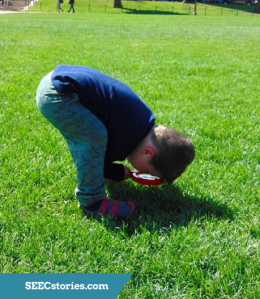
SEECstories.com (11)I could go on and on about ways we can all learn from the youngest around us, but I’ll offer just one last thought on what I can learn from our youngest: what if we all tried to recapture some small sense of wonder?  Young children are fascinated with even the smallest details, and they notice much that we overlook.  They find joy in little, unexpected ways. Imagine if we could match the level of joy a toddler finds in discovering that perfect piece of mulch or a satisfyingly smooth stone.  We can all get easily frustrated by life’s ups and downs, but I find myself trying to keep that joy and wonder in mind in those challenging moments – I just need to find my piece of mulch!
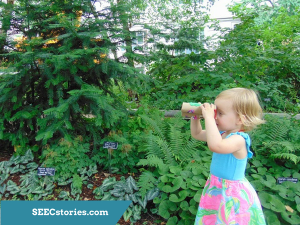
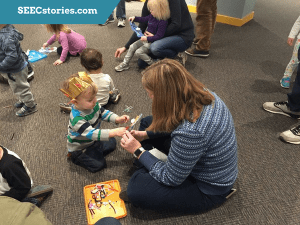
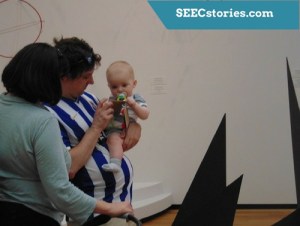
Ask for help when you can’t work it out on your own.

What We Believe

WhySEECstories.com (6)

At SEEC, we respect young children and recognize that through care and education we can support their development and foster their love of learning. We take time to reflect on our practice, try new techniques, think about what benefits our students and as a result, our approach to learning subtly changes over time. We embrace a variety of pedagogical approaches and adapt them to our unique museum school hybrid.  But because our model can be hard define in a single catch phrase, our faculty has had to think about the best ways in which to effectively communicate our educational approach, especially to our caregivers. Caregivers are an essential component to all of our programs. They participate in our weekend and part-time programs and while they are not present during our daily school operations, they most certainly connected to the classrooms and also benefit from understanding our work.

It is with these factors in mind, that the team of educators who work with our family programs sat down last year and began to construct a document for caregivers. We hope this provides insight into our methods and an understanding of how deeply committed we are to creating meaningful learning experiences for your child. Educators – we hope you enjoy reading and will share with us some of your own beliefs.

We BelieveCORNER TAB (1)

  • that children are individuals who develop and learn differently. If you let them choose what speaks to them, you will set them up for a lifetime love of learning.
  • that caregiving is a hard job and is not to be judged.
  • that young children are developing their ability to sit, listen, cooperate, and control their emotions. As adults, is it important to remember that this is hard work and we should try to balance our expectations with a child’s individual progression.
  • that our programs are for fun and family.
  • that playing is learning.
  • in playing with children, being silly, singing, having fun, and getting dirty.
  • in asking open-ended questions and wondering out loud, even with infants and toddlers.
  • SEECstories.com (2)in taking time to stop, look carefully, and describe the objects we encounter in the classroom, community, and in the museums.
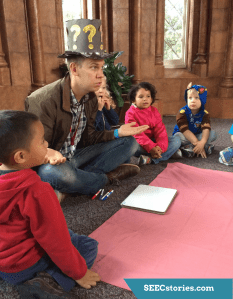
  • in encouraging children to try new skills and not be afraid to fail.
  • in a community of learners. Learning truly begins at birth and should continue into adulthood.
  • that having a calm body and adult hand will keep us and the objects we visit safe, but this will not preclude us from looking, talking, singing, and playing during our museum visits.

How We Teach

Not all children will be interested in ALL of our teaching methods so we use a variety of techniques to engage them. Follow your child’s lead and be flexible; there is no one way to learn.

Community1-3
The world is our classroom and we not only use museums, but parks, stores, libraries, and beyond.

Objects
Objects help engage the senses and provide a concrete and memorable learning experience. They are more powerful than words and pictures alone and children are more like to remember and connect with them.

Observations
Observation encourage minds to focus, eyes to look closely, and brains to develop a deeper understanding.  We often start lessons by asking, “What do you see?”

Questions2
Questions require children to be active participants in the learning process and because of this, inquiry is more powerful than simply sharing information. We also ask questions as a way to create dialog and cultivate flexible thinking. Thinking out loud helps us see how others are thinking and therefore, expand our own thinking.

Preverbal Learners
Posing questions to children who are preverbal is still important. Look for nonverbal cues such as pointing, looking, and giggling and respond to them.

Experimentation
Experimentation is a process by which children explore a topic. Children experiment as a way of understanding cause and effect relationships or as a way to solve problems. Anything a child does more than once can be considered an experiment. We will ask “What would happen if …” as a way to harness a learner’s natural desire to experiment.

ExplorationSEECstories.com (5)
Exploration allows children to discover and learn about a topic in a variety of ways.

Math
Math concepts are interwoven into lessons. Examples you might observe are: counting, representing quantities, noticing differences in quantities, observing patterns, and categorizing.

Fine motor
Fine motor activities allow children to use the small muscles in their hands to help them learn how to do things like dress independently, and write.

Movement
Gross motor activities engage a child’s large muscles, for example running, jumping, and climbing. Movement helps children learn what their bodies are capable of, as well as provide necessary and fun outlets for physical movement.

ArtSEECstories.com (4)
Our art activities focus on the process, rather than the outcome. Participating in process-based art encourages creativity and problem solving and develops fine motor skills.

Sensory
Sensory activities are those that stimulate a child’s senses. Young children have a more meaningful learning experience when their senses are engaged.

Play
Play can be defined in many ways, but typically involves some element of imagination.  Play helps children explore roles, ideas, and situations, and often builds social skills as they navigate play with peers or adults.

Literacy
Research has proven the importance of reading with young children, and that positive experiences with books help create a love of reading.

Singing
Singing is important tool with young children, science has proven that music helps children better remember concepts and vocabulary. It also helps children transition from one activity to another.


BYOB: Bring Your Own Baby

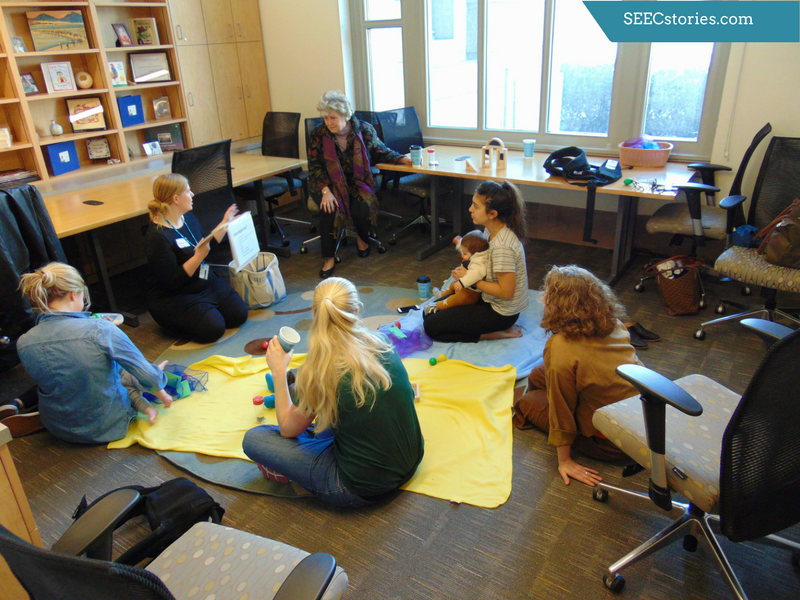
SEEC recently began the new program Bring Your Own Baby, which we fondly call “BYOB”. This program expands on the rest of our programming in several exciting ways. More than our other programs, such as our Family Workshops or the Smithsonian Early Explorers, BYOB is geared towards the adults who are bringing the children. The program is broken into two parts – coffee and play and then, a museum visit.

SEECstories.com (1)

In the development of this program, we considered the needs of both the adults and the babies. The class begins with coffee and the opportunity to meet and chat. We decided to begin this way for two reasons. The first was that we wanted to build in time for a flexible start since we know that it can be difficult getting yourself and your baby out of the house on a schedule (and kudos to all those who try!). We were also hoping to provide parents with the opportunity to create a community through conversation. The topics discussed have been seemingly endless, ranging from how much sleep everyone got the night before to their favorite Impressionist artist.

SEECstories.com (3)

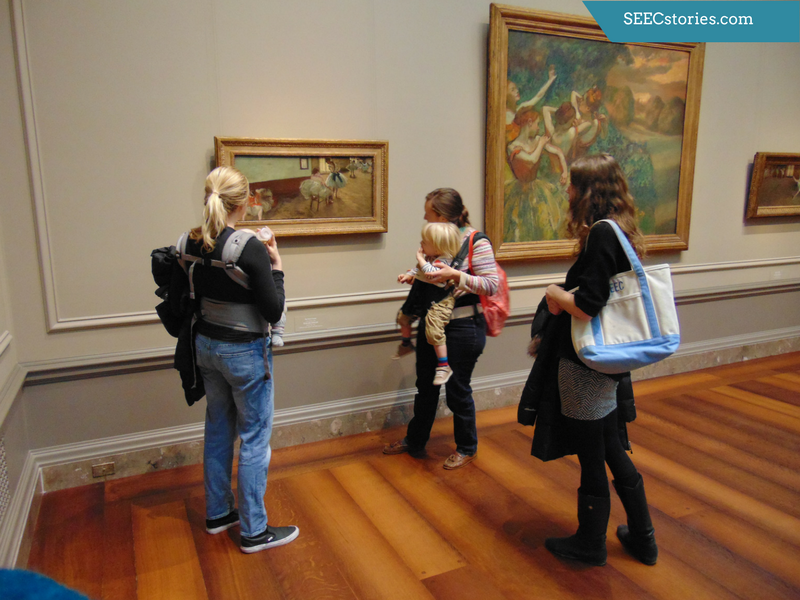
As we head out into the museum, we are mindful that babies can sometimes be fickle. We are comfortable with crying, babbling, nursing, and even cutting the adventure short because somebody (caregiver or baby) needs to go home early to take a nap. Our flexibility on these tours makes the sometimes stodgy world of museums more approachable for caregivers and babies alike.

SEECstories.com

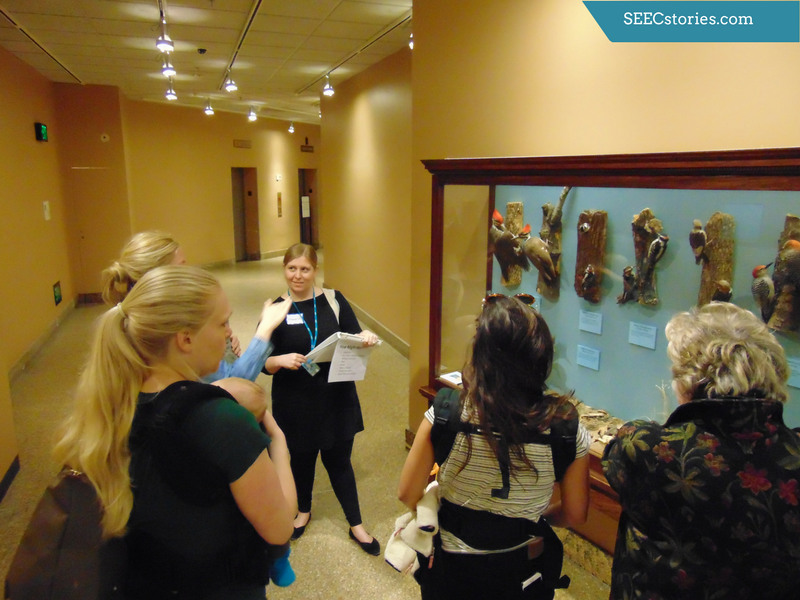
For these museum tours, we are hoping foster flexible thinking and spark the imagination of grown-ups rather than going quickly between objects and paintings and unloading a barrage of facts. To make these tours informative and interactive for adults, we have found ourselves modifying many of the tools that we use with young children. This makes our programming more playful and interactive than many programs geared towards adults. We believe approach to learning will make it more likely for you to learn something and leave the experience with something new to ponder.

SEECstories.com (4)

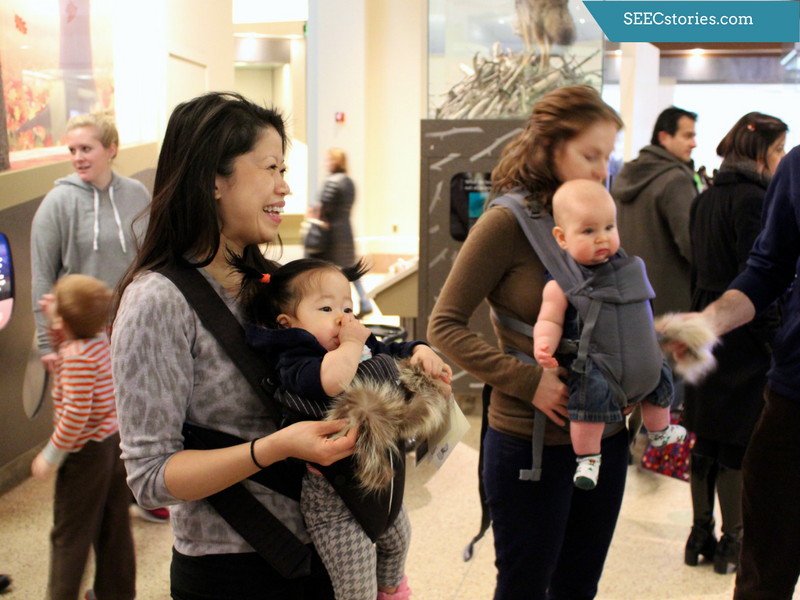
While the programs are written for adults, we could never forget the babies that are tucked away in their carriers. As the tours progress, we discuss theories in early childhood education and offer ways to incorporate this research into your interactions with your child. We show off some tips and tricks about how to make museum visits beneficial and enjoyable for young children. Our goal for this program is to help parents and their babies have an enjoyable time in the museums.

If you are interested, please sign up for one our our upcoming BYOB classes.

Looking for ways to engage your infant? Check out our Pinterest board on Infant Activities for ideas. 

10 Things You Can Do Right Now with Your Child in the Grocery Store

7

Taking a trip to the grocery store? Try these easy activities to convert your trip to the store from a chore to a fun and enriching outing for you and your child!

  1. Alphabet Grocery List: While not the most efficient way to plan your visit, sorting your list alphabetically is a great way to work on early literacy skills and make hunting for items a fun game!
  2. Scale Showdown: Weighing your fruits and veggies is a great way to work on early math skills. Make it a game by taking turns weighing items and guessing whose item will weigh more!SEECstories.com (18)
  3. Take a Walk on the Wild Side: Get a little gross motor practice in as you move around the grocery store. Select different animals to imitate and stomp, slither, and hop down the aisles.
  4. Play: Where does it come from?: By the time food reaches your child it is often very far removed from its original source. Have your child guess where the item came from. For example, milk comes from cows, blueberries grow on bushes, etc.
  5. Warm, Warmer, Warmest: Hunting for items will keep your child engaged in the shopping process and may keep them from breaking down before you reach the end of your list. Pre-spot the item and have your child hunt for them based on saying warm, warmer, warmest.
  6. Plan a Recipe Together: Picky eater? Having your child be a part of the process from the very beginning will give them a larger investment in the final product. Who knows, it might even get them to try something new!
  7. Texture Talk: There are lots of great textures at the grocery store. Ask your child to help find items based on their texture. 6
  8. Shape Hunt: Just like texture, there are a number of great shapes at the grocery store. Ask your child to find items based on their shape.
  9. Start a Grocery Cart Band: While being conscious of other shoppers, pick a few items from your cart for your child to use as instruments. Items such as coffee cans, boxes, of cereal, and spices make excellent shakers!
  10. Pay: Create a smaller group of items that your child is in charge of checking out with (this works especially well at the self-checkout). Allow them to help pay and bag the items. Children love taking on adult tasks and it will give them a sense of responsibility and ownership over those items.


Have other fun grocery store games? Please share! We would to love to hear them.


Learning Lab as a Tool for Early Educators

SEECstories.com (1)

We are pleased to share a guest blog post by Maureen Leary, Director of Kindergarten and Toddler Programs at the Smithsonian Early Enrichment Center. Prior to becoming a Director at SEEC last summer, Maureen spent 16 years as the Kindergarten Spanish teacher, among other roles at SEEC. Maureen is also the parent of three SEEC alumni. 


Technology has immense power to improve our lives and put a world of information at our fingertips. However, for those who work with young children, the relationship with technology may sometimes feel a bit complex. Screens are ever-present and young children are true digital natives, meaning they will never know a world devoid of online tools. So, while it’s important to be mindful of reasonable uses of and limits on screen time, it’s also critical for adults to lead the way in modeling positive online behavior and habits for children. Finding appropriate and interesting tools to achieve is a quest I’m sure many teachers share with me.

What Is Learning Lab?

2

From the first moment I was introduced to the Smithsonian’s Learning Lab, the platform has been an inspiration to me as an educator. In a nutshell, the Learning Lab is an online database of Smithsonian collection items that also includes lessons and tools created by users. I have found the Learning Lab to be a unique, dynamic resource with the potential to enrich and enhance both museum and classroom learning experiences. In the year since I first explored the Learning Lab, I have created a number of my own collections to both use in the classroom and to share with families. Using collections allows me to have all my digital resources in one place, both readily accessible and easily customizable. I always include information for families about how the individual resources were used in my lesson, and how the lesson was structured overall. My hope is that the shared viewing of these these collections by adults and children will both offer insights into the learning experiences and spark meaningful conversations about them.

Learning Lab In Action

3

One of my favorite Learning Lab experiences with students was during a Kindergarten lesson on Spanish artist Joan Miró. Before leading my students on a visit to two pieces of art by Miró at the Hirshhorn Museum and Sculpture Garden, I created a Learning Lab collection to introduce his life and work to my students. We watched a video of the painter at work and listened to family members talk about his art and how it affected them as viewers. We looked at various images of his work on screen. Finally, we watched an animated version of one of his paintings – the individual components moving playfully across the screen to gradually create a cohesive whole. These technological pieces laid the groundwork for a more hands-on exploration of Miró’s work, both in the classroom and in the museum. To wrap up our classroom time we played a dice game that I found online called “Roll-a-Miró” that encouraged the children to create their own Miró-inspired drawings. Later, while settled in front of “Woman before an Eclipse with her Hair Disheveled by the Wind” at the Hirshhorn, we discussed what we saw in the painting and looked again at prints of the images we had seen on screen earlier. The children were given various loose parts to experiment with (foam pieces, pipe cleaners, etc…) and they worked together to create Miró-inspired pieces of art. Over the course of the day the exploration moved seamlessly from the screen to the classroom to the museum, and demonstrated that hands-on activities and screen time are not mutually exclusive concepts.

1For the Miró collection and others I’ve made, I’ve found that the customizable aspect of the Learning Lab is one of its most appealing features. Users can search collections and adapt already existing ones, or create their own from whatever resources they find, both on the Learning Lab and on other platforms. The Learning Lab also has tools embedded to help users customize their resources to suit their needs. I’ve enjoyed making use of “hot spots” to mark places on works of art that I wanted to focus the kids’ attention on, and to feature open-ended questions to spark discussions. Another teacher I work with tried using the hot spots in a more child-led way, by asking the kids choose a spot to mark, and to include their own observations or questions. Her class had a great time making notes on a photo portrait of Neil DeGrasse Tyson, which the teacher then shared with families via email. Not only is this a fantastic way to expand the learning experience to include families, but it could provide inspiration for adults to do a similar exploration on their own with their children, on whatever topics interest them. Similarly, the sorting tool offered by the Learning Lab allows users to create activities that include whatever images are relevant to their particular topic. Searching the Learning Lab for images is a great place to start, but users are not limited to that content.
Learning Lab and Families

In addition to my classroom work, I have also used the Learning Lab in an outreach project with preschool children and their families who live in the Kenilworth neighborhood of Washington, DC. I was very encouraged by the enthusiasm for Learning Lab that I encountered from both kids and adults, and how they connected it to other experiences. In one case the collection was tailored to a museum visit the children had just completed, and they were visibly excited to make the connection between what they saw on the screen and what they had seen in the museum. (“Look, mom, it’s the animals we saw today!”) The adults in the group were reassured by the educational nature of the Learning Lab and and the age-appropriate digital environment it provides. The interactions I observed in this setting reinforced the importance of adults acting as “digital mentors” with children. Technology is everywhere, and children have a natural interest in using it in an active way. It’s up to us to create a positive relationship with it for ourselves and our children and students.

Teacher Feature: Infant Class Explores Animals

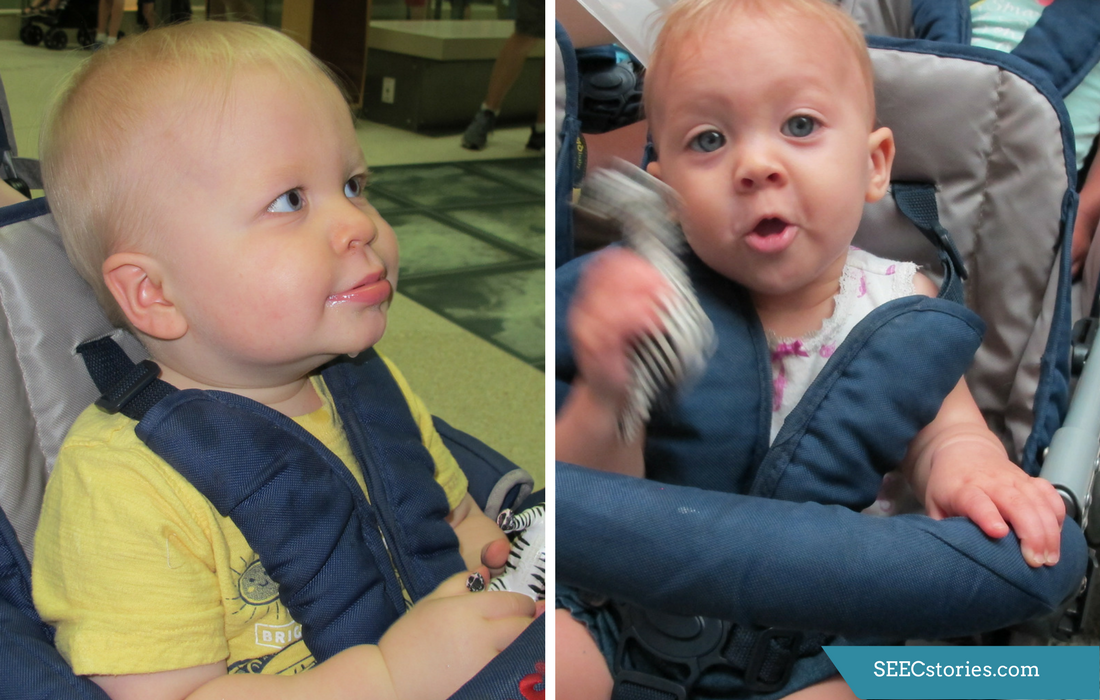
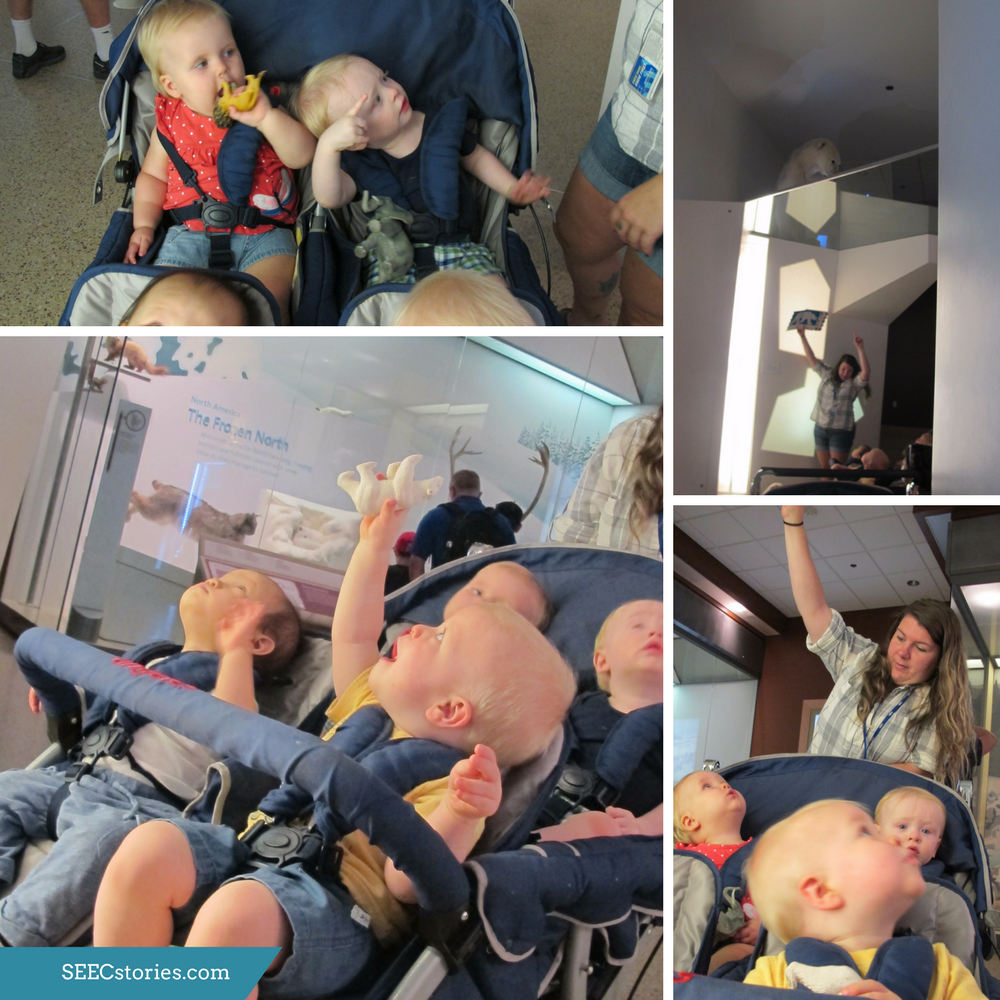
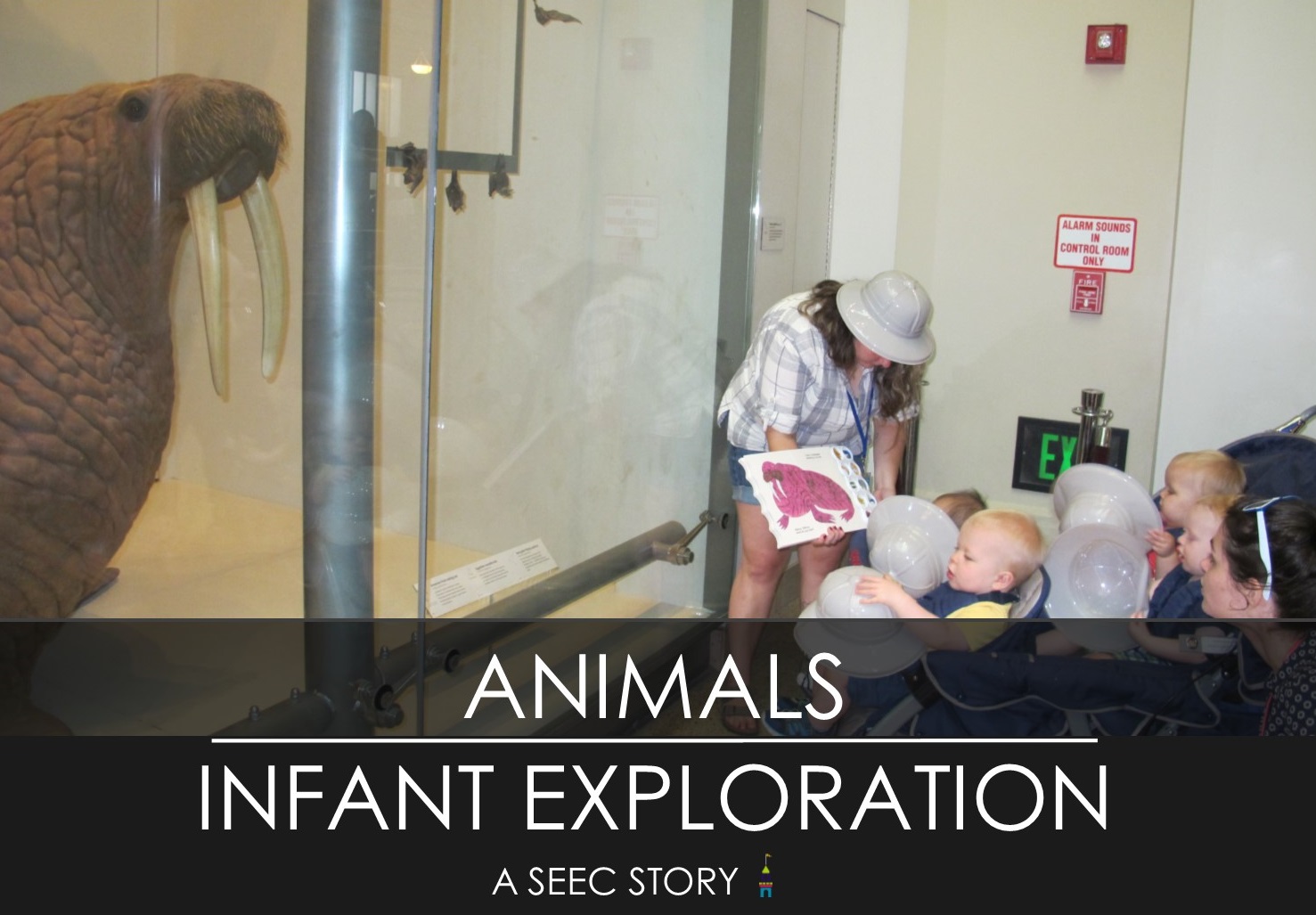
This week’s teacher feature highlights an infant class’s adventure to the Kenneth E. Behring Family Hall of Mammals at the National Museum of Natural History. The teachers, Erica Collins, Katherine Schoonover, and Noel Ulmer, paired the museum excursion with the book “Polar Bear, Polar Bear, What do you Hear?” by Bill Martin Jr. and Eric Carle. While this experience was carefully planned and curated by the teachers, the infants’ interests ultimately determined which animals the class focused on. By intentionally responding to their class’s cues, the teachers allowed the infants to lead the lesson based on individual interests. Below you will find images from the day as well as a reflection from the teachers.

 Cover Photo


SEECstories.com (1)

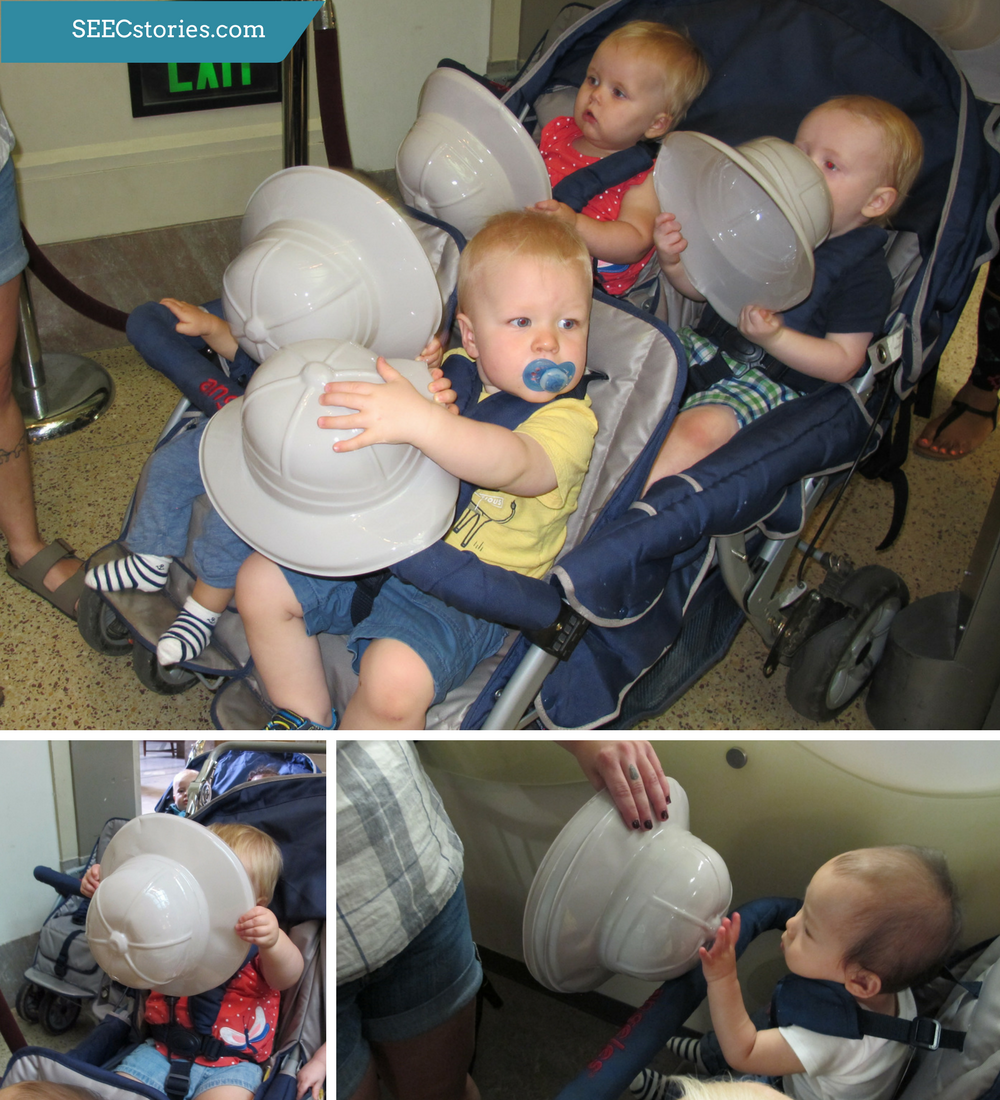
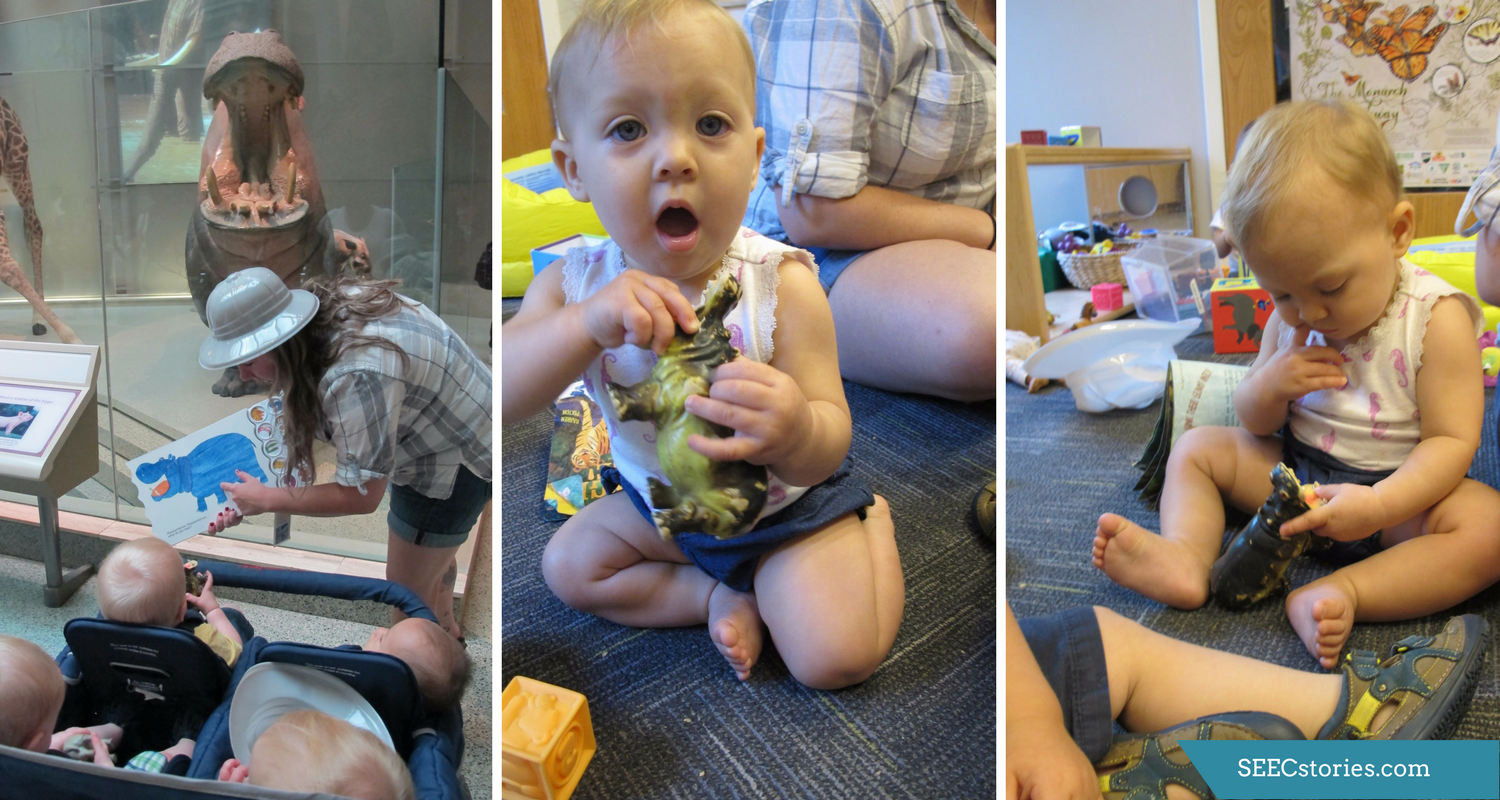
To start their adventure, the teachers passed out safari hats. Each child was given the opportunity to touch and explore the hats. Many tried putting the hats on, taking the hats off, and even experimented with covering their eyes with the hats. In addition to something new to hold, the hats also served as a transitional object to ease the move from the classroom and to the mammal hall.

SEECstories.com

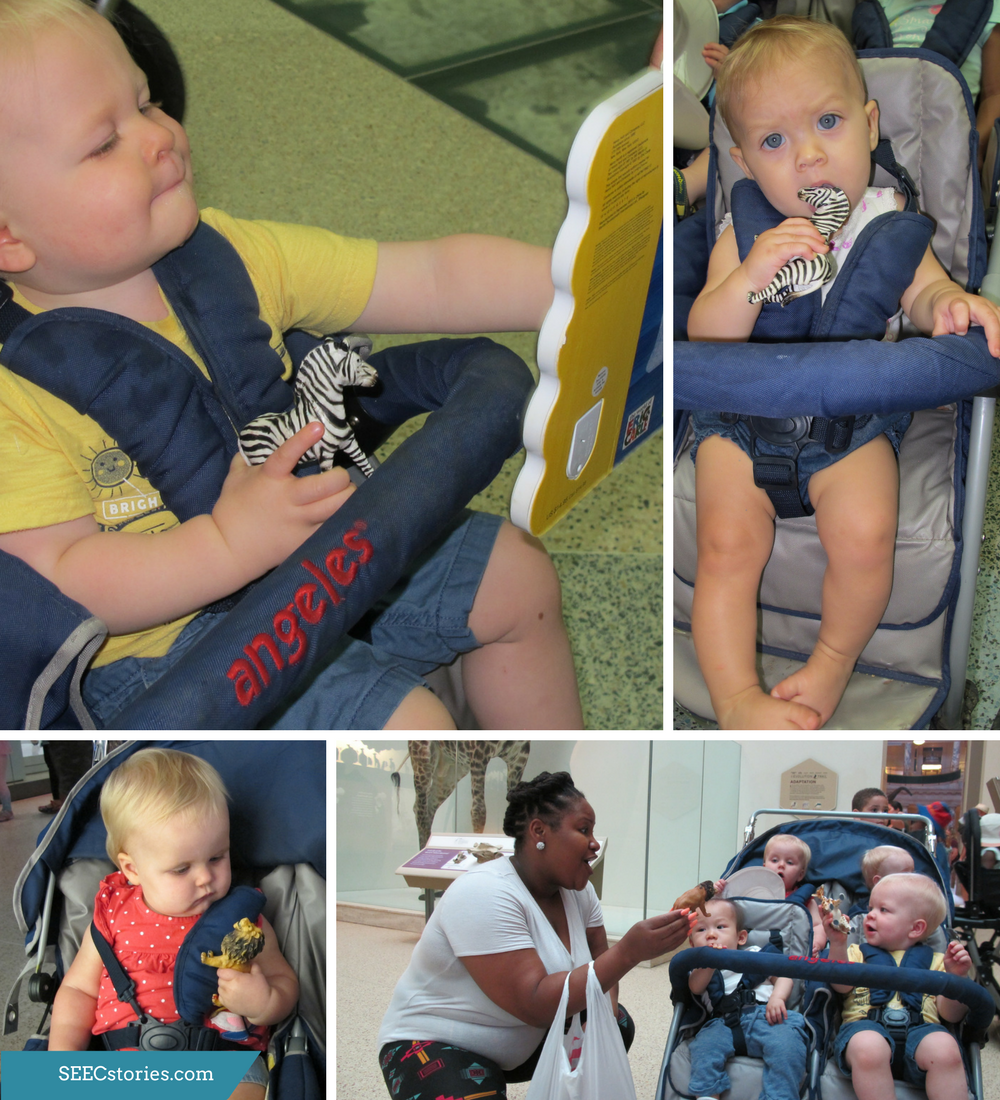
While in the mammal hall, the children were able to hold animal figurines that matched the animals that they saw in the mammal hall and in the book Polar Bear, Polar Bear, What do you hear? These animals helped the teachers personalize the lesson as they could take note of which animal each child was most interested in based on the animal that the children chose to hold.

SEECstories.com (2)

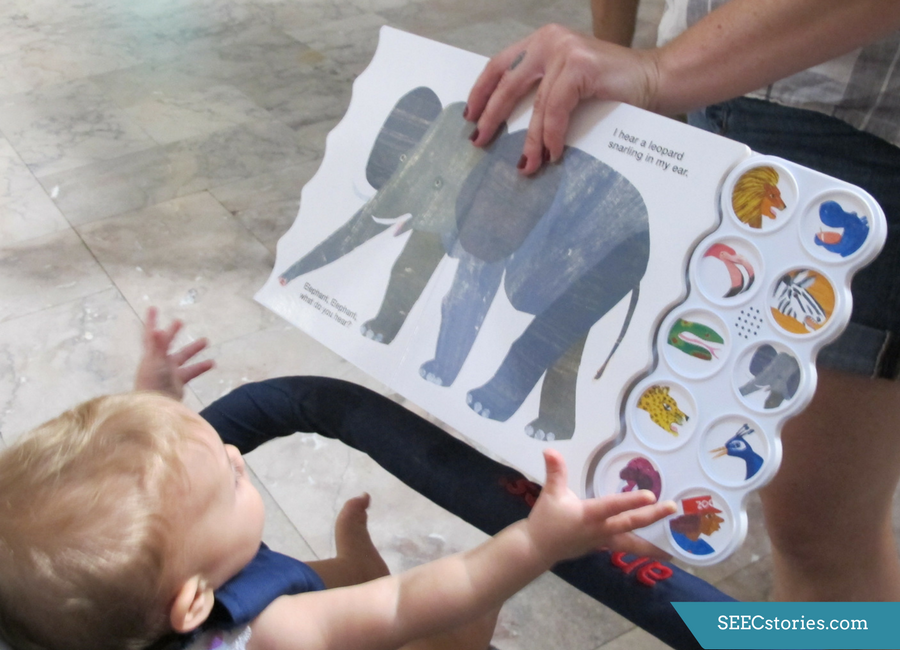
For these young children, the book itself was an object. They were excited to be able to touch, hold, explore, and even push buttons to make noise. The book, which the class had been reading regularly, helped bridge the gap from the familiar to the unfamiliar large animals.

SEECstories.com (4)

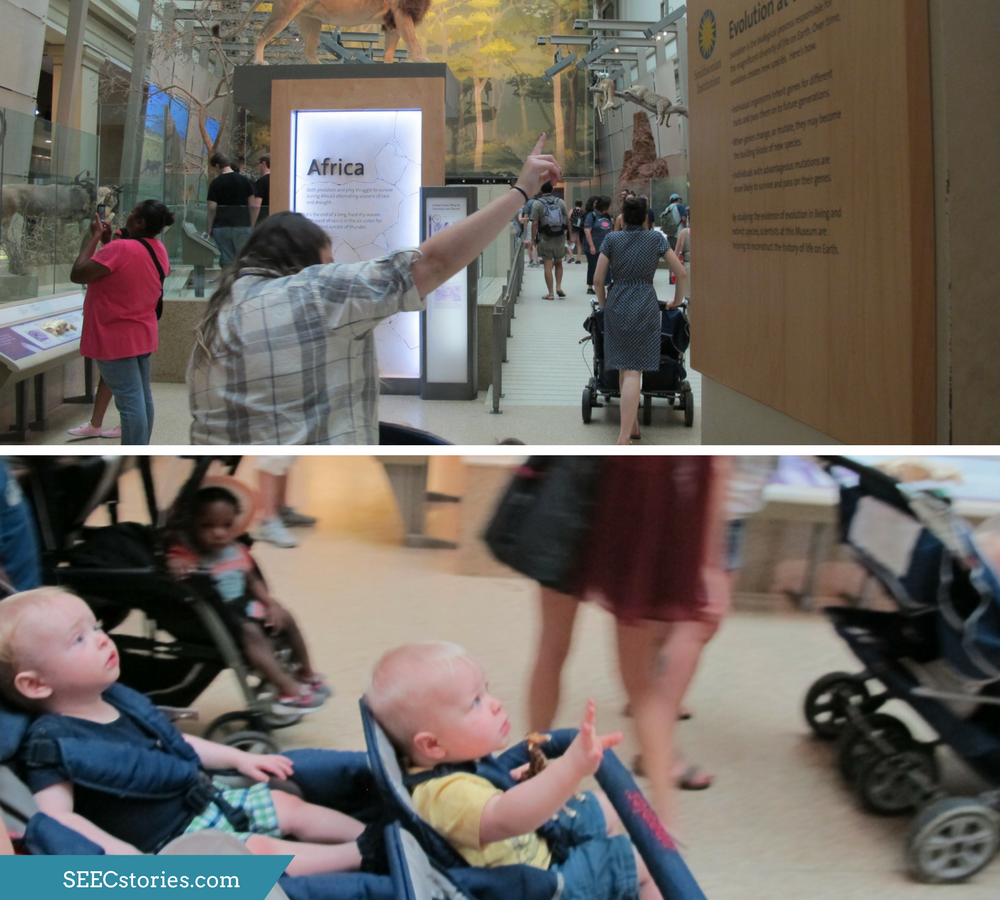
Most of the children in this class are preverbal, but this does not mean that they are unable to communicate. In fact, the infants use their physical activity to communicate by pointing and making gestures. The teachers were careful to narrate everything they saw and also communicated with gestures while paying careful attention to the children.

SEECstories.com (6)

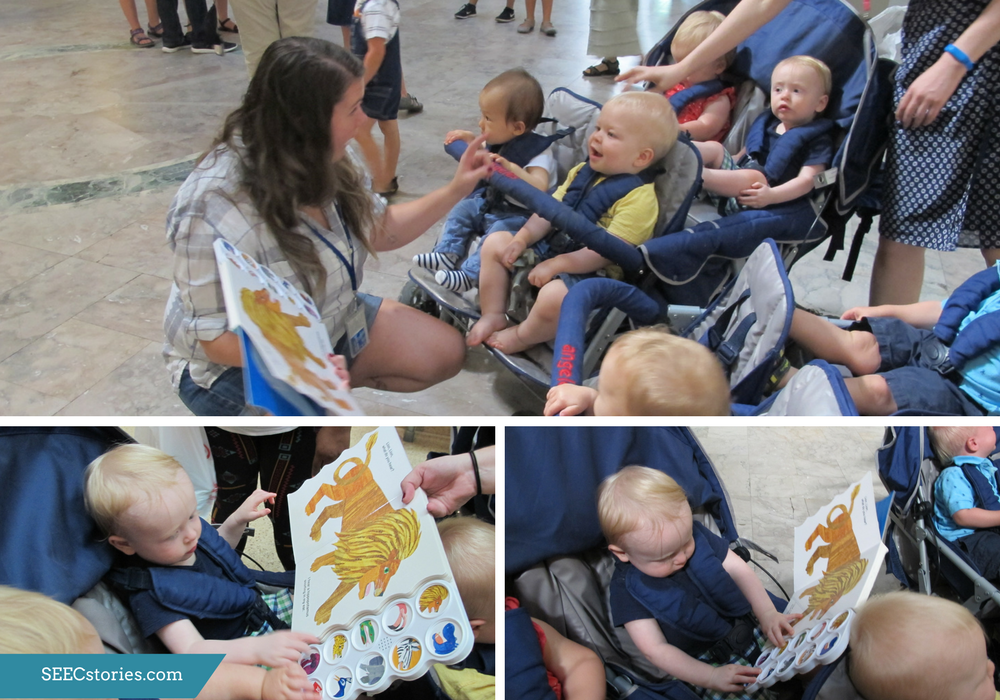
Another way the teachers were responsive to the class was by rotating who held the book Polar Bear, Polar Bear, What do you Hear? If a child expressed interest in looking closer at the book, the teachers would bring the book over to that child. If that child wanted to hold the book and explore it on his or her own, the teachers responded to the wants and needs of the individual by giving the child the opportunity to hold the book on his or her own while the rest of the class observed some of the mammals.

SEECstories.com (8)

The book, Polar Bear, Polar Bear, What do you Hear?, focuses on the sounds that the different animals make and young children love experimenting with the different sounds they can make. This makes for a perfect pair. While in the mammal hall, the children attempted to mimic the sounds that different animals make.

SEECstories.com (7)

The last stop on their adventure was to see the polar bear, which is on display up high. The children were captivated by the polar bear and craned their necks upward to get a better view.

Untitled design (1)

Back in the classroom, the teachers were able to continue assessing which animals the children wanted to explore further. The children gravitated towards certain animals. In the picture above, you can see one child actively exploring the teeth of the hippopotamus, which she had seen earlier in the mammal hall, and comparing them to her own teeth.


A reflection from Erica, Katherine, and Noel:

Preparation

We began learning about animals by exploring the different ways they look, sound, and move. This topic started to emerge within our classroom when the students began to recognize animals and mimicked the sounds animals make to let us know that they had noticed a specific animal. We wanted to show our class these animals up close and personal and to relate them to the books we see them in, the songs we sing about them, and the images of different mammals we encounter every day. Choosing to go to the mammal hall made the most sense since the animals there are so lifelike, other than they don’t make noise, but luckily the students helped us with that. We took safari hats with us to wear as we searched for our favorite animals and the animals mentioned in the book Polar Bear Polar Bear What Do You Hear? We wanted the students to come away from the lesson having made the connections between what they saw and heard in one of their favorite books to the size and shape of the animals in the mammal hall. In preparation for this lesson, we did many different kinds of movement in the classroom to mimic animal movements and often demonstrated the sounds these animals make.

Lesson

The most effective part of our lesson was showing the students the connection between the animals on the page and the animals in the mammal hall. Creating space for the students to get a sense of how big the animals are helped to expand this topic. Viewing the images of animals on a page, then seeing them in person, and then still being able to connect to the of sound of animals is pretty significant. Our time spent preparing in the classroom and going over the different animals made the lesson smoother. Rather than overwhelming the children with all the massive animals, we gave them time to adjust to each animal. Some students even had favorites, which we had planned to focus on. We were surprised to see which students were really engaged as we went through the mammal hall. Some students, who we had expected to be very vocal because they growl and make lion noises all day, were relatively quiet. We think they saw how lifelike and big a real lion was when we got up close and they were so entranced that they stopped growling and making noise which none of us expected to happen.

Reflection

Avoiding crowds is always something that is hard to manage, especially in the mammal hall, because it attracts so many people. The book we brought with us also had buttons for each animal to make noise, but it was so crowded that it was hard to hear at times. Luckily, our class had been pushing these buttons for weeks, so they were still able to make the connection even without us using the sounds in the book. After completing our safari hunt through the mammal hall, we continued to look at different animal books, wear our safari hats, and make observations about different animals.

If we were to do this lesson again, we would spend more time discussing all types of animals rather than just mammals. We would also focus on what makes different animals distinct from each other. We believe that looking at more types of animals (reptiles, birds, etc.) would not have hindered the students’ exploration of the mammals, but rather it would have opened up the topic to more discussion and learning.