
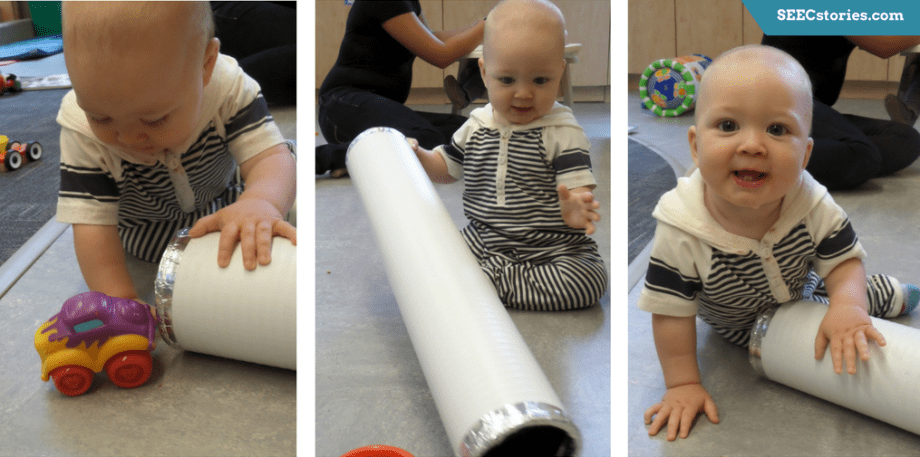
Over the last hundred years there has been a monumental shift in how the scientific community sees babies. Neuroscientists and clinical psychologists now deem young children worthy of study and through their studies we have gained a wealth of information about brain development. This shift from seeing babies as blobs, to babies as beings undergoing a crucial stage of development, has been slower outside the fields of science and academy.This is unfortunate because every day people have the opportunity to interact with babies and are able to observe firsthand how babies grow and develop. These observations can result in an appreciation for the importance of enriching early childhood experiences.
What follows is an overview of brain research. It starts by discussing some overarching theories and moves into a breakdown of some of the newest findings. Hopefully this body of work will inspire you to take a new look at babies and discover that they are fascinating beings.
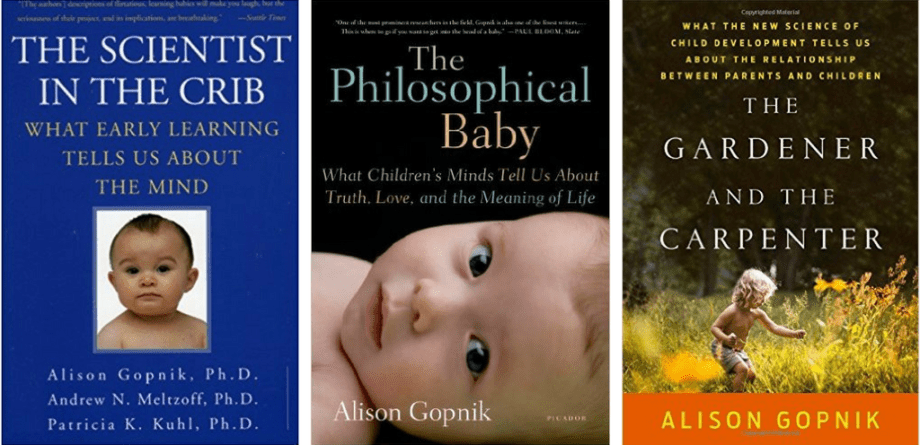
Ted Talks offers a series of five videos in a playlist called “Genius of Babies”. Alison Gopnik, a developmental psychologist and author of The Scientist in the Crib: What Early Learning Tells Us About the Mind, The Philosophical Baby: What Children’s Minds Tell Us About Truth, Love, and the Meaning of Life, and The Gardener and the Carpenter: What the New Science of Child Development Tells Us About the Relationship Between Parents and Children, is one of the speakers highlighted. During her Ted Talk, titled “What Do Babies Think?”, she makes the argument that babies are born as scientists who actively conduct experiments to learn about the world around them.
Cognitive brain scientist, Laura Shultz explains “The surprisingly logical minds of babies”. Shultz notes that babies’ brains have to be very powerful because “they are figuring out their entire world.” She concludes her Ted Talk by saying:
In the years to come, we’re going to see technological innovations beyond anything I can even envision, but we are very unlikely to see anything even approximating the computational power of a human child in my lifetime or in yours. If we invest in these most powerful learners and their development, in babies and children and mothers and fathers and caregivers and teachers the way we invest in our other most powerful and elegant forms of technology, engineering and design, we will not just be dreaming of a better future, we will be planning for one.
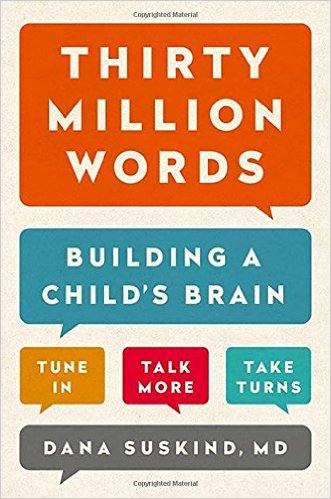
Researchers have noted the importance of babies’ exposure to both language and stimulation. Dana Suskind, a surgeon who routinely performed cochlear implants, wrote the book Thirty Million Words: Building A Child’s Brain. Suskind begins with the premise made famous by Betty Hart and Todd Risley’s paper “The Early Catastrophe”, which was published in the early 2000s and describes the thirty million word gap. Children in lower socioeconomic backgrounds have heard thirty million less words than their peers from high socioeconomic backgrounds by age three. According to Suskind, some children thrived after receiving a cochlear implant, while others did not and she discovered that the children who thrived heard millions and millions more words. In addition to regularly hearing words, a new study from the Norwegian University of Science and Technology “Babies Exposed to Stimulation Get a Brain Boost”. The study highlights the importance of actively challenging young children as well as stimulating their senses.
Another recent baby brain study to note is from the University of Miami about how “Mothers and infants connect through song”. The study noted the mother’s ability to change the pitch or the tempo to keep the infant engaged in the song. Another interesting study looked at how babies’ sight develops. According to the study from the University of Oslo, babies who are 2 to 3 days old can see emotions on a human face from a distance of 30 cm, but at 60 cm the faces become too blurry to detect any facial details.
There should be plenty more interesting neuroscience studies in the future. In fact, the researches from the Massachusetts Institute of Technology have adapted MRI machines to make them more baby-friendly by making the MRI seat more like a car seat so the baby is more comfortable. The newly adapted MRI machines also have a mirror that allows the baby to watch videos and provides a space for the parent or researcher to sit next to the baby while the baby is getting an MRI. These adaptations have allowed researchers to discover more about how babies’ brains work. It has led to findings that the same part of a baby’s brain responds to images of faces as in an adult’s brain, which has allowed researchers to conclude that babies’ brains and adult brains are more similar than previously thought.
As an educator, this wealth of information on how babies’ brains develop has impacted my practice. Research tells us that babies and young children need to be exposed to variety of subjects, materials, and situations. One wonderful way to expose babies and young children to new environments is to take them to museums and to explore the collections and watch their brains make connections and grow. Scientific research has shown the importance of exposure in early childhood and I am hopeful that one day this knowledge will permeate even into our everyday thinking.



 Why the early years?
 The second day of the workshop will feature several techniques for supporting children in their understanding of the themselves and the world. We will examine how to use objects (both every day and museum objects) to teach and, identify developmentally appropriate ways to talk about race and culture in the classroom. Participants will create collections that encourage children to embrace differences and acknowledge our shared humanity. We will also work in NMAAHC’s art galleries to model how looking and thinking routines can encourage young children to stop, look, think, and inquire. In this section, we will help educators respond to potentially awkward questions and remarks and support the notion that we don’t have to have all the answers – even if we are teachers. We will conclude the day by examining some common pitfalls used in preschool settings and provide participants with a chance to curate a learning environment using the techniques and resources that we explored during the workshop.
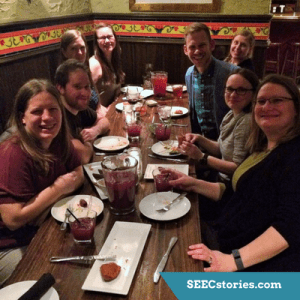 In keeping with the awards season time of year, SEEC held its annual Staff Appreciation dinner recently in order to recognize the hard work and dedication of our entire team. It was also a great opportunity to kick back, relax, and enjoy some time together.


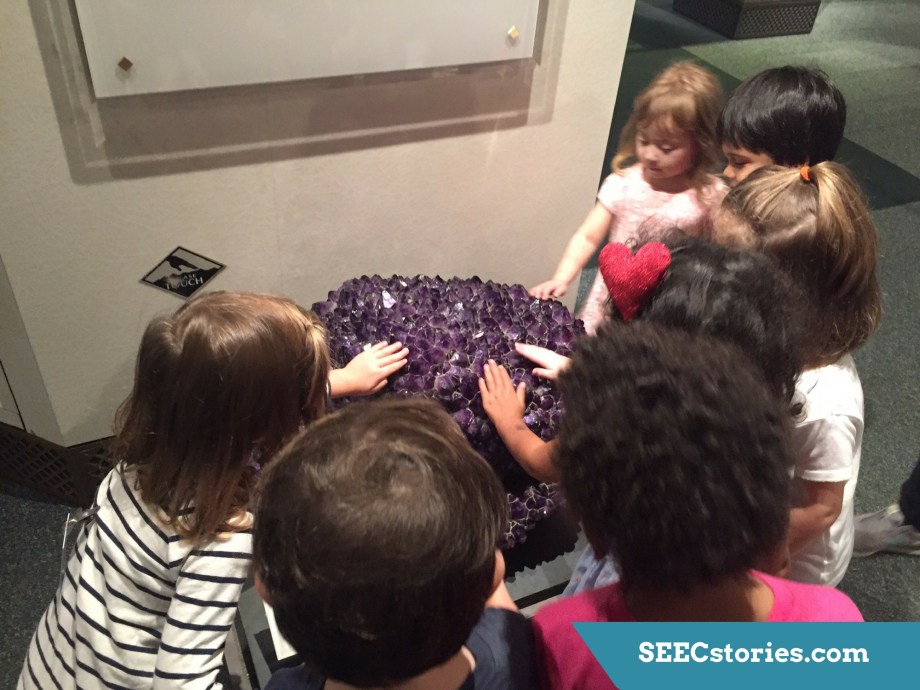 To explore their sense of touch, the class went to the
 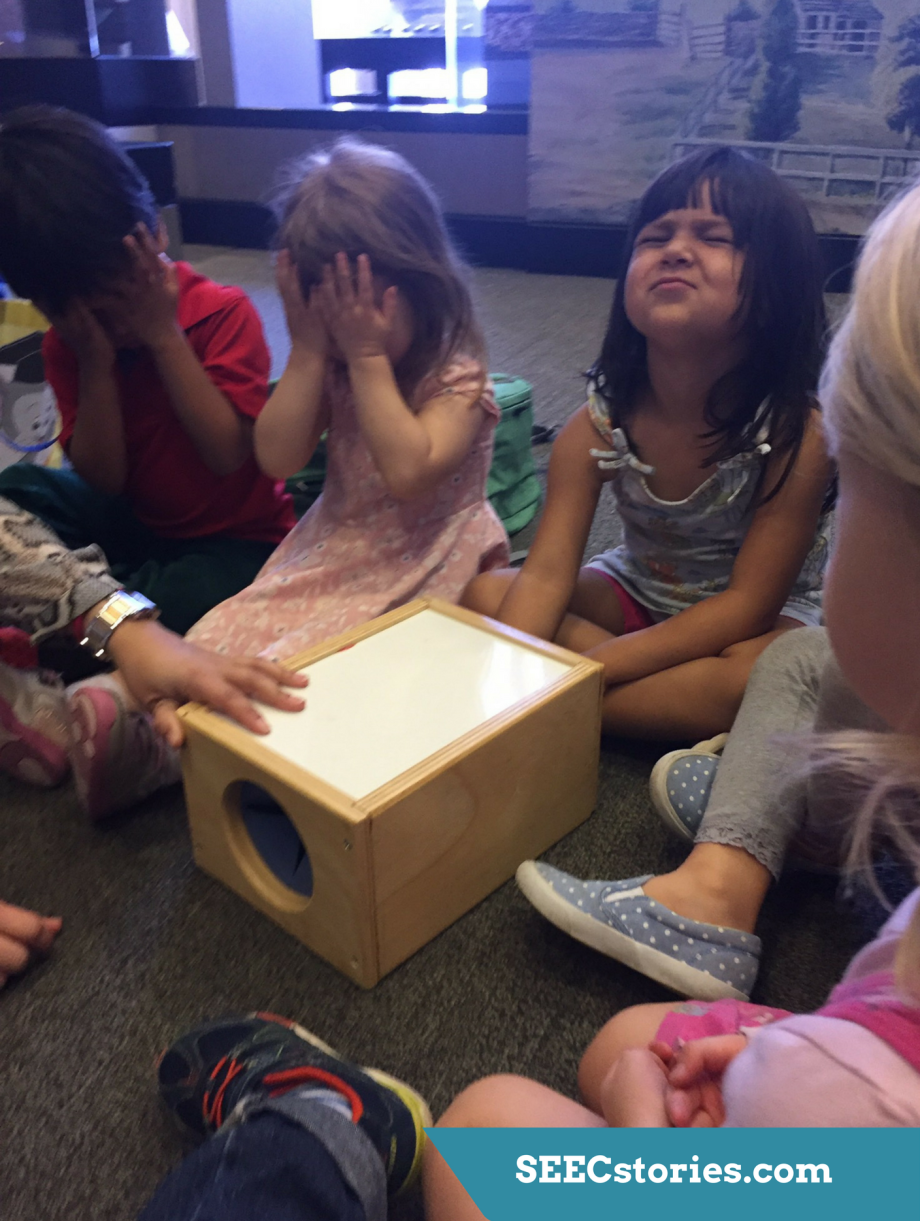 Afterwards, the class sat down and played a game using their sense of touch. Laura brought objects to put in the
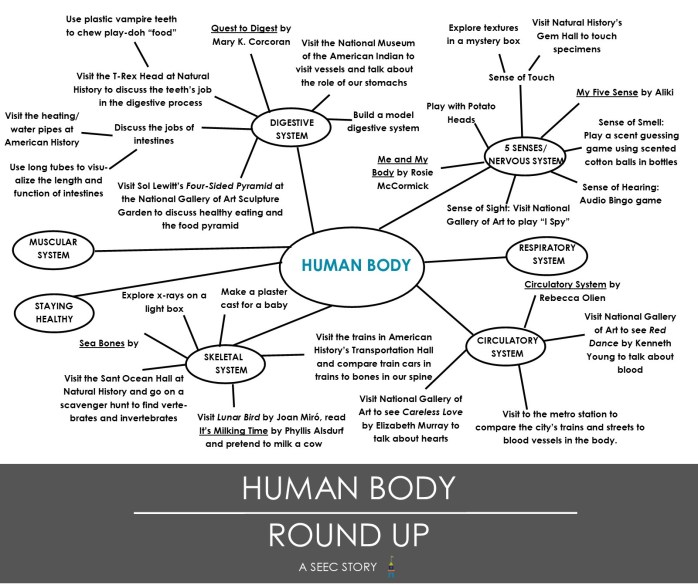
 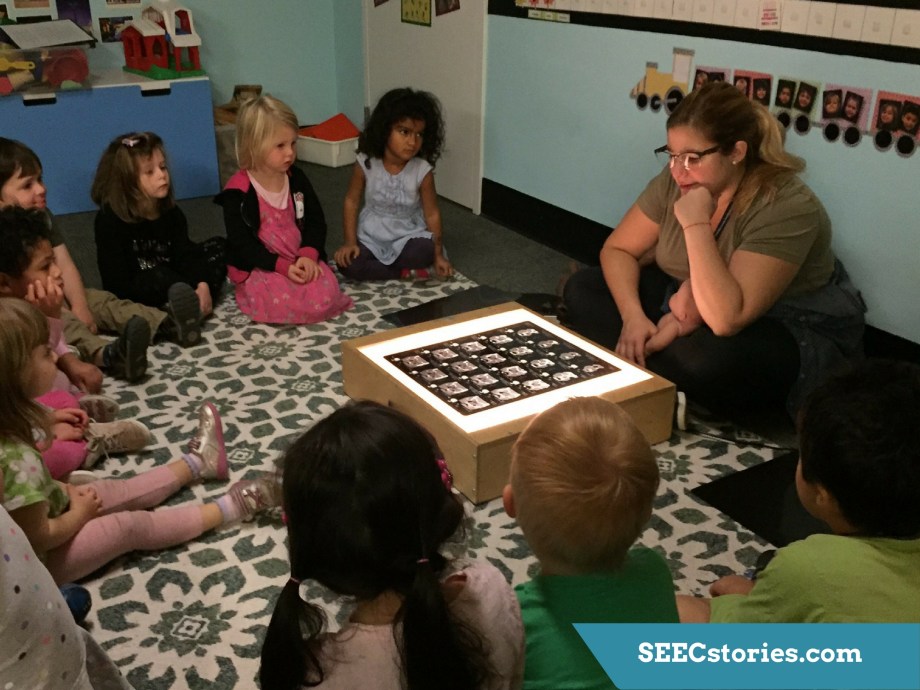 While learning about the skeletal system, the class talked about bones, and what happens when they break. Since we know we cannot see our bones from the outside, the class learned about x-rays and how doctors use them to take a look at our bones if we hurt them. To illustrate this, the class looked at bone x-rays on a light table to get a better idea of what doctors look at when seeing if a bone looks normal or injured.
 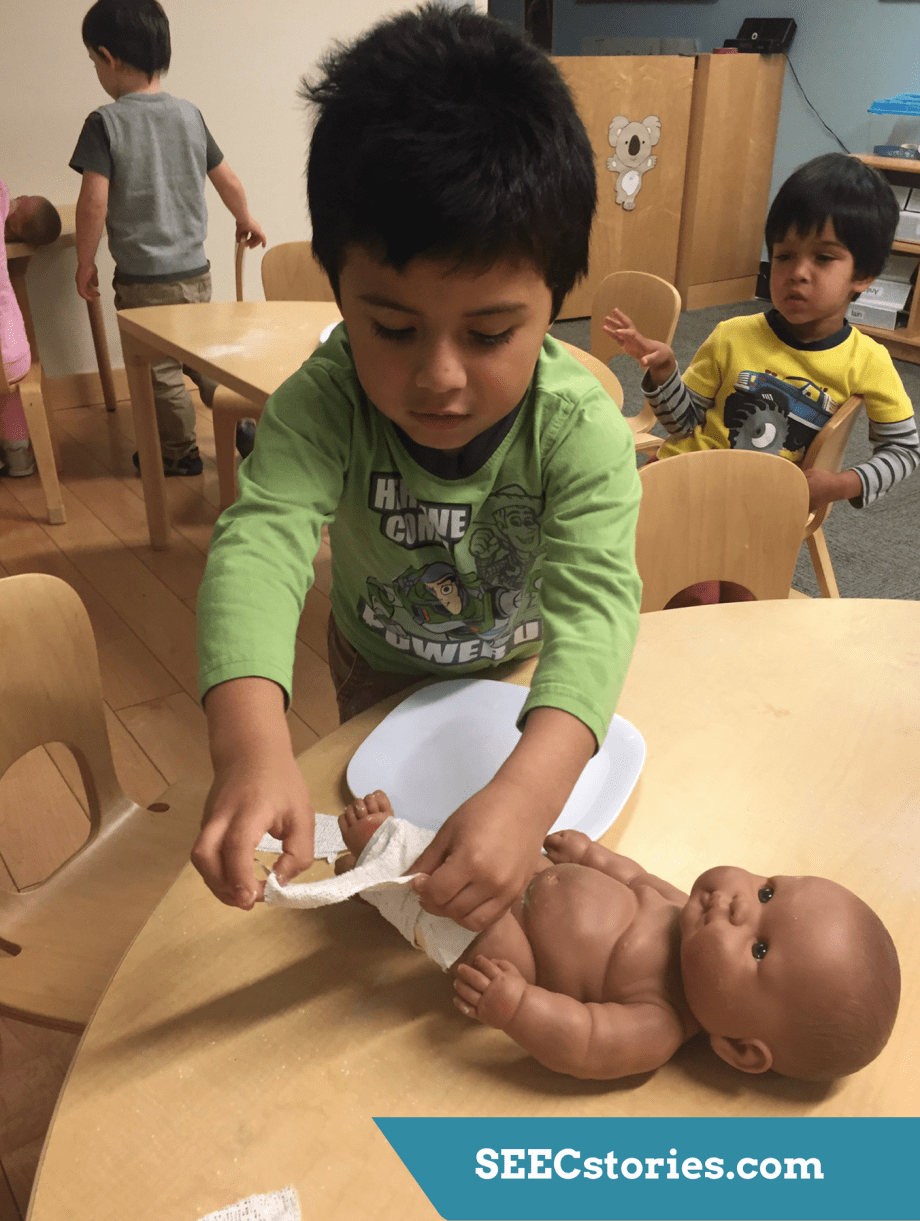 Laura explained how broken bones are wrapped in a cast so they can heal. To make this concept more concrete, the children used bandages to cast a baby doll’s leg.
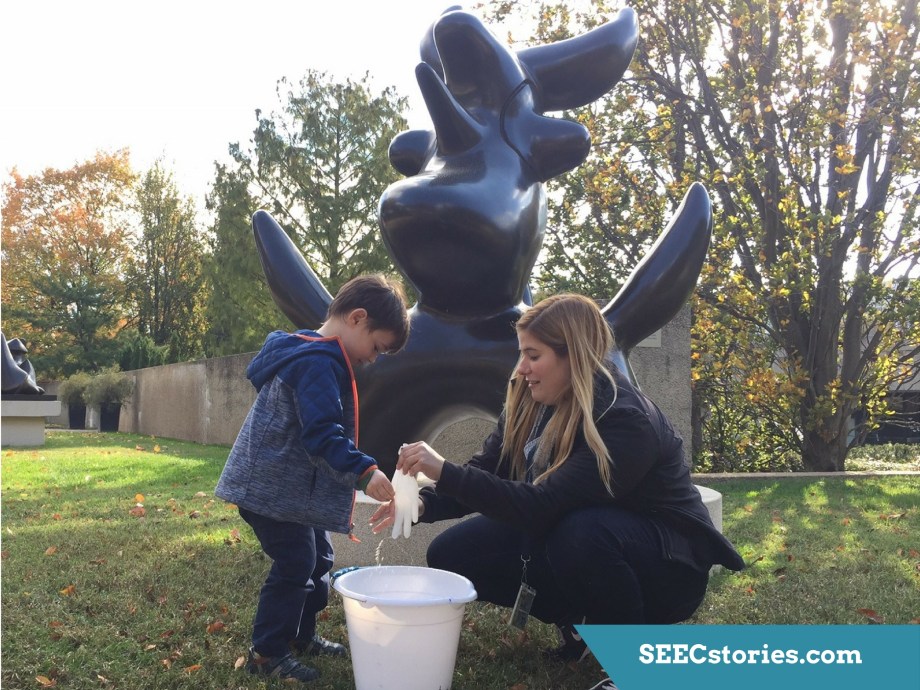 To cap off their week on bones, the class talked about the ways in which we can keep our bones healthy and strong, including drinking milk, which contains calcium. To explore where milk comes from, the class went to the
 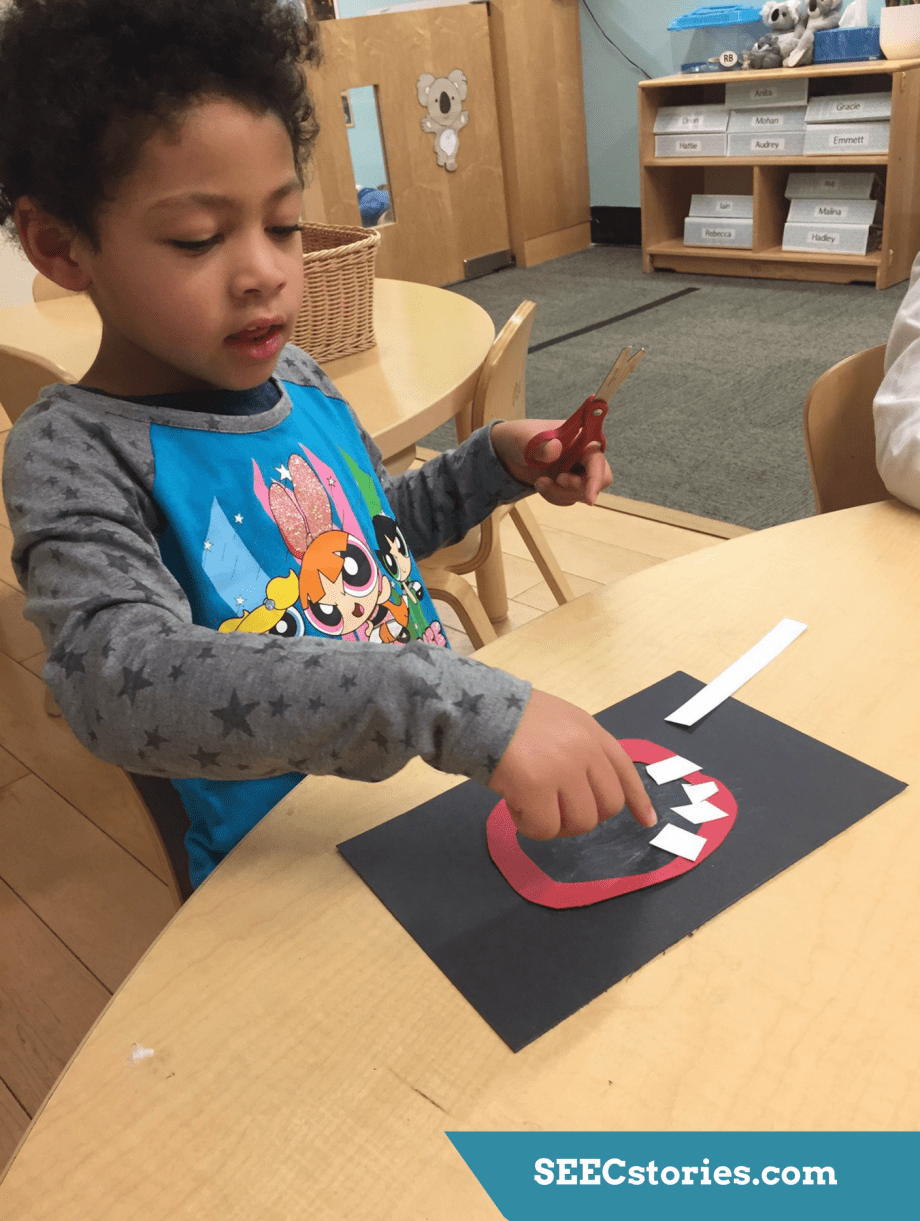 The class began their week on the digestive system by focusing on where food enters our bodies – the mouth! After seeing a giant mouth of a dinosaur, the children practiced their fine motor skills by cutting long strips of white paper into teeth and gluing them into a mouth.
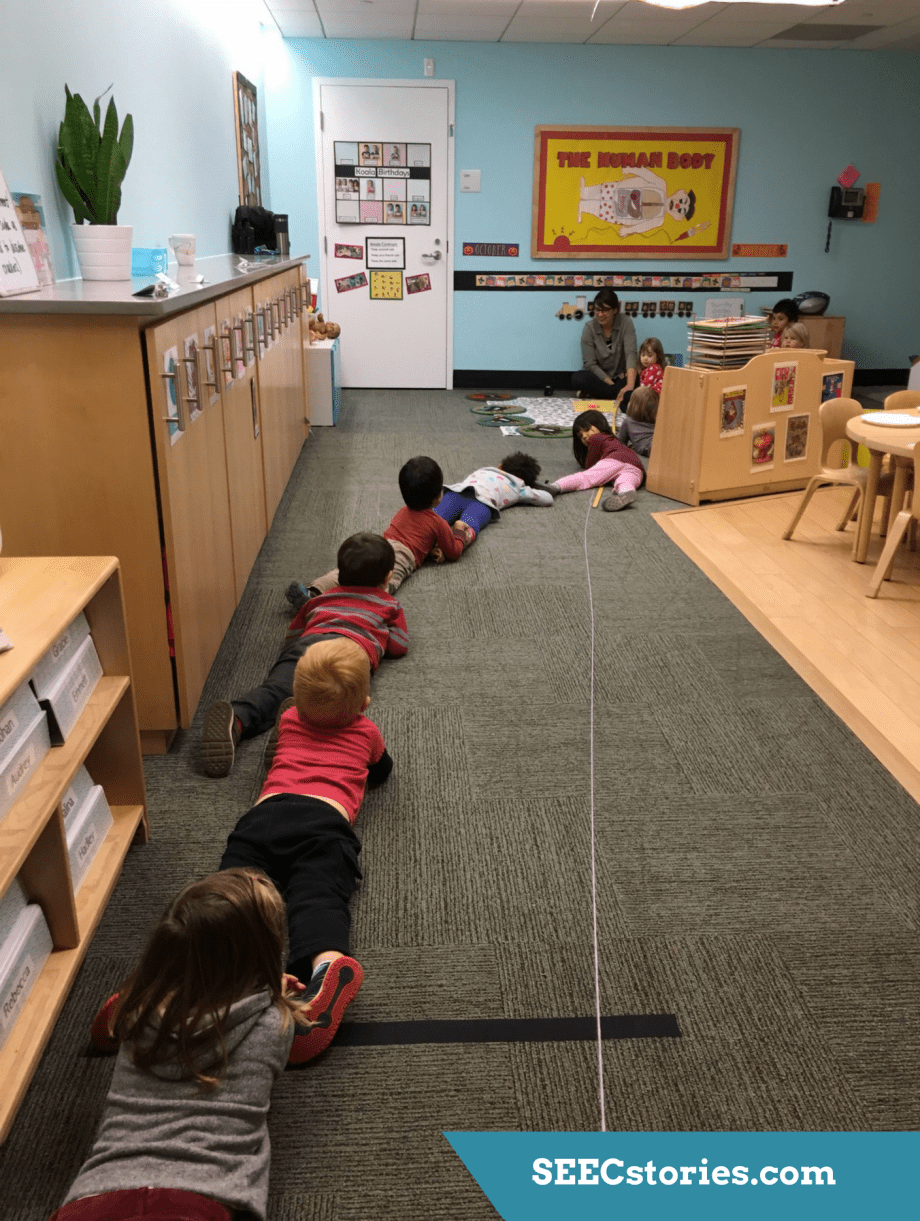 Explaining the length of intestines using only words can prove difficult for young children to understand, so Katie made it more concrete by measuring yarn to visualize how long intestines actually are. After they measured the yarn, the class lay on the floor along the yarn to see how many kids it would take to make the length of the intestine, which turns out to be a lot!
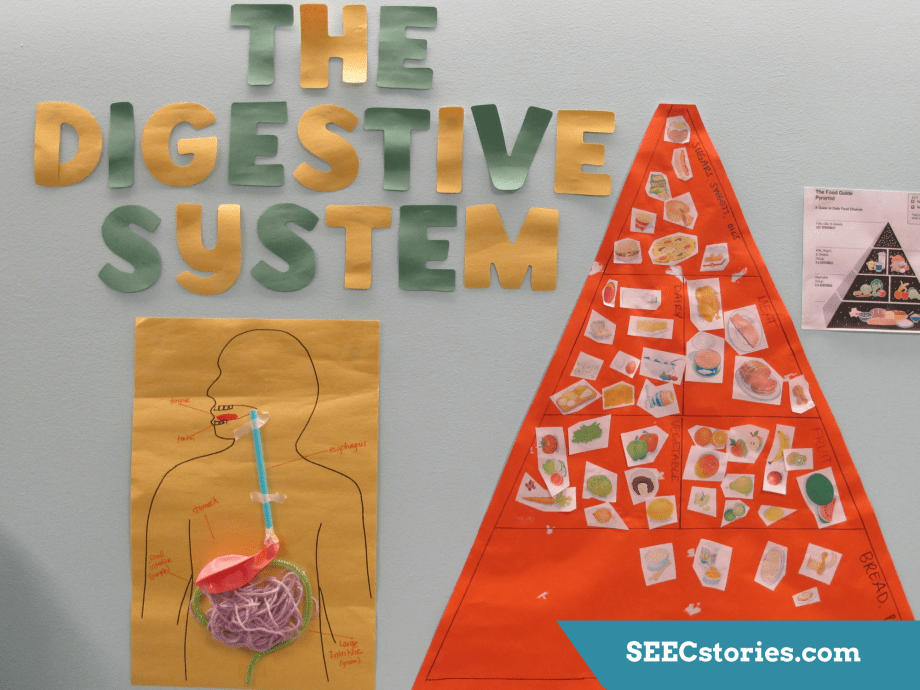 As they went through their week on the digestive system, the class added pieces to a paper model. They used a straw to represent the esophagus, a balloon as a stomach and yarn and ribbon as the intestines.
 When the class first sat down, Katie asked the children to look at the painting Red Dance by Kenneth Young, and share what it reminded them of. The piece reminded children of a brain, blood, and strawberries. Katie shared that the painting reminded her of blood too, and that was what they were going to learn more about that day. The class had already learned about how hearts and veins move blood around the human body, but now they were going to look at blood more in depth and see what elements make up blood.
 Katie asked, “Who has ever cut themselves and had blood come out?” Immediately the children began to roll up sleeves or pant legs to display a cut, and several told stories about how they got their boo-boos. Katie asked, “Did your cut keep bleeding forever, or did it stop? Is your cut still bleeding or has it stopped?” The children said they weren’t still bleeding anymore, and Katie explained that cuts stop bleeding because a hard scab is formed by some platelets, just one part that makes up our blood.
 To take a closer look at blood, Katie read
 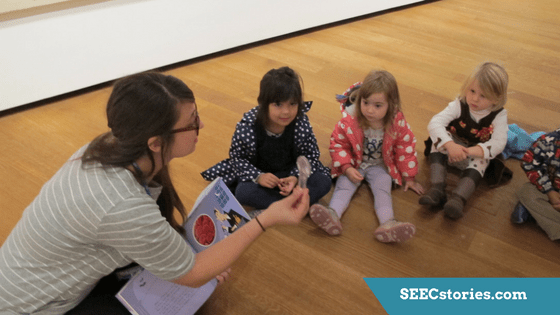 Katie asked the children what blood looks like when we cut ourselves, and the children said, “red”. She explained that when we bleed it looks red like the red dots on the painting, but if you look really close, with a microscope, you can see the different parts of blood. While the children are not as familiar with the concept of a microscope, they are very familiar with magnifying glasses, and Katie brought some out to make the connection that a microscope helps us to see small things that we can’t see with just our eyes.
 As they went through the book, Katie paused to talk about white blood cells, red blood cells, plasma, and platelets. The children passed around pictures of each to get a closer look, while Katie explained why each part is important for our bodies.
 After reading the book it was time to make their own blood! This activity provided a hands-on and engaging way for the children to practice what they had just learned. Katie brought out three “drops of blood”, which were three circles of contact paper. She said that the contact paper is sticky and looks wet, so it would be like the plasma, which keeps everything together. Then the children came up in turns to add red blood cells, and white blood cells (circles of red and white paper).
 To finish the blood, they added platelets, the small blood cells that come together to form a clot and stop a cut from bleeding.
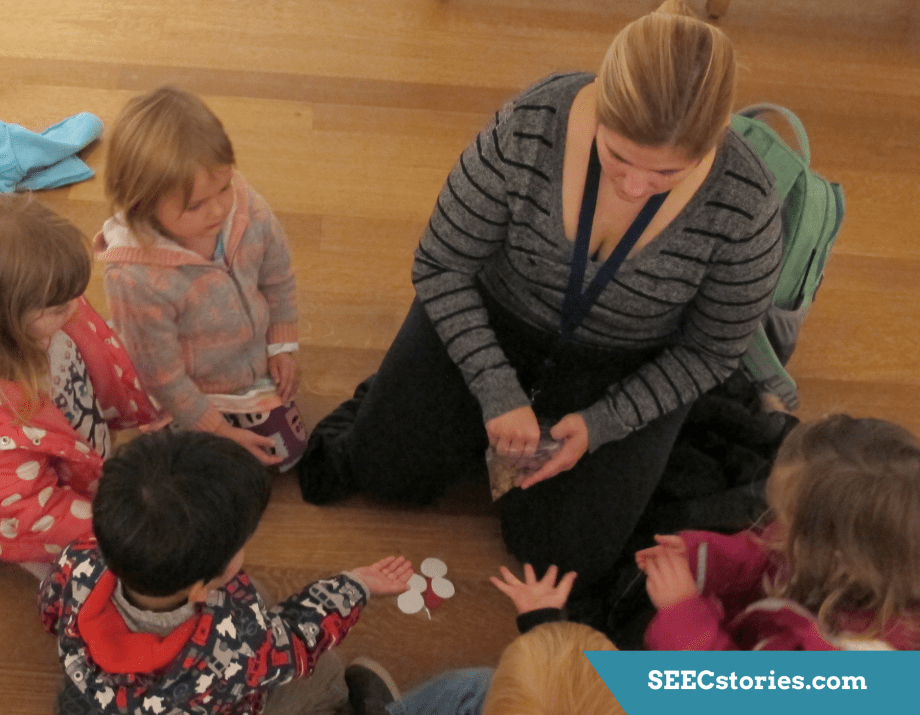 After making one blood cell together, the class split up into two groups and worked together to make more drops of blood. After they finished, there were some stray blood cells on the gallery floor, and the children were excited to help pick them up to leave the space clean.
 Back at school in the afternoon, the class made their own blood cells that they could take home.
 Then it was time to make more blood, but this time it was an edible version for their afternoon snack! First the class helped mix red food coloring into yogurt, which was the plasma.
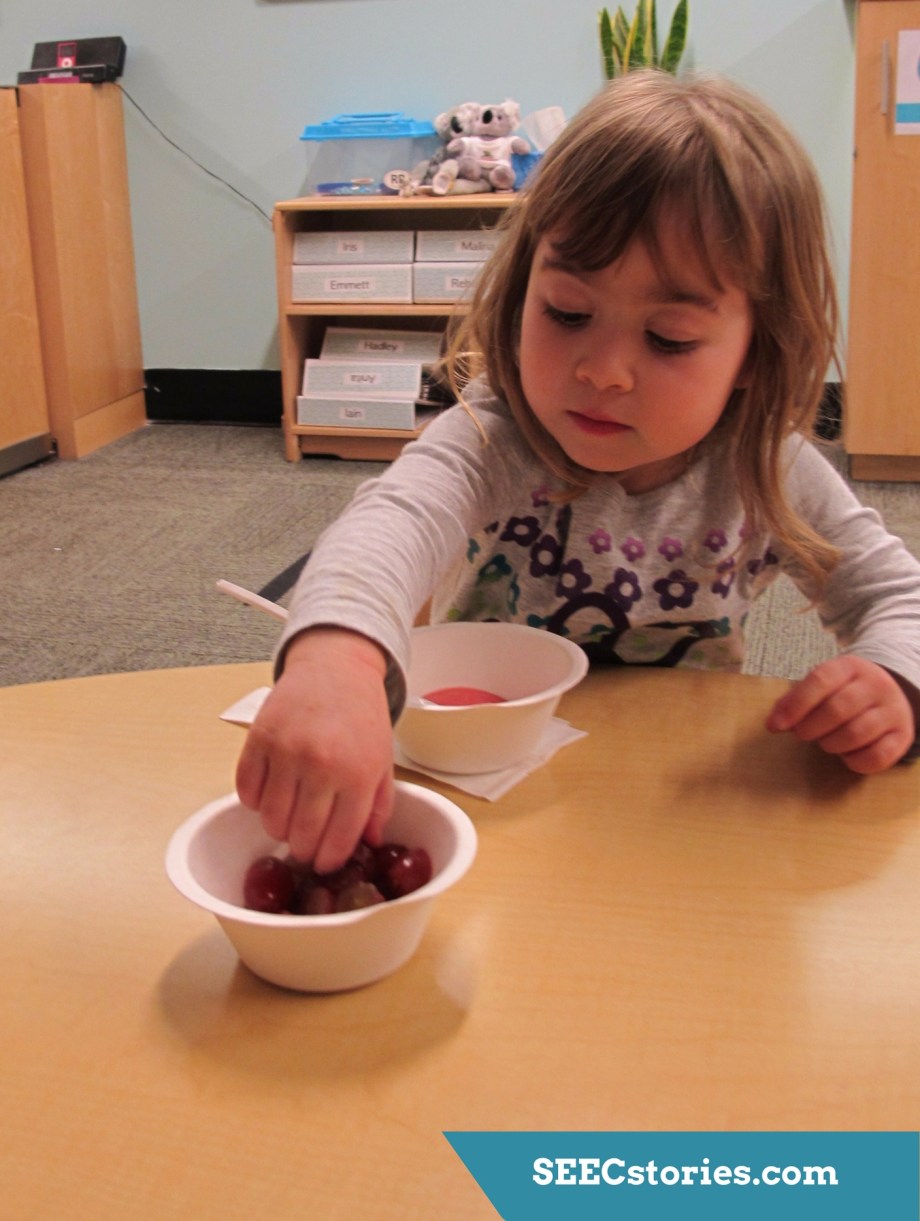 Next they added sliced grapes as the red blood cells.
 For the white blood cells, they added sliced bananas.
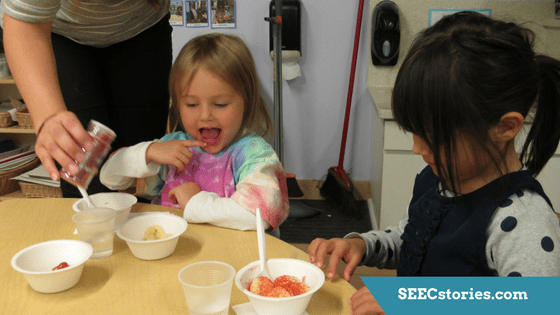 And finally, they topped off their blood snack with red sprinkles, acting as the many platelets found in our blood.
 The only thing left to do was enjoy eating it! By making blood in another way, the children experienced multiple exposure to the same concept, which helps to reinforce it. They were also actively involved in the process, which not only makes it more fun, but helps to strengthen their understanding of the concept.
 Following our coffee and conversation, the group will head out to a nearby museum where we will explore a topic through an adult lens. These museum visits won’t be tours in the traditional sense. They will be opportunities to look, learn, and exchange ideas. So what does SEEC know about adult programming? We actually work a lot with adults through our professional development programs. Not only are we comfortable working with adults, but we find that many of the methods we use with young children work equally as well with this audience. SEEC believes strongly that learning is a lifelong endeavor and we love the idea a of educating caregivers, while at the same time exposing their infants to a new and rich environment.





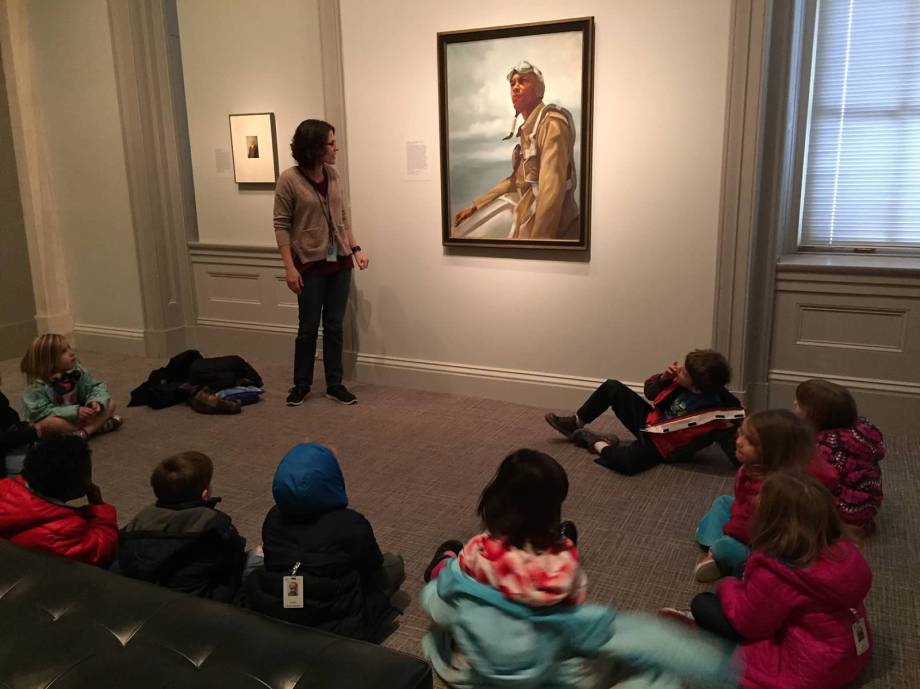
 They talked about Luke Skywalker and then visited the National Portrait Gallery to look at a painting of William Campbell, a fighter pilot who flew more than 100 missions across three different wars. They talked about the characteristics of a hero and what makes a person brave and what courage looks like.
 They learned math and compared their own heights to the height of C3PO, learning to measure and compare.
 (Pictured Sculpture:


 seecstories.com