Teacher Feature: Ducklings Explore Bubbles

This teacher feature focuses on the older infant (Duckling) class’s exploration of Bubbles and the development of their classroom exhibit: HOME during the month of May. At this point of the year, students in the Duckling class were between the ages of 14-20 months old.  

Preparation:   

Why and how did you choose the visit? 

The Ducklings were showing their teachers an increased interest in helping clean the classroom throughout the day. After each meal at school, the Ducklings would ask to help with a “Task,” such as wiping down the table, carrying dirty dishes to the kitchen, and putting the laundry in the laundry room. The students were excited to help and to mimic what their teachers were doing. The Duckling educators decided to follow that interest.  

What were your topics of exploration?  

This month-long exploration was all about Bubbles. Each week focused on a different way to encounter bubbles: Laundry, Dishes, and Bathtime. The class then spent the last week of the month discussing how we can take care of the spaces and things in our home. The unit concluded with the classroom Exhibit entitled HOME to show off all their hard work.  

What were your learning objectives? (What did you want your children to take away from the lesson?)  

There were a few learning objectives for the Bubbles unit. A major focus was for the Ducklings to gain a sense of autonomy and independence in their space. Throughout the month, the students had opportunities to decide how they wanted to interact with the lesson. For example, there were spare clothes available to the students during the week on Laundry. They could then decide if they wanted to practice putting on and taking off the clothes, pretend to wash them in the model washer and dryer, or work on hanging them up on the clothesline set up in the classroom. Having these options available allowed the students to decide for themselves where their interests lay and to work on a variety of gross and fine motor skills.  

Caption: Two infants practice hanging clothes on a pretend clothesline in their classroomPicture 

Caption: Duckling infant class explores spare clothes and laundry baskets on the floor with their educator.  

Another goal was to create a positive association with cleaning as it can be a difficult part of a child’s daily routine. By allowing them to create a mess and then have them help clean it up, the teachers could show the students that cleaning up after ourselves (a skill they will continue to develop later in life) is just as engaging as the mess making.   

Implementation:   

What was most successful about your lesson?  

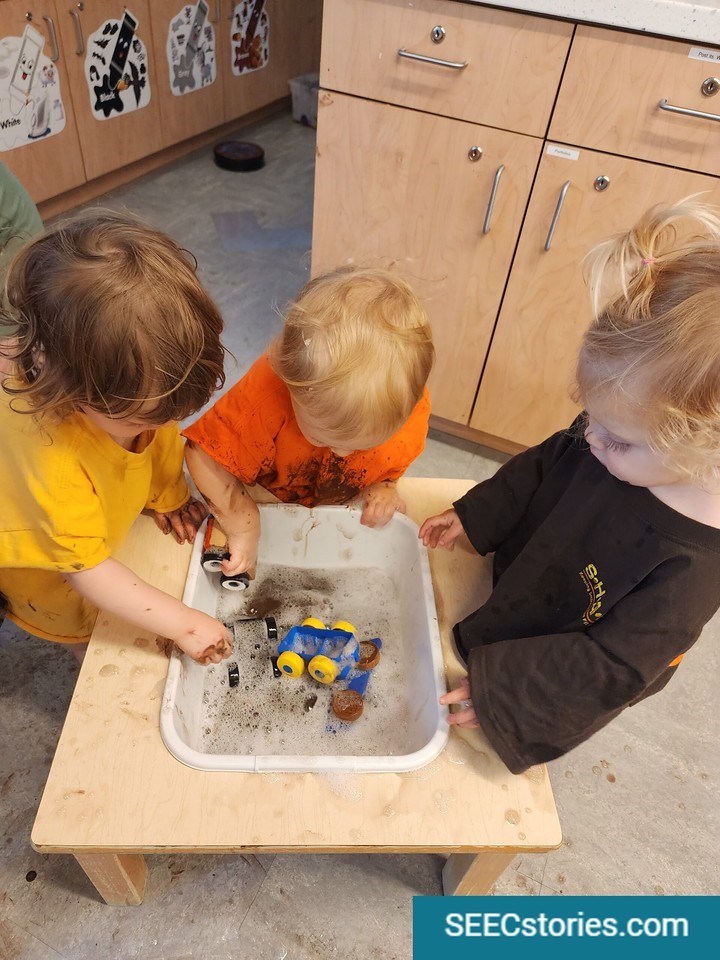
The most successful part of the whole month was watching the Ducklings get objects dirty and then get excited to clean them. It was a real full circle moment for the class. Over the course of the month, they would return to this cycle a number of times. First, they painted with dishes and utensils and when they were done painting, they cleaned them in soapy water. The class repeated this activity with toy cars in “mud” (brown paint) and then, again, using their full bodies. By the end it was clear to the teachers that the students understood that something gets messy and then it gets clean.  

Caption: Duckling students painted with their toys cars in “mud” (brown paint) and later washed the cars clean at a “car wash.” 

Another successful element was the cardboard washer and dryer Calla and Kevon built prior to the unit. The Ducklings quickly learned that they could move clothes from one machine to another and that the washer and dryer were only meant for clothes. It was great to see their gross and fine motor skills as well as their spatial reasoning skills in action as they moved clothes and turned the dials. 

Caption: Duckling student shows off her laundry and coordination skills by moving the clothes from the washing machine to the dryer 

How did the lesson reach your objectives to expand the topic?  

Each week the Ducklings got to focus on a different way they could clean and interact with bubbles. They would have similar experiences, such as painting and then cleaning up, but the methods would be different enough to expand their understanding of cleaning.  

The Ducklings were able to build on their prior knowledge of what it means to clean in order to understand how to clean with the new objects in front of them. For example, they were used to seeing their teachers clean the table with washcloths and liked to help rub down the table. The teachers took the class to Within These Walls at American History to discuss laundry. When presented with a washboard, typically used for cleaning clothes, they talked about how they could “rub, rub, rub” their washcloths on the board just like they would on the table. When their teacher placed a modern washboard basin in front of them, the Ducklings quickly associated that washboard with the one they had seen in the museum.  

Caption: Ducklings went to visit the laundry portion of the Within These Walls exhibit before returning to their classroom to do some washing of their own. They took their washcloths and got them clean in their soapy water buckets.  

What was successful in terms of your preparation and logistics? 

What made this lesson so successful was having everything prepared in advance. The Duckling educators knew that they wanted to spend an entire month talking about bubbles and cleaning, so they spent time thinking about how to break that down into smaller topics. This enabled the team to dive deeper into each topic but still create a cohesive lesson as the month progressed. 

The Duckling team also intentionally revisited spaces and concepts. They took more than one visit to Inside These Walls during their month-long unit. This allowed the Ducklings to become a little more familiar with the space and more comfortable engaging with the exhibit. They followed a similar thought process for their art lessons during the month. By using a similar formula for their art projects, they allowed their art making to become a routine. The children were able to know what to expect and, therefore, they spent more time exploring and engaging with their projects.   

Reflection:   

How did you document the lesson in order to reflect back on the work? 

The Duckling’s month-long exploration on Bubbles culminated in their classroom exhibit entitled HOME. The students spent so much time exploring bubbles and cleaning that it felt like the perfect topic for an exhibit and to have their adults come and see their hard work.  While not every project was displayed for the exhibit, the Duckling team chose to focus on displaying work that showed the process of getting things dirty and then getting things clean. The art around the classroom was the biproduct of that exploration.  

Caption: Ducklings students made bubble art by making bubbles with colored water and transferring the bubbles onto paper. Once dry, those art works were hung on a pretend clothesline for their classroom exhibit.   

The teachers also decided to bring back out the different cleaning stations they learned about during the month. There was a pretend bathtub, a toy kitchen, the washer and dryer, the laundry line, as well as brooms and dust pans. These stations were in place for the Ducklings to show their adults all the new gross and fine motor skills they developed over the month.  

Each station was brought out because it spoke to the interests of the children. There was a way for each child to engage, and work samples were present for each student.   

Caption: During the exhibit, one Duckling was exciting to show off her fine motor skills back at the clothesline.  

What could you have done differently to better achieve your objectives and expand the topic? 

There is always room for improvement in lesson planning, and if the Duckling team were to do this lesson over, one thing that they’d like to do is to scaffold some of their exploration out a little differently. For example, instead of putting up a clothesline, hanging clothes on it, and just letting the children explore, the team would have liked to break it down into smaller experiences first. Like just practicing pinching the clothes pins open and shut, then trying to balance clothes on a more solid clothes line, then transitioning to a string line. This slower introduction would have helped the students make their own connections.  

What was challenging regarding logistics?  

One challenge was finding the balance between experiencing getting messy and ensuring that the students are safe. Water play, and full-body paint exploration, can get slippery if the educators aren’t keeping a close eye on the situation. It can be a fine line between letting the children explore as they want to and making sure they keep their bodies safe. The Duckling team did their best to let the children explore freely by working to mitigate the mess before it happened. During water play, for example, they covered the floor with towels ahead of the play.  

What recommendations would you have for another teacher trying out this lesson? 

The biggest recommendation is to let the children experience the real thing, whenever possible. If the class is discussing how clothes get laundered when they get dirty, spend a day doing just that! Let the children get their clothes dirty, have them change, and then walk them through the steps of washing their clothes and take the time to investigate each step. The Ducklings loved being involved in the many steps of keeping themselves and their classroom clean. 

Creating Intentional, Reflective Spaces: SEEC’s Commitment to Meaningful Classroom Environments 

Introduction 

 Earlier this year, educators across SEEC’s vibrant community came together for an all-class meeting led by our Office of Engagement and Administrative Team. With representation from every classroom serving children from 2 months to 4 years, this gathering was an opportunity to reflect, share, and envision the future of our learning environments. 

The heart of the presentation focused on how classroom environments at SEEC should be more than just spaces—they should be reflections of what’s happening in the life of each class. They should be intentional, curated, and consistent across our community. As a lab school that integrates museums, community connections, play, and object-based learning, our environment serves not only as a backdrop, but also as an active participant in the learning process. 

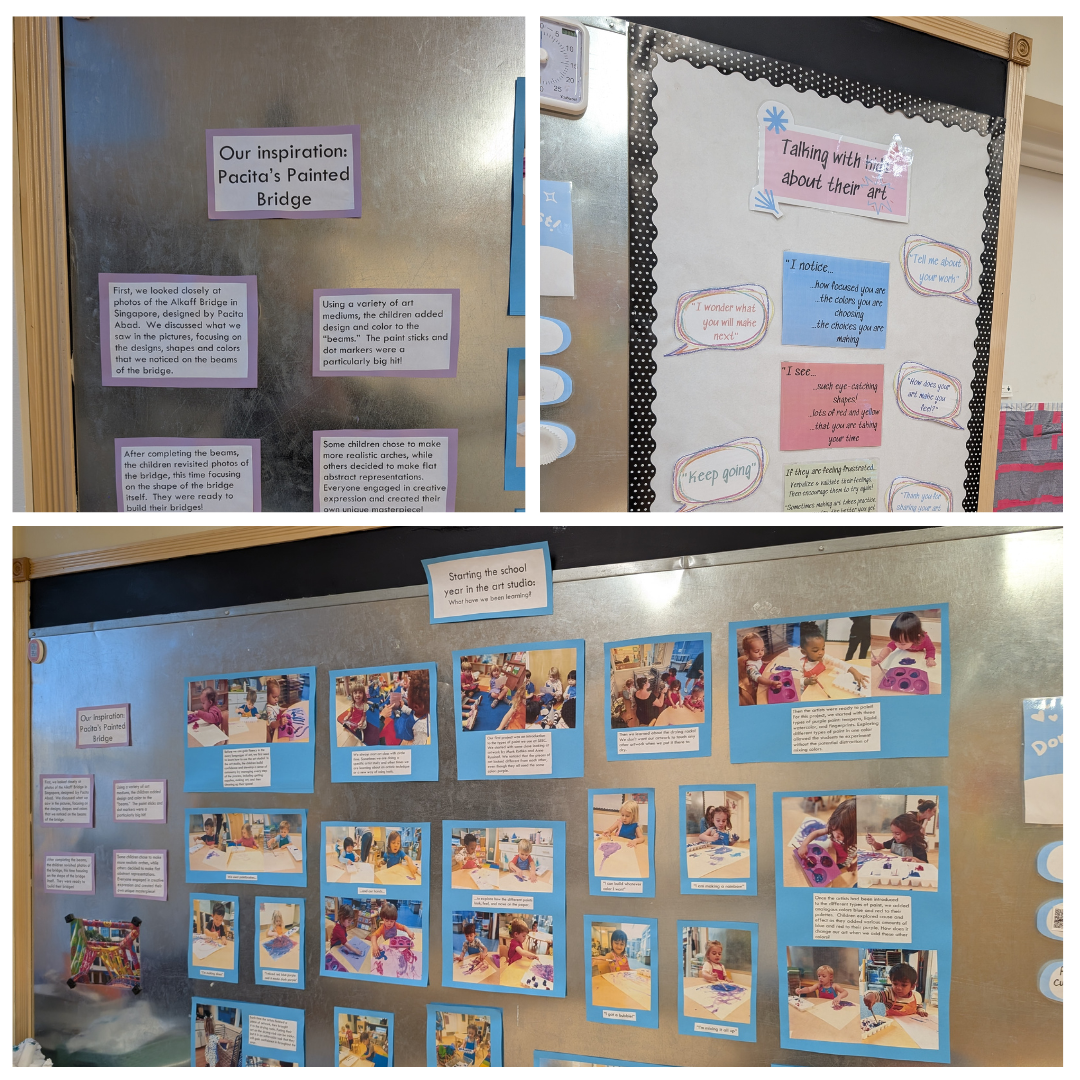
The display boards in the Art Studio about the children’s exploration of Pacita’s Painted Bridge; the top left board discusses the inspiration from the art with descriptive posters, the top right board features a “Talking with Art” theme with children’s art and comments, the bottom board showcases multiple photos and descriptions of children engaged in the process of creating their pieces. 

Documentation is …   

“An effective piece of documentation tells the story and the purpose of an event, experience, or development. It is a product that draws others into the experience—evidence or artifacts that describe a situation, tell a story, and help the viewer to understand the purpose of the action”  

   – NAEYC 

Art display featuring a colorful collage with images, patterns, and cellophane fish, all pinned on a wall. It also features photographs of the children creating the fish, an image of Untitled by Simon George Mpata and a description plaque of the children’s exploration. 

Guidelines for Curated Spaces 
 

The administrative team outlined several key guidelines for building and sustaining rich classroom environments. One major takeaway was the idea of keeping displays fresh and relevant by changing them out monthly in alignment with each class’s unit of learning. Educators were encouraged to use real photos whenever possible, and to be mindful of how someone without any context—a new family, a visitor, or even a child—might engage with the documentation they encounter. 

Importantly, the team challenged educators to think beyond the bulletin board. Documentation should be thoughtfully showcased, using the full range of space within the classroom to reflect learning, discovery, and growth. Typed descriptions should support the visuals, offering clear, intentional narratives about what is happening and why it matters. 

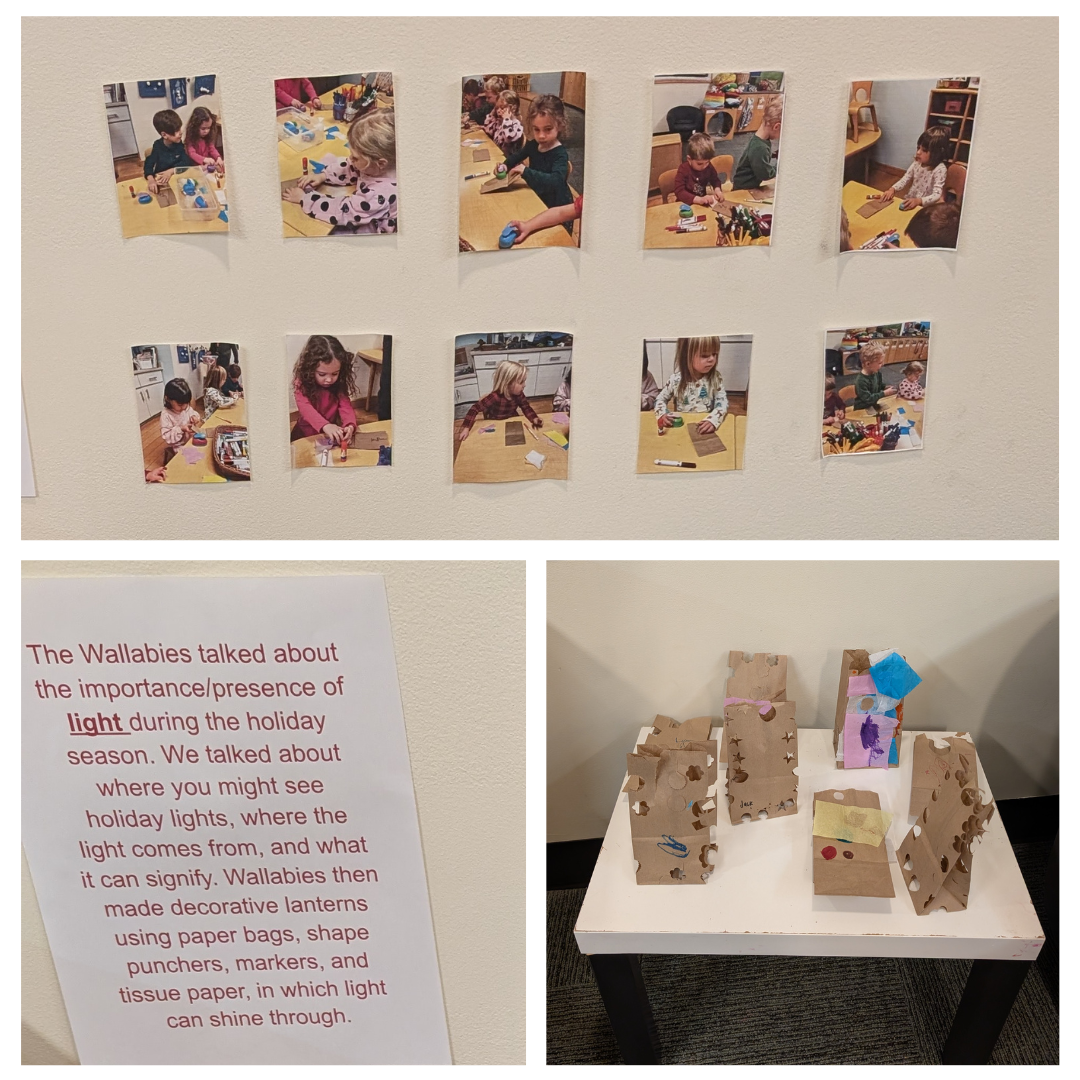
A display featuring multiple photos of children in our Threes class engaging in the process of creating lanterns, and a text panel describing their exploration of lights during the holidays, complemented by a display of their lanterns. 

Showcasing the Extraordinary 
 

Another theme of the presentation was recognizing and intentionally showcasing the extraordinary work that is happening every day in our classrooms. Documentation is a tool for storytelling—and those stories should be shared with our caregivers, our peers, and the children themselves. It fosters connection, supports classroom community, and builds trust with families. 

We revisited an important question: Who is documentation for? The answer was multifaceted. It’s for children, who deserve to see their learning reflected back at them. It’s for caregivers, who want to understand and engage with their child’s experience. It’s for fellow educators, directors, and even for each of us as individual educators—a way to reflect on and grow in our own practice. It’s also a window for new families into the values and rhythms of SEEC classrooms. 

Left: An outdoor class exhibit with a child and their caregiver viewing paper artworks.  

Right: A caregiver reading a description of their child’s class art display while two children and two educators engage in play and story time. 

Engaging Children Through Environment 
 

The team emphasized that placement matters. Documentation intended for children should be placed low enough for them to engage with it—yes, even to touch it. When we introduce materials thoughtfully and set expectations, children can interact with their learning environment in respectful and meaningful ways. 

We also explored how the environment itself can shape classroom behavior. A carefully arranged, engaging, and responsive space can reduce challenges and support deeper exploration. Our surroundings can either hinder or enhance the work we do—and we have the power to use them intentionally. 

Wall display at child level featuring one of our Twos’ class artworks and a descriptive plaque, in a classroom setting. 

From Discussion to Action 
 

The presentation concluded with an open dialogue. Educators discussed practical concerns—how to manage time constraints, where to print documentation, and how to embrace the idea that children will interact physically with the materials on display. 

In the five months since, educators across SEEC have taken this guidance to heart. Classrooms are now filled with purposeful documentation that highlights the daily wonders unfolding in our community. From toddler rooms to preschool spaces, there’s a renewed commitment to documenting learning not just consistently, but meaningfully. 

As we look ahead, our goal is to continue growing in this work—pushing ourselves to create environments that don’t just display learning but deepen and celebrate it. 

Top: A display in our older infant class featuring the work of Alma Thomas alongside the children’s artwork. Bottom: Abstract paintings and textured art pieces by one of our toddler classes, and a central portrait of Piet Mondrian with a description of the children’s exploration of his art. 

Teacher Feature: Infants Explore Flowers

An educator wearing a mask looks at a baby she is holding while the baby looks at a large display of pink azealas inside a museum.

Preparation:  

What were your topics of exploration? Why did you choose them? Where did they come from? 

During our walks outside, we noticed the Cottontails (infant class) seemed to enjoy when we pointed out the budding flowers to them. It is always exciting when the cherry blossoms reach peak bloom, so we decided to get into flower fever! 

Why and how did you choose the visit? 

As followers of @smithsoniangardens on Instagram, we were able to see when the various trees and garden displays were blossoming. Because our kids were on differentiated schedules, we needed to choose easily accessible locations so we could easily return to the classroom when our bottles and naps beckoned.  

Grouping of three photos. 1) A baby sits on a rug holding a gourd with a teach sitting behind. 2) Three babies sitting a large blue stroller look at a small pumpkin in their teacher's hand while at a farmer's market. 3) A baby is supported by their teacher while they finger paint and create art.

This class had previously learned about nature and plants through visits, art making and exploring objects. 

What were your learning objectives? What did you want your children to take away from the lesson?

Sensory exploration is a great entry point for our age group, so our goal was for our kids to get familiar with the sights, smells, and textures of spring. We paid attention to their reactions to see where their curiosities were leading them. 

Implementation:  

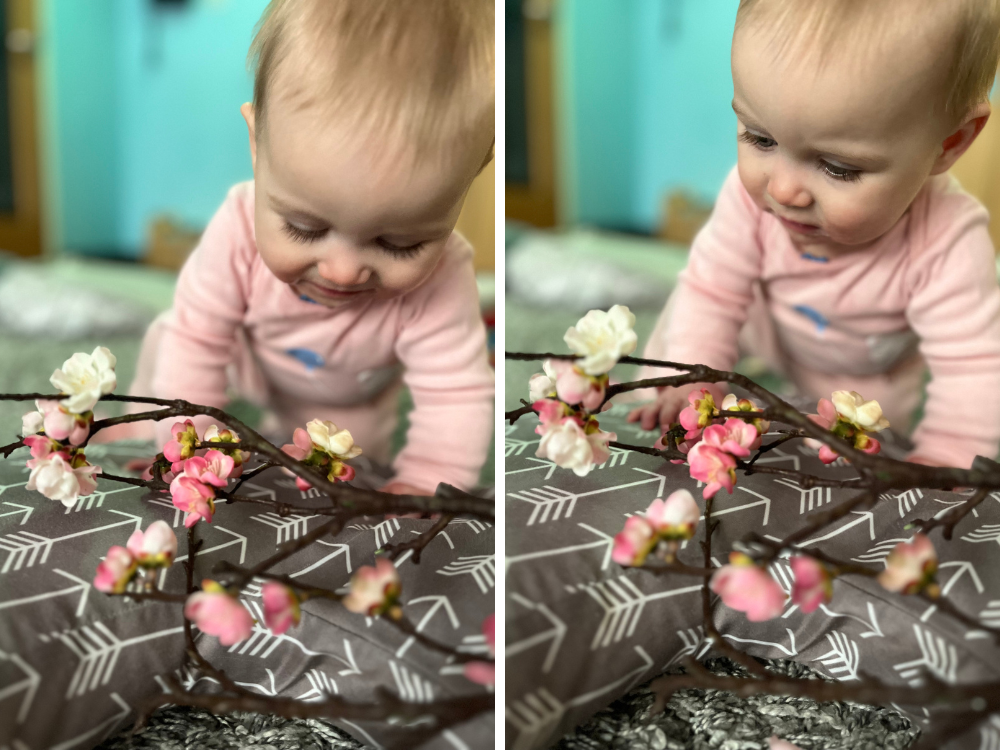
A baby crawling on the ground looks a branch with cherry blossoms and starts to smile.

 An infant child investigates a faux cherry blossom branch.

What activities did you use to engage the children in in the classroom?   

We placed several new materials in the classroom to connect to our outdoor explorations. We brought in live cherry blossoms to decorate our counters and offered faux blossoms to the children for more in-depth investigation and pretend play. We gently fluttered the fake branches and blew on them so that it seemed like the branches were moving in the wind. The children enjoyed trying to imitate blowing the branches – this was also good practice for calming ourselves with deep breaths! 

We also brought in baskets of soft, crocheted, cherry blossoms and placed them in baskets. The children practiced filling and dumping the baskets of blossoms and covering their bodies with them. 

Grouping of three photos. 1) A baby sits ontop of a tray of pink tea and explores the wetness with his hands 2) Standing baby reaches down with a paint brush in each hand to dip the brush into a tray of pink tea. 3) A standing baby reaches up to try to touch completed pink art hanging from a window.

The class created ”flower petals” by dipping coffee filters in hibiscus and rose petal tea. The warm, yummy-smelling, tea provided a soothing sensory experience that the kids really seemed to enjoy. 

Finally, we did a process art activity using hibiscus and rose petal tea to paint on coffee filters. The scent of the tea was delicious, and it created a lovely pink hue on the filters. After the project was dry, we laminated the pieces and hung them in the window for the children to continue to admire. 

Group of three photos. 1) A baby reaches out to try to touch azaelas on display in a musuem. 2) A baby who is bundled up for cold weather is outside touching a magnolia petal which is held in their teacher's hand. 3) A baby is held by their teach and points at white azealas on display inside a museum.

The infants look closely at and reach out to touch different flower petals including azaleas at the National Gallery of Art and the Saucer Magnolia flowers at the Haupt Garden.

What was it like taking the children out of the classroom to see various flower displays? How did you keep them engaged?   

Outings with young infants can be tricky to schedule, especially in the chillier months when everyone has multiple layers to bundle up in! We found success by choosing our destinations strategically and paying attention to our children’s cues. We kept the Cottontails engaged by talking to them about the sights and sounds around us and lifted them out of the stroller to help get them closer to the flower displays. Connecting our adventures with song is another winning tactic – our Cottontails loved playing “Ring around the Roses” next to the azalea display in the National Gallery of Art! 

How did you tailor your lessons to meet the learning needs of your age group?  

Babies are always taking in information from the environment around them, so we do our best to let them explore freely and notice where their curiosities are leading them. While they aren’t able to communicate with language, we can understand so much by paying attention to what they are looking at or reaching towards. 

Reflection:  

What was most successful about your lesson?  

We were proud of how active and engaged the group was throughout our explorations! By offering plenty of time and support for them to observe and interact freely with the materials and flowers, we were able to build on their natural curiosity and sense of focus.  

A group of two photos. 1) An educator in a mask holds child while they both look at a display of azealas in a museum. 2) An educator and child walk in a circle around a large display of azealas in a museum.

When the children got a little restless in the stroller the educators helped them take walk (or dance) break and held them closer to get a better look at the flowers.

How did the lesson reach your objectives to expand the topic?  

We tried to think creatively about how to offer a variety of sensory experiences that would help our Cottontails get familiar with the sights, smells, and feel of springtime blossoms. We later laminated the art project we made using hibiscus and rose petal tea and displayed it in our classroom window. Even after we had ended the unit, the children could look at the artwork and we would remind them of our springtime explorations.  

What recommendations would you have for another teacher trying out this lesson? 

Pay attention to the non-verbal cues of your students and offer as much free exploration as possible! Kids put everything in their mouths, so have a plan to discourage snacking on flowers while still acknowledging that appropriate developmental need.  

SEEC’s Oscars

2-2In keeping with the awards season time of year, SEEC held its annual Staff Appreciation dinner recently in order to recognize the hard work and dedication of our entire team. It was also a great opportunity to kick back, relax, and enjoy some time together.

During the course of the evening, we honored six individuals who have really stood out.

Without further ado, the winners are….

Diane Homiak Award

The Diane Homiak Award is a lasting tribute to the memory of SEEC supporter, parent, and employee Diane Homiak. A fund has been established that annually recognizes the commitment, creativity, and contributions made by a teacher to SEEC.sign-me-up

Melinda Bernsdorf, teacher in one of our two-year-old classes, was the 2017 recipient. With numerous nominations from parents, teammates, and colleagues, Melinda was singled out for fostering a creative and inspiring learning environment, her ability to build independence and inquisitiveness in her children, her willingness to share ideas, and the remarkable warmth she brings to everything she does.  Melinda has been at SEEC since 2014 and holds a Bachelors in Psychology. She has a long history of working with children and says she loves how each child has their own individual way of exploring their world.

Rookie of the Year1

First year toddler teacher Elizabeth Kubba was celebrated as this year’s Rookie of the Year!  She, too, was recognized for her creativity in the classroom, her dedication to her children, and her level of communication. As an undergrad, she realized that educating and developing young people was her true passion so she went on to earn her M.Ed. in School Counseling from Liberty University. She has been working in special education at the elementary level for the past three years.

Spirit of SEEC1-3

Brooke Shoemaker was celebrated with the Spirit of SEEC Award.  This award isn’t given out every year – it’s only awarded when an educator who reaches across the entire school really stands out, and Brooke truly fits that bill!  She was recognized for her work supporting teachers in all three of SEEC’s sites, her ability to connect with everyone (big and little), and her outstanding work within the Center for Innovation in Early Learning. Brooke serves as the Education Specialist for Pre-K and Elementary programs. She holds an M.Ed. in Early Childhood Education and you will often find her combining her knowledge of young learners with her love for theater.

Team Player Awards

The Team Player is awarded to staff who is recognized by their peers. Infant Educator, Logan Crowley, and Assistant Educators,  Ace Walton and Phoebe Cos were selected as this year’s award winners – each goes above and beyond to support his/her colleagues, with warmth, willingness to jump in, and a positive outlook! We’re incredibly lucky to have such supportive and dedicated educators across SEEC!

While these 6 individuals were specifically recognized, we also took the time at our dinner to recognize each and every member of SEEC’s team.  We’re so incredibly fortunate to have a community of educators as strong and dedicated as those working here each day – it’s what makes SEEC the special place that it is – and we know you recognize that, too! An incredible 27 individuals were nominated this year, and we received more than 50 nominations for these talented educators!

A Fresh Take: Back-to-School Books

It’s that time again! Many of our nation’s teachers are preparing their classrooms for the first day of school and so we wanted to share with you what some of our SEEC teachers are planning to include on their bookshelves this coming fall. Before school ended this past week, I interviewed several of our teachers to get their perspective on back-to-school books and here’s what I learned.
Duckling Book_1

HOMEMADE BOOKS

Many of our infant and toddler teachers lamented that there weren’t a lot of options for their young students. They were opting for making homemade books like the one featured to the right that documents a trip to their new classroom. This group of toddlers will be going to a new center, so the teacher thought it was especially important to have something to ease into a new location. I liked that the book highlighted the children’s feelings and pointed out some exciting new components of the classroom. I guess you could call it an end-of-the-year book, but since it will be with them in their new classroom too it still bridges their experiences and offers them continuity.  Duckling Book_2

Many of our teachers also like to create individual books for their students that include photos of family, special events or things the child likes. These types of books can be a great source of comfort at any time of the year when they need a little extra soothing. They also help classmates learn about each other.

FAMILIAR FRIENDS

At least four teachers said to me that they weren’t necessarily looking for back-to-school books for September. Rather they wanted  books with which the children were familiar. Having these books were important because they built in a familiar component that would help their students feel safe and more easily transition to their new teachers and routines. This was especially true of the teachers in our toddler and twos classes. Here were some of their top recommendations.

  1. Chicka, Chicka, Boom, Boom by Bill Martin, Jr. and John Archambault
  2. Good Night Moon by Margaret Wise Brown
  3. Brown Bear, Brown Bear, What do You See by Bill Martin Jr.
  4. The Napping House by Audrey Wood
  5. The Very Hungry Caterpillar by Eric Carle

MAKE IT A PROJECT

Our current Kindergarten teacher shared that when she was teaching in Europe she stumbled across the book, Mommy in My Pocket by Carol Hunt Sendarak. She said she fell in love with the book and its story of a little girl who imagines shrinking her mother so she can accompany her to school. In the end, she realizes that she will be fine on her own as she carries the memory of her mother’s hug and kiss.

Our teacher, Cathryn, took the book a step further and had her pocketstudents bring in a photo of their moms/caretakers and adhered it to the shape of a person. The children were invited to “dress” the body by coloring in clothes. When they were finished, she attached it to a heart, which was then glued on top of a cut-out pocket shape. Finally, she attached yarn to the pocket so the children could wear their “caretaker pockets” like a necklace.

After their project was done, the class sat together and talked. She recounts that she would ask about their feelings or other objects that they might want to bring to school with them.

CELEBRATING INDIVIDUALITY

Many of our PreK teachers said they like to use the beginning of the year to teach about what makes their students special or unique. One PreK-4 teacher praised Tacky the Penguin by Helen Lester for not only honoring everyone’s differences, but also just being silly. Another teacher suggested Ian Falconer’s Olivia because of how it embraces the character’s unique spirit – plus, it doesn’t hurt that the book showcases a visit to the museum where Olivia encounters paintings by Degas and Pollock – a very SEEC moment.

OTHER FAVORITESImage 3346

  1. Lilly’s Purple Plastic Purse by David Henkes

Though not really about back-to-school, this book features the relationship between student and teacher and introduces children to the concept of having different perspectives.

2.  The Night Before Kindergarten by Natasha Wing

This one is for the parents out there! It is a personal favorite that helped both my children transition to Kindergarten.

2.  Splat the Cat by Rob Scotton

3.   If  You Take a Mouse to School by Laura Numeroff

4.   Franklin Goes to School by Paulette Bourgeois

DON’T FORGET THE SPACEphoto 4

Creating a cozy corner, can be as important as the books. Have fun creating a space that is quiet by sectioning it off from the classroom buzz. Use inviting colors, comfortable furniture and include soft, soothing objects. Such a space will undoubtedly help with those first day transitions as well as difficult moments throughout the year.

Hope these give you some fresh ideas! Happy back-to-school.

Ready Set Go

Post by Betsy Bowers, Director of the Center for Innovation in Early Learning
As another school year comes to a close and we begin to say farewell to the many children who have spent the past 5 years or so with us, it’s hard not to wonder what’s ahead for them. Our educators tirelessly support SEEC students as we help them make sense of the world, love learning and grow into thoughtful young citizens. Over the course of this past year, a group of SEEC educators discussed what our students should be able to do when they leave SEEC.

Critical thinking and analysis.

Critical thinking and analysis.

There’s quite a long list. A few of the things we agreed on were that our students should leave SEEC being able to solve problems, be responsible, take risks, understand their role in the community and their ability to affect change, have compassion, respect and empathy for others, and communicate their ideas.

It’s a lot to ask a 5 year old if they know how to solve a problem or be responsible, because of course they will say, “yes.” We are, after all, working on having them leave SEEC with self confidence so a positive response is expected. Because I wanted to find out if our 5 year olds are entering Kindergarten as independent thinkers, I asked a few of them this more indirect question: “If I told you that five of your friends wanted you to climb up the Washington Monument so that you could jump off, what would you say?” One student gave me an odd look and responded, “That’s not really a good idea.” One student did say, “Yes.” We’ll hope that she has some clever ideas about how to do that safely. One student simply said, “Ouch,” while a few others were much too busy to want to elaborate and so responded with a “no.”

Ability to share ideas.

Ability to share ideas.

The response, though, that reminds us that all these skills are intertwined and expands our notion of “independent thinking” was this – “Only if we could jump off like a cannonball and onto a big trampoline!” Of course, why didn’t I think of that?

Here’s hoping that this playfulness, creativity, critical thinking and overall healthy outlook on the world that we have worked so hard to nurture is embraced by our elementary school colleagues and the world. Good luck, dear friends, as you now go and bravely pursue life.

Self esteem and confidence.

Self esteem and confidence.