Teacher Feature: Ducklings Explore Bubbles

This teacher feature focuses on the older infant (Duckling) class’s exploration of Bubbles and the development of their classroom exhibit: HOME during the month of May. At this point of the year, students in the Duckling class were between the ages of 14-20 months old.  

Preparation:   

Why and how did you choose the visit? 

The Ducklings were showing their teachers an increased interest in helping clean the classroom throughout the day. After each meal at school, the Ducklings would ask to help with a “Task,” such as wiping down the table, carrying dirty dishes to the kitchen, and putting the laundry in the laundry room. The students were excited to help and to mimic what their teachers were doing. The Duckling educators decided to follow that interest.  

What were your topics of exploration?  

This month-long exploration was all about Bubbles. Each week focused on a different way to encounter bubbles: Laundry, Dishes, and Bathtime. The class then spent the last week of the month discussing how we can take care of the spaces and things in our home. The unit concluded with the classroom Exhibit entitled HOME to show off all their hard work.  

What were your learning objectives? (What did you want your children to take away from the lesson?)  

There were a few learning objectives for the Bubbles unit. A major focus was for the Ducklings to gain a sense of autonomy and independence in their space. Throughout the month, the students had opportunities to decide how they wanted to interact with the lesson. For example, there were spare clothes available to the students during the week on Laundry. They could then decide if they wanted to practice putting on and taking off the clothes, pretend to wash them in the model washer and dryer, or work on hanging them up on the clothesline set up in the classroom. Having these options available allowed the students to decide for themselves where their interests lay and to work on a variety of gross and fine motor skills.  

Caption: Two infants practice hanging clothes on a pretend clothesline in their classroomPicture 

Caption: Duckling infant class explores spare clothes and laundry baskets on the floor with their educator.  

Another goal was to create a positive association with cleaning as it can be a difficult part of a child’s daily routine. By allowing them to create a mess and then have them help clean it up, the teachers could show the students that cleaning up after ourselves (a skill they will continue to develop later in life) is just as engaging as the mess making.   

Implementation:   

What was most successful about your lesson?  

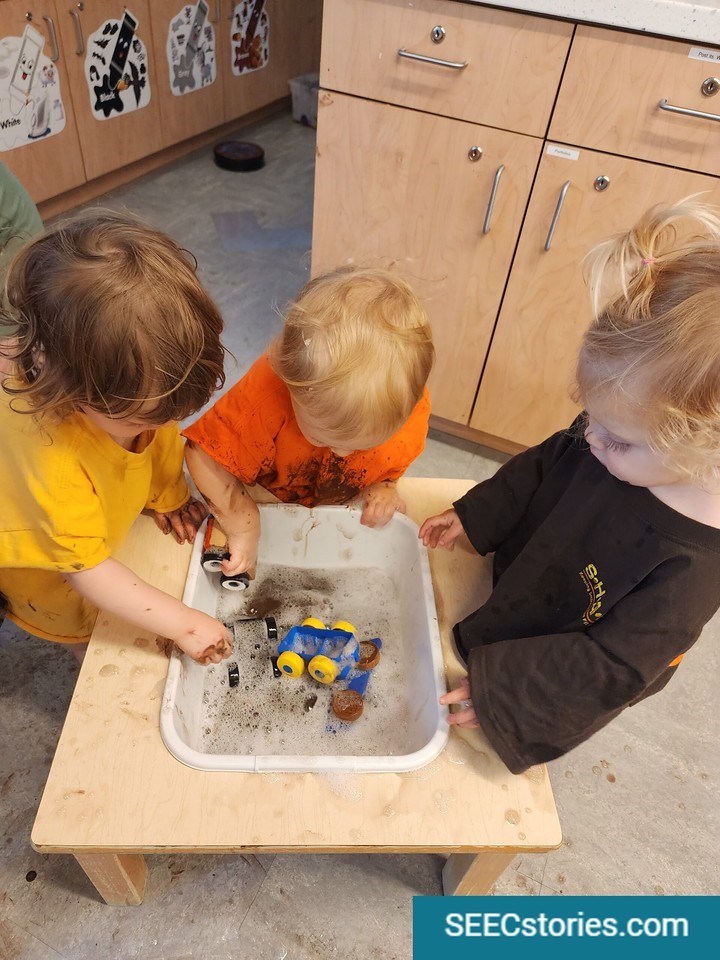
The most successful part of the whole month was watching the Ducklings get objects dirty and then get excited to clean them. It was a real full circle moment for the class. Over the course of the month, they would return to this cycle a number of times. First, they painted with dishes and utensils and when they were done painting, they cleaned them in soapy water. The class repeated this activity with toy cars in “mud” (brown paint) and then, again, using their full bodies. By the end it was clear to the teachers that the students understood that something gets messy and then it gets clean.  

Caption: Duckling students painted with their toys cars in “mud” (brown paint) and later washed the cars clean at a “car wash.” 

Another successful element was the cardboard washer and dryer Calla and Kevon built prior to the unit. The Ducklings quickly learned that they could move clothes from one machine to another and that the washer and dryer were only meant for clothes. It was great to see their gross and fine motor skills as well as their spatial reasoning skills in action as they moved clothes and turned the dials. 

Caption: Duckling student shows off her laundry and coordination skills by moving the clothes from the washing machine to the dryer 

How did the lesson reach your objectives to expand the topic?  

Each week the Ducklings got to focus on a different way they could clean and interact with bubbles. They would have similar experiences, such as painting and then cleaning up, but the methods would be different enough to expand their understanding of cleaning.  

The Ducklings were able to build on their prior knowledge of what it means to clean in order to understand how to clean with the new objects in front of them. For example, they were used to seeing their teachers clean the table with washcloths and liked to help rub down the table. The teachers took the class to Within These Walls at American History to discuss laundry. When presented with a washboard, typically used for cleaning clothes, they talked about how they could “rub, rub, rub” their washcloths on the board just like they would on the table. When their teacher placed a modern washboard basin in front of them, the Ducklings quickly associated that washboard with the one they had seen in the museum.  

Caption: Ducklings went to visit the laundry portion of the Within These Walls exhibit before returning to their classroom to do some washing of their own. They took their washcloths and got them clean in their soapy water buckets.  

What was successful in terms of your preparation and logistics? 

What made this lesson so successful was having everything prepared in advance. The Duckling educators knew that they wanted to spend an entire month talking about bubbles and cleaning, so they spent time thinking about how to break that down into smaller topics. This enabled the team to dive deeper into each topic but still create a cohesive lesson as the month progressed. 

The Duckling team also intentionally revisited spaces and concepts. They took more than one visit to Inside These Walls during their month-long unit. This allowed the Ducklings to become a little more familiar with the space and more comfortable engaging with the exhibit. They followed a similar thought process for their art lessons during the month. By using a similar formula for their art projects, they allowed their art making to become a routine. The children were able to know what to expect and, therefore, they spent more time exploring and engaging with their projects.   

Reflection:   

How did you document the lesson in order to reflect back on the work? 

The Duckling’s month-long exploration on Bubbles culminated in their classroom exhibit entitled HOME. The students spent so much time exploring bubbles and cleaning that it felt like the perfect topic for an exhibit and to have their adults come and see their hard work.  While not every project was displayed for the exhibit, the Duckling team chose to focus on displaying work that showed the process of getting things dirty and then getting things clean. The art around the classroom was the biproduct of that exploration.  

Caption: Ducklings students made bubble art by making bubbles with colored water and transferring the bubbles onto paper. Once dry, those art works were hung on a pretend clothesline for their classroom exhibit.   

The teachers also decided to bring back out the different cleaning stations they learned about during the month. There was a pretend bathtub, a toy kitchen, the washer and dryer, the laundry line, as well as brooms and dust pans. These stations were in place for the Ducklings to show their adults all the new gross and fine motor skills they developed over the month.  

Each station was brought out because it spoke to the interests of the children. There was a way for each child to engage, and work samples were present for each student.   

Caption: During the exhibit, one Duckling was exciting to show off her fine motor skills back at the clothesline.  

What could you have done differently to better achieve your objectives and expand the topic? 

There is always room for improvement in lesson planning, and if the Duckling team were to do this lesson over, one thing that they’d like to do is to scaffold some of their exploration out a little differently. For example, instead of putting up a clothesline, hanging clothes on it, and just letting the children explore, the team would have liked to break it down into smaller experiences first. Like just practicing pinching the clothes pins open and shut, then trying to balance clothes on a more solid clothes line, then transitioning to a string line. This slower introduction would have helped the students make their own connections.  

What was challenging regarding logistics?  

One challenge was finding the balance between experiencing getting messy and ensuring that the students are safe. Water play, and full-body paint exploration, can get slippery if the educators aren’t keeping a close eye on the situation. It can be a fine line between letting the children explore as they want to and making sure they keep their bodies safe. The Duckling team did their best to let the children explore freely by working to mitigate the mess before it happened. During water play, for example, they covered the floor with towels ahead of the play.  

What recommendations would you have for another teacher trying out this lesson? 

The biggest recommendation is to let the children experience the real thing, whenever possible. If the class is discussing how clothes get laundered when they get dirty, spend a day doing just that! Let the children get their clothes dirty, have them change, and then walk them through the steps of washing their clothes and take the time to investigate each step. The Ducklings loved being involved in the many steps of keeping themselves and their classroom clean. 

Creating Intentional, Reflective Spaces: SEEC’s Commitment to Meaningful Classroom Environments 

Introduction 

 Earlier this year, educators across SEEC’s vibrant community came together for an all-class meeting led by our Office of Engagement and Administrative Team. With representation from every classroom serving children from 2 months to 4 years, this gathering was an opportunity to reflect, share, and envision the future of our learning environments. 

The heart of the presentation focused on how classroom environments at SEEC should be more than just spaces—they should be reflections of what’s happening in the life of each class. They should be intentional, curated, and consistent across our community. As a lab school that integrates museums, community connections, play, and object-based learning, our environment serves not only as a backdrop, but also as an active participant in the learning process. 

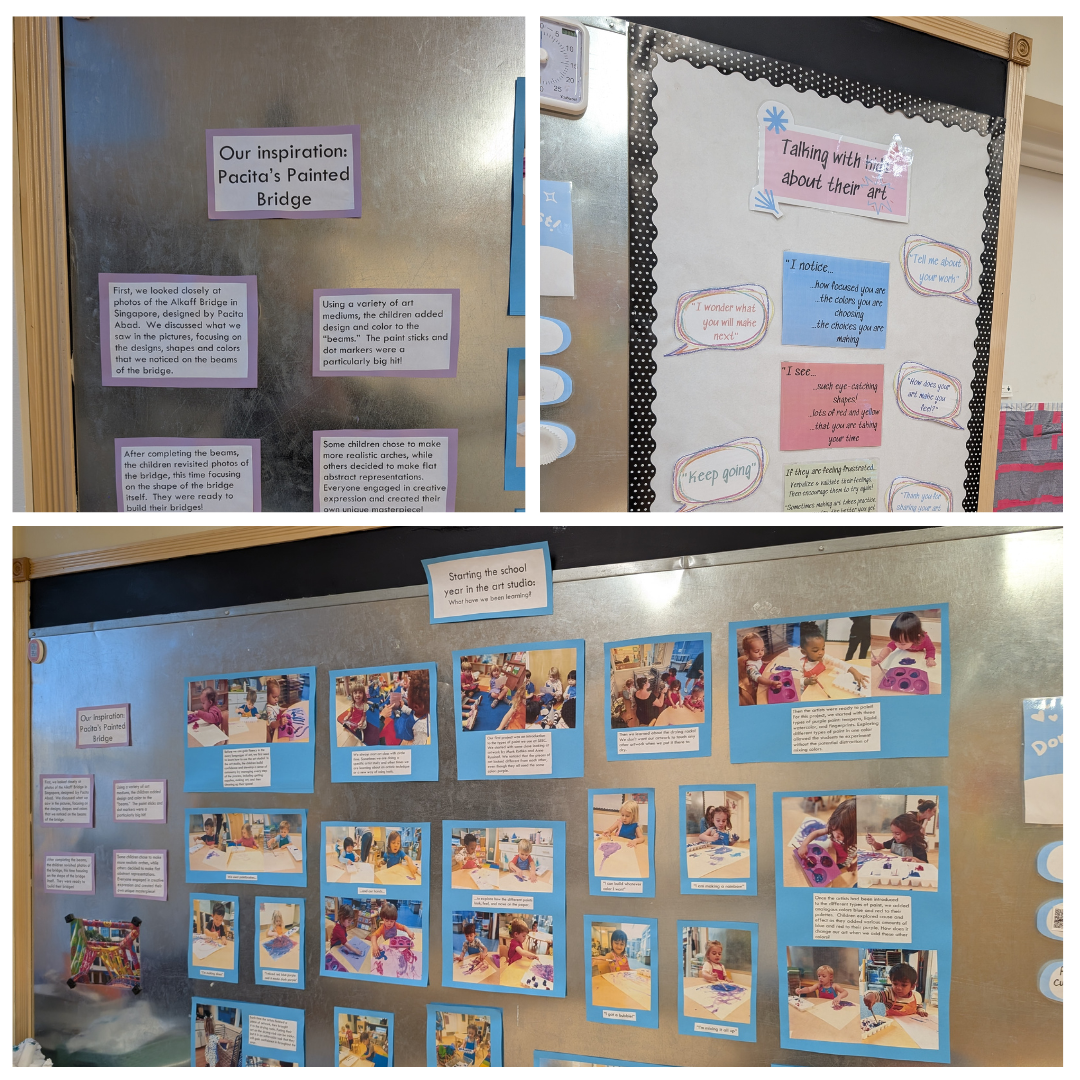
The display boards in the Art Studio about the children’s exploration of Pacita’s Painted Bridge; the top left board discusses the inspiration from the art with descriptive posters, the top right board features a “Talking with Art” theme with children’s art and comments, the bottom board showcases multiple photos and descriptions of children engaged in the process of creating their pieces. 

Documentation is …   

“An effective piece of documentation tells the story and the purpose of an event, experience, or development. It is a product that draws others into the experience—evidence or artifacts that describe a situation, tell a story, and help the viewer to understand the purpose of the action”  

   – NAEYC 

Art display featuring a colorful collage with images, patterns, and cellophane fish, all pinned on a wall. It also features photographs of the children creating the fish, an image of Untitled by Simon George Mpata and a description plaque of the children’s exploration. 

Guidelines for Curated Spaces 
 

The administrative team outlined several key guidelines for building and sustaining rich classroom environments. One major takeaway was the idea of keeping displays fresh and relevant by changing them out monthly in alignment with each class’s unit of learning. Educators were encouraged to use real photos whenever possible, and to be mindful of how someone without any context—a new family, a visitor, or even a child—might engage with the documentation they encounter. 

Importantly, the team challenged educators to think beyond the bulletin board. Documentation should be thoughtfully showcased, using the full range of space within the classroom to reflect learning, discovery, and growth. Typed descriptions should support the visuals, offering clear, intentional narratives about what is happening and why it matters. 

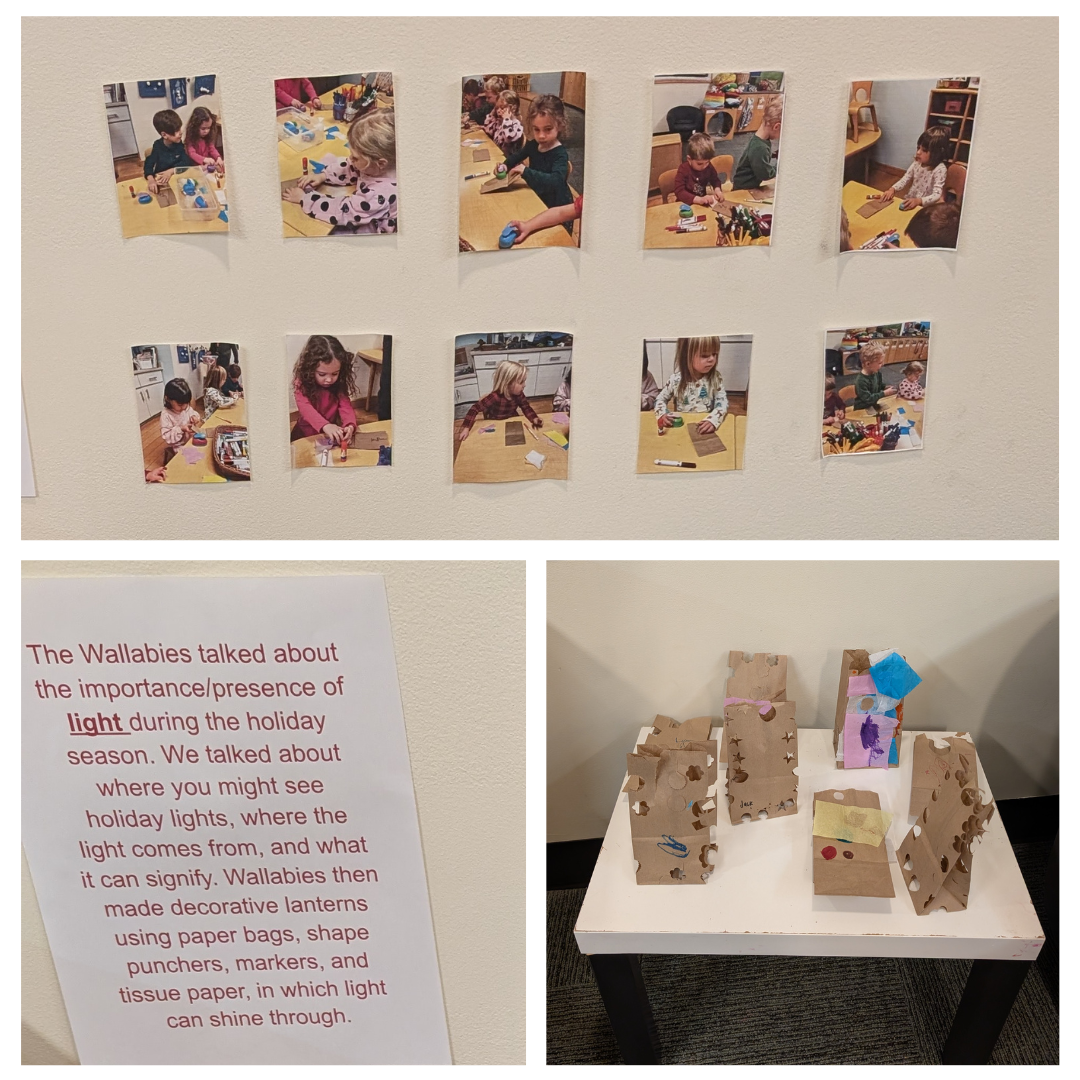
A display featuring multiple photos of children in our Threes class engaging in the process of creating lanterns, and a text panel describing their exploration of lights during the holidays, complemented by a display of their lanterns. 

Showcasing the Extraordinary 
 

Another theme of the presentation was recognizing and intentionally showcasing the extraordinary work that is happening every day in our classrooms. Documentation is a tool for storytelling—and those stories should be shared with our caregivers, our peers, and the children themselves. It fosters connection, supports classroom community, and builds trust with families. 

We revisited an important question: Who is documentation for? The answer was multifaceted. It’s for children, who deserve to see their learning reflected back at them. It’s for caregivers, who want to understand and engage with their child’s experience. It’s for fellow educators, directors, and even for each of us as individual educators—a way to reflect on and grow in our own practice. It’s also a window for new families into the values and rhythms of SEEC classrooms. 

Left: An outdoor class exhibit with a child and their caregiver viewing paper artworks.  

Right: A caregiver reading a description of their child’s class art display while two children and two educators engage in play and story time. 

Engaging Children Through Environment 
 

The team emphasized that placement matters. Documentation intended for children should be placed low enough for them to engage with it—yes, even to touch it. When we introduce materials thoughtfully and set expectations, children can interact with their learning environment in respectful and meaningful ways. 

We also explored how the environment itself can shape classroom behavior. A carefully arranged, engaging, and responsive space can reduce challenges and support deeper exploration. Our surroundings can either hinder or enhance the work we do—and we have the power to use them intentionally. 

Wall display at child level featuring one of our Twos’ class artworks and a descriptive plaque, in a classroom setting. 

From Discussion to Action 
 

The presentation concluded with an open dialogue. Educators discussed practical concerns—how to manage time constraints, where to print documentation, and how to embrace the idea that children will interact physically with the materials on display. 

In the five months since, educators across SEEC have taken this guidance to heart. Classrooms are now filled with purposeful documentation that highlights the daily wonders unfolding in our community. From toddler rooms to preschool spaces, there’s a renewed commitment to documenting learning not just consistently, but meaningfully. 

As we look ahead, our goal is to continue growing in this work—pushing ourselves to create environments that don’t just display learning but deepen and celebrate it. 

Top: A display in our older infant class featuring the work of Alma Thomas alongside the children’s artwork. Bottom: Abstract paintings and textured art pieces by one of our toddler classes, and a central portrait of Piet Mondrian with a description of the children’s exploration of his art. 

Children are Citizens: A Collaboration with Project Zero (Part II)

Book ImageChildren are Citizens

On April 25, 2015 at the National Gallery of Art several DC schools, including SEEC, and Harvard’s Project Zero celebrated the launch of a book authored by over 300 students. The book was the result of a research and professional development project entitled: Children are Citizens: Children and Teachers Collaborating across Washington, D.C. The premise of this project is the belief that children are as much part of the community as their adult counterparts. They should not only be able to voice their opinions, but also participate in their community. Through their participation children will learn to see other’s points of view, work together, and understand how we are all interconnected, thus creating an informed and thoughtful citizenry who will become active participants in our democracy.  To learn more about Project Zero and this collaboration visit here.

SEEC’s Role

The first phase of the project entailed some thoughtful discovery. Children and teachers had several conversations about what they thought of their city, what they would like to change, important people and places. The second phase culminated in a book where SEEC students focused on their relationship with the museums on the National Mall.

Three classes participated in this project—PreK3, PreK4 and Kindergarten. Our first installment in this series featured our PreK4 class (insert link) and this installment will explore our PreK3 class, the Wallabies. Their section of the book focused on their favorite parts of the Air and Space Museum, the Hirshhorn Museum and the National Museum of American History.

This interview was conducted with, Erin Pruckno, Wallaby teacher.

Erin Pruckno with her PreK3 Wallaby Class

Erin Pruckno with her PreK3 Wallaby Class

What made you want to participate in this project?

I wanted to participate in this project because the concept of citizenship and education is something I’m very interested in and was a major part of my master’s degree in International Education. In my studies, I encountered a lot of scholarship about citizenship education—how we educate students to be citizens, how students are citizens, the definitions of citizenship—however, not many touched upon citizenship and young children. This always irked me because, as an early childhood educator, I believe wholeheartedly that education at this age matters so much and that young children should be treated as citizens who have a vital role in our communities and our futures. So, I jumped at the opportunity to put to action these ideas.

Could you describe the process through which your class participated in the project?

We began by going on investigatory visits to the museums we were covering for our contribution to the book the project published. The Wallabies contributed pages on the Hirshhorn Museum, the National Museum of American History, and the National Air and Space Museum. During these visits, I looked for clues to what the students were interested in, as well as documenting their experiences in these spaces. Later in our classroom, we followed up with conversations on our visits; asking them about what was important about our museums, what other children should know about them, our favorite things there. I really wanted to encourage a sense of ownership from our children and to convey their passion and expertise to the book’s audience. We would then go on follow-up visits to the museums, continuing our conversations, and then later illustrating some of the things they saw or described.

Visiting the Air & Space Museum

Visiting the Air & Space Museum

Can you outline how this project was implemented in your classroom?

We tried to integrate the project into our already existing courses of exploration. For example, when we were learning about space, a trip to NASM was easy to do since it aligned with our topic and we could have a museum visit as well as research trip for the project. Other times, we set aside days to visit the museums and document our learning just for the purpose of the project.

How did the professional development portion of this project help or change your ideas of how to teach or connect children to the city in which they live?

As a professional development opportunity, the project really challenged me to think more about how I document student learning and also how I engage them in conversations. The method I’ve often relied upon with my class is to pose a question, then let students take turns to respond. However, when doing this, we have less of a dialogue among

the class and more of a back-and-forth between me and individual students. This project encouraged me to take a step back during classroom conversations and listen more—allowing students to talk to each other instead of directly to me.

file (1)

Making maps of the museums

The project seems to emphasize collaborations and discussion, is there a conversation you had among your students that really stands out?

Some of our most interesting conversations started when I would ask the Wallabies to share the most important thing to know about the museums and the students began talking about things you can’t do in museums. As I sat back and listened, letting them guide the conversation (which was, as I said, a challenge and learning experience for me), dramas would unfold about why we couldn’t touch exhibits or the planetarium screen. They came up with elaborate stories about how touching the screen would make a hole, creating a problem, workers would have to fix it, and the president and other people coming to the museum would feel sad that it was broken.

How do you think your students views of DC changes during the course of the project?

My hope was that my students expanded their understanding of other children in D.C. They already have a strong understanding of their families’ communities (coming from neighborhoods all over D.C., Virginia, and Maryland) and of our SEEC community, but I wanted them to think more about other students in D.C.  By asking them to think of what other children need to know about the museums, I think they became more aware of how there are children outside our community who do not know the museums as intimately as they do, and that these other students might have different perspectives on D.C. that we can both learn from and share our knowledge with.

What was one of your more challenging moments during the process?

As I mentioned, facilitating conversations in a way that encouraged students to have a dialogue among them was a challenge, but a good learning experience for us. Initially, some questions were difficult for students to answer such as those that asked them to think about D.C. broadly, but over the course of the project it became easier to provoke conversation as we broke down things into more manageable pieces, like discussions about individual museums.

Visiting the Hirshhorn as part of their study of light and dark.

Visiting the Hirshhorn as part of their study of light and dark.

What was one of the most rewarding moments during the process?

During one conversation, a student exclaimed to the class, “Guys! I know something!” I loved her enthusiasm, eagerness, and confidence in sharing her knowledge. This moment also summed up the project for me. I wanted to help my students show that even though they are young, they know something, many things in fact, about their community and Washington, D.C and that their contributions to our understanding of our city are to be valued and heard.