Easy At-Home Learning: Architecture

Why Architecture

As a parent, I am always on the look out for fun and easy learning opportunities. While I was scrolling through my Facebook feed, I noticed this great blog on shadows and I began to think more about architecture. We encounter architecture everyday– it is all around us. Whether we live in the city, suburbs or country – architecture is an essential component of our environment. And if you haven’t read any previous posts, SEEC staff has been busy thinking about the importance of environment and its impact on learning. Young children connect to architecture and at an early age, begin to notice its features. Don’t believe me….Well, just take a walk with a group of SEEC students across the Mall and ask them where their parents works. Inevitably, they will identify the museum by the building’s architecture. “My mommy works in the round one (Hirshhorn Museum and Sculpture Garden).” or “Dad works in the one with a lot of glass (National Air and Space Museum).”


Seize the Moment

Maybe your child doesn’t spend their days in Washington, DC, but I bet they are noticing their own neighborhood. Ask them to think about their friend’s homes, can they identify a feature: color, shape, number of stories? What about their school? The first words out of my kid’s mouths when they set foot in their school cafeteria was, “There are a ton of windows.” Its true, one wall of their cafeteria is ceiling to floor windows that look out onto a wooded area. That feature made a strong impression and four years later, they continue to marvel at the fact these windows connect them to the outdoors. The point I am trying to make is simple: if your child notices these details seize the opportunity to take what they are interested in and run with it.

That is exactly what our teachers did in the set of photos below of our three-year old class last year. I specifically chose to highlight this lesson because I thought it would be easy to recreate at home and inspire your inner teacher. Keep in mind, I am not suggesting that after working a 10-hour day (whether it be in an office or at home) that you whip up a lesson plus museum visit (for on-the-spot ideas, see below), but it is something to keep in mind for a weekend. These ideas encourage your child’s imagination, include some simple math and gets them to think about design, engineering and even aesthetics.

Since SEEC is located near so many buildings that feature columns that seemed like an obvious element to discuss with the class.

Since SEEC is located near so many buildings that feature columns – they were the perfect element to discuss with the class. Using the tablet, helps them visualize the idea before the headed out for their museum visit.

An over-sized can was another convenient choice - something easily pulled from the kitchen.

An over-sized can was another convenient choice for the teachers who simply pulled it from the kitchen. Each child got a turn feeling the weight of the can. This is an important step so that they experience of the weight of the can.

The teacher places the can on her 2-column building with disappointing results.

The teacher places the can on her 2-column building, made simply of cardboard and blocks. Clearly, the results were disappointing.

It turns out that by adding two columns, the house will hold the can.

It turns out that by adding two more columns, the house will hold the can.

The kids get a chance to see the real thing at the National Archives.

The kids get a chance to see the real thing at the National Archives.

And inside the National Gallery of Art.

And inside the National Gallery of Art.


On-the-spot Ideas

Don’t have time or energy to plan – don’t worry. Here are a few simple, spontaneous ideas that will get your little one to notice the architecture in their neighborhood.

1. Ask them to count the number of windows/columns (or whatever feature interests them) and draw their shapes with their finger – identify the shapes.

2. Ask them what they like or dislike about a building or a particular part of it?

3. Ask them to draw what they see or use their imagination to draw a building.

5. Play with building blocks when you get home and design your own space.

5. Play “I spy” with a particular architectural feature while riding home and describe its physical characteristics.

Hoping these ideas inspire you to get out and learn with your little one!

Teacher Feature: Three-Year-Old Class Explores Amphibians

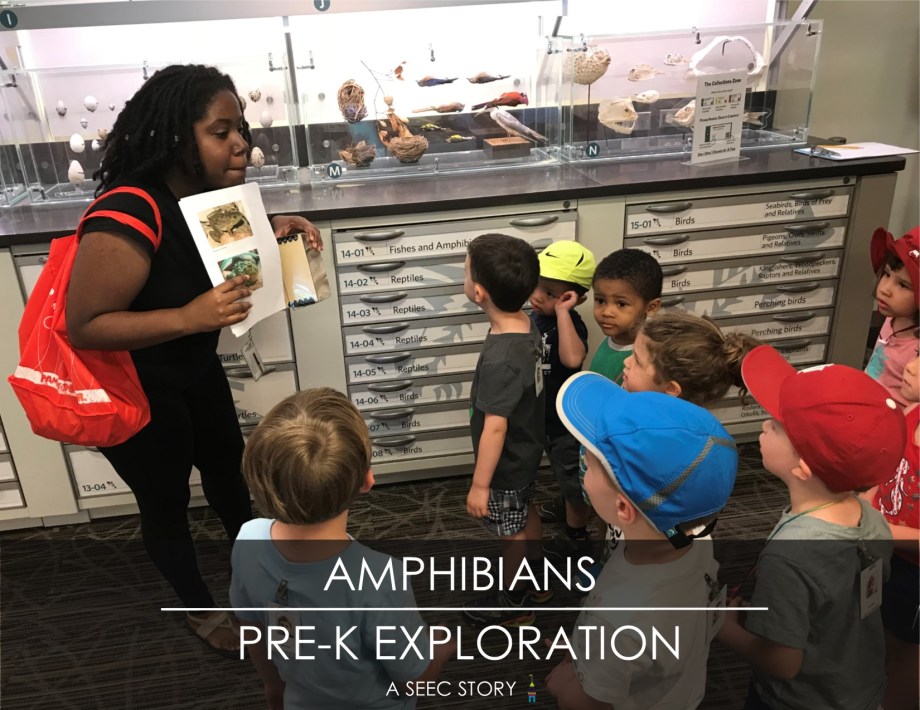
Today we’re featuring Maya Alston and Amy Schoolcraft, the teachers of the three-year-old Wallaby class. The class has been busy exploring the Animal Kingdom, and I joined them for a lesson about amphibians and frogs at the National Museum of Natural History. Below you will find images from the lesson, as well as reflections from Maya.

cover.jpg

For the past two years, a mallard duck has made SEEC’s playground her nesting ground to lay her eggs. Every year we section off a part of the playground for mama duck to lay her eggs safely and use this as an opportunity to engage the children about the importance of respecting her space while she cares for her babies. This was the Wallabies’ first time experiencing the process, and while they have always shown interest in animals through play, we noticed that this experience really seemed to stick with them and pique their interest. Amy and I decided this was the perfect time to begin a unit on the animal kingdom.

i-vp9nVnv-L

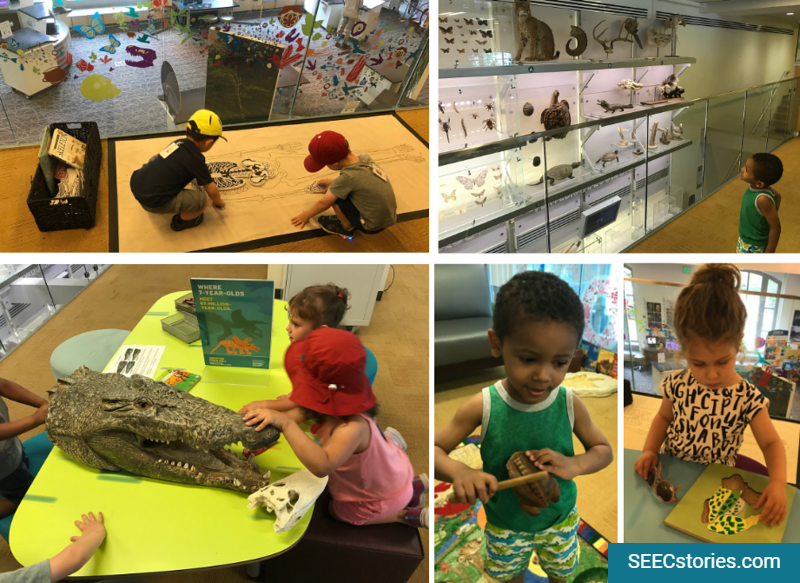
For their lesson, the class headed to Q?rius, an interactive learning space at the National Museum of Natural History, for their lesson.

Q?rius is a space dedicated to encouraging young children to be curious and investigate through hands on exploration. I wanted my students to be active participants and be able to have tangible objects to help them make these connections. I took some time to explore Q?rius on my own first, imagining how my children could engage with objects that were relevant to our lesson. From there, I began to piece together what I wanted the lesson to look like based off what the space offered.

Since it was also my first time going to Q?rius, I wanted to make sure the space was appropriate for my students. I took time to explore on my own as well as speaking with Q?rius employees about what objects they had related to amphibians.

i-h6ccHXB-L

Q?rius has many objects and specimens to examine closely. Maya led the class to a case and took out a specimen box without showing the class. She gave the group some clues as to what might be in the box including making a frog noise with a frog musical instrument, and showing them an image of a frog. Between both clues many children exclaimed, “a froggie!”

For this unit, we wanted our students to understand the concept that animals belong to different groups. While animal kingdoms are generally taught in later years, I wanted to build a foundation of the concept of categorizing animals based on physical traits, habitat, and other characteristics unique to that animal group. In this lesson, we began exploring amphibians.

i-mR8hMt8-L

Maya shared two frog skeletons and allowed each child a turn to look closely. They noticed the difference in sizes between the skeletons.

i-SQK6pGb-L

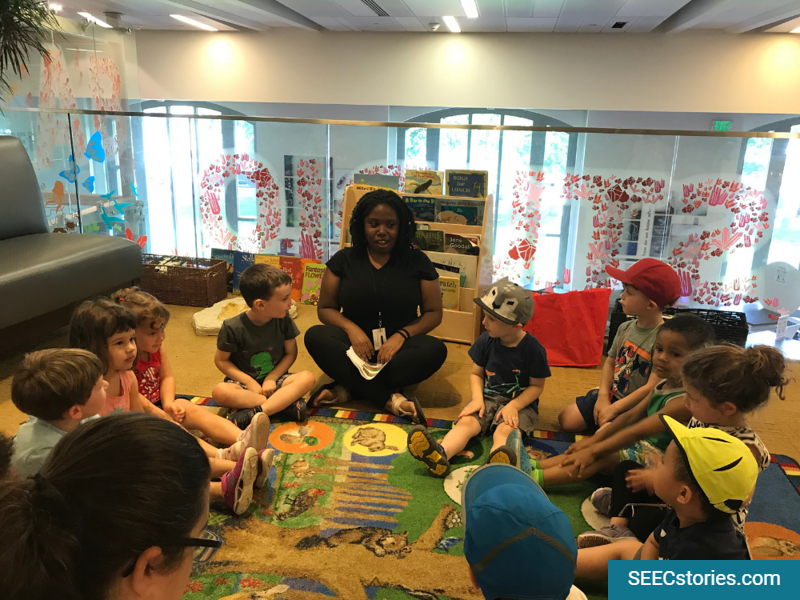
Next, the class went upstairs to the Q?rius jr. space, a dedicated area of Q?rius for young children. They sat down and Maya told the class what they were going to learn about today: amphibians. They practiced saying the word and Maya explained that amphibian means two lives; one life in the water, and one on land. She asked what animals they know of that live in the water. The children listed animals such as sharks, fish, and dolphins. Next, she asked what animals live on land. They identified many animals including butterflies, cheetahs, birds, bunnies, and elephants.

i-8rMq2MP-L

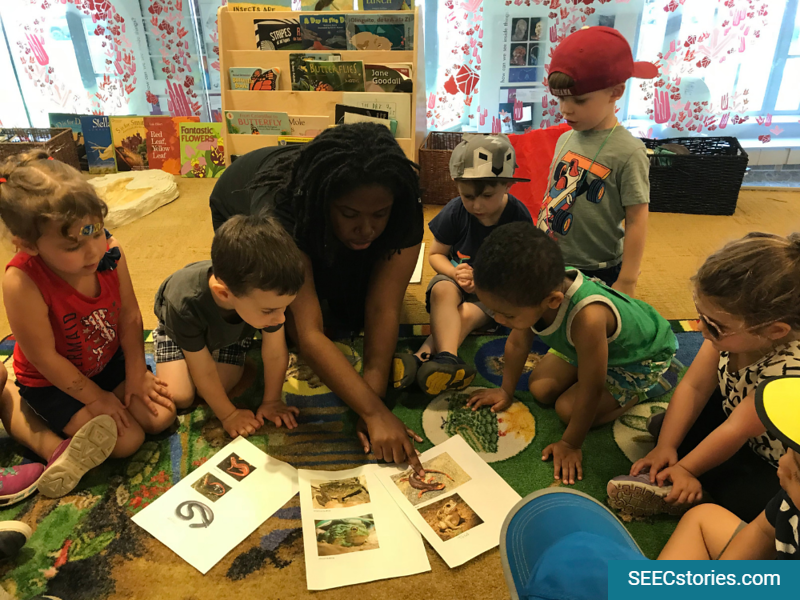
Maya reiterated that amphibians are special because they live in both the water and on land, such as frogs. She showed them images of more amphibians including newts, salamanders, toads and caecilians. The group remembered some previously learned knowledge about how many legs insects have (six) and arachnids have (eight). Maya let the class know that many amphibians have four. The class counted the legs of the amphibians together. The group explored another physical aspect of amphibians – how they feel. The class felt their own skin and described it as smooth and soft. Maya let them know that amphibians are smooth and soft as well, but they’re also moist, meaning they’re always a little bit wet.

I knew very general information about amphibians and frogs, but to prepare for this lesson I took some time to research as well. Sometimes the children have questions that I might not have been expecting, so it’s always helpful to come with some additional information prepared.

i-bRkj9rB-L

One of the children brought up how bunnies feel, and Maya took this opportunity to transition to her next point. She asked the group what bunnies like to do. They excitedly said, “hopping!” Maya told the group that frogs also like to hop. The class began jumping and hopping like frogs all over the circle. Maya let them have some time and then said, “3, 2, 1, and done.” The children took the cue and sat back down in their circle.

While I had not planned for the group to jump like frogs at this point, it was the children’s way of staying engaged and actively participating with the lesson. I really want them to connect with our lesson in a way that speaks to them, and most often, it is through movement. It makes our lessons feel a lot more organic and can even help to push the conversation along. I’ve found my lessons to be much more fun and exciting when I allow the kids to steer the direction we go in just a little during our discussions. It’s an excellent way to gauge their interest and see what they know already.

i-mFQxwrX-L

Next, they explored frogs more deeply by looking at plastic frogs, and playing wood frog guiro musical instruments. They enjoyed stroking the wooden frog’s back with the mallet and listening to the ribbit-like sound. They also compared the difference in sound between the larger frog guiro and the smaller one.

i-zwFxKZm-L

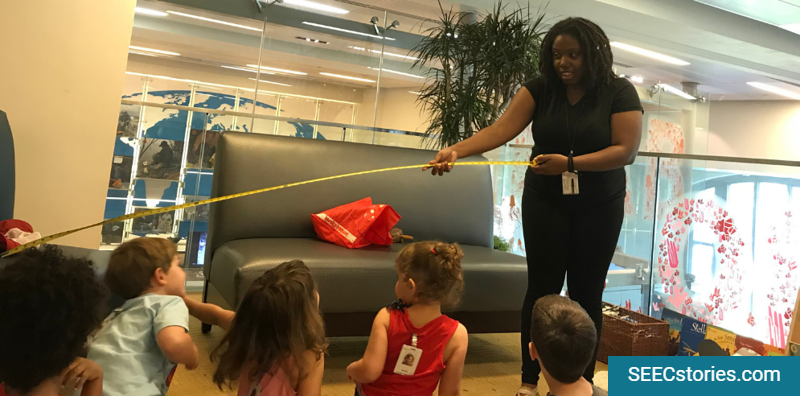
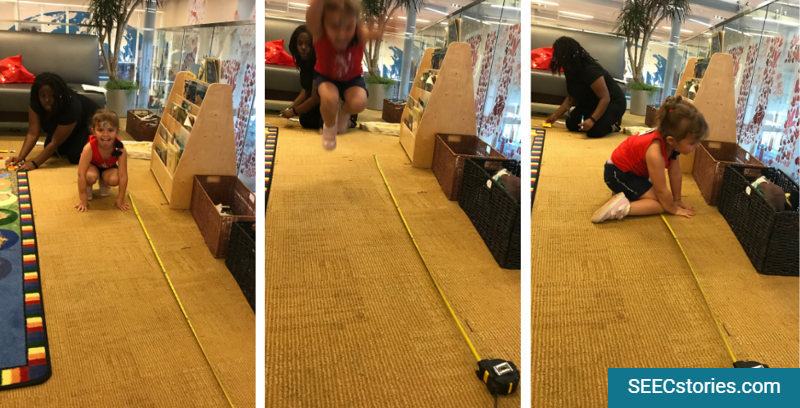
The last aspect of the lesson was to explore how strong frog legs are and how they help them to jump very far distances. Maya said that some frogs can jump up to seven feet! To illustrate this she measured out the distance with a tape measure.

The inclusion of math skills into the lesson was something that happened naturally. I really wanted to provide a visual to see just how far of a distance it was, and a tape measure was the perfect object. It just so happened to be a great way to incorporate math skills!

i-kX7b5QQ-L

Then it was the children’s turn to jump like a frog and measure how far they could go. Maya randomly pulled each child’s photo from a bag to indicate it was their turn to jump.

The children seemed to really take to the activity portion and liked comparing their distances to see if they could jump as far as their friends. I think the activity was engaging enough that even when it wasn’t their turn to jump, they were still excited to get to participate in some fashion, for example cheering on their friend who was jumping.

There’s always a little bit of unknown when taking your students to a new space. Sometimes doing gross motor activities in confined spaces can be a little tricky. I wanted to make sure the kids were able to get the most out of the lesson, while also respecting other people using the space, so we discussed.

i-PjNpgwb-L

As each child jumped, the rest of the class cheered for them and how far they went. Maya integrated math skills by measuring how far each child went and writing down the numbers next to their photo. To conclude this part of the lesson Maya let them know that they were all great jumpers, but frogs could still jump a lot further and they would learn more about them later in the week.

I absolutely loved how the group waited so patiently to take their turn to jump and were cheering each other on. It can be difficult to wait patiently for eleven other people to go before it’s finally your turn. Unity and camaraderie are concepts we encourage throughout the year, and seeing them be so supportive unprompted was very heartwarming.

i-ZHjGptc-L

To end the visit, the class got a chance to explore the Q?rius jr. space. Some children explored the many specimens both displayed and available to touch. Some played more with the frog instruments or engaged in a variety of puzzles (including a frog puzzle!).

I think what’s great about this lesson is the fact that it can be done in just about any setting with objects. My recommendation for other educators without easily accessible museum spaces, but wishing to do a similar lesson would be to go sit outside or go to a local nature center or pond to connect with the concepts.

We made sure to say a quick goodbye to our frog skeletons before leaving Q?rius. Upon reflection, this would have been an excellent time to have the students take another look at the skeletons and have a brief discussion about what new information they had learned during the lesson. That would give them the opportunity to make connections and help to bring the visit full circle.

Later in the week, we continued the conversation by visiting the Moongate Garden to talk about the life cycle of frogs. Following our week on amphibians, we began to explore other animal classifications.


After exploring frogs the class learned about reptiles. For more animal ideas, visit our Amphibian, Birds, Reptile, and Ocean Pinterest boards.

Our second posting in our Diversity, Equity, Accessibility, and Inclusion Series.

i-jgMbrGZ-X2The Journey

People familiar with Diversity, Equity, Accessibility, and Inclusion (DEAI) will often describe it as a journey or a process. Now that I am a couple of years into my own DEAI experience, I can finally say that I understand what they mean. Each time I feel like I make some headway, I find that something comes along and reminds me that I still have work to do.

Such was the case at a recent educator workshop I was co-leading, Never Too Young. Going into the workshop, I was feeling confident and prepared. Overall the morning went well and there were many meaningful conversations. During the section where we discussed relationships with families, we asked participants to split up in small groups and talk about one of a variety of scenarios that we described as, “difficult conversations.” As each group shared their thoughts, it became clear that some of the participants were uncomfortable because the scenarios portrayed lifestyle choices with which they disagreed. It was a conundrum; the focus of the workshop was to help educators create an inclusive environment where children can develop a positive sense of self.  Yet, I could see that the discussion made some people uncomfortable and moreover, these participants had stopped listening.

i-pKMtvLP-X2As a facilitator, I recognized my role in their discomfort and I felt like we needed to reconsider our approach – we were talking about inclusion after all. I had several questions:

How do we navigate conversations when peoples’ ideals are not aligned with inclusivity? Was it my role to challenge those ideas? What are SEEC’s priorities when providing these types of training? And most importantly, how do we keep the children’s best interests at the center of what we do?

At the next session of the workshop, I made a few modifications. We added inclusive language to our introduction so that participants knew what to expect and understood we would talk about some issues with which they many not agree. Before the scenarios, we reiterated the role of the caregiver as the decision maker and the role of the educator as someone whose role was to make a child feel safe and loved. I think this helped, but we are definitely still thinking things through.

DEAI and Educator Programs

i-bH6jtnR-X2In addition to this specific experience, we have been thinking about our entire menu of educator workshops through a DEAI lens. Some of the changes are small and obvious, and others are still in the “thinking” phase, but as I said….it’s a journey. Below is a list of ways we are thinking about DEAI in terms of our professional development options. These perspectives are with us as we rethink content and introduce new conversations to our educator programs.


  1. Demonstrating how objects can tell stories of similarities and differences.
  2. Exploring ways community visits can:
    • Provide children with experiences to connect with peoples and cultures that are different or similar to their own, which may not always be the case in their classroom.
    • Create opportunities for children to build social emotional skills, especially in terms of empathy and considering perspectives other than their own.
    • Provide real-life examples of people working for change.
    • Provide real age-appropriate experiences for children to make change.
  3. i-LbjP8rd-X2Considering how the museum community views families and young children and how we can help museum professionals understand that children are capable and should be respected. Helping museums think through how to make their spaces accessible to families, and how to support family learning.
  4. Strategies for talking to children in age appropriate ways about history, culture, and current events.
  5. The role silence plays when educators don’t acknowledge bias in the classroom.
  6. Ways of building classroom lessons and environments that authentically weave in diversity and inclusion, and avoid tokenism.
  7. How educators can build strong relationships with families to establish a community in which everyone feels respected, even when there are disagreements.

Teacher Truths: Working with Toddlers

Welcome to Teacher Truths presented by the Smithsonian Early Enrichment Center, SEEC. Each episode of Teacher Truths take place between two SEEC faculty members and explores a topic related to education. Have a topic you’d like to hear about? Email SEECSocialMedia@si.edu.

This week features a conservation between Kat Schoonover and Shannon Conley who are both toddler teachers. They spoke about working with toddlers and focused on toddlers growing independence and need for communication. Please listen and enjoy!

Highlights from the conversation between Kat and Shannon:


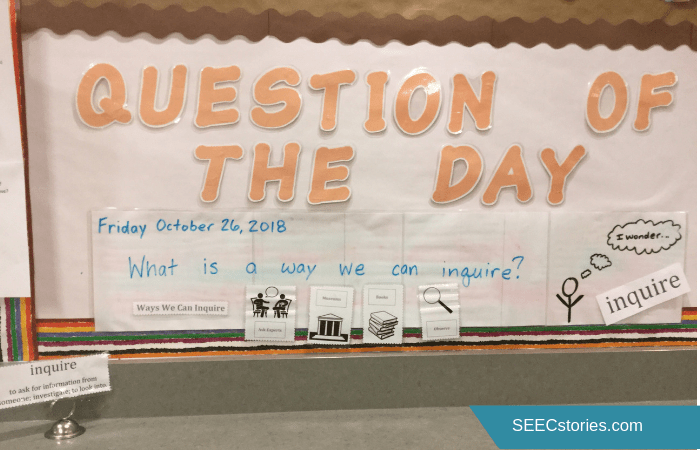
Inquiry Tools

A few years ago several of my three-year-old students asked me a question, and I responded, “How could we find the answer to your question?” They stared at me and said, “We’re asking you because you’re a teacher, and teachers know everything!” While flattering, I had to tell them that I most certainly do not know everything. Instead, there are many other ways in which we can seek the answers to our questions. This moment illustrates the importance of directly teaching children the skills, even as young children, to find the answers to their wonders.

At SEEC, we define inquiry as asking questions, but also as the process to find the answers. In order to ask effective questions and have the tools to seek answers, children must be curious, know how to observe, describe, make connections, and communicate. From infants to kindergarten, our classes foster these skills to ensure our children leave our school with a love of learning, a ferocious curiosity and the ability to find the answers to their questions.

Recently, one of our four-year-old classes, led by Will Kuehnle and Jessie Miller, spent some time discussing what it means to be curious, and what tools could help them explore their curiosities.

5

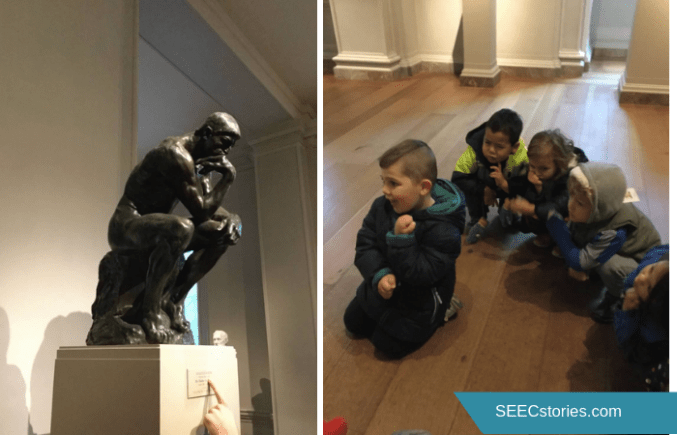
To begin their experience they went to the National Gallery of Art to see The Thinker (Le Penseur) by Auguste Rodin. They looked at the sculpture and pondered how its body language depicted thinking. They even tried to pose themselves.

8

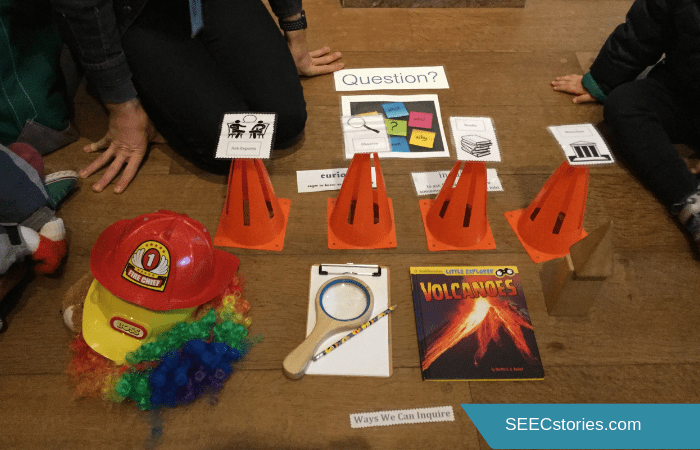
Next, they discussed four tools to use when we have a question: asking an expert, observing, reading a book, and/or going to a museum. After discussing these inquiry tools in the gallery, the class headed outside to the National Mall to make these ideas more concrete through play.

6

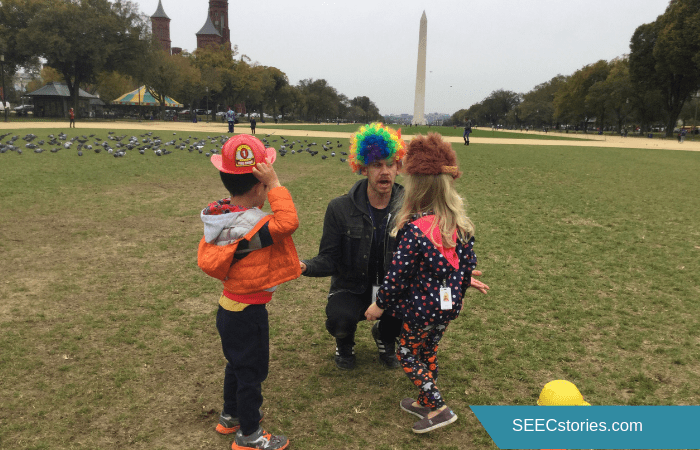
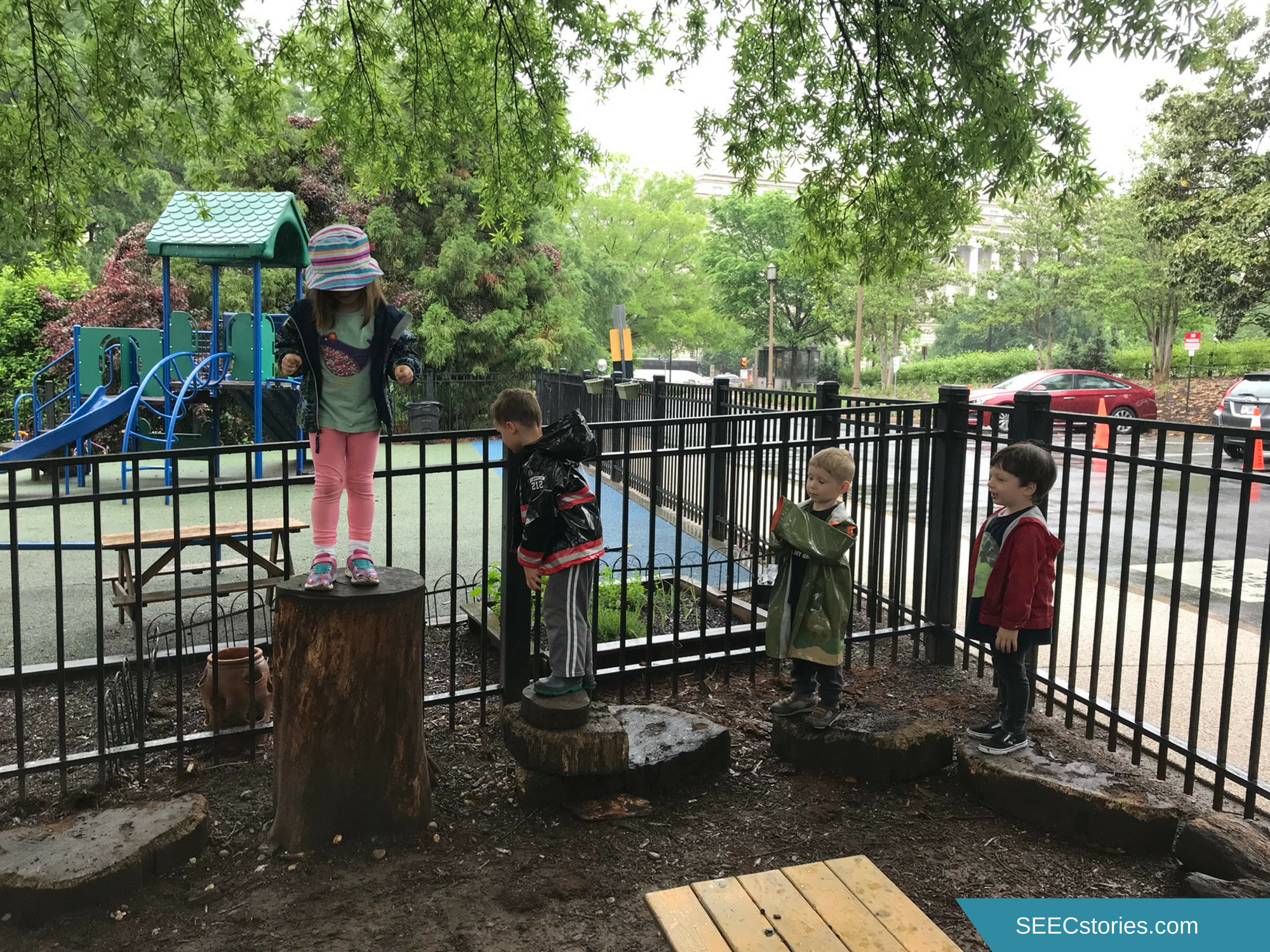
The children got into groups and went through stations, each representing one of the inquiry tools they previously identified. At the “Ask the Expert” station, the children dressed up and pretended to be experts on different topics. One child would ask a question while the other child listened. The conversation would continue back and forth while one child spoke and the other waited and responded. The teacher could step in and model this for the children as well as praise them when waited for their turn to speak. This was a great opportunity for the children to practice patience and listening.

2

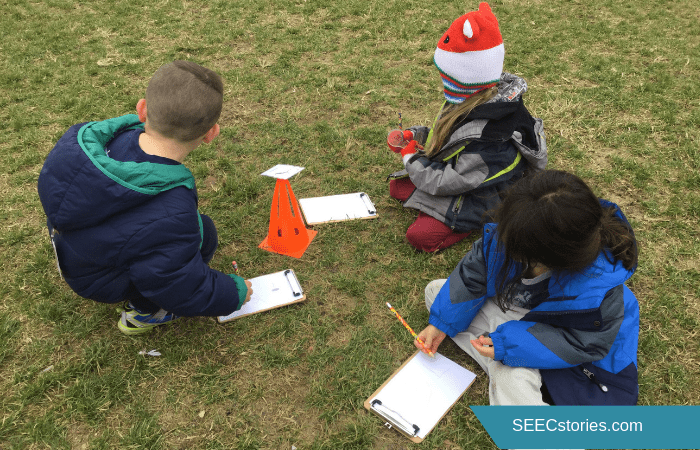
At the “Observe” station, children observed what they saw on the Mall and recorded these thoughts through writing and drawing. This was an open-ended activity that allowed the children the freedom to observe anything in their surroundings. It gave the teachers a glimpse into what the children find most interesting and, since SEEC uses an emergent curriculum, will serve as a guide for possible future topics for the class

4

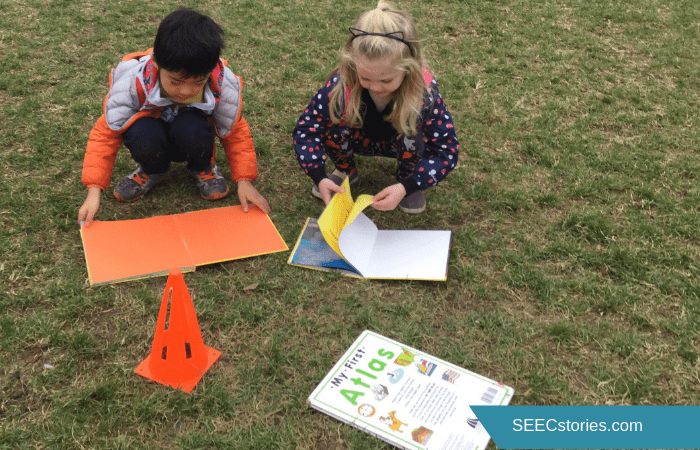
The “Read a Book” station contained several books where children could flip through and gain knowledge through their reading.

7

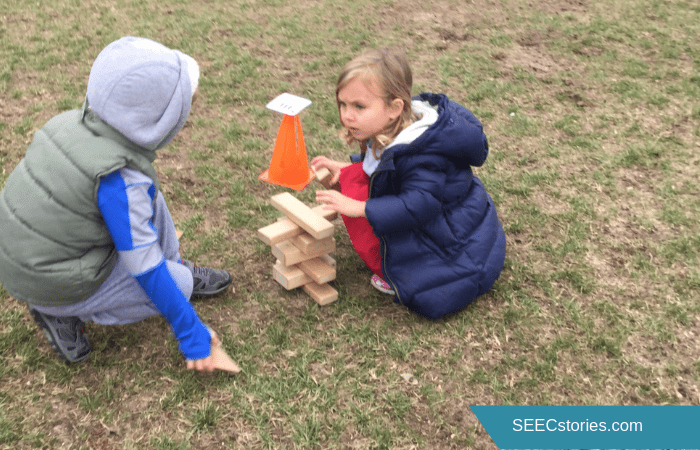
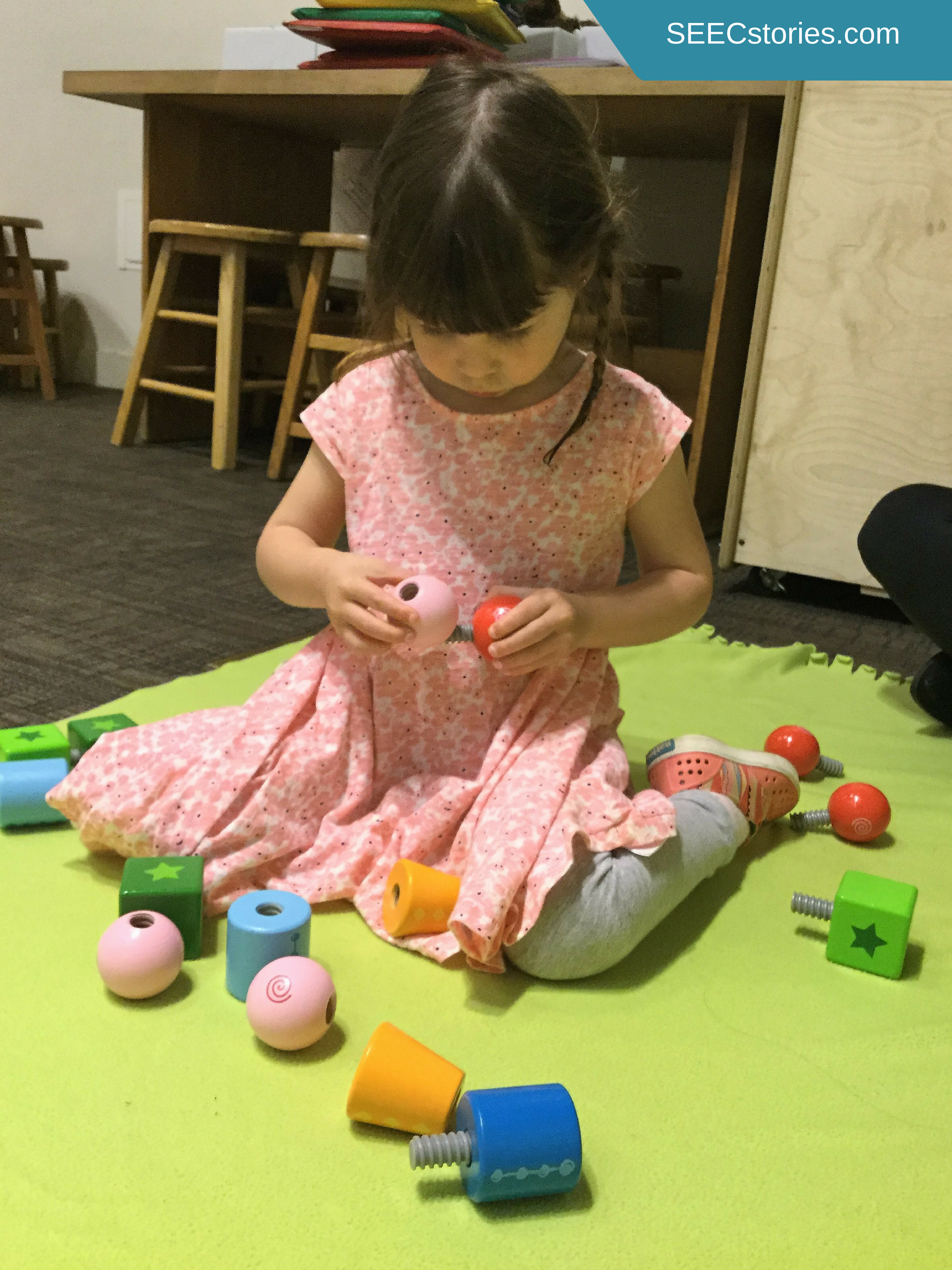
Lastly, the “Go to a Museum” station had blocks for the children to build a museum where they might be able to answer their wonders.

1


Back at school that afternoon, the class had an opportunity to play at the stations again if they wished.


3

Recently, during storytime a child asked a question about something in the book. The other children were quick to suggest finding a book on the subject or visiting a museum to find out more information. The teachers have also observed students using language such as “curious” and “inquire” more often in their day-to-day conversations. By spending time practicing listening, vocalizing questions, and exploring how to find answers, the students have built a strong foundation that will serve them as they progress in school and life.


Join us on January 17th to learn more about Fostering Wonder with young children.

Caregivers and Play: A Sneak Peak at Our Upcoming Seminar

Play at SEEC

Though our school is not strictly play-based, it recognizes the importance of play and incorporates it into our unique brand of object-based learning. Much like other early childhood schools, you will observe our children engaging in play during classroom choices and playground time. You can also find our children playing in the museums, but not just in the play-based spaces. We think creatively about how to safely incorporate play into our museum or community visits.

Caregiver Perspectives on Play

Over the years, we have heard from educators that often caregivers don’t appreciate or understand the value of play. I won’t lie, I too, was at one point one of those parents. Before beginning my career in early childhood education, I enrolled my daughter in a play-based cooperative preschool and one of my biggest concerns was if they would incorporate letter/number recognition into the curriculum. That was more than ten years ago and my outlook has drastically changed.

I have also observed sentiments similar in parents today. I recall a specific conversation with a parent whose child had recently transitioned from a play group to a SEEC program. The parent was happy about the transition because she felt like all the kids did “was play.” Through discussions with other educators, in and outside of SEEC, I have found that other parents share a similar concern about the role of play in the classroom.

I don’t mean to suggest that all caregivers feel that play is not important or even that they don’t see ANY value in the act of playing. In fact, there was recently a heated discussion at the school one of my children attends regarding recess. Some of the students had been missing recess due to make up work or for disciplinary reasons and that did not sit well with our parent community. I think it is important to note that there is a range of parent perspectives on play.

Starting the Conversation

At the same time that we have been reflecting on how parents feel about play, our team has also been focusing in how we can support our parent community and the community at large. It occurred to us that our upcoming workshop, Play: Engaging Learners in Object Rich Environments would be an ideal venue to explore parent attitudes towards play and strategize ways we can engage parents in a dialogue about the value of it.

In order to have this dialogue, we feel it’s important to better understand caregivers’ beliefs surrounding play. Therefore, we have begun to collect data that will inform that understanding and thus far, we have hit on some themes:

  • It’s a waste of money to pay for someone to watch their kids just play.
  • Play doesn’t look like traditional learning.
  • Play doesn’t look like hard work, so it’s not important.
  • Playing won’t teach them how to hold a pencil, read, or write.
  • Playing won’t give them the skills to be successful in life.

  • Play looks like chaos.

Over the next few weeks, we will be collecting more feedback from parents and look forward to sharing their perspectives at our upcoming seminar in July. We are excited to think together about this as a group and look forward to sharing more broadly in future postings.

Building the Next Generation of Democratic Thinkers

SEECstories.com (4)In a recent article Smithsonian Secretary Skorton posited that museums can help people regain trust in “traditional democratic institutions”. His argument centered around a study indicating that many Americans have lost faith in the institutions that are the foundation of our democratic system. He spoke to the fact that not just Americans, but citizens across the globe seem to be losing trust in their own societies and pondered how a democracy can function without the trust of its citizens. Secretary Skorton sees museums and libraries, not only as institutions that provide reliable and objective information, but also as places where questions can be posed, dialogues can be had, and a variety of perspectives can be explored. As leader of the Smithsonian, moreover, he sees museums as places where communities can come together to better understand themselves and the world around them.

As an organization, SEEC, also sees museums, libraries, and the larger community as sources for information, discussion, and reflection. We were particularly excited when in the same article, Skorton noted the role of educators:

I have seen how our museums and centres engage visitors and transform the way they see the world—especially our youngest visitors, who light up with the joy of new discovery. Through our education programs, we reach millions of national and international students, often using objects from our collections to demonstrate experiences and viewpoints that differ from what they might have encountered. By revealing history through the lens of diverse perspectives, museums humanize other cultures and contextualize present-day events and people.

SEECstories.com (5)The Secretary’s comments made me think more about the role museums can play in supporting a young child’s civic education. When I look specifically at SEEC, I see our school and programs as supporting a child’s understanding of democracy via museums in three ways.  One of those ways, is asking them to understand the importance of objects from other cultures or historical periods. Many don’t see young children as capable of this type of perspective-taking, but with the right approach, young children can develop this type of understanding and empathy. One of the ways SEEC educators manage this is by taking what is familiar to children and applying it to the unfamiliar. Consider the collection of footwear on display at the Smithsonian Castle from the National Museum of the American Indian. The shoes, at first glance, may feel strange to a young child living in contemporary American society, but an educator can encourage a child to think beyond their own experiences by beginning with what they do know. A faculty member might inquire: “Why do we wear shoes? When do we wear certain types of shoes?,  How do shoes help us?.” By applying these answers to the American Indian collection, children begin to see the many things we, humans, have in common. At the same time, a child are also able to acknowledge and celebrate the differences they observe. This type of lesson, especially if repeated, makes a lasting impression. We might be different, but those differences can be celebrated. It also underlines how we are part of one human family who shares many commonalities.

SEECstories.com (1)Secondly, young children who consistently spend time in museums can begin to understand and appreciate the role museums can play in learning, exploring, and questioning. During a recent conversation with a SEEC educator, he shared with me that in his Pre-K classroom children are routinely encouraged to ask questions and look for answers. He tell his class, that he, himself, doesn’t always have the answers and encourages them to seek answers via trusted resources. The children in this classroom have created a shortlist of “go to” places where they can get trusted answers. Of course, at the the top of this list is the museum.  For our SEEC students who have spent much of their young lives in these institutions, they understand how museums provide not simply information, but concrete manifestations of this knowledge. Consider the toddler who is learning about colors and visits the Hirshhorn Museum and Sculpture Garden. His knowledge is expanded by exploring the artworks and seeing the many different hues of blue. Similarly, consider the kindergartner who is learning about Rosa Parks and after viewing her portrait by Marshall D. Rumbaugh at the National Portrait Gallery. Through age-appropriate conversation, she can gain deeper insight into Parks’ role in the Montgomery Bus Boycott. Both children are learning that the museum is a place where they can turn to for both factual information and for viewpoints other than their own.

SEECstories.com (3)Finally, the very nature of how we teach at SEEC (and I think you could say this is true for many museum and classroom educators) reaffirms trust in democratic discourse. SEEC lessons often begin with a question and are composed around a conversation. For example, we might pose a scientific question like, “Why do cars have wheels?” or something more abstract like, “How do you think the woman in the painting feels?.” By simply engaging young children in conversation we are helping them to develop socially and emotionally. By framing these conversations within a museum, we can also encourage children to see the institution as a place in which dialogue is part of the experience. Within that dialogue, educators can facilitate conversations that encourage children to listen to and respect the ideas of others – something which will hopefully cultivate a generation of leaders who can engage in conversations resulting in positive democratic change.

SEECstories.com (2)As early childhood educators, whether in the classroom or the museum, we have a unique opportunity to frame the museum as a place where children can acquire knowledge throughout their life. Museum education is so much more than learning a new fact. It is a place where people of all ages can apply new information in a way that helps them value different perspectives and understand the ideas of others. While SEEC is uniquely situated to achieve this as a school on the Smithsonian campus, all schools and museums can support these democratic values. Classroom faculty can engage in conversations at their schools utilizing museum objects as a focal point via online resources. Museum educators can cultivate educational experiences that are friendly to all families and and frame developmentally appropriate experiences that support young children as capable learners. If we can support learning in this open-ended way, museums can and will remains stalwarts of democracy.


References

Skorton, David J. “How Do We Restore Trust in Our Democracies?” Smithsonian.com, Smithsonian Institution, 12 Mar. 2018, http://www.smithsonianmag.com/smithsonian-institution/how-do-we-restore-trust-our-democracies-museums-can-be-starting-point-180968448/#FsSTi0ZDsl6qSVV0.99.

Top 8 Books for Kindergarten Read-Alouds

This week’s blog is written by Silvana Oderisi. This is Silvana’s seventh year teaching kindergarten and her third year with the Smithsonian Early Enrichment Center where she is the reading teacher. Prior to joining SEEC, she spent two years as a Corps Member of Teach for America in Tulsa, Oklahoma as well as teaching in the District of Columbia. She is passionate about reading, learning languages, and being active.


SEECstories.com (1)

As I mentioned in my last blog, Top 5- Elements of a Great Read-Aloud, I thoroughly enjoy getting the chance to read to my group of kindergarten students during our daily read-aloud lessons! As a class, we love engaging with exciting and fun stories that push us to think critically about what we see and hear therein.

Here are some of the books we love the most and how we’ve used them in our classroom.

61toF5azwoL._SY411_BO1,204,203,200_

  1. Nanette’s Baguette by Mo Willems

This is one of my students’ all time favorite authors. So, suffice it to say that any book of his is bound to be a crowd pleaser for a read-aloud in a kindergarten classroom and beyond! This particular book of his combines silly rhyming words with a very relatable problem. On a trip to the bakery for her mom, Nanette eats all of the warm, delicious baguette before she even gets home! With a twist ending that shows adults can be as silly as kids, the book will have your children roaring with laughter!

  1. The Day the Crayons Quit by Drew Daywalt

Get ready for another fun book to read with your children. This popular book is one that will have kids re-evaluating the way they treat the crayons in their own crayon boxes. The poignant, hilarious letters from the crayons in Duncan’s crayon box, give kids a glimpse into the point of view of what they had formerly thought of as inanimate objects. In our classroom, we like to use this book to help us practice identifying problems in a story. We define a problem as something the character wants to change, fix, or figure out. And boy, do those crayons come to Duncan with some problems! From arguing over which color is the true color of the sun, to being overused and overworked, or not used enough, each letter provides my class with practice identifying problems and then using critical thinking skills to wonder how we would solve the problem if we were Duncan!

61QzYtb12LL._SX494_BO1,204,203,200_

  1. Lady Pancake and Sir French Toast by Josh Funk

If you couldn’t tell by now, I am a big fan of comedic children’s books. I love to make my students laugh and see them smile as we think about the stories we read together. I want nothing more than for my students to absolutely LOVE reading, so I try to incorporate as many of these happy moments as I can into my read-alouds. This book, in particular, combines silly characters and a relatable competition to get the last drop of maple syrup making for one hilarious story. In our classroom, we used this story to help us be able to identify a character as the person, animal, or thing (we really had to include that last one in this story) that does the ACTIONS! This helped us look more closely at a character’s actions, which comes in very handy when analyzing character traits, discussing problems and solutions, and more critical thinking questions.

  1. Ada Twist, Scientist by Andrea Beaty

While I do appreciate the imaginative and abstract characters in a lot of the books on this list, I strongly believe that it is also important for my students to see and read books that are a positive reflection of their own identities. I try to incorporate books, such as this one, so that the young girls in my class (and especially the girls of color) see their own potential in the STEM field. Reading books like this helps open the doors for young girls to explore their own curiosities about the world and ask questions about how the world works, without feeling like they’re stepping into a “boy’s world.”

617yIY-j0EL._SX410_BO1,204,203,200_

  1. Mufaro’s Beautiful Daughters by John Steptoe

Not only do I believe that my students should see their own identities reflected in the stories they read, but I also like to make sure that my students are able to make positive personal connections to other cultures through our read-alouds. This book is based on an African tale, and tells the story of a king looking for the “most worthy and beautiful” woman to be his queen. Mufaro believes that his two daughters, Manyara and Nyasha, are worthy and beautiful enough for the king and they decide to journey to the palace. Although both characters are outwardly very beautiful, their choices and actions throughout the story demonstrate two entirely different concepts of beauty, giving your readers plenty of opportunities to analyze personality traits along the way. This story truly begs the question of whether or not beauty can be found on the inside or the outside and can lead to very powerful discussions with your children about the concept of beauty.

  1. The Napping House by Audrey Wood

A classic Kindergarten favorite, this book is helpful to readers practicing sequencing events of a story, an important kindergarten comprehension skill. My students love the hilarious events that happen in the Napping House and re-tell the events with ease thanks to the silly rhymes and repetition throughout the book. The repetitive phrases help not only with remembering the sequence of events from beginning to end, but also help this age group develop fluency skills as they read, re-read, and read again the same words throughout the text.

41uUddbOyQL._SY342_BO1,204,203,200_

  1. Naked Mole Rat Gets Dressed by Mo Willems

I just could not go through this Top 8 list without adding another book by Mo Willems. As one of my personal favorite children’s authors, I really enjoy using any of his books in my classroom for a multitude of learning objectives. In particular, this book is helpful for making inferences about a character’s physical and personality traits. This is a great opportunity to practice identifying personality traits by analyzing the character’s actions, words, thoughts, and feelings. Wilbur is a naked mole rat who likes to wear clothes – fancy outfits, fun costumes, you name it! However, Wilbur is the only naked mole rat in his colony who does so, leaving his peers to be outraged by his scandalous behavior. Nonetheless, Wilbur shows determination and bravery to stay true to himself and even dresses up for a royal proclamation wearing…socks!

  1. Tap the Magic Tree by Christie Matheson

This book is one of my favorites because no matter the age group, every class I’ve read this book with has been on the edge of their seats to see what happens to the Magic Tree. This book incorporates movements like rubbing, tapping, counting, patting, and blowing that encourage children to participate in the changing of the seasons. The beauty of this book is that the realistic looking illustrations and bodily kinesthetic movement make it fun for many different age groups to read. If you’re interested in learning more about how to make your favorite picture books age appropriate for both toddlers and kindergartners, make sure to check back in for the blog I will be co-writing with toddler expert, Meredith Osborne!

BYOB: Bring Your Own Baby

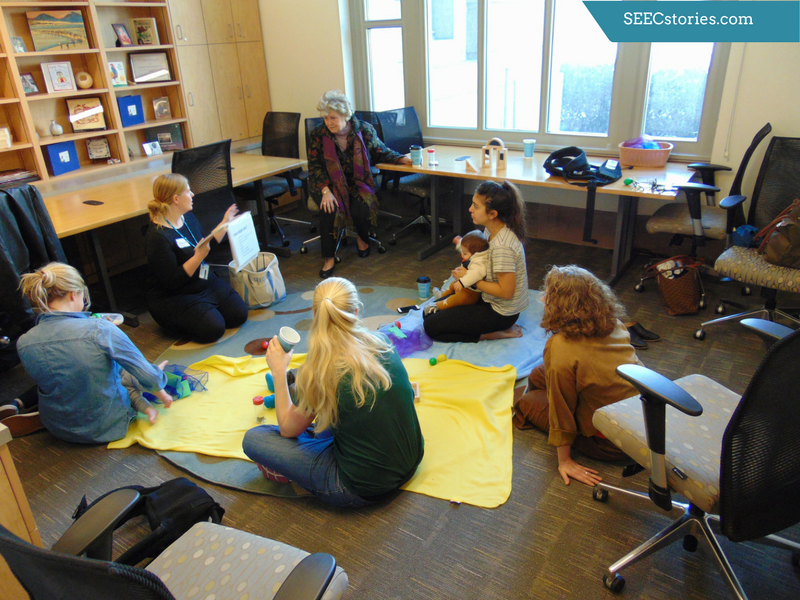
SEEC recently began the new program Bring Your Own Baby, which we fondly call “BYOB”. This program expands on the rest of our programming in several exciting ways. More than our other programs, such as our Family Workshops or the Smithsonian Early Explorers, BYOB is geared towards the adults who are bringing the children. The program is broken into two parts – coffee and play and then, a museum visit.

SEECstories.com (1)

In the development of this program, we considered the needs of both the adults and the babies. The class begins with coffee and the opportunity to meet and chat. We decided to begin this way for two reasons. The first was that we wanted to build in time for a flexible start since we know that it can be difficult getting yourself and your baby out of the house on a schedule (and kudos to all those who try!). We were also hoping to provide parents with the opportunity to create a community through conversation. The topics discussed have been seemingly endless, ranging from how much sleep everyone got the night before to their favorite Impressionist artist.

SEECstories.com (3)

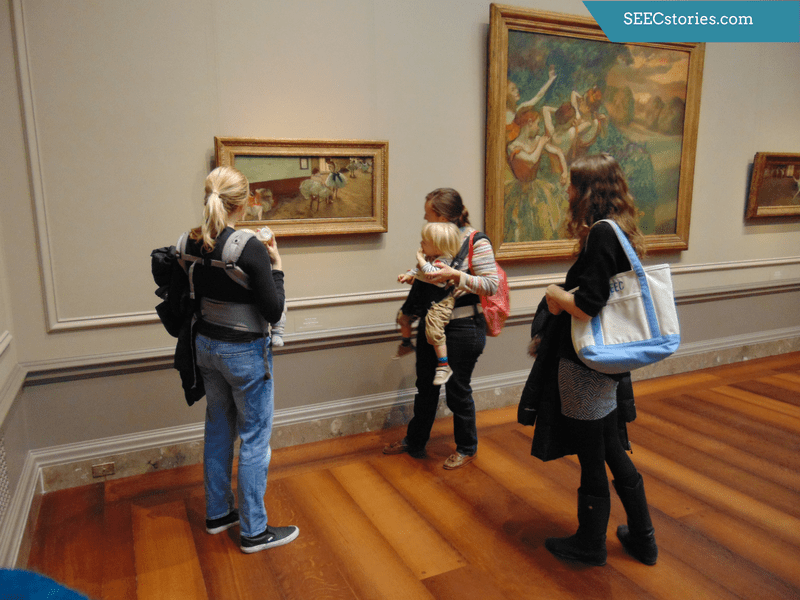
As we head out into the museum, we are mindful that babies can sometimes be fickle. We are comfortable with crying, babbling, nursing, and even cutting the adventure short because somebody (caregiver or baby) needs to go home early to take a nap. Our flexibility on these tours makes the sometimes stodgy world of museums more approachable for caregivers and babies alike.

SEECstories.com

For these museum tours, we are hoping foster flexible thinking and spark the imagination of grown-ups rather than going quickly between objects and paintings and unloading a barrage of facts. To make these tours informative and interactive for adults, we have found ourselves modifying many of the tools that we use with young children. This makes our programming more playful and interactive than many programs geared towards adults. We believe approach to learning will make it more likely for you to learn something and leave the experience with something new to ponder.

SEECstories.com (4)

While the programs are written for adults, we could never forget the babies that are tucked away in their carriers. As the tours progress, we discuss theories in early childhood education and offer ways to incorporate this research into your interactions with your child. We show off some tips and tricks about how to make museum visits beneficial and enjoyable for young children. Our goal for this program is to help parents and their babies have an enjoyable time in the museums.

If you are interested, please sign up for one our our upcoming BYOB classes.

Looking for ways to engage your infant? Check out our Pinterest board on Infant Activities for ideas. 

Teacher Feature: Infant Class Explores Animals

This week’s teacher feature highlights an infant class’s adventure to the Kenneth E. Behring Family Hall of Mammals at the National Museum of Natural History. The teachers, Erica Collins, Katherine Schoonover, and Noel Ulmer, paired the museum excursion with the book “Polar Bear, Polar Bear, What do you Hear?” by Bill Martin Jr. and Eric Carle. While this experience was carefully planned and curated by the teachers, the infants’ interests ultimately determined which animals the class focused on. By intentionally responding to their class’s cues, the teachers allowed the infants to lead the lesson based on individual interests. Below you will find images from the day as well as a reflection from the teachers.

 Cover Photo


SEECstories.com (1)

To start their adventure, the teachers passed out safari hats. Each child was given the opportunity to touch and explore the hats. Many tried putting the hats on, taking the hats off, and even experimented with covering their eyes with the hats. In addition to something new to hold, the hats also served as a transitional object to ease the move from the classroom and to the mammal hall.

SEECstories.com

While in the mammal hall, the children were able to hold animal figurines that matched the animals that they saw in the mammal hall and in the book Polar Bear, Polar Bear, What do you hear? These animals helped the teachers personalize the lesson as they could take note of which animal each child was most interested in based on the animal that the children chose to hold.

SEECstories.com (2)

For these young children, the book itself was an object. They were excited to be able to touch, hold, explore, and even push buttons to make noise. The book, which the class had been reading regularly, helped bridge the gap from the familiar to the unfamiliar large animals.

SEECstories.com (4)

Most of the children in this class are preverbal, but this does not mean that they are unable to communicate. In fact, the infants use their physical activity to communicate by pointing and making gestures. The teachers were careful to narrate everything they saw and also communicated with gestures while paying careful attention to the children.

SEECstories.com (6)

Another way the teachers were responsive to the class was by rotating who held the book Polar Bear, Polar Bear, What do you Hear? If a child expressed interest in looking closer at the book, the teachers would bring the book over to that child. If that child wanted to hold the book and explore it on his or her own, the teachers responded to the wants and needs of the individual by giving the child the opportunity to hold the book on his or her own while the rest of the class observed some of the mammals.

SEECstories.com (8)

The book, Polar Bear, Polar Bear, What do you Hear?, focuses on the sounds that the different animals make and young children love experimenting with the different sounds they can make. This makes for a perfect pair. While in the mammal hall, the children attempted to mimic the sounds that different animals make.

SEECstories.com (7)

The last stop on their adventure was to see the polar bear, which is on display up high. The children were captivated by the polar bear and craned their necks upward to get a better view.

Untitled design (1)

Back in the classroom, the teachers were able to continue assessing which animals the children wanted to explore further. The children gravitated towards certain animals. In the picture above, you can see one child actively exploring the teeth of the hippopotamus, which she had seen earlier in the mammal hall, and comparing them to her own teeth.


A reflection from Erica, Katherine, and Noel:

Preparation

We began learning about animals by exploring the different ways they look, sound, and move. This topic started to emerge within our classroom when the students began to recognize animals and mimicked the sounds animals make to let us know that they had noticed a specific animal. We wanted to show our class these animals up close and personal and to relate them to the books we see them in, the songs we sing about them, and the images of different mammals we encounter every day. Choosing to go to the mammal hall made the most sense since the animals there are so lifelike, other than they don’t make noise, but luckily the students helped us with that. We took safari hats with us to wear as we searched for our favorite animals and the animals mentioned in the book Polar Bear Polar Bear What Do You Hear? We wanted the students to come away from the lesson having made the connections between what they saw and heard in one of their favorite books to the size and shape of the animals in the mammal hall. In preparation for this lesson, we did many different kinds of movement in the classroom to mimic animal movements and often demonstrated the sounds these animals make.

Lesson

The most effective part of our lesson was showing the students the connection between the animals on the page and the animals in the mammal hall. Creating space for the students to get a sense of how big the animals are helped to expand this topic. Viewing the images of animals on a page, then seeing them in person, and then still being able to connect to the of sound of animals is pretty significant. Our time spent preparing in the classroom and going over the different animals made the lesson smoother. Rather than overwhelming the children with all the massive animals, we gave them time to adjust to each animal. Some students even had favorites, which we had planned to focus on. We were surprised to see which students were really engaged as we went through the mammal hall. Some students, who we had expected to be very vocal because they growl and make lion noises all day, were relatively quiet. We think they saw how lifelike and big a real lion was when we got up close and they were so entranced that they stopped growling and making noise which none of us expected to happen.

Reflection

Avoiding crowds is always something that is hard to manage, especially in the mammal hall, because it attracts so many people. The book we brought with us also had buttons for each animal to make noise, but it was so crowded that it was hard to hear at times. Luckily, our class had been pushing these buttons for weeks, so they were still able to make the connection even without us using the sounds in the book. After completing our safari hunt through the mammal hall, we continued to look at different animal books, wear our safari hats, and make observations about different animals.

If we were to do this lesson again, we would spend more time discussing all types of animals rather than just mammals. We would also focus on what makes different animals distinct from each other. We believe that looking at more types of animals (reptiles, birds, etc.) would not have hindered the students’ exploration of the mammals, but rather it would have opened up the topic to more discussion and learning.