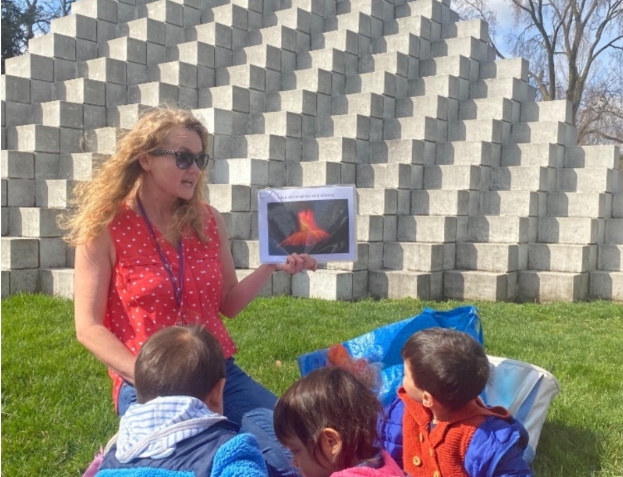
For young children, books are magical, useful, and familiar. They are a classic circle time tool and are wonderful for explaining complex topics. Yet, for many museums no published books exist that explain their objects or their institutional values. Instead of relying on existing children’s books, the Smithsonian Early Enrichment Center (SEEC) has started creating our own books which act as scripted lesson plans with embedded images. These books can be easily applied to multiple programs.
Getting Started
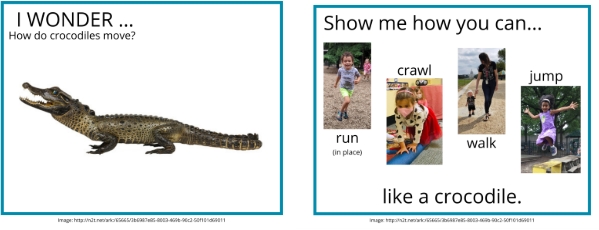
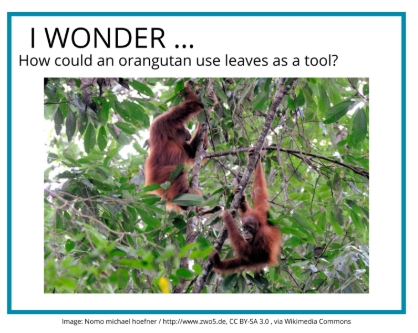
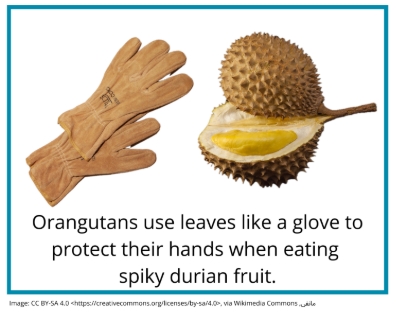
To design our books, we use a presentation program. Best practice is to include one or two large photos and two lines of large font text per page. (There are several examples of pages from our books found in this blog.) If the object needs more context or explanation, it can be included in the author’s note. Books can be printed, laminated, and then collated in a ring binder for ease of use. A photo album service can also be used to create a more traditional looking book.
Interactive Stories
Interactive elements for your story times can be built into the books you create. The book can prompt you to encourage children to pretend, move, sing, and experiment. Writing activity breaks directly into the book allows children to have the opportunity to be active participants throughout the whole story time experience.
Questions & Wait Time
Core museum education practices such as asking questions and giving wait time can be written into books, too. We often ask a question on one page and make sure the answer is on the next page. Making the educator or docent turn the page is one way to intentionally slow down the reading of the story and allow for thoughts and conversations to develop.
Familiar / Unfamiliar
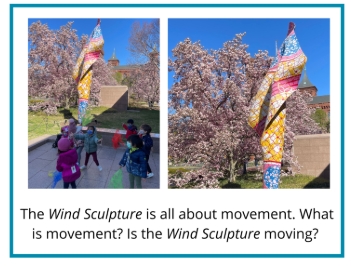
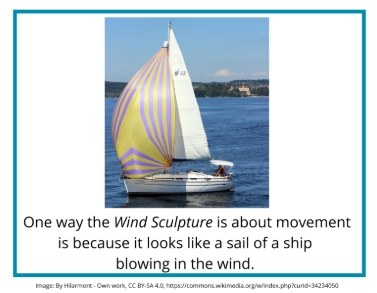
To start creating books, we identify and leverage subjects that are familiar to young children to create context for the unfamiliar. In writing our Wind book, we knew that most pre-k children have some familiarity with sailboats. They may play with boats in the bathtub or may have sailed on a real boat. Early in the book we made the connection that the Wind Sculpture was like a boat. This grounded the book in the familiar, and from there, we made additional connections to the unfamiliar.
Translating Complex Ideas
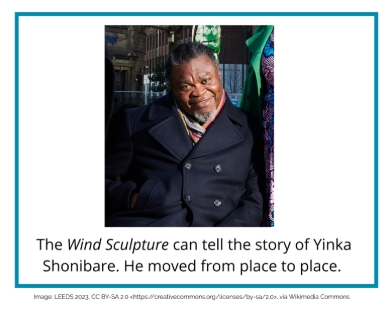
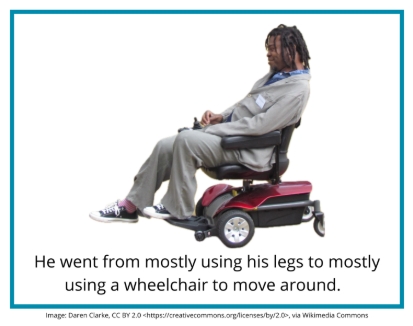
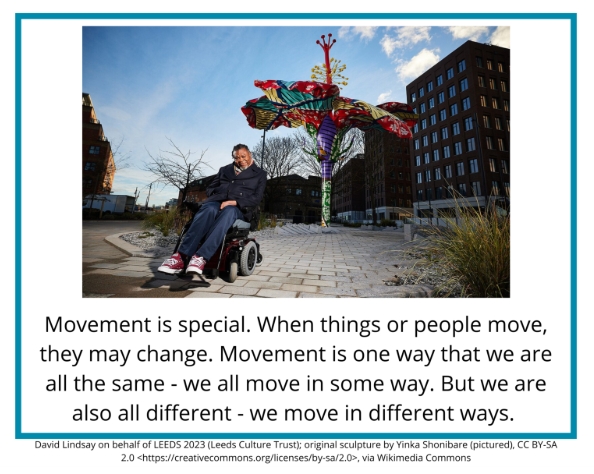
Our goal when creating books is to convey the true meaning of the objects to young children. Since source materials are not accessible to children, it is our responsibility to adapt them to make connections to the familiar. Artist Yinka Shonibare described the meaning of his piece as “None of us have isolated identities anymore, and that’s a factor of globalization” and we translated that quotation as:
Scripts & Key Phrases
Rooted in the philosophy of anti-bias education, SEEC uses the phrase, “We are all the same. We are all different.” This key phrase helps young children foster a positive sense of self while embracing diversity. Since this phrase is core to our hidden educational theories and values, we embed this script into our books. We encourage you to consider what values are core to your organization and how you can create a script that is relatable to young children and reflects those core values.
Longevity of Books
These books that we write can easily be pulled off a shelf and read. This makes them incredibly useful and easier to implement than a lesson plan. We love that they can be used over and over again by different classes and educators. Writing books may not be something that every preschool or museum educator does in their daily practice, but we encourage you to try, and you will likely have a product that you reach for again and again.
This teacher feature focuses on the older infant (Duckling) class’s exploration of Bubbles and the development of their classroom exhibit: HOME during the month of May. At this point of the year, students in the Duckling class were between the ages of 14-20 months old.
Preparation:
Why and how did you choose the visit?
The Ducklings were showing their teachers an increased interest in helping clean the classroom throughout the day. After each meal at school, the Ducklings would ask to help with a “Task,” such as wiping down the table, carrying dirty dishes to the kitchen, and putting the laundry in the laundry room. The students were excited to help and to mimic what their teachers were doing. The Duckling educators decided to follow that interest.
What were your topics of exploration?
This month-long exploration was all about Bubbles. Each week focused on a different way to encounter bubbles: Laundry, Dishes, and Bathtime. The class then spent the last week of the month discussing how we can take care of the spaces and things in our home. The unit concluded with the classroom Exhibit entitled HOME to show off all their hard work.
What were your learning objectives? (What did you want your children to take away from the lesson?)
There were a few learning objectives for the Bubbles unit. A major focus was for the Ducklings to gain a sense of autonomy and independence in their space. Throughout the month, the students had opportunities to decide how they wanted to interact with the lesson. For example, there were spare clothes available to the students during the week on Laundry. They could then decide if they wanted to practice putting on and taking off the clothes, pretend to wash them in the model washer and dryer, or work on hanging them up on the clothesline set up in the classroom. Having these options available allowed the students to decide for themselves where their interests lay and to work on a variety of gross and fine motor skills.
Caption: Two infants practice hanging clothes on a pretend clothesline in their classroom
Caption: Duckling infant class explores spare clothes and laundry baskets on the floor with their educator.
Another goal was to create a positive association with cleaning as it can be a difficult part of a child’s daily routine. By allowing them to create a mess and then have them help clean it up, the teachers could show the students that cleaning up after ourselves (a skill they will continue to develop later in life) is just as engaging as the mess making.
Implementation:
What was most successful about your lesson?
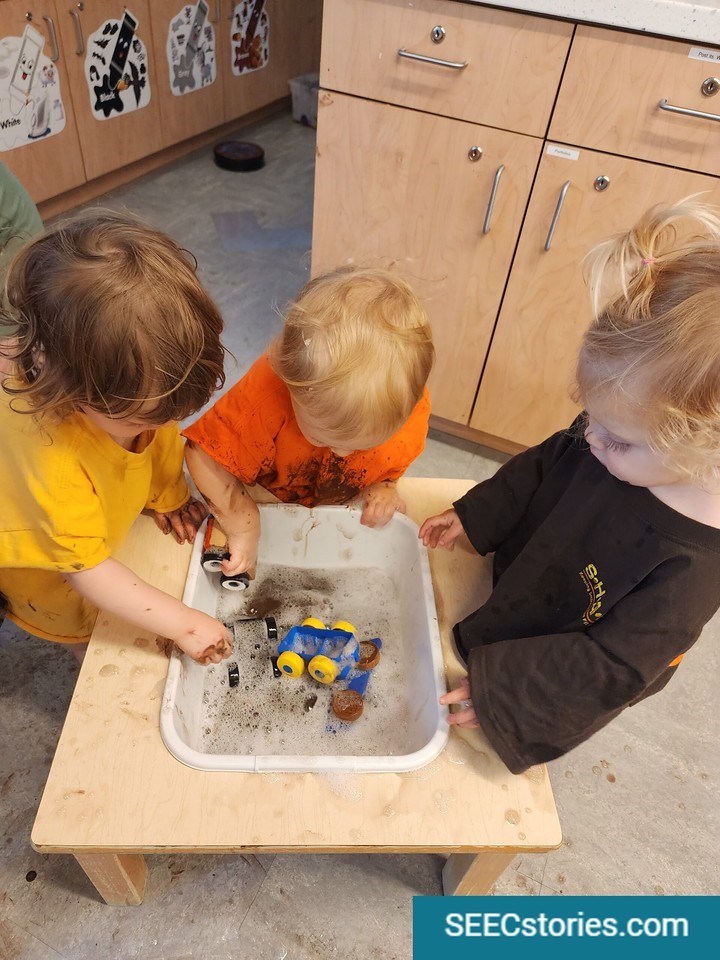
The most successful part of the whole month was watching the Ducklings get objects dirty and then get excited to clean them. It was a real full circle moment for the class. Over the course of the month, they would return to this cycle a number of times. First, they painted with dishes and utensils and when they were done painting, they cleaned them in soapy water. The class repeated this activity with toy cars in “mud” (brown paint) and then, again, using their full bodies. By the end it was clear to the teachers that the students understood that something gets messy and then it gets clean.
Caption: Duckling students painted with their toys cars in “mud” (brown paint) and later washed the cars clean at a “car wash.”
Another successful element was the cardboard washer and dryer Calla and Kevon built prior to the unit. The Ducklings quickly learned that they could move clothes from one machine to another and that the washer and dryer were only meant for clothes. It was great to see their gross and fine motor skills as well as their spatial reasoning skills in action as they moved clothes and turned the dials.
Caption: Duckling student shows off her laundry and coordination skills by moving the clothes from the washing machine to the dryer
How did the lesson reach your objectives to expand the topic?
Each week the Ducklings got to focus on a different way they could clean and interact with bubbles. They would have similar experiences, such as painting and then cleaning up, but the methods would be different enough to expand their understanding of cleaning.
The Ducklings were able to build on their prior knowledge of what it means to clean in order to understand how to clean with the new objects in front of them. For example, they were used to seeing their teachers clean the table with washcloths and liked to help rub down the table. The teachers took the class to Within These Walls at American History to discuss laundry. When presented with a washboard, typically used for cleaning clothes, they talked about how they could “rub, rub, rub” their washcloths on the board just like they would on the table. When their teacher placed a modern washboard basin in front of them, the Ducklings quickly associated that washboard with the one they had seen in the museum.
Caption: Ducklings went to visit the laundry portion of the Within These Walls exhibit before returning to their classroom to do some washing of their own. They took their washcloths and got them clean in their soapy water buckets.
What was successful in terms of your preparation and logistics?
What made this lesson so successful was having everything prepared in advance. The Duckling educators knew that they wanted to spend an entire month talking about bubbles and cleaning, so they spent time thinking about how to break that down into smaller topics. This enabled the team to dive deeper into each topic but still create a cohesive lesson as the month progressed.
The Duckling team also intentionally revisited spaces and concepts. They took more than one visit to Inside These Walls during their month-long unit. This allowed the Ducklings to become a little more familiar with the space and more comfortable engaging with the exhibit. They followed a similar thought process for their art lessons during the month. By using a similar formula for their art projects, they allowed their art making to become a routine. The children were able to know what to expect and, therefore, they spent more time exploring and engaging with their projects.
Reflection:
How did you document the lesson in order to reflect back on the work?
The Duckling’s month-long exploration on Bubbles culminated in their classroom exhibit entitled HOME. The students spent so much time exploring bubbles and cleaning that it felt like the perfect topic for an exhibit and to have their adults come and see their hard work. While not every project was displayed for the exhibit, the Duckling team chose to focus on displaying work that showed the process of getting things dirty and then getting things clean. The art around the classroom was the biproduct of that exploration.
Caption: Ducklings students made bubble art by making bubbles with colored water and transferring the bubbles onto paper. Once dry, those art works were hung on a pretend clothesline for their classroom exhibit.
The teachers also decided to bring back out the different cleaning stations they learned about during the month. There was a pretend bathtub, a toy kitchen, the washer and dryer, the laundry line, as well as brooms and dust pans. These stations were in place for the Ducklings to show their adults all the new gross and fine motor skills they developed over the month.
Each station was brought out because it spoke to the interests of the children. There was a way for each child to engage, and work samples were present for each student.
Caption: During the exhibit, one Duckling was exciting to show off her fine motor skills back at the clothesline.
What could you have done differently to better achieve your objectives and expand the topic?
There is always room for improvement in lesson planning, and if the Duckling team were to do this lesson over, one thing that they’d like to do is to scaffold some of their exploration out a little differently. For example, instead of putting up a clothesline, hanging clothes on it, and just letting the children explore, the team would have liked to break it down into smaller experiences first. Like just practicing pinching the clothes pins open and shut, then trying to balance clothes on a more solid clothes line, then transitioning to a string line. This slower introduction would have helped the students make their own connections.
What was challenging regarding logistics?
One challenge was finding the balance between experiencing getting messy and ensuring that the students are safe. Water play, and full-body paint exploration, can get slippery if the educators aren’t keeping a close eye on the situation. It can be a fine line between letting the children explore as they want to and making sure they keep their bodies safe. The Duckling team did their best to let the children explore freely by working to mitigate the mess before it happened. During water play, for example, they covered the floor with towels ahead of the play.
What recommendations would you have for another teacher trying out this lesson?
The biggest recommendation is to let the children experience the real thing, whenever possible. If the class is discussing how clothes get laundered when they get dirty, spend a day doing just that! Let the children get their clothes dirty, have them change, and then walk them through the steps of washing their clothes and take the time to investigate each step. The Ducklings loved being involved in the many steps of keeping themselves and their classroom clean.
Earlier this year, educators across SEEC’s vibrant community came together for an all-class meeting led by our Office of Engagement and Administrative Team. With representation from every classroom serving children from 2 months to 4 years, this gathering was an opportunity to reflect, share, and envision the future of our learning environments.
The heart of the presentation focused on how classroom environments at SEEC should be more than just spaces—they should be reflections of what’s happening in the life of each class. They should be intentional, curated, and consistent across our community. As a lab school that integrates museums, community connections, play, and object-based learning, our environment serves not only as a backdrop, but also as an active participant in the learning process.
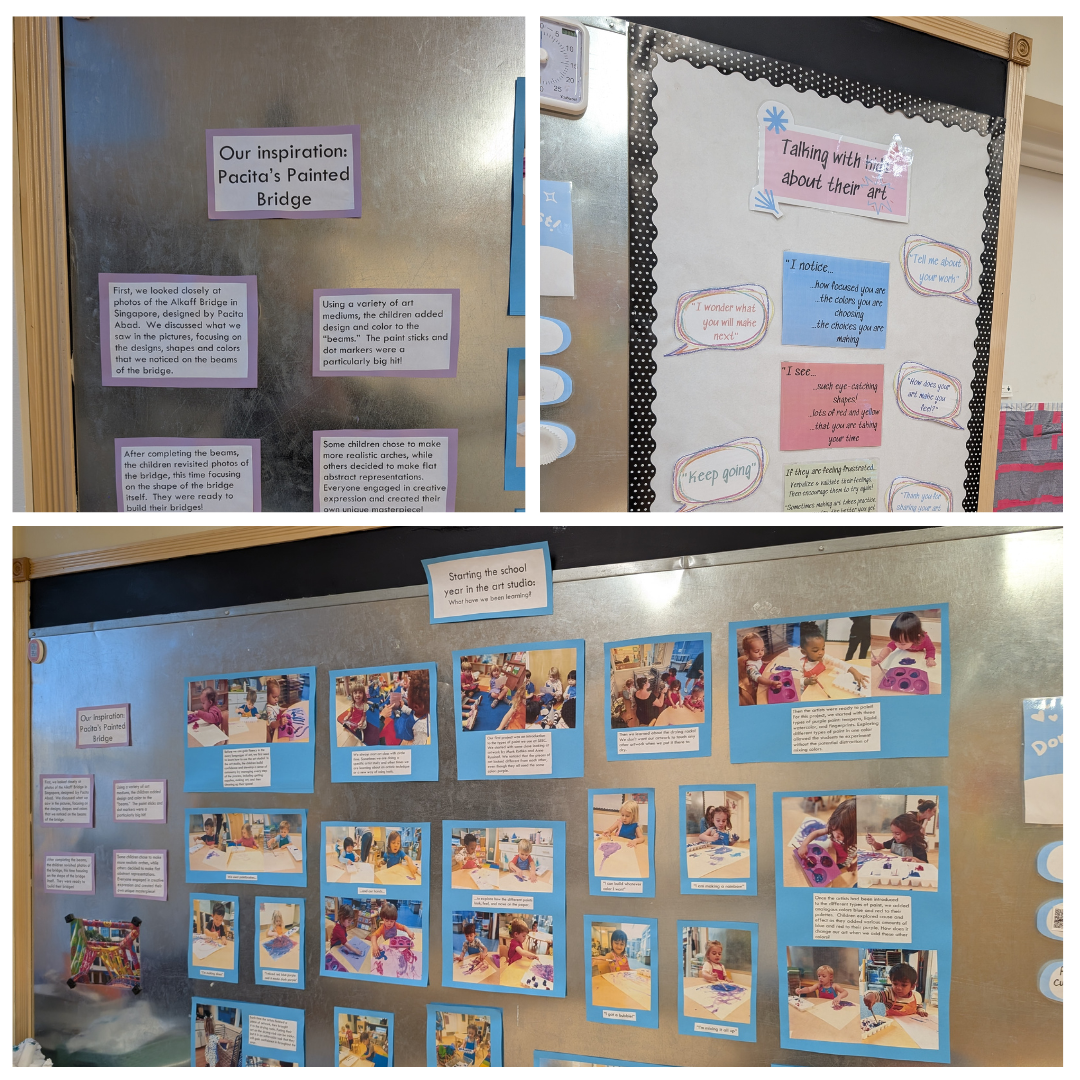
The display boards in the Art Studio about the children’s exploration of Pacita’s Painted Bridge; the top left board discusses the inspiration from the art with descriptive posters, the top right board features a “Talking with Art” theme with children’s art and comments, the bottom board showcases multiple photos and descriptions of children engaged in the process of creating their pieces.
Documentation is …
“An effective piece of documentation tells the story and the purpose of an event, experience, or development. It is a product that draws others into the experience—evidence or artifacts that describe a situation, tell a story, and help the viewer to understand the purpose of the action”
Art display featuring a colorful collage with images, patterns, and cellophane fish, all pinned on a wall. It also features photographs of the children creating the fish, an image of Untitled by Simon George Mpata and a description plaque of the children’s exploration.
Guidelines for Curated Spaces
The administrative team outlined several key guidelines for building and sustaining rich classroom environments. One major takeaway was the idea of keeping displays fresh and relevant by changing them out monthly in alignment with each class’s unit of learning. Educators were encouraged to use real photos whenever possible, and to be mindful of how someone without any context—a new family, a visitor, or even a child—might engage with the documentation they encounter.
Importantly, the team challenged educators to think beyond the bulletin board. Documentation should be thoughtfully showcased, using the full range of space within the classroom to reflect learning, discovery, and growth. Typed descriptions should support the visuals, offering clear, intentional narratives about what is happening and why it matters.
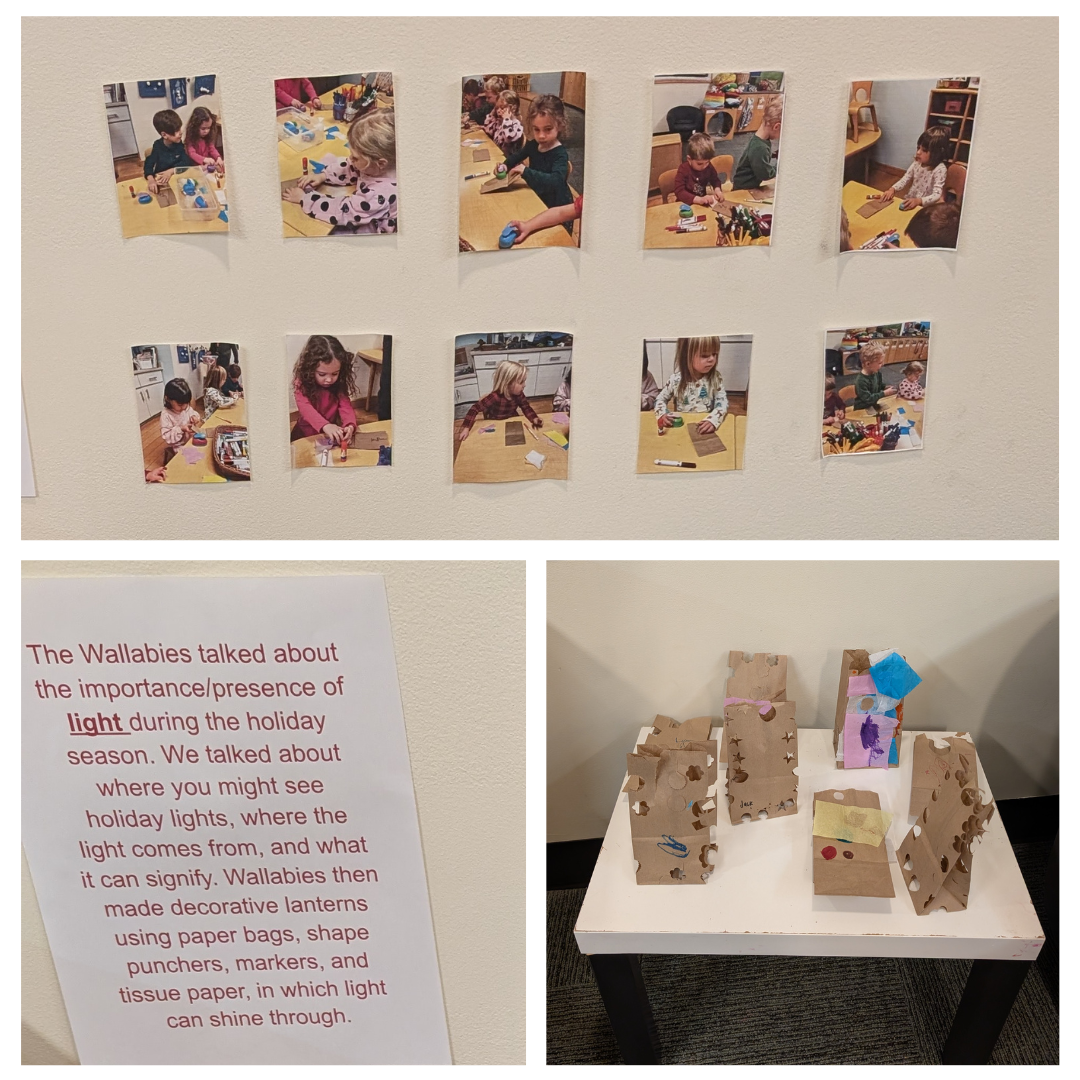
A display featuring multiple photos of children in our Threes class engaging in the process of creating lanterns, and a text panel describing their exploration of lights during the holidays, complemented by a display of their lanterns.
Showcasing the Extraordinary
Another theme of the presentation was recognizing and intentionally showcasing the extraordinary work that is happening every day in our classrooms. Documentation is a tool for storytelling—and those stories should be shared with our caregivers, our peers, and the children themselves. It fosters connection, supports classroom community, and builds trust with families.
We revisited an important question: Who is documentation for? The answer was multifaceted. It’s for children, who deserve to see their learning reflected back at them. It’s for caregivers, who want to understand and engage with their child’s experience. It’s for fellow educators, directors, and even for each of us as individual educators—a way to reflect on and grow in our own practice. It’s also a window for new families into the values and rhythms of SEEC classrooms.
Left: An outdoor class exhibit with a child and their caregiver viewing paper artworks.
Right: A caregiver reading a description of their child’s class art display while two children and two educators engage in play and story time.
Engaging Children Through Environment
The team emphasized that placement matters. Documentation intended for children should be placed low enough for them to engage with it—yes, even to touch it. When we introduce materials thoughtfully and set expectations, children can interact with their learning environment in respectful and meaningful ways.
We also explored how the environment itself can shape classroom behavior. A carefully arranged, engaging, and responsive space can reduce challenges and support deeper exploration. Our surroundings can either hinder or enhance the work we do—and we have the power to use them intentionally.
Wall display at child level featuring one of our Twos’ class artworks and a descriptive plaque, in a classroom setting.
From Discussion to Action
The presentation concluded with an open dialogue. Educators discussed practical concerns—how to manage time constraints, where to print documentation, and how to embrace the idea that children will interact physically with the materials on display.
In the five months since, educators across SEEC have taken this guidance to heart. Classrooms are now filled with purposeful documentation that highlights the daily wonders unfolding in our community. From toddler rooms to preschool spaces, there’s a renewed commitment to documenting learning not just consistently, but meaningfully.
As we look ahead, our goal is to continue growing in this work—pushing ourselves to create environments that don’t just display learning but deepen and celebrate it.
Top: A display in our older infant class featuring the work of Alma Thomas alongside the children’s artwork. Bottom: Abstract paintings and textured art pieces by one of our toddler classes, and a central portrait of Piet Mondrian with a description of the children’s exploration of his art.
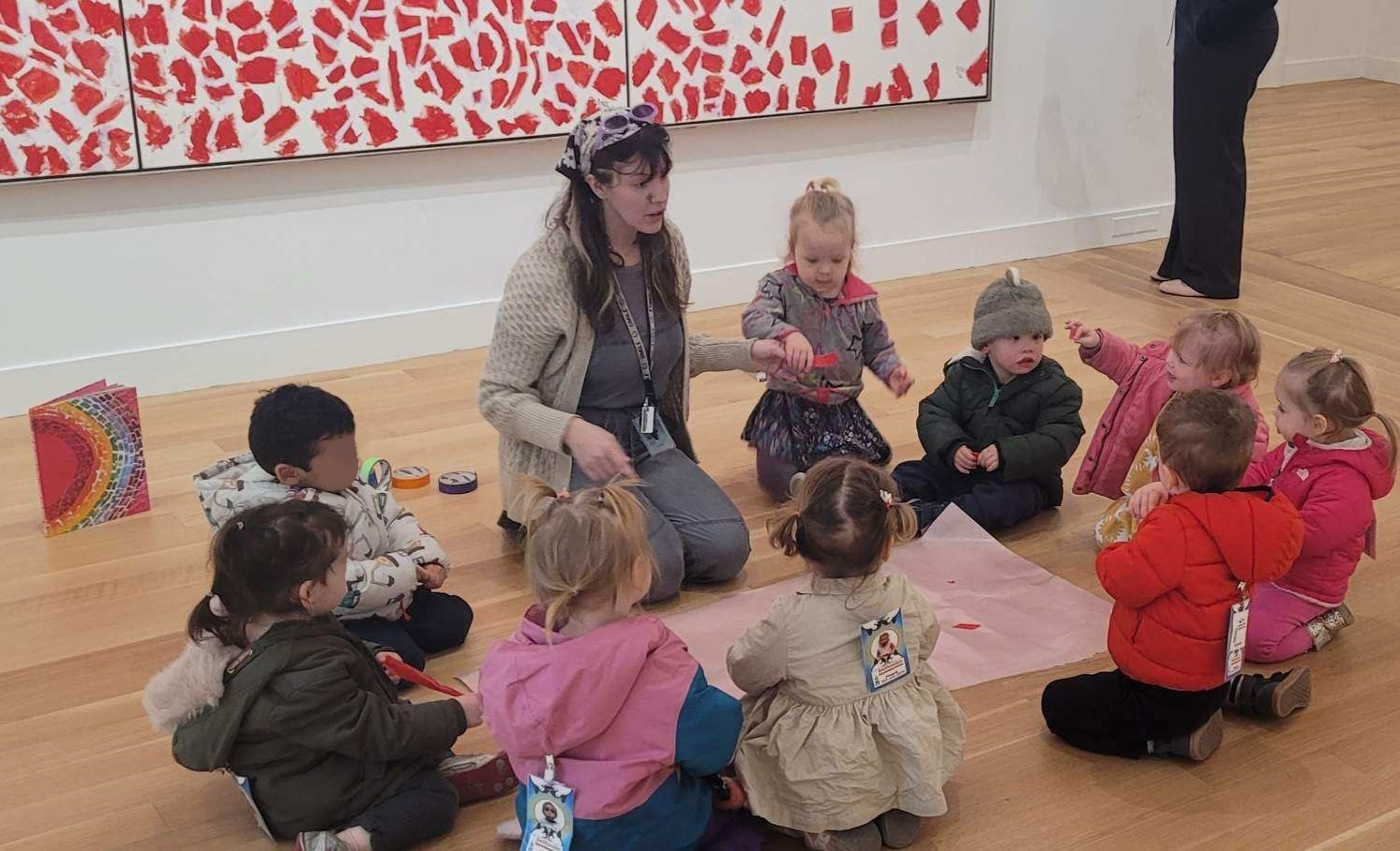
Our Twos class recently spent some time talking about colors. On this day, the focus was on the vibrant color red and its name. To make the learning experience even more engaging, this Twos class drew inspiration from Alma Thomas’ stunning artwork, Red Azaleas Singing and Dancing Rock and Roll Music, at the Smithsonian American Art Museum @americanart.
One of our Twos educators began this lesson with the story Ablaze With Color by Jeanne Walker Harvey to capture the attention of the children and introduce them to Alma Thomas.
What were the learning objectives? (What did you want the children to take away from the lesson?)
This visit was an opportunity for our young learners to begin recognizing and appreciating colors in a real-world context. The bright and lively hues of Thomas’ painting captivated their attention and sparked their curiosity, making the concept of color recognition both fun and memorable.
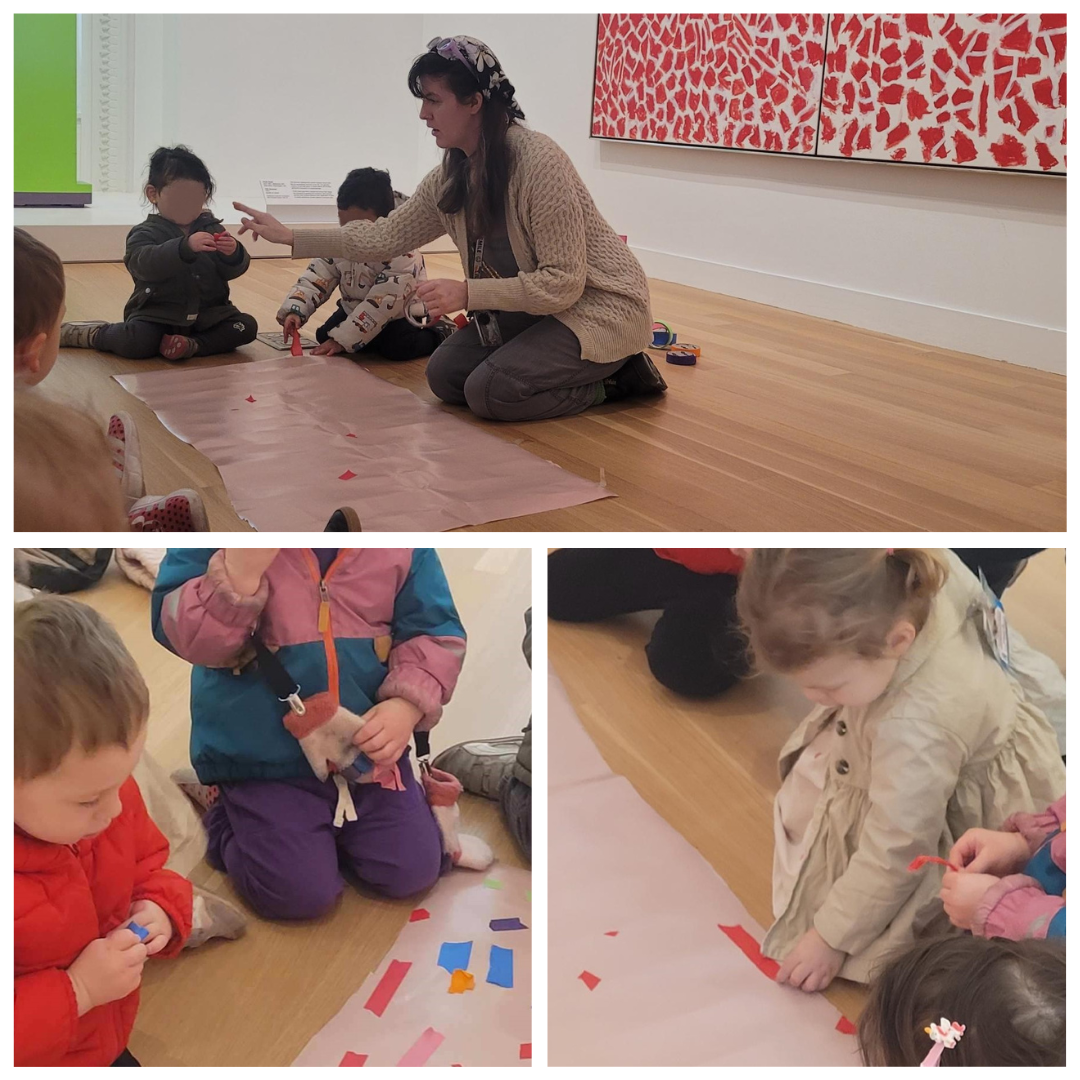
The educator passed out pieces of red tape to each child for the ‘Doing” portion of their visit at the Smithsonian American Art Museum. The background features Alma Thomas’ Red Azaleas Singing and Dancing Rock and Roll Music
Implementation:
What was most successful about the lesson?
How did the lesson reach your objectives to expand the topic?
The most successful aspect of the lesson was the Twos educator reading “Ablaze with Color” by Jeanne Walker Harvey, a captivating story about Alma Thomas’ journey as an artist and her love for vibrant colors and the collaborative art created by the children. This beautiful story naturally facilitated the children’s exploration and appreciation of colors, sparking a conversation about the small red pieces in Thomas’ paintings. The lesson reached its objectives by expanding the topic through this engaging story, which encouraged the children to delve deeper into the world of colors and art.
What was successful in terms of preparation and logistics?
The children were inspired by the story and discussion, which led to a wonderful opportunity for them to create a collaborative piece of art in the gallery. By emulating Alma Thomas’ unique style, they used small pieces of colored tape on contact paper to craft their own vibrant masterpiece. This hands-on activity not only deepened their understanding of colors but also allowed them to express their creativity in a fun and engaging way.
The educator gave each child the opportunity to place the pieces of tape onto a larger piece of contact paper for a collaborative art piece inspired by Red Azaleas Singing and Dancing Rock and Roll Music
Reflection:
What could have been done differently to better achieve the learning objectives and expand the topic?
To enhance their connection with Alma Thomas’s work, bring along multiple small prints of her pieces (you can find examples of her colorful abstract art in books or online). Having a print for each child allows them to hold and closely observe the details while viewing a larger piece, fostering a more personal engagement with the artwork.
You could also bring along color words paired with their corresponding colors to encourage early literacy. For example, having “red” written on a red card or “blue” on a blue card can help young learners associate written words with visual cues. It’s a simple and fun way to integrate literacy skills into an art-themed adventure!
Additionally, introduce the tools Alma Thomas used to create her masterpieces—such as a canvas, paintbrush, or any other materials. This hands-on approach offers insight into how artists work and inspires creativity.
What was challenging regarding logistics?
The Smithsonian American Art Museum (SAAM) opens its doors at 11:30 AM, which is not ideal timing for our young learners. We’re so grateful to have the option to request tours before the museum officially opens, making visits more accessible for our group. If visiting at 11:30 doesn’t work for your schedule, you can also see Alma Thomas’s vibrant Watusi (Hard Edge) on display at the Hirshhorn Museum—another fantastic option to explore her incredible artistry!
What recommendations would you have for another teacher trying out this lesson?
If you’re inspired to explore the work of Alma Thomas like our Twos class, here’s an idea to create a meaningful and engaging experience. Start by defining the space for each child and ensuring a respectful distance from the artwork. A small blanket or portable morning meeting circles can help provide a clear boundary between the class and the art, creating a cozy yet organized setting.
To extend this experience into an art-making activity, colorful tape is a great way to replicate Thomas’s unique style. If colorful tape isn’t accessible, don’t worry! You can use vibrant pieces of construction paper in combination with contact paper to mimic her bold, textured patterns.
This setup not only helps children appreciate art but also encourages exploration and creativity—just like Alma Thomas’s work inspires all of us.
This past week I had the chance to attend one of SEEC’s seminars: Play: Engaging Learners in Object Rich Environments. During the two-day workshop, we explored the meaning of play and how to use it when teaching with objects. We began the seminar by defining play as a group. Some of the key words were: fun, tools, free thought, child directed, social, emotional, intellectual. To help us articulate the discussion, we also read Museum Superheroes: The Role of Play in Yong Children’s Lives by Pamela Krakowski, which distinguishes play as:
active engagement, intrinsic motivation, attention to process rather than the ends, nonliteral (symbolic behavior) and freedom from external rules.1
I reflected on these concepts and how they related to my own teaching. I wondered how I could incorporate more play into my practice, especially when I was in the museums. I decided to try out some new play strategies on a recent visit to the National Gallery of Art with a group of preschoolers.
Asher Brown Durand The Stranded Ship 1844 oil on canvas National Gallery of Art Gift of Ann and Mark Kington/The Kington Foundation through Millennium Funds 2003.71.1
My first playful endeavor was completely spontaneous. I began the discussion by asking the children to describe this painting by Asher Brown Durand. One girl pointed toward the artwork and said:
The sun is always moving through the sky.
I took this opportunity to ask the rest of the class whether they had ever noticed the sun moving through the sky too. They immediately offered their own examples. At that moment, I decided we should play the Earth. I asked everyone to stand up and slowly turn their bodies. I grabbed a parent and had her stand in the center pretending to be the sun. As we moved, I explained how it was actually the Earth’s rotation that made it look the sun was moving in the sky. This was a completely unexpected and child-initiated moment, which was great. I think it was the playful element though that really made the experience memorable. If I hadn’t asked the children to get up and pretend to be the Earth, they would have been less likely to understand and remember the concept of rotation. By having them participate in the experience the concept was made real, tangible.
Part of the seminar was inspired by our colleagues at Discovery Theater. This session was, as one would expect, more theater driven and honestly, really challenged me. As the class continued to describe the Durand painting, I added secondary questions to enliven the discussion. For example, when the ocean was observed, I asked them to show me with their bodies how the ocean was moving and then I asked them to make the sound of the waves. The kids were happy to illustrate both for me so when it came time to talk about the clouds and wind, we added sound effects and movements again. These exercises captured the essence of the painting, encouraged different learning styles and made everything more fun.
As the last part of the object lesson, I laid out several objects and asked them to work together to recreate the painting. They needed no instruction, but went right to work, collaborating until the composition was complete. Was it exactly like the painting, no, but they had used these tools to create their OWN composition. They were quite proud and were completely engaged in the activity. I saw them looking back at the painting, rearranging objects and making their own decisions.
All in all, the visit felt playful and meaningful. I am continuing to think about how to make my lessons more playful and how play can be a tool for learning within the museum environment. If you have any ideas, please share!!!!
1. Journal of Museum Education, Volume 37, number 1, Spring 2012, pp. 49-58.
A special guest post by Rhian Evans Allvin, Executive Director of the National Education for the Education of Young Children
Every year, NAEYC’s Week of the Young Child™ brings together thousands of young children, educators, and families from around the globe in celebration of our youngest learners. WOYC™ is a wonderful opportunity to celebrate the joy and play that are at the heart of early learning.
During this year’s Week of the Young Child™, April 10—16, parents and teachers are encouraged to explore developmentally-appropriate activities based around five fun daily themes: Music Monday, Taco Tuesday, Work Together Wednesday, Artsy Thursday, and Family Friday. These suggested themes offer activity ideas supporting early math, language, literacy, and more, while promoting social-emotional development with diverse hands-on learning opportunities.
For this year’s WOYC™, NAEYC invites everyone to get involved in the celebration! Make up a fun dance routine to our 2016 featured song, “One Love” as performed by Aaron Nigel Smith and the One World Chorus on Music Monday, or invite children to help measure ingredients on Taco Tuesday. Work Together to explore the world around you on Wednesday, create imaginative works of art on Artsy Thursday, and celebrate your unique family on Family Friday!
The Week of the Young Child™ is also a great opportunity to thank early educators for their hard work and dedication to the early learning profession. Research tells us that US voters overwhelmingly believe that early educators play an essential role within our communities—nearly on par with firefighters and nurses. These same voters recognize that early childhood educators have complex and demanding jobs and responsibilities, and that our national policies do not reflect the vast amount of developmental science supporting the importance of high-quality early learning experiences during a child’s most formative years. No matter how you celebrate WOYC™ this year, be sure to thank the early educators in your life, and the family members who help encourage learning at home.
As an NAEYC-accredited program, the Smithsonian Early Enrichment Center has proven to maintain high-quality early learning standards and offers quality learning experiences to its students and community. NAEYC is excited to see the fun activities and learning experiences that will be taking place this year! Teachers and families are encouraged to share their WOYC™-inspired activities by sharing photos, activity ideas, videos and more to NAEYC’s Facebook or Twitter using #woyc16, or sending directly to woyc@naeyc.org. We can’t wait to see how you celebrate the early learners in your life!
To learn more about NAEYC’s Week of the Young Child™ visit naeyc.org/woyc. To get involved in the conversation about supporting and elevating the early education profession through our nation’s public policy, join NAEYC’s Early Ed for President movement at earlyedforpresident.org.
Pools, beaches, lakes, sprinklers…it’s that time again! Children all over the US are enjoying summer-time to its fullest and likewise, parents are looking for water-inspired activities. Here in DC, we are lucky enough to have a number of public fountains that are both beautiful and refreshing. Fountains capture the imagination of children, so why not take this opportunity to create a learning experience?
Infants
Infants often have mixed feelings about water, it can be both scary and exhilarating. Why not introduce them to water through their senses, especially sight, sound and touch. Simply draw their attention to different aspects of the fountain.
Do they hear that sound? Mimic the roar of the fountain.
Describe the color of the water.
Connect the fountain to the actual feeling of water by getting their hands wet.
At home, identify other places where you might find water and remind them of their visit to the fountain.
Toddlers
Toddlers are excited by new things and fountains are no exception. Take the time to explore the fountain and ask simple questions about its design:
What direction is the water moving?
Is there water that is still, where?
From where do you think the water is coming?
What else do you see besides water?
Do you see any pictures or decorations?
Try making your own fountain at home with a hose and baby pool.
Preschool and Up
By now your child has seen a few fountains and you can begin to investigate the concept further. Here are some fun multidisciplinary ideas:
Rainbows, light and water. This blog has some nice experiments you can easily duplicate.
Experiment with force and getting water to move in a certain direction. You can even perform this experiment at home if you are feeling adventurous.
Discuss why fountains are used: are they pretty, do they help us remember something, are they for cooling off, do people seem to like them?
Ask them to choose a location in your community and design their own fountain.
If you have a child in elementary school, they have probably come home with some sort of summer packet. I’ve seen the “packet” take various forms: from a list of innovative ways to encourage reading to a dull packet of worksheets. Either way, parents and educators alike want to encourage learning outside of school and during a time that has been characterized as the “summer slide.” I hope some of the ideas on how to build a collection will inspire your family to engage in playful learning this summer. Adjust as you see fit for age and your schedule.
Choose a topic in which your child is interested and then find a space in your home where you can place a table and don’t mind hanging things on the wall.
Begin building your collection by visiting your local library and selecting several books.
Find other toys and household items that you don’t mind donating to the cause.
Use these items in a way that they can explore them with their senses, i.e. what does the flower smell like or what sound do seeds make in a bottle. Also allow them to manipulate the toys or objects so they are using they are able to discover how things work and practice their fine motor skills.
Build a model, draw pictures and display.
Add vocabulary words.
Take it outside of the home and “experience” the topic, i.e. pick flowers or keep a journal of flowers you see during your day.
Take to the community and visit a museum, local store, etc. Take pictures and post in the collection area.
Helpful Hints
Collect, create and display together!
Keep the collection at their height.
When they are ready, change it up or expand on the topic, i.e. flowers – gardening – water cycle.
Let them come and go on their own and edit along the way.
Well, we have made it to January. That delightful in between month—the month where we leave the stretch of holiday breaks behind and take a deep breath before the chaos of spring begins. Our students are settling back into familiar routines but experiencing the expected adjustments that time away from school brings. As educators, we too are experiencing the adjustment, searching for renewed inspiration in the face of the winter blues, unpredictable weather, and in my case, growing preschoolers. It seems almost daily one of my students leaves early for their five year preschool check-up.
We are also in the period of resolutions: Join the gym. Use your phone less. Sleep more. Build up your savings. Be more creative in the classroom or museum. In the midst of the screaming gym ads and hyper students, come join us for some respite and rejuvenation. SEEC is offering a space to renew your creativity, collaborate with peers, and take some deep breaths. Our premier seminar, Learning Through Objects, is almost upon us (February 27th & 28th). This seminar brings together educators from a diverse set of learning environments such as classrooms, museum galleries, and cultural centers. Presented by our staff and representing work from our 25 years of learning with young children in museums, LTO may be the perfect antidote to the winter doldrums.
A LTO alum wrote of her experience, “I walked away not only refreshed and inspired, but also with a variety of ideas for how I can incorporate museums, objects, and artist studies into my classroom teaching. I am looking forward to sharing the lesson plan and field trip ideas I learned with my colleagues and of course to sharing the activities themselves with my students.” Additionally, for those in the DC area, LTO is accredited by the DC Office of the State Superintendent of Education and counts as CEUs. Come be renewed, come be refreshed, and check one or two of your resolutions of the list. We look forward to seeing you.
Full registration info can be found here. Keep that “save money” resolution as well, register before February 14th for our Early Bird Rate and plug in discount code SEECPD14 for an additional 10% off!
In our first blog, I talked about what the museum education department does at the Smithsonian Early Enrichment Center. Just to recap, we have two educators who work specifically with our classes here at the lab school. Our director, Betsy Bowers, heads our professional development efforts (more on that later) and my main responsibility is to promote and coordinate our outreach efforts for families who are not enrolled in the school.
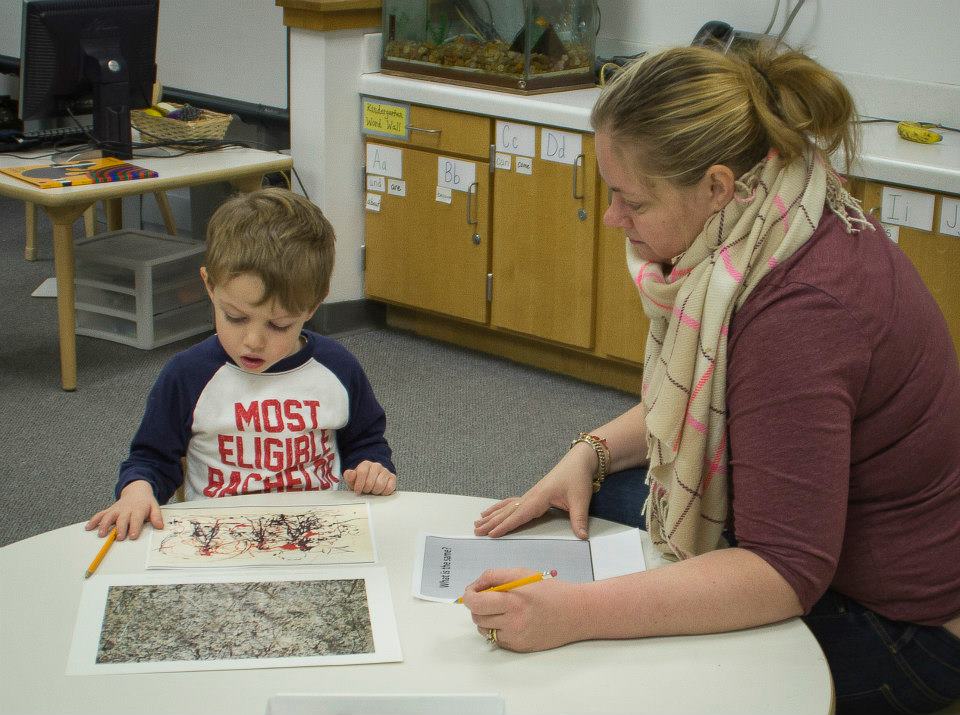
Comparing Jackson Pollock paintings
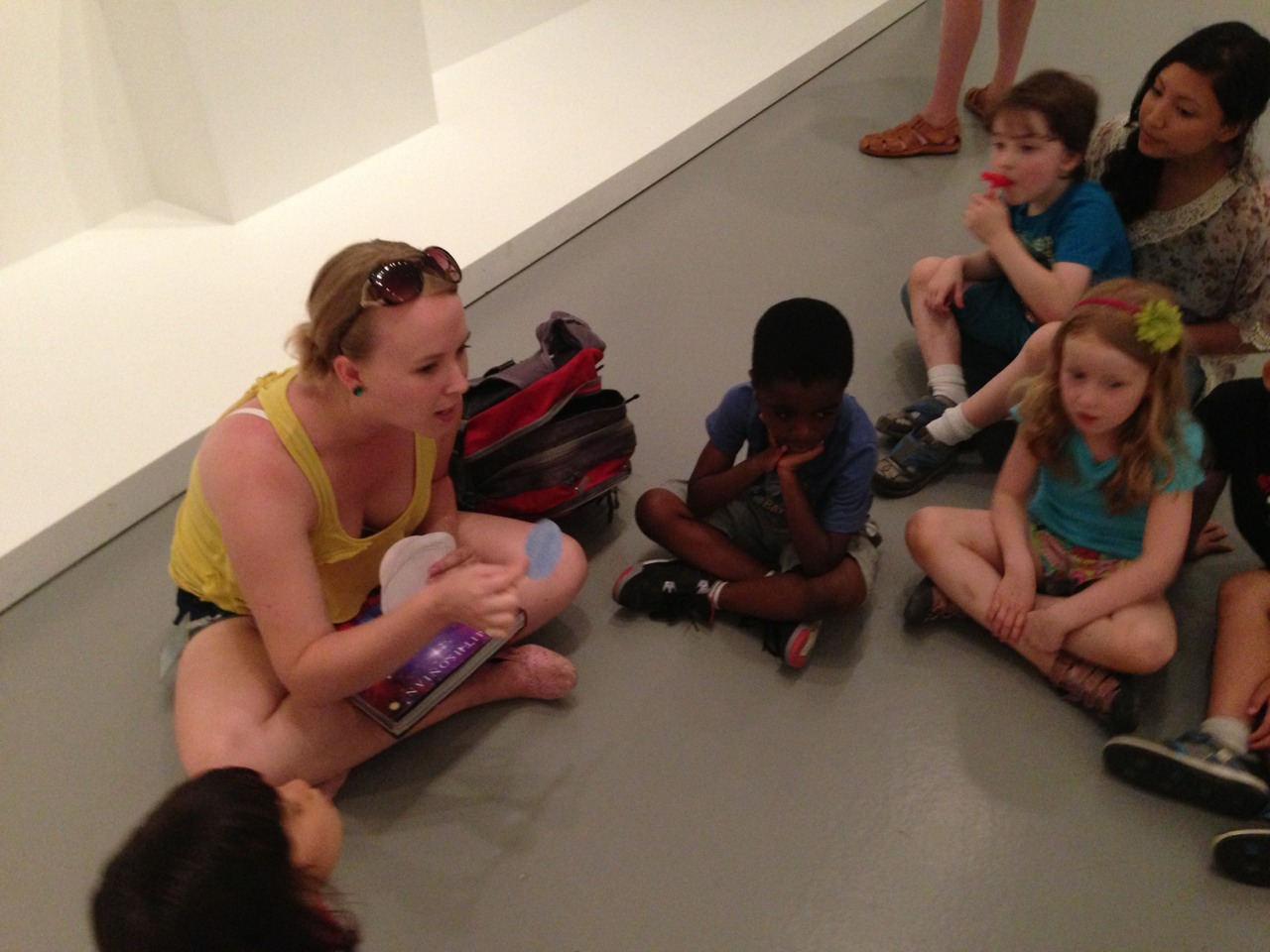
With Labor Day in our sights, I thought it was the perfect time to take a look ahead at what we are doing for our community families. Last year, we started offering preschool courses. These courses took place over a four-week period, meeting Saturday mornings. Each course had a theme (more information) and met for two hours. In the first portion of our morning, we would do some sort of introductory activity. This activity ranged from exploring a discovery box featuring cultural objects to comparing two paintings. Almost always these activities were meant to be done independently, meaning child and caretaker working together separate from the teacher. (These classes are very literally family classes, so caretakers play an important role). After our initial work, we would come together in a circle to discuss what they had done. Our discussion led us to an introduction to the museum visit.
Using hands-on objects to teach in the galleries
After bathroom breaks and the putting on of coats, we head to the museum for what is typically a 20-30 minute visit to one to two objects. During our visits, we use hands-on objects to engage the children in a multi-sensory experience and inquiry to guide the conversation. Museum educators are likely familiar with these approaches of object-based learning and the inquiry method. For educators who are unfamiliar with these approaches, let me suggest SEEC’s line of professional development seminars and/or MOMA’s inquiry course offered through Coursera (just completed it myself, very informative).
Freer Gallery of Art Shiva Nataraja, ca. 990 Chola Dynasty, India Bronze Purchase–Margaret and George Haldeman, and Museum funds F2003.2
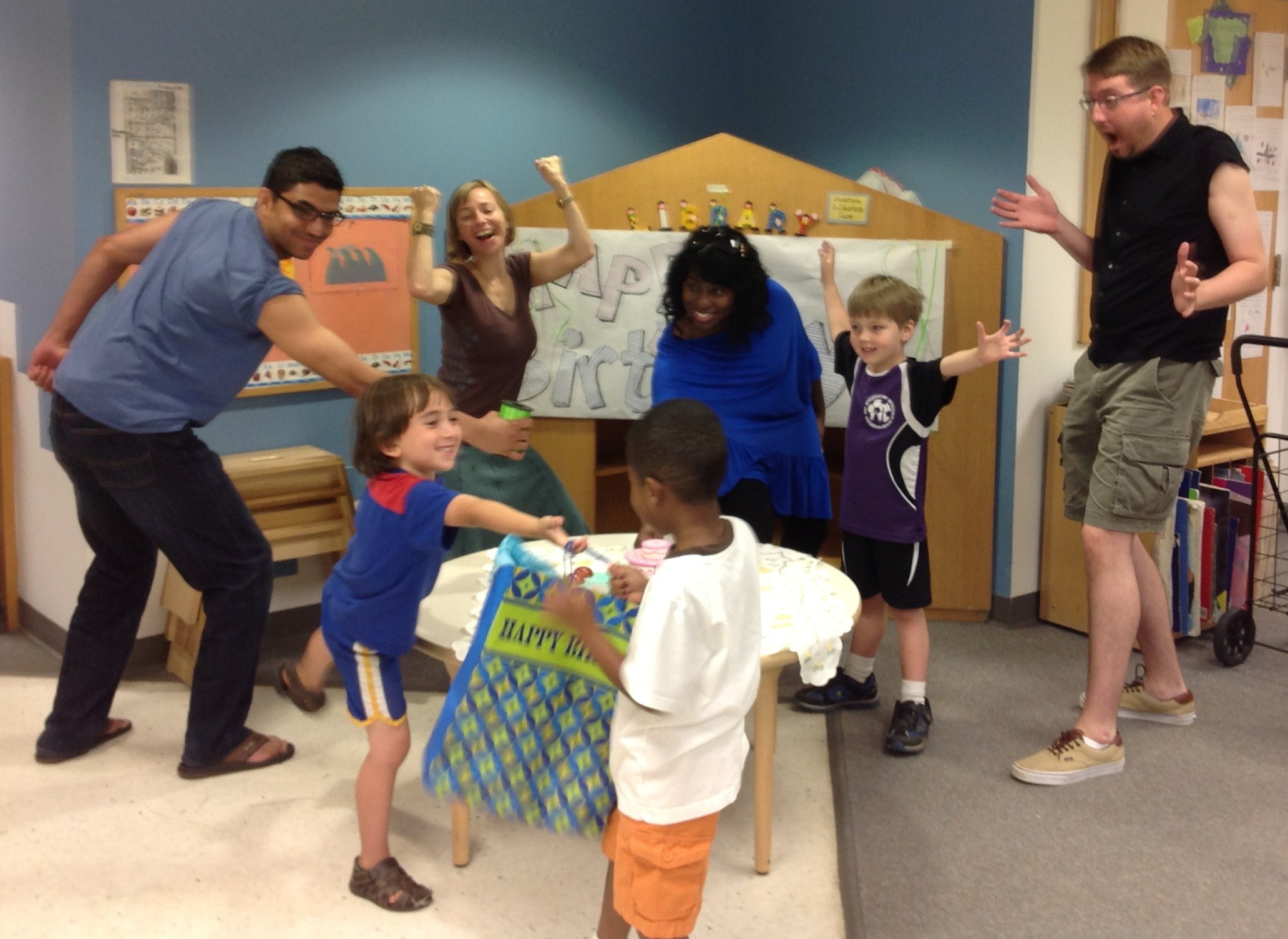
After our visit, we head back to the classroom where we wrap up with a final project.While it’s most often an art project, I do not limit myself to that platform. This is extremely helpful for two reasons; first, sometimes it is not developmentally appropriate for children to recreate the art they have just seen and second, sometimes it’s not culturally sensitive to recreate the art either. A good example of the first scenario is when I did a lesson on the Renaissance and I wanted to talk about composition. They were not up for the challenge of creating a masterpiece that depicted, balance, dynamism and fluidity. However, they could connect to these concepts by acting out their own birthday party photo and seeing the results. And when we do our class on Hinduism and visit the Freer’s Shiva Nataraja, we opt to look at videos of Bharatnatyam dance, do a sample of mudras and keep a beat with bells on our ankles. All activities are meant to build upon the concepts introduced through the lesson in a way that is interactive and self-directed.
This year we also offering infant and toddler class, so keep an eye out for future blogs about these audiences. In the meantime, let me know what is working for you with young audiences in your museum!









 As the last part of the object lesson, I laid out several objects and asked them to work together to recreate the painting. They needed no instruction, but went right to work, collaborating until the composition was complete. Was it exactly like the painting, no, but they had used these tools to create their OWN composition. They were quite proud and were completely engaged in the activity. I saw them looking back at the painting, rearranging objects and making their own decisions.
 To learn more about NAEYC’s Week of the Young Child™ visit
  Pools, beaches, lakes, sprinklers…it’s that time again! Children all over the US are enjoying summer-time to its fullest and likewise, parents are looking for water-inspired activities. Here in DC, we are lucky enough to have a number of public fountains that are both beautiful and refreshing. Fountains capture the imagination of children, so why not take this opportunity to create a learning experience?
 Infants



 seecstories.com