
 One of the first things we do with our young children is teach them the colors. As I sit and write this blog, I can hear families arriving for school and parents talking to their children about what they see in their environment and describing how they look – and most often I hear parents describing colors. Color helps us identify, sort, and can even elicit an emotional response. All too often though we, parents and educators, think of color in terms of art. No longer! The Smithsonian Libraries’ exhibit Color in a New Light will open up a whole new world and make you think about color in ways you haven’t before.
To put it in perspective, Sara Cardello, Education Specialist, at the Smithsonian Libraries has provided us with four fun STEM (science, technology, engineering, and math) facts about color that will get you excited to learn more about color with your little one.
Fun Color Facts
Science
Did you know that in 1666, Sir Isaac Newton, an English physicist and mathematician made an important observation? He noticed, when looking through a prism, clear light was not clear after all. In fact, it was made from seven different colors, which we now know as the rainbow. These colors cannot be seen by our eyes all the time, but science has proven that in the right settings we can see that our light is very colorful!

Newton Sir Isaac Newton experimenting with a prism. Engraving after a picture by J.A. Houston, ca. 1870. Courtesy of The Granger Collection, New York
Technology
Did you know that before the 1880s all colors were made from natural dyes? It was not until an accident in 1856 that we got our first synthetic way to make color. William Henry Perkins, an English chemist, was searching for a cure for malaria. While experimenting with coal-tar, he noticed an oily residue left a vibrant purple stain on some silk. While the cure for malaria was not found, a new process to create synthetic dye was discovered and changed the technology of color forever.
Engineering
Henry Ford is credited with creating the affordable and mass produced automobile in America. The Model T was originally sold in red, gray, green, and black. But as demand rose for the car, production was not able to keep up. From 1914 to 1926 Ford only offered the Model T in black, because it dried the quickest. It wasn’t until a more efficient assembly line was engineered by Ford that they could begin producing the car in various colors and keep up with the booming automobile industry.
Mathematics
Robert Ridgeway was the first curator of birds for the Smithsonian in 1880. One of the things he noticed were all of the different colors used to describe the animals, which made it confusing for scientists. In 1886 he created A Nomenclature of Colors for Naturalists which helped count, sort, and order all the different colors and name them, like Warbler Green. His work helped take the mathematical guess-work out of bird watching!
SEEC and the Smithsonian Libraries will host an open Color Studio on Saturday, July 16. Don’t let the name fool you though, our color activities will be STEM inspired. We plan to mix and create our own colors, make our own paint, make rainbows and make a color-inspired mural. Following your studio experience, families will be given a guide to the Color in a New Light exhibit.
Join us for our upcoming Artful Afternoon featuring Color.
 In the fall of 2015, the Friends of the National Zoo, National Museum of African American History and Culture, National Air and Space Museum, National Museum of American History, National Museum of Natural History, Smithsonian Associates’ Discovery Theater, and the Smithsonian Early Enrichment Center, together with the DC Promise Neighborhood Initiative (DCPNI) were awarded a two-year grant through Grow Up Great, PNC’s initiative focused on early childhood education, to launch Word Expeditions. The grant’s objective is to build vocabulary in preschool students from the Kenilworth-Parkside neighborhood in Northeast DC. DCPNI works exclusively with this neighborhood supporting all members of the Kenilworth-Parkside and describes its mission as “improving the quality of their own lives and inspiring positive change in their neighborhood.” The group has a strong foothold with families of young children and so it seemed natural to integrate Word Expeditions into their already existing Take and Play structure. Once a month, Smithsonian representatives visit Neval Thomas Elementary School during which time, families participate in activities that teach about the Institution’s collections, build vocabulary, and support a child’s development. The evening concludes with a meal and families take home a kit from DCPNI outlining fun and simple ways to incorporate learning and vocabulary skills at home.
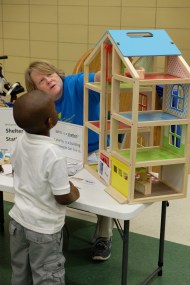 A few weeks later, families are invited to come to the museum that co-hosted the
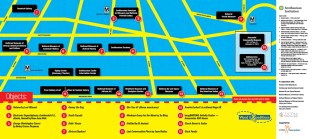 accompanied by what I like to call, conversation starters. These conversation starters include key vocabulary terms that help families define some big ideas they can use to discuss the object. They also pose open-ended questions and suggest easy ways to engage with the object and use the vocabulary in ways that will help children understand and recall the word’s meaning. For example, The Smithsonian Gardens description asks families to look closely at an elm tree and find its parts. The children will walk away with a concrete understanding of terms like roots, trunk and bark. The National Portrait Gallery’s entry asks families to imagine what they would see, hear and taste if they jumped into the portrait of George Washington Carver and suggest that parents use the term five senses and, of course, portrait.
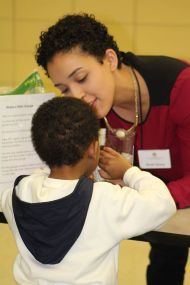 I find that dinner time at the Take and Play program provides the perfect opportunity for me to get to know families on a deeper level as I talk with them about the maps and their museum visits. Recently, I engaged in a conversation with two families who have become “regulars” at the workshops and museum visits. When I asked what museums the families had visited lately, the mothers immediately began to list all of the museum trips they had been on since the program’s inception in the fall and what’s more, they described their visits in detail – recalling the vocabulary that was introduced and the activities in which they participated. It was exciting to see their enthusiasm for the program and it was clear that the map had helped foster and grow their interest in museums.

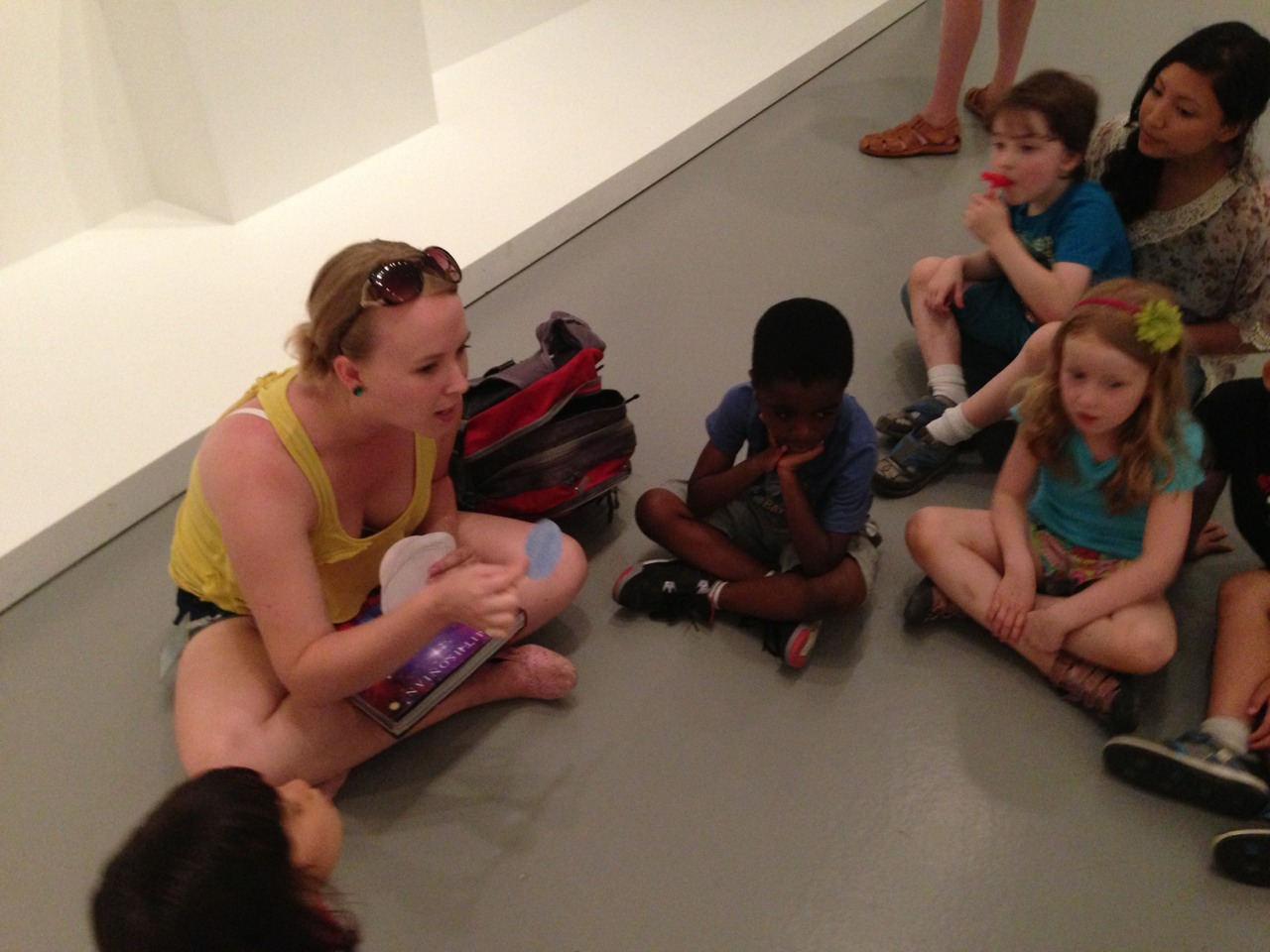
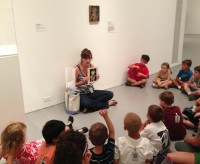
 As the last part of the object lesson, I laid out several objects and asked them to work together to recreate the painting. They needed no instruction, but went right to work, collaborating until the composition was complete. Was it exactly like the painting, no, but they had used these tools to create their OWN composition. They were quite proud and were completely engaged in the activity. I saw them looking back at the painting, rearranging objects and making their own decisions.








 seecstories.com