
Object-based Learning
Museum educators have been practicing object-based learning (OBL) for years. It has been written about and discussed extensively. This blog isn’t so much meant to expand on that literature as it is meant to explore how OBL is used within the SEEC model.
First, let’s define SEEC’s learning environment. We are so much more than a daycare. We consider ourselves a school whose approach is defined by high quality early childhood practice. Our curriculum is emergent, and we use the community – not just museums – as part of the learning experience. Moreover, our Office of Engagement focuses on family learning via both long-term and stand-alone programs.
Definition
How does SEEC define OBL? At the center of our definition is, of course, the objects on display at the Smithsonian. All of our classes, even the infants, visit the museums regularly. While the experience will look different for each age group, all children benefit from being in front of an object. There could be an entire blog on this topic, but we recognize the importance of seeing the real thing – the awe and wonder it inspires. For children under two, who can not necessarily grasp the significance of these objects, the value often resides in their exposure to new spaces, things, and environments.
Tactile

Because our children are young, we add an additional layer to the OBL experience – the tactile component. Children are concrete learners who explore using their senses and therefore, employing objects that can be handled or physically experienced adds to their learning. This can be a toy, like the boat pictured here, or it could be an element that somehow better describes an object. For example, manipulating a ballet shoe while looking at one of Degas’ dancers.
Sensorial

At SEEC, we expand upon this idea to curate a sensorial experience by adding components like feeling the wind while looking at this painting at the National Gallery of Art by Winslow Homer. The moving air, though not a physical object, certainly takes on that role with the learner. What’s important for the young learner is that they get to observe the wind portrayed in an actual object, like a painting, and feel the air moving on their faces. These experiences enhance their understanding.
Experiment

Likewise, the “object” can also be defined as an experiment. Imagine that a class visits the transportation hall at the American History Museum or observes vehicles moving on a street. The group could experiment with wheel shapes. A teacher constructs a car out of cardboard and uses a simple ramp to demonstrate how the car moves with wheels that are square, circular and triangular. Students quickly see the benefits of having a circular wheel and begin to recognize differences in shapes and how they connect to things in their everyday life.
Nature

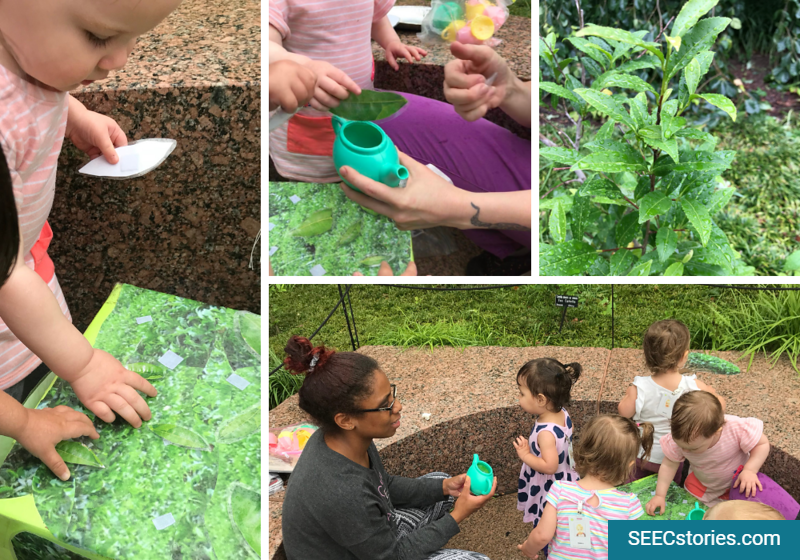
For educators working in or using informal learning environments, object-based learning should be considered through a wider lens – one that helps young children to experience and explore via multiple modes. Finally, OBL also corresponds to nature-based learning. Just this week I observed how a lesson on nests with toddlers incorporated both museum objects and nature. The lesson started out by looking at nests sculptures displayed outside the Natural History Museum and concluded with the children making their own nests by collecting twigs, grass, and leaves. To add an additional layer and to help the children better interact with the animals, the children helped throw birdseed and watched as the birds came to eat.
To learn more join us for our Learning Through Objects seminar on March 13th and 14th.




 students bring in a photo of their moms/caretakers and adhered it to the shape of a person. The children were invited to “dress” the body by coloring in clothes. When they were finished, she attached it to a heart, which was then glued on top of a cut-out pocket shape. Finally, she attached yarn to the pocket so the children could wear their “caretaker pockets” like a necklace.


 interaction during the museum visit. Often we ask parents to lead simple activities in the galleries that are open-ended and encourage observation and conversation. For example, we might ask infant/toddler parents to find all the boats in a gallery space or simply describe an object. If it seems odd to talk about having conversations with your little one, remember recent research is making direct correlations between how much a parent talks to their child and their literacy.
 Preschooler families might be asked to create a story or make a list of questions they have about an object. In both of these scenarios, we are encouraging independent thinking, literacy and providing time for you and your child to learn together. It is also giving the parent practice having open-ended conversations and ideas of how to use museums when there is not an educator around.
 seecstories.com