Beyond Stereotypes: Teaching about Native Peoples in Practice

We take a look back at a blog that we published three years ago around Thanksgiving, hoping it will help educators think about ways they might consider talking about other cultures all year around.


As we discussed in our previous blog, the National Museum of the American Indian (NMAI) and the Smithsonian Early Enrichment Center have teamed up to provide teachers with a framework for exploring culturally diverse topics in their classrooms. We believe that early childhood educators are in a unique position to craft experiences for young children that will help them appreciate the diverse world around them. We also feel that it is important for children to see themselves reflected in their classroom in order to develop a positive sense of self.

Though we published the first blog just before the Thanksgiving holiday, we specifically wanted to post the follow-up afterwards as a reminder that teachers can explore American Indian culture throughout the school year.

Before we look at the lesson, it is important to note that I had only a week to implement it and I struggled with how to use the limited time frame best with the students. Ultimately, I decided that it was important to begin the lesson with what was familiar to the students and build on that.  Had I had the opportunity to continue the lesson, I would have most certainly spent more time exploring Wampanoag culture and ensuring that the children were introduced to the Wampanoags in a contemporary context.

Lesson Objectives

  • observe natural materials and weather in our own environment and how these elements vary in other environments
  • demonstrate that not all homes look the same, but all homes do have the job of protecting us.
  • introducing three different types of American Indian homes and explore the natural materials out of which they are made.
  • investigate the materials used to construct wetus and how those materials serve as protection against their environment

Day 1

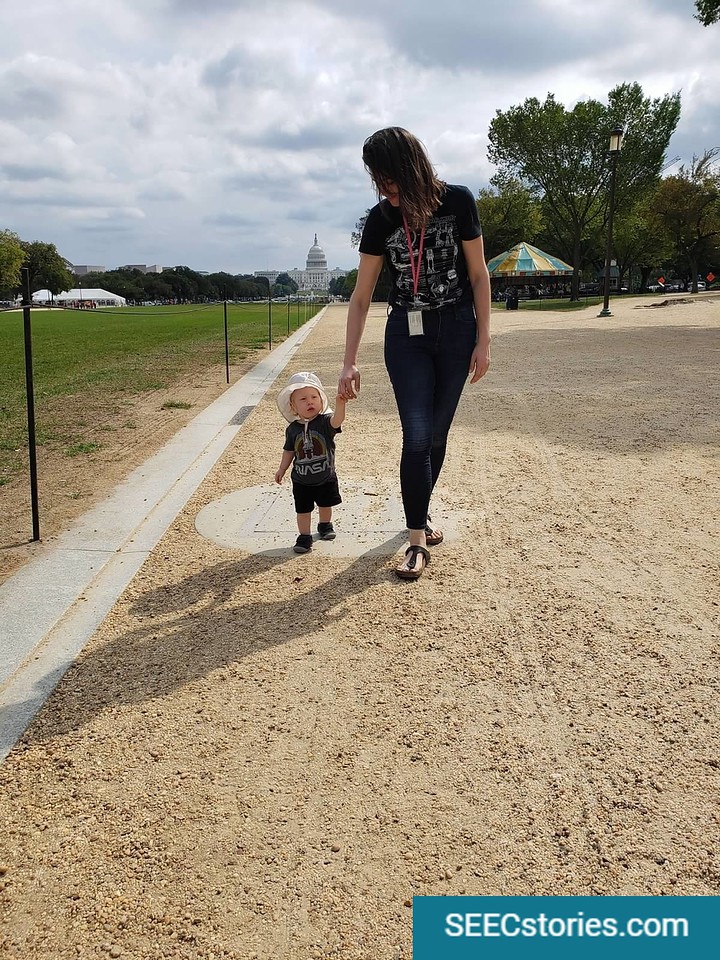
We began our morning with a visit to the National Mall where we used our senses to explore what was part of our environment. I wrote down the children’s responses and then we headed to the National Gallery of Art where we sat in front of Albert Bierstadt’s Mount Corcoran. Together, we recreated the landscape with representative objects and worked as a group to create a “soundscape.” To create the soundscape, we identified a sound for each element of the landscape. Once complete, we assigned a sound to small groups and then produced our soundscape all-together.

Day 2

When we were on the Mall, I observed the children were noticing elements of their environment that were man-made, so I thought it was important to use day two’s lesson to distinguish between the natural environment and human-made environment. This discussion transitioned nicely into a conversation about weather, which was another natural component of our environment. We identified different types of weather by making a list and then creating our own weather movements. We watched a weather report and read Sky Tree by Thomas Locker. While we read the book, we paused to use our weather movements when they were mentioned.

Day 3

Before heading out for the morning, we reviewed the different types of weather and discussed the weather that day. We walked to the National Gallery of Art’s Sculpture Garden to visit Roy Lichtenstein’s House I. We spent a few minutes walking around the house and then I asked the students to share what they noticed. Following their observations, I asked them if they thought that the house was a good one. There was a consensus that it would not be a good house to live in because it wasn’t real – it was open on the backside. I agreed that I didn’t think the house was doing what a house or home needed to do. I asked them what homes were for, to which I heard responses like: “to play in, eat in, sleep in.” I agreed and pulled out a blanket – I said the blanket was a lot like a home – it could keep me warm when it was cold, it would keep me dry if it rained. I concluded that both the blanket and the home could protect me from things in my environment.

I asked the group whether they thought that everyone lived in the same type of home. We had a short discussion about what our homes were like, the other educators with us shared that they lived in an apartment. We then began to make a home collage. Students shared photos of their homes and we placed them on large sized paper. I also brought photos of homes from around the world and as we placed them on our collage. When we finished, we discussed the similarities and differences.

Day 4

I began this class by asking the students about the Thanksgiving holiday that was coming up. Each child excitedly shared what they were planning to do for the holiday. I shared was formed around the idea that two groups of people came together to have a meal.   One group had come to America from a place called Europe and another had lived on the land we call America for a very long time. I explained that these people who had been living here for a long time were often referred to as American Indians and that in fact, there are many groups of American Indians. I shared a map and said that each group has their own language, clothing, traditions, and of, course, homes. I also pulled out our sensory bins that were representative of a Eastern coastal environment, a desert environment, and an Arctic environment.  We looked at the bins and discussed their physical features and imagined what the weather would feel like.  We wondered together whether the homes in these environments would be the same or different.

We then walked to the ImagiNATIONS Activity Center at NMAI and invited them to play in the Native homes area.  When we sat down, I asked them what they noticed about the different homes. After sharing their own observations, we talked about how each of these homes came from a different type of environment – a lot like our sensory bins. I brought objects that demonstrated the connection between these homes and their environment. For the iglu, I had a simple bottle of water; for the tipi, I had a photo of a buffalo, and for the adobe house, I had some mud and straw. I shared my objects with each student in the circle and left them with the reminder that Native peoples live in many places throughout the country and their homes tell us a lot about their environment.

Day 5

On our last day together,  I reminded them about that Thanksgiving meal. I said that many people assume that the American Indians who ate with the Europeans during that meal lived in tipis. We paused to recall the tipi we had seen the day before and then I shared with them that the Native peoples who were at the meal so long ago actually lived in wetus and they are called Wampanoags.  Using 1621: A New Look at Thanksgiving by Catherine O’Neill Grace, we explored some of the photos of what life for the Wampanoags looked a long time ago. I was careful to note that the photographs were of people pretending to be from a long time. They were helping teach people today about what life was like in the past.

We proceeded to watch parts of this video. We looked at the materials of the winter and summer wetu. We decided that all of the materials were from nature and we took a closer look at cattail reed mat provided by NMAI that would have covered the roof of the summer wetu. We talked about how the rain water would slide off the reeds and keep the house dry. We also blew through the mat so we could feel the way the breeze could come through and help keep the space cool.

We ended our morning by taking a nature walk and collecting materials. We broke out into smaller groups and built houses out of our materials.

In addition to the lessons, the teachers planned the following learning centers for the children to interact with during free-time.

  • Dramatic Play – Kitchen, office, or playing house
  • Fine motor – blocks or other loose parts for building (include photos of different types of houses from all over the world)
  • Environment – This sensory station recreates three different types of environment
    • North Eastern – Wampanoag – inland/coastal environment with forest, ponds, grass, sand, and water
    • Choose two others.
  • Dramatic Play – weatherman
  • Puzzles and Maps – United States

By no means is the lesson an all-encompassing study of Native Peoples or the Wampanoags, but it is a realistic snapshot of how with a little planning we, as educators, can begin to develop lessons that share more accurate information that help our students see that the world from multiple perspectives. Let us know what you are doing in your classroom to help combat stereotypes and create an inclusive environment.

My Child is Throwing an Epic Temper Tantrum…Now What?

We’ve all been there. You’re out with your child at the _____(grocery store, restaurant, library, etc.) and your child melts into a ______(screaming, yelling, crying, etc.) puddle on the floor.  Over time, SEEC faculty has developed tips and tricks for dealing with the tantrum.

Teacher reading a story to a child sitting on another teachers lap

Stop and Drop

Unless the child is in the middle of the street or in immediate danger, we don’t try and push forward with the activity. Stop what you are doing and drop to their level so that you are face to face. This helps the conversation feel more personal and meets children  on their level.

Stay Calm

It’s easy to get flustered and frustrated when a child is upset and acting out. However, it’s often more effective to remain calm and level headed. Not only is it better for you, but you are modeling the behavior you want to see from the child. We speak slowly in a soft voice, using vocabulary that is age-appropriate and clear. What we say to a toddler might be different than a preschooler.  During a tantrum, children’s brains are on over drive, so it’s important to make it easier for them to understand our words. Also, we suggest to children that they take a minute to calm themselves, so that we can better understand their words.  Self-soothing is an important skill to learn and we want to give them time and space to figure that out if possible. Since children are unpredictable, it often helps to add extra time to your routine – you will both have a better day if you have time to calm down.

Acknowledge their Feelings

Adults don’t much care for it when they are upset and someone responds to them, “You’re ok!” or “Stop being upset!”? The same is true for children.  It’s important to verbally acknowledge when a child is upset. Saying things like “I can see that made you very angry.” or “I know you are upset about…” will help children feel like they are being heard. It may seem little from an adult perspective, but its not for them, When we stop and listen, we are demonstrating behavior that will help them develop into adults who can deal in healthy ways with their emotions.

Pre-Verbal or Limited Language

Young children especially may throw a tantrum because they don’t have the verbal skills yet to communicate effectively. If we saw what they were doing before the meltdown, we start by narrating the preceding events. For example, “I saw you were playing with the toy and a friend took it from you. Is that what is upsetting you?” or “I watched you crawl over there and reach for a book, would you like help getting it.”

Negotiable V. Non-Negotiable

Once you’ve identified and acknowledged a child’s feelings, you still have to grapple with the tantrum trigger. In some situations, it may not be what they want but the way they went about getting your attention that was the problem. In such situations, after the child has calmed down, ask them to re-frame the request. “Can you ask me in a calm way if we can stay and play a little longer.”

Natural consequences can also be easier and more effective than having a power struggle over the tantrum. A child may not want to wear a coat on a chilly day or may insist on wearing a heavy coat in the middle of summer. Children will  learn that both scenarios will result in their own discomfort. A smart parenting move is to take the weather appropriate clothing with you, so that another tantrum doesn’t result from that discomfort.

Other times, you may want to offer a child a reasonable choice: “you can’t wear sandals when its snowing, but you can choose between two shoes that you, the adult, deems appropriate for a snowstorm. Again, caregivers should encourage children to use calm and respectful language when making requests.

There will also be times when you simply are not going to give a child their way. Think about crossing the street. A child may refuse to hold your hand and begin to have a tantrum. We’ve all been there, you have 30 seconds to cross and are already running late for work.  Your response can be non-negotiable – crossing streets is a safety issue and you need to stick to a schedule. Its ok to let a child be upset. You can give them the choice of holding hands or being picked up, but let them know that safety is first. Its awful to hear a child screaming, but using a calm voice and acknowledging their feelings is sometimes all that you can do. Remember, children also need to learn to cope with disappointment and frustration and a situation like this, is part of their learning journey.

At the end of the day these tantrums are a normal part of a child’s development. Although challenging, try not to feel like other’s are judging you. Chances are they have been through a similar experience with a child at some point. You are an expert on your child and ultimately know their personality better than a stranger does.

Keep an eye out for another upcoming blog on calming strategies or take a look back at 10 Tips and Tricks to help you both make it through the challenging moments.

Have something that works well for you and your family? If so, PLEASE share below. We are always grateful to be able to learn from each other!

Teacher Feature: Infant Class Explores Farm to Table

“Teacher Feature: Infant Class Explores Farm to Table” was originally published on January 4, 2018. We are posting it again to help people embrace teaching farm to table units.

This week’s teacher feature highlights one of our infant classes. The teachers in the class, Mallory Messersmith, Morgan Powell, and Rosalie Reyes, were inspired by National Farm to School Month to lead their class on a month-long exploration of food and community. For this outing, the class went to the United States Department of Agriculture Farmers Market to learn about locally sourced fruits and vegetables. Below you will find images from the lesson and reflections from Mallory, Morgan, and Rosalie.

Teacher holding a child while looking at tomatoes

 Preparation:

Image on the left is a child in a stroller reaching for an apple
Image on the right is teachers pointing at a sign about vegetables
The preparation for this outing began well before the day of the visit. The class had spent several weeks exploring local produce before venturing out to the USDA. The teachers, Mallory, Morgan, and Rosalie, educated themselves about National Farm to School Month and did some research of their own.

Rosalie first learned of the National Farm to School Network while attending DC Teacher’s Night: Connecting Teachers with Environmental Education at the United States Botanic Garden. This nation-wide initiative is meant to promote connections between communities and fresh, healthy foods by focusing on educational activities related to agriculture, food, health, and nutrition. After attending the teacher’s night, Rosalie joined the National Farm to School Network and was excited to see resources for early childhood education.

Mallory, Morgan, and Rosalie were then inspired to create a unit around the idea of farm to school because of the many diverse areas of exploration that the study of fruits and vegetables offered their class, including colors, shapes, and textures. Additionally, they noticed that many of their students were starting to eat new solid foods. They sought to align their lessons in the classroom with the developmental milestones the children were experiencing regarding eating new foods.

Variety of pictures of children playing with stamps
The teachers transformed their classroom for this unit. They carefully thought about how to organize the room to best fit the needs of their students and were excited to create experiences that were conducive for learning.

To begin preparing for their unit, Morgan, Mallory, and Rosalie chose a collection of art prints and  created their own works of art to post throughout their classroom. They paid special consideration to their students’ cubbies where they posted images of fruits and vegetables. Mallory even crocheted fruits and vegetables to add to the classroom. Since many children in their class were actively learning to crawl, the teachers taped images to ground for their class to explore while on the move. They also researched and chose children’s books to add to their classroom collection and brainstormed which produce to highlight with the class.

Variety of pictures of children exploring different fruits and vegetables
The children also took part in the preparations for the outing well before the actual day. As a class they explored fresh fruits and vegetables. They often started with the whole produce and then began cutting and breaking them apart to see what was inside. The process of exploring the fruits and vegetables quickly became a sensory experience for the infants as they touched, smelled, heard, and even tasted the various produce.

The class explored most of the produce using sight, touch, smell, and sound. The children were able to use their sense of taste when interacting with the avocados and strawberries for a more immersive experience. For both strawberries and avocados, the children looked at and touched images of the produce. They then compared the images to the real produce before and after it was cut up. Mallory, Morgan, and Rosalie believed that it was important for the children to be able to make connections between the whole product, which the children do not always see, and the cut up portions that the children regularly eat at snack time. To finish the experience, the class had the opportunity to sample! The strawberries were a big hit, but many students were a little more cautious about the avocado. This immersive, multisensory experience left the children with a greater understanding of the food that they eat.

The teachers also combined this multisensory teaching approach with thinking routines including See, Think, Wonder to encourage curiosity and new understandings. Since many of their infants were preverbal, Mallory, Morgan, and Rosalie would verbalize out loud the different things that they saw, thought, and wondered while the children in their class were exploring the various fruits and vegetables. The teachers were careful to keep in mind that this might be the first time that their class had been exposed to many of the images and objects and allowed time for the infants to experience and make discoveries. One particularly fun lesson that built upon the multisensory and thinking routine approaches, was when the infants were exploring the red cabbage. As the children were bending, breaking, smelling, and feeling the texture of the cabbage, Morgan began to read Eating the Alphabet by Lois Ehlert. As she read, she asked questions about the colors, textures, and sounds that the class heard when they were peeling the leaves of the cabbage.

Lesson Implementation:

Children in a stroller looking at several baskets of apples
The USDA holds a Farmers Market on Fridays throughout the spring, summer, and early fall. SEEC classes regularly visit to see the produce, buy snacks, and enjoy sitting on the grassy lawn.

Mallory, Morgan and Rosalie chose to visit the USDA’s farmers market in part because of its accessibility, since it is just off the National Mall and not far from their classroom. They also wanted to embrace the community aspects of the visit, as the farmers market is a great place for people to gather. This community space has picnic blankets and open space for people (including this class) to sit, gather, and reflect on the experience of being at the farmers market. It was a perfect fit for this lesson because it encouraged the children to make connections between the familiar foods that the class eats every day and the less familiar, whole, unprocessed, muddy foods that they saw at the market. Mallory, Morgan, and Rosalie brought objects with them to enhance this community visit, including soft and hard toy fruits and vegetables and a board book to read to the group.

Teacher smiling at a child while on a plot of farm land
As the class approached the farmers market, they paused at the People’s Garden. This small urban garden in the heart of Washington, DC expanded the children’s experiences in and understanding of the city that they live in.

 At SEEC, teachers regularly take their classes on museum visits where they connect ideas that they are learning about in the classroom with museum objects. They often extend their lessons beyond the museum doors while still using the same techniques that they used on the community visits.

When asked to explain why it is important to take infants on community and museum visits, Mallory, Morgan, and Rosalie cited this quotation:

 “Our connections to the people, animals, and plants around us make us who we are. Humans are not a solitary species; we need one another to survive. In the same way that children need opportunities to get to know the natural world so that they can develop a strong relationship with it, they need that same opportunity to connect with the human and human-made community that they are a part of. When children develop a strong relationship with their community at an early age, they grow up knowing and feeling a strong sense of belonging.”

Source: https://shelburnefarms.org/sites/default/files/cultivatingjoywonder_all_smaller.pdf

Variety of pictures of children exploring soil on a farm
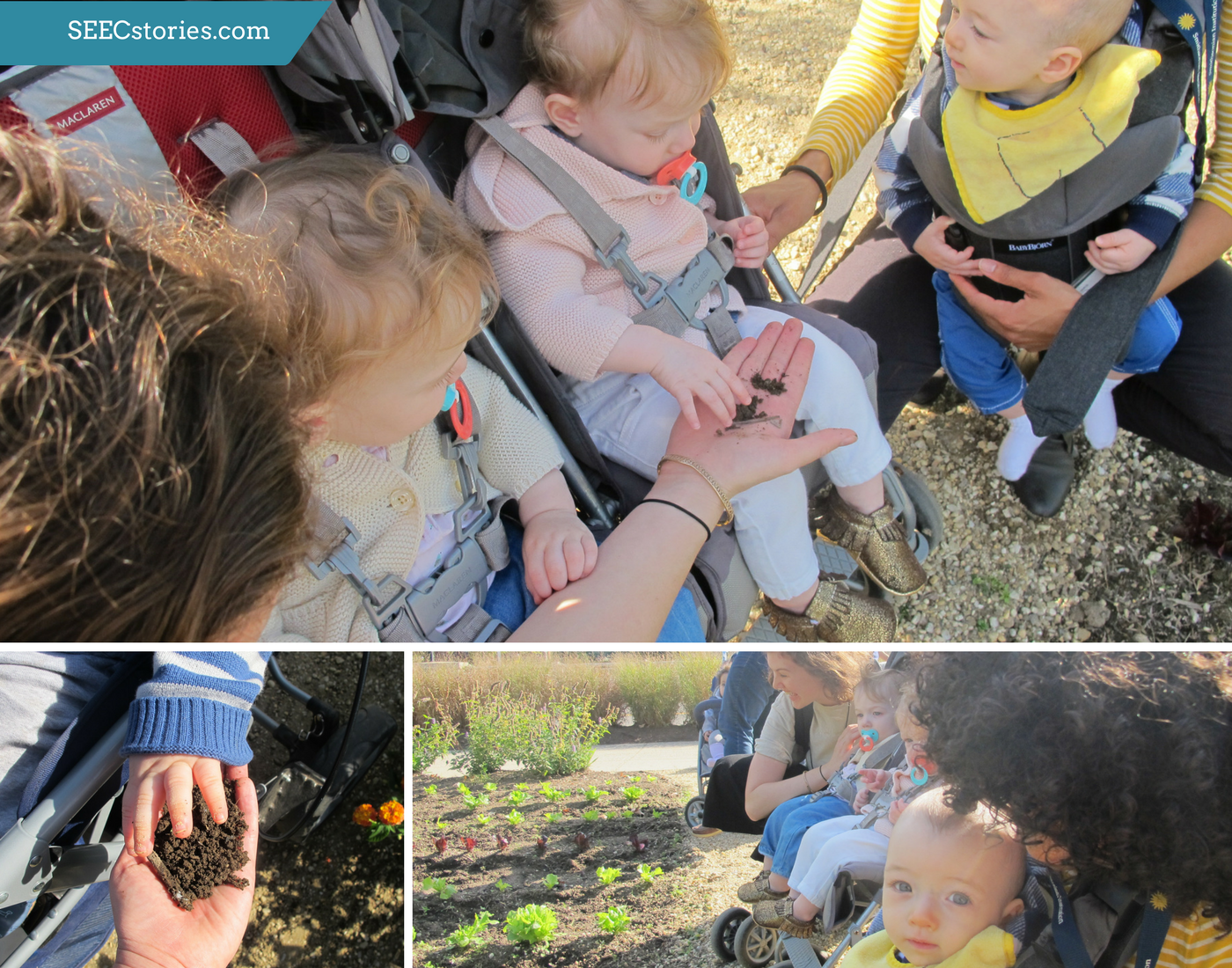
Mallory, Morgan, and Rosalie encouraged their class to touch and explore the dirt when they noticed that their class was interested in it. Some teachers and caregivers might be hesitant to encourage their young children to play in dirt, but at SEEC we believe it is a vital part of learning.

While strolling through the People’s Garden, the class paused for a moment and reached to grab handfuls of soil. This part of the lesson was actually completely spontaneous! The teachers noticed students pointing towards the ground and saw it as an opportunity to follow their curiosity and facilitate hands-on learning. Through these early experiences with soil, children learn that soil is a living system full of healthy and fascinating relationships. The educators were also able to connect back to soil later during the visit by pointing out dirt on some of the produce the children were examining at the Farmers Market.

Children exploring a squash
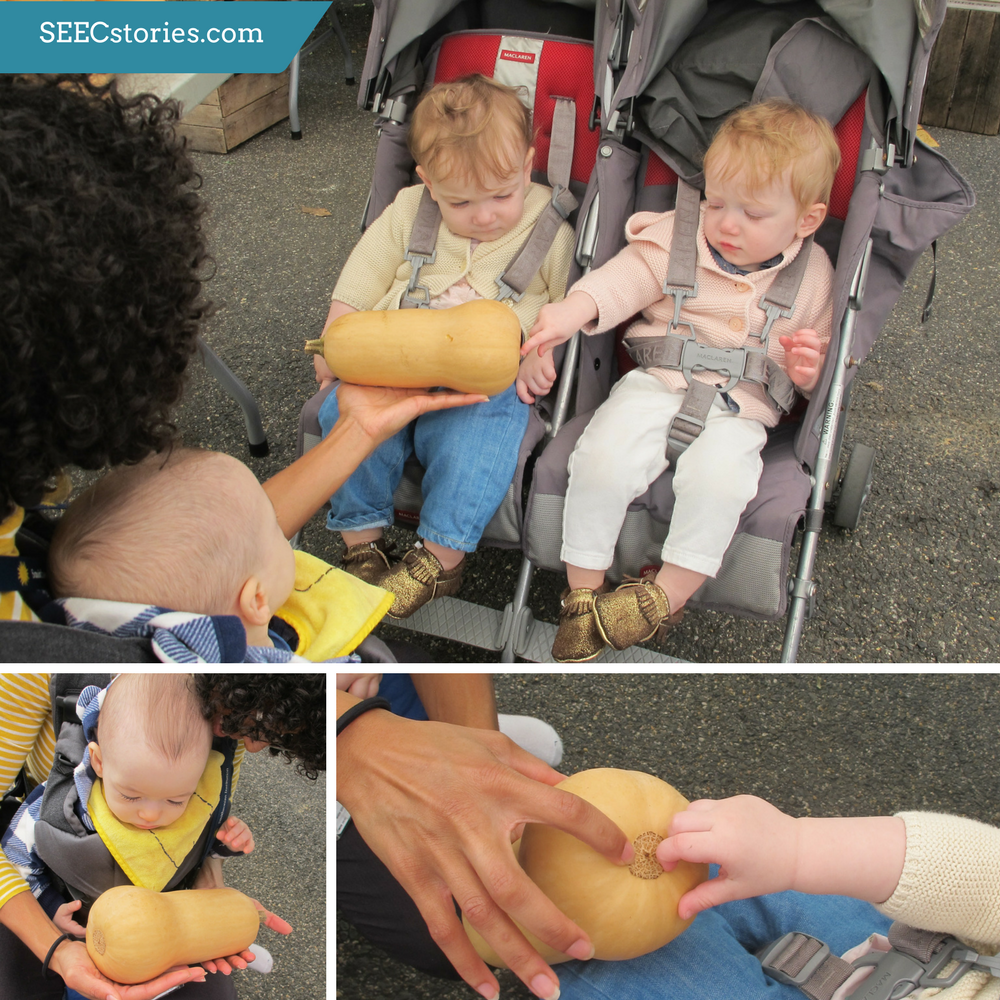
As the class passed through the booths at the farmers market, they paused to examine some produce like this butternut squash.

While exploring the butternut squash, the children not only touched the smooth sides, but also noticed how the textures of the squash changed as Rosalie rotated it. When she turned the squash on its side, the children immediately reached out to touch the small, dry area of the squash. Even though the children could not talk yet, the teachers, Mallory, Morgan, and Rosalie, were able to follow each child’s nonverbal cues. The teachers paid special attention to the things the children were pointing to, the changes in their facial expressions, and their use of sign language. In fact, throughout the lesson the children regularly signed “more” as they moved from one booth to another, signaling that they wanted to explore different types of produce. When the children signed “more”, it helped Mallory, Morgan, and Rosalie know that the children were enjoying their visit and wanted to continue.

Children in a stroller, with a teacher showing them a tomato
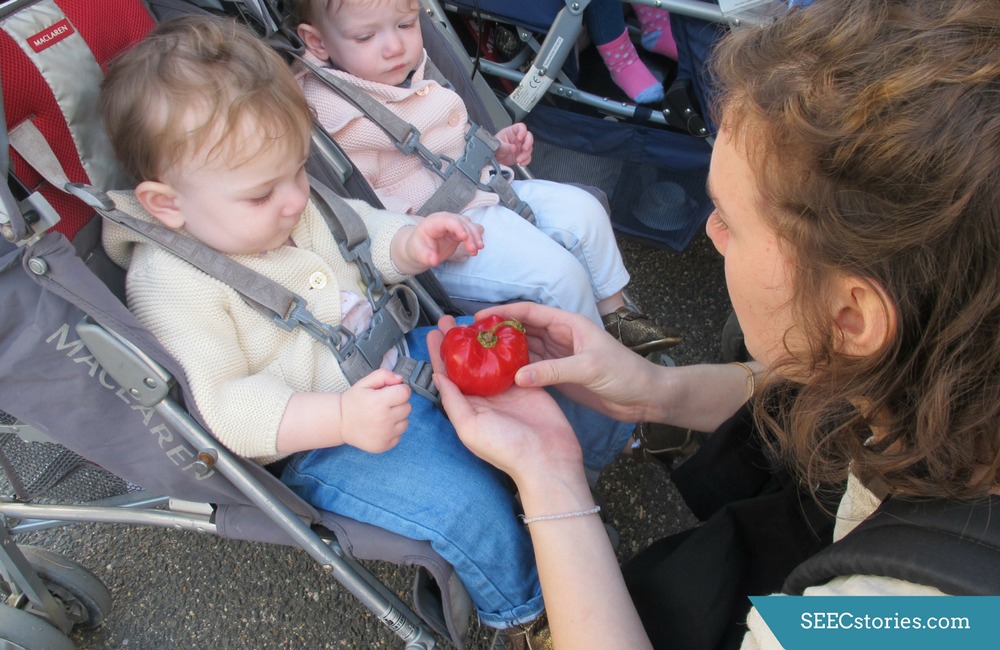
As they walked, the class continued their sensory exploration by touching smooth red peppers, bumps on an acorn squash, and the rough stems of a pumpkin. Both students and teachers seemed to believe that their trip to the USDA’s Farmers Market was a huge success.

Mallory, Morgan, and Rosalie were so excited to take their class to the farmers market because this was their first trip outside as a group! The teachers had spent the month hoping that they could visit the farmers market for this unit and on the last Friday of the month they were able to make it work! Even the journey to the Market was exciting for the students; they experienced the sights and sounds of a beautiful autumn day outside in Washington, DC. The class noticed squirrels, fall foliage, and insects on the trip across the National Mall. Once the class arrived at the market, Mallory, Morgan, and Rosalie were happy to see their students so engaged with a variety of produce. They also embraced the unplanned moments, including feeling the dirt and meeting a big, fluffy dog which made their outing extra special.

Children sitting on a picnic blanket being read a story by their teacher
The class gathered on a blanket to play with toys from the classroom and explore produce that they had bought from the farmers market. A major component of this time was Mallory, Morgan, and Rosalie singing various songs.

After the visit to the vendors at the market, the class gathered on the grass near the market. As part of the Friday Farmers market, the grassy area has lawn games set up as well as communal picnic blankets, which the class used for their outdoor story time. The teachers made sure that each child was engaged by offering them toys from the classroom and produce that they had recently purchased from the market.

Once everyone was settled in, the class looked at some pages in a book and sang a variety of songs. They sang a variety of autumnal songs that the music teacher, Ms. Allison, had introduced to the class during October. One song was about a pumpkin, big and round; another song was about autumn leaves falling down. They sang the pumpkin song as the children touched the pumpkin. As children began venturing off their blanket and started to explore the leaves they found on the ground, Mallory, Morgan, and Rosalie sang the autumn leaves song. It was clear that the children enjoyed the songs as they rocked their bodies to the beat and even clapped along.

Reflection:

A child sitting on a picnic blanket holding a pumpkin
While the group was engaged singing and looking at books, Mallory, Morgan, and Rosalie encouraged individual exploration. This child discovered that he could lift the pumpkin by its stem as the class sang the song “Orange Pumpkin – Big and Round”.

Since their class is composed of young children, much of the beginning of the year is focused on learning and supporting each individual child’s feeding and resting schedule. This complicates finding time to go on outings. However, when the opportunity arises to go on a trip, Mallory, Morgan, and Rosalie, jump on it, as they know the benefits of getting their class out of the classroom for experiential learning.

When thinking about what the class could have done differently, Mallory, Morgan, and Rosalie thought it would have been nice to bring food for their class to eat while on the picnic blankets. They explained that bringing food to taste would have enhanced their class’ experience beyond seeing and feeling by adding the sense of taste.

After the visit, the class continued to build upon what they had experienced that day. The children decorated canvas bags which would be perfect to take to the Farmers Market for shopping. To decorate, the children mixed and splattered paint with their hands, feet, and brushes. At the end of October, the bags were sent home with a small gourd inside. It was a great way to finish off the month!

Teacher Feature: Kindergarten Class Explores Paleontology

Today we’re featuring kindergarten teachers Cathryn Prudencio and Sharon Jensen. The class has been exploring dinosaurs, and I joined them for a lesson at the National Museum of Natural History that answered the question, “How do dinosaurs get to the museum?”  Below you will find images from the lesson, as well as reflections from Cathryn and Sharon. 

Children gathered around a box filled with dirt and toy dinosaurs

When the kindergarten class needs to pick a new topic to study, the children always start out by answering the question “What would you like to learn about?” in their journals. Then the students draw what they are interested in. We also explore different ideas for topics throughout the year, and when it’s time for a new topic we brainstorm ideas as a group. We vote to narrow the choices down to the top three or four, and then vote again for our final topic. This way we make sure that the students are truly involved in choosing what they will be learning about, and they are satisfied that it was a decision made fairly. This is how we ended up doing a unit on dinosaurs as our last unit before the kindergartners graduated.

Children looking at pictures of paleontologists
The class went to The Last American Dinosaurs exhibit; a temporary exhibit while the new Hall of Fossils: Deep Time was being renovated. The group’s first stop was at a wall of photographs from a 2013 trip to North Dakota made by a team of paleontologists from the museum. They stopped and carefully looked at the photographs, making observations about what the paleontologists were wearing and why. Some of their observations included: hats to keep them cool, pants to protect their legs from sun burn and the risk of getting cut from sharp tools, and gloves to both protect their hands and protect the fossils from the oils on their hands.

The objective of this lesson was to deepen the understanding of what a paleontologist does on a dig, and what tools and procedures are used. We used the pictures hanging up in the exhibit to support what we were talking about, and to help the children think about what was needed for the dig. We also used the objects on display to talk about the materials needed and how they were used, supporting this with objects passed around for the children to see and hold. Doing this, we not only reinforced information from a previous lesson, but we also prepared the children for their own miniature dig in the museum.

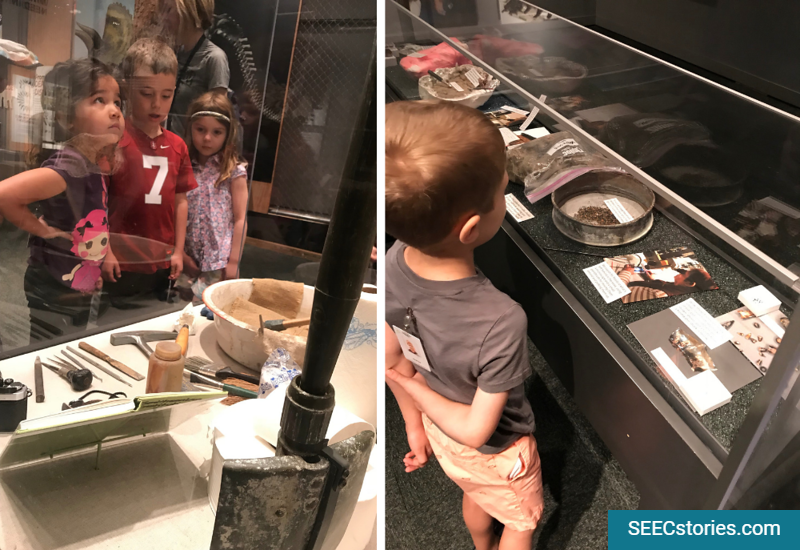
Children looking at tools used to dig for dinosaur bones
Next, they did more careful looking at exhibit cases display tools that paleontologists use. The children excitedly called out what they saw, and Cathryn read the label for them to glean more information.
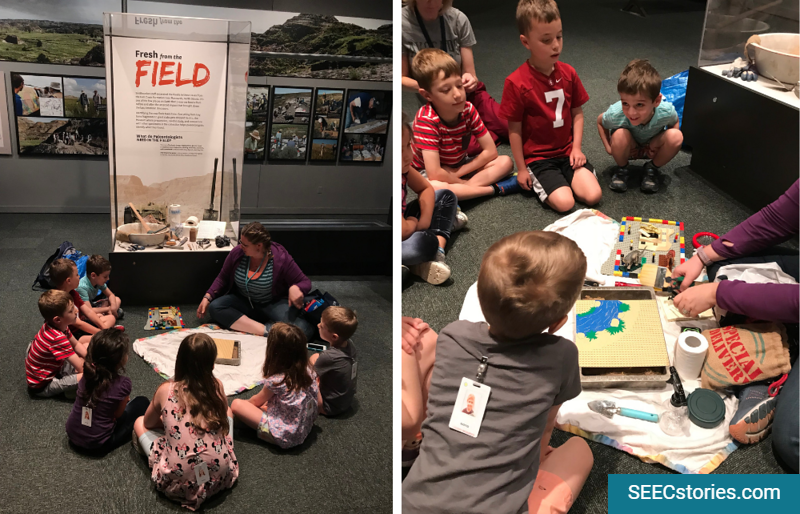
Children sitting in a circle looking at archaeology tools
After careful looking and making observations, the class sat down to talk more about what paleontologists do, and how they get a dinosaur to the museum and on display. They named tools that paleontologists need and Cathryn brought out a version of each tool they named. Next, brought out a Lego model of a dinosaur hall that might be in a museum. She explained that to find out how the dinosaurs get to the museum, they must go back in time to when the paleontologists began their dig.
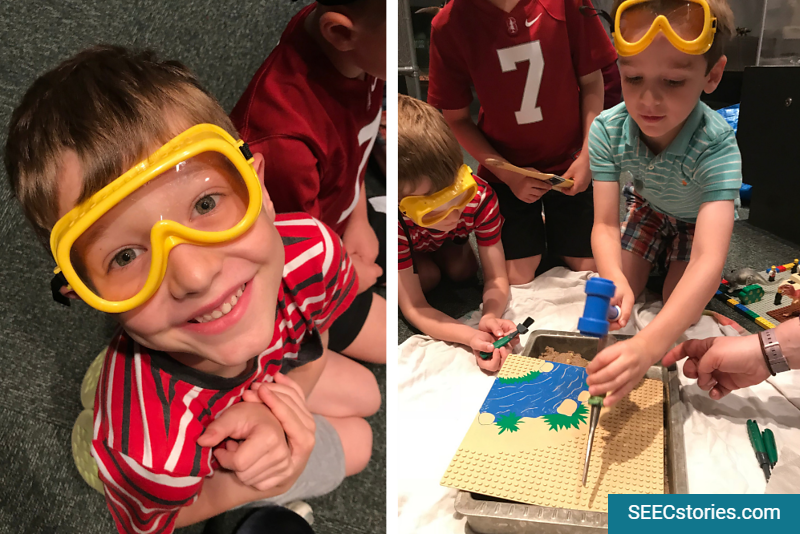
Children wearing googles pretended to excavate
The children all donned goggles to protect their eyes, and got to work on a dig. One child used a chisel and hammer to scrap off the “hard top layer”.
Children sitting in a circle around a pan filled with dirt and dinosaur bones
Next, the children got to work using the tools to uncover what was buried beneath the ground. They were excited as the found what the believed to be dinosaur skeletons. Sharon asked how they could tell what kind of dinosaur it was, and the children responded that they should look at the heads and neck.

Something that surprised us during the lesson was how the children really took turns and then worked together on the “dig site” in the museum space. Sometimes they get so excited about an activity that it can be hard for them to be patient and wait their turn.

Children sitting in a circle listening to a book about dinosaurs
To learn what happens next, Sharon read the book How the Dinosaur Got to the Museum by Jessie Hartland.  The story follows the journey of a Diplodocus, discovered in Utah in 1923 and its journey to the National Museum of Natural History. The children were impressed to see the numerous people involved in getting the Diplodocus from the ground to the exhibit hall. They also were shocked to hear that it took seven years for the Diplodocus bones to be assembled in the gallery.

The most ineffective part of our lesson was most likely the read aloud. Even though it explained the process of getting the dinosaur bones from the discovery part to the display in the museum, and all the people involved in the process, it was rather long and made our lesson longer. By the time we finished the story, the children had been sitting for some time. However, this was okay because we  already talked about the process so much and the people involved, that it was a way to reinforce what we were teaching.  Even though the read aloud was very long, we were still surprised at how well they stayed engaged and listening.

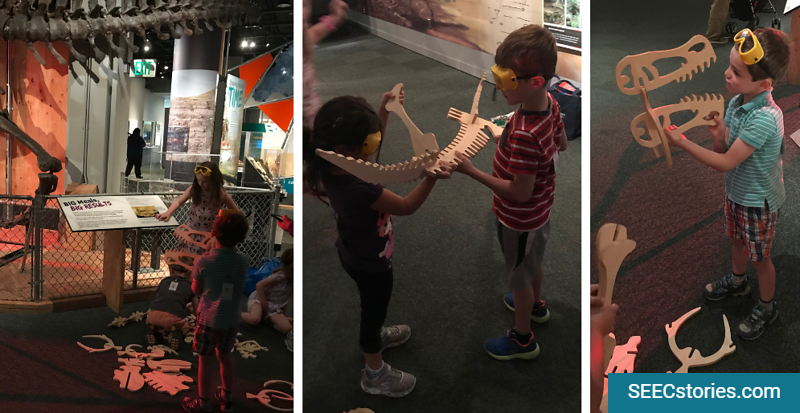
Children looking at and holding pretend dinosaur bones
The children noticed that some of the bones were hard to tell exactly what they were. Sharon reminded the class that it took seven years to put the Diplodocus together, and while it might not take seven years to put the puzzle together, it might take them longer than the time they had in the museum. The group was reassured that they could continue work back in the classroom.

In the beginning, when putting the puzzle together, the children were super excited, but that soon faded when they were trying to figure out which piece went where. Again this was okay, because they did try and got pretty far with it. Eventually they just lost interest.

Children playing with legos and toy dinosaurs
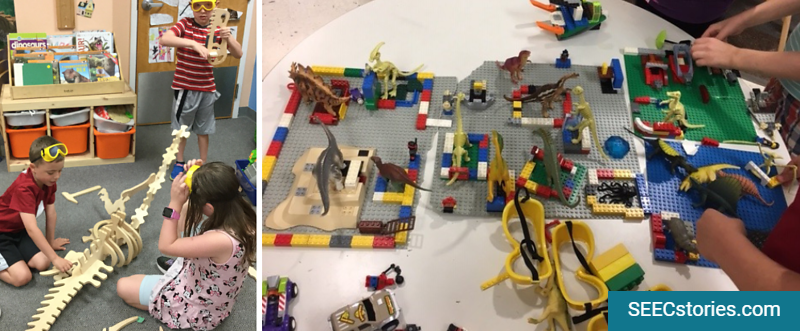
That afternoon the children continued to work together to put the skeleton together. They also used Legos and plastic dinosaurs to create their own dinosaur exhibit hall.

Later in the classroom, we left the section of the museum for the children to play with. On their own they created several additional sections of the museum using Legos, dinosaurs and some blocks. It took up the entire table and throughout the week there were more additions. Written labels the children made to identify objects, for example, and more “tourists” made from Legos were added to see the “exhibit.” It was awesome!


After exploring dinosaurs it was time for our kindergartners to graduate! For more dinosaur ideas, visit our dinosaur Pinterest board.