Theater Round Up

Our recent Teacher Feature highlighted a lesson on set design. This lesson was part of a larger unit on theater. The two year old class explored theater for several weeks before they decided to put on their own play based off the book Abiyoyo by Pete Seeger. The web below shows the different activities, museum visits, and books that the teachers Melinda Bernsdorf, Brittany Brown, and Brittany Leavitt used to teach their class about theater. For more details, take a look at some of the photos from their lessons, which serve to supplement the web.

Web - Theater_With Edits

SEECstories.com

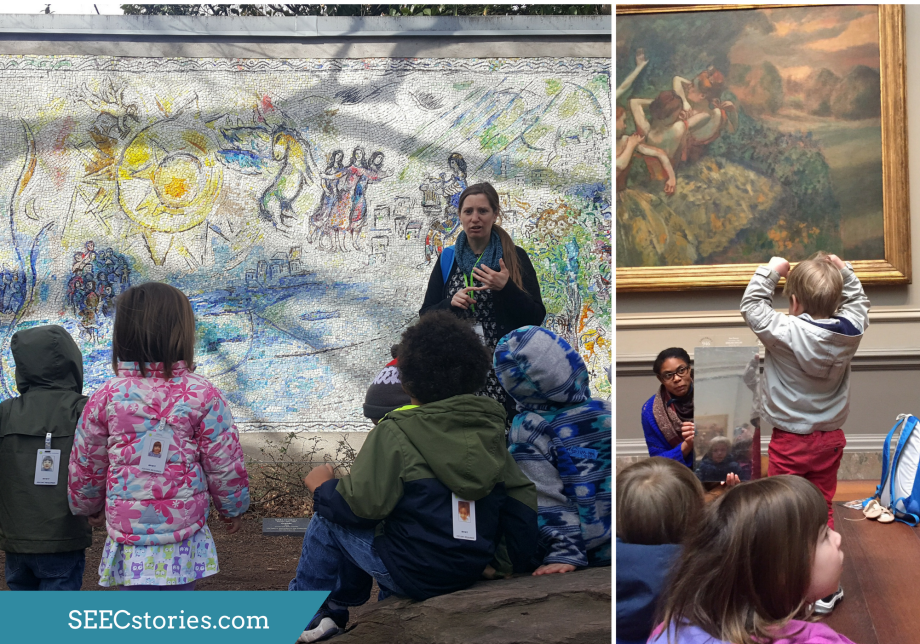
The class began their unit by exploring different ways that people perform on stage. When learning about ballet, the class visited the National Gallery of Art to look at Four Dancers by Edgar Degas. While in front of the painting, the class noted the poses of the dancers and practiced their own poses using a mirror that Brittany Leavitt brought into the gallery. Opera was another type of performance that the class talked about. While learning about opera they went to the National Gallery of Art’s Sculpture Garden to look at the large mosaic Orphée by Marc Chagall.

SEECstories.com (1)

They visited National Theatre where they stood on stage, sat in the audience, explored the orchestra pit, and experienced sitting in the balcony. Visiting a working theater gave the class a greater understanding of the plays and performance.
SEECstories.com (2)

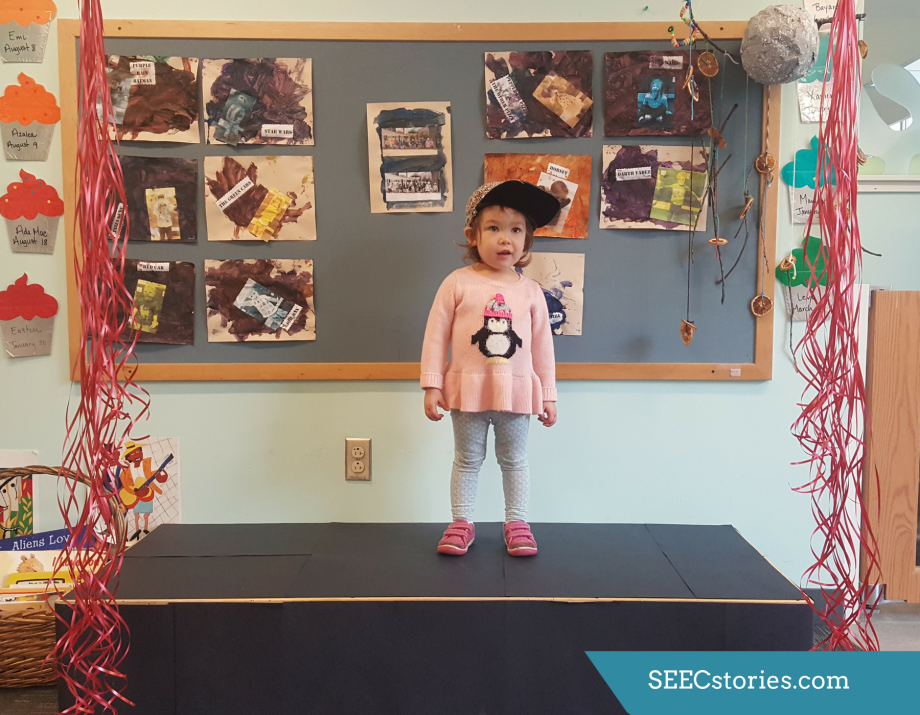
They transformed their classroom into a theater! Melinda Bernsdorf, Brittany Brown, and Brittany Leavitt hung red ribbon from the ceiling and repurposed a large wooden box as a stage.

SEECstories.com

In order to make their classroom stage a more immersive experience, the teachers gathered different types of clothing, hats, and props for the children to use on stage. The children were able to choose their own costumes and were invited to perform on their classroom stage.
SEECstories.com (4)

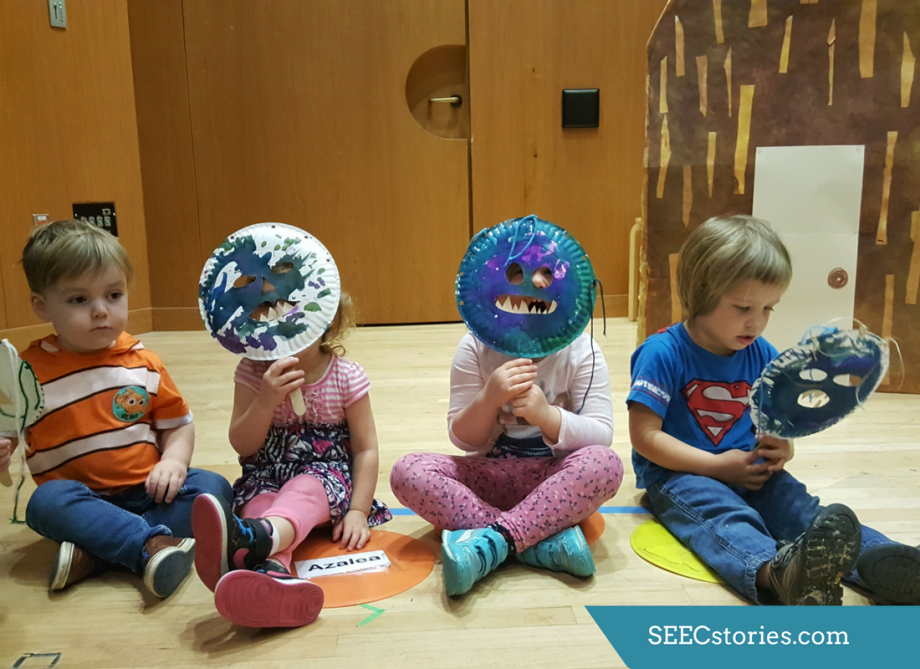
For their performance of the play Abiyoyo, which Melinda Bernsdorf, Brittany Brown, and Brittany Leavitt adapted from the book by Pete Seeger, the two year old class made their own costumes. The costume for the giant Abiyoyo was made by using paper plates, paint, and string. The class used these costumes while performing their play on stage in front of their families.
CORNER TAB

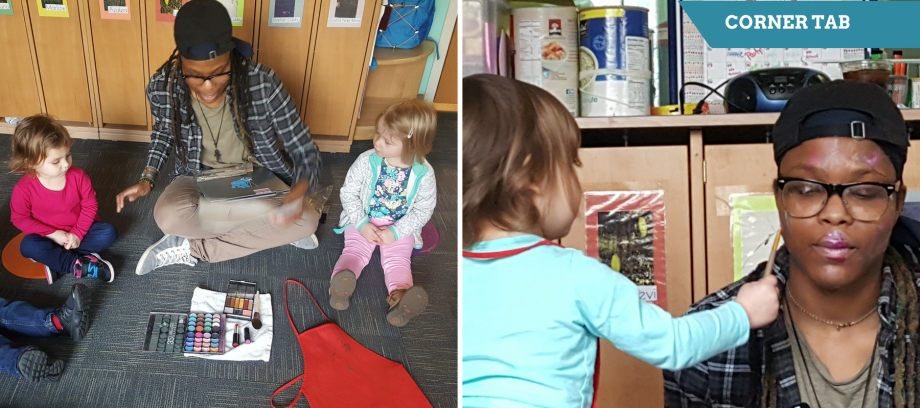
In addition to costumes, the class explored stage makeup. Before becoming makeup artists, the class learned about colors and palettes. Then they used one of their teachers, Brittany Brown, as a model. Each child was given the chance to put on Brittany’s stage makeup to get her ready for her performance.
SEECstories.com (5)

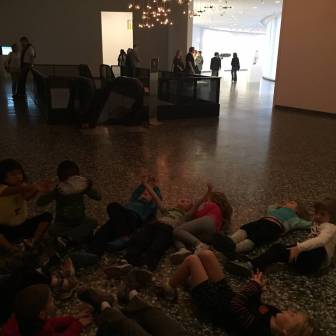
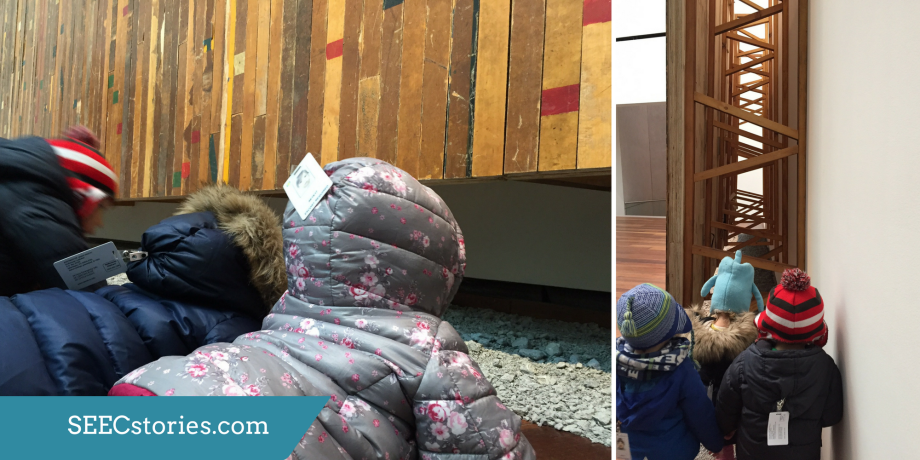
To learn about set design, the class went on a variety of museum visits to be inspired including visiting the special installment “In the Tower: Theaster Gates: The Minor Arts” at the National Gallery of Art. By looking at A Game of My Own by Theaster Gates from the side and even from below while laying on their bellies, the class was able to see the internal structure of a seemingly flat piece. This proved to be useful when they assembled their own set.

SEECstories.com (6)

The class used the knowledge that they gained to create their own set. Making the set involved the whole group’s efforts and took several weeks to completely compile, since they had to create something large enough to fill up the whole stage.

SEECstories.com (7)

After a complete tech week and several dress rehearsals the class preformed their verison of Abiyoyo in front of a set that they had created and wore costumes that they made. In the audience sat the class’s close friends and family.

Teacher Feature: Two Year Olds Explore Sets & Theater

This week we are featuring a lesson from one of SEEC’s two year old classes. The teachers Melinda Bernsdorf, Brittany Brown, and Brittany Leavitt used Yayoi Kusama’s Infinity Mirrors as inspiration for talking about and designing a theatrical set with their class. After experiencing the Infinity Mirrors, the class went to the theater to rehearse their performance and talk about sets and props while on stage. Below you will find images from the lesson and a reflection from Melinda, Brittany, and Brittany.

Cover Photo DOTS

Here are some pictures from the day’s lesson:

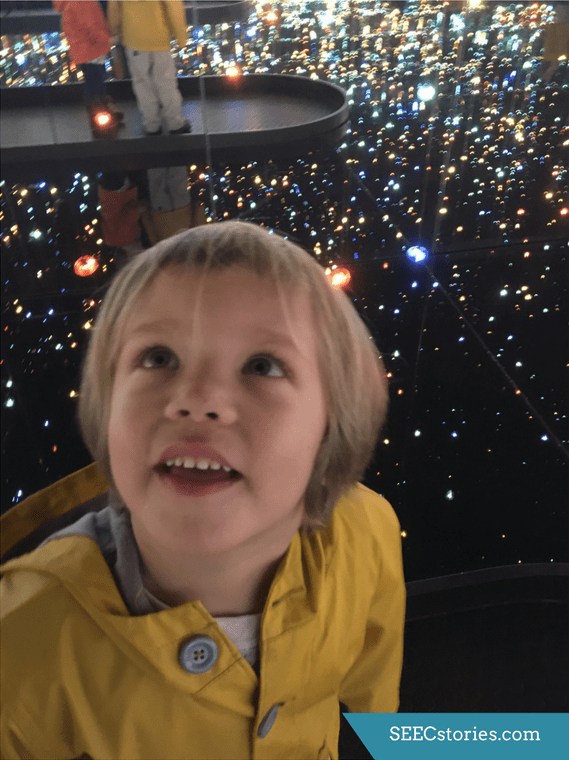
SEECstories.comThe first Infinity Mirror room that the class visited is entitled “Souls of Millions of Lightyears Away”. Before each group entered the space, their teachers asked them to think about “What story might take place here.” When the children exited the room, some of their answers included a story about “outer space” and “rainbows” and a story that included “flashing light, jingle bells inside a cave.”
SEECstories.com (1)

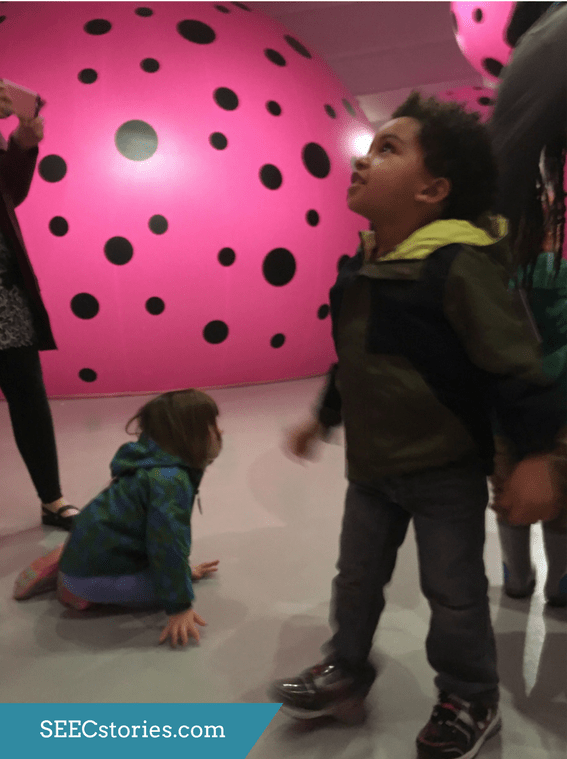
The class then visited “Dots Obsession Love Transformed Into Dots”. This space also inspired the class to think about a variety of stories including some about “Spiderman”, “a circus with balloons”, and “soccer balls”.

SEECstories.com (2)

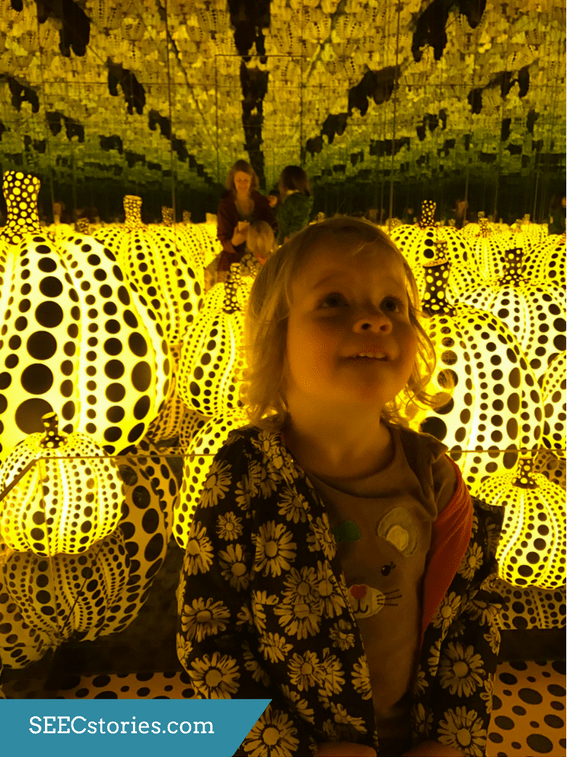
The final mirrored room that the class saw is called “All the Eternal Love I Have for Pumpkins”. Possible stories that could take place in this room included a story about things “that live in space” and a story about “polka dots on (people’s) cheeks.”

SEECstories.com (3)

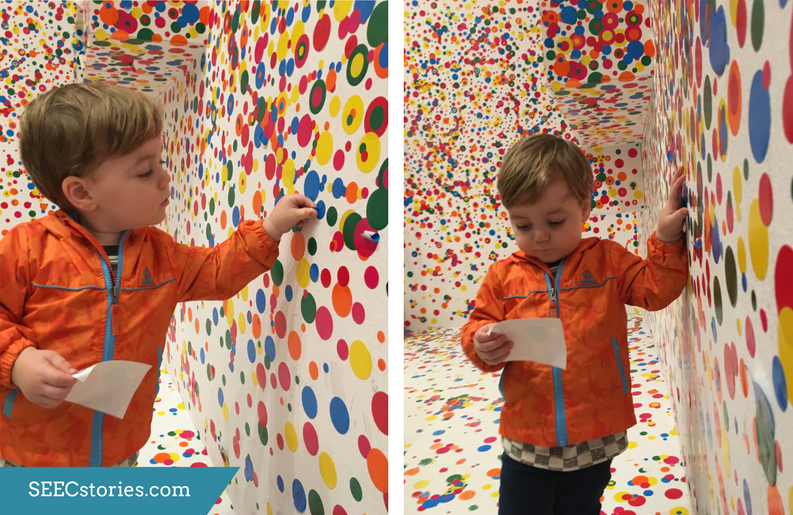
The class finished their trip by stopping in “The Obliteration Room” where they were given polka dot stickers to put on the walls. It was fun for them to help take part in designing the space.

SEECstories.com (4)

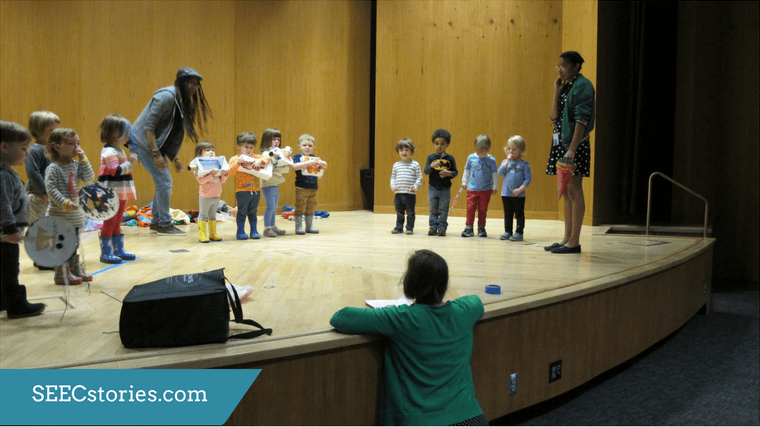
After their trip to the Infinity Rooms, the class went to the theater to rehearse their play entitled Abiyoyo. While on stage, the class was given the chance to hold the props, run through the play, and discuss potential set designs.

SEECstories.com (5)

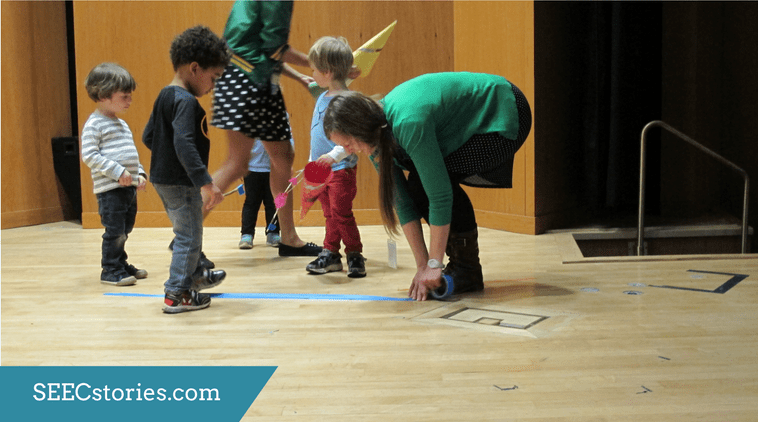
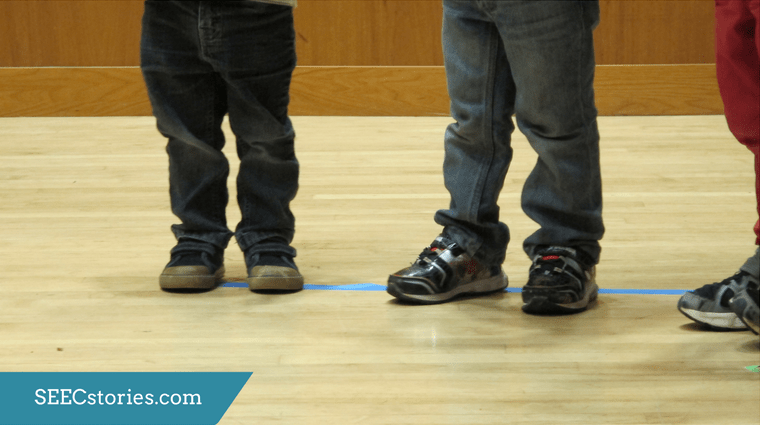
In their reflection, the teachers noted this time on stage as a trying part of the lesson. The children had just completed an immersive experience while visiting the Infinity Rooms and were having a hard time focusing on their rehearsal. Upon identifying the problem, the teachers were able to work quickly to try to resolve it so the class could experience a successful rehearsal. Since the class was struggling with staying in their positions, Melinda Bernsdorf grabbed blue tape to mark the ground.

SEECstories.com (7)

After placing the blue tape and with the guiding support of Brittany Brown and Brittany Leavitt, the class was able to focus on the play.

SEECstories.com (6)

After thinking about how sets help tell stories, the class designed and created their own set for the play Abiyoyo which they performed in front of their families.

A reflection from Melinda Bernsdorf, Brittany Brown, and Brittany Leavitt:

This lesson was a part of a month long exploration of musical theater. Our class had been examining different plays and musicals as well as talking about the areas of work that go into putting on a production. As a class we had been working on our own production of Abiyoyo, which we had adapted from the book Abiyoyo by Pete Seeger. In the weeks leading up to this lesson, we had talked about stage make-up, choreography, costumes and props, and set design, discussing how each had an impact on furthering the story narrative.

We had been anticipating the Yayoi Kusama’s Infinity Mirrors exhibit and because of the high level of interest in the exhibit, we had to schedule our trip long before we knew what our class would be exploring. It worked out beautifully that we could use Kusama’s immersive art to extend the ideas we had been discussing. We hoped to dive further into the concept of set design and setting as storytelling devices. We intended to use each different area of the exhibit as a different “set” and discuss what story was taking place. We also had a more challenging goal of using Kusama’s Infinity Mirrors to get across the concept of remaking a whole world or reality within a tiny space, like how the set of a play can bring a world to a stage.

From the first room, our students were open to the idea of telling stories about their surroundings and were imaginative in their ideas. In this way, Kusama’s art was very successful in showing how set design and setting are important aspects of storytelling. The more abstract ideas of directly associating that with the play we were producing in class may have been lost along the way, but that was fine. Our main goal was facilitating an incredible experience for our students and pushing them to wonder and dream about what they were seeing, rather than just being present for the moment.

Our visit actually went much more smoothly than expected. We had anticipated a high volume of visitors and had some plans in reserve in case there were long lines for the infinity rooms. We also had a strategy in mind for which rooms we thought would be most valuable if we discovered that we could only see one or two because of time. We knew that we could only ask our students to stay engaged for a limited time if most of what we were doing was waiting. Luckily, none of this ended up being a concern during our visit. We were able to walk up to each area and enter almost immediately. However the rooms were small and only allowed for a few students to enter at a time. While waiting for each student to have a turn, we talked about the storytelling aspects of our environment. These small amounts of down time enabled us to have open ended discussions with our students in small groups while still in the museum space. Our class had the opportunity to share their ideas while they were still surrounded by the experience.

We followed our visit to the Hirshhorn Museum with a trip to the theater we were using for our play. Each day this week we had been spending some time rehearsing in this environment, allowing our students to become comfortable on stage and in the space. This ended up being the least successful part of our lesson on this day. The transition from the time spent exploring Kusama’s art to the more focused work of rehearsing our play was difficult for our students. We had been able to maintain their focus for an extended period of time in the museum, and if in the same situation again, I would give myself permission to let go of the second part of the lesson. Trying to make the connection by physically having our students experience both the Infinity Mirrors and the theater was unnecessary and too much. It would have been more appropriate to revisit the lesson the following day as we assembled our own set on the stage.

We concluded our exploration of musical theater by putting on our Abiyoyo play at the end of the week in front of an audience of our students’ families.

Stay tuned for the Roundup on Theater for more ideas from Melinda, Brittany, and Brittany and to learn more about their class’ exploration of musical theater.


SEEC’s Book Club: The Scientist in the Crib

We recently decided to start up our own book club and chose The Scientist in the Crib: What Early Learning Tells Us About the Mind for the club’s second meeting. We featured this book in a recent blog post “From Blobs to Beings: An Overview of Research on Baby Brains” and it made sense for us to come together as a group of professionals to think more about it. In the course of our book club discussion several topics emerged including teaching empathy, learning, and language. Below are some highlights from our discussion.  

On Empathy

The Scientist in the Crib explained that “real empathy isn’t just about knowing that other people feel the same way you do; it’s about knowing that they don’t feel the same way and caring anyway” (p. 39). The authors describe an experiment during which they provided young children with broccoli and goldfish and then requested some broccoli from the children. Children younger than 18 months, gave the researchers goldfish, despite the researchers requesting broccoli. These children cannot fathom someone wanting anything that differs from their own desires, which in this case are clearly the tasty goldfish. By 18 months, children realize what they want may actually be different from what someone else wants, hence they are willing to give broccoli to the person who requests it even if goldfish seem like the only logical choice to them  (p. 38-39).

SEECstories.com

This example of young children showing empathy was shared at book club. The teacher described the situation by explaining that one of the children in her class was feeling upset and another child crawled over to pat the child’s belly, which made everyone feel better.   

Our discussion began largely by sharing examples of young children being empathetic in our own classrooms. The teachers fondly recalled examples of young children acting emphatically for the first time. There was a discussion about a toddler offering to help zip up their friend’s jacket and another example of a young child who was barely talking going out his way to find a sad child’s favorite toy in hopes of making the child feel better. These examples of young children showing empathy were clearly some of the teachers’ favorite memories of their past classes. The teachers also talked about how important it was to teach social emotional learning, because according to one teacher “children need to learn how to become people”. We concluded that teachers need to focus on teaching empathy as well as teaching the classic academic skills in their classrooms.

On Learning and Language

Much of The Scientist in the Crib featured the different ways that babies learn about the world around them and it devoted a whole chapter to children’s development of language.  As a group, we talked about how difficult it can be to learn a new language as an adult and how baby’s brains are better suited for the task than adult brains.

SEECstories.com (1)

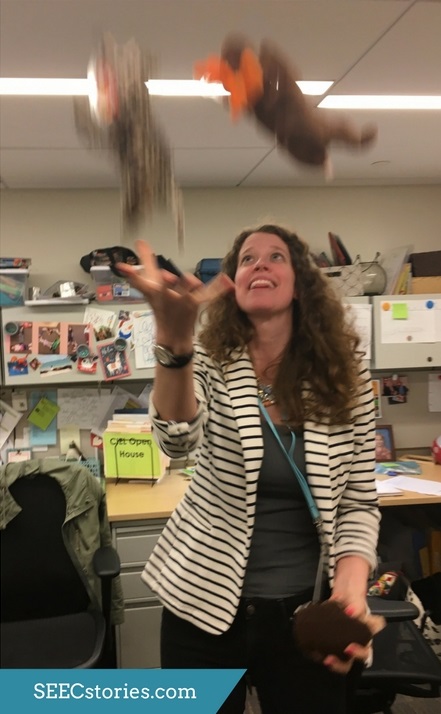
Brooke demonstrating her juggling, which she used as an example of something that she learned to do as an adult.

Babies are learning far more than just language as they develop. In fact, since everything they experience is brand new, they are actively learning about everything. As adults, we rarely get to experience the challenge of learning something completely new. This is yet another difference between adult learning and children’s learning. One participant, Brooke, brought up the challenge of learning how to juggle as an adult. She explained that it was “Simple once you get it; you can actually move your hands and stop paying attention.” But before you get to that point it was “super hard!” From the discussion of the difficulties of learning a new language and learning how to juggle, we noted how hard we had to work to accomplish our goals and we were amazed by just how much and how quickly infants and young children are able to learn. Throughout our discussion we became more and more amazed by the infant brain.

Required Reading

As we were concluding our discussion one participant said “I think this book should be required reading!” When pressed about who should be required to read The Scientist in the Crib, the group decided with a resounding “everybody!” The benefit for parents and caregivers seemed obvious. In fact, one book club participant had texted the paragraph on the “deliberately perverse” two years to a friend of hers who was currently experiencing that phenomenon (p. 39).

In addition to parents and caregivers, we discussed how policy makers should read this book so they can gain an understanding of the importance of early childhood education. We concluded that everyone was a child once and will probably interact with a child at some point and this book would help people gain an understanding of their own brains as well as the brains of young children.

Catch us next time when we will be reading For White Folks Who Teach in the Hood, and the Rest of Y’all Too by Chris Emdin.


References:

Gopnik, A., Meltzoff, A. N., & Kuhl, P. K. (2004). The Scientist in the Crib: What Early Learning Tells Us About the Mind. New York, NY: Perennial.

Music Monday

To help celebrate the National Association for the Education of Young Children’s (NAEYC) Week of the Young Child, we are highlighting our music teacher Allison Brake for Music Monday! As SEEC’s music teacher, Allison visits each SEEC class, infants through kindergarten, once a week for music class.

SEECstories (5)

Allison has been teaching with SEEC since SEEC’s beginning back in 1988, but she has not always been the music teacher. In fact, Allison became SEEC’s music teacher relatively recently in the mid-2000s. In the time between she was a classroom teacher, assistant director, and a resource teacher. Even when Allison was not SEEC’s music teacher, she explained that she “always brought music into the classroom.”

This experience made her the ideal music teacher for SEEC. She happily took on the challenge of expanding the music classes to the youngest classes so the whole school had the opportunity to have a time focused on music. Allison explained that she loves using music as a tool for helping children develop starting in infancy and following them through kindergarten.

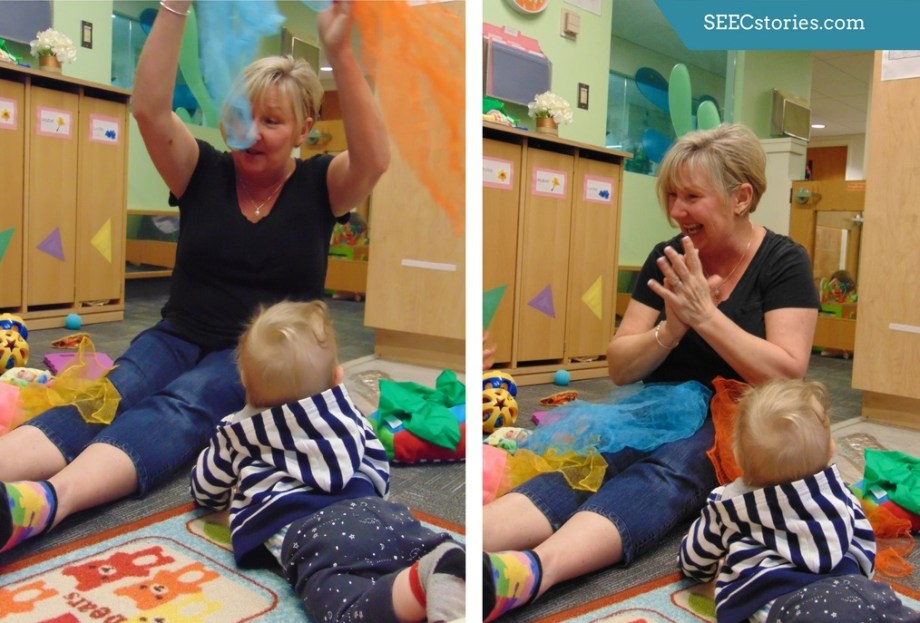
SEECstories (3)While Allison believes that music is a vital program for children of all ages, she focused on the importance of music with the youngest of children. In particular, Allison highlighted how hearing familiar sounds or songs helps infants learn to self-regulate and self soothe. She also discussed how music helps to build babies’ language development. She noted how she likes to start her classes by singing a song that includes each child’s name. With the babies, she explains that they very quickly respond to hearing their own name by clapping, bouncing, or smiling.
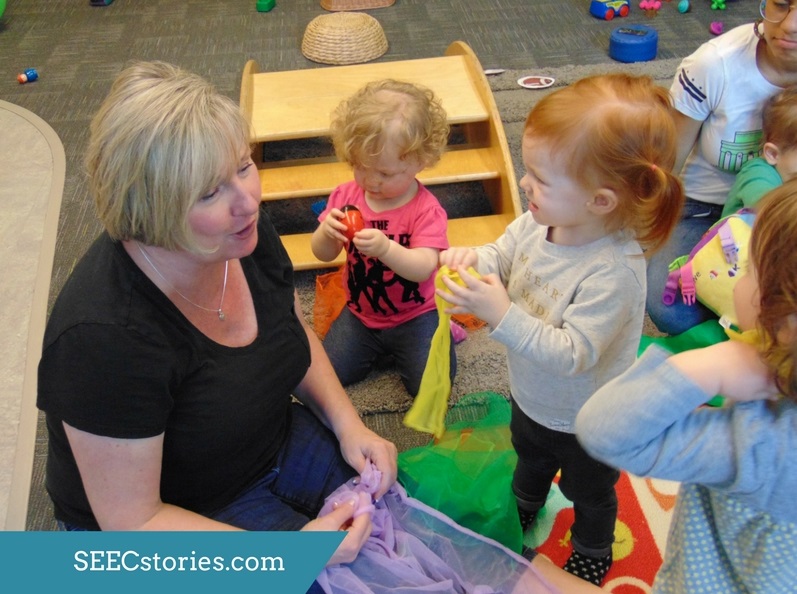
SEECstories (1)Beyond name recognition, Allison explained that singing hello to the individual is important for the start of each of her music classes. It gives her the opportunity to “build off who the child is” from the start of each class. She explained that it set the class up for social emotional growth opportunities since music class is the whole group singing with opportunities for the individual to shine.
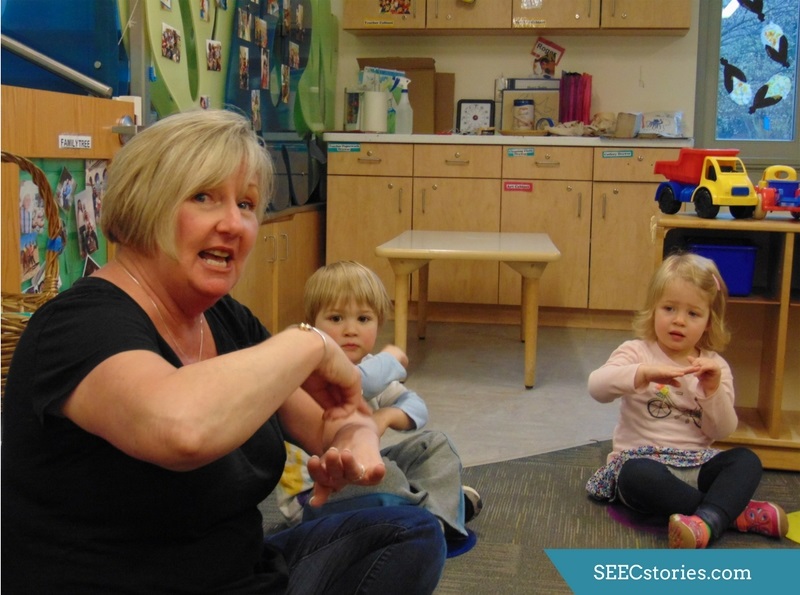
When asked to offer advice to parents, Allison said “Don’t be too hesitant.” Music can be used for fun and to comfort. If as a parent, you still feel uneasy singing, Allison recommends buying and playing music. She clarified that playing music is different from putting on the TV because music allows the parent to continue to be present both with eyesight and in interaction in a way that is impossible with a screen. But in the end, Allison encourages all parents to sing to their children and says that your children “aren’t making judgement” so you should “free yourself from judgement” as well.

SEECstories (2)Her advice for teachers included using music as cues when transitioning in the classroom and repeating songs so that children can learn them. Once the class knows a song, then the teachers can add variety and build upon the songs so that they are challenging and offer new opportunities.
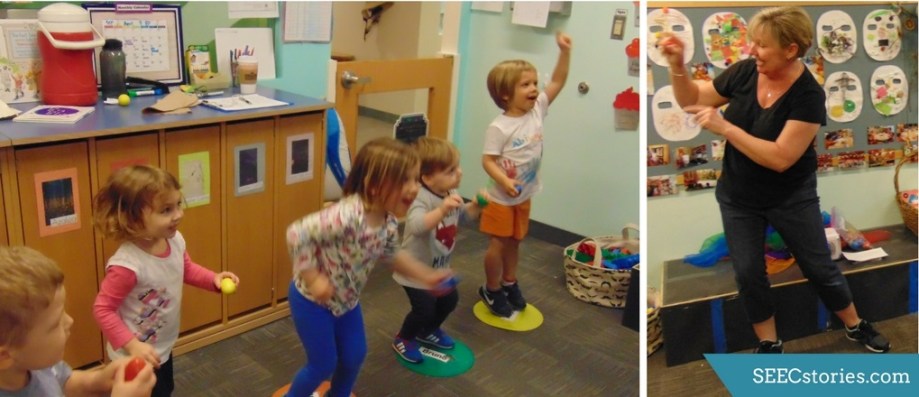
SEECstories (4)Lastly, Allison told us some of her favorite songs. She said that she loves “Popcorn” by Greg and Steve,because it helps children “lose their inhibition” and ties in disco, which is always fun. Another favorite is “Listen to the Horses” by Raffi and the “All the Pretty Horses”, which is a lullaby that Allison sang to her own children and said that it has a “soothing melody like a waterfall.” Don’t all these songs sound great? At SEEC we love hearing new music! What are some of your favorite songs to sing?
From Blobs to Beings: An Overview of Research on Baby Brains

Bayard Car CORNER TAB

Over the last hundred years there has been a monumental shift in how the scientific community sees babies. Neuroscientists and clinical psychologists now deem young children worthy of study and through their studies we have gained a wealth of information about brain development. This shift from seeing babies as blobs, to babies as beings undergoing a crucial stage of development, has been slower outside the fields of science and academy.This is unfortunate because every day people have the opportunity to interact with babies and are able to observe firsthand how babies grow and develop. These observations can result in an appreciation for the importance of enriching early childhood experiences.

What follows is an overview of brain research. It starts by discussing some overarching theories and moves into a breakdown of some of the newest findings. Hopefully this body of work will inspire you to take a new look at babies and discover that they are fascinating beings.

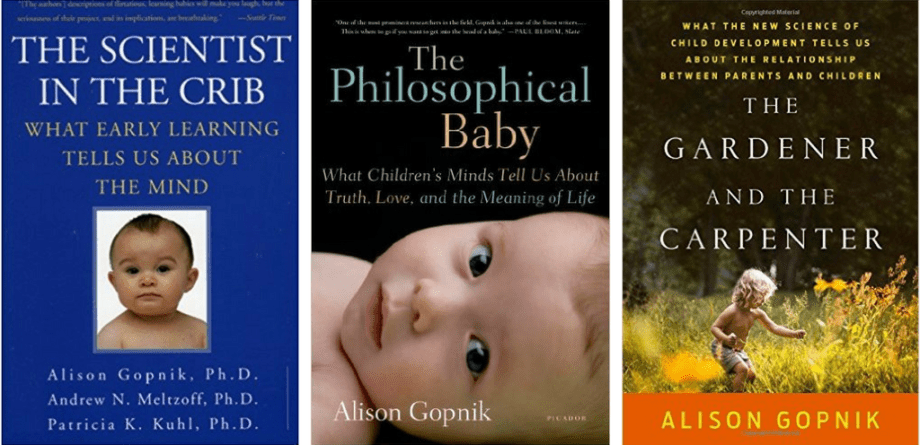
Ted Talks offers a series of five videos in a playlist called “Genius of Babies”. Alison Gopnik, a developmental psychologist and author of The Scientist in the Crib: What Early Learning Tells Us About the Mind, The Philosophical Baby: What Children’s Minds Tell Us About Truth, Love, and the Meaning of Life, and The Gardener and the Carpenter: What the New Science of Child Development Tells Us About the Relationship Between Parents and Children, is one of the speakers highlighted. During her Ted Talk, titled “What Do Babies Think?”, she makes the argument that babies are born as scientists who actively conduct experiments to learn about the world around them.

gopniktitle

Cognitive brain scientist, Laura Shultz explains “The surprisingly logical minds of babies”. Shultz notes that babies’ brains have to be very powerful because “they are figuring out their entire world.” She concludes her Ted Talk by saying:

In the years to come, we’re going to see technological innovations beyond anything I can even envision, but we are very unlikely to see anything even approximating the computational power of a human child in my lifetime or in yours. If we invest in these most powerful learners and their development, in babies and children and mothers and fathers and caregivers and teachers the way we invest in our other most powerful and elegant forms of technology, engineering and design, we will not just be dreaming of a better future, we will be planning for one.

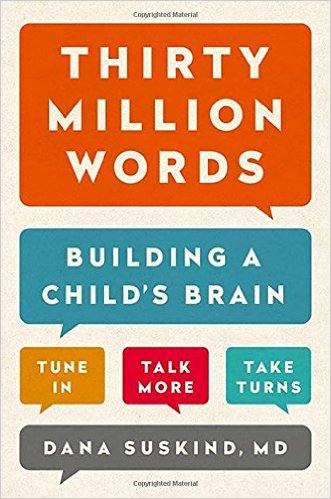
Researchers have noted the importance of babies’ exposure to both language and stimulation. Dana Suskind, a surgeon who routinely performed cochlear implants, wrote the book Thirty Million Words: Building A Child’s Brain. Suskind begins with the premise made famous by Betty Hart and Todd Risley’s paper “The Early Catastrophe”, which was published in the early 2000s and describes the thirty million word gap. Children in lower socioeconomic backgrounds have heard thirty million less words than their peers from high socioeconomic backgrounds by age three. According to Suskind, some children thrived after receiving a cochlear implant, while others did not and she discovered that the children who thrived heard millions and millions more words. In addition to regularly hearing words, a new study from the Norwegian University of Science and Technology “Babies Exposed to Stimulation Get a Brain Boost”. The study highlights the importance of actively challenging young children as well as stimulating their senses.

51uVntpL6iL._SX329_BO1,204,203,200_

Another recent baby brain study to note is from the University of Miami about how “Mothers and infants connect through song”. The study noted the mother’s ability to change the pitch or the tempo to keep the infant engaged in the song. Another interesting study looked at how babies’ sight develops. According to the study from the University of Oslo, babies who are 2 to 3 days old can see emotions on a human face from a distance of 30 cm, but at 60 cm the faces become too blurry to detect any facial details.

There should be plenty more interesting neuroscience studies in the future. In fact, the researches from the Massachusetts Institute of Technology have adapted MRI machines to make them more baby-friendly by making the MRI seat more like a car seat so the baby is more comfortable. The newly adapted MRI machines also have a mirror that allows the baby to watch videos and provides a space for the parent or researcher to sit next to the baby while the baby is getting an MRI. These adaptations have allowed researchers to discover more about how babies’ brains work. It has led to findings that the same part of a baby’s brain responds to images of faces as in an adult’s brain, which has allowed researchers to conclude that babies’ brains and adult brains are more similar than previously thought.  

As an educator, this wealth of information on how babies’ brains develop has impacted my practice. Research tells us that babies and young children need to be exposed to variety of subjects, materials, and situations. One wonderful way to expose babies and young children to new environments is to take them to museums and to explore the collections and watch their brains make connections and grow. Scientific research has shown the importance of exposure in early childhood and I am hopeful that one day this knowledge will permeate even into our everyday thinking.

Brown Bear, Brown Bear Roundup

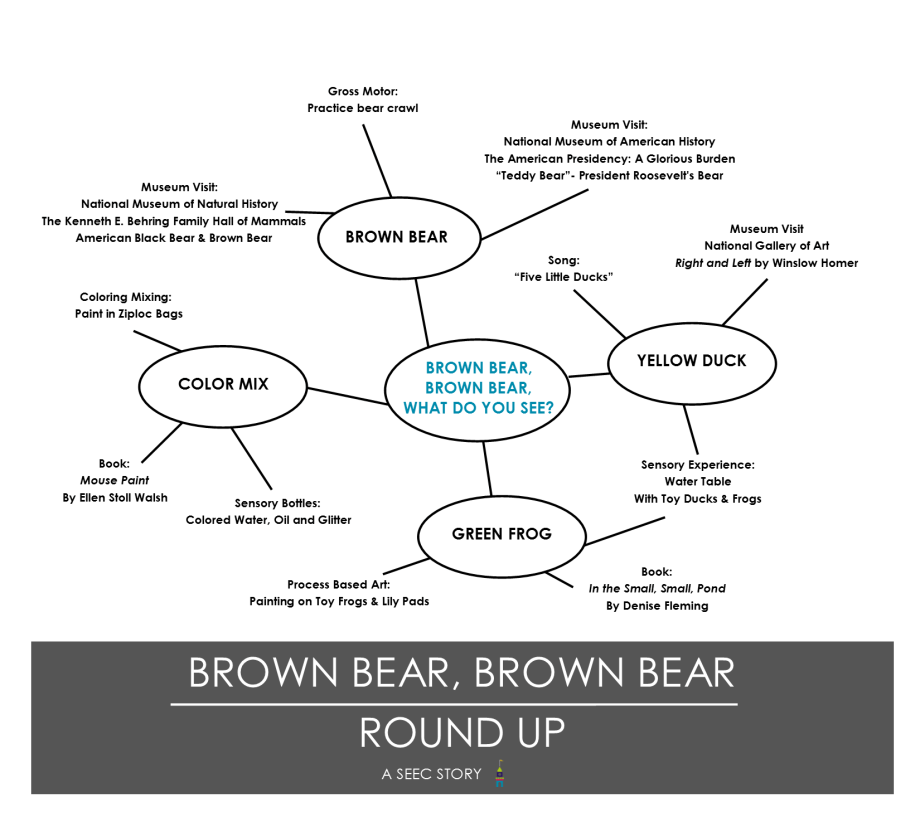
Our most recent infant Teacher Feature on frogs was part of a larger unit based on the book Brown Bear, Brown Bear, What Do You See? by Bill Martin Jr. and Eric Carle. This classic picture book asks different colored animals, such as a brown bear, a yellow duck, and a green frog, what animal they see. Both colors and animals are major themes of the book. The infant class teachers, Logan Crowley, Jill Manasco, and Rosalie Reyes, realized that the children in their class were requesting to read Brown Bear, Brown Bear, What Do You See? more than other books, so they decided to create a unit focusing on the major themes, animals and colors. The web and pictures below show some of the activities, songs, stories, and museums that Logan, Jill, and Rosalie utilized when teaching the unit.

web-brown-bear

Brown Bear, Brown Bear, What Do You See?

seecstories-com-7

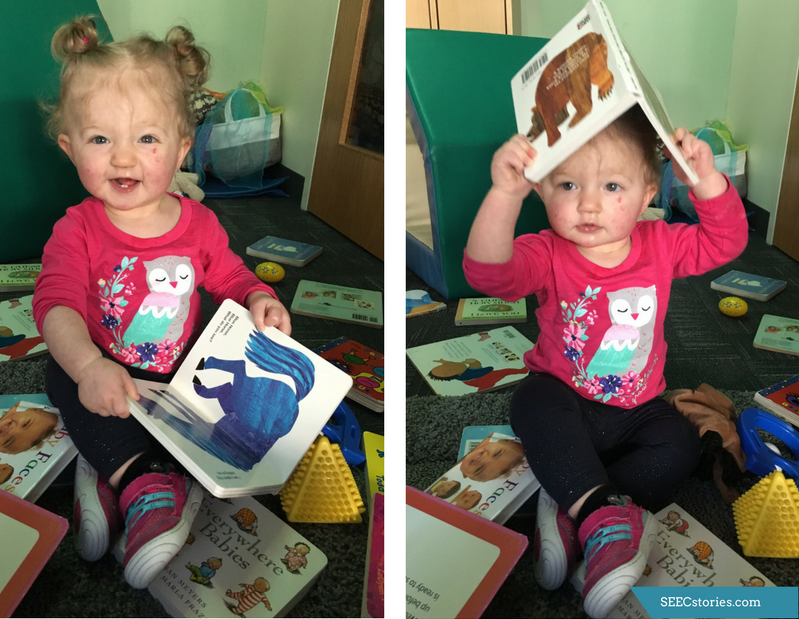
The infant teachers, Jill, Logan, and Rosalie, followed the interests of their class to come up with the unit on Brown Bear, Brown Bear. The infant’s love of Bill Martin Jr. and Eric Carle’s classic children’s book did not wane during the unit. Since infants learn through repetition, this story was read to them over and over again.

seecstories-com-6

The infants would often pick up Brown Bear, Brown Bear, What Do You See? and look at it independently. For young children, books are not merely books, books are objects that are meant to be explored and played with along the lines of toys.

Brown Bear

seecstories-com-8

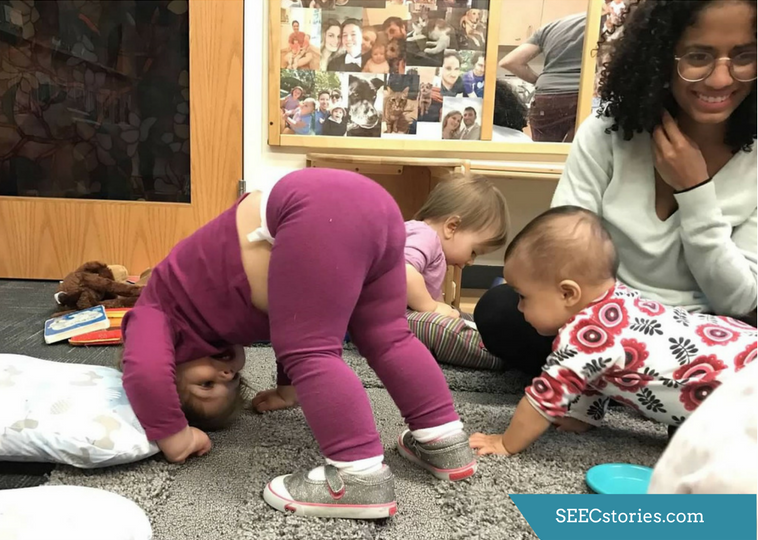
Infants love discovering how their bodies move. While learning about bears, the class experimented with moving like a bear by doing bear crawls.

seecstories-com-9

To compare different types of bears, the class went to the National Museum of Natural History’s Kenneth E. Behring Family Hall of Mammals. While there, Jill was able to point out the characteristics of bears and allow the children to observe the similarities and differences between the brown bear and the American black bear.

Yellow Duck

seecstories-com-10

To explore the environment that ducks and frogs live in, the infant teachers allowed plenty of time for their class to experiment with water in the sensory table.

seecstories-com-15

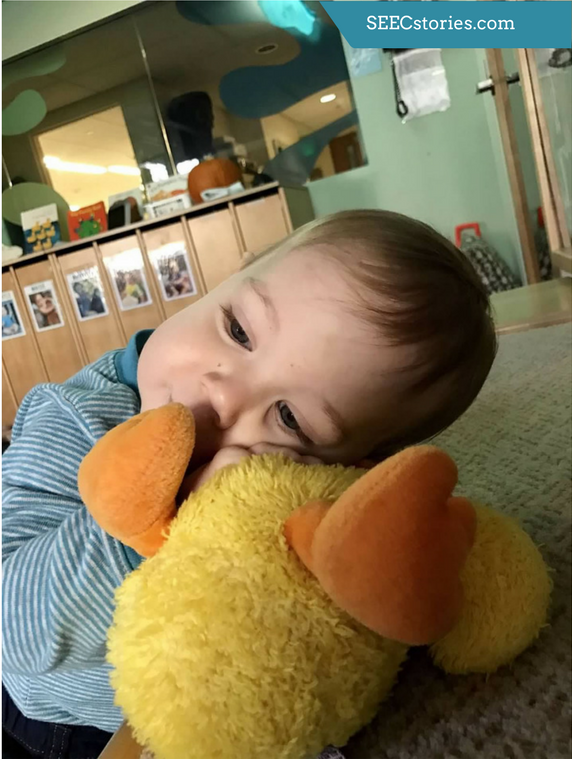
Throughout the unit, the infants were provided with many different examples of the animals that they were learning about. The class played with rubber and stuffed ducks and were able to investigate images of ducks in the wild.

Green Frog

seecstories-com-11

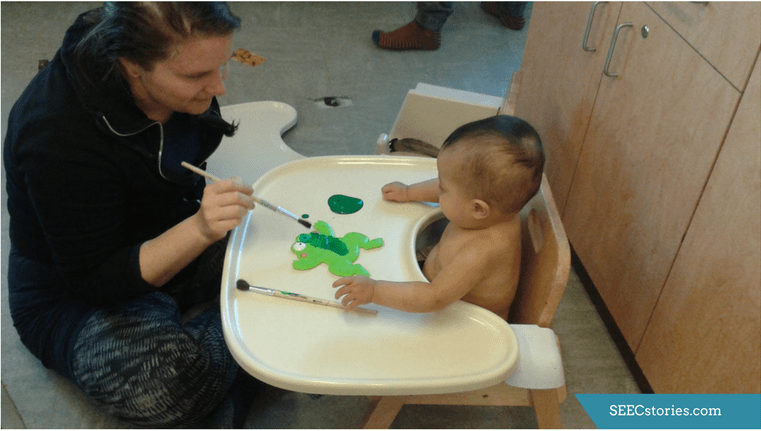
As part of an art class, the infants painted on toy frogs and lily pads. They were able to experience their toys in a new way. Using a paintbrush and their hands to paint, they were able to practice their fine motor skills.

seecstories-com-12

The class explored the colors related to the animals. For frogs, Logan, Jill, and Rosalie put out different types of green things. Some of the green objects were soft like the scarf and the infants were able to look through some of the objects like the plastic green containers.

Color Mixing

seecstories-com-13

Logan, Jill, and Rosalie realized that one way to extend the unit on Brown Bear was to add a unit on color mixing. They put out zip lock bags with two colors of paint inside and allowed the children to mix the colors to discover what happens when different colors are mixed together.

seecstories-com-14

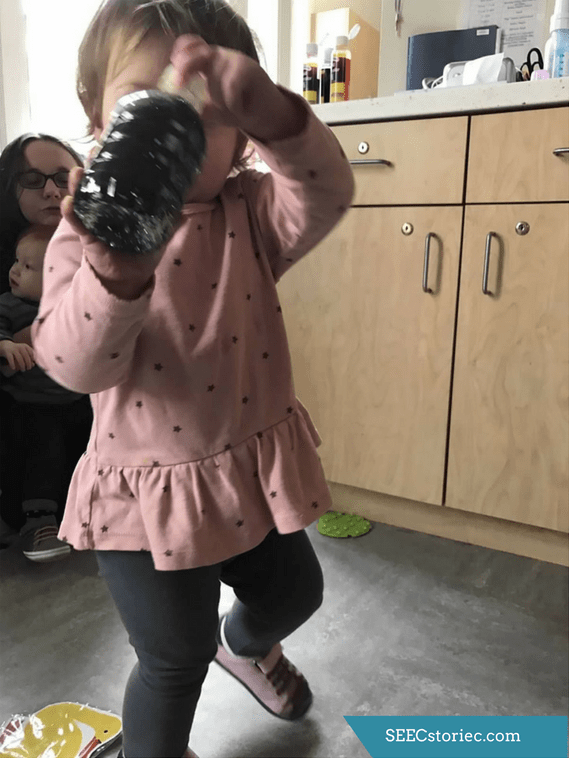
So their class could further explore color, Logan, Jill, and Rosalie made sensory bottles. They filled water bottles with colored water and some oil as well as glitter. Lastly, they glued the lids shut and then gave them to their class to shake, hold up to the light, and look through.


What happened to Kindergarten?

This blog was originally posted February 18, 2016 by our former executive director Kim Kiehl. To learn more about SEEC’s kindergarten, please come to our Kindergarten Open House on Thursday, February 9, 2017 from 10:15 to 11:30. Check out our event page for more information.


When I went to Kindergarten it was the place where I learned about being in school. Nobody expected me to be reading by the time the year was over. I had music and art and recess. It was a gentle transition into school and one that made me love learning and be excited to go to school, a feeling that is still with me to this very day.

Sadly, the same is not true for many children today. For them, Kindergarten is a place of high stress and pressure. Stories and questions have been replaced with worksheets and testing. Rugs and shared round tables have been replaced by individual desks. But none of this is true in our Kindergarten at SEEC. Sure, our morning is spent learning math and reading but not in a high pressure, “you have to learn this by the end of the year” way. Instead, it is done in large circles on a rug with conversation, at shared tables with the children discussing what they are learning, and in ways that introduce concepts connected to things the children care deeply about. In the afternoon they head out on their daily trip to the museums of the Smithsonian to more deeply explore some of their ideas, to ask questions and search for answers, and to learn to look carefully at the world around them.

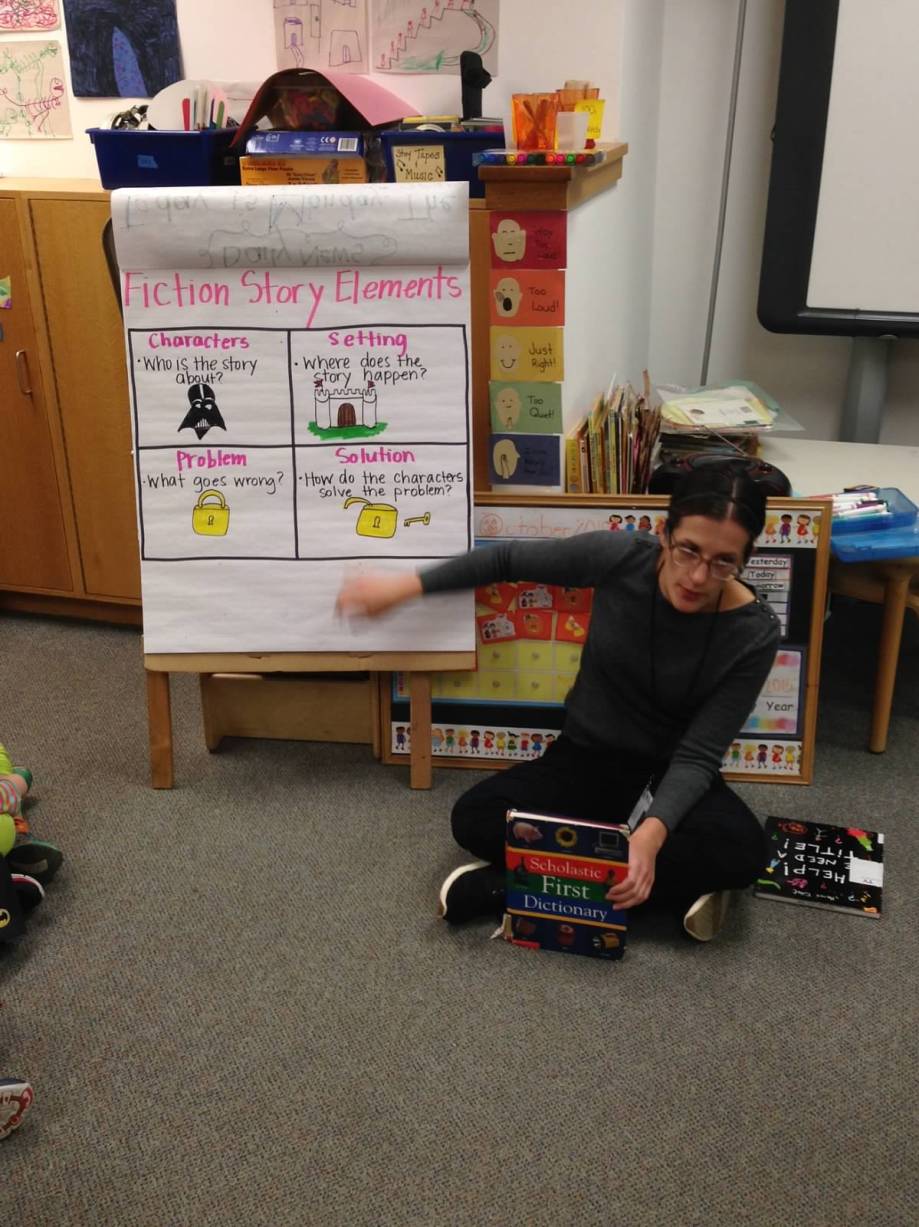
Let me give you and example of how this works. During the fall months our Kindergarten teachers noticed the children had a strong interest in Star Wars. For months they used that interest to teach everything from reading to appropriate behavior, from marketing strategies to the elements of a fiction story. Some of the activities that happened during these months included the following…

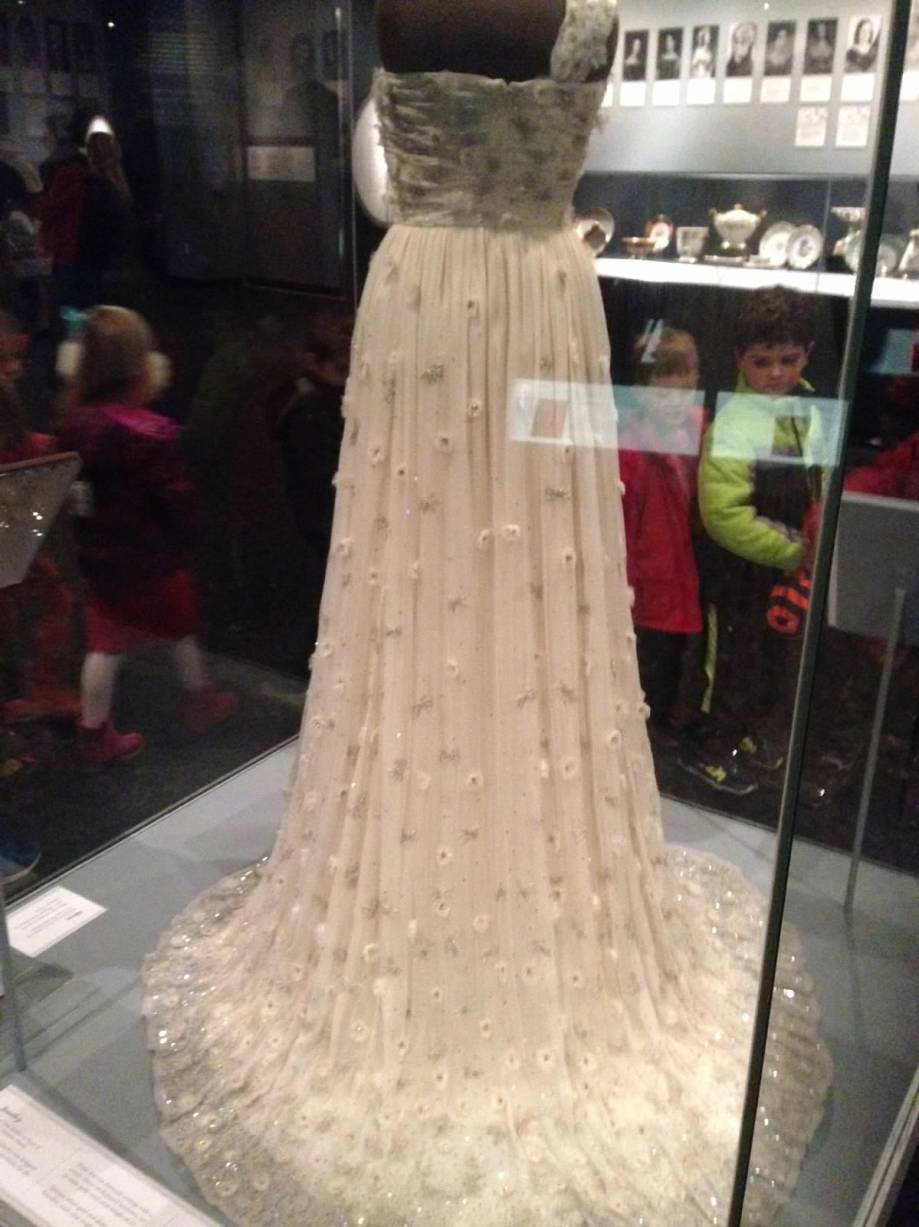
The classroom made connections between the women of Star Wars and the First Ladies of our country, exploring everything from their clothing to their characteristics. They explored the First Ladies exhibit in the National Museum of American History and through careful looking noticed that Michelle Obama’s dress looked very similar to the dress worn by Princess Leia!

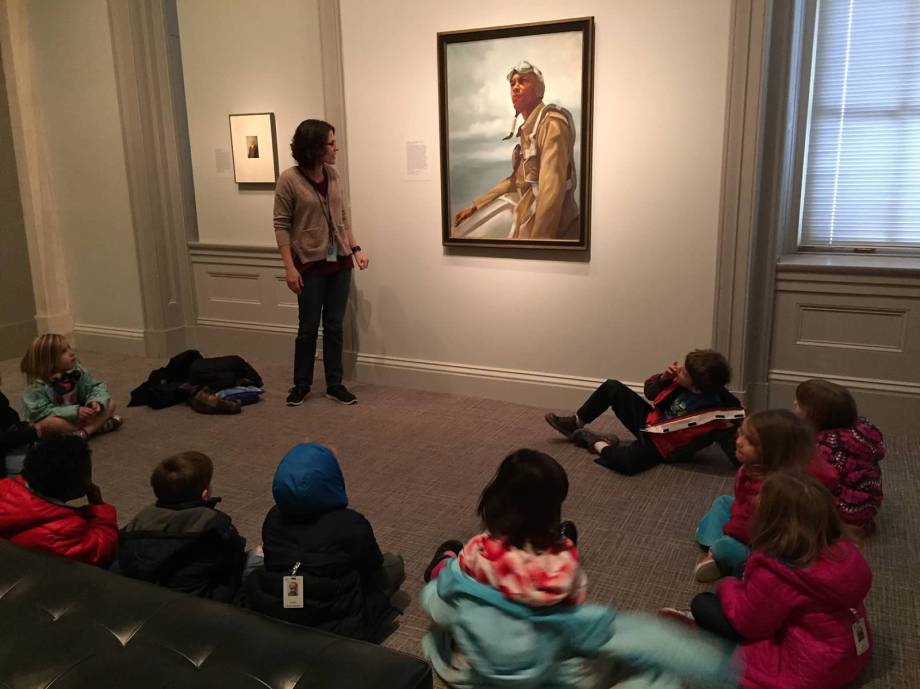
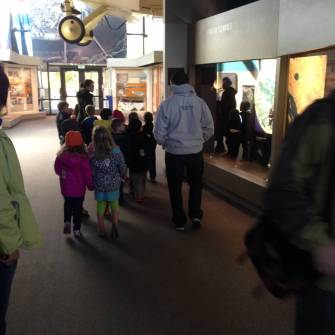
IMG_1407They talked about Luke Skywalker and then visited the National Portrait Gallery to look at a painting of William Campbell, a fighter pilot who flew more than 100 missions across three different wars. They talked about the characteristics of a hero and what makes a person brave and what courage looks like.
IMG_5570They learned math and compared their own heights to the height of C3PO, learning to measure and compare.
IMG_0527

They learned about the elements found in fiction stories as they explored the Star Wars story.IMG_0529

And, of course, there was a lot of learning about space and the stars!

IMG_0533  IMG_4700

At SEEC we also believe that art and music are vital parts of the curriculum and we have playground time every day. We have a Spanish teacher who comes several times each week and a researcher from the Smithsonian who comes to teach science as well. All of this is done in ways that are engaging and fun—no high pressure, no testing. But there is a lot of conversation, a lot of questions being asked by both the teachers and the children, and a lot of curiosity. Do our children learn to read by the end of the year? Those of them who are ready to read absolutely do, the rest leave us with the skills they need to make that leap in first grade. Do they do well when they leave us for “regular” school? Absolutely. The biggest concern we hear from parents is that when their child gets to their new school they get in trouble for asking so many questions. If that’s the biggest issue that comes up we’ll take it because ultimately the best learning comes from asking questions. So we will keep encouraging questions, helping children learn to look at the world around them carefully and with great curiosity and allowing them to explore their own ideas and search for their own answers to things that interest them.  Because we believe that is what Kindergarten should be– a gentle transition into school that leaves you hungry to learn more.

Never Too Young

Opening

This blog was first published last spring during NAECY”s Week of the Young Child. We decided to re-post it as we so often get ask the question, “What do you do with babies in a museum?” We hope this answers some of your questions. If you are interested in seeing our work in action, families are welcome to join us for one of our Infant Investigators  classes that occur most first Saturday and Sundays of the month.

When I first discovered that the theme for NAEYC’s 2016 Week of the Young Child™ was “Celebrating Our Youngest Learners,” I was excited by how clearly it related to my work as an infant and toddler teacher. Most people who read the phrase “Celebrating Our Youngest Learners” would immediately think of children older than the ones I work with every day. Even among the early childhood community, the term “young learners” often refers to Pre-K and Kindergarten students. I believe that we should include infants and toddlers in our celebration of the youngest learners. In my mind this is something that is both natural and necessary. In fact, it has so permeated my life that I sometimes forget that not everyone feels the same way that I do.

As an infant and toddler teacher at the Smithsonian Early Enrichment Center, I take my class on daily outings into the museums that line the National Mall. Upon seeing a group of infants or toddlers in a museum, visitors often remark on how amazing it is to see so many young children or how engaged my class seems. But far too often we get another response; people will come up to my class and say “Aren’t they too young for a museum?”

While I understand that a class of infants and toddlers may be an unusual sight in a museum, I can’t help but be baffled by the very premise of their question. My audible response to this accusation is a cheery “Never too young,” but my inner dialogue consists of wondering “Too young for what? Too young for learning?” I believe that museums make ideal places for self-directed learning. For an infant or toddler to be considered too young for a museum, then the extension of that logic is that the child is too young to learn, which cannot be further from the truth.

Infant’s and toddler’s brains are ripe for learning and processing. In fact, they are learning at a faster rate than at any other time in their life. They are learning language, how to move their bodies, pre-literacy skills, how to interact with others, and whether or not their world is a safe and secure place. Beyond that infants and toddlers are discovering what interests and motivates them. All of these things and more can be learned in museums. Below are a couple of examples:


Hirshhorn

We visited Shirin Neshat’s The Book of Kings, My House is Burning Down (2012) at a recent Hirshhorn Museum and Sculpture Garden exhibit as part of a unit of Eric Carle’s From Head to Toe. We were looking at the parts of the body and a favorite movement came from the line “I am a gorilla and I thump my chest. Can you do it?”


NGA

To discover more about different types of shoes, such as wooden clogs and ballet slippers, we went to the National Gallery of Art to see Paul Gauguin’s Breton Girls Dancing, Pont-Aven (1888)For a toddler, shoes represent a way for them to start creating a sense of autonomy. In my class, my students often come dressed in pink cowboy boots or purple rain boots that they picked out themselves. They are expressing their new found independence by choosing what shoes or clothes they want to wear.


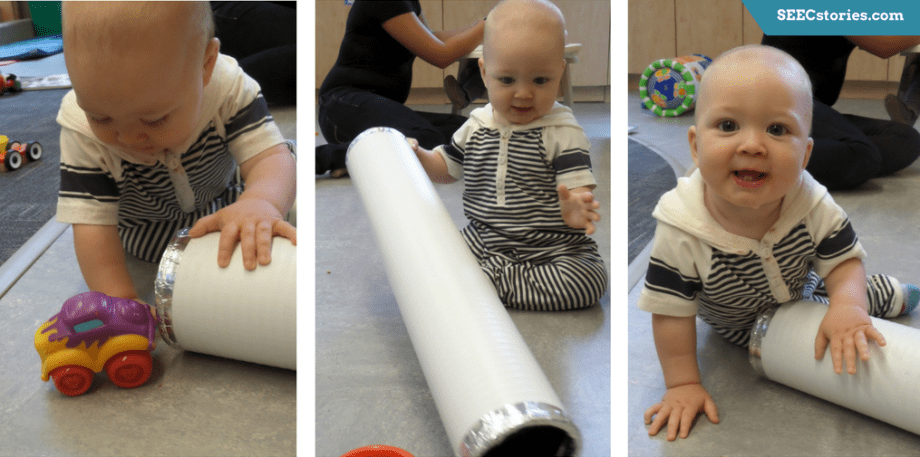
Infants and toddlers expend much of their energy discovering how they can move. Here my class of mobile infants visited a termite mound, which they were able to crawl through.

Infants and toddlers expend much of their energy discovering how they can move. Here my class of mobile infants visited a termite mound at the O. Orkin Insect Zoo in the National Museum of Natural History, which they were able to crawl through.


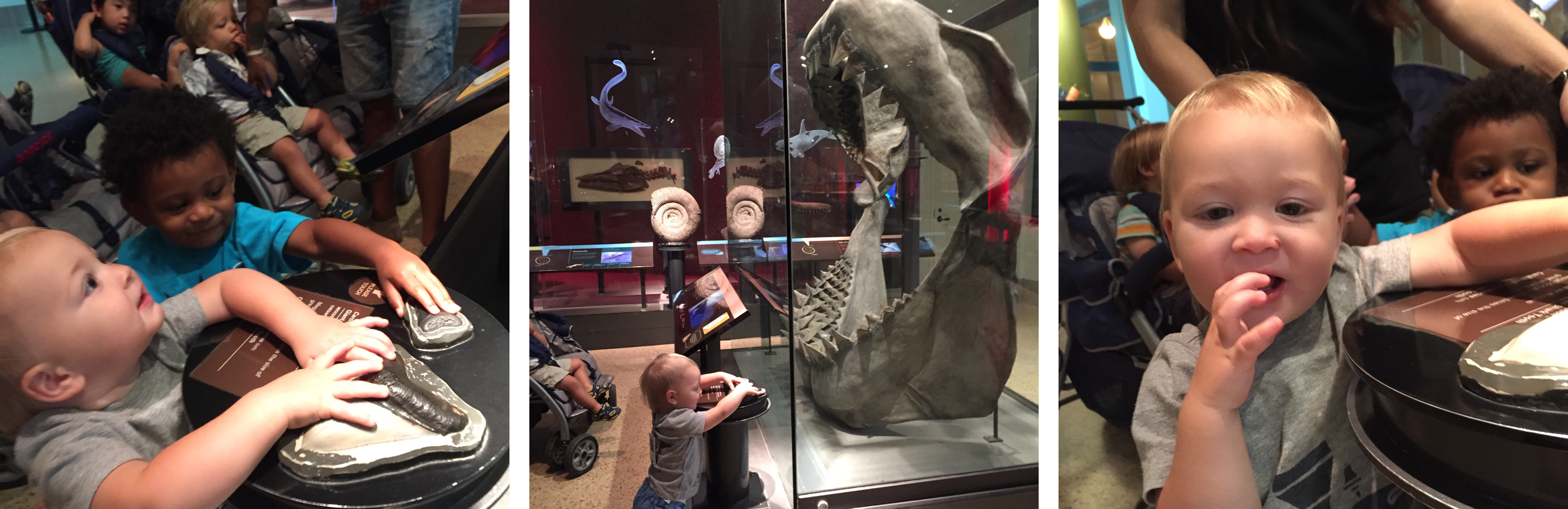
Getting new teeth impacts so many aspects of the lives of infants and toddlers. It allows them to transition to eating solid food, affects their mood, and is often detrimental to their sleep. What better way to learn about what is happening inside their own bodies, than to examine the jaw of a great white shark and touch a replica of some of the shark’s teeth?

Getting new teeth impacts so many aspects of the lives of infants and toddlers. It allows them to transition to eating solid food, affects their mood, and is often detrimental to their sleep. What better way to learn about what is happening inside their own bodies, than to examine the jaw of a great white shark and touch a replica of some of the shark’s teeth in the Sant Ocean Hall at the National Museum of Natural History.

Great strides have recently been made in explaining the importance of Pre-K and Kindergarten to the public. People across the nation now believe in the importance of these early learning experiences. While there is more work to be done, it is important that do not waver from celebrating and supporting the youngest of the young learners — infants and toddlers.

Infants and toddlers are active learners, so the environment and the people they interact with impact their learning. Infant and toddler educators need extra support and should be encouraged to see the myriad of possibilities for learning that occur with infant and toddlers every day. I hope that one day everyone who hears the term “youngest learner” will automatically include infants and toddlers in that group. I am excited for the day that I am greeted with “What are they learning about?” when I am walking in the museum with the infants and toddlers in my class.


BioMeredith Osborne is the infant and toddler specialist at the Smithsonian Early Enrichment Center. She received her Master’s in museum education from The George Washington University and studied history and psychology at Ohio Wesleyan University. She has experience working with both children and adults including positions at Playgroup in the Park, the Children’s Museum of Cleveland, teaching adults literacy classes, and interning at the Supreme Court of the United States.