Top 8 Books for Kindergarten Read-Alouds

This week’s blog is written by Silvana Oderisi. This is Silvana’s seventh year teaching kindergarten and her third year with the Smithsonian Early Enrichment Center where she is the reading teacher. Prior to joining SEEC, she spent two years as a Corps Member of Teach for America in Tulsa, Oklahoma as well as teaching in the District of Columbia. She is passionate about reading, learning languages, and being active.


SEECstories.com (1)

As I mentioned in my last blog, Top 5- Elements of a Great Read-Aloud, I thoroughly enjoy getting the chance to read to my group of kindergarten students during our daily read-aloud lessons! As a class, we love engaging with exciting and fun stories that push us to think critically about what we see and hear therein.

Here are some of the books we love the most and how we’ve used them in our classroom.

61toF5azwoL._SY411_BO1,204,203,200_

  1. Nanette’s Baguette by Mo Willems

This is one of my students’ all time favorite authors. So, suffice it to say that any book of his is bound to be a crowd pleaser for a read-aloud in a kindergarten classroom and beyond! This particular book of his combines silly rhyming words with a very relatable problem. On a trip to the bakery for her mom, Nanette eats all of the warm, delicious baguette before she even gets home! With a twist ending that shows adults can be as silly as kids, the book will have your children roaring with laughter!

  1. The Day the Crayons Quit by Drew Daywalt

Get ready for another fun book to read with your children. This popular book is one that will have kids re-evaluating the way they treat the crayons in their own crayon boxes. The poignant, hilarious letters from the crayons in Duncan’s crayon box, give kids a glimpse into the point of view of what they had formerly thought of as inanimate objects. In our classroom, we like to use this book to help us practice identifying problems in a story. We define a problem as something the character wants to change, fix, or figure out. And boy, do those crayons come to Duncan with some problems! From arguing over which color is the true color of the sun, to being overused and overworked, or not used enough, each letter provides my class with practice identifying problems and then using critical thinking skills to wonder how we would solve the problem if we were Duncan!

61QzYtb12LL._SX494_BO1,204,203,200_

  1. Lady Pancake and Sir French Toast by Josh Funk

If you couldn’t tell by now, I am a big fan of comedic children’s books. I love to make my students laugh and see them smile as we think about the stories we read together. I want nothing more than for my students to absolutely LOVE reading, so I try to incorporate as many of these happy moments as I can into my read-alouds. This book, in particular, combines silly characters and a relatable competition to get the last drop of maple syrup making for one hilarious story. In our classroom, we used this story to help us be able to identify a character as the person, animal, or thing (we really had to include that last one in this story) that does the ACTIONS! This helped us look more closely at a character’s actions, which comes in very handy when analyzing character traits, discussing problems and solutions, and more critical thinking questions.

  1. Ada Twist, Scientist by Andrea Beaty

While I do appreciate the imaginative and abstract characters in a lot of the books on this list, I strongly believe that it is also important for my students to see and read books that are a positive reflection of their own identities. I try to incorporate books, such as this one, so that the young girls in my class (and especially the girls of color) see their own potential in the STEM field. Reading books like this helps open the doors for young girls to explore their own curiosities about the world and ask questions about how the world works, without feeling like they’re stepping into a “boy’s world.”

617yIY-j0EL._SX410_BO1,204,203,200_

  1. Mufaro’s Beautiful Daughters by John Steptoe

Not only do I believe that my students should see their own identities reflected in the stories they read, but I also like to make sure that my students are able to make positive personal connections to other cultures through our read-alouds. This book is based on an African tale, and tells the story of a king looking for the “most worthy and beautiful” woman to be his queen. Mufaro believes that his two daughters, Manyara and Nyasha, are worthy and beautiful enough for the king and they decide to journey to the palace. Although both characters are outwardly very beautiful, their choices and actions throughout the story demonstrate two entirely different concepts of beauty, giving your readers plenty of opportunities to analyze personality traits along the way. This story truly begs the question of whether or not beauty can be found on the inside or the outside and can lead to very powerful discussions with your children about the concept of beauty.

  1. The Napping House by Audrey Wood

A classic Kindergarten favorite, this book is helpful to readers practicing sequencing events of a story, an important kindergarten comprehension skill. My students love the hilarious events that happen in the Napping House and re-tell the events with ease thanks to the silly rhymes and repetition throughout the book. The repetitive phrases help not only with remembering the sequence of events from beginning to end, but also help this age group develop fluency skills as they read, re-read, and read again the same words throughout the text.

41uUddbOyQL._SY342_BO1,204,203,200_

  1. Naked Mole Rat Gets Dressed by Mo Willems

I just could not go through this Top 8 list without adding another book by Mo Willems. As one of my personal favorite children’s authors, I really enjoy using any of his books in my classroom for a multitude of learning objectives. In particular, this book is helpful for making inferences about a character’s physical and personality traits. This is a great opportunity to practice identifying personality traits by analyzing the character’s actions, words, thoughts, and feelings. Wilbur is a naked mole rat who likes to wear clothes – fancy outfits, fun costumes, you name it! However, Wilbur is the only naked mole rat in his colony who does so, leaving his peers to be outraged by his scandalous behavior. Nonetheless, Wilbur shows determination and bravery to stay true to himself and even dresses up for a royal proclamation wearing…socks!

  1. Tap the Magic Tree by Christie Matheson

This book is one of my favorites because no matter the age group, every class I’ve read this book with has been on the edge of their seats to see what happens to the Magic Tree. This book incorporates movements like rubbing, tapping, counting, patting, and blowing that encourage children to participate in the changing of the seasons. The beauty of this book is that the realistic looking illustrations and bodily kinesthetic movement make it fun for many different age groups to read. If you’re interested in learning more about how to make your favorite picture books age appropriate for both toddlers and kindergartners, make sure to check back in for the blog I will be co-writing with toddler expert, Meredith Osborne!

Week of the Young Child 2018

For this past week, we have been celebrating the National Association for the Education of the Young Child’s Week of the Young Child. Week of the Young Child was started in 1971 and we are excited to help promote a week celebrating children and their caregivers, including parents and educators. This week also serves to bring attention to some of the unique issues surrounding early childhood and to highlight children’s incredible ability to learn while promoting young children’s need for bonding, love, and emotional support.

Since each day of the week has its own unique theme, we have decided to compile some of the resources that we used throughout this week in the hope that you will find these resources interesting and inspiring.

Music Monday

SEEC believes in the importance of music and movement, which helps to promote language, literacy, motor skills, and more! We even have our own music teacher who visits all of our classes.

Here are some other resources related to music:

Tasty Tuesday

Eating may seem like a simple, everyday task, but children are expanding new horizons while consuming meals together. They have to practice navigating new social experiences and also have the opportunity to be introduced to unfamiliar tastes and textures.

Here are some other resources related to eating and preparing food:

Work Together Wednesday

At SEEC, we embrace play as a crucial form of learning. We encourage children to interact and work together to develop their social-emotional skills and believe that when young children work together they will develop novel solutions to any problem which may occur.

More resources related to working together:

Artsy Thursday

Even the youngest of children benefit from the opportunity to create. These enriching, multisensory experiences help them make sense of their world.

More resources related to creating:

Family Friday

SEECstories.com

We were lucky enough to have Family Friday and SEEC’s Grandparents’ Day fall on the same day. We love having the grandparents visit – almost as much as the grandparents love visiting our SEEC classrooms and going on museum visits with their grandchildren!

More family resources:

How to Take Care of a Baby Shark (and Baby Human)

This week’s blog is written by Phoebe Cos.  Phoebe is a preschool educator at the Smithsonian Early Enrichment Center. 


Baby shark (doo, doo, doo, doo, doo, doo), Mama shark (doo, doo, doo, doo, doo, doo), Daddy shark (doo, doo, doo, doo, doo, doo)Preschool Song

The first time I sang this song in my three-year-old class this year, one child cut into the song halfway through and said, “We missed brother shark! What about him?” This question made perfect sense. We were singing about a shark family and the child is a brother in his family. This child, like many children, felt very strongly about their responsibility and place in their family and wanted that role to be acknowledged. When a child gains a new sibling, their family dynamic changes and it is understandable if that change can be hard to cope with.

This winter, my class showed an interest in babies during our ocean unit. Many of the kids in our class have younger siblings and were concerned when they learned some ocean animals are never taken care of by their parents. To further discuss this concern, my colleague, Katie, and I ventured over with our class to the National Museum of Natural History’s Nature’s Best Photography exhibit to meet and learn from some great white sharks.

We chose to first talk about sharks, as it engaged with the larger topic of familial care through a topic the children were familiar with discussing: ocean animals. The sharks made their appearance as three vivid photographs by nature photographers. We started by looking at the photographs and two toy sharks. Using these objects, we briefly explained that sharks take care of their babies primarily before they are born like finding hidden places to lay their eggs or (for sharks that give live births) feeding their babies through umbilical cords. We learned that humans also feed their babies before birth by umbilical cords and found our belly buttons where our umbilical cords used to be.

preschool families SEEC

For comparison, we next turned to human babies. Drawing a baby doll out of my backpack, I asked, “What do we need to do as humans to take care of our babies?” Many of the older siblings and cousins in our class quickly raised their hands, wanting to share their life experiences: “We need to rock them, like this (cradling arms)”; “Don’t yell around them”; “Sing them songs”; “Feed them milk”; “Change their diapers”; “Not throw them”. We noticed how a lot of these human care practices happen after a baby is born and how some can be done by brothers and sisters, as well as by parents. The children noted that many of these practices existed, because babies had a hard time moving or communicating on their own yet. The children each took a turn cradling the baby doll gently, adding a physical element to their cognitive and social emotional learning. Many children took great care passing off the baby to their neighbor and were proud when a teacher or friend noticed how gentle they were being.

We are lucky enough to be part of a school that includes infant classes and thought we might be able to discover some more ways that humans take care of their young by visiting one of the classes. Our first stop was to the infant director’s office to ask some questions about how she sees teachers helping out the infants in our community everyday. After the hands-on engagement and listening portion upstairs, the class was excited to ask her questions. From my experience, children get excited and inquisitive when they are able to have a special conversation with an expert. More voices and sources for children to access allow for a greater exploration of a topic. An expert does not need to be exclusive to a certain academic field; experts that we have talked to here at SEEC include geographers, curators, construction workers, dentists, Metro workers and librarians to name a few.

SEEC preschool babies new


After discussing how we can take care of the babies in our school with quiet voices and calm bodies, the director led us to the infant classroom, where we met them at the doorway. Children noticed that the teachers talked to the babies and that when some babies fell, the teachers would check on them. At SEEC, our preschool center is not connected to the center that houses the infants and twos, so after half a year of being in the preschool center, many children enjoyed visiting their old school. “I’m not a baby anymore,” said one child as we walked back to school. “Now I’m the big kid.” The feeling of responsibility that comes with being older in a room of younger humans carried great importance around our classroom when we came back to school. One child said that if he ever gets a baby sister, he will rock her so softly and gently and sing her to sleep. Another child said he helps his mom with his brother.

preschool SEEC venn diagram

To recap the day, we set out a large Venn Diagram on the floor and compared what was the same and different between how sharks and humans take care of their babies. This exercise gathered all of the information found throughout the morning and prompted the class to use their cognitive and language skills to compare and contrast the different traits we’d learned about.

A baby doesn’t need to be coming into a family to have conversations about taking care of younger humans. Children encounter children that are younger than them all the time, be it at family reunions, story hours or on the playground. It is valuable to create an awareness of how humans take care of each other at different ages. And if a baby is joining a child’s life in the future, these discussions and physical practicing can prepare a child to take on their new role as brother or sister shark in their family with pride and a feeling of importance.

Recommended Books We Love About Taking Care of Babies

Peter’s Chair by Ezra Jack Keats

The Baby Sister by Tomie DePaola

Mr. Seahorse by Eric Carle

Waiting for May by Janet Stoeke

Julius, Baby of the World by Kevin Henkes


Guiding the Development of Positive Body Images in Young Children

This blog is authored by museum Museum and Early Learning Specialist, Brooke Shoemaker. Brooke has been at SEEC since 2011, and holds a BA in Theatre Performance from the University of Maryland with a minor in Human Development, and a M.Ed. in Early Childhood Education form Towson University.  Brooke loves bringing traditional gallery spaces to life with young children through playful theatrical techniques.


Did you know that 30 million people in the United States suffer from an eating disorder during their lifetime? I am just one of these 30 million people, and over the last five years I’ve been on a personal journey to a feeling of self-worth that is not dependent on my appearance. About six years ago I developed anorexia at a time in my life when I felt like I couldn’t control many things, but I could control whether I went to the gym and “ate healthy”. I began to tie my success and worthiness to numbers: the number of miles I ran, the number of calories consumed in a day, and the number on the scale. I realized fairly quickly that my exercise and eating habits had veered away from healthy and had become obsessive and restrictive, and sought help from professionals, family, and friends. While I never thought that I would be dealing with this in my late twenties, the road to recovery from my eating disorder has led me to reflect deeply on body image, relationships with food, self-worth, and where it all begins.

Do you remember when you first had a sense of your body and what it could do? How old were you? Did you have positive or negative feelings toward your body? Children begin to develop their identities at a very young age, and this includes body image. A 2010 study found that almost a third of children age five to six would prefer a body that is thinner than their current size. Five and six. Think about that. What have children been exposed to, or influenced by, that leads them to these feelings of body dissatisfaction? My personal experience has led me to reflect on strategies adults can utilize to help foster a positive body image and healthy relationship with food in young children so that we can hopefully guide the next generation to feel positive about their bodies. Please note that body image and disordered eating are very complex issues, and there’s no set of circumstances to prevent or ensure they occur, however these tips are a step in the right direction.

SEECstories.com (8).png

Reflect on how you Talk about your Body and Relationship with Food

Expressing dissatisfaction with your own body or food habits can affect children’s body image and relationship with food. This was illustrated to me clearly when I overheard a four-year-old say, “When your stomach sticks out you need to exercise, that’s what my mom does.” I’m sure that the child’s mother would never say anything negative about her daughter’s body, but children absorb these messages from adults, and what happens if this child observes her own stomach sticking out? Will she conclude that she must work out until she reaches a certain standard of acceptability? Children learn from what others do and say, and negative comments about our own bodies are no exception. By contrast, modeling body comfort encourages children to have acceptance and appreciation for their bodies. For example, “Exercising made my body feel really good and now I have more energy”, or after coming back from a long walk: “Wow, thank you feet! You helped me walk such a long way today.” If negative body talk is ingrained in your everyday language, Dove has some great tips in recognizing and curbing it.

Recognizing Biases

We all have biases, but recognizing our negative biases regarding body image and food is the first step in countering those biases and ensuring that we don’t pass them on to children. During my own recovery, I’ve recognized how many “should” and “should not” beliefs I held about my body and food. Try to catch yourself when you think or say something about your body or food and question why you think that. If you’re not sure where to begin, try taking the Weight Implicit Association Test from Harvard’s Project Implicit. The results might surprise you and spur your reflection.

Commenting on Children’s Appearance

While I don’t remember any of my early childhood teachers commenting on my appearance, I do remember multiple teachers in middle and high school making comments about my lanky frame. One high school teacher made a comment that I must not eat very much because I was so skinny. Other teachers made comments about how thin I was. I’m sure these teachers believed their comments were innocuous. Upon reflection, however, I see how these comments began to ingrain themselves into my identity. Being skinny was part of who I was, and what I was recognized for, so what happens if I lose that identity?

When I started this journey, I became more aware of the way I talked to children about their appearance. As an early childhood educator, I knew that I often commented on children’s bodies in terms of their function. For example, “Your feet help you run on the playground” or “Your stomach breaks down your food, which gives you energy.” However, I started to notice that I also often remarked on children’s clothes, partly because I really did enjoyed the pattern, colors, or designs of their clothes, and partly because it’s an easy and quick way to engage with a child. But what did the children learn when I remarked on their clothing, often as soon as they arrived at school? Probably that their clothing and appearance is important and garners approval. Children’s identities should be built on their inner qualities, not their outer appearance, which changes by the day. I now immediately recognize when I say something about a child’s clothing, and instead follow up with a comment about them as a person, not their appearance.

3

Celebrating the Body

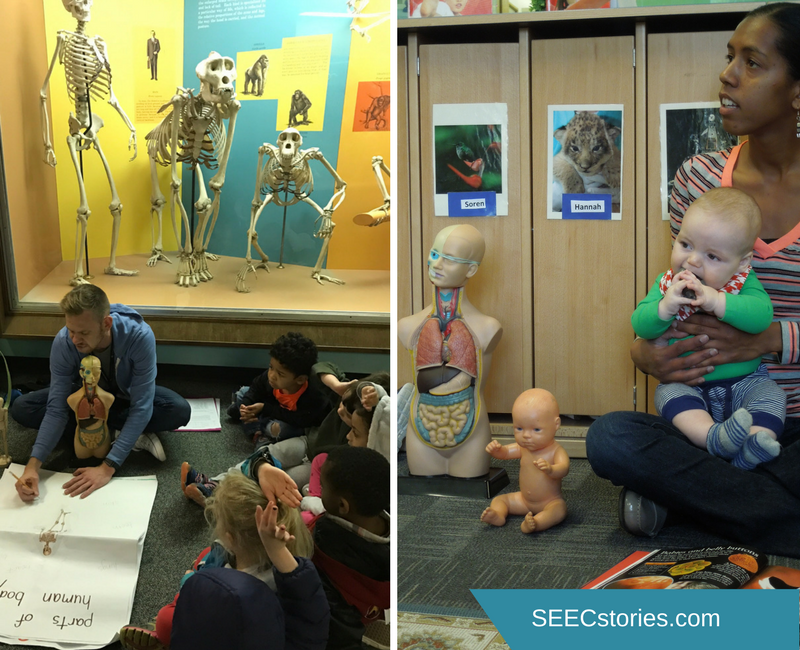
Our bodies are amazing! They hold intricate systems that help us do things like running, jumping, dancing, climbing, hugging, and more. At SEEC we follow an emergent curriculum, but embarking on a Human Body unit is a common occurrence in our classrooms. Young children’s bodies develop so many new skills in such a short amount of time, from growing teeth and chewing, to crawling, to running, to controlling bowel movements. There are many exciting milestones. Children are often curious about this and want to learn more, which has led to lessons about blood, hair, and more. Learning about the body creates an appreciation, respect, and love for all it can do.

4

Identity Work That Goes Beyond the Physical Characteristics

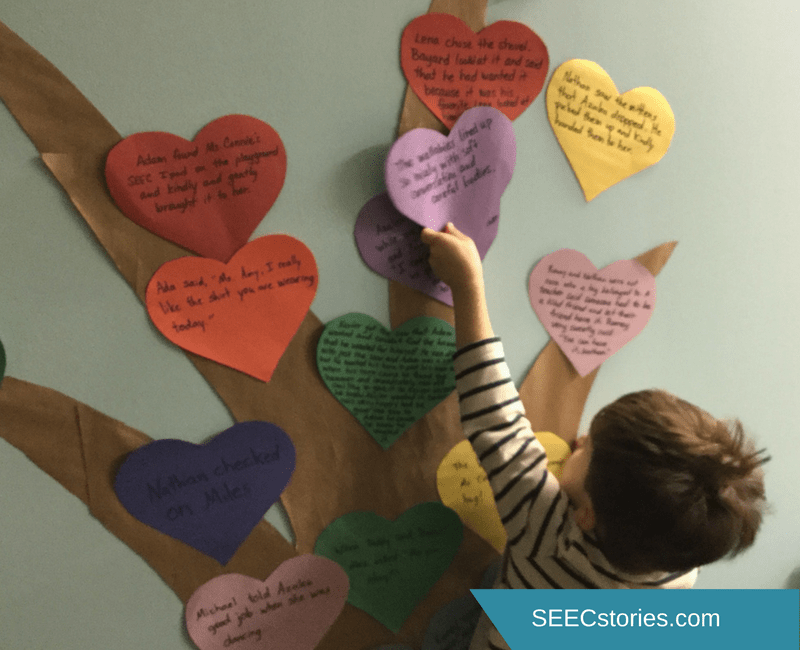
A common topic explored in our classrooms is “All About Me” which encourages children to think about their identity. While we focus in part on outward appearances, we also delve deeper into what makes each of us, “us.” We value those traits and preferences that make us each unique, and those that make us similar. Some of this work happens at the start of a new school year when teachers and children are getting to know each other. We share favorite things and talk about our home and family lives. However, this topic of building our identities does not end in September. Our classes explore this topic through all of their units. For example, during a unit on sports, our preschoolers considered the character traits athletes must have including perseverance, teamwork, and integrity. The class discussed how each child also had these traits and how they help us as people. Another way to value children’s characteristics throughout the year is making note of their actions that exhibit these traits and celebrating them. For example, one of our three-year-old classes has a paper tree in which they add notes to the tree limbs to recognize moments that exhibit character traits. Children are able to celebrate the fact that they are kind, helpful, persistent, brave, etc., which builds their sense of identity.

2

Discussing Media Influences

Even if all the adults in a child’s life speak positively about their and other people’s bodies, we unfortunately cannot escape the media. Children receive messages from books, TV, games, advertisements, and even politicians. Although we cannot control the media, we can have conversations with children that combat stereotypes and negative body talk.

In addition to conversations, adults can provide positive media, such as images and books, that represent the world around them with bodies of all shapes and sizes. At SEEC, we are lucky to be surrounded by the amazing collections of the Smithsonian, including artwork and objects that showcase variety in bodies. However, even if you’re not located near the Smithsonian or other such resources, you can access them online via Smithsonian’s Learning Lab. I’ve created a collection of artwork and objects from the Smithsonian and beyond that reflect a variety of bodies that can be used with young children in the home or school.


As educators, parents, caregivers, grandparents, older siblings, etc., we have the big and important job to guide young children as they are beginning their own journey with developing their self-worth and body image. With this foundation, when children get older and encounter negative body stereotypes and talk, they will have the tools to think critically and reject it.

Changes: Talking with Young Children about Death

This blog is authored by our Director of Infant and Toddler Programs, Melody Passemante Powell. Melody graduated from James Madison University with a BS in Early Childhood Education and earned her MEd in Education Management from Strayer University. She has been working with and for young children for nearly two decades in a variety of roles. In her down time, she enjoys having fun with her two-year-old daughter, wife, and dog Jack.

TRIGGER WARNING: This blog explores the ways in which young children process death and how adults can support them through such a difficult time. The author reflects on her own experience with the death of her mother at a young age and may be triggering to some.


As the philosopher Heraclitus so aptly stated, change is the only constant. Some changes are simple and easy to adapt to, while others might be more complex and can evoke mixed emotions. As our previous blog explored, moving to a new house, welcoming a new sibling, or starting at a new school are changes that would likely cause feelings of nervousness mixed with excitement. Then there are other changes that are incredibly hard and complicated to adapt to, like death. Unlike many other changes in life, death is one change that is often very hard to talk about because it is such a big and complex concept that even many adults have a hard time processing. It can be even more daunting to be tasked with talking to children about death, especially when we ourselves may be dealing with the situation, and potentially grieving at the same time.

SEECstories.com (4).png

I have always felt drawn to this topic because I have a unique perspective as I lost someone very close to me when I was a young child. I went back and forth about sharing my personal experience, not because I have trouble sharing, but because I worried about making others uncomfortable. As I processed these feelings, I realized they were connected to a norm in my culture: to avoid making others feel sad and uncomfortable. I decided that sharing my experience felt relevant and important. Although like most stories associated with death, it may be hard to read.

SEECstories.com (5)

When I was three, my mother died. The situation was even more complicated by the fact that my mother died by suicide. On the day that it happened I had been to play therapy in the morning, where my therapist had told me my mother might try to kill herself again. Unfortunately my mother had tried before and I was aware since I was in the house. On the day my mother died, my Grandma had been tasked with telling me what had happened. After school my Grandma held me on her lap and asked if I had remembered my therapist telling me my mother might try to kill herself again. She let me know that sadly she did today and she died. My Grandma told me that my mother loved me very much, but that she was very sick. She stressed that she had needed grownup help but sadly even that wasn’t enough. My Grandma answered all my questions succinctly without elaboration and took her lead from me.

Later at home in a room of adults I said something to the effect of, “I am sad that mommy killed herself.” My family replied that they were all sad too. I was given space to process and while I do recall being sad, I also remember having a pretty solid understanding that this was permanent and I would not be seeing my mother anymore, likely because this is what I was told. I wasn’t confused because even though it was a very complex concept to grasp, I was given honest, age-appropriate answers about what was going on. My questions were welcomed and I was given a safe space to talk through anything I was feeling or wondering about.

I recognize that my experience is not the same as any other child going through the difficult change of losing someone close to them. Death and grief are deeply personal topics, often connected to our cultures and belief systems. Even within cultures, no two people experience death and grief in the exact same ways. So how do you talk to children about death? Of course it will depend on your personal beliefs, but here are some tips based on my experience, what we know about child development and how young children understand the world around them.

Be honest

Although it can be incredibly hard, being honest with children helps to avoid any confusion. Often what children think about in their own heads may be worse than the actual situation. It is hard to know exactly what to say because every child and situation is different, but here are a few examples of wording you could use in various situations:

Death of an older person or pet: “Sometimes very old living things, people and animals, die because they are very old and their bodies have worn out.”

Sudden death due to illness: “Sometimes people who seem healthy get sick very suddenly. It doesn’t happen very often, but it does happen sometimes.”

Sudden death due to accident: “Our bodies are very strong but there are some things that can hurt our bodies so badly that we die.”

These phrases would be used within a larger, ongoing conversation, but might be helpful as a starting point for honest, age appropriate communication. Young children are better able to understand complex topics when they are able to make personal connections to things in their life. It can be helpful to reference something they are already familiar with to make a comparison such as a plant that was old and died, a pet that died, or a character in a book or movie.

Welcome questions and follow the child’s lead

2

Children are curious by nature, working to understand the world around them. Young children think in concrete terms, so it is best to use clear language and avoid euphemisms that may cause confusion. Phrases like “her body stopped working” or for a child a little older, “her heart stopped pumping blood through her body to keep her alive” are concrete and honest. Phrases like “he is sleeping forever” and “he is up in the clouds now” can cause confusion for children because they will take these literally. Children might worry they may never wake up if they go to sleep. It is normal that children might become nervous or fearful in general when learning about and processing a complex topic like death. When answering questions, be honest, but avoid elaborating unnecessarily. We might think that children need lots of information or we are being dishonest by withholding, but in this case sometime less is more.

Talk about how you are feeling

Everyone grieves in different ways, and talking about your feelings when you are grieving may not be the way you process your emotions, but talking with young children about our feelings is critical for young children. A good rule of thumb is to find times to simply narrate out loud about your feelings. For example, “I am feeling sad about our dog Francis dying. Sometimes when I feel sad, I cry with someone. Other times I just want to be alone.” Mentioning that people grieve in different ways, and even the same person can work through grief in a variety of ways helps children feel safe to feel whatever it is they might be feeling, and safe to talk about those feelings if they wish to. Although it can be difficult at times, not saying anything sends a powerful message to young children that these topics are taboo, and not to be discussed.  over time children begin to make their own assumptions about death and grieving, which may or may not be true. Children as young as infants use social referencing, looking to those they trust in uncertain situations to decide how to act and feel. Showing children that having feelings is a normal, human process, is incredibly important. Some cultures are often taught to suppress emotions, and many children think that crying or feeling sad is not okay, when actually these feelings and expressions are completely normal and healthy ways of coping.

Validate the child’s feelings

www.SEECstories.com (6).png

Validation goes hand in hand with talking about our own feelings. When a child has been sent the message from the important adults in his or her life that grieving, and expressing feelings is okay, they will likely feel safe to express their own feelings. There are no right or wrong feelings and there are no right or wrong ways to process complex situations like death. Remind yourself and your child that grief is a non-linear process. Some days we might feel okay, even happy, and other days we might find it unmanageable to get out of bed.

None of this is easy, especially if you have to talk with a young child when you yourself might be grieving. My personal silver lining from my experience with my mother’s death, is that I am able to remember how I felt when I was younger, and to be able to say that when given honest information, and a safe supportive space to work through their feelings, young children can be quite capable of processing big changes like death. Of course as an adult dealing with these topics when we ourselves are stricken with grief is easier said than done. Remember that you are not alone in dealing with this and there are lots of resources out there to use as support.

Resources:

Related Articles & Book Reviews:

Dealing with Death from the Fred Rogers Company

How to Talk to Kids about Death from the Child Development Institute

Saying Goodbye: Talking to Kids about Death by Christina Frank 

5 Books to Help Kids Understand Death by Heather Feldstein

Top 10 children’s books on death and bereavement by Holly Webb

64 Children’s Book to Talk about Death and Grief from What’s Your Grief?

Books to Help You Explain Death to Children from Aha! Parenting

Books:

1.png

In a Nutshell by Joseph Anthony – This book is about the life of a tree, and the ways it changes, grows and impacts the nature and earth around it, even after it grows old and dies. This book is more abstract and does not deal with the death of a person or a pet. It is a good conversation starter, and a good reference point to look back to when the time comes that you do need to talk about the death of someone or something close to you and your child. The images are beautiful and very eye catching.

A Mama for Owen by Marion Dane Bauer – Luckily, I have not had to talk with my two year old about the loss of someone we know yet, but I know the time will eventually come. We have a lovely book called “A Mama for Owen” and in the story a baby hippo, Owen, is separated from his mother during a tsunami and he is understandably sad. Eventually he is rescued by humans who take him to a zoo, and he bonds with a very old turtle named Mzee, who basically takes Owen in as his own. My daughter talks frequently about this book. “Owen no Mama” she says in a sad tone, “Owen sad”. I will ask her what happens next, and she enthusiastically says, “Finds turtle Mama! Owen happy!”

No Matter What by Debi Mori – My daughter loves this book as well. This is great book to reinforce that our love for our children persists, no matter what. Dealing with death and loss is hard, and it is important that children are sent the message that they are safe and loved even when things are sad, scary, and confusing.

SEEC Speak

Every community, whether it be a neighborhood, family, school, etc., has a unique culture with its own language. Schools typically have common phrases, as it is helpful for children to hear consistent messages from the adults around them. Here at SEEC we call the phrases that are unique to our school “SEEC Speak”. We often hear from parents that when their child first uses these phrases at home they’re not sure what they mean, but as one parent said, they soon “just become so much a part of our lives I don’t even remember that they are SEEC speak!” We have detailed some of our most common SEEC Speak phrases below in hopes that they might be useful in your setting, whether it be your home or classroom!

Dip and Flip

Dip and flip is a trick that even the youngest of children can master and allows them to put on their coat independently. To dip and flip, place your coat on the floor in front of you with the hood or collar in front of your feet. Dip your arms into the sleeves and flip the coat over your head.

Walking On Trains

As we travel to our museum and community visits safety is our priority, therefore we stay safe by “walking on trains”. This means that there’s a teacher at the front or engine, with one to two children holding hands on either side of them. There is also a teacher at the end or caboose with one to two children holding hands on either side. There are also trains in between the “teacher trains”. These train cars can be teacher trains with a teacher and children, or “free trains”, meaning children holding hands without a teacher. In our toddler and twos classes, we generally only have teacher trains, and begin to have free trains in our preschool and kindergarten classes.

Gobble Up

As you can imagine, sometimes our trains slow down and we need to speed up. A teacher will give this cue to our students by saying “gobble up!”, and the children speed up to connect the train once again. Legend has it that the phrase “gobble up” came from a reference to the video game Pac-Man, meaning to gobble up the space between your train and the next just like Pac-Man gobbles up pellets. Whatever the origin, if you’re with a SEEC class on any given day you’re sure to hear “gobble up”, and many of our parents report using the phrase at home as well.

Hands Up, Bubbles In

While we encourage children to talk on our walks and share observations, we want to ensure they are very focused when crossing streets.  To achieve this, we say “hands up, bubbles in”.  The “hands up” refers to putting their free hands up high to ensure that cars see them. “Bubbles in” or “catch a bubble” means that it’s time to be quiet and attentive to the teachers. Children pretend to catch a bubble in their mouth and know that the teacher will let them know when it’s time to talk again.

Friday Song

Our Friday Song was brought to SEEC from a teacher who left several years ago, but it can still be heard throughout our school on Fridays. Teachers love it, children love it and it’s a great way to celebrate a Friday.

Lyrics:

It’s Friday, it’s Friday, it’s the end of the week, it’s the last day, so ___________ it’s on you, so what’re you gonna do? Go _______, go __________, go ___________, go _____________!

Stop, Drop, Hands Up Top!

This phrase is a new one to SEEC, and was picked up by one of our preschool classes from another school who was visiting the same exhibit as they were. The children love it and it’s a great cue that it’s time to clean up and transition to a new activity.


To see all the SEEC Speak phrases in one video, visit our YouTube page. Keep a look out for another installment of SEEC Speak where we’ll outline the language we use to guide children in their interactions with their peers that help build social emotional skills.


Book Club: Free to Learn

For our most recent book club we read and discussed Free to Learn: Why Unleashing the Instinct to Play Will Make Our Children Happier, More Self-Reliant, and Better Students for Life by Peter Gray. We were initially drawn to this book because of how it embraced play and we were excited to read, learn, and discuss teaching methods that are not often embraced by the public schools. Our book club meeting was lively and you can find a recap of our discussion below.

51UmYPiSXHL._SX326_BO1,204,203,200_

Trustful Parenting vs. Trustful Teaching

Gray describes trustful parenting as the belief that “children’s instincts can be trusted, that children who are allowed to follow their own wills will learn what they need to learn and will naturally begin to contribute … when they have the skills and maturity to do so” (26). He explains that this style of parenting has deep roots in human history and was used by our hunter-gather ancestors whose children were “allowed to spend most of their time playing and exploring freely” (28). Gray traces the decline of trustful parenting to the decline of neighborhood playgroups and the rise of fears about safety and future job employment opportunities for their children as well as the role of schools (213 – 218). Gray advocated for a resurgence of trustful parenting and argued that considering alternative schools might be a necessary step to becoming a trustful parent (226-227).

Since trustful parenting and the education system are seemingly at odds with one another. We decided to look critically at the parenting philosophy and see how if it could be adapted to a teaching philosophy that we could embrace at SEEC. In some ways, it was easy for our SEEC educators to say that they were on board with a trustful teaching philosophy. We fully embrace the importance of learning through play and exploration and believe in child-directed learning. We hesitantly agreed to the children’s use (or at least being exposed to) of adult tools, even the dangerous ones, because we believe that children learn through objects. At school, we are comfortable with children taking risks, while as educators we simultaneously try to minimize hazards. This balance between risk and hazards was what Gray was describing when he explained that children are trusted “to have enough sense to not hurt themselves” with “some limits”, such as the “poison-tipped darts or arrows (that) are kept well out of small children’s reach” (29).

There were reasons that we had difficulties embracing the philosophy of trustful parenting and therefore were unable to adequately adapt it. In many ways, being a teacher and trying to impart knowledge on a child goes against the philosophy of trustful parenting. As educators, we all felt that a crucial part of our jobs is to impart knowledge. This means that while being receptive and responsive to the children, we make lesson plans with the goal of opening their eyes to new things. We actively monitor our children to make sure that they are meeting developmental milestones and try to seek out ways to encourage growth in areas that children are not mastering by themselves. While we trust children to learn, we also hope that our children will trust us as teachers to help guide them.

SEECstories.com (4)

Rethinking Shame and Discipline

While Gray mostly focused on shame used as a tool against older children, we found that this argument could be applicable to the field of early childhood education. Gray explains that using shame as a tool to entice children to perform better actually causes an increase in cheating (73). While young children are unable to cheat, they are able to lie and we know that children are much more likely to lie about a situation if they are worried that they will disappoint us. For this reason, we decided that it is crucial to look at how we are treating children when we are disciplining or redirecting their behavior.

At SEEC, we never purposefully shame children into changing their behavior. But, we wondered if there were times when we might have been shaming unknowingly. While having this discussion, we came to another question, “What is the difference between correcting and shaming?” We decided that at least one key component of trying to change a problem behavior without shaming was to describe why that behavior cannot be allowed to continue. Rather than saying “Don’t do that!”, we should say “When you hit, it hurts my body” or ask an older child to explain why that behavior cannot continue by asking them “Is that hurting someone?”. These are pillars of SEEC’s behavior management philosophy and we feel comfortable using them. After reading Free to Learn and thinking deeply about the role of shame in discipline, we left the discussion unable to draw a distinct line between correcting and shaming. In the end, we decided that we all needed to go back to our practices and be mindful of this topic.

SEECstories.com (2)

Alternative Schools

Much of Free to Learn is a description and study of the Sudbury Valley School. Gray explains that to “visualize the Sudbury Valley School, you have to set aside all of your notions of what traditional schools look like, including your notions of what progressive versions of traditional schools look like” (88). We found this statement to be true. Sudbury valley is indeed “something entirely different” (88). The Sudbury Valley School is founded on the belief that the students, as a democracy, run the school and are in charge of their education. Staff members, which there are very few of, are not called teachers “because they recognize that students learn more from one another” (90 – 91) and must be reelected by the students yearly to keep their positions (90). Children are able to explore the entire campus whenever they want, do not have grades or tests, and do not have to join a single class. The principle tenet of the Sudbury Valley School is that “each person is responsible for his or her own education” (91).

In some ways, the Sudbury Valley School was almost impossible to compare to other schools. As a group we found this both frustrating and enlightening. It was frustrating because so many of the practices highlighted seemed impossible to adapt to other schools, particularly public schools. We discussed how some public schools want to be progressive, but testing and pressure make it impossible. The pressure on schools, teachers, and students is so overwhelming that no one is willing to experiment or try new educational methods. This problem also extends past discouraging teachers from experimenting with new educational methods. It was recently discovered that D.C. public schools graduated more than 900 students who had not earned their graduation last year. With this need to push children through the school system, rather than considering their needs, how can schools be expected to take a gamble and embrace such extreme teaching alternatives?

SEECstories.com (1)

Ways to Incorporate Ideas at SEEC

 At SEEC, we are lucky to be able to discuss concepts, adapt them, and implement them in our own ways. Even though our student population is under the age of six, we value their voices. Students as young as two years old regularly hold votes about what the class should learn about next. At the beginning of the school year, our four-year-old classes create a class contract, which explains the rules of the room, and the teachers and students sign it. We are able to embrace democracy within limits and still give each child a voice.

We believe that children are constantly learning from each other. Rather than try to solve disputes, we give children the words to create their own solutions. For example, if two children are fighting over a shovel, we could say, “It is Sally’s turn for five minutes and then it is Jose’s turn for five minutes”. Rather than forcing a teacher directed solution in that manner, we say “I see there is problem here. What should we do to fix it?” The children may very well choose a five minute on, five minute off solution, or they may decide that Jose should play with it because he is wearing blue shoes and the shovel is also blue. So long as both children agree, a SEEC teacher will happily accept this solution. We believe that when children are given the freedom to learn from each other, they learn critical thinking and real life skills. Our goal is to help children discover these skills and grow to love learning.

While we were unable to incorporate all the things that Gray advocated for in Free to Learn, we were able to have a vibrant discussion on the book. In the end, we valued Gray’s embrace of learning through play but advocated that thoughtful educators can have a meaningful place in a young child’s learning.

Celebrating our Faculty

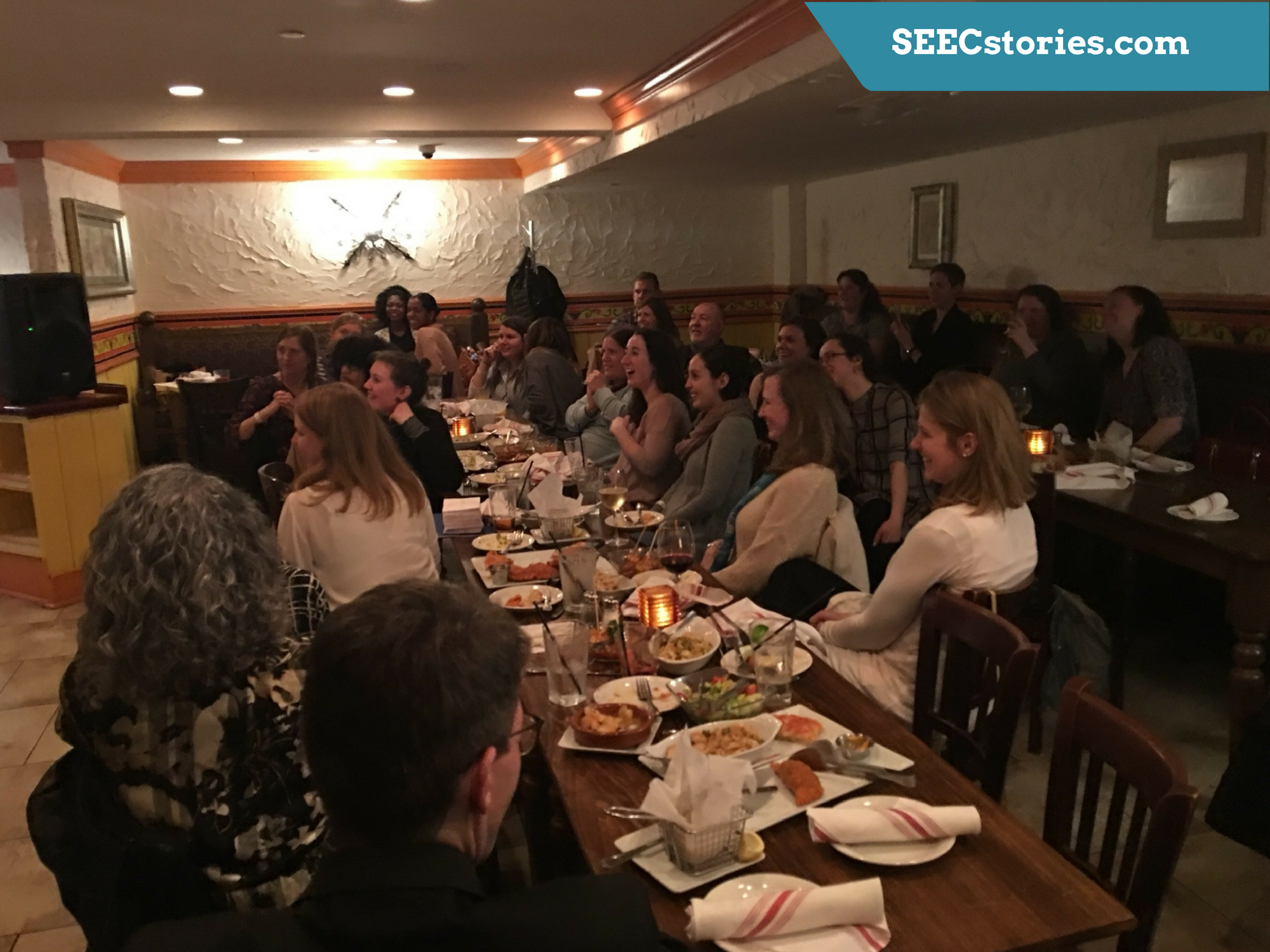
Every year, SEEC hosts a dinner in honor of its educators. This annual event takes place at a local restaurant where we enjoy food, drink, and each other’s company. In addition to the  festivities, we also use a portion of the evening to honor our faculty. This year, our center directors took a moment to individually recognize each of SEEC’s educators. Though our administrative team feels that SEEC is an amazing school because of its unique approach to learning and location on the Smithsonian campus, they also know that at the heart of this school are the amazing individuals who spend their days loving, teaching, and nurturing our students.

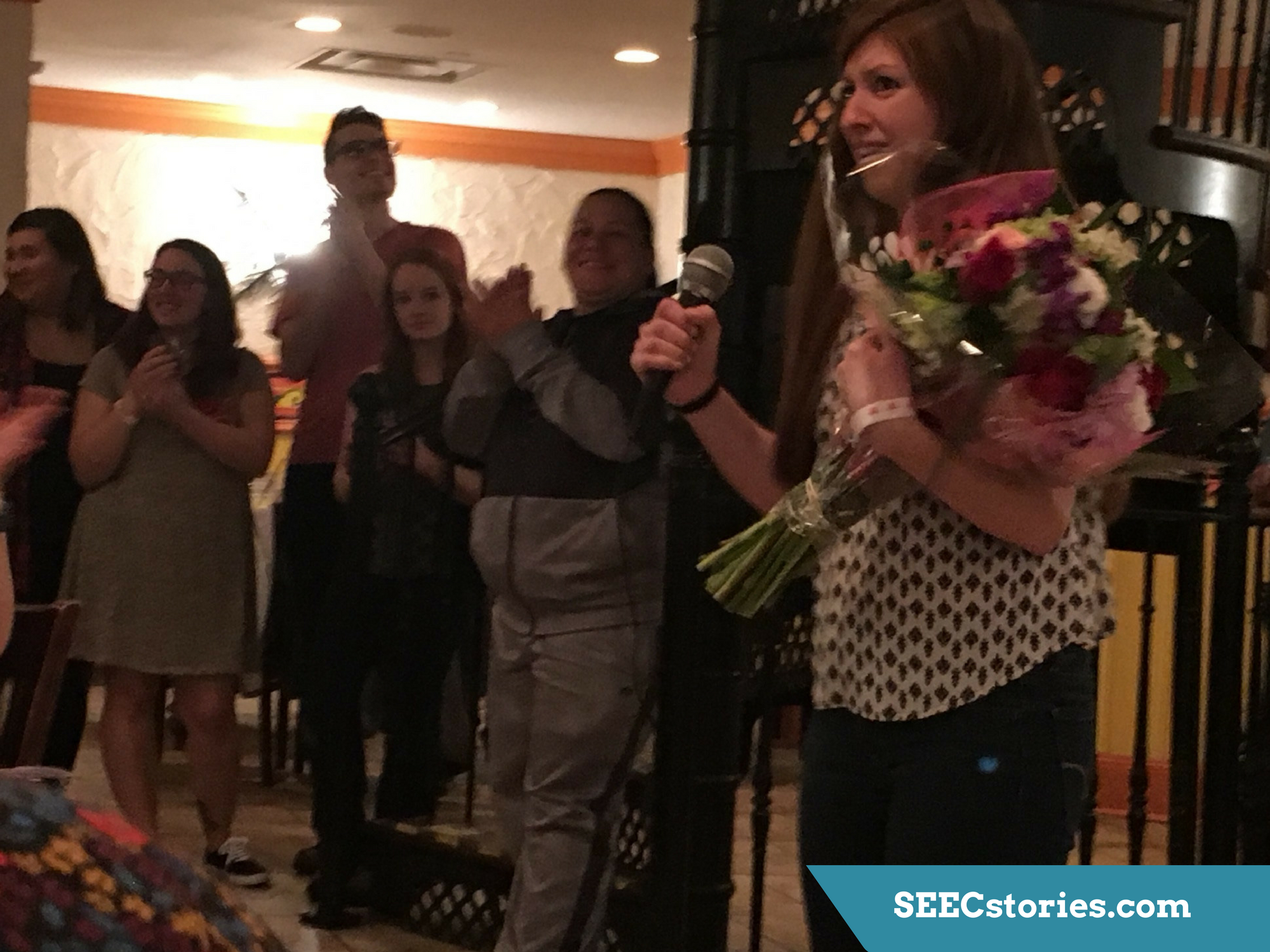
Once we concluded sharing about our team as a whole, a few special educators were singled out for their work. We began by recognizing Jessie Miller, the recipient of the Diane Homiak award. This award is a long-standing tradition at SEEC that recognizes the commitment, creativity, and contributions of a stellar educator. Jessie is an educator in one of our Pre-K 4 classrooms and has been teaching at SEEC since 2012.  She is originally from Norfolk, VA and completed her Master’s in Early Childhood Education at George Mason University in 2015. In numerous nominations from both current and former parents, as well as her colleagues, Jessie was singled out for the creativity she brings to the learning experiences she creates, her boundless enthusiasm and energy, her caring nature, and her ability to tap into the innate curiosity of her students in meaningful ways.

SEEC also  recognizes educators from each of its three centers who are team players. These educators were selected for their willingness to lend a hand, positive spirit, and for contributing to a strong sense of community.  Support educator, Dana Brightful was honored for her work at our preschool location at the American History Museum. Dana realized her passion for teaching young children while in college and has been part of the SEEC family since 2005. Silvana Oderisi, kindergarten teacher, was acknowledged for her work at one of our Natural History locations. Before joining SEEC, Silvana completed her Bachelors in French from George Mason University and taught as a Corps Member of Teach for America. Finally, an entire team from one of our infant classrooms was awarded the team player award for our second Natural History location: Rosalie Reyes, Morgan Powell, and Mallory Messersmith. This threesome truly exemplifies the spirit of SEEC.

All in all, we had more than 30 different educators that were nominated by families and peers this year. It was a difficult decision, but we are so proud of our team and are thrilled to be able to honor their hard work and dedication.

10 Things You Can Do Right Now with Your Child at the Doctor’s Office

5

You made it to the doctor on time, but now you are stuck in the waiting room! Here are a few things to help you and your child pass the time!

  1. Prep for the Appointment: Use this extra down time to help calm any pre-appointment jitters. Help your child transition by describing what will happen between now and when they enter the exam room. This is a good time to break the news about shots so they don’t come as a total surprise.3
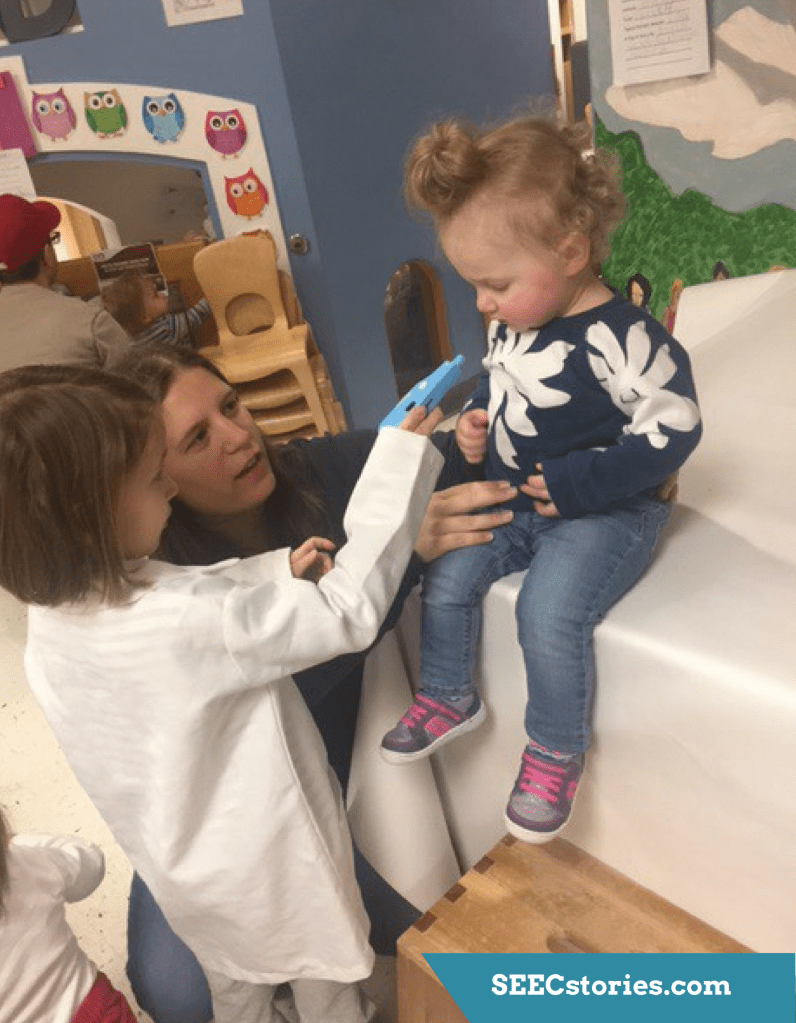
  2. Doctor Pretend Play: Allow your child a chance to pretend to be the doctor! It is a fun and easy way to have your child feel more comfortable.
  3. Magazine Collage: There are always an abundance of old magazines in the waiting room. Ask the receptionist if you can use one for an art project. Tear or borrow scissors to make a temporary collage of magazine images.
  4. Magazine Drawing: Ask the receptionist if you can use one of the older magazines as a sketch pad. Your child can add their own illustrations to the images in the magazine.
  5. Chair Exercises: Get in a little gross motor movement while sitting in the waiting room. In a seated position have your child place their palms on either side of their upper thighs and try to lift themselves up using only their arms. You can also have your child sit on the edge of their seat and have them lift their legs up and down slowly. This engages the abs and helps them build core strength. It will also test their self-control since your child’s urge will be to swing their legs back and forth quickly. You can also search for more ideas on the web using “seated exercises.”4
  6. Play Charades: Take turns miming different activities (eating ice cream, reading a book, etc.).
  7. Play Categories: Take turns selecting a topic and then work together to make a list of all the things in that category. For example, if you select the topic “Animals,” take turns listing all the animals you can think of. For an extra challenge use a letter of the alphabet as the category subject.
  8. Stack Something: No blocks in sight? Not a problem! Grab cups, pens, magazines, or even appointment cards and start building a tall tower!
  9. Practice with Zippers, Shoelaces, and Buttons: Take advantage of this quiet time by having your child practice their fine motor skills. To make it a little more exciting allow them to practice on your clothing.
  10. Write a Thank You Note: This is a simple but impactful activity! It helps the child recognize the role of the doctor as someone who helps take care of them and not someone who is scary. It also helps your child build a habit of gratitude. Who knows, it may also make your doctor’s day!

Have other great waiting room activities? Please share!

Top 5 – Elements of a Great Read-Aloud

This week’s blog is written by Silvana Oderisi. This is Silvana’s seventh year teaching kindergarten and her third year with the Smithsonian Early Enrichment Center where she is the reading teacher. Prior to joining SEEC, she spent two years as a Corps Member of Teacher for American in Tulsa, Oklahoma as well as teaching in the District of Columbia. She is passionate about reading, learning languages, and being active. 

SEECstories.com (2) - Copy

Read-alouds are my absolute favorite part of the day in my kindergarten classroom! You can often find me animatedly reading my favorite stories to my captivated students. Beyond simply reading the text, I am actively asking and answering questions to help my students infer meaning from the text. Not only do I love reading aloud to my students, I make sure to intentionally plan each and every lesson to teach the necessary skills my kindergartners need to develop their literacy and comprehension.

It is well known that reading aloud to children is great for developing early literacy skills like print awareness, one to one correspondence, and letter and sound recognition, but did you know that reading aloud to children could be the most important way to build comprehension skills? It helps young children understand what they are reading by allowing them to make connections, infer meaning, and develop higher-order thinking skills. Reading aloud is an important activity to do at home too, as research shows that children’s brain activity increases when parents or caregivers read to them.

At school, a read-aloud is a planned part of reading instruction where a teacher reads aloud to their students. It is an opportunity for a child to witness the ways a confident, expert reader approaches reading a story. It gives children the chance to hear how a fluent reader reads text with expression and excitement while allowing them to think through the various elements of a story. Most importantly, it is through read-alouds that children are able to experience the way reading can take them places through their imagination.

Here are five ways that I make my read-aloud lessons as meaningful as possible for the children in my kindergarten class.

SEECstories.com (5) - Copy

Modeling Thinking Routines

I always remember that when I am reading aloud to children, they are experiencing the many ways a fluent reader approaches text. One thing that I try to do is model my way of thinking, decoding, and making connections to a story. One great way to do this is to use thinking routines when reading aloud.  Some of my favorites are, “This reminds me of the time…” and “Have you ever…?” Although these types of thinking routines may be second nature for fluent readers, this foundational skill helps children make connections to the real world.

SEECstories.com (3) - Copy

Checking for Understanding

I have to make sure that the skills that I am teaching in my read-aloud are understood by all the children in my group. For example, a student might not be able to make inferences to a certain situation because they have no background schema to connect them to the events in the story. When I ask detailed questions, I can begin to pinpoint where the breakdown in understanding is occurring. It also helps me to glean an individual’s comprehension and understanding. Asking comprehension questions while reading aloud also engages children to think critically about the content instead of simply relying on the adult to break down everything for easy understanding. That being said, it is also important to gradually release responsibility to the child by asking questions throughout reading the text that allow them to build on skills and knowledge they have already acquired.

SEECstories.com (1)

Engagement

Who doesn’t love to see an adult dress up and get silly? This shows that adults are never too old to enjoy a good book and nurtures a lifelong love of reading. It also helps relieve tension for some children who find reading difficult by making it more fun! In my classroom, we love to incorporate dramatic play to encourage children to participate and be involved in reading.

SEECstories.com

Visuals

Children are more likely to remember the content when some type of visual is presented such as an anchor chart. Anchor charts are a great way to make thinking visible. I record strategies, processes, cues, guidelines, and other content on a chart during the learning process. Whether it is an anchor chart with pictures to help them identify the setting of a story or steps that show the moral of a story, these visuals help them to build comprehension and make further connections to the story that is being read. I also use these visual charts as a reference to help the children think about what is being read to them and formulate their answers to questions about the text.

SEECstories.com (4) - Copy

The Right Book

The single most important part of a read-aloud is making sure that I have chosen the right book! I try to choose books that are not only connected to the skills that we are working on, but that are also engaging and exciting. Whenever possible, I try to connect the book to the interests of my students. For example, my students really enjoy books written by Mo Willems, so I incorporate his books into as many of our units as possible. When we were learning about how to identify the setting of a story, we read Knuffle Bunny which takes place in Brooklyn, New York, a place that some of the students had even visited before!

Stay tuned for my list of the Top 10 Books for Kindergarten Read-Alouds!