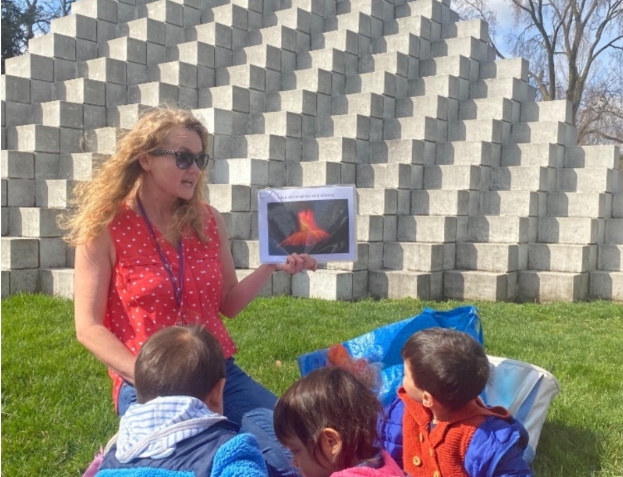
For young children, books are magical, useful, and familiar. They are a classic circle time tool and are wonderful for explaining complex topics. Yet, for many museums no published books exist that explain their objects or their institutional values. Instead of relying on existing children’s books, the Smithsonian Early Enrichment Center (SEEC) has started creating our own books which act as scripted lesson plans with embedded images. These books can be easily applied to multiple programs.
Getting Started
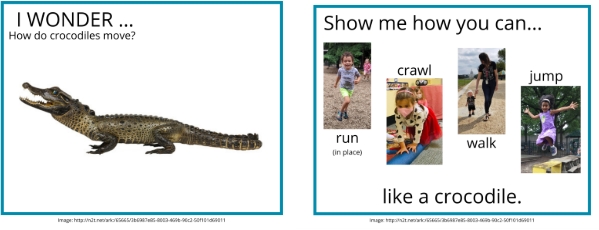
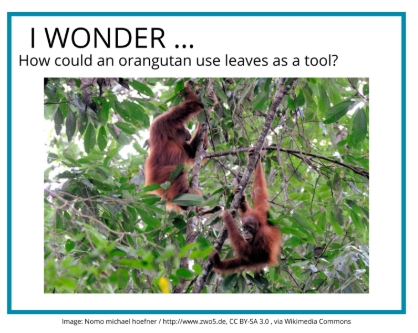
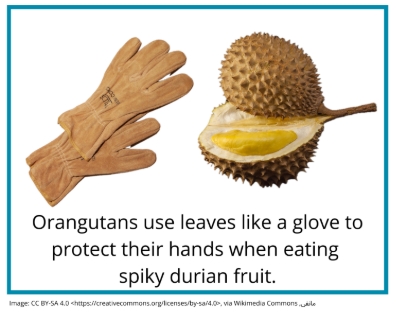
To design our books, we use a presentation program. Best practice is to include one or two large photos and two lines of large font text per page. (There are several examples of pages from our books found in this blog.) If the object needs more context or explanation, it can be included in the author’s note. Books can be printed, laminated, and then collated in a ring binder for ease of use. A photo album service can also be used to create a more traditional looking book.
Interactive Stories
Interactive elements for your story times can be built into the books you create. The book can prompt you to encourage children to pretend, move, sing, and experiment. Writing activity breaks directly into the book allows children to have the opportunity to be active participants throughout the whole story time experience.
Questions & Wait Time
Core museum education practices such as asking questions and giving wait time can be written into books, too. We often ask a question on one page and make sure the answer is on the next page. Making the educator or docent turn the page is one way to intentionally slow down the reading of the story and allow for thoughts and conversations to develop.
Familiar / Unfamiliar
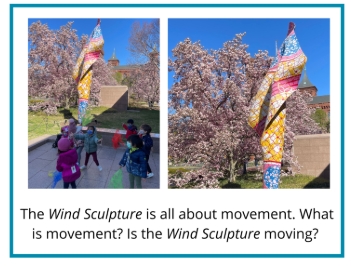
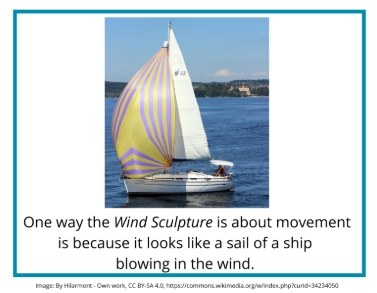
To start creating books, we identify and leverage subjects that are familiar to young children to create context for the unfamiliar. In writing our Wind book, we knew that most pre-k children have some familiarity with sailboats. They may play with boats in the bathtub or may have sailed on a real boat. Early in the book we made the connection that the Wind Sculpture was like a boat. This grounded the book in the familiar, and from there, we made additional connections to the unfamiliar.
Translating Complex Ideas
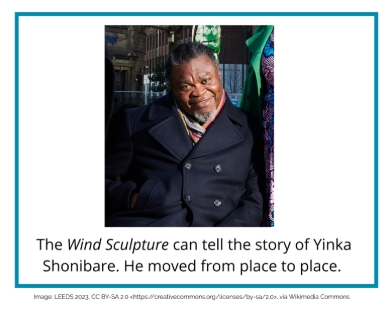
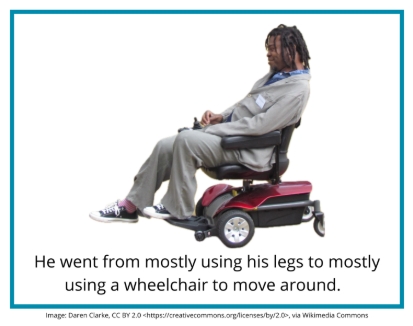
Our goal when creating books is to convey the true meaning of the objects to young children. Since source materials are not accessible to children, it is our responsibility to adapt them to make connections to the familiar. Artist Yinka Shonibare described the meaning of his piece as “None of us have isolated identities anymore, and that’s a factor of globalization” and we translated that quotation as:
Scripts & Key Phrases
Rooted in the philosophy of anti-bias education, SEEC uses the phrase, “We are all the same. We are all different.” This key phrase helps young children foster a positive sense of self while embracing diversity. Since this phrase is core to our hidden educational theories and values, we embed this script into our books. We encourage you to consider what values are core to your organization and how you can create a script that is relatable to young children and reflects those core values.
Longevity of Books
These books that we write can easily be pulled off a shelf and read. This makes them incredibly useful and easier to implement than a lesson plan. We love that they can be used over and over again by different classes and educators. Writing books may not be something that every preschool or museum educator does in their daily practice, but we encourage you to try, and you will likely have a product that you reach for again and again.
The closure of the federal government, beginning October 1st, 2025, impacted much of Washington, D.C. and SEEC was not immune to the ripple effects. SEEC educators began preparing for the possibility of a federal government shutdown by re-evaluating how we utilized our community spaces. Taking our classes into our community on a regular basis is an integral part of our object-based and inquiry-based learning philosophy. What do our days look like when one of the key pillars of our community, the Smithsonian museums our classes call home, is closed for an indeterminate amount of time?
While the Smithsonian museums are a major resource and source of inspiration for our educators, SEEC teachers are also well versed in using other parts of our community to inform their lessons. At SEEC, we believe that learning can happen everywhere, not just in a classroom or a museum gallery. Educators routinely host lessons on the National Mall, utilize local businesses, and tap into creative explorations of places they’ve been before.
From explorations of architecture to farm animals to fairytales, SEEC educators rose to the challenge of using our community spaces during a government shutdown.
Toddlers Explore The Built Environment
Our youngest toddler class, the Toucans, took the government shutdown as an opportunity to switch topics and begin a multi-week investigation of the built environment. These little learners, ranging from 12-18 months old, started their architecture unit exploring various building materials in their classroom.
After looking at wood, brick, and stone, the class went on a walk to MLK Library and made a stop at St. Patrick’s Catholic Church to discuss the materials they could see and take turns touching the rougher stone of the building facade and the carved stone of the archway. The toddler teachers realized that building materials were all around them and that each city block offered a new and exciting learning opportunity for the class.
The Toucans continued their study of buildings and architecture by visiting the construction site at the Hirshhorn Sculpture Garden. The students were so excited to see some of the tools and construction vehicles they had been reading about in their classroom. Through a lot of pointing and excited sounds, the teachers could tell the students were making connections between objects they were seeing on their community visits and the toy versions they had been playing with.
Caption: Toucan Toddler class explores the stone walls of St. Patrick’s Catholic Cathedral and the carved stone of the columns.
Twos Bring the Farm to the National Mall
Prior to the government shutdown, one of our two-year-old classes, the Penguins, began a unit on farm animals. What started as an exploration of horses soon transformed into a deep dive into life on a farm. When the federal government shut down, the Penguins took their classroom outside and enjoyed a nice long walk over to the National Park Services Stables. They compared the barns they had in their classroom to what they could see at the stables. As the shutdown progressed, they continued their investigation of farm animals by discussing pigs and cows.
During their week on cows, the class learned where milk comes from and how milk is turned into butter. The Penguins took their learning back outside to practice ‘milking’ a cow using a plastic glove, water and a bucket. Each student had the opportunity to squeeze the makeshift udder and watch as the ‘milk’ came out and collected in the bucket below. They culminated their week on cows by creating their own butter. Using heavy cream and small, tightly sealed, containers, the Penguins were able to shake the cream until it turned into soft butter. They could see the change happening before their own eyes! This progression of farm animals to food allowed the class to transition into a lesson other foods are found on farms.
Caption: Penguin Twos Class takes turns squeezing milk out of a plastic glove ‘udder’ during their week on cows (left). Students look at horses at the National Park Service Stables (right).
Fours Imagine Fairytale Creatures in DC
SEEC’s four-year-old class, the Honey Bears, expressed interest in storytelling right before the government shutdown began. While they couldn’t visit the National Gallery of Art to look at Rogier van der Weyden’s Saint George and the Dragon, they could pretend to be giants towering about the city on the rooftop of MLK Library. The outdoor rooftop garden was the perfect place to use their imagination and see the world through a giant’s eyes. Four stories up, the Honey Bears read Jack and the Bean Stalk and discussed how different the city looked so high up.
Later that same week, the Honey Bears went over to the water feature outside of the National Museum of the American Indian (NMAI) to talk about what they need to trap a mermaid. The water feature became their mermaid lagoon and using their nets, the Honey Bears searched for mermaids and sunken treasure. These outdoor visits enabled the students to really use their imaginations and practice their dramatic play skills.
Caption: Honey Bear Fours class prepares their net to catch a mermaid (left). Students investigate the mermaid’s treasure outside NMAI (right).
While the government shutdown, and the subsequent closure of many museums, offered challenges for SEEC educators, they were able to make the pivots they did because of the foundational understanding that our community is more than just museums. For teachers at SEEC, the classroom extends beyond the museum galleries and out into the world around us. Our classrooms can be the local library, outdoor fountain, stable, and the exterior of a church. It is less about where children learn, and more about how they learn.
Teachers were able to seamlessly continue the learning happening in their classrooms because they are confident in their ability to teach using real life objects and experiences. While pictures and books are a vital part of early learning, SEEC believes that children learn best through exposure to tangible objects and concepts. This hands-on approach allows students to make connections for themselves and helps bridge the gap between the familiar and the unfamiliar. It is possible to explain to a toddler how cream turns into butter but allowing them to shake a jar until the butter separates from the milk offers a deeper understanding of the process. The hands-on experience moves the learning from conceptual to tangible.
These hands-on experiences and community visits won’t disappear with the re-opening of the federal government. Classes will still take trips to MLK library, explore the architecture of the buildings around SEEC, and visit horse stables. Those kinds of visits will be in conjunction with visits to museum galleries, just like SEEC has done since our founding. We are so excited to bring our classes into all parts of our community and to continue to share how the learning extends beyond the classroom.
This blog was written by guest blogger Carla Barefoot who is an intern at SEEC’s office of engagement. She graduated from the University of Virginia with a major in Youth and Social Innovation and a minor in Global Studies in Education. Her passion for incorporating inclusive and equitable practices in community spaces has led her to strive to increase diverse and accurate representation in museums and youth work more generally.
As a 12-week intern at SEEC’s Office of Engagement, I had the amazing opportunity to dive head-first into contributing to the center’s anti-bias education journey. Although the approach is intentionally being integrated into every component of SEEC, from lesson plan creation to professional development opportunities, my particular focus was on ensuring that there is authentic and diverse representation of identities in the center’s books.
As this previous SEEC blog explores, it is developmentally important that early learners see a broad diversity of individuals in the media they are exposed to. This provides young learners with the opportunity to gain more confidence in who they are, as they may see someone who they find to be similar to themselves in a way. That said, it also allows them to familiarize themselves with people from different communities. In this way, books can support SEEC’s use of language that promotes the idea that people can be “the same and different” in many ways.
My contribution to this journey consisted of four major phases: evaluation, perspective-taking, analysis, and creation.
Evaluation
The beginning of the journey, evaluation, consisted of going through around 370 books at SEEC’s east court library. From here, the books were categorized as either red books, green books, or books to be weeded. If the book had content that stereotyped communities of people, was not developmentally appropriate, used inappropriate language, or was harmful in any way, they were classified as a red book. On the other hand, if the book had good representation of diverse communities and centered a developmentally supportive lesson or skill, they were classified as a green book that is highlighted for educators to use for their lessons, if applicable. Finally, weeded books are either damaged or have lower-quality stories that could be replaced by other books.
Perspective-Taking
This evaluation period served to build the foundation of my understanding of SEEC’s library – the books they had, the types of books they wanted, and those that did not lend to the overall purpose or values of SEEC. That said, I also wanted to look past the theoretical and gage what books were actually being used within the classrooms and how. To do this, I assisted with the weekly classes of the Smithsonian Early Explorer program, conducted informal observations within different classrooms, and asked to interview a few SEEC educators that work with different age groups. Through these experiences, I was both able to directly note how the youth themselves engaged with books when in their classes and gain insight into the thought-processes of educators when deciding when and how to use a book. I could then analyze the information provided from these two sources and draw some overall conclusions.
Analysis
I began by identifying some common themes across the interviews. Some of these include:
Role of books to normalize diverse representation
Importance of developmentally appropriate content
Using books to…
Connect to approaching site visits
Support skill-building
Dig into topics of interest to the class
Prepare for classroom transitions
These themes served as a jumping-off point to then scope out possible Smithsonian objects to center in the books that I would create for educators to use in their lessons.
Creation
When entering the creation phase of the project, there were a few priorities I kept in mind. Firstly, I wanted the content to focus on Latine culture and community, as these topics are authentic to my voice and desired contribution to SEEC’s library collection. Secondly, it was important that the books could be used for years to come, which limited my object search to either permanent exhibits or objects that were frequently rotated into display. Lastly, I found it important to provide educators with a variety of accompanying craft and/or activity choices they could engage their class in after reading the book. In fact, the primary reason why I chose to have such a heavy focus on exploring artist Verónica Castillo’s Tree of Life sculpture was because a SEEC class expressed a substantial interest in the object.
Now that it is the end of my time here, I look at the five books I created and hope that they highlight the importance of telling Latine stories through museum objects. That said, the topics of these books range from community and justice to clothing and identity. You can explore the digital adaptations of these books by clicking on any of the topics below:
Although there is still much to do, I hope the work that I have done at SEEC will lend to one overarching goal: for early learners to make healthy connections between the diverse stories they hear, their sense of self, and the communities with which they are familiar and unfamiliar.
What were your topics of exploration? Why did you choose them? Where did they come from?
During our walks outside, we noticed the Cottontails (infant class) seemed to enjoy when we pointed out the budding flowers to them. It is always exciting when the cherry blossoms reach peak bloom, so we decided to get into flower fever!
Why and how did you choose the visit?
As followers of @smithsoniangardens on Instagram, we were able to see when the various trees and garden displays were blossoming. Because our kids were on differentiated schedules, we needed to choose easily accessible locations so we could easily return to the classroom when our bottles and naps beckoned.
This class had previously learned about nature and plants through visits, art making and exploring objects.
What were your learning objectives? What did you want your children to take away from the lesson?
Sensory exploration is a great entry point for our age group, so our goal was for our kids to get familiar with the sights, smells, and textures of spring. We paid attention to their reactions to see where their curiosities were leading them.
Implementation:
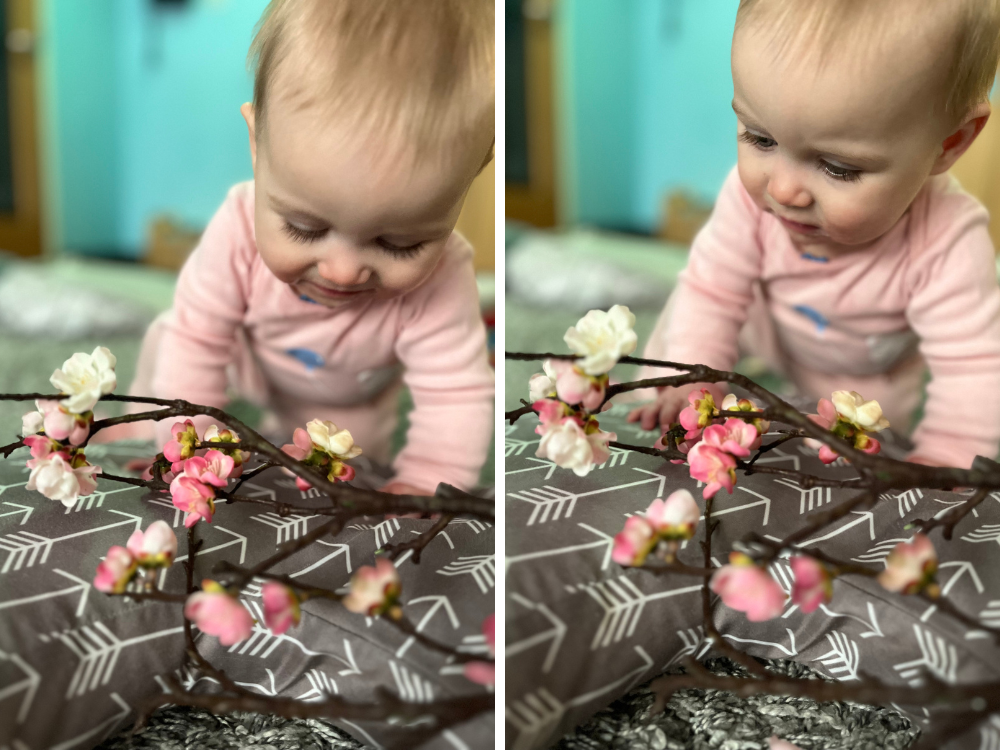
An infant child investigates a faux cherry blossom branch.
What activities did you use to engage the children in in the classroom?
We placed several new materials in the classroom to connect to our outdoor explorations. We brought in live cherry blossoms to decorate our counters and offered faux blossoms to the children for more in-depth investigation and pretend play. We gently fluttered the fake branches and blew on them so that it seemed like the branches were moving in the wind. The children enjoyed trying to imitate blowing the branches – this was also good practice for calming ourselves with deep breaths!
We also brought in baskets of soft, crocheted, cherry blossoms and placed them in baskets. The children practiced filling and dumping the baskets of blossoms and covering their bodies with them.
The class created ”flower petals” by dipping coffee filters in hibiscus and rose petal tea. The warm, yummy-smelling, tea provided a soothing sensory experience that the kids really seemed to enjoy.
Finally, we did a process art activity using hibiscus and rose petal tea to paint on coffee filters. The scent of the tea was delicious, and it created a lovely pink hue on the filters. After the project was dry, we laminated the pieces and hung them in the window for the children to continue to admire.
The infants look closely at and reach out to touch different flower petals including azaleas at the National Gallery of Art and the Saucer Magnolia flowers at the Haupt Garden.
What was it like taking the children out of the classroom to see various flower displays? How did you keep them engaged?
Outings with young infants can be tricky to schedule, especially in the chillier months when everyone has multiple layers to bundle up in! We found success by choosing our destinations strategically and paying attention to our children’s cues. We kept the Cottontails engaged by talking to them about the sights and sounds around us and lifted them out of the stroller to help get them closer to the flower displays. Connecting our adventures with song is another winning tactic – our Cottontails loved playing “Ring around the Roses” next to the azalea display in the National Gallery of Art!
How did you tailor your lessons to meet the learning needs of your age group?
Babies are always taking in information from the environment around them, so we do our best to let them explore freely and notice where their curiosities are leading them. While they aren’t able to communicate with language, we can understand so much by paying attention to what they are looking at or reaching towards.
Reflection:
What was most successful about your lesson?
We were proud of how active and engaged the group was throughout our explorations! By offering plenty of time and support for them to observe and interact freely with the materials and flowers, we were able to build on their natural curiosity and sense of focus.
When the children got a little restless in the stroller the educators helped them take walk (or dance) break and held them closer to get a better look at the flowers.
How did the lesson reach your objectives to expand the topic?
We tried to think creatively about how to offer a variety of sensory experiences that would help our Cottontails get familiar with the sights, smells, and feel of springtime blossoms. We later laminated the art project we made using hibiscus and rose petal tea and displayed it in our classroom window. Even after we had ended the unit, the children could look at the artwork and we would remind them of our springtime explorations.
What recommendations would you have for another teacher trying out this lesson?
Pay attention to the non-verbal cues of your students and offer as much free exploration as possible! Kids put everything in their mouths, so have a plan to discourage snacking on flowers while still acknowledging that appropriate developmental need.
As we move toward Thanksgiving and celebrate Native American Heritage Month, we want to re-share this blog post featuring thoughts from Adrienne Smith of the National Museum of the American Indian. Her thoughtful advice is important any time of year, but is particularly resonant as many people approach teaching about the history of Thanksgiving. We encourage you to look through the many resources (found at the bottom of this article) that NMAI has created for educators, particularly if you plan to approach this topic with children.
At a very young age, a child begins to form their sense of self, even infants can recognize subtle differences between themselves and others. Early childhood educators can play a key role in helping a child form a positive self-image. Similarly, educators can also instill in their young students a respect and appreciation for diversity. It seems like a tall order, but by thoughtfully choosing content and activities and, by creating an inclusive environment, educators can begin to help shape a child who values both themselves, and others.
SEEC has partnered with the National Museum of the American Indian (NMAI) to publish a series of blogs that we hope will begin to help teachers and parents reconsider some of the traditional lessons and activities that are often circulated, especially on social media channels, during the Thanksgiving season. While they may appear fun and cute, many of the suggestions actually perpetuate stereotypes and historical inaccuracies. There has been a long history of misinformation about Indigenous Americans in our school systems and we want to work together to alter some of those misconceptions.
During my early childhood years, I was fortunate enough to attend a preschool that was directed by my tribal nation. When I would walk into the classroom, there were items from my culture and words familiar to me in my tribal language, posted on the bulletin boards and, in our play areas. It made me feel comfortable to be here and see things with which I was familiar. That changed when I entered the public-school system for elementary school. I can recall making paper headdresses and paper roll totem poles. I went along with it because, “Hey, Iknew it wasn’t my culture.” It wasn’t until my adulthood that I looked back and wondered “Why didn’t my elementary or high school teachers use the resources that were readily available?” We had a tribal museum with educators from my tribe who could have come out and spoken to them. Maybe the teachers just didn’t know or were uncomfortable changing the way they taught. Either way, I missed out on being able to connect to my culture while at school.
Working at the National Museum of the American Indian has given me the opportunity to observe what our visitors know about American Indians and sadly, much of it is stereotypical. Below is a list of ways that you, as a teacher, can break through some of those stereotypes and begin to paint a more realistic picture of American Indians.
Teacher Tips
Never assume that there are no Native or indigenous students in your class.
I have had visitors tell me that I am not Native or that I am only a little bit Native because of my green eyes and fair skin. Not all Native people look like what you see in the movies or in books.
Allow students to explore their own cultures and other cultures by including culturally diverse objects, contemporary photos, and toys in your classroom.
Be mindful not to choose stereotypical or culturally insensitive materials. For example, Native people prefer that their clothing not be used as dress up because traditional clothing or regalia is sacred and there are many cultural meanings behind the items that we wear.
Discuss similarities and differences of American Indian tribes, even those that live in the same area.
There was not one Native language or culture. Though Native people adapted to other languages and cultures, each Nation still has their own identity.
Should you teach about regions, for example, “plains” tribes, be mindful to note their differences, as well.
Consider using maps, talking about the environment, and comparing housing to illustrate these differences. They are great examples of the unique attributes of different tribes.
Teach that Native people are still here today.
Share with your students that American Indian nations are vibrant communities that exist today living in the modern world and still honoring their traditions.
Utilize the internet and explore Native American owned businesses. They can provide access to goods for your classroom. I recommend Native Northwest Select or museum gift shops. Do be thoughtful when choosing which site from which to purchase.
There’s More
In a future blog, we will feature actual classroom lessons that will be centered initially on homes, a concept with which most children easily identify. We will then branch out to explore a typical home of the Wampanoag Nation, a wetu. Our goal is to illustrate how preschools can easily incorporate engaging, playful, and interactive lessons that can breakdown stereotypes and build appreciation for the diverse and rich cultures of the American Indian.
Similarly to most schools in the world, SEEC was thrown a huge curveball in March when we closed the doors to our centers and embarked on a virtual journey with the youngest of children. Faculty and families alike worked to find best practices for our children to maintain relationships and engagement while connecting through a screen. Much of our philosophy focuses on experiencing the world in person with strong social interactions, so we wrestled with how this would translate to a whole new platform. Like many others dealing with this new normal, we have been actively trying out new strategies and assessing their success as we go. We wanted to share our successes, failures, and reflections from the past five months through a blog series. Below are some of the themes we will expand on in the coming weeks.
Create a Routine
Children thrive when they have a routine. Knowing what is coming next gives children a sense of control and comfort especially in the midst of a sudden, major, lifestyle change. So it’s not surprising that our faculty found it helpful to outline the plan of the day at the start of each lesson. In addition, our teachers often began each session in the same way, for example, singing a hello song, or doing some deep breathing, and ended in the same way. These subtle cues helped children adjust to adapt to the new “classroom”
Community Connections
While we may all be physically apart from each other, we still need to connect with our community through authentic interactions. We’ve had other school community members join video calls to share their expertise in a topic that the class is learning about. For example, one of our preschool classes was learning about gardening and produce. One of our toddler educators is a gardener and was able to join them from her home and share some of her plants and tools with them. Other ways to connect to the community include sharing related videos and images of community members and safe, nearby, locations that families could visit.
Make it Silly
Life is challenging right now, for parents, teachers, kids, everyone. Our faculty wanted to lighten the mood, so they kept the silliness and fun flowing even while virtual. Some silly strategies they employ are creating characters who appear on the video calls, playing music and having a virtual dance party, and having a week of theme days such as crazy hair day or dress like your favorite book character day.
In addition to needing to keep the silliness, our faculty also quickly recognized the children’s need for plain, simple, social interaction. Some of our preschool classes began having virtual snack time where children signed on and ate their snack and chatted together like they would at school. This has become very popular among the children and it often lasts far longer than the teachers anticipate!
Maintain Relationships
Strong relationships are essential to meaningful learning experiences in early childhood. While more difficult to foster through screens, it is possible! Besides one-on-one video calls between teachers and students, our faculty incorporates photos of the children in their lesson presentation. The children love to see themselves in the presented topic, and are able to reflect on past learning. Each of our classes also has a shared photo album where families can upload photos from the week. This allows children to see each others’ learning and feel a connection with their peers.
Incorporate Objects
A cornerstone of our practice is the use of objects to teach children. We often venture into the museums to observe and learn about artifacts or artworks related to our curriculum, but we also frequently use everyday objects and find that they’re also a powerful tool. While we’re away from the museum, teachers have asked children to bring their own easily accessible objects to the class, which has served several purposes. First, children became more invested in the session because they had something to share to the experience. Having an object also allows for tactile learning that is so important in early childhood when a teacher cannot physically facilitate that from a screen. Sharing objects also allows children to see the variation and nuances of a theme or concept, expanding their view of the world.
We’re taking everything we’ve learned and incorporating it into Virtual Family Workshops this fall. To learn more and register, check our Family Workshops page. Also, be sure to check back for more blogs expanding on the above themes.
Museum educators have been practicing object-based learning (OBL) for years. It has been written about and discussed extensively. This blog isn’t so much meant to expand on that literature as it is meant to explore how OBL is used within the SEEC model.
First, let’s define SEEC’s learning environment. We are so much more than a daycare. We consider ourselves a school whose approach is defined by high quality early childhood practice. Our curriculum is emergent, and we use the community – not just museums – as part of the learning experience. Moreover, our Office of Engagement focuses on family learning via both long-term and stand-alone programs.
Definition
How does SEEC define OBL? At the center of our definition is, of course, the objects on display at the Smithsonian. All of our classes, even the infants, visit the museums regularly. While the experience will look different for each age group, all children benefit from being in front of an object. There could be an entire blog on this topic, but we recognize the importance of seeing the real thing – the awe and wonder it inspires. For children under two, who can not necessarily grasp the significance of these objects, the value often resides in their exposure to new spaces, things, and environments.
Tactile
Because our children are young, we add an additional layer to the OBL experience – the tactile component. Children are concrete learners who explore using their senses and therefore, employing objects that can be handled or physically experienced adds to their learning. This can be a toy, like the boat pictured here, or it could be an element that somehow better describes an object. For example, manipulating a ballet shoe while looking at one of Degas’ dancers.
Sensorial
At SEEC, we expand upon this idea to curate a sensorial experience by adding components like feeling the wind while looking at this painting at the National Gallery of Art by Winslow Homer. The moving air, though not a physical object, certainly takes on that role with the learner. What’s important for the young learner is that they get to observe the wind portrayed in an actual object, like a painting, and feel the air moving on their faces. These experiences enhance their understanding.
Experiment
Likewise, the “object” can also be defined as an experiment. Imagine that a class visits the transportation hall at the American History Museum or observes vehicles moving on a street. The group could experiment with wheel shapes. A teacher constructs a car out of cardboard and uses a simple ramp to demonstrate how the car moves with wheels that are square, circular and triangular. Students quickly see the benefits of having a circular wheel and begin to recognize differences in shapes and how they connect to things in their everyday life.
Nature
For educators working in or using informal learning environments, object-based learning should be considered through a wider lens – one that helps young children to experience and explore via multiple modes. Finally, OBL also corresponds to nature-based learning. Just this week I observed how a lesson on nests with toddlers incorporated both museum objects and nature. The lesson started out by looking at nests sculptures displayed outside the Natural History Museum and concluded with the children making their own nests by collecting twigs, grass, and leaves. To add an additional layer and to help the children better interact with the animals, the children helped throw birdseed and watched as the birds came to eat.
Valentine’s Day is almost upon us, and we’ve put together a list of our Top 5 books that can be read in conjunction with the holiday. While none are specifically about Valentine’s Day, they each explore a relevant theme. We’ve also included ideas on how to extend the book reading into an activity at home or a visit in the community. Happy reading!
My Heart is Like a Zoo by Michael Hall – With its bright colors and whimsical artwork, this book is sure to appeal to young animal lovers. Plus, all the animals are made from heart shapes. Can you count the hearts you see? Extend it: Explore the shape of a heart! Cut hearts out of felt and allow your child to play with them on a fleece blanket. See what kind of patterns or combinations you can make together. Can you make any of the hearts into an animal shape?
Dear Juno by Soyung Pak – Valentine’s Day is all about expressing affection to those you love, but what if a loved one lives far away? This is a story of a boy who sends letters back and forth to his grandmother who lives in faraway Korea. With the ubiquitous nature of email, many young children are not as familiar with physical mail. Dear Juno illustrates how a physical letter or drawing can capture a feeling of love and closeness that will be sure to leave your child wanting to send some snail mail.Extend it: Visit the National Postal Museum or the local post office to learn more about the mail system. Then create a valentine for a family member or friend and mail it to them. Let your child help stick on the stamp and deliver the mail to the closest mail box!
Loving by Ann Morris – This book may be almost 30 years old, but it still resonates today. The photographs and text illustrate the ways in which people express their love for each other, from giving a child a bath to giving a hug. The photographs depict a variety of people and environments around the world, which sends a message that we might have differences, but there are similarities that all people have in common, one being love. Extend it: Discuss with your young one something that you do that shows them you love them. Tell them what they do that makes you feel loved. Ask a grandparent or older family friend to tell you about what their parents did to make them feel loved and see if it’s similar to what you do.
The Kissing Hand by Audrey Penn – Sometimes things scare us, but with support and encouragement from loved ones, we can face our fears. This story illustrates this notion, as Chester the raccoon, who is apprehensive about starting school, feels love from his mother all day long through the kiss she plants on his hand. With all the changes that young children experience, this is a great story to illustrate that the love of their family is with them, wherever they go and whatever they do.Extend it: Visit to the Hirshhorn Museum and Sculpture Garden to see “Untitled” (for Jeff) by Felix Gomez-Torres. Read the book in front of the large scale artwork. Compare Chester’s raccoon hand to your own hands and the hand in the artwork. What is similar? What’s different? Then think about what loving message you want to leave on each others’ hand. Bring a couple sheets of paper and pencils. Trace each others’ hands and then take some time writing or drawing loving messages on each others’ hand outlines.
See a Heart Share a Heart by Eric Telchin – Eric Telchin, author and photographer of this book, finds hearts in some unexpected places! From the beach to a piece of wood to an onion – he’s captured all the hearts he’s seen over the years. You can even go to his website to see more hearts he’s spotted.Extend it: You tend to see lots of hearts around Valentine’s Day, but what if you searched for them in unusual places? Take a walk outside and hunt for heart shapes. Can you create heart shapes from leaves or sticks you find on the ground?
“Teacher Feature: Infant Class Explores Farm to Table” was originally published on January 4, 2018. We are posting it again to help people embrace teaching farm to table units.
This week’s teacher feature highlights one of our infant classes. The teachers in the class, Mallory Messersmith, Morgan Powell, and Rosalie Reyes, were inspired by National Farm to School Month to lead their class on a month-long exploration of food and community. For this outing, the class went to the United States Department of Agriculture Farmers Market to learn about locally sourced fruits and vegetables. Below you will find images from the lesson and reflections from Mallory, Morgan, and Rosalie.
Preparation:
The preparation for this outing began well before the day of the visit. The class had spent several weeks exploring local produce before venturing out to the USDA. The teachers, Mallory, Morgan, and Rosalie, educated themselves about National Farm to School Month and did some research of their own.
Mallory, Morgan, and Rosalie were then inspired to create a unit around the idea of farm to school because of the many diverse areas of exploration that the study of fruits and vegetables offered their class, including colors, shapes, and textures. Additionally, they noticed that many of their students were starting to eat new solid foods. They sought to align their lessons in the classroom with the developmental milestones the children were experiencing regarding eating new foods.
The teachers transformed their classroom for this unit. They carefully thought about how to organize the room to best fit the needs of their students and were excited to create experiences that were conducive for learning.
To begin preparing for their unit, Morgan, Mallory, and Rosalie chose a collection of art prints and created their own works of art to post throughout their classroom. They paid special consideration to their students’ cubbies where they posted images of fruits and vegetables. Mallory even crocheted fruits and vegetables to add to the classroom. Since many children in their class were actively learning to crawl, the teachers taped images to ground for their class to explore while on the move. They also researched and chose children’s books to add to their classroom collection and brainstormed which produce to highlight with the class.
The children also took part in the preparations for the outing well before the actual day. As a class they explored fresh fruits and vegetables. They often started with the whole produce and then began cutting and breaking them apart to see what was inside. The process of exploring the fruits and vegetables quickly became a sensory experience for the infants as they touched, smelled, heard, and even tasted the various produce.
The class explored most of the produce using sight, touch, smell, and sound. The children were able to use their sense of taste when interacting with the avocados and strawberries for a more immersive experience. For both strawberries and avocados, the children looked at and touched images of the produce. They then compared the images to the real produce before and after it was cut up. Mallory, Morgan, and Rosalie believed that it was important for the children to be able to make connections between the whole product, which the children do not always see, and the cut up portions that the children regularly eat at snack time. To finish the experience, the class had the opportunity to sample! The strawberries were a big hit, but many students were a little more cautious about the avocado. This immersive, multisensory experience left the children with a greater understanding of the food that they eat.
The teachers also combined this multisensory teaching approach with thinking routines including See, Think, Wonder to encourage curiosity and new understandings. Since many of their infants were preverbal, Mallory, Morgan, and Rosalie would verbalize out loud the different things that they saw, thought, and wondered while the children in their class were exploring the various fruits and vegetables. The teachers were careful to keep in mind that this might be the first time that their class had been exposed to many of the images and objects and allowed time for the infants to experience and make discoveries. One particularly fun lesson that built upon the multisensory and thinking routine approaches, was when the infants were exploring the red cabbage. As the children were bending, breaking, smelling, and feeling the texture of the cabbage, Morgan began to read Eating the Alphabet by Lois Ehlert. As she read, she asked questions about the colors, textures, and sounds that the class heard when they were peeling the leaves of the cabbage.
Lesson Implementation:
The USDA holds a Farmers Market on Fridays throughout the spring, summer, and early fall. SEEC classes regularly visit to see the produce, buy snacks, and enjoy sitting on the grassy lawn.
Mallory, Morgan and Rosalie chose to visit the USDA’s farmers market in part because of its accessibility, since it is just off the National Mall and not far from their classroom. They also wanted to embrace the community aspects of the visit, as the farmers market is a great place for people to gather. This community space has picnic blankets and open space for people (including this class) to sit, gather, and reflect on the experience of being at the farmers market. It was a perfect fit for this lesson because it encouraged the children to make connections between the familiar foods that the class eats every day and the less familiar, whole, unprocessed, muddy foods that they saw at the market. Mallory, Morgan, and Rosalie brought objects with them to enhance this community visit, including soft and hard toy fruits and vegetables and a board book to read to the group.
As the class approached the farmers market, they paused at the People’s Garden. This small urban garden in the heart of Washington, DC expanded the children’s experiences in and understanding of the city that they live in.
At SEEC, teachers regularly take their classes on museum visits where they connect ideas that they are learning about in the classroom with museum objects. They often extend their lessons beyond the museum doors while still using the same techniques that they used on the community visits.
When asked to explain why it is important to take infants on community and museum visits, Mallory, Morgan, and Rosalie cited this quotation:
“Our connections to the people, animals, and plants around us make us who we are. Humans are not a solitary species; we need one another to survive. In the same way that children need opportunities to get to know the natural world so that they can develop a strong relationship with it, they need that same opportunity to connect with the human and human-made community that they are a part of. When children develop a strong relationship with their community at an early age, they grow up knowing and feeling a strong sense of belonging.”
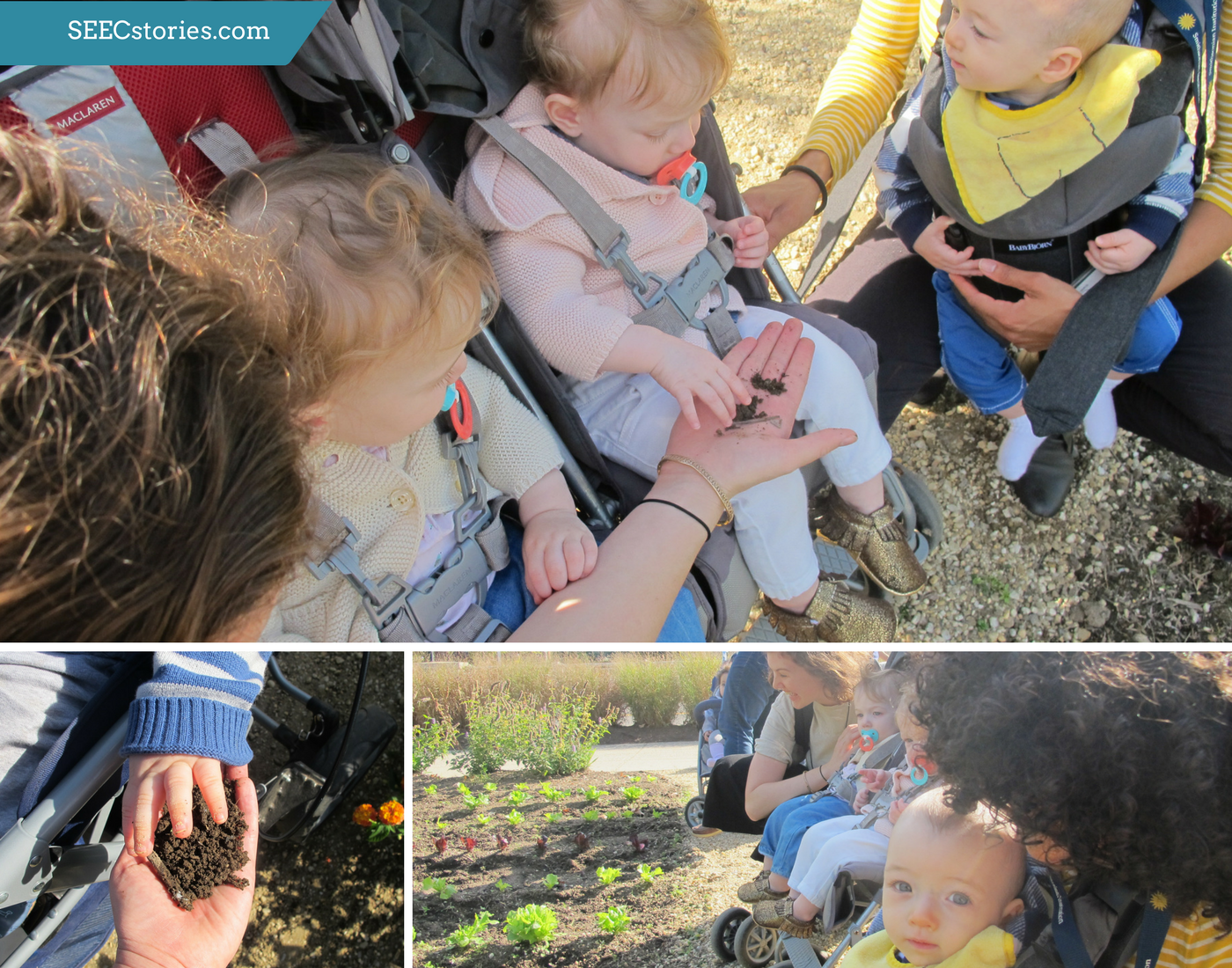
Mallory, Morgan, and Rosalie encouraged their class to touch and explore the dirt when they noticed that their class was interested in it. Some teachers and caregivers might be hesitant to encourage their young children to play in dirt, but at SEEC we believe it is a vital part of learning.
While strolling through the People’s Garden, the class paused for a moment and reached to grab handfuls of soil. This part of the lesson was actually completely spontaneous! The teachers noticed students pointing towards the ground and saw it as an opportunity to follow their curiosity and facilitate hands-on learning. Through these early experiences with soil, children learn that soil is a living system full of healthy and fascinating relationships. The educators were also able to connect back to soil later during the visit by pointing out dirt on some of the produce the children were examining at the Farmers Market.
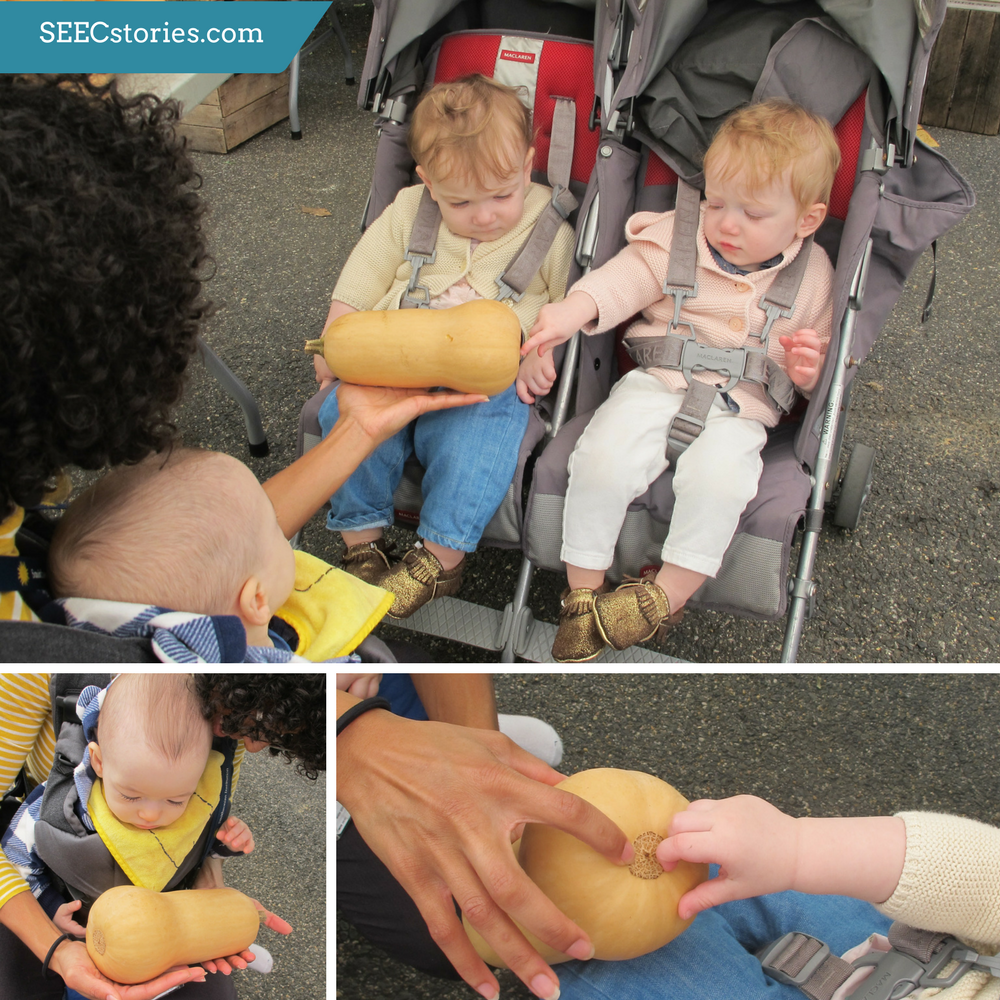
As the class passed through the booths at the farmers market, they paused to examine some produce like this butternut squash.
While exploring the butternut squash, the children not only touched the smooth sides, but also noticed how the textures of the squash changed as Rosalie rotated it. When she turned the squash on its side, the children immediately reached out to touch the small, dry area of the squash. Even though the children could not talk yet, the teachers, Mallory, Morgan, and Rosalie, were able to follow each child’s nonverbal cues. The teachers paid special attention to the things the children were pointing to, the changes in their facial expressions, and their use of sign language. In fact, throughout the lesson the children regularly signed “more” as they moved from one booth to another, signaling that they wanted to explore different types of produce. When the children signed “more”, it helped Mallory, Morgan, and Rosalie know that the children were enjoying their visit and wanted to continue.
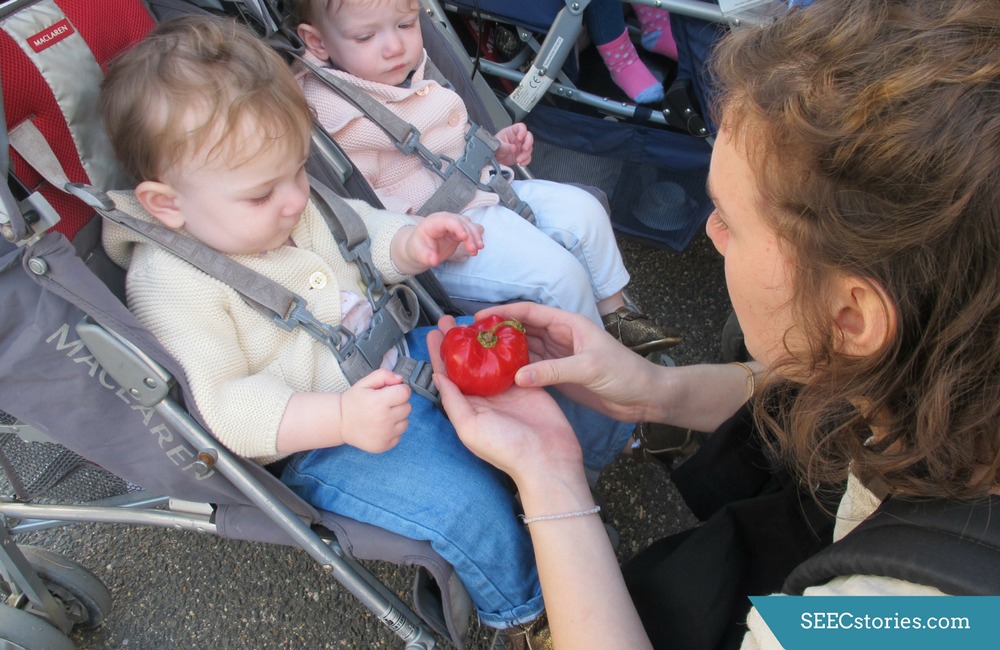
As they walked, the class continued their sensory exploration by touching smooth red peppers, bumps on an acorn squash, and the rough stems of a pumpkin. Both students and teachers seemed to believe that their trip to the USDA’s Farmers Market was a huge success.
Mallory, Morgan, and Rosalie were so excited to take their class to the farmers market because this was their first trip outside as a group! The teachers had spent the month hoping that they could visit the farmers market for this unit and on the last Friday of the month they were able to make it work! Even the journey to the Market was exciting for the students; they experienced the sights and sounds of a beautiful autumn day outside in Washington, DC. The class noticed squirrels, fall foliage, and insects on the trip across the National Mall. Once the class arrived at the market, Mallory, Morgan, and Rosalie were happy to see their students so engaged with a variety of produce. They also embraced the unplanned moments, including feeling the dirt and meeting a big, fluffy dog which made their outing extra special.
The class gathered on a blanket to play with toys from the classroom and explore produce that they had bought from the farmers market. A major component of this time was Mallory, Morgan, and Rosalie singing various songs.
After the visit to the vendors at the market, the class gathered on the grass near the market. As part of the Friday Farmers market, the grassy area has lawn games set up as well as communal picnic blankets, which the class used for their outdoor story time. The teachers made sure that each child was engaged by offering them toys from the classroom and produce that they had recently purchased from the market.
Once everyone was settled in, the class looked at some pages in a book and sang a variety of songs. They sang a variety of autumnal songs that the music teacher, Ms. Allison, had introduced to the class during October. One song was about a pumpkin, big and round; another song was about autumn leaves falling down. They sang the pumpkin song as the children touched the pumpkin. As children began venturing off their blanket and started to explore the leaves they found on the ground, Mallory, Morgan, and Rosalie sang the autumn leaves song. It was clear that the children enjoyed the songs as they rocked their bodies to the beat and even clapped along.
Reflection:
While the group was engaged singing and looking at books, Mallory, Morgan, and Rosalie encouraged individual exploration. This child discovered that he could lift the pumpkin by its stem as the class sang the song “Orange Pumpkin – Big and Round”.
Since their class is composed of young children, much of the beginning of the year is focused on learning and supporting each individual child’s feeding and resting schedule. This complicates finding time to go on outings. However, when the opportunity arises to go on a trip, Mallory, Morgan, and Rosalie, jump on it, as they know the benefits of getting their class out of the classroom for experiential learning.
When thinking about what the class could have done differently, Mallory, Morgan, and Rosalie thought it would have been nice to bring food for their class to eat while on the picnic blankets. They explained that bringing food to taste would have enhanced their class’ experience beyond seeing and feeling by adding the sense of taste.
After the visit, the class continued to build upon what they had experienced that day. The children decorated canvas bags which would be perfect to take to the Farmers Market for shopping. To decorate, the children mixed and splattered paint with their hands, feet, and brushes. At the end of October, the bags were sent home with a small gourd inside. It was a great way to finish off the month!
If you visit our toddler and twos classes you are bound to hear joyful voices singing songs as they begin their morning routine. The classes sing hello to each student, use songs during their morning circles, and to help ease transitions throughout their day. While a chorus of young voices is undeniably sweet and fun, their singing is helping to set a strong academic foundation by strengthening the children’s pre-literacy skills.
Songs & Vocabulary
When children hear a song, they are exposed to new words. The words that young children hear, whether spoken or sung, are the words that form their vocabulary. The repetitive nature of many song lyrics, combined with the fact that children are likely to hear the same song many times, gives them the opportunity to fully learn new words. Later in their academic lives, this understanding of a variety of words will help with their ability to read and their overall reading comprehension.
Songs, Sounds, Rhymes
For very young children, listening to songs exposes them to the many different sounds that make up our words. As you sing a song, you emphasize certain sounds and by doing so, you highlight the building blocks of our language. Singing gives the youngest children the opportunity to mimic and communicate with these sounds in a way that is ideal for toddlers. When singing, they are given the freedom to be loud, let their voices ring, and play with sounds. Additionally, a child whose words often slur together or who regularly skips words while speaking is often able to sing a tune in such a way that an adult will know what they are singing. This can hold true even in cases where the adult is not able to understand many of the individual words being sung. Children rely on the sounds they learned while singing when they start sounding out words and when they are developing the ability to read.
As young children develop pre-literacy skills, they begin to have the ability to rhyme. Singing songs such as Willoughby Wallaby Woo, Down by the Bay, and Silly Nilly Name Song allow children to explore rhyming sounds while singing. Pausing before you say the rhyming word can give the children the chance to fill it in, which helps children progress from hearing rhymes to creating their own rhymes. These singing games can provide hours of entertainment while challenging young children to explore sounds and rhymes.
Songs, Symbols, & Letter Recognition
A crucial component of learning to read is recognizing that the letter “m” means the sound “mmm”. In order to learn this, children must first understand the use of symbols, because the letter “m” is a symbol for the sound “mmm”. Children begin recognizing symbols well before they are ready to read and symbol recognition is considered an important pre-literacy skill. While using songs to help children understand letters may seem unlikely, song cards offer the ideal opportunity to pair singing with symbol recognition.
Songs cards are images that are used to represent or be a symbol for a particular songs. For example, an image of a sun might be used to represent Mr. Sun and a star might be used to represent Twinkle, Twinkle. When using song cards, make sure that image is large, engaging and/or colorful. Also be sure that the images are double sided and laminated for durability. Then dramatically spread the song cards out in the middle of the circle and encourage the class to explore the cards. As they pick up the images, sing the corresponding song. Over time, children will learn that specific images represent their favorite songs and will go out of their way to find these images. Young children love using these song cards because it helps them to communicate what songs they want to sing without having to come up with the name of the song or even the tune. In essence, song cards help young children to learn about symbols in a way that is appealing to them by helping to fulfill their need to communicate their wants and desires.








 students in your class.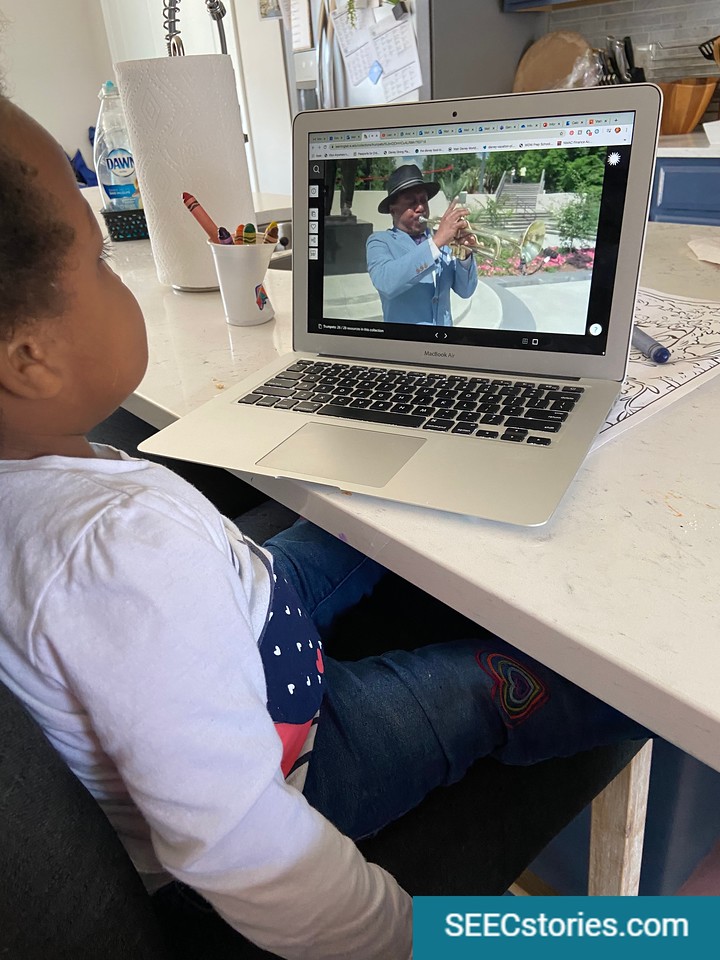




 If you visit our toddler and twos classes you are bound to hear joyful voices singing songs as they begin their morning routine. The classes sing hello to each student, use songs during their morning circles, and to help ease transitions throughout their day. While a chorus of young voices is undeniably sweet and fun, their singing is helping to set a strong academic foundation by strengthening the children’s pre-literacy skills.
 seecstories.com