BYOB: Bring Your Own Baby

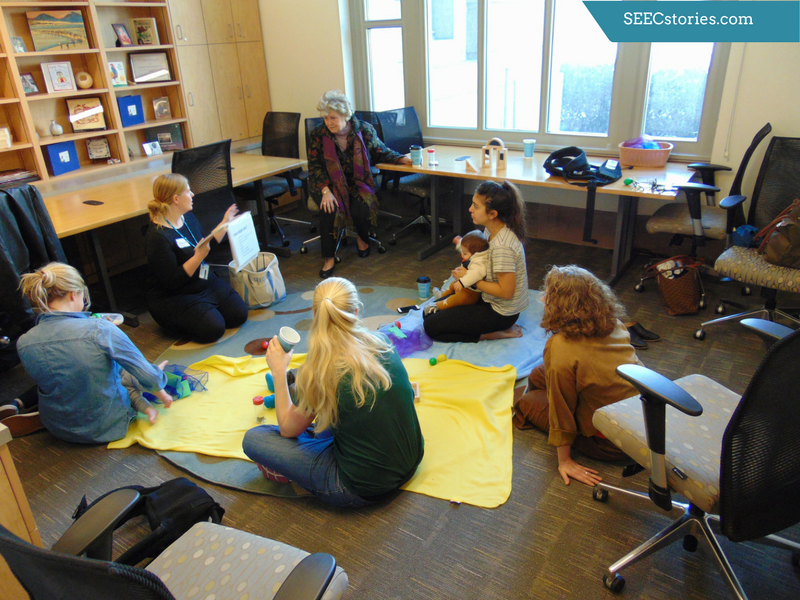
SEEC recently began the new program Bring Your Own Baby, which we fondly call “BYOB”. This program expands on the rest of our programming in several exciting ways. More than our other programs, such as our Family Workshops or the Smithsonian Early Explorers, BYOB is geared towards the adults who are bringing the children. The program is broken into two parts – coffee and play and then, a museum visit.

SEECstories.com (1)

In the development of this program, we considered the needs of both the adults and the babies. The class begins with coffee and the opportunity to meet and chat. We decided to begin this way for two reasons. The first was that we wanted to build in time for a flexible start since we know that it can be difficult getting yourself and your baby out of the house on a schedule (and kudos to all those who try!). We were also hoping to provide parents with the opportunity to create a community through conversation. The topics discussed have been seemingly endless, ranging from how much sleep everyone got the night before to their favorite Impressionist artist.

SEECstories.com (3)

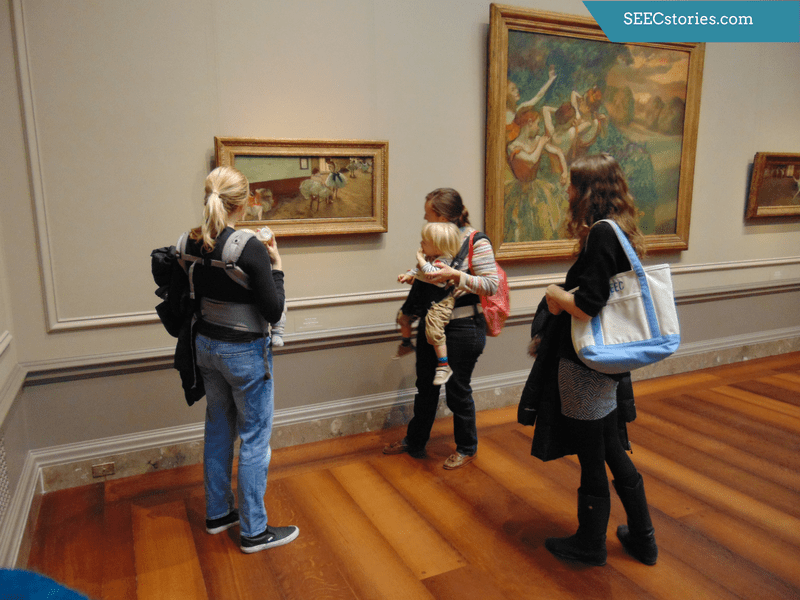
As we head out into the museum, we are mindful that babies can sometimes be fickle. We are comfortable with crying, babbling, nursing, and even cutting the adventure short because somebody (caregiver or baby) needs to go home early to take a nap. Our flexibility on these tours makes the sometimes stodgy world of museums more approachable for caregivers and babies alike.

SEECstories.com

For these museum tours, we are hoping foster flexible thinking and spark the imagination of grown-ups rather than going quickly between objects and paintings and unloading a barrage of facts. To make these tours informative and interactive for adults, we have found ourselves modifying many of the tools that we use with young children. This makes our programming more playful and interactive than many programs geared towards adults. We believe approach to learning will make it more likely for you to learn something and leave the experience with something new to ponder.

SEECstories.com (4)

While the programs are written for adults, we could never forget the babies that are tucked away in their carriers. As the tours progress, we discuss theories in early childhood education and offer ways to incorporate this research into your interactions with your child. We show off some tips and tricks about how to make museum visits beneficial and enjoyable for young children. Our goal for this program is to help parents and their babies have an enjoyable time in the museums.

If you are interested, please sign up for one our our upcoming BYOB classes.

Looking for ways to engage your infant? Check out our Pinterest board on Infant Activities for ideas. 

Smithsonian Early Explorers

**Please note that the 2019-2020 school year, SEE will be meeting at the Hirshhorn Museum and Sculpture Garden on Mondays and the National Museum of American Art on Tuesdays.

We are about embark on our fourth year of the Smithsonian Early Explorers program. The upcoming anniversary is a little bittersweet as some of our long-time families are leaving the program and moving on to preschool. The toddlers who began this program have grown into competent three-year-olds who are capable, empathetic, and ready for their next big adventure. The adults will also be missed as they have become part of our SEEC community and really helped us reflect on the overall program.

To celebrate the development and growth of the program and it’s students, I thought it would best to tell the story of SEE through photos in the hopes of capturing what makes this program so unique.1
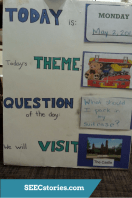
Like many early education programs, we begin our day with a schedule. SEE also includes a “Question of the day.” Our belief is that asking questions can lead to a life-long habit of analysis and critical thinking. These questions also help caretakers who are not present learn about their child’s day.

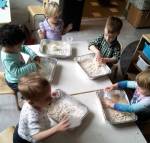
Each morning we invite our students to play and often include real objects or materials.  This helps create authentic experiences that support a child’s physical, cognitive, and emotional growth. By including real objects, children can have concrete experiences that engage their senses. The photo here shows a lesson in which children explored different types of green as part of a larger study on forests.

We also create imaginative spaces using traditional toys. Our class meets in the Natural History museum’s Q?rius Jr. space and our educators are thoughtful to design a learning environment that encourages imagination and creativity.  We also believe in getting dirty and having fun.


This slideshow requires JavaScript.

Another cornerstone of our program is routine. Each morning the children look forward to ringing the bowl to indicate it is time to gather. Following that, we welcome each other with a our hello song. We often choose books that are regularly reread over the course of the trimester. As the children become familiar with a piece of literature, they delight in knowing what will come next and matching photos to the text. When we depart for snack and our museum visit, the children get on “trains.” They hear the sound of the whistle and know that they need to grab an adult hand and walk safely to their next destination. These routines help the children feel safe, know what to expect, and help the whole group transition.


This slideshow requires JavaScript.

We are a museum school and therefore, regularly visit the museums on the National Mall. Learning in museums can be beneficial to young children especially because they are better able to learn when they connect more concretely with subject matter that they actually experience. SEE does not limit itself though – we see our classroom as extending beyond the National Mall and museums. Some of our highlights this year were the DC Circulator and the National Arboretum. We also take advantage of new exhibitions even when they don’t tie into the curriculum, as was the case with the Kusama show at the Hirshhorn Museum. Really, who could pass up such a fun experience?!


This slideshow requires JavaScript.

We believe in play and we believe it should happen in museums. I know for some that might seem contradictory to museum etiquette, but we believe that play can and should happen in museums. With some forethought it can be done successfully with young children. Below you will observe how bringing some loose parts allowed one child to build a structure of his own. He was no doubt inspired by the house on view in the American History gallery where he was You can also see how we transformed a lesson on maple leaves into a game of placing leaves onto a tree. Finally, and perhaps one of my favorites, watch both the children and adults have fun practicing their penguin walk at the Natural History Museum.


This slideshow requires JavaScript.

SEE is a program that not only supports the child, but the parent/child relationship. Our educators help parents in their role as their child’s first teacher. We try to educate our parents on issues of child development and assist them as they navigate specific situations with their child. Caretaking is hard work and we use daily interactions, weekly emails, and conferences as ways to help parents navigate these early years.


This slideshow requires JavaScript.

It takes a village and SEE is a community which relies on it’s families and staff to help cultivate a diverse learning experience and strong community. Below are just a few examples: one grandmother shares her sticky rice after viewing bowls from the Sackler Gallery, our resident science educator, and retired entomologist, shares his expertise and live specimens, a small potluck marks the end of a trimester, and one child focuses during their monthly visit to our art studio.


This slideshow requires JavaScript.


We are proud of the Early Explorers program for not only its use of museums, but its approach to educating the whole child, supporting families, and creating community. We wish our graduates well and look forward to meeting our new students in the fall!

7

Do you have a child who will be between the ages of 18 – 24 months this fall? You may want to consider joining the SEE program. We are hosting our Prospective Student Day on May 24. During the day, we invite families to participate in the program to experience it for themselves and have the opportunity to talk to other families. Join us by registering here.


Music Monday

To help celebrate the National Association for the Education of Young Children’s (NAEYC) Week of the Young Child, we are highlighting our music teacher Allison Brake for Music Monday! As SEEC’s music teacher, Allison visits each SEEC class, infants through kindergarten, once a week for music class.

SEECstories (5)

Allison has been teaching with SEEC since SEEC’s beginning back in 1988, but she has not always been the music teacher. In fact, Allison became SEEC’s music teacher relatively recently in the mid-2000s. In the time between she was a classroom teacher, assistant director, and a resource teacher. Even when Allison was not SEEC’s music teacher, she explained that she “always brought music into the classroom.”

This experience made her the ideal music teacher for SEEC. She happily took on the challenge of expanding the music classes to the youngest classes so the whole school had the opportunity to have a time focused on music. Allison explained that she loves using music as a tool for helping children develop starting in infancy and following them through kindergarten.

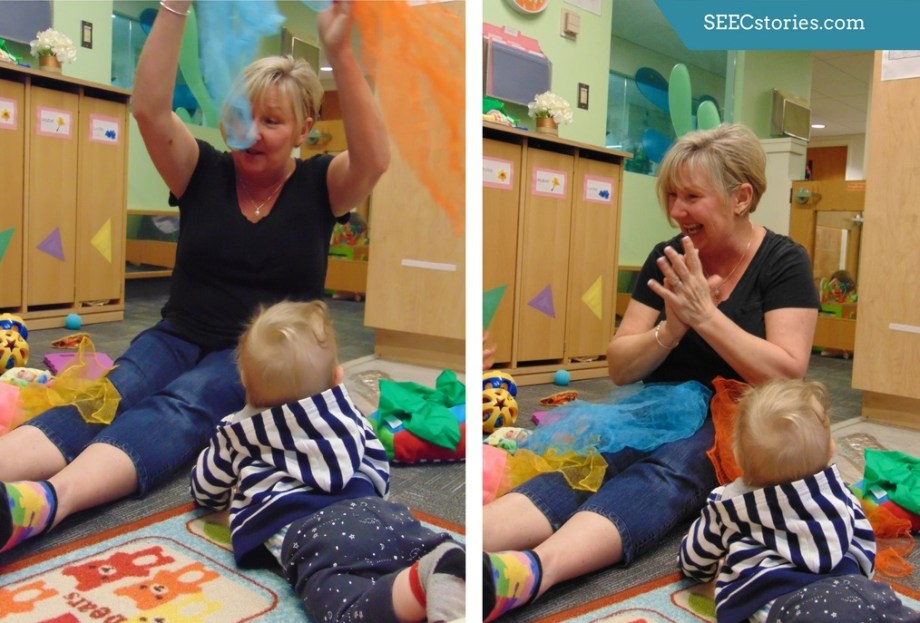
SEECstories (3)While Allison believes that music is a vital program for children of all ages, she focused on the importance of music with the youngest of children. In particular, Allison highlighted how hearing familiar sounds or songs helps infants learn to self-regulate and self soothe. She also discussed how music helps to build babies’ language development. She noted how she likes to start her classes by singing a song that includes each child’s name. With the babies, she explains that they very quickly respond to hearing their own name by clapping, bouncing, or smiling.
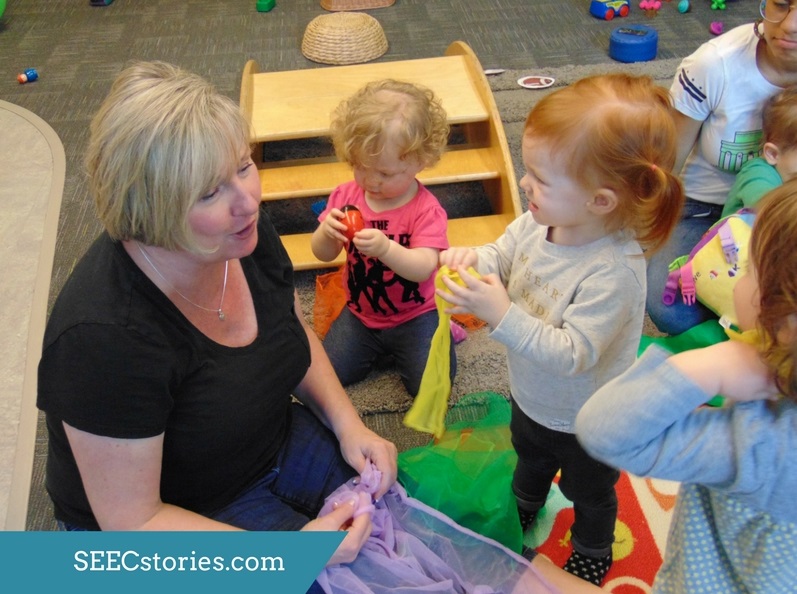
SEECstories (1)Beyond name recognition, Allison explained that singing hello to the individual is important for the start of each of her music classes. It gives her the opportunity to “build off who the child is” from the start of each class. She explained that it set the class up for social emotional growth opportunities since music class is the whole group singing with opportunities for the individual to shine.
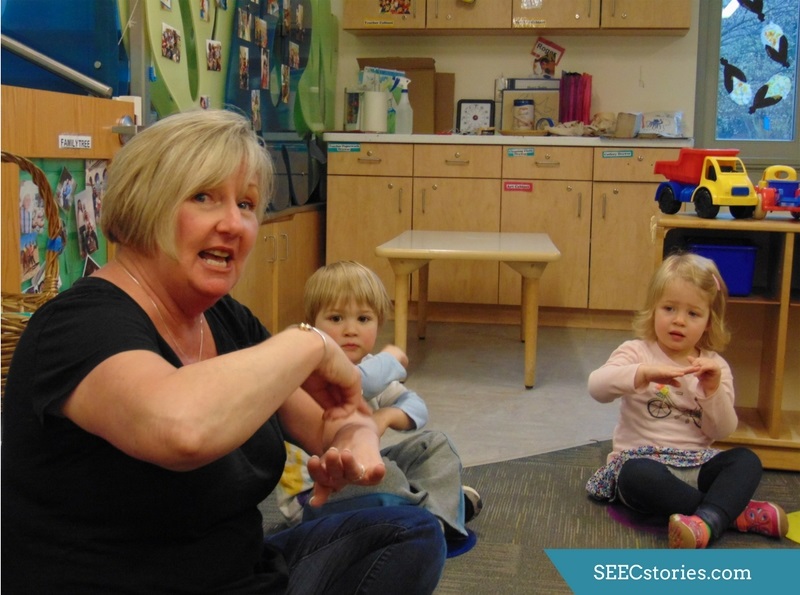
When asked to offer advice to parents, Allison said “Don’t be too hesitant.” Music can be used for fun and to comfort. If as a parent, you still feel uneasy singing, Allison recommends buying and playing music. She clarified that playing music is different from putting on the TV because music allows the parent to continue to be present both with eyesight and in interaction in a way that is impossible with a screen. But in the end, Allison encourages all parents to sing to their children and says that your children “aren’t making judgement” so you should “free yourself from judgement” as well.

SEECstories (2)Her advice for teachers included using music as cues when transitioning in the classroom and repeating songs so that children can learn them. Once the class knows a song, then the teachers can add variety and build upon the songs so that they are challenging and offer new opportunities.
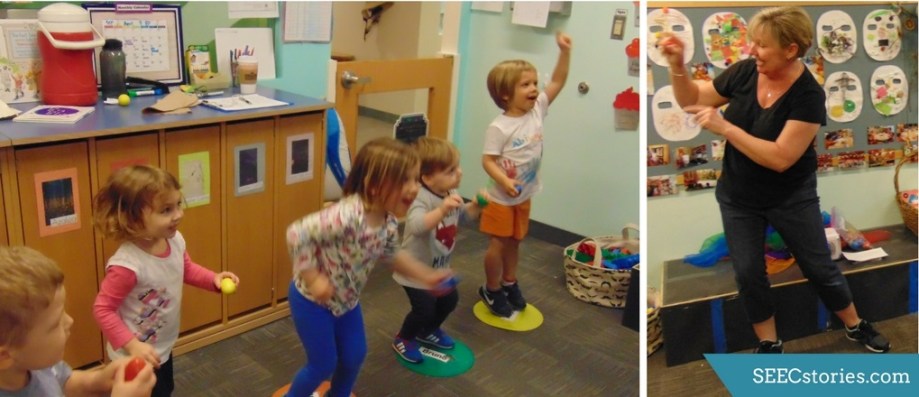
SEECstories (4)Lastly, Allison told us some of her favorite songs. She said that she loves “Popcorn” by Greg and Steve,because it helps children “lose their inhibition” and ties in disco, which is always fun. Another favorite is “Listen to the Horses” by Raffi and the “All the Pretty Horses”, which is a lullaby that Allison sang to her own children and said that it has a “soothing melody like a waterfall.” Don’t all these songs sound great? At SEEC we love hearing new music! What are some of your favorite songs to sing?

Museum Visits: Autumn Edition

Congratulations parents, you made it through the summer and the first month of school! By now, I hope you are settling into a routine and finding that you have a few free afternoons to enjoy this glorious time of year. While many of you are out apple-picking or in the pumpkin patch, the National Mall is another viable option. It can offer a cost-friendly opportunity where you can divide your time between the museums and taking in the beauty of the Nation’s Capital.

For this year’s fall picks, we have two categories: autumn-inspired exhibits and newly-opened features.

Autumn

PreK class making their own Arcimboldo portraits.

PreK class making their own Arcimboldo portraits.

Four Seasons in One Head is tucked deep inside the National Gallery’s main level in a room that is often forgotten but should never be ignored. Arcimboldo, known for his distinctive portraits in which faces are formed from natural materials, depicts the four seasons in this image. This portrait has an element of mystery that will pique a child’s curiosity and it offers a strong connection to what your child is observing everyday outside. To make deeper connections bring along straw and autumnal fruits for the child to touch and interact with during your visit (note: keep all materials in a sealed plastic bags).

Artifact Walls- You Must Remember This at the National Museum of American History is a no-brainer when it comes to fall-themed visits. Situated adjacent to the Warner Brothers Theater in the Constitution lobby of the National Museum of American History Museum, the cases showcase a selection of Hollywood costumes. In the past, it has featured such classics as robes from the Harry Potter films and Super Man’s cape. With Halloween fast approaching, this is a great stop for the family who wants to brainstorm costume ideas. It is also a learning opportunity for children to think about the process of costume making. PreK children might enjoy sketching their Halloween costume or working with an adult to make a list of materials you will need for the costume.   These simple activities will encourage fine motor development and planning skills. Younger children might enjoy reading a book where one of the costumes are featured or simply bringing a favorite book in which a character wears a costume.

image (7)Food: Transforming the American Table 1950–2000 also at the National Museum of American History is the perfect stop as we begin to approach Thanksgiving.   This exhibition demonstrates the inclusive nature of American culture as seen through food. Young children can see examples of our multicultural food identity in their everyday lives as they accompany you to the grocery store or eat at a local restaurant. Before your museum visit, identify foods in your kitchen that originate from countries other than America and then see if you can find them in the exhibition. Infants and toddlers, on the other hand, might enjoy taking a stroll through the space and matching cooking implements from home with ones on display. End your visit by sitting at the large table planning your Thanksgiving meal or reading a book about family meals.

What’s New

Don’t forget that the Smithsonian is also home to the Discovery Theater. On November 23 and 24, the theater will host Mother Earth and Me: Sister Rain and Brother Earth. This interactive musical uses life-size puppets to tell the story of Mother Nature and her determination to save the Earth from drought – with the help of the audience. Recommended for ages 4-8, this story conveys the importance of working together to protect the Earth.

The Great Inka RoadThe National Museum of the American Indian has it all! It is brand new and showcases the museum’s cutting edge collaboration with the company ideum to capture 3D imaging of the ancient Incan capital of Cusco. The images can be viewed on an interactive touch table and are completely spherical. This technological innovation allows visitors to move through the images in all four directions and transports viewers into the space of the pictures. But that is far from the only interactive element. The exhibit also features several video and audio elements which include bilingual storytelling and two “flythrough” stations where you can take a virtual tour of Cusco.

IMG_3588

Family workshop participants heading into the Sackler Gallery.

Sōtatsu: Making Waves opens October 24th at the Arthur M. Sackler Gallery and based on prior experience, this will be a great stop for the family. The spacious galleries in the Sackler are often quiet and work well for families who might need a little space. If the two screens highlighted on the Sackler’s website: Waves at Matsushima and Dragons and Clouds  are any indication, the exhibition will be full of lively, dramatic imagery that will capture a young child’s imagination.  In addition to featuring large-scale Japanese screens (perfect for young viewers) hanging scrolls and fans will also be included. It is a great opportunity to introduce young children to these mediums and experiment with making your own versions. Don’t forget to check out the ImaginAsia classroom schedule on the Sackler’s website for the all-ages offering tied to this exhibition!

Life Lessons from Two-Year-Olds

I spend a lot of time listening to two year olds since my office at SEEC is across the hall from the two year old classrooms. Two year olds are incredibly cool human beings. They are honest, yet loving; assertive, yet shy; funny, yet serious. I have always said that the year between two and three is one of my favorite years of child development because you have a rare and fleeting view into the mind of your child– they can tell you what they are thinking but they have not yet started to censor what they are saying. I think that there are a lot of life lessons we adults can learn from two year olds. Here are some of those lessons…

  • Use all your energy to engage in things that you are interested in doing. Two year olds go and go and go, seemingly nonstop, but it’s all about doing what they are interested in. We all say that we wish we had the kind of energy two year olds have…maybe we would all have this kind of energy if we spent more time doing things we like.
  • When you are done, be done. While two year olds go and go, when they are done they are done. When they are done with the Playdoh there is no convincing them otherwise. When they are done playing cars they move on. Have you ever watched a tired two year old fall asleep? One minute they are wide awake and the next…sound asleep. No tossing and turning and worrying there. Be done with it and move on.
  • Eat a little bit all day long. Nutritionists tell us that this idea of grazing is the right way to eat but do we do it? No! We sit and eat three (often huge) meals every day. Two year olds, when left alone, prefer to graze on small meals all day long. It is so much healthier.
  • Hold someone’s hand and get their attention when you want to tell or show them something really important. I love how two year olds come take my hand or put their tiny hands on my face to be sure I am looking right at them when they have something important to tell or show me. Too often we talk at people rather than with them.  Get people’s attention when you want to talk to them and give them your attention when they talk to you.
  • Don’t underestimate the power of a great facial expression. Two year olds are experts at funny faces. They break the tension, communicate their feelings and make people laugh. If only more of us did that the world would be a better place.
  • Make sure people clap for you when you do something cool. I love how two year olds do something and then look to you to clap for them as soon as they stop. Everyone needs to be acknowledged for doing something cool. We should do it for each other more often.
  • Ask “What’s this?” and “Why?” a lot. It makes things more clear and helps everyone know what is really going on. You should also ask “Why not?” a lot as you get older. It opens new doors and new ways of thinking.
  • Feel proud of yourself in pictures. As adults we often resist getting our pictures taken and worry about how we look when they are taken. Two year olds delight in getting their pictures taken and insist on seeing them over and over regardless of how they look. They just love to see themselves. No image problems here.
  • Move around often rather than sitting still for hours. It makes you healthier and keeps you slim. Two year olds have it right. It also makes you tired so you sleep better. Not a bad deal.
  • Let people know when you are not happy. It is so much healthier than keeping your feelings all bottled up inside. Two year olds are masters at letting you know when they are not happy, but they don’t hold a grudge either. We could learn from both of these behaviors.
  • Try something new often. Two year olds often don’t think twice about trying something new, especially if you don’t make a big deal about it being new. Two year olds know how to “live juicy”…not a bad way to live your life.
  • Give hugs and kisses. Lots of them. Every day. To lots of people. Say “I love you” often.

If you have not spent any time with a two year old lately I strongly suggest you find one (the adorable one below is my granddaughter!). It will put your life in perspective and make you appreciate the small things that truly make up a life. It is definitely making my life better.

10472730_10204759529774632_5172286771279512364_n

A Fresh Take: Back-to-School Books

It’s that time again! Many of our nation’s teachers are preparing their classrooms for the first day of school and so we wanted to share with you what some of our SEEC teachers are planning to include on their bookshelves this coming fall. Before school ended this past week, I interviewed several of our teachers to get their perspective on back-to-school books and here’s what I learned.
Duckling Book_1

HOMEMADE BOOKS

Many of our infant and toddler teachers lamented that there weren’t a lot of options for their young students. They were opting for making homemade books like the one featured to the right that documents a trip to their new classroom. This group of toddlers will be going to a new center, so the teacher thought it was especially important to have something to ease into a new location. I liked that the book highlighted the children’s feelings and pointed out some exciting new components of the classroom. I guess you could call it an end-of-the-year book, but since it will be with them in their new classroom too it still bridges their experiences and offers them continuity.  Duckling Book_2

Many of our teachers also like to create individual books for their students that include photos of family, special events or things the child likes. These types of books can be a great source of comfort at any time of the year when they need a little extra soothing. They also help classmates learn about each other.

FAMILIAR FRIENDS

At least four teachers said to me that they weren’t necessarily looking for back-to-school books for September. Rather they wanted  books with which the children were familiar. Having these books were important because they built in a familiar component that would help their students feel safe and more easily transition to their new teachers and routines. This was especially true of the teachers in our toddler and twos classes. Here were some of their top recommendations.

  1. Chicka, Chicka, Boom, Boom by Bill Martin, Jr. and John Archambault
  2. Good Night Moon by Margaret Wise Brown
  3. Brown Bear, Brown Bear, What do You See by Bill Martin Jr.
  4. The Napping House by Audrey Wood
  5. The Very Hungry Caterpillar by Eric Carle

MAKE IT A PROJECT

Our current Kindergarten teacher shared that when she was teaching in Europe she stumbled across the book, Mommy in My Pocket by Carol Hunt Sendarak. She said she fell in love with the book and its story of a little girl who imagines shrinking her mother so she can accompany her to school. In the end, she realizes that she will be fine on her own as she carries the memory of her mother’s hug and kiss.

Our teacher, Cathryn, took the book a step further and had her pocketstudents bring in a photo of their moms/caretakers and adhered it to the shape of a person. The children were invited to “dress” the body by coloring in clothes. When they were finished, she attached it to a heart, which was then glued on top of a cut-out pocket shape. Finally, she attached yarn to the pocket so the children could wear their “caretaker pockets” like a necklace.

After their project was done, the class sat together and talked. She recounts that she would ask about their feelings or other objects that they might want to bring to school with them.

CELEBRATING INDIVIDUALITY

Many of our PreK teachers said they like to use the beginning of the year to teach about what makes their students special or unique. One PreK-4 teacher praised Tacky the Penguin by Helen Lester for not only honoring everyone’s differences, but also just being silly. Another teacher suggested Ian Falconer’s Olivia because of how it embraces the character’s unique spirit – plus, it doesn’t hurt that the book showcases a visit to the museum where Olivia encounters paintings by Degas and Pollock – a very SEEC moment.

OTHER FAVORITESImage 3346

  1. Lilly’s Purple Plastic Purse by David Henkes

Though not really about back-to-school, this book features the relationship between student and teacher and introduces children to the concept of having different perspectives.

2.  The Night Before Kindergarten by Natasha Wing

This one is for the parents out there! It is a personal favorite that helped both my children transition to Kindergarten.

2.  Splat the Cat by Rob Scotton

3.   If  You Take a Mouse to School by Laura Numeroff

4.   Franklin Goes to School by Paulette Bourgeois

DON’T FORGET THE SPACEphoto 4

Creating a cozy corner, can be as important as the books. Have fun creating a space that is quiet by sectioning it off from the classroom buzz. Use inviting colors, comfortable furniture and include soft, soothing objects. Such a space will undoubtedly help with those first day transitions as well as difficult moments throughout the year.

Hope these give you some fresh ideas! Happy back-to-school.

Springtime Fun: Full STEAM Ahead

Parent as Teacher_MG_0715_72dp_webi

It has been a long time coming, but spring is finally here and it is the perfect time to introduce your child to some of the changes that are occurring right in front of their eyes. I recently did a lesson on clouds for a family workshop and that, coupled with, some fantastic lessons from my fellow teachers was the inspiration for this blog. These ideas are a blend of natural observation, art, science and museum visits and have all the components of STEAM. STEAM is a popular and important educational movement, which advocates for using science, technology, engineering, art, and math as a means through which children can learn and develop critical thinking skills.

Parents, remember you are your child’s teacher too. When you teach them you are expanding their world,  sharing your interests and bonding. Don’t feel like you have to be a Pinterest guru and spend hours developing a lesson or buying materials. Instead, keep it simple and have fun by using ideas that are easily accessible and follow your own interests.

Clouds and Rain

Natural Observation

  • Walk outside during a light rain and enjoy the feeling of the water or notice the water droplets on the leaves.
  • Feel the ground after a rainstorm and notice the difference in texture and weight when it’s wet.
  • Notice how the sidewalk changes color after its wet.
  • Take a picnic to a nearby park and spend time observing the clouds. Look for shapes and movement.

Science Experimentfile (7)

  • Fill a cup with water and top it off with shaving cream. Add food coloring. Eventually the food coloring will begin to fall when the shaving cream is too full, just like rain falls when a cloud is too full of water.
  • For infants and toddlers, they will enjoy watching the color and might not understand the concept of the cloud, it will help them understand from where rain comes.  Consider using different colors and having fun with it.

Literacy

  • Eric Carle’s The Cloud works well for infants through preschoolers. When you are reading to your child, remember to include them in the book too. In this book, for example, you could ask them what sounds a sheep makes or encourage them to move their arms like a wave when the cloud passes over the ocean in the story.
file (9)

3-year-olds at the National Gallery of Art

Museum Visit

  • Choose a straightforward piece like Ships in Distress of a Rocky Coast by Ludolf Backhuysen at the National Gallery of Art and bring a few simple scarves to reenact the wind from the storm.
  • Choose something more imaginative like the Dangerous Logic of Wooing by Ernesto Neto at the Hirshhorn Museum and Sculpture Garden. We made  tactile clouds by filling white nylons with marshmallows. Even the adults loved them.
  • Don’t live in DC? Visit your local museum or explore these pieces online with your child–that is some worthwhile screen time.

Art Project

  • Make your own clouds with blue construction paper, cotton balls and glue.
  • Make umbrellas using a half paper plate and Popsicle stick. We used do-a-dot markers to decorate them. These are not messy and the perfect size for older infants and toddlers to use.

Gardening

Now that you have had some fun with clouds and rain, your child might be interested in other, related topics. Here are a few more ideas!

Natural Observationfile (1)

  • Get out the sand toys and play in the dirt. If you want to keep things a little neater, you can always grab a large tub and fill it with dirt. I find that a little goes a long way. The sensory experience will give infants and toddlers the chance to experience different textures and to practice filling and dumping.
  • Preschoolers might enjoy the opportunity to plant a few seeds and watch the outcome of their efforts. Not only will they see the physical changes that will occur, but they will likely take ownership and pride in their planting.

Museum Visit

  • Local gardens are everywhere! Even if you just visit a neighbor’s garden.
  • Visit a farmer’s market.
  • My top DMV choices are: the Victory Garden at the National Museum of American History, the US Botanical Gardens and Brookside Gardens in Silver Spring

Fun in the Kitchen_SAM0126

  • Use this chocolaty recipe for making dirt and include some gummy worms for added realism. The kitchen is a great place for a young child to learn because of the countless learning and developmental opportunities like: math – sorting, counting measuring, fine motor skills – pouring, stirring, sensory input, practice working together and following directions.

Literacy

  • Lois Ehlert’s books Eating the Alphabet or Planting a Rainbow.
  • Flower Garden by Eve Bunting and Kathleen Hewitt

Keep visiting us for more ideas. Enjoy your time together and the beautiful spring weather.


Early Learning in Museums: A Thoughtful Process at DAM

Denver Art Museum
Denver Art Museum

We’ve noticed that more and more museums are thinking about how to create effective programming for children under the age of 6 years old. Why do you think that is? I know we have some ideas but would be curious to know what you all are thinking.

Just last month, SEEC had the opportunity to work with one such museum.  It was inspiring to see how thoughtful they are being about the process. Over the next year, the Denver Art Museum (DAM) will systematically develop programs for early childhood programs in their area. Implementation of these programs is scheduled to start next year.

Mud Woman by Roxanne Swentzell at the Denver Art Museum
Mud Woman by Roxanne S Wentzell at the Denver Art Museum

To get this effort off the ground, the education department has created a case statement that articulates why this initiative is important and how it ties to the mission and vision of the larger organization. In addition, they have brought together a team of stakeholders that will contribute to the development of concepts, monitor progress, communicate considerations and keep the process moving forward. They have considered external factors and internal implications and are working together in new ways to better accommodate the unique of early childhood audiences – whether they arrive in school groups or with a family.

In addition, they engaged the local teacher community. On a Classroom Shotbeautiful October morning in Denver, Colorado, over 20 early childhood educators devoted their time to talking to the Denver Art Museum about what their idea of an ideal early childhood program would include. The teachers were extremely enthusiastic about the possibilities and informed the museum educators that they would like to see everything from museum experiences led by visiting artists to workshop spaces that encouraged young children in “messy” but meaningful play.

We know that many museums are doing interesting programming for young children. If you have stories to share or lessons learned, we would love to hear from you!

Denver Art Museum

Denver Art Museum

Classroom Snapshot: All that Jazz

Our four’s camp was in full swing with their study of jazz this past month. Even though it is summer, our SEEC teachers are still thinking of innovative and creative ways to bring our museum objects to life. As a museum educator who spends a lot more time behind the computer than in front of the classroom these days, I was very jealous of all the fun the four’s were having.

JAZZ 1

The week begins with a study of jazz instruments at the National Museum of American History.

JAZZ 2

The whole class made it up to the National Portrait Gallery where they learned about Duke Ellington and made some jazz gumbo!

Next up: Billie Holiday. The class explored the voice as an instrument.

Next up: Billie Holiday. The class explored the voice as an instrument.


After all that learning, the kids played with some instruments of their own and created their own jazz ensemble.

The kids played with some instruments and created their own jazz ensemble.

These lessons take place over a period of time and typically take shape as teachers discover and nurture the interests of their students. If you have questions or comments, please let us know. We see our teaching practice as constantly evolving.

Educators: Want to learn more about working with museums and early childhood audiences, please visit our list of professional development offerings.

Parents: These snapshots  can give you some great ideas of how to use museums with your children. You can also enroll in one of our weekend classes  or  our 2-day/week program for toddlers and experience it firsthand!


Sensory Learning – What and Why?

Have you scrolled through Pinterest lately and seen all the preschool or parenting boards related to sensory play? Usually it involves some beautifully crafted photos featuring a young child participating in a hands-on activity, but sensory learning is so much more than just getting dirty. As the name suggest, it is learning through the senses. Often times, it is related to the sense o

Sensory Play

f touch, i.e finger painting, water table, playing with sand. Sensory learning is not limited to touch and can encompass all the senses.

Why bother with all of this – children and adults learn best through their senses. Sensory learning also helps children retain information. Think about it this way: if you are cooking and your child inquires about the rosemary you are using you can, A: simply describe it as something that adds flavor to your dish or, B: hand some over and give them the opportunity touch, smell and examine it. I can guarantee that your child will be able to recount their rosemary experience better if they are given the sensory option.

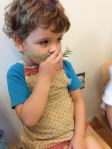
Once a child begins to explore something through their serosemarynses, a lot of other things can happen. They can use the experience to practice and build upon their vocabulary. Ask them questions: “What color is it?; How does it feel?; What does it smell like?. A parent can also enhance this experience by adding objects that can be used for comparison purposes. , Add parsley, for example, and encourage basic math skills by asking them to find shapes or compare the size of the two herbs. You can also stimulate critical thinking by adding elements like, scissors or water. These elements prompt children to conduct experiments: i.e. “What will happen if I cut the rosemary – will it still smell? or, What will the rosemary feel like when I pour water on it? Adding these components not only gets them to investigate and hypothesize, it also gives them the chance to practice their fine motor skills. Cutting and pouring are everyday tasks that they hope to master one day and using these skills will also aid in developing the coordination required for writing.
You can take the sensory experience a step further by adding some art supplies too. Put out some glue and construction paper, but don’t give them explicit instructions. Let them be inspired to create what comes to their mind. You’d be surprised at what they can come up with! Finally, try including a friend or sibling in the experience, which will encourage social interaction and compel them to practice taking turns and listening to one another. It also encourages them to work as a team and build on each others ideas.penguins food

So the next time you see a beautifully crafted sensory experience pop up on your Pinterest feed, don’t feel daunted. Remember, sensory learning can happen organically during the course of the day and you can add to the experience by simply including common art tools and other found objects in and around the home. Too busy to clean it up? Don’t worry leaving it out for awhile and letting your child return to the materials will actually enhance the experience.