Theater Round Up

Our recent Teacher Feature highlighted a lesson on set design. This lesson was part of a larger unit on theater. The two year old class explored theater for several weeks before they decided to put on their own play based off the book Abiyoyo by Pete Seeger. The web below shows the different activities, museum visits, and books that the teachers Melinda Bernsdorf, Brittany Brown, and Brittany Leavitt used to teach their class about theater. For more details, take a look at some of the photos from their lessons, which serve to supplement the web.

Web - Theater_With Edits

SEECstories.com

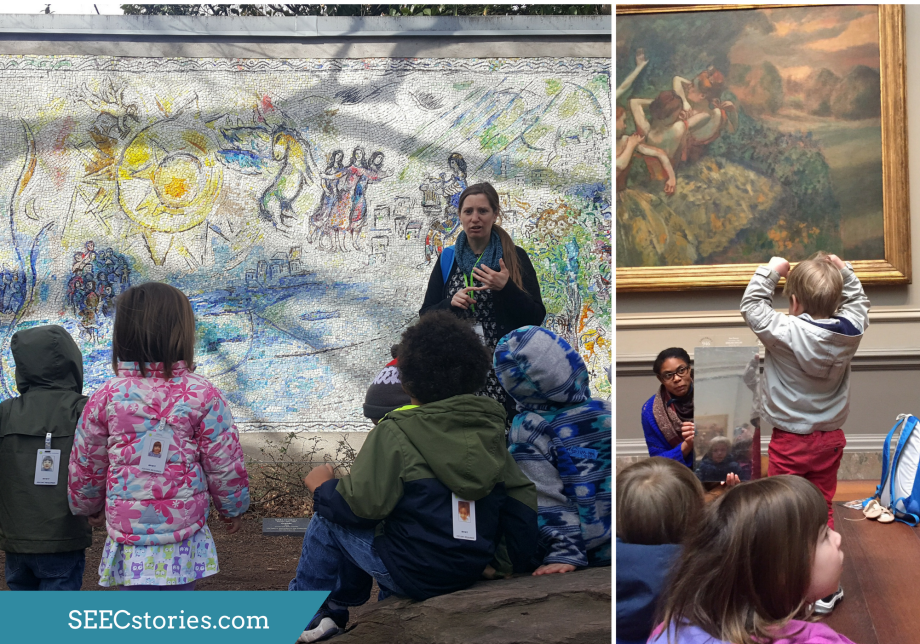
The class began their unit by exploring different ways that people perform on stage. When learning about ballet, the class visited the National Gallery of Art to look at Four Dancers by Edgar Degas. While in front of the painting, the class noted the poses of the dancers and practiced their own poses using a mirror that Brittany Leavitt brought into the gallery. Opera was another type of performance that the class talked about. While learning about opera they went to the National Gallery of Art’s Sculpture Garden to look at the large mosaic Orphée by Marc Chagall.

SEECstories.com (1)

They visited National Theatre where they stood on stage, sat in the audience, explored the orchestra pit, and experienced sitting in the balcony. Visiting a working theater gave the class a greater understanding of the plays and performance.

SEECstories.com (2)

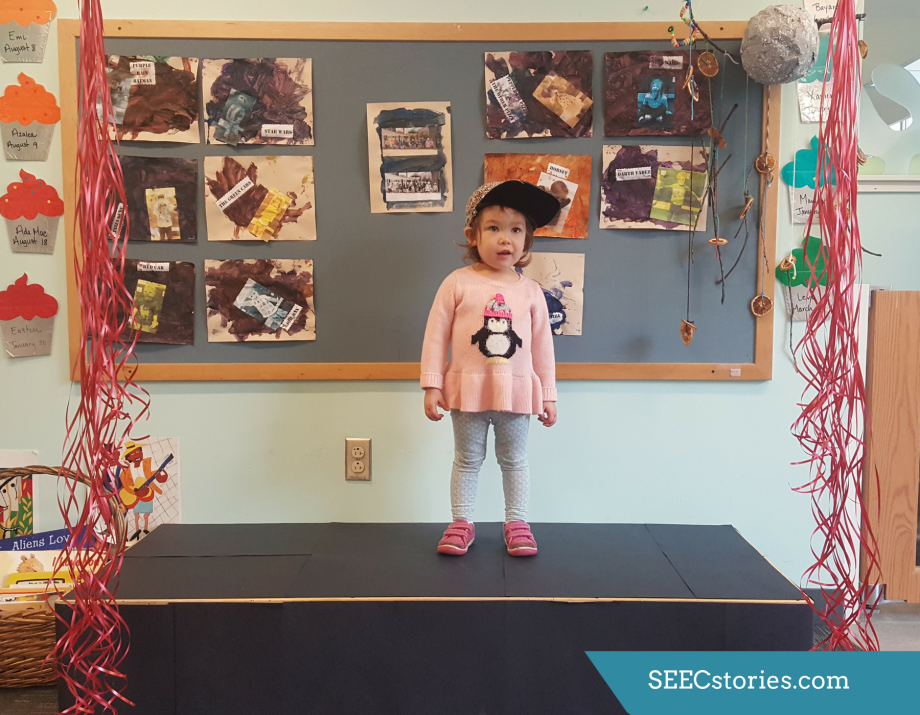
They transformed their classroom into a theater! Melinda Bernsdorf, Brittany Brown, and Brittany Leavitt hung red ribbon from the ceiling and repurposed a large wooden box as a stage.

SEECstories.com

In order to make their classroom stage a more immersive experience, the teachers gathered different types of clothing, hats, and props for the children to use on stage. The children were able to choose their own costumes and were invited to perform on their classroom stage.

SEECstories.com (4)

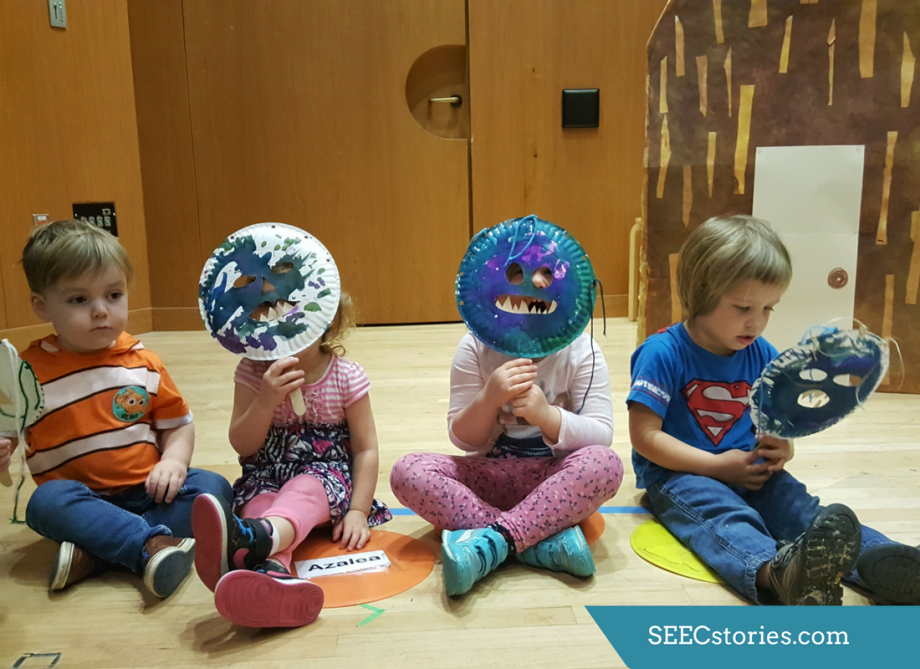
For their performance of the play Abiyoyo, which Melinda Bernsdorf, Brittany Brown, and Brittany Leavitt adapted from the book by Pete Seeger, the two year old class made their own costumes. The costume for the giant Abiyoyo was made by using paper plates, paint, and string. The class used these costumes while performing their play on stage in front of their families.

CORNER TAB

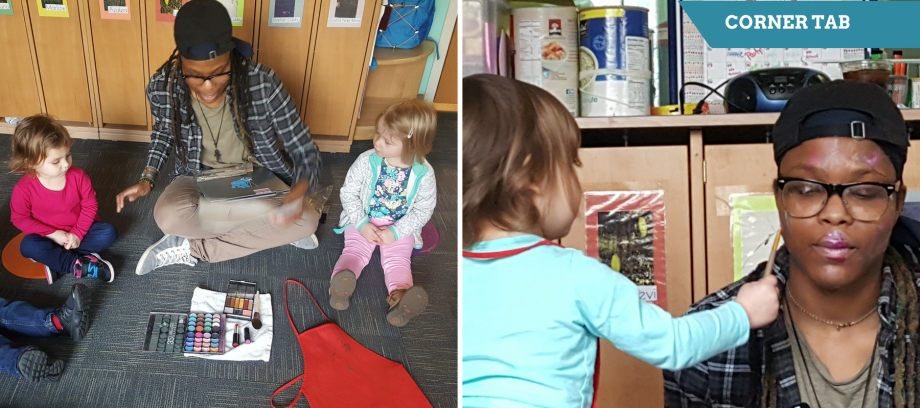
In addition to costumes, the class explored stage makeup. Before becoming makeup artists, the class learned about colors and palettes. Then they used one of their teachers, Brittany Brown, as a model. Each child was given the chance to put on Brittany’s stage makeup to get her ready for her performance.

SEECstories.com (5)

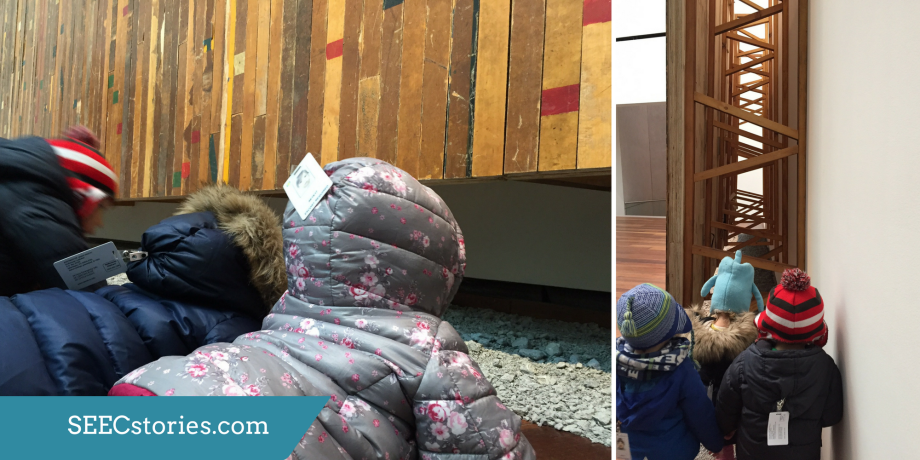
To learn about set design, the class went on a variety of museum visits to be inspired including visiting the special installment “In the Tower: Theaster Gates: The Minor Arts” at the National Gallery of Art. By looking at A Game of My Own by Theaster Gates from the side and even from below while laying on their bellies, the class was able to see the internal structure of a seemingly flat piece. This proved to be useful when they assembled their own set.

SEECstories.com (6)

The class used the knowledge that they gained to create their own set. Making the set involved the whole group’s efforts and took several weeks to completely compile, since they had to create something large enough to fill up the whole stage.

SEECstories.com (7)

After a complete tech week and several dress rehearsals the class preformed their verison of Abiyoyo in front of a set that they had created and wore costumes that they made. In the audience sat the class’s close friends and family.

Teacher Feature: Two Year Olds Explore Sets & Theater

This week we are featuring a lesson from one of SEEC’s two year old classes. The teachers Melinda Bernsdorf, Brittany Brown, and Brittany Leavitt used Yayoi Kusama’s Infinity Mirrors as inspiration for talking about and designing a theatrical set with their class. After experiencing the Infinity Mirrors, the class went to the theater to rehearse their performance and talk about sets and props while on stage. Below you will find images from the lesson and a reflection from Melinda, Brittany, and Brittany.

Cover Photo DOTS

Here are some pictures from the day’s lesson:

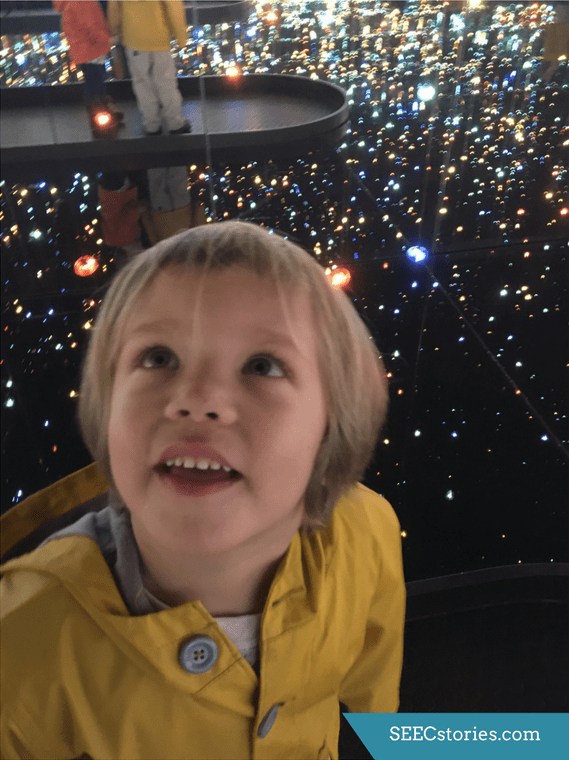
SEECstories.comThe first Infinity Mirror room that the class visited is entitled “Souls of Millions of Lightyears Away”. Before each group entered the space, their teachers asked them to think about “What story might take place here.” When the children exited the room, some of their answers included a story about “outer space” and “rainbows” and a story that included “flashing light, jingle bells inside a cave.”

SEECstories.com (1)

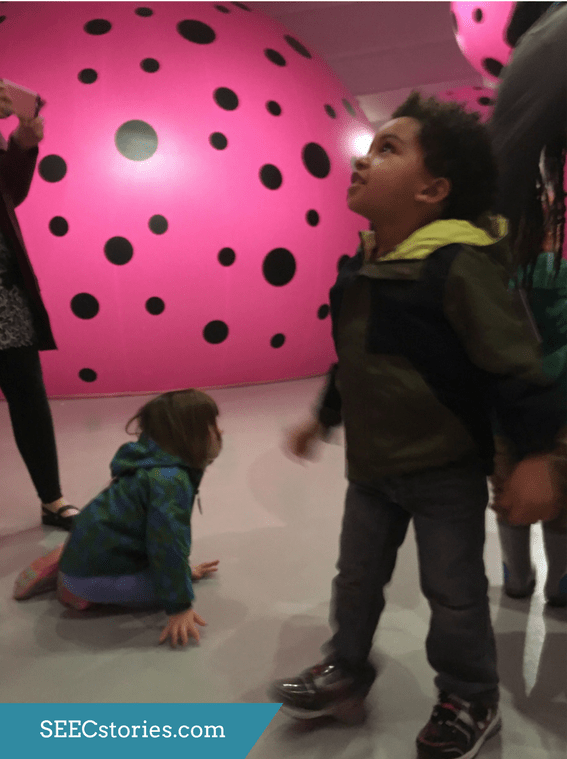
The class then visited “Dots Obsession Love Transformed Into Dots”. This space also inspired the class to think about a variety of stories including some about “Spiderman”, “a circus with balloons”, and “soccer balls”.

SEECstories.com (2)

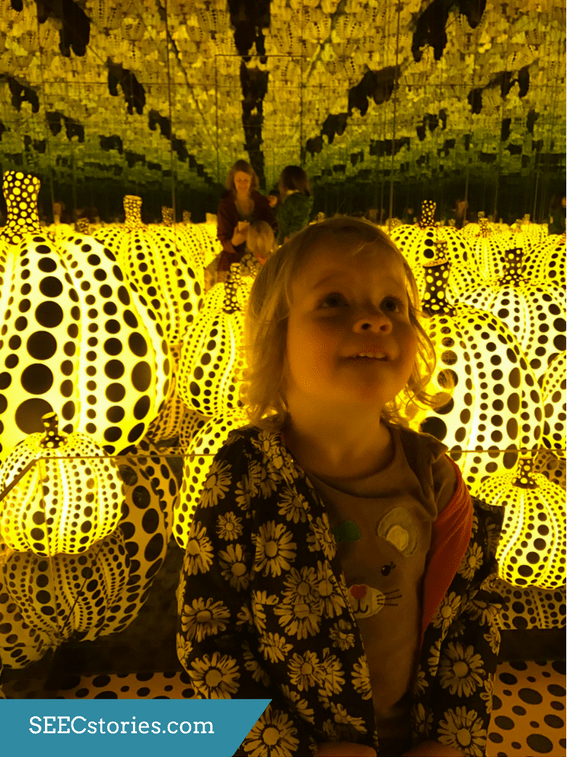
The final mirrored room that the class saw is called “All the Eternal Love I Have for Pumpkins”. Possible stories that could take place in this room included a story about things “that live in space” and a story about “polka dots on (people’s) cheeks.”

SEECstories.com (3)

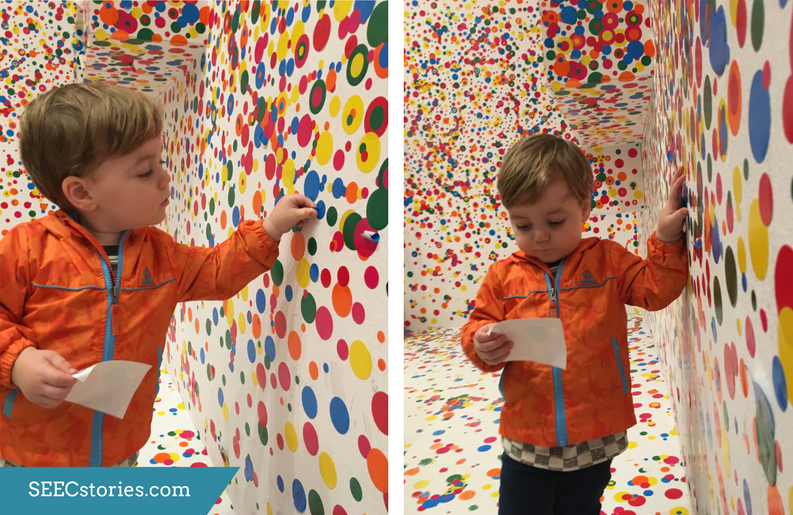
The class finished their trip by stopping in “The Obliteration Room” where they were given polka dot stickers to put on the walls. It was fun for them to help take part in designing the space.

SEECstories.com (4)

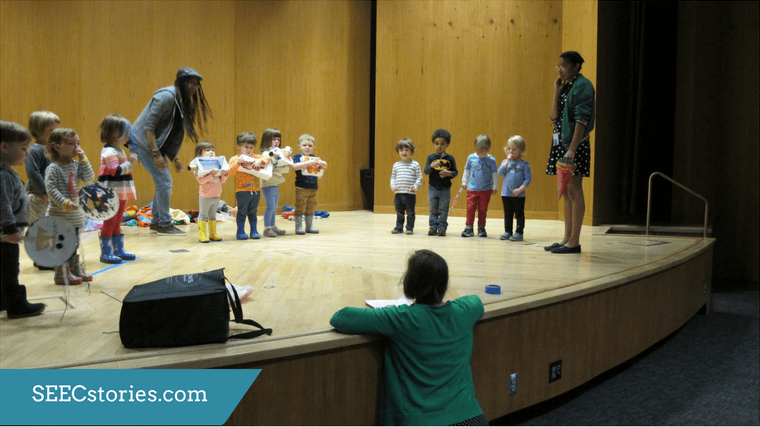
After their trip to the Infinity Rooms, the class went to the theater to rehearse their play entitled Abiyoyo. While on stage, the class was given the chance to hold the props, run through the play, and discuss potential set designs.

SEECstories.com (5)

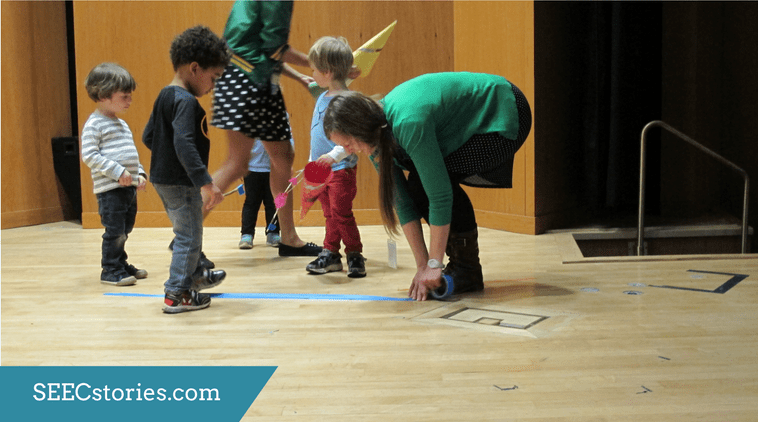
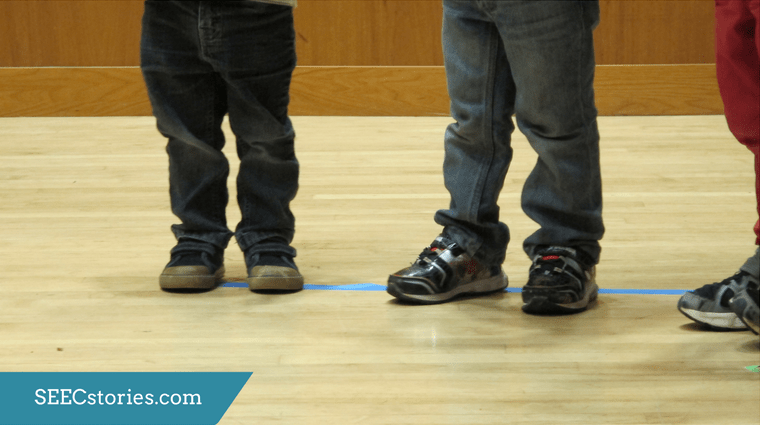
In their reflection, the teachers noted this time on stage as a trying part of the lesson. The children had just completed an immersive experience while visiting the Infinity Rooms and were having a hard time focusing on their rehearsal. Upon identifying the problem, the teachers were able to work quickly to try to resolve it so the class could experience a successful rehearsal. Since the class was struggling with staying in their positions, Melinda Bernsdorf grabbed blue tape to mark the ground.

SEECstories.com (7)

After placing the blue tape and with the guiding support of Brittany Brown and Brittany Leavitt, the class was able to focus on the play.

SEECstories.com (6)

After thinking about how sets help tell stories, the class designed and created their own set for the play Abiyoyo which they performed in front of their families.

A reflection from Melinda Bernsdorf, Brittany Brown, and Brittany Leavitt:

This lesson was a part of a month long exploration of musical theater. Our class had been examining different plays and musicals as well as talking about the areas of work that go into putting on a production. As a class we had been working on our own production of Abiyoyo, which we had adapted from the book Abiyoyo by Pete Seeger. In the weeks leading up to this lesson, we had talked about stage make-up, choreography, costumes and props, and set design, discussing how each had an impact on furthering the story narrative.

We had been anticipating the Yayoi Kusama’s Infinity Mirrors exhibit and because of the high level of interest in the exhibit, we had to schedule our trip long before we knew what our class would be exploring. It worked out beautifully that we could use Kusama’s immersive art to extend the ideas we had been discussing. We hoped to dive further into the concept of set design and setting as storytelling devices. We intended to use each different area of the exhibit as a different “set” and discuss what story was taking place. We also had a more challenging goal of using Kusama’s Infinity Mirrors to get across the concept of remaking a whole world or reality within a tiny space, like how the set of a play can bring a world to a stage.

From the first room, our students were open to the idea of telling stories about their surroundings and were imaginative in their ideas. In this way, Kusama’s art was very successful in showing how set design and setting are important aspects of storytelling. The more abstract ideas of directly associating that with the play we were producing in class may have been lost along the way, but that was fine. Our main goal was facilitating an incredible experience for our students and pushing them to wonder and dream about what they were seeing, rather than just being present for the moment.

Our visit actually went much more smoothly than expected. We had anticipated a high volume of visitors and had some plans in reserve in case there were long lines for the infinity rooms. We also had a strategy in mind for which rooms we thought would be most valuable if we discovered that we could only see one or two because of time. We knew that we could only ask our students to stay engaged for a limited time if most of what we were doing was waiting. Luckily, none of this ended up being a concern during our visit. We were able to walk up to each area and enter almost immediately. However the rooms were small and only allowed for a few students to enter at a time. While waiting for each student to have a turn, we talked about the storytelling aspects of our environment. These small amounts of down time enabled us to have open ended discussions with our students in small groups while still in the museum space. Our class had the opportunity to share their ideas while they were still surrounded by the experience.

We followed our visit to the Hirshhorn Museum with a trip to the theater we were using for our play. Each day this week we had been spending some time rehearsing in this environment, allowing our students to become comfortable on stage and in the space. This ended up being the least successful part of our lesson on this day. The transition from the time spent exploring Kusama’s art to the more focused work of rehearsing our play was difficult for our students. We had been able to maintain their focus for an extended period of time in the museum, and if in the same situation again, I would give myself permission to let go of the second part of the lesson. Trying to make the connection by physically having our students experience both the Infinity Mirrors and the theater was unnecessary and too much. It would have been more appropriate to revisit the lesson the following day as we assembled our own set on the stage.

We concluded our exploration of musical theater by putting on our Abiyoyo play at the end of the week in front of an audience of our students’ families.

Stay tuned for the Roundup on Theater for more ideas from Melinda, Brittany, and Brittany and to learn more about their class’ exploration of musical theater.


SEEC’s Book Club: The Scientist in the Crib

We recently decided to start up our own book club and chose The Scientist in the Crib: What Early Learning Tells Us About the Mind for the club’s second meeting. We featured this book in a recent blog post “From Blobs to Beings: An Overview of Research on Baby Brains” and it made sense for us to come together as a group of professionals to think more about it. In the course of our book club discussion several topics emerged including teaching empathy, learning, and language. Below are some highlights from our discussion.  

On Empathy

The Scientist in the Crib explained that “real empathy isn’t just about knowing that other people feel the same way you do; it’s about knowing that they don’t feel the same way and caring anyway” (p. 39). The authors describe an experiment during which they provided young children with broccoli and goldfish and then requested some broccoli from the children. Children younger than 18 months, gave the researchers goldfish, despite the researchers requesting broccoli. These children cannot fathom someone wanting anything that differs from their own desires, which in this case are clearly the tasty goldfish. By 18 months, children realize what they want may actually be different from what someone else wants, hence they are willing to give broccoli to the person who requests it even if goldfish seem like the only logical choice to them  (p. 38-39).

SEECstories.com

This example of young children showing empathy was shared at book club. The teacher described the situation by explaining that one of the children in her class was feeling upset and another child crawled over to pat the child’s belly, which made everyone feel better.   

Our discussion began largely by sharing examples of young children being empathetic in our own classrooms. The teachers fondly recalled examples of young children acting emphatically for the first time. There was a discussion about a toddler offering to help zip up their friend’s jacket and another example of a young child who was barely talking going out his way to find a sad child’s favorite toy in hopes of making the child feel better. These examples of young children showing empathy were clearly some of the teachers’ favorite memories of their past classes. The teachers also talked about how important it was to teach social emotional learning, because according to one teacher “children need to learn how to become people”. We concluded that teachers need to focus on teaching empathy as well as teaching the classic academic skills in their classrooms.

On Learning and Language

Much of The Scientist in the Crib featured the different ways that babies learn about the world around them and it devoted a whole chapter to children’s development of language.  As a group, we talked about how difficult it can be to learn a new language as an adult and how baby’s brains are better suited for the task than adult brains.

SEECstories.com (1)

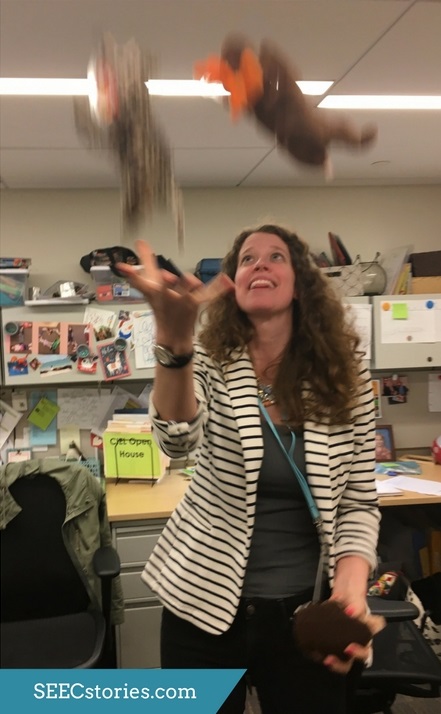
Brooke demonstrating her juggling, which she used as an example of something that she learned to do as an adult.

Babies are learning far more than just language as they develop. In fact, since everything they experience is brand new, they are actively learning about everything. As adults, we rarely get to experience the challenge of learning something completely new. This is yet another difference between adult learning and children’s learning. One participant, Brooke, brought up the challenge of learning how to juggle as an adult. She explained that it was “Simple once you get it; you can actually move your hands and stop paying attention.” But before you get to that point it was “super hard!” From the discussion of the difficulties of learning a new language and learning how to juggle, we noted how hard we had to work to accomplish our goals and we were amazed by just how much and how quickly infants and young children are able to learn. Throughout our discussion we became more and more amazed by the infant brain.

Required Reading

As we were concluding our discussion one participant said “I think this book should be required reading!” When pressed about who should be required to read The Scientist in the Crib, the group decided with a resounding “everybody!” The benefit for parents and caregivers seemed obvious. In fact, one book club participant had texted the paragraph on the “deliberately perverse” two years to a friend of hers who was currently experiencing that phenomenon (p. 39).

In addition to parents and caregivers, we discussed how policy makers should read this book so they can gain an understanding of the importance of early childhood education. We concluded that everyone was a child once and will probably interact with a child at some point and this book would help people gain an understanding of their own brains as well as the brains of young children.

Catch us next time when we will be reading For White Folks Who Teach in the Hood, and the Rest of Y’all Too by Chris Emdin.


References:

Gopnik, A., Meltzoff, A. N., & Kuhl, P. K. (2004). The Scientist in the Crib: What Early Learning Tells Us About the Mind. New York, NY: Perennial.

10 Things You Can Do Right Now with Your Child at a Restaurant

9

Looking for alternatives to passing your child a phone or gaming device when out to eat? Here are a few quick tips on how to engage your child during your meal!

  1. Read the Whole Menu: Instead of pre-selecting a few items to read to your child as choices take time to read most of the menu with them. This is a great way to encourage the development of literacy practices as well as making them a participant in the ordering process.
  2. Let your Child Order for You and Themselves: Instead of speaking for your child allow them to order. It helps them invest in their order and allows them to practice social skills.
  3. Talk: This one is obvious, but when choosing topics of conversation, select a topic in1 which your child can participate. Ask them what they want to talk about. Children have a lot to share if they are given a chance!
  4. Create a Try-It Plate for Everyone at the Table: Make trying new foods fun, not a task. Have the whole table contribute a small sample from their order to a communal plate. Then take turns trying foods that other people ordered. When you try something “different” you are modeling this behavior for your child and encouraging them to try new things.10
  5. Guess the Object: Without revealing the object (a fork, salt shaker, pen, etc.), take turns hiding it under your napkin. Then try and guess the object based only on the shape and size.
  6. People Watching: Make up a story about other guests in the restaurant (make sure the group is out of earshot). Have your child observe the table and think about who the people might be and what they might be talking about. Picking up on social/emotional cues is a big part of your child’s development and this is a fun way to get some practice from afar.
  7. Draw: Sketch on a paper napkin, back of a check, or scrap of paper. You can even take it a step further and convert your child’s doodle into more complicated illustrations and create a story as you draw.
  8. Get up and Move: Sometimes your child just needs to get up and move: climb the stairs, take a walking tour of the restaurant, check out an open kitchen, or even just take a step outside.
  9. Pay the Check: Include your child in the paying process by allowing them to help with simple math (for example, counting a few dollars to leave for the tip) and handing off the check to the waiter. This will provide them with a feeling of responsibility and also allows them to begin to understand that goods and service have real value.
  10. Recognize When it is Time to Go: As you have probably noticed, young children have short attention spans. So, set realistic expectations and look for signs that your child is ready to move on to the next location/activity.

Have other ways you engage your child when out to eat? Please Share!

What Does Play Tell Us?

If you are a parent or educator you see kids playing all the time.  We know that children learn through play, but what can we learn from watching children’s play? Observing play offers a valuable glimpse into a child’s mind – what they’re interested in, what they’re thinking about, and what they understand.

2

Insight into Children’s Interest

At SEEC, we follow an emergent curriculum – we use the children’s interests as a vehicle to teach developmental skills, as well as content knowledge.  We’ve found that capitalizing on children’s interests make them much more invested in learning, and are motivated to find out more.  But how do you decide what topic to study if you’ve got a group of 15 four-year-olds?  Or even a group of nine, pre-verbal infants? To determine what the children are interested in, we observe and make note of many things the children do including; the questions they ask, the comments they make while we’re out in the community, the conversations they have with their friends, the books they want to read, and maybe most importantly, their play.

For example, a couple of years ago, my preschool class could not stop talking about Medusa.  One of the children had heard a story about the Greek mythological monster, and the rest of the children began incorporating the character into their play.  One day I observed a child jump down from the top of the playground climber and shout, “I’m jumping down from Mt. Olympus!”  Clearly there was an interest in Greek mythology, and storytelling and so we embarked on a Greek Mythology unit.

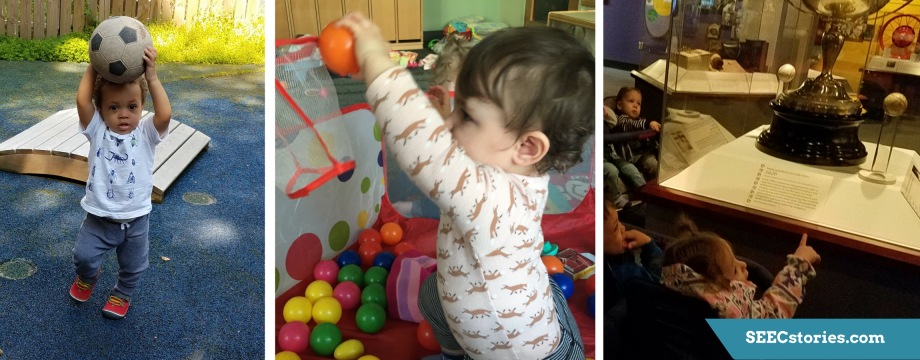
Observing infants playing can prove equally insightful.  For example, our older infant class recently explored sports because their teachers noticed that many children were gravitating towards balls in the classroom and on the playground, and experimenting with throwing and kicking objects.  They observed the toys they chose to play with, and the games they wanted to play again and again which led them to their next topic of exploration.

SEECstories.com (31).png

Play as Assessment

As educators, we need to reflect on our instruction, and assess whether our students are understanding the concepts being taught.  However, this can prove to be tricky with young children.  Observing play is a natural way to assess children’s understandings of concepts.  As Vivian Gussin Paley, noted play theorist, states, “…the continued observation of children at play demonstrates the importance of make-believe as the thinking tool that children use.”  During my years in the classroom I used any free play time  to ascertain what they had gleaned from the morning lesson.  I usually knew that I had provided a successful and exciting learning experience when the children worked the content into their dramatic play.

For example, directly after a lesson about astronauts and gravity, I witnessed several children using jump ropes to tether themselves to a tree or fence.  When I asked what they were doing one child said, “I don’t want to float off into space!”  That afternoon one child took a shoelace, and tried to tie it around himself.  When I asked why, he said, “I’m going to space.  I might fall, so it’s my seat belt.”  Children experiment with new knowledge through play. Adults can get a window into how they are processing that information, and get a better idea of where to go next with their instruction.

SEECstories.com (32)

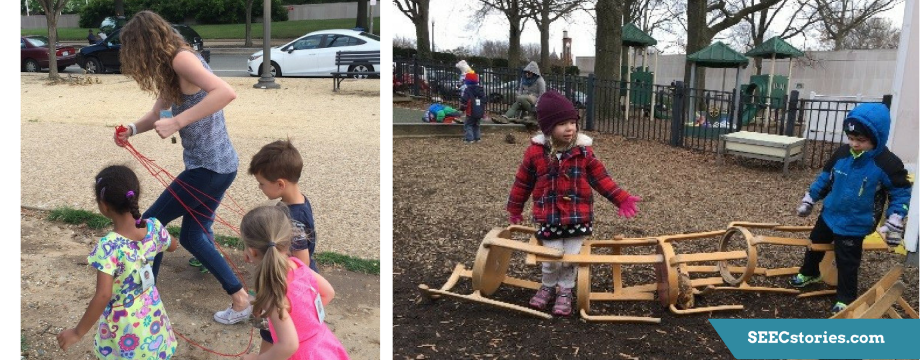
Another time, two children built a large rocket out of stools on the playground.  They decided together which part was safe to ride on, and which part was for the T-Rex.  Through observing their play, I understood that these children were processing the new information they had learned earlier that day about rockets and space shuttles.  The fact that they were discussing which part of the rocket was safe let me know that they understood that rockets have multiple parts, and not every section is suitable for people.  The fact that they added a seat for a T-Rex shows me that they’re incorporating multiple interests and that the possibilities are endless in their play.

The process can not end with simply observing play, but should be extended to assessment.  After reflecting on my own practice, I noticed I used the play observations to inform my cycle of teaching as shown in the diagram below. I would begin by planning a guided play experience with my class, meaning the activities I led were teacher-directed, but playful and hands-on. This guided-play often took place in a museum or community setting and helped illustrate a concept.  This guided play would often lead to spontaneous child-directed play. I would then observe and reflect on the child-directed component and take what I observed and apply it to the next guided play experience.

SEECstories.com (33)

Play is powerful: it’s fun, it’s necessary, and it’s the way young children learn.  Why not use it to create positive, engaging and meaningful learning experiences for young children?

Interested in learning more?

Come play with us at the Smithsonian!  Join us in June for our seminar, Play: Engaging Young Learners in Object Rich Environments, where we’ll explore how to use play to engage young children in the classroom, museum, and community.  Use early bird discount code BIRD17 to receive 20% off from now until May 20th.


References

Dombrink-Green, M. (2011).  A conversation with Vivian Gussin Paley. Young Children, 90-93.

Teacher Feature: Preschool Art Explores Yayoi Kusama

It’s Teacher Feature Thursday!

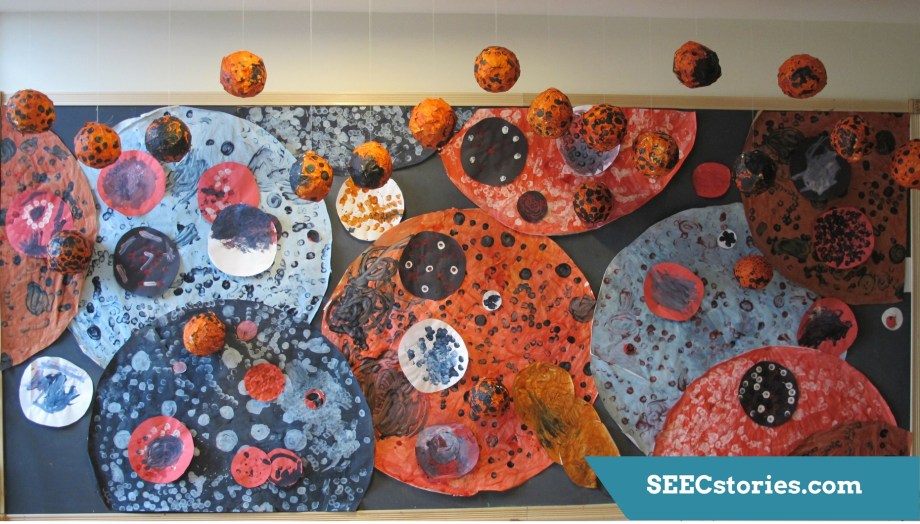
This week we are featuring Carolyn Eby, our school-wide art teacher!  Carolyn teaches art to all of our children, but on this particular day I joined her for a lesson with our preschoolers.  She meets with the three and four-year-olds every afternoon in small groups.  In conjunction with the excitement of the Hirshhorn’s Kusama Exhibit, Carolyn decided to do a mini-unit on Yaoyoi Kusama, exploring her artwork and background.  Below you will find images and descriptions of the lesson, and a reflection from Carolyn.

cover.jpg

Here are a few images from their lesson on Kusama:

 Carolyn’s Kusama unit began before any of the classes visited the Kusama Exhibit.  Her lessons helped lay a foundation of knowledge about Kusama as well as build an appreciation for her artwork.  All the preschool classes were excited to visit the exhibit and see firsthand the artwork they had been learning about in art class.

11Carolyn started this particular lesson by reviewing what they had done so far in their Kusama unit.  They remembered the flat pieces that Kusama makes, and looked at the flat artwork they made with inspiration from Kusama.

8They also talked about Kusama’s sculptural art, and looked at their spheres and “sock-sculpture” they had collaboratively made together in previous art classes.

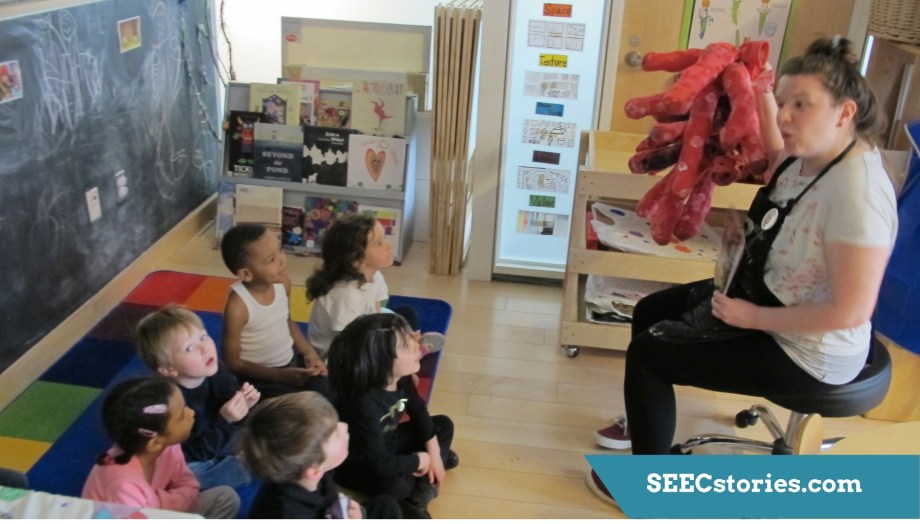
3Carolyn told the children that there was one more type of art that Kusama makes that they hadn’t talked about yet – clothes!  Carolyn explained that when Kusama came to the United States from Japan, she began to make her own clothes.

7Next, Carolyn said that Kusama is a designer, and asked the children what that meant.  One child responded, “you make things!”  Carolyn agreed and said that designers have a passion to make things and we use these things every day.  She surprised the children by telling them that everything they were wearing was designed by someone.  The children looked at their clothes and clips in their hair and expressed their shock that someone actually designed the items they were currently wearing.

5To explore the idea of a designer further, Carolyn read D is for Design ABCS from Cooper Hewitt, Smithsonian Design Museum.  They looked at multiple products that serve the same purpose, but noticed how the design of these items can be very different.  For example, all chairs are meant to be sat in, but they can vary tremendously in their size, color, shape, etc.  Carolyn explained that designers must think about lines, shapes, and colors when making something.

3The class then looked at images of Kusama in her clothes and noticed patterns.  Some questions Carolyn asked were, “Are the polka dots carefully placed or random?”  “Do the polka dots go in a line?”  “What size are the polka dots?”  Through this careful looking of Kusama’s art, the children were analyzing the fundamentals of art that they learned about at the beginning of the year including shape, line, and color.

4Then it was the children’s turn to be a clothing designer!  They had each brought in an old shirt from home, and the first step was placing a piece of cardboard inside the shirt so that the paint didn’t leak through from one side to the other.  This was tricky for many of the children, and Carolyn encouraged teamwork to accomplish the task.

1The next step was taping down the sleeves on the back, so that the shirt was tight on the cardboard, making an easy surface for the children to paint on.

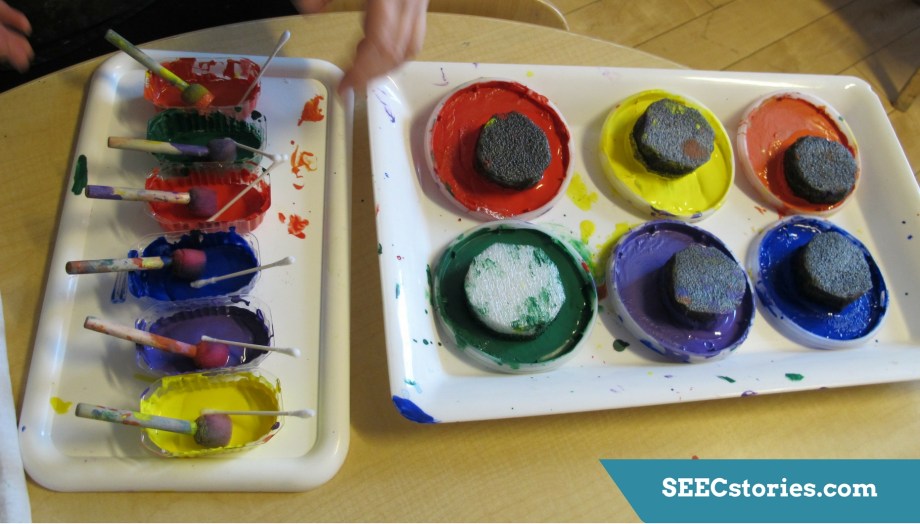
2Carolyn had acrylic paints and tools ready to go.  She explained that unlike the paint they normally use, acrylic paint does not wash out of clothing, so they needed to be extra careful!  She showed the children the colors, as well as the tools to make different sized polka-dots. There were cotton swabs for small dots, foam circle paint tools for medium dots, and circles cut from foam packaging for large dots.

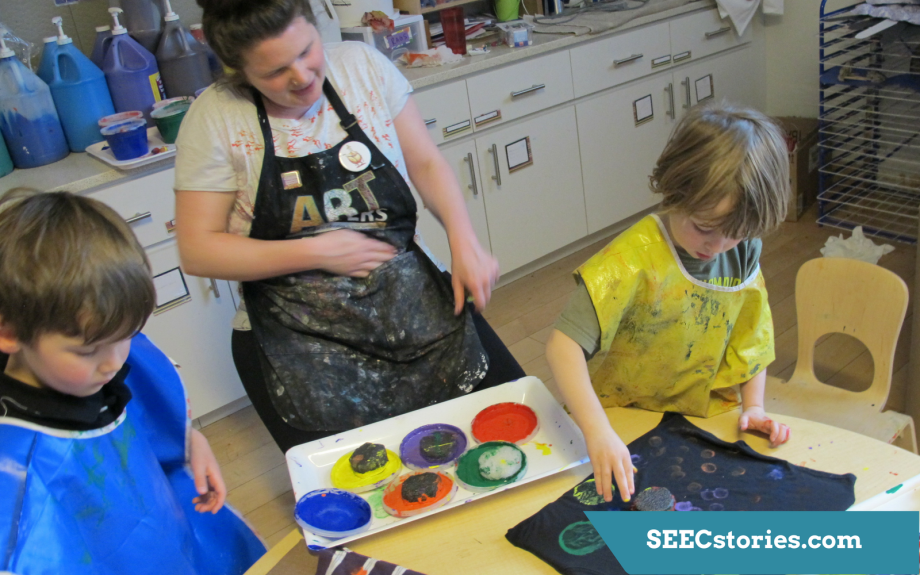
The children set to work using Kusama’s polka dots as inspiration for their shirts, but they added their own perspective and creativity.  They talked to their friends about what they were making including carrots, snowmen, and rain clouds.

2Carolyn came around with the large polka dot tools and paint, and showed the children how to use two hands to get the tool off of the paint tray.  After one child used the large polka dot tool, he said, “Hey!  Look, I made a tire!”  Carolyn asked how he did this and he showed Carolyn how he pressed the tool down hard and then turned it slightly back and forth without lifting it, making tread marks.

5While all the children used the same tools and artist as inspiration, each designed a very unique shirt.  When I asked this child about her design, she said, “I just had to think of it, and then I made it. It’s a flower!”

A reflection from Carolyn:

When the Yayoi Kusama exhibit opened at the Hirshhorn Museum, I was lucky enough to visit, and what I saw was so inspiring! I knew that each of the classes was planning a trip, and I really wanted to create a collaborative art piece with them that would help them process the exhibit and make their experience in the space much more meaningful. I wanted to make sure that in this unit children explored the different types of artwork that Kusama made (sculpture, painting, clothing design, etc.), techniques she used to create these artworks, and elements of Kusama’s characteristic style. Additionally, I always have an objective in the art studio to cultivate students’ curiosity about what they see in the museums, community, and classroom.  I also want them to feel empowered by their ability to create. To prepare for the lessons, I did some research about Kusama, but we also used the tool of observation and discussion when looking at pictures of the artist, her artwork.  We reflected together on their visit to the exhibit to ascertain what the children were most curious about and wanted to make.  With this particular unit I loved the questions the children asked about Kusama’s life and work, and their wonder when we finally put all the pieces they had created together.

During this particular week we took a close look at Kusama’s fashion career. We looked at pictures of Kusama in outfits she created, as well as photos of her fashion collaborations with Uniqulo and Louis Vuitton. We talked about what it means to be a designer, which is important to me because I want students to know that art is not only paintings and sculptures, but around us daily, whether it be a chair or shirt. We read through “D is for Design: ABCs from Cooper Hewitt, Smithsonian Design Museum” and looked at different objects that artists design. I loved our discussion about translating an artist’s style from paintings to clothing. The children made personal connections to the concept of designing, for example, one child referred to his father having a hand in designing jewelry for his mother!  Another aspect of the lesson that I found surprising was the children’s response to using a different type of paint.  I think that the students loved the responsibility of using “real acrylic artist paints” and it made an impact on how carefully they designed their shirts.

In order to better prepare for next time, I would try to create more countertop space in the art room so that I could accommodate more art supplies.  The studio itself is always a game of logistics with regards to materials! I want to make sure the kids have access to the tools we are going to use, but figuring out how to introduce them during the project or how to arrange them for their ease of use is always tricky and something I am always working on!  For this particular lesson I only had one set of large circle stamps with paint for the children to make large polka-dots on their shirts.  I began the week by taking the large stamps to each child, however, after spilling the paints twice, I set up a table for the artists to visit (I am lucky to have neighboring classrooms that are very generous with extra furniture.  Thank you, Honey Bears!).  This enabled the children to take their time with the large stamps, while I was able to use my energy visiting and checking in with other children as they worked on their designs.  My recommendation to any other teacher with this lesson is to try your best to connect the fact that each and every piece of clothing they are wearing is made by a designer.  This is a BIG idea that children might not think of, and having them begin that thought process changes their view of what an artist is. Since this lesson we have been taking a deeper look into fiber arts and we have even worked on doing some embroidery!

Smithsonian Early Explorers

**Please note that the 2019-2020 school year, SEE will be meeting at the Hirshhorn Museum and Sculpture Garden on Mondays and the National Museum of American Art on Tuesdays.

We are about embark on our fourth year of the Smithsonian Early Explorers program. The upcoming anniversary is a little bittersweet as some of our long-time families are leaving the program and moving on to preschool. The toddlers who began this program have grown into competent three-year-olds who are capable, empathetic, and ready for their next big adventure. The adults will also be missed as they have become part of our SEEC community and really helped us reflect on the overall program.

To celebrate the development and growth of the program and it’s students, I thought it would best to tell the story of SEE through photos in the hopes of capturing what makes this program so unique.1

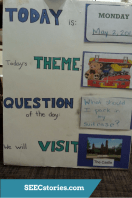
Like many early education programs, we begin our day with a schedule. SEE also includes a “Question of the day.” Our belief is that asking questions can lead to a life-long habit of analysis and critical thinking. These questions also help caretakers who are not present learn about their child’s day.

Each morning we invite our students to play and often include real objects or materials.  This helps create authentic experiences that support a child’s physical, cognitive, and emotional growth. By including real objects, children can have concrete experiences that engage their senses. The photo here shows a lesson in which children explored different types of green as part of a larger study on forests.

We also create imaginative spaces using traditional toys. Our class meets in the Natural History museum’s Q?rius Jr. space and our educators are thoughtful to design a learning environment that encourages imagination and creativity.  We also believe in getting dirty and having fun.


This slideshow requires JavaScript.

Another cornerstone of our program is routine. Each morning the children look forward to ringing the bowl to indicate it is time to gather. Following that, we welcome each other with a our hello song. We often choose books that are regularly reread over the course of the trimester. As the children become familiar with a piece of literature, they delight in knowing what will come next and matching photos to the text. When we depart for snack and our museum visit, the children get on “trains.” They hear the sound of the whistle and know that they need to grab an adult hand and walk safely to their next destination. These routines help the children feel safe, know what to expect, and help the whole group transition.


This slideshow requires JavaScript.

We are a museum school and therefore, regularly visit the museums on the National Mall. Learning in museums can be beneficial to young children especially because they are better able to learn when they connect more concretely with subject matter that they actually experience. SEE does not limit itself though – we see our classroom as extending beyond the National Mall and museums. Some of our highlights this year were the DC Circulator and the National Arboretum. We also take advantage of new exhibitions even when they don’t tie into the curriculum, as was the case with the Kusama show at the Hirshhorn Museum. Really, who could pass up such a fun experience?!


This slideshow requires JavaScript.

We believe in play and we believe it should happen in museums. I know for some that might seem contradictory to museum etiquette, but we believe that play can and should happen in museums. With some forethought it can be done successfully with young children. Below you will observe how bringing some loose parts allowed one child to build a structure of his own. He was no doubt inspired by the house on view in the American History gallery where he was You can also see how we transformed a lesson on maple leaves into a game of placing leaves onto a tree. Finally, and perhaps one of my favorites, watch both the children and adults have fun practicing their penguin walk at the Natural History Museum.


This slideshow requires JavaScript.

SEE is a program that not only supports the child, but the parent/child relationship. Our educators help parents in their role as their child’s first teacher. We try to educate our parents on issues of child development and assist them as they navigate specific situations with their child. Caretaking is hard work and we use daily interactions, weekly emails, and conferences as ways to help parents navigate these early years.


This slideshow requires JavaScript.

It takes a village and SEE is a community which relies on it’s families and staff to help cultivate a diverse learning experience and strong community. Below are just a few examples: one grandmother shares her sticky rice after viewing bowls from the Sackler Gallery, our resident science educator, and retired entomologist, shares his expertise and live specimens, a small potluck marks the end of a trimester, and one child focuses during their monthly visit to our art studio.


This slideshow requires JavaScript.


We are proud of the Early Explorers program for not only its use of museums, but its approach to educating the whole child, supporting families, and creating community. We wish our graduates well and look forward to meeting our new students in the fall!

7

Do you have a child who will be between the ages of 18 – 24 months this fall? You may want to consider joining the SEE program. We are hosting our Prospective Student Day on May 24. During the day, we invite families to participate in the program to experience it for themselves and have the opportunity to talk to other families. Join us by registering here.


Music Monday

To help celebrate the National Association for the Education of Young Children’s (NAEYC) Week of the Young Child, we are highlighting our music teacher Allison Brake for Music Monday! As SEEC’s music teacher, Allison visits each SEEC class, infants through kindergarten, once a week for music class.

SEECstories (5)

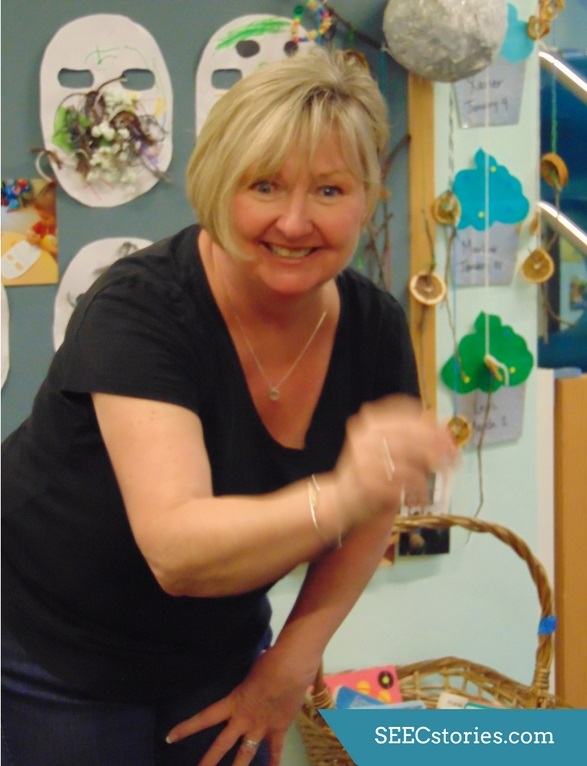
Allison has been teaching with SEEC since SEEC’s beginning back in 1988, but she has not always been the music teacher. In fact, Allison became SEEC’s music teacher relatively recently in the mid-2000s. In the time between she was a classroom teacher, assistant director, and a resource teacher. Even when Allison was not SEEC’s music teacher, she explained that she “always brought music into the classroom.”

This experience made her the ideal music teacher for SEEC. She happily took on the challenge of expanding the music classes to the youngest classes so the whole school had the opportunity to have a time focused on music. Allison explained that she loves using music as a tool for helping children develop starting in infancy and following them through kindergarten.

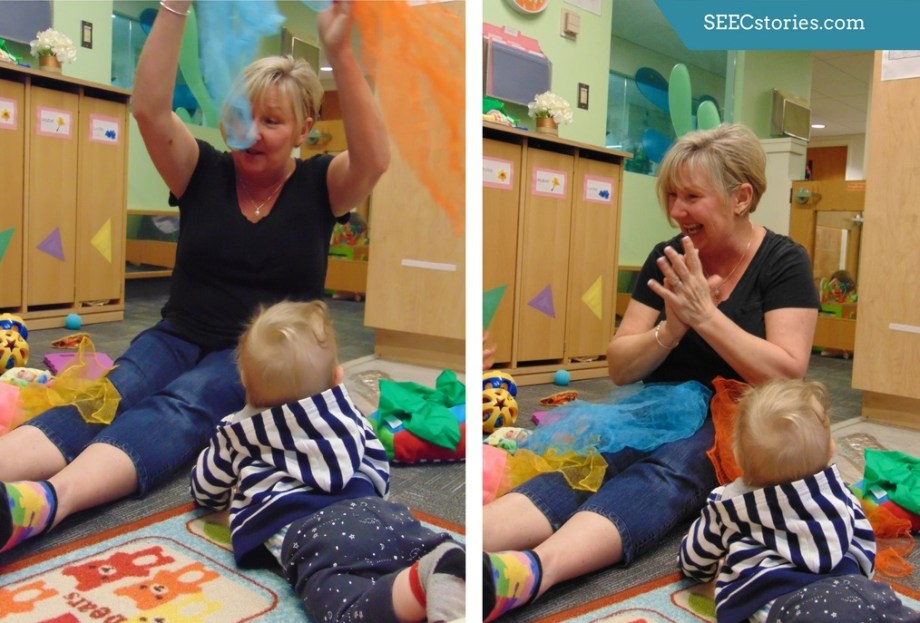
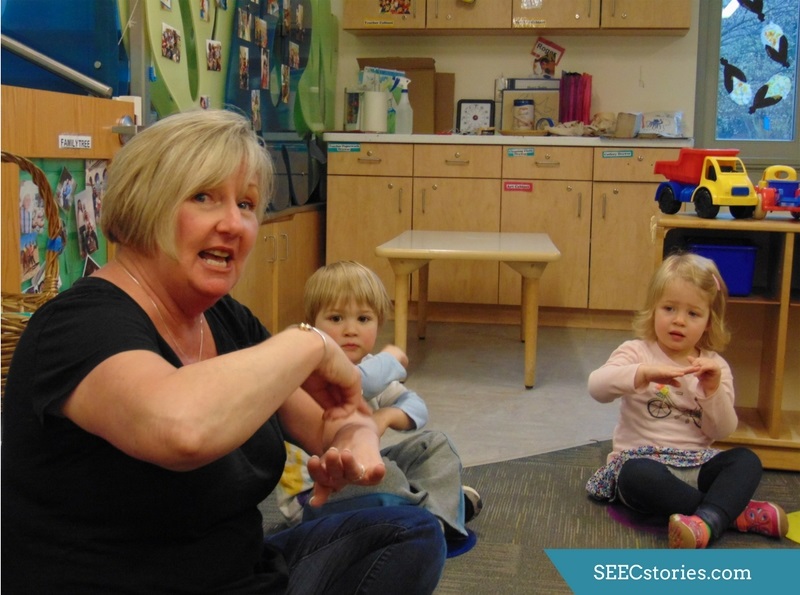
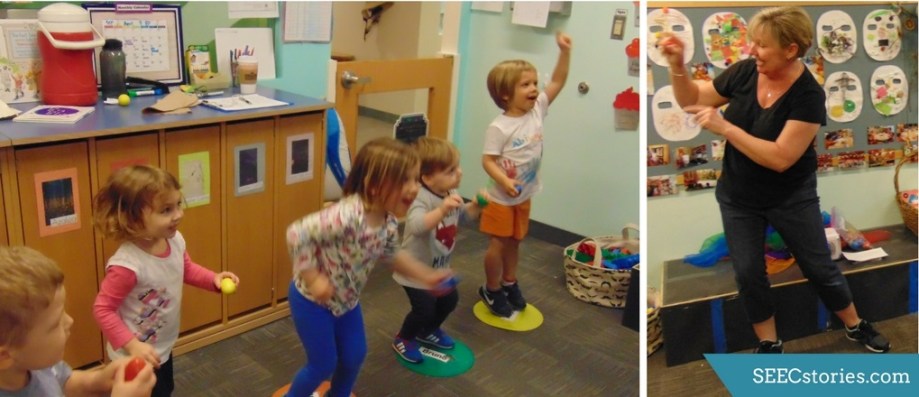
SEECstories (3)While Allison believes that music is a vital program for children of all ages, she focused on the importance of music with the youngest of children. In particular, Allison highlighted how hearing familiar sounds or songs helps infants learn to self-regulate and self soothe. She also discussed how music helps to build babies’ language development. She noted how she likes to start her classes by singing a song that includes each child’s name. With the babies, she explains that they very quickly respond to hearing their own name by clapping, bouncing, or smiling.

SEECstories (1)Beyond name recognition, Allison explained that singing hello to the individual is important for the start of each of her music classes. It gives her the opportunity to “build off who the child is” from the start of each class. She explained that it set the class up for social emotional growth opportunities since music class is the whole group singing with opportunities for the individual to shine.

When asked to offer advice to parents, Allison said “Don’t be too hesitant.” Music can be used for fun and to comfort. If as a parent, you still feel uneasy singing, Allison recommends buying and playing music. She clarified that playing music is different from putting on the TV because music allows the parent to continue to be present both with eyesight and in interaction in a way that is impossible with a screen. But in the end, Allison encourages all parents to sing to their children and says that your children “aren’t making judgement” so you should “free yourself from judgement” as well.

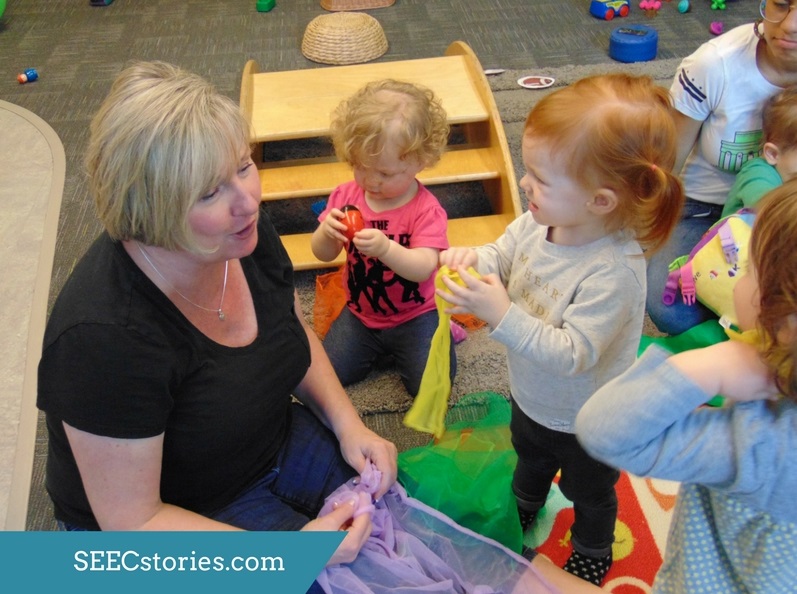
SEECstories (2)Her advice for teachers included using music as cues when transitioning in the classroom and repeating songs so that children can learn them. Once the class knows a song, then the teachers can add variety and build upon the songs so that they are challenging and offer new opportunities.

SEECstories (4)Lastly, Allison told us some of her favorite songs. She said that she loves “Popcorn” by Greg and Steve,because it helps children “lose their inhibition” and ties in disco, which is always fun. Another favorite is “Listen to the Horses” by Raffi and the “All the Pretty Horses”, which is a lullaby that Allison sang to her own children and said that it has a “soothing melody like a waterfall.” Don’t all these songs sound great? At SEEC we love hearing new music! What are some of your favorite songs to sing?

Top 5 – Nature Play

cover.jpg

Last week we brought you a blog highlighting the many benefits of nature play. While any outdoor play is beneficial, play in natural environments, such as a forest or athletic field, has greater opportunities for discoveries. These opportunities yield greater exploration and learning.  But let’s face it, we don’t all live or teach near a forest, so how can caregivers or teachers mitigate this, and make the most of their outdoor space?  We’ve rounded up some great nature play resources and ideas for everyone – whether you live in a rural or urban environment.  The first two come from Emily Porter, Education Program Specialist at the National Zoo.

1. Children and Nature Network – The Children and Nature Network (C&NN) is a non-profit organization co-founded by Richard Louv, author of the seminal text “Last Child in the Woods: Saving Our Children from Nature-Deficit Disorder.” C&NN supports grassroots efforts to encourage natural play and education by creating networks of teachers, parents, and natural organizers to share ideas and ask questions and by providing a wealth of free resources, including toolkits for establishing Family Nature Clubs in your community. Their 2015 guide “Thriving Through Nature: Fostering Children’s Executive Function Skills” describes how and why natural play supports executive function development and provides a variety of specific nature-based activities by age group.

download

2. Help Children become Young Environmentalists – Many environmental conservation organizations like Friends of the National Zoo are intensifying their efforts to promote natural play among young children and families based on evidence that demonstrates the connection between natural play and conservation-based behaviors later in life. In this spirit, our FONZ children’s classes provide opportunities for  young learners to participate authentically in environmental conservation. Not only do these activities promote agency and responsibility for young children, but they also help us focus on the positive narratives of conservation, rather than the typical “doom and gloom” stories that can be overwhelming for young children. For example try out one of these activities from our classes with your children:

  • Instead of throwing away scraps of yarn, gather them and hang them on tree branches for birds to use in nest building.
  • Make seed balls with native wildflower seeds that can be thrown into barren areas to create habitats for pollinators.
  • Create temporary mud puddles to use as play habitats for plastic animals like elephants, warthogs, and frogs to explore the different ways that animals use mud and dirt in the wild.

Panda crop_for website

3. Tinkergarten Tinkergarten is an organization that promotes nature play for families with young children, and they offer classes around the country for ages 18 months to 8 years.  In addition, their website has a plethora of DIY activities that can be filtered to specific ages, length of activity, and skills that the activity helps to develop.   For example, their Tiny Friends activity encourages children to stop and look at the bugs that are in their environment.  The activity outline has ideas for books to read, questions to ask, and how to prompt further curiosity.  Even if you don’t teach or live near a forest, this activity can be done in a yard or small patch of grass.

Tinkergarten-Meme-Winter1.jpg

4. Bring the Outdoors In – One factor contributing to children’s lack of outdoor nature time is the diminishing lack of green space, but you can bring the outdoors inside in a variety of ways.  We love these nature-inspired sensory bottles from Rhythms of Play.  They’re safe for babies, mess-free, and can be changed depending on the time of year or what your children are interested in.  Another way to get nature inside is by using natural materials for art projects.  During our one snow storm in Washington, DC this year, our art educator, Carolyn Eby, brought in buckets of snow, and used it as a blank canvas for their art.  The children used waterproof battery-powered lights and water colors for their creations.

5. Smithsonian Garden’s New App – Community of Gardens- Smithsonian Gardens has just released a free app, Community of Gardens, that explores the hidden stories of gardens nearby and around the country.  Download the app and take a walk around your neighborhood, stopping at the gardens on the map to read the stories with your child. You can even share your own garden story with the Smithsonian!  Work together to write a story about your garden, or take this opportunity to make your own garden, even it’s only a flower box.  Planting seeds, watering, and pulling weeds are all great sensory and movement exercises, and watching the changes in your garden is a fantastic way to incorporate science concepts.

hm-logoSEECstories.com (25)


Please comment and share some of your favorite nature play activities; we’d love to hear your ideas!  And check out our Nature Pinterest board for more ideas!

Get Out of the Classroom and Into Nature: The Importance of Nature Play in Child Development


This post is coauthored by SEEC’s Brooke Shoemaker, and Emily Porter, Education Program Specialist, at the National Zoo.
1

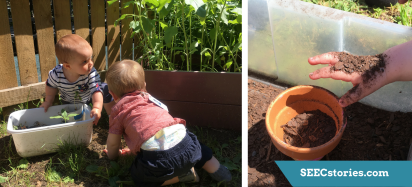
Growing up, I had a special spot in the corner of my backyard that felt like it was all mine.  I would spend hours back there cooking stews made up of mud, leaves and sticks; making up stories about the lives of the bugs I saw; imagining I was an explorer in a new world; building forts with my sister, and observing the changes in the season.  While I was having a ball outside, I of course didn’t realize all the positive affects nature was having on my development- it was just fun!

Being outdoors and in nature is associated with numerous benefits including better physical, mental, and emotional health.  The natural environment is a complex and diverse one that contains opportunities for children to learn and develop in all areas.  Although the many benefits of being in nature have been researched, children are spending less time outdoors than ever before. This disconnect to nature may be due to several factors including the prevalence of media and technology, less green space to play, safety concerns, and adult perceptions about the importance of time spent outdoors.  Due to all of these factors, children spend much more time indoors involved in adult-planned activities than they do outside participating in free, spontaneous play.  So why is nature play so important?  We’ve outlined some key developmental areas, and how being outside positively affects children’s development in each domain.

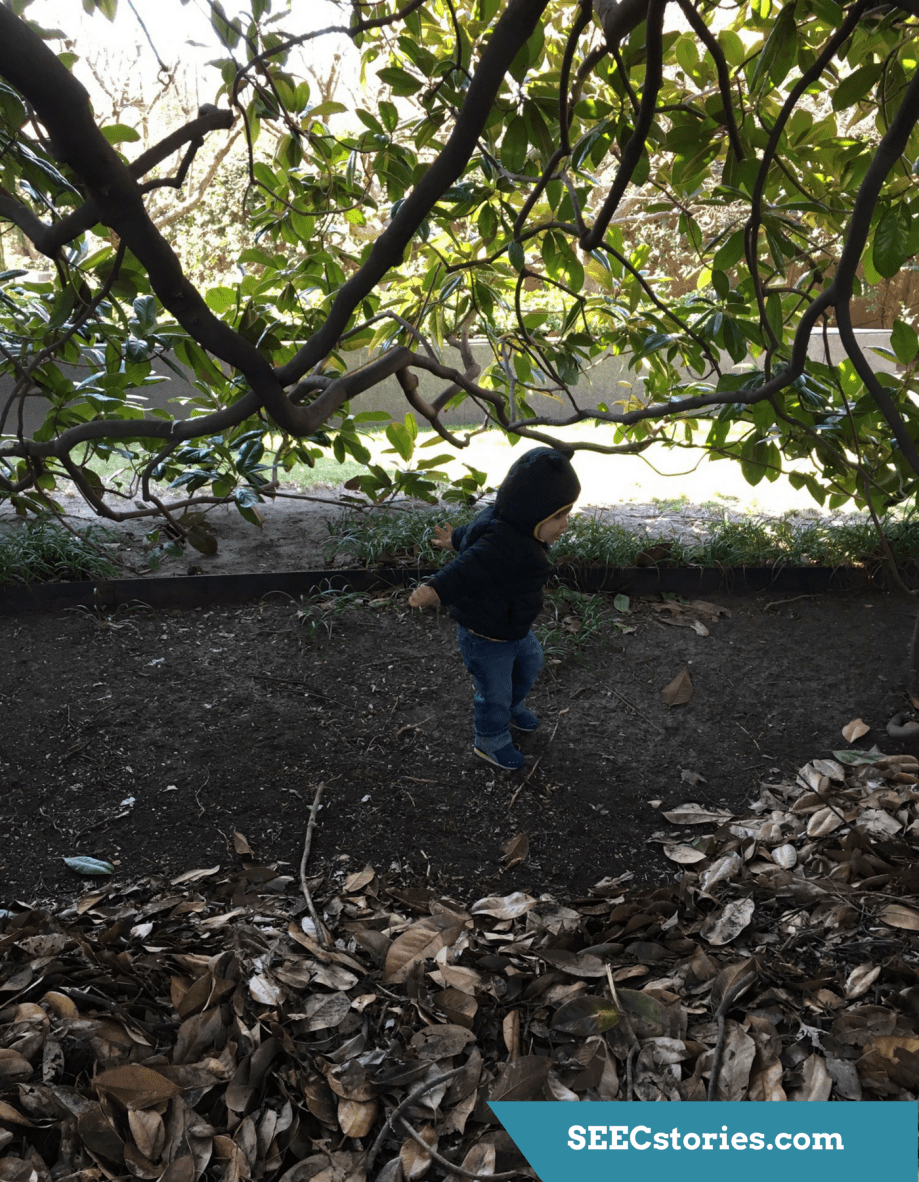
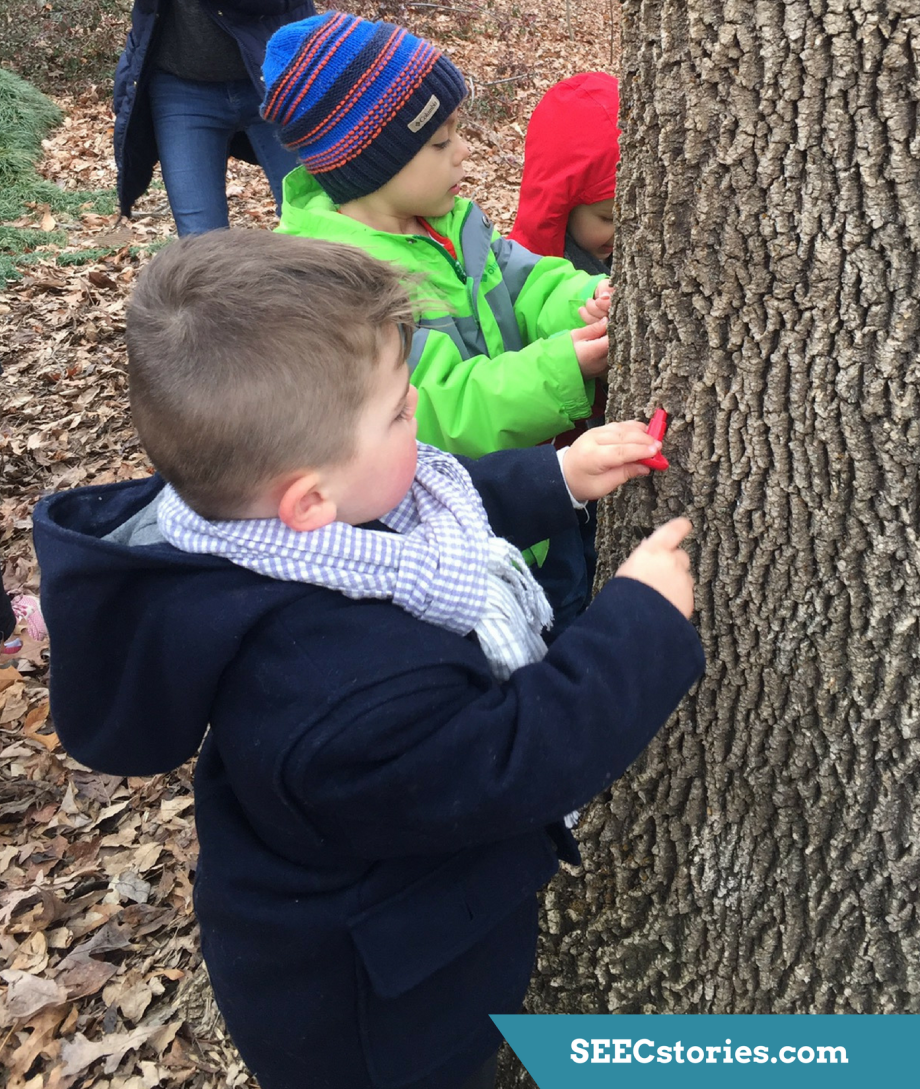
Cognitive Benefits:  While some schools have cut recess time in favor of more academic time, being outside in an unstructured environment has numerous cognitive benefits.  It is common for children to have trouble focusing in the modern world with all the stimuli from media, and technology, as well as having to sit still for long periods of time.  Luckily, nature has been found to have restorative effects on attention and thus it is cognitively beneficial for children to have outside breaks.  Also, nature can be used as a subject of academic inquiry, not just as a break in between learning.  The ever changing environment found outdoors provides ample opportunities for children to explore and learn through question-asking, observation, experimentation, and reflection. Richard Louv, author of The Last Child in the Woods, even states in his article, The More High-Tech Schools Become, the More They Need Nature, that schools which utilize the outdoors as a continuation of their indoor classrooms have reported higher student gains in academic subjects such as mathematics and language arts.
6.png

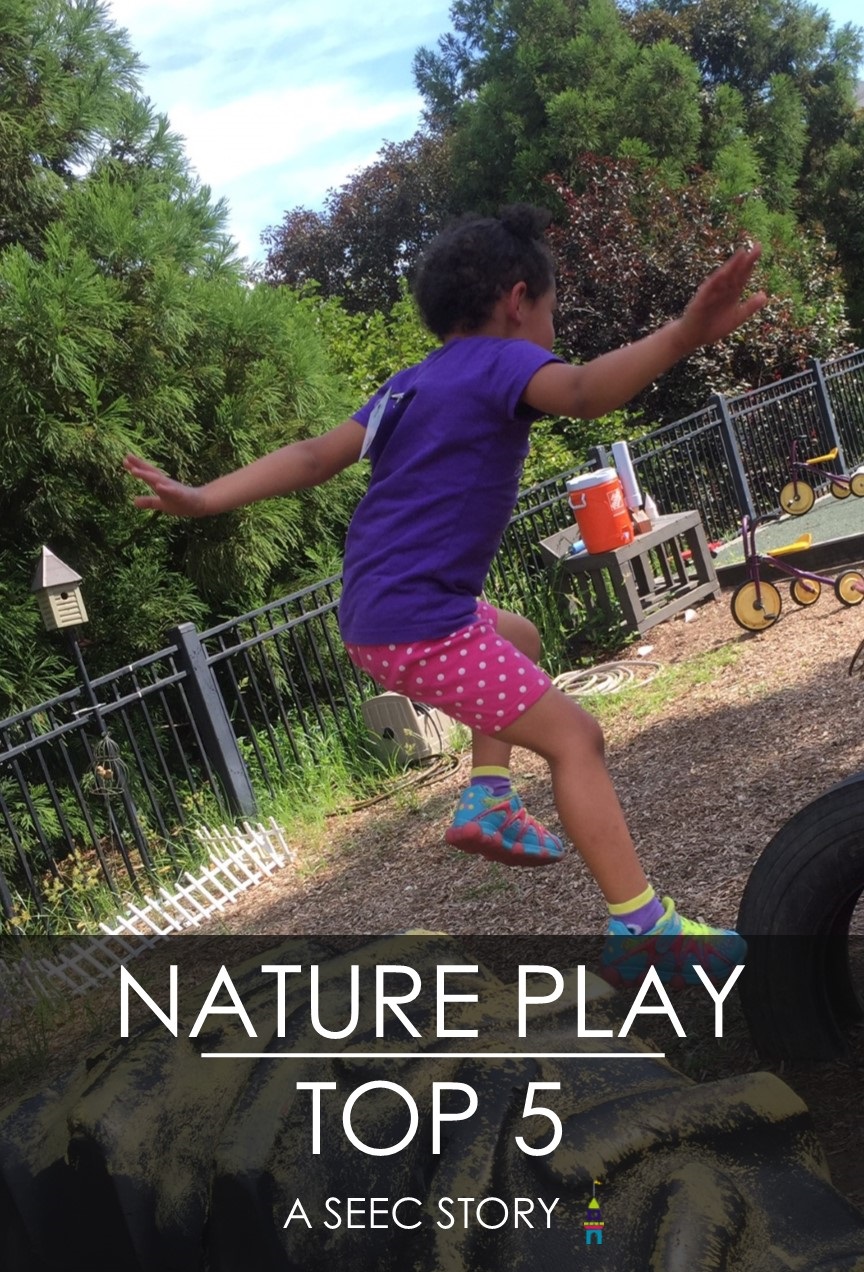
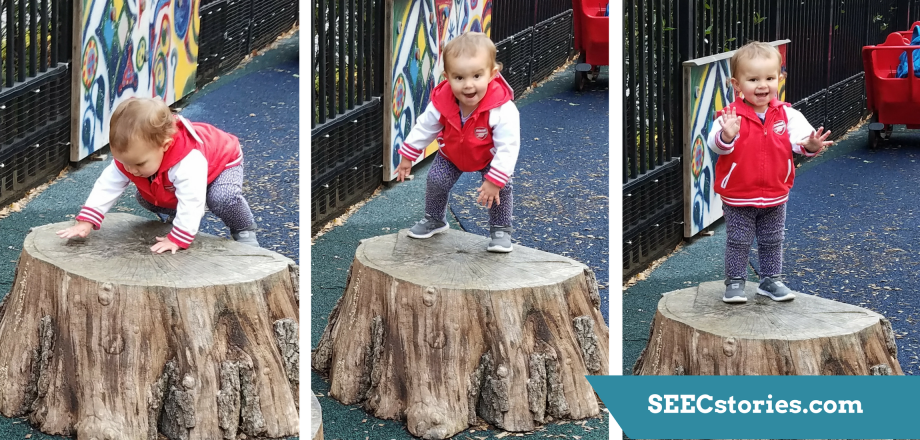
Physical Benefits:  Nature play provides numerous opportunities for physical development through activities such as climbing, jumping, running, and balancing.  The environment outside is ever changing which gives children new terrain to encounter daily and access risk.  Outdoor spaces also tend to be larger than the indoor spaces children play in, allowing children opportunities to move in different ways and experiment with what their bodies are capable of.  On any given day one of SEEC’s classes can be seen engaging in large and small muscle development when out on our playground or the National Mall.  From climbing up on a tree stump, to carefully sorting through dirt and collecting small pebbles, nature play helps develop all muscles of the body.   Research also shows that children who have positive experiences in nature will grow up to be adults who enjoy being outside, so nature play is not only significant to developing physical skills, but also in maintaining children’s current and future health.
SEECstories.com (22)

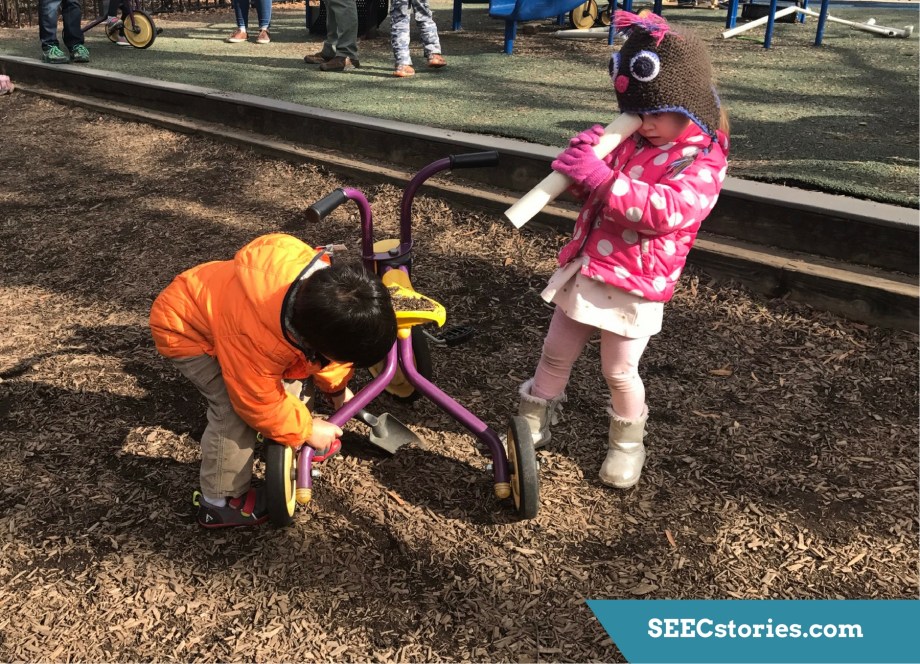
Social Benefits: With a little planning ahead, Nature is all-inclusive, it does not matter what a person’s ability, race, gender or class; there are opportunities for everyone to play outside.  Play outside is also usually unstructured, which allows children to share, cooperate, and navigate peer conflicts.  Nature play commonly supports small group play, as this photo demonstrates, in order to move a heavy log, a child must enlist the help of their peers.
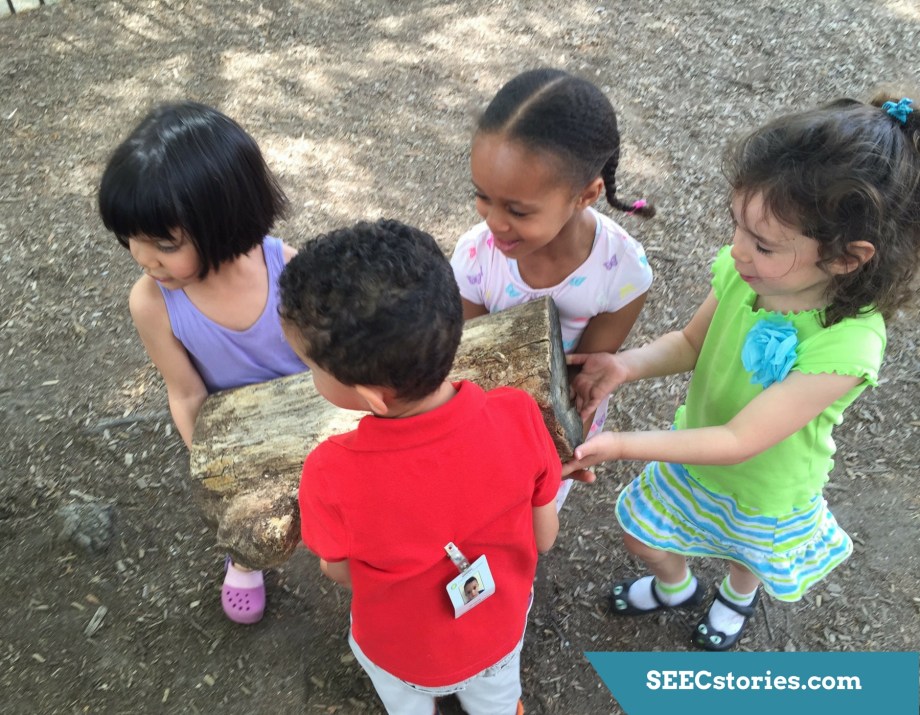
SEECstories.com (17).jpg

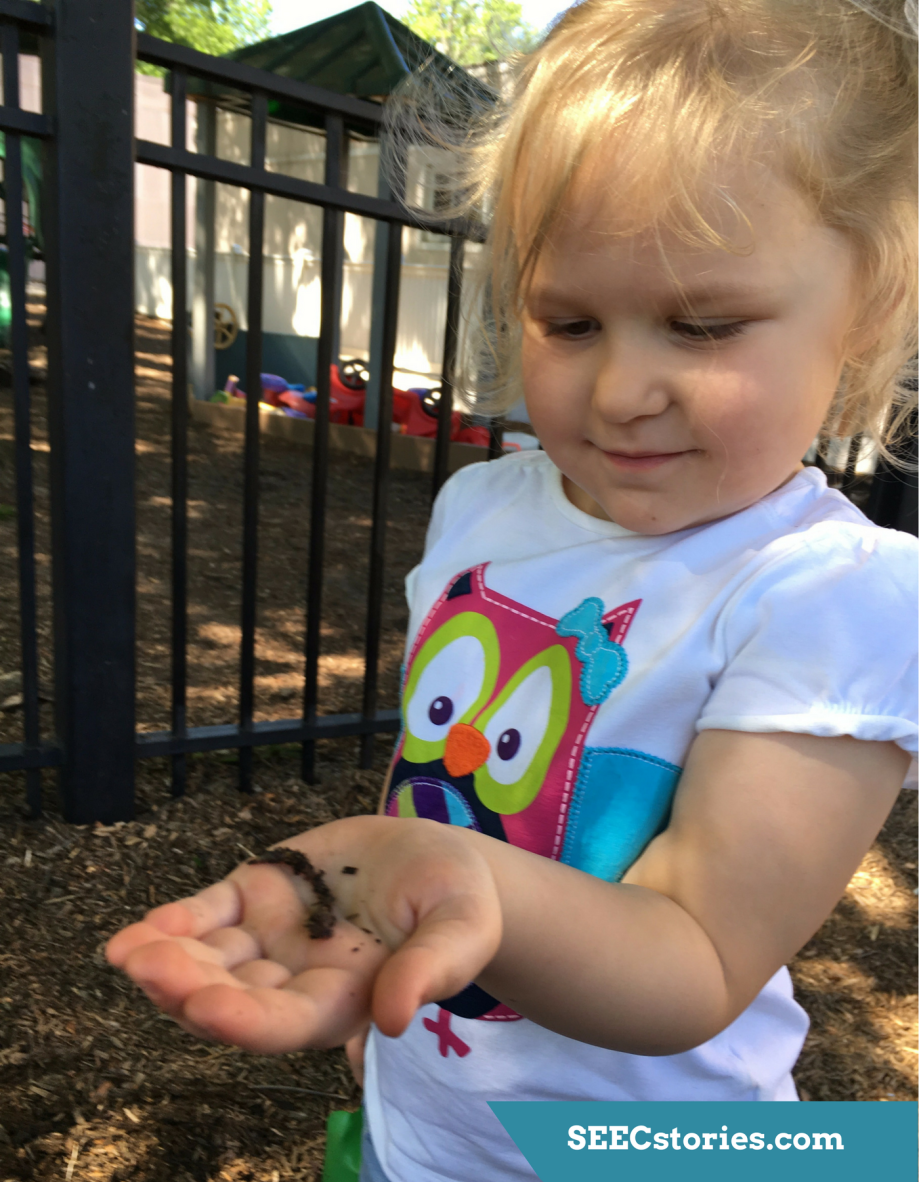
Empathy Benefits:  Nature play can also play a role in young children’s development of theories of mind by supporting the type of perspective taking that is critical to moving beyond an egocentric view of the world.  When children play in nature, they are engaging with living beings other than themselves, from trees and grass to birds and caterpillars. This direct exposure to other living organisms offers a host of access points for children to begin developing an understanding of plants and animals as individual living things, like themselves, and develop larger understandings of what living things need.

By establishing positive connections between young children to the plants and animals that share their world, time outdoors promotes empathy to all the plants and animals in nature. Reduction in children’s exposure to nature can result in their developing fearful responses to and misunderstandings about nature, specifically surrounding certain “less-desirable” parts of nature: bugs, dirt, germs.  However, when young children are given the opportunity to explore the natural world on their own terms through play, particularly when in the company of a trusted adult, they create connections to and positive associations with natural spaces as their brains form critical neural pathways.  By framing nature and wild spaces as places of wonder early in development, we are helping children build the ability to care for those places in the future. In fact, research has shown that people who spend more time outdoors are more concerned about the environment, and are more invested in protecting it.  
2

Positive Sense of Self Benefits: Nature is, by definition, real and changeable. The natural play environment that a child encounters on Tuesday will be different on Thursday as leaves fall, winds blow, and animals move.  When adults encourage children to self-direct their own play in nature, this environment of constant change offers rich opportunities for children to develop confidence and practice making choices. On the flip side, the unpredictability of the environment can be frustrating for a child who finds that she is unable to replicate yesterday’s play experience exactly. However, when a supportive adult can helps her reframe these changes into a positive opportunity to have new adventures, it can be a great opportunity for practicing self-regulation and control.

Additionally, participating in nature play offers even the youngest learners the opportunity to participate actively and authentically in environmental conservation. Too often, issues in environmental conservation are introduced with a pessimistic outlook that can feel overwhelming to children. By offering children the opportunity to practice caring behaviors in wildlife and wild spaces, nature play empowers children and gives them the opportunity to take positive action, even if only in play.

We know nature play is great and beneficial to children’s growth, but how can it be incorporated more into a child’s home and school life? Be sure to check back next week for a Top 5 Nature blog for ideas to include more nature into your young child’s life!  In the meantime, check out SEEC’s Nature Pinterest board for resources and inspiration.


References:

Berto, R. (2014). The role of nature in coping with psycho-physiological stress: A literature review on restorativeness. Behavioral Sciences, 4, 394-409.

Burris, K., & Burris, L. (2011).  Outdoor play and learning: Policy and practice.  International Journal of Education Policy and Leadership, 6(8), 1-12.

Burris, K. & Burris, L. (2011)  Fearful people: Parental perceptions and children’s outdoor activity. Delta Journal of Education, (1)1, 45-60.

Ernst, J. (2012). Early childhood nature play: A needs assessment of Minnesota licensed childcare providers. Journal of Interpretation Research, 17(1), 7-24).

Ferreria, M. M., Grueber, D., & Yarema, S. (2012).  A community partnership to facilitate urban elementary students’ access to the outdoors.  School Community Journal, 22(1), 49-64.

Fjørtoft, I. (2001). The natural environment as a playground for children: The impact of outdoor play activities in pre-primary school children.  Early Childhood Education Journal, 29(2), 111-117.

Ingraham, C. (2015).  There’s never been a safer time to be a kid in America. The Washington Post. 

Louv, R. (2011). Reconnecting to nature in the age of technology.  Futurist, 45(6), 41-45.

Louv, R. (2012).  The more high-tech our schools become, the more they need nature.  Science & Children, 49(7), 8-9.

Mainella, F. P., Agate, J. R., & Clark, B. S. (2011).  Outdoor-based play and reconnection to nature: A neglected pathway to positive youth development. New Directions For Youth Development, 2011(130), 89-104.

Thompson, C. W., Aspinall, P., & Montarzino, A. (2007). Adult visits to green places and the significance of childhood experience. Environment and Behavior, 40(1), 111-143.

Zelenski, J. M., Nisbet, E. K. (2014). Happiness and feeling connected: The distinct role of nature relatedness. Environment and Behavior (46(1), 3-23.