
**Please note that the 2019-2020 school year, SEE will be meeting at the Hirshhorn Museum and Sculpture Garden on Mondays and the National Museum of American Art on Tuesdays.
We are about embark on our fourth year of the Smithsonian Early Explorers program. The upcoming anniversary is a little bittersweet as some of our long-time families are leaving the program and moving on to preschool. The toddlers who began this program have grown into competent three-year-olds who are capable, empathetic, and ready for their next big adventure. The adults will also be missed as they have become part of our SEEC community and really helped us reflect on the overall program.
To celebrate the development and growth of the program and it’s students, I thought it would best to tell the story of SEE through photos in the hopes of capturing what makes this program so unique.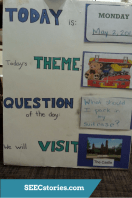
Like many early education programs, we begin our day with a schedule. SEE also includes a “Question of the day.” Our belief is that asking questions can lead to a life-long habit of analysis and critical thinking. These questions also help caretakers who are not present learn about their child’s day.
Each morning we invite our students to play and often include real objects or materials. This helps create authentic experiences that support a child’s physical, cognitive, and emotional growth. By including real objects, children can have concrete experiences that engage their senses. The photo here shows a lesson in which children explored different types of green as part of a larger study on forests.
We also create imaginative spaces using traditional toys. Our class meets in the Natural History museum’s Q?rius Jr. space and our educators are thoughtful to design a learning environment that encourages imagination and creativity. We also believe in getting dirty and having fun.
Another cornerstone of our program is routine. Each morning the children look forward to ringing the bowl to indicate it is time to gather. Following that, we welcome each other with a our hello song. We often choose books that are regularly reread over the course of the trimester. As the children become familiar with a piece of literature, they delight in knowing what will come next and matching photos to the text. When we depart for snack and our museum visit, the children get on “trains.” They hear the sound of the whistle and know that they need to grab an adult hand and walk safely to their next destination. These routines help the children feel safe, know what to expect, and help the whole group transition.
We are a museum school and therefore, regularly visit the museums on the National Mall. Learning in museums can be beneficial to young children especially because they are better able to learn when they connect more concretely with subject matter that they actually experience. SEE does not limit itself though – we see our classroom as extending beyond the National Mall and museums. Some of our highlights this year were the DC Circulator and the National Arboretum. We also take advantage of new exhibitions even when they don’t tie into the curriculum, as was the case with the Kusama show at the Hirshhorn Museum. Really, who could pass up such a fun experience?!
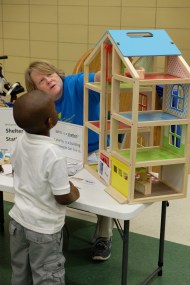
We believe in play and we believe it should happen in museums. I know for some that might seem contradictory to museum etiquette, but we believe that play can and should happen in museums. With some forethought it can be done successfully with young children. Below you will observe how bringing some loose parts allowed one child to build a structure of his own. He was no doubt inspired by the house on view in the American History gallery where he was You can also see how we transformed a lesson on maple leaves into a game of placing leaves onto a tree. Finally, and perhaps one of my favorites, watch both the children and adults have fun practicing their penguin walk at the Natural History Museum.
SEE is a program that not only supports the child, but the parent/child relationship. Our educators help parents in their role as their child’s first teacher. We try to educate our parents on issues of child development and assist them as they navigate specific situations with their child. Caretaking is hard work and we use daily interactions, weekly emails, and conferences as ways to help parents navigate these early years.
It takes a village and SEE is a community which relies on it’s families and staff to help cultivate a diverse learning experience and strong community. Below are just a few examples: one grandmother shares her sticky rice after viewing bowls from the Sackler Gallery, our resident science educator, and retired entomologist, shares his expertise and live specimens, a small potluck marks the end of a trimester, and one child focuses during their monthly visit to our art studio.
We are proud of the Early Explorers program for not only its use of museums, but its approach to educating the whole child, supporting families, and creating community. We wish our graduates well and look forward to meeting our new students in the fall!

Do you have a child who will be between the ages of 18 – 24 months this fall? You may want to consider joining the SEE program. We are hosting our Prospective Student Day on May 24. During the day, we invite families to participate in the program to experience it for themselves and have the opportunity to talk to other families. Join us by registering here.


 In the fall of 2015, the Friends of the National Zoo, National Museum of African American History and Culture, National Air and Space Museum, National Museum of American History, National Museum of Natural History, Smithsonian Associates’ Discovery Theater, and the Smithsonian Early Enrichment Center, together with the DC Promise Neighborhood Initiative (DCPNI) were awarded a two-year grant through Grow Up Great, PNC’s initiative focused on early childhood education, to launch Word Expeditions. The grant’s objective is to build vocabulary in preschool students from the Kenilworth-Parkside neighborhood in Northeast DC. DCPNI works exclusively with this neighborhood supporting all members of the Kenilworth-Parkside and describes its mission as “improving the quality of their own lives and inspiring positive change in their neighborhood.” The group has a strong foothold with families of young children and so it seemed natural to integrate Word Expeditions into their already existing Take and Play structure. Once a month, Smithsonian representatives visit Neval Thomas Elementary School during which time, families participate in activities that teach about the Institution’s collections, build vocabulary, and support a child’s development. The evening concludes with a meal and families take home a kit from DCPNI outlining fun and simple ways to incorporate learning and vocabulary skills at home.
 A few weeks later, families are invited to come to the museum that co-hosted the
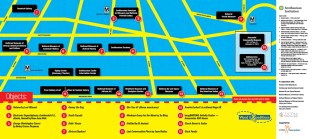 accompanied by what I like to call, conversation starters. These conversation starters include key vocabulary terms that help families define some big ideas they can use to discuss the object. They also pose open-ended questions and suggest easy ways to engage with the object and use the vocabulary in ways that will help children understand and recall the word’s meaning. For example, The Smithsonian Gardens description asks families to look closely at an elm tree and find its parts. The children will walk away with a concrete understanding of terms like roots, trunk and bark. The National Portrait Gallery’s entry asks families to imagine what they would see, hear and taste if they jumped into the portrait of George Washington Carver and suggest that parents use the term five senses and, of course, portrait.
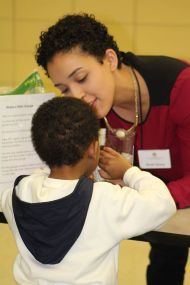 I find that dinner time at the Take and Play program provides the perfect opportunity for me to get to know families on a deeper level as I talk with them about the maps and their museum visits. Recently, I engaged in a conversation with two families who have become “regulars” at the workshops and museum visits. When I asked what museums the families had visited lately, the mothers immediately began to list all of the museum trips they had been on since the program’s inception in the fall and what’s more, they described their visits in detail – recalling the vocabulary that was introduced and the activities in which they participated. It was exciting to see their enthusiasm for the program and it was clear that the map had helped foster and grow their interest in museums.


 Pools, beaches, lakes, sprinklers…it’s that time again! Children all over the US are enjoying summer-time to its fullest and likewise, parents are looking for water-inspired activities. Here in DC, we are lucky enough to have a number of public fountains that are both beautiful and refreshing. Fountains capture the imagination of children, so why not take this opportunity to create a learning experience?
 Infants

 seecstories.com