It’s Teacher Feature Thursday!
This week we are featuring Melinda Bernsdorf, Meredith Osborne, and Megan Gallagher in the Toucan toddler classroom. Inspired by their change of clothing and season, the teachers decided to focus on winter. I was able to join their class for a lesson led by Melinda. She decided to focus on showing the children the different ways animals stay warm in nature. Below you will find a reflection from Melinda, Meredith, and Megan and images from Melinda’s lesson.

What were your topics of exploration? Why did you choose them? Where did they come from?
This lesson was the beginning of a week in which we were exploring how to keep warm during winter. We had recently finished a unit on senses and wanted to expand the skills we were building to focus on more specific questions. Besides being seasonal, talking about how to dress during winter fits the daily needs of our students. As the weather turns colder, we spend more time in the classroom getting ready to head outside. We have noticed that this can lead to some frustrating transitions, and saw an opportunity to explore connections between our physical needs and those needs of something well-loved by our class this year, animals.
Why and how did you choose the visit?
The location for the visit was easy to pick. The National Museum of Natural History has a fantastic collection of animals in the Kenneth E. Behring Family Hall of Mammals, including a section focusing on animals of North America that live in the Far North, where it gets very cold. This exhibit space explores different adaptations that northern animals have made in order to comfortably live in these places, such as layers of blubber, thick undercoats, hibernation, burrowing underground, or camouflage to hide from predators.
As a class, we have visited this area of the museum frequently as we really love animals. The students feel comfortable in this space and recognize their favorite animals. This enables us to move beyond the immediate reaction of surface interest, and go more in depth on a specific subject regarding these animals. Additionally, there is a quiet space directly in front of the animals we wanted to discuss that is well suited for a class of our size to sit and have a lesson. It is a bit out of the way of the main traffic of the museum and is shaped like a little nook, which always helps lessen the surrounding distractions.
What were your learning objectives? (What did you want your children to take away from the lesson?)
We wanted to open the conversation with our students about winter clothing. We also wanted to deepen their understanding about adaptations in animals, the ways in which animals are different from each other, and the ways in which animals are similar to people and have similar needs. The idea that fur and blubber are like jackets that animals always wear is a fairly abstract concept that we wanted to make more concrete with as many connections as possible. We also wanted our students to have fun, exciting sensory experiences that engaged their thinking surrounding our discussions. We treated this like a science experiment, helping the students to ask meaningful questions, gather information, and draw conclusions in a natural, unstructured way.
What was most successful about your lesson?
This lesson turned out to have some great moments that we were able to expand on throughout our week on winter clothing. We introduced a new song that got our students excited about winter clothing. We took a song that our student knew well and allowed them to move their bodies (Head Shoulders, Knees and Toes) and wrote new lyrics to fit our lesson. We sang “Hats, mittens, scarves and boots, Scarves and Boots! Hats, mittens, scarves and boots, scarves and boots. Sometimes we even wear snowsuits! Hats, mittens, scarves and boots, Scarves and Boots!” Our students also really enjoyed exploring the ice. At one point, some of the students started bringing some soft animal toys to the ice, letting them also feel the cold. This was a great organic opportunity to talk about the fur and fleece that lambs or bears have and ask thoughtful questions that call for analysis of the information we discussed.
How did the lesson reach your objectives to expand the topic?
We were able to talk about all the things we wanted to discuss in a fluid and natural way. The students were engaged and excited about lots of different aspects of the lesson. It set a good foundation for conversations we continued to have with the students and gave them lots of experiences that connected to our topic, giving students chances to process the information in many different ways.
What was successful in terms of your preparation and logistics?
When visiting museums with toddler students, we try to have very realistic expectations of their abilities and needs. We bring along objects and learning aids that reinforce our message, but that also serve the function of filling a toddlers needs to touch and explore. Each student had a laminated picture of winter clothing or a Far North animal which they were able to hold, feel or stick in their mouth throughout the lesson. Because they were laminated, they were easily wiped down and used throughout the week as we revisited this topic. I also brought adult sized scarves, hats, and mittens made of animals fibers the students could put on to illustrate the idea that fur and fleece keeps warm air close to animal bodies, just as jackets and scarves keep warm air close to people’s’ bodies. One scarf, made out of buffalo fleece was especially cozy!
The students had multiple chances to touch and feel animal fur and fleece. We were able to bring some along to the museum where we could explore these objects while looking at the animals they might have come from. Again, in the classroom they got to explore these objects along with the sensory exploration of ice and cold. It was great that we were able to bring enough of these objects that every student was able to explore them at their own pace and comfort level.
The ice experiment went as smoothly as it did because of preparation. The water was frozen inside of plastic baggies, which allowed the students to see the ice and feel the cold, but kept our objects and students from getting covered in cold water. Each adaptation had its own space so that students could move from object to object, feeling comfortable with the exploration. Some of our students weren’t sure about touching the animal fur, but enjoyed feeling the ice through the fleece or with mittens on. Others loved the feel of the “blubber” bag, made of butter, but didn’t want to put their hand in the gloves.
What could you have done differently to better achieve your objectives and expand the topic?
While we think this lesson went really well for an introduction to a topic, there is always the opportunity to try things another way. In choosing to wrap the ice with the pieces of fur fleece and “blubber,” we were able to let the students have a freer exploration without the necessity of taking turns, but it may have made more of an impact if we had wrapped their hands instead. The contrast of their hands directly touching the ice versus their hands covered in fur not being able to feel the cold may have been more concrete.
What was challenging regarding logistics?
Although it was early December here in Washington D.C., a time we would usually be wearing coats and hats outside every day, this December it was still really warm and we barely put on sweaters to go outside the entire week! It was a much more difficult concept to approach when our students didn’t really have a frame of reference for what it felt like to be cold outside. Because of their age, this is the first winter in which they have any agency over being warm or cold while outside due to the way they dress themselves.
What recommendations would you have for another teacher trying out this lesson?
While the museum aspect of this lesson was exciting and gave the students a great perspective on the size of the animals and the way they might look in their habitats, this lesson can certainly be accomplished in a more traditional classroom setting. Pictures of animals, books displaying animal winter activities, and larger pieces of fur (or even faux fur if necessary) can be used in the classroom to explore this topic. The ice experiment could be a great activity in a group of winter centers as well. We had out winter dress-up and a small tent covered in blankets to act as a hibernation cave, and these helped to control the flow of traffic in the room, so as to naturally limit the number of students that wanted to be at the ice experiment table.
Here are a few images from their unit on winter:
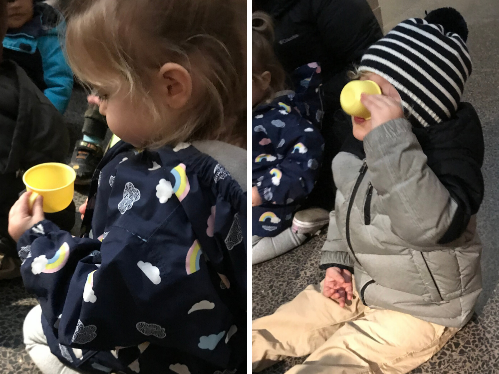
 The class headed straight to the National Museum of Natural History to start exploring their topic! They first stopped in the Icelandic photo exhibition to find some cold environments. These two are pretending to shiver from being in the ice landscape behind them.
 Their next stop was animals of North America in the Mammal Hall.
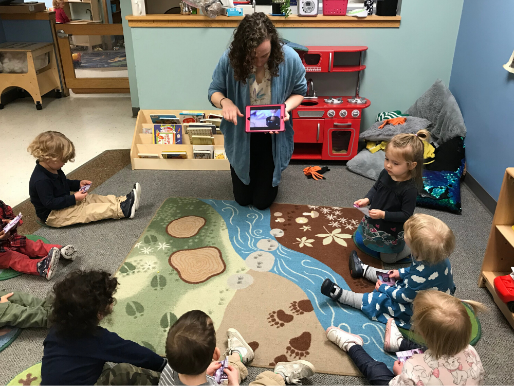
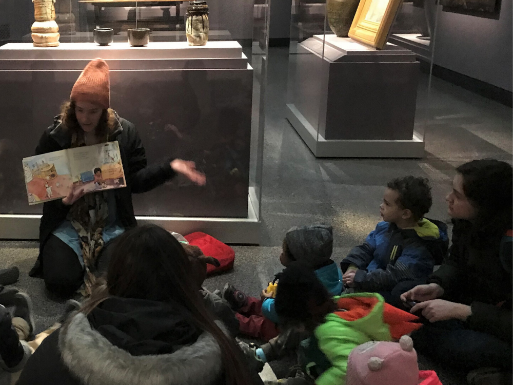
 Melinda brought along photos of winter clothing and animals for the children to hold in the gallery,
 She also brought along animal fur that corresponded to the animals in the exhibits. She explained that animals have different ways to keep themselves warm and safe in the winter.
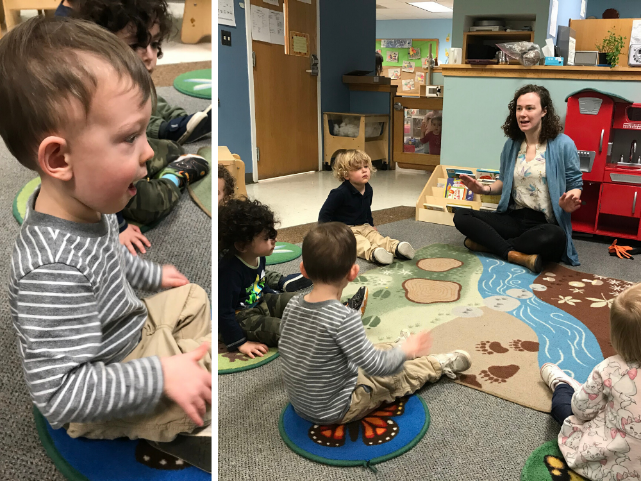
 Melinda then explained that people don’t have fur to keep them warm so we have to get dressed for the winter instead. She got dressed in winter attire and proceeded to sing a winter clothing version of “head, shoulders, knees, and toes” (lyrics above).
 The children then took turns trying on different winter clothing items. Melinda included some clothing that mimicked fur or were made from the wool/fur of animals so that the children could feel how warm these animals are kept by their skin.

 When they got back to the classroom, Melinda had several bowls on the table with large blocks of ice. She then covered each block with a different material: butter bags to mimic blubber, wool, and fur. This gave the children the opportunity to feel the cold and how these materials can protect them from it. One child also tried wearing a wool glove to touch the cold butter.
  One little girl brought a stuffed wolf to the table because she had matched the fur in the bowl to the animal.
 This lesson inspired lots of curiosity and provided many different interactions between the children and teachers!
Melinda, Meredith, and Megan finished up their unit on winter and started exploring transportation. Check out our Facebook, Twitter, Instagram, and Pinterest for more ideas from their unit on winter! See you in two weeks with our next Teacher Feature!










 Our inaugural Object of the Month is actually not so much an object, but a gallery. The Rocks Gallery in the National Museum of Natural History is tucked at the back of the


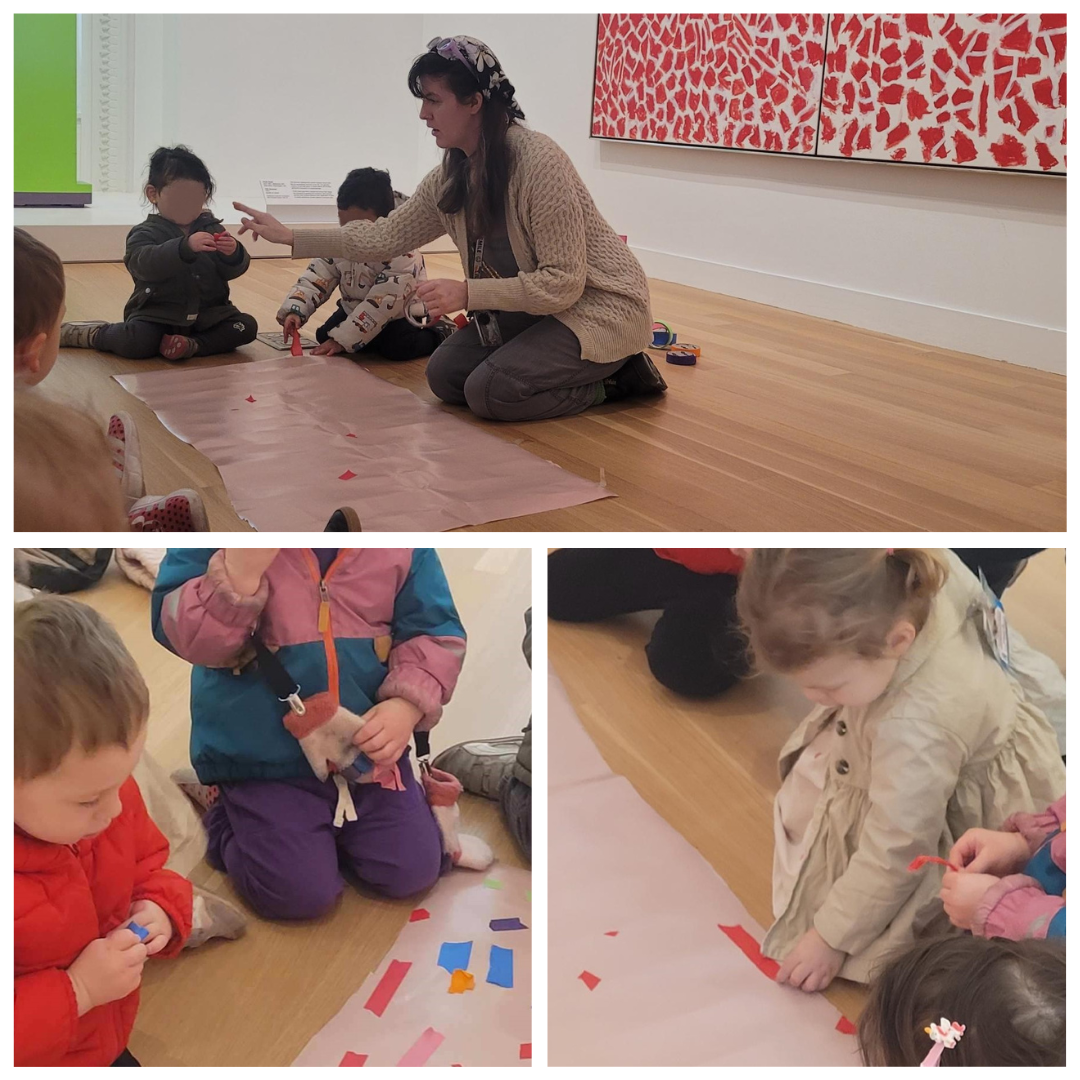
 As the last part of the object lesson, I laid out several objects and asked them to work together to recreate the painting. They needed no instruction, but went right to work, collaborating until the composition was complete. Was it exactly like the painting, no, but they had used these tools to create their OWN composition. They were quite proud and were completely engaged in the activity. I saw them looking back at the painting, rearranging objects and making their own decisions.
 seecstories.com


