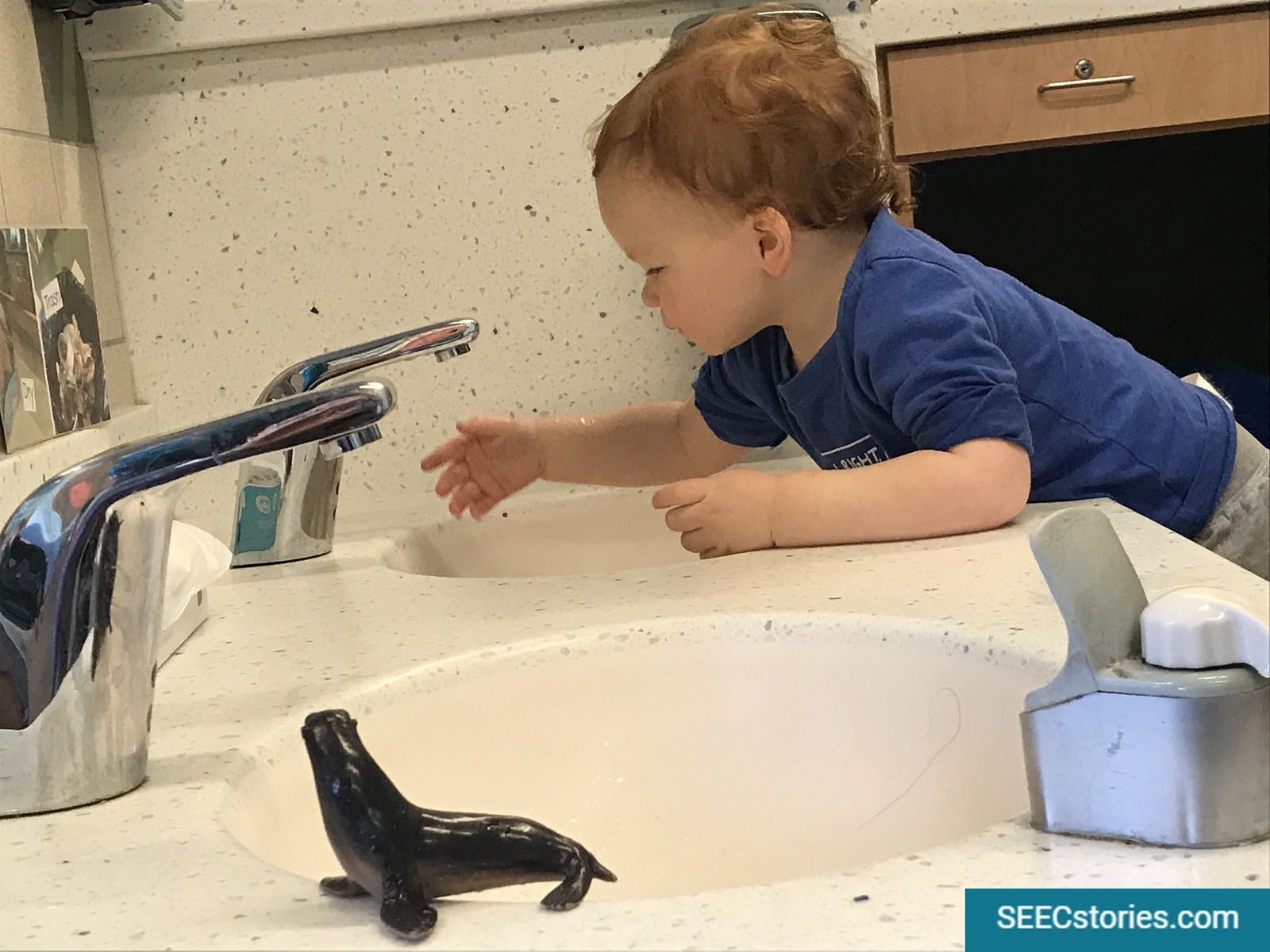
Community Visits During the Government Shutdown

The closure of the federal government, beginning October 1st, 2025, impacted much of Washington, D.C. and SEEC was not immune to the ripple effects.  SEEC educators began preparing for the possibility of a federal government shutdown by re-evaluating how we utilized our community spaces. Taking our classes into our community on a regular basis is an integral part of our object-based and inquiry-based learning philosophy.  What do our days look like when one of the key pillars of our community, the Smithsonian museums our classes call home, is closed for an indeterminate amount of time? 

While the Smithsonian museums are a major resource and source of inspiration for our educators, SEEC teachers are also well versed in using other parts of our community to inform their lessons. At SEEC, we believe that learning can happen everywhere, not just in a classroom or a museum gallery. Educators routinely host lessons on the National Mall, utilize local businesses, and tap into creative explorations of places they’ve been before.  

From explorations of architecture to farm animals to fairytales, SEEC educators rose to the challenge of using our community spaces during a government shutdown. 

Toddlers Explore The Built Environment 

Our youngest toddler class, the Toucans, took the government shutdown as an opportunity to switch topics and begin a multi-week investigation of the built environment. These little learners, ranging from 12-18 months old, started their architecture unit exploring various building materials in their classroom.  

After looking at wood, brick, and stone, the class went on a walk to MLK Library and made a stop at St. Patrick’s Catholic Church to discuss the materials they could see and take turns touching the rougher stone of the building facade and the carved stone of the archway. The toddler teachers realized that building materials were all around them and that each city block offered a new and exciting learning opportunity for the class.  

The Toucans continued their study of buildings and architecture by visiting the construction site at the Hirshhorn Sculpture Garden. The students were so excited to see some of the tools and construction vehicles they had been reading about in their classroom. Through a lot of pointing and excited sounds, the teachers could tell the students were making connections between objects they were seeing on their community visits and the toy versions they had been playing with.

 Caption: Toucan Toddler class explores the stone walls of St. Patrick’s Catholic Cathedral and the carved stone of the columns.

Twos Bring the Farm to the National Mall 

Prior to the government shutdown, one of our two-year-old classes, the Penguins, began a unit on farm animals. What started as an exploration of horses soon transformed into a deep dive into life on a farm. When the federal government shut down, the Penguins took their classroom outside and enjoyed a nice long walk over to the National Park Services Stables. They compared the barns they had in their classroom to what they could see at the stables. As the shutdown progressed, they continued their investigation of farm animals by discussing pigs and cows. 

During their week on cows, the class learned where milk comes from and how milk is turned into butter. The Penguins took their learning back outside to practice ‘milking’ a cow using a plastic glove, water and a bucket. Each student had the opportunity to squeeze the makeshift udder and watch as the ‘milk’ came out and collected in the bucket below. They culminated their week on cows by creating their own butter. Using heavy cream and small, tightly sealed, containers, the Penguins were able to shake the cream until it turned into soft butter. They could see the change happening before their own eyes! This progression of farm animals to food allowed the class to transition into a lesson other foods are found on farms.  

Caption: Penguin Twos Class takes turns squeezing milk out of a plastic glove ‘udder’ during their week on cows (left). Students look at horses at the National Park Service Stables (right).

Fours Imagine Fairytale Creatures in DC 

SEEC’s four-year-old class, the Honey Bears, expressed interest in storytelling right before the government shutdown began. While they couldn’t visit the National Gallery of Art to look at Rogier van der Weyden’s Saint George and the Dragon, they could pretend to be giants towering about the city on the rooftop of MLK Library. The outdoor rooftop garden was the perfect place to use their imagination and see the world through a giant’s eyes. Four stories up, the Honey Bears read Jack and the Bean Stalk and discussed how different the city looked so high up.  

Later that same week, the Honey Bears went over to the water feature outside of the National Museum of the American Indian (NMAI) to talk about what they need to trap a mermaid. The water feature became their mermaid lagoon and using their nets, the Honey Bears searched for mermaids and sunken treasure. These outdoor visits enabled the students to really use their imaginations and practice their dramatic play skills.  

Caption: Honey Bear Fours class prepares their net to catch a mermaid (left). Students investigate the mermaid’s treasure outside NMAI (right).

While the government shutdown, and the subsequent closure of many museums, offered challenges for SEEC educators, they were able to make the pivots they did because of the foundational understanding that our community is more than just museums. For teachers at SEEC, the classroom extends beyond the museum galleries and out into the world around us. Our classrooms can be the local library, outdoor fountain, stable, and the exterior of a church. It is less about where children learn, and more about how they learn. 

Teachers were able to seamlessly continue the learning happening in their classrooms because they are confident in their ability to teach using real life objects and experiences. While pictures and books are a vital part of early learning, SEEC believes that children learn best through exposure to tangible objects and concepts. This hands-on approach allows students to make connections for themselves and helps bridge the gap between the familiar and the unfamiliar. It is possible to explain to a toddler how cream turns into butter but allowing them to shake a jar until the butter separates from the milk offers a deeper understanding of the process. The hands-on experience moves the learning from conceptual to tangible.  

These hands-on experiences and community visits won’t disappear with the re-opening of the federal government. Classes will still take trips to MLK library, explore the architecture of the buildings around SEEC, and visit horse stables. Those kinds of visits will be in conjunction with visits to museum galleries, just like SEEC has done since our founding. We are so excited to bring our classes into all parts of our community and to continue to share how the learning extends beyond the classroom.  

Teacher Feature: Ducklings Explore Bubbles

This teacher feature focuses on the older infant (Duckling) class’s exploration of Bubbles and the development of their classroom exhibit: HOME during the month of May. At this point of the year, students in the Duckling class were between the ages of 14-20 months old.  

Preparation:   

Why and how did you choose the visit? 

The Ducklings were showing their teachers an increased interest in helping clean the classroom throughout the day. After each meal at school, the Ducklings would ask to help with a “Task,” such as wiping down the table, carrying dirty dishes to the kitchen, and putting the laundry in the laundry room. The students were excited to help and to mimic what their teachers were doing. The Duckling educators decided to follow that interest.  

What were your topics of exploration?  

This month-long exploration was all about Bubbles. Each week focused on a different way to encounter bubbles: Laundry, Dishes, and Bathtime. The class then spent the last week of the month discussing how we can take care of the spaces and things in our home. The unit concluded with the classroom Exhibit entitled HOME to show off all their hard work.  

What were your learning objectives? (What did you want your children to take away from the lesson?)  

There were a few learning objectives for the Bubbles unit. A major focus was for the Ducklings to gain a sense of autonomy and independence in their space. Throughout the month, the students had opportunities to decide how they wanted to interact with the lesson. For example, there were spare clothes available to the students during the week on Laundry. They could then decide if they wanted to practice putting on and taking off the clothes, pretend to wash them in the model washer and dryer, or work on hanging them up on the clothesline set up in the classroom. Having these options available allowed the students to decide for themselves where their interests lay and to work on a variety of gross and fine motor skills.  

Caption: Two infants practice hanging clothes on a pretend clothesline in their classroomPicture 

Caption: Duckling infant class explores spare clothes and laundry baskets on the floor with their educator.  

Another goal was to create a positive association with cleaning as it can be a difficult part of a child’s daily routine. By allowing them to create a mess and then have them help clean it up, the teachers could show the students that cleaning up after ourselves (a skill they will continue to develop later in life) is just as engaging as the mess making.   

Implementation:   

What was most successful about your lesson?  

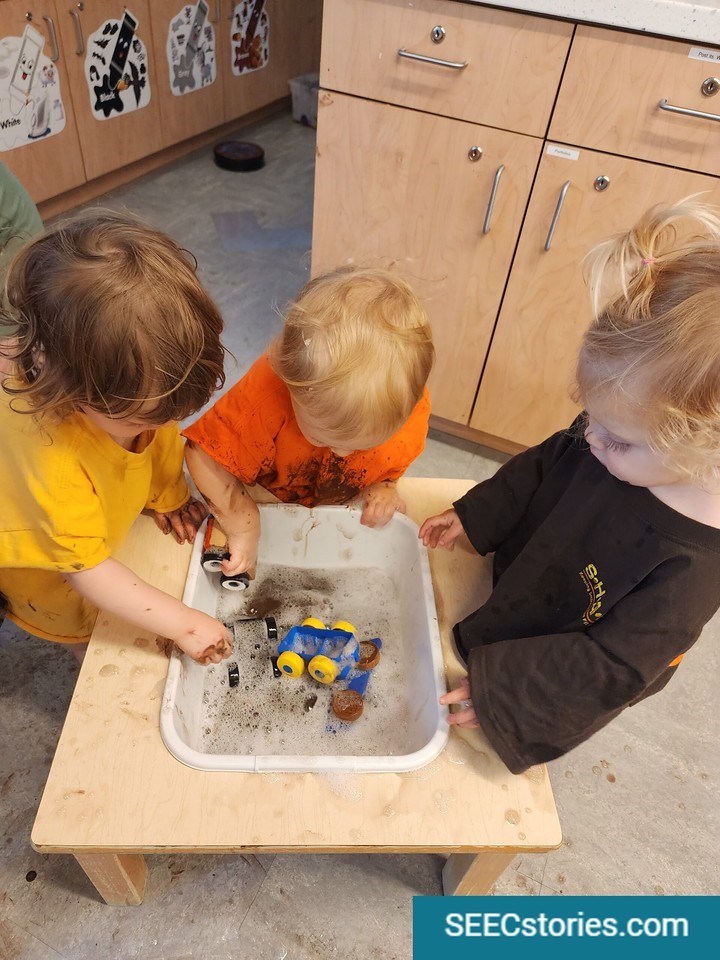
The most successful part of the whole month was watching the Ducklings get objects dirty and then get excited to clean them. It was a real full circle moment for the class. Over the course of the month, they would return to this cycle a number of times. First, they painted with dishes and utensils and when they were done painting, they cleaned them in soapy water. The class repeated this activity with toy cars in “mud” (brown paint) and then, again, using their full bodies. By the end it was clear to the teachers that the students understood that something gets messy and then it gets clean.  

Caption: Duckling students painted with their toys cars in “mud” (brown paint) and later washed the cars clean at a “car wash.” 

Another successful element was the cardboard washer and dryer Calla and Kevon built prior to the unit. The Ducklings quickly learned that they could move clothes from one machine to another and that the washer and dryer were only meant for clothes. It was great to see their gross and fine motor skills as well as their spatial reasoning skills in action as they moved clothes and turned the dials. 

Caption: Duckling student shows off her laundry and coordination skills by moving the clothes from the washing machine to the dryer 

How did the lesson reach your objectives to expand the topic?  

Each week the Ducklings got to focus on a different way they could clean and interact with bubbles. They would have similar experiences, such as painting and then cleaning up, but the methods would be different enough to expand their understanding of cleaning.  

The Ducklings were able to build on their prior knowledge of what it means to clean in order to understand how to clean with the new objects in front of them. For example, they were used to seeing their teachers clean the table with washcloths and liked to help rub down the table. The teachers took the class to Within These Walls at American History to discuss laundry. When presented with a washboard, typically used for cleaning clothes, they talked about how they could “rub, rub, rub” their washcloths on the board just like they would on the table. When their teacher placed a modern washboard basin in front of them, the Ducklings quickly associated that washboard with the one they had seen in the museum.  

Caption: Ducklings went to visit the laundry portion of the Within These Walls exhibit before returning to their classroom to do some washing of their own. They took their washcloths and got them clean in their soapy water buckets.  

What was successful in terms of your preparation and logistics? 

What made this lesson so successful was having everything prepared in advance. The Duckling educators knew that they wanted to spend an entire month talking about bubbles and cleaning, so they spent time thinking about how to break that down into smaller topics. This enabled the team to dive deeper into each topic but still create a cohesive lesson as the month progressed. 

The Duckling team also intentionally revisited spaces and concepts. They took more than one visit to Inside These Walls during their month-long unit. This allowed the Ducklings to become a little more familiar with the space and more comfortable engaging with the exhibit. They followed a similar thought process for their art lessons during the month. By using a similar formula for their art projects, they allowed their art making to become a routine. The children were able to know what to expect and, therefore, they spent more time exploring and engaging with their projects.   

Reflection:   

How did you document the lesson in order to reflect back on the work? 

The Duckling’s month-long exploration on Bubbles culminated in their classroom exhibit entitled HOME. The students spent so much time exploring bubbles and cleaning that it felt like the perfect topic for an exhibit and to have their adults come and see their hard work.  While not every project was displayed for the exhibit, the Duckling team chose to focus on displaying work that showed the process of getting things dirty and then getting things clean. The art around the classroom was the biproduct of that exploration.  

Caption: Ducklings students made bubble art by making bubbles with colored water and transferring the bubbles onto paper. Once dry, those art works were hung on a pretend clothesline for their classroom exhibit.   

The teachers also decided to bring back out the different cleaning stations they learned about during the month. There was a pretend bathtub, a toy kitchen, the washer and dryer, the laundry line, as well as brooms and dust pans. These stations were in place for the Ducklings to show their adults all the new gross and fine motor skills they developed over the month.  

Each station was brought out because it spoke to the interests of the children. There was a way for each child to engage, and work samples were present for each student.   

Caption: During the exhibit, one Duckling was exciting to show off her fine motor skills back at the clothesline.  

What could you have done differently to better achieve your objectives and expand the topic? 

There is always room for improvement in lesson planning, and if the Duckling team were to do this lesson over, one thing that they’d like to do is to scaffold some of their exploration out a little differently. For example, instead of putting up a clothesline, hanging clothes on it, and just letting the children explore, the team would have liked to break it down into smaller experiences first. Like just practicing pinching the clothes pins open and shut, then trying to balance clothes on a more solid clothes line, then transitioning to a string line. This slower introduction would have helped the students make their own connections.  

What was challenging regarding logistics?  

One challenge was finding the balance between experiencing getting messy and ensuring that the students are safe. Water play, and full-body paint exploration, can get slippery if the educators aren’t keeping a close eye on the situation. It can be a fine line between letting the children explore as they want to and making sure they keep their bodies safe. The Duckling team did their best to let the children explore freely by working to mitigate the mess before it happened. During water play, for example, they covered the floor with towels ahead of the play.  

What recommendations would you have for another teacher trying out this lesson? 

The biggest recommendation is to let the children experience the real thing, whenever possible. If the class is discussing how clothes get laundered when they get dirty, spend a day doing just that! Let the children get their clothes dirty, have them change, and then walk them through the steps of washing their clothes and take the time to investigate each step. The Ducklings loved being involved in the many steps of keeping themselves and their classroom clean. 

Creating Intentional, Reflective Spaces: SEEC’s Commitment to Meaningful Classroom Environments 

Introduction 

 Earlier this year, educators across SEEC’s vibrant community came together for an all-class meeting led by our Office of Engagement and Administrative Team. With representation from every classroom serving children from 2 months to 4 years, this gathering was an opportunity to reflect, share, and envision the future of our learning environments. 

The heart of the presentation focused on how classroom environments at SEEC should be more than just spaces—they should be reflections of what’s happening in the life of each class. They should be intentional, curated, and consistent across our community. As a lab school that integrates museums, community connections, play, and object-based learning, our environment serves not only as a backdrop, but also as an active participant in the learning process. 

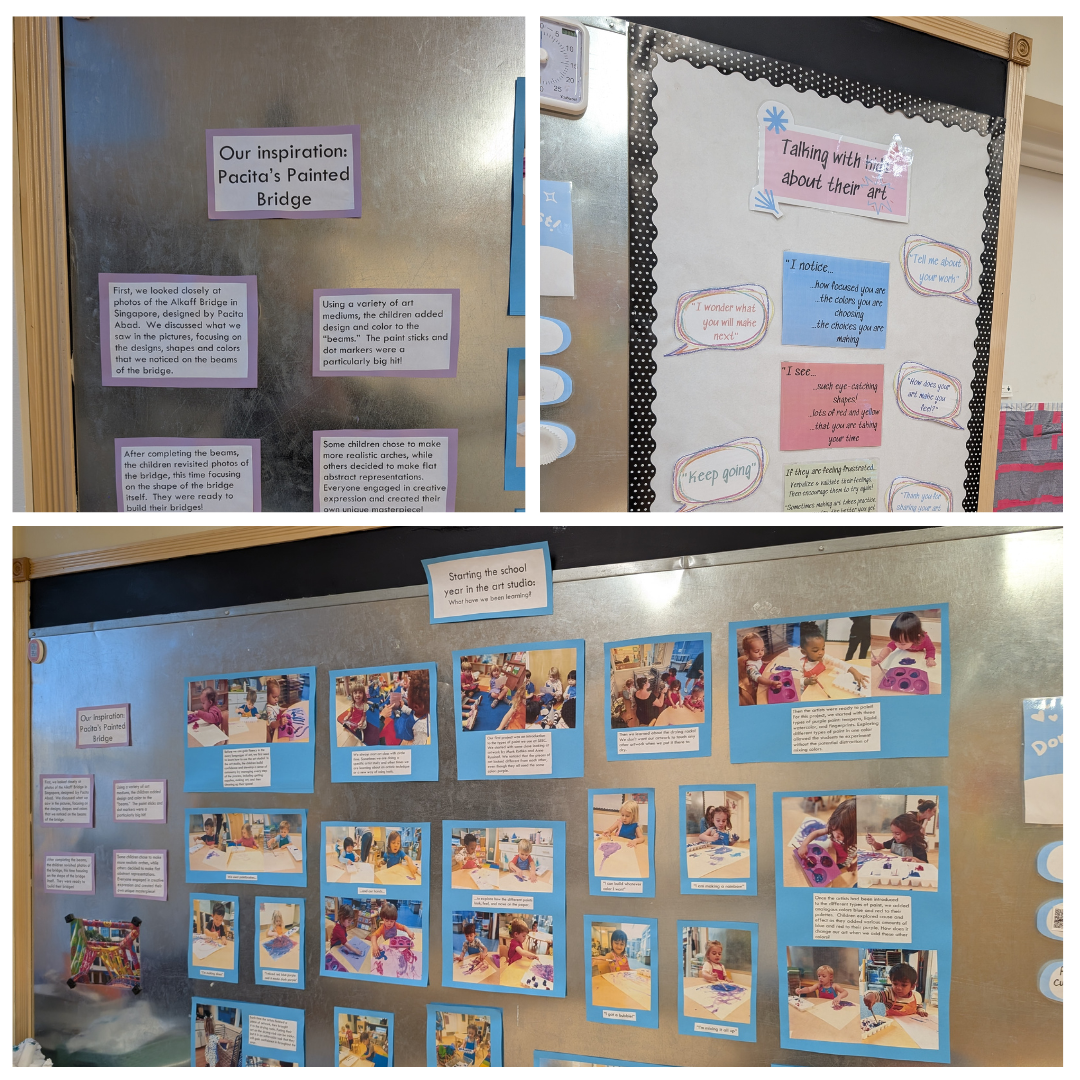
The display boards in the Art Studio about the children’s exploration of Pacita’s Painted Bridge; the top left board discusses the inspiration from the art with descriptive posters, the top right board features a “Talking with Art” theme with children’s art and comments, the bottom board showcases multiple photos and descriptions of children engaged in the process of creating their pieces. 

Documentation is …   

“An effective piece of documentation tells the story and the purpose of an event, experience, or development. It is a product that draws others into the experience—evidence or artifacts that describe a situation, tell a story, and help the viewer to understand the purpose of the action”  

   – NAEYC 

Art display featuring a colorful collage with images, patterns, and cellophane fish, all pinned on a wall. It also features photographs of the children creating the fish, an image of Untitled by Simon George Mpata and a description plaque of the children’s exploration. 

Guidelines for Curated Spaces 
 

The administrative team outlined several key guidelines for building and sustaining rich classroom environments. One major takeaway was the idea of keeping displays fresh and relevant by changing them out monthly in alignment with each class’s unit of learning. Educators were encouraged to use real photos whenever possible, and to be mindful of how someone without any context—a new family, a visitor, or even a child—might engage with the documentation they encounter. 

Importantly, the team challenged educators to think beyond the bulletin board. Documentation should be thoughtfully showcased, using the full range of space within the classroom to reflect learning, discovery, and growth. Typed descriptions should support the visuals, offering clear, intentional narratives about what is happening and why it matters. 

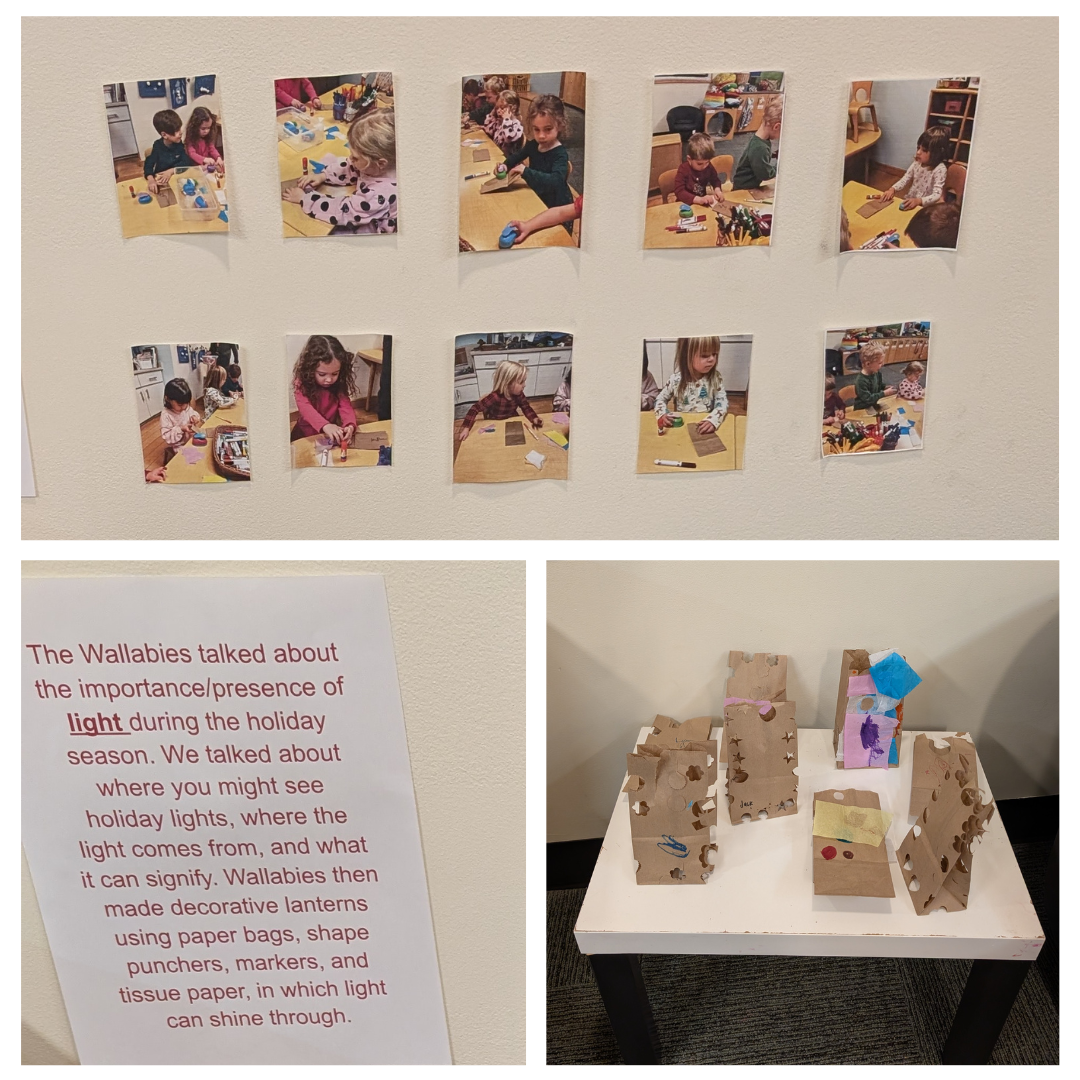
A display featuring multiple photos of children in our Threes class engaging in the process of creating lanterns, and a text panel describing their exploration of lights during the holidays, complemented by a display of their lanterns. 

Showcasing the Extraordinary 
 

Another theme of the presentation was recognizing and intentionally showcasing the extraordinary work that is happening every day in our classrooms. Documentation is a tool for storytelling—and those stories should be shared with our caregivers, our peers, and the children themselves. It fosters connection, supports classroom community, and builds trust with families. 

We revisited an important question: Who is documentation for? The answer was multifaceted. It’s for children, who deserve to see their learning reflected back at them. It’s for caregivers, who want to understand and engage with their child’s experience. It’s for fellow educators, directors, and even for each of us as individual educators—a way to reflect on and grow in our own practice. It’s also a window for new families into the values and rhythms of SEEC classrooms. 

Left: An outdoor class exhibit with a child and their caregiver viewing paper artworks.  

Right: A caregiver reading a description of their child’s class art display while two children and two educators engage in play and story time. 

Engaging Children Through Environment 
 

The team emphasized that placement matters. Documentation intended for children should be placed low enough for them to engage with it—yes, even to touch it. When we introduce materials thoughtfully and set expectations, children can interact with their learning environment in respectful and meaningful ways. 

We also explored how the environment itself can shape classroom behavior. A carefully arranged, engaging, and responsive space can reduce challenges and support deeper exploration. Our surroundings can either hinder or enhance the work we do—and we have the power to use them intentionally. 

Wall display at child level featuring one of our Twos’ class artworks and a descriptive plaque, in a classroom setting. 

From Discussion to Action 
 

The presentation concluded with an open dialogue. Educators discussed practical concerns—how to manage time constraints, where to print documentation, and how to embrace the idea that children will interact physically with the materials on display. 

In the five months since, educators across SEEC have taken this guidance to heart. Classrooms are now filled with purposeful documentation that highlights the daily wonders unfolding in our community. From toddler rooms to preschool spaces, there’s a renewed commitment to documenting learning not just consistently, but meaningfully. 

As we look ahead, our goal is to continue growing in this work—pushing ourselves to create environments that don’t just display learning but deepen and celebrate it. 

Top: A display in our older infant class featuring the work of Alma Thomas alongside the children’s artwork. Bottom: Abstract paintings and textured art pieces by one of our toddler classes, and a central portrait of Piet Mondrian with a description of the children’s exploration of his art. 

SEEC at Home: Environment

For many families engaging in virtual learning the delineation between home and school has all but disappeared. Our preschool teachers thought it be helpful to share a few things about how we set up and implement different strategies in our SEEC classrooms. The tools we use at school may also be helpful for establishing routines and daily schedules at home and most strategies are easy to adapt! Today we’ll share some specific techniques about how we set up our school environment to help young children gain independence and success.

Five pillows sit on top of blankets in an alcove.

Cozy Corner/Safe Space

Cozy corners provide a safe space for children to go and are needed now more than ever. They help children to regulate their emotions by taking space and time to process. At SEEC, different classrooms set up their cozy corners differently, but they all serve the same purpose. Here is a list of items that might be in a cozy corner: 

  •  Pillows
  •  A soft rug or something to sit on
  •  Lovies
  • Sensory items like a stress ball, liquid timer, or sensory bag 
  • Calming pictures, like photos family or a favorite place
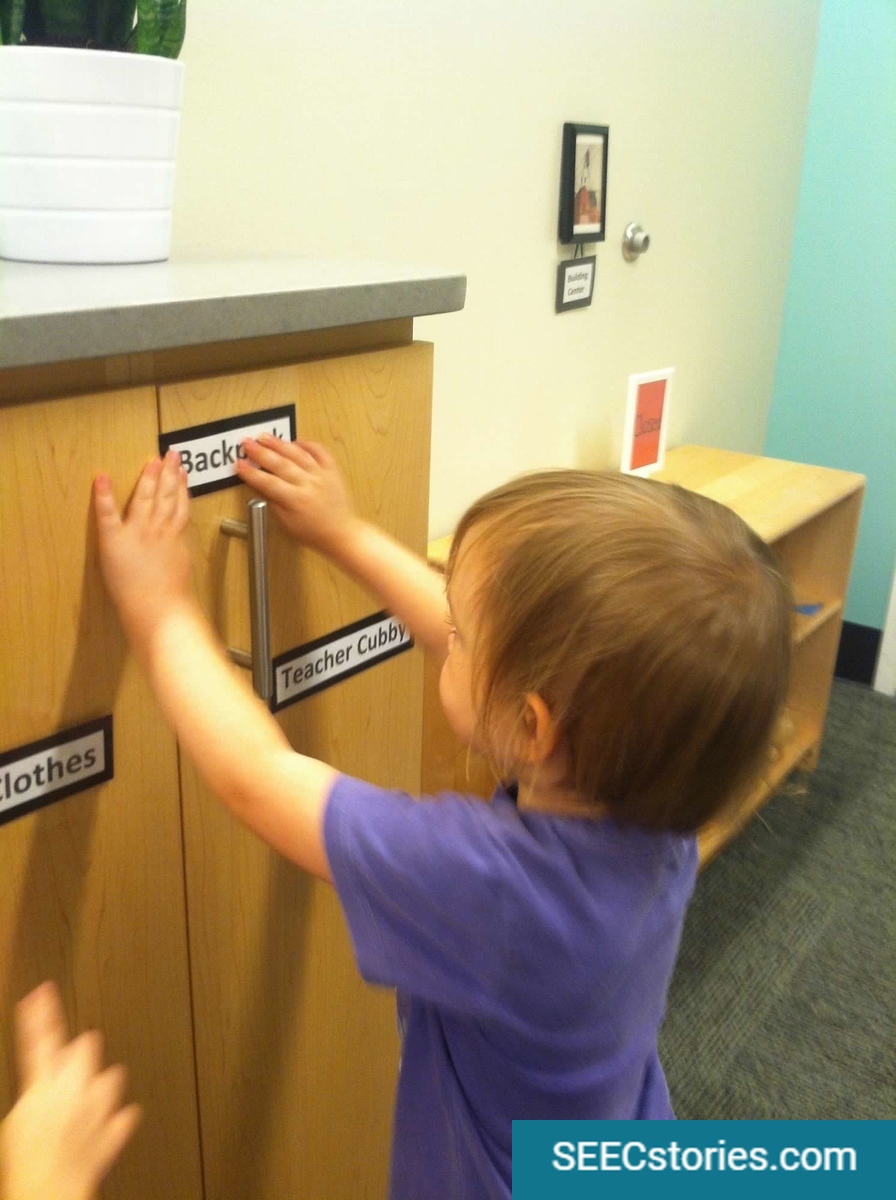
A child puts up the label "backpack" on a cubby in a classroom. Two labels are seen below: "clothes" and "Teacher Cubby".

Labels 

Labels have a several benefits. First, they help make clean up quicker! When shelves, containers, and or cabinets are labeled, children can figure out where things go on their own. Labels also help children develop their pre-literacy skills; they reinforce the idea that words have meaning. They can be handwritten or printed, as long as your child knows what they are. If you can use images of the actual object, that can be helpful. In the classroom, we label as much as we can including the following: 

  • Containers for toys and the shelves they go on 
  •  Sink, soap dispenser
  •  Art materials
A child washes their hands at a sink with photo instructions displayed on the wall above the sink.

Photo Instructions  

We try to use photo instructions whenever possible. While children can’t read written instructions, they can follow photo instructions. Photo instructions are step by step instructions using images to cue the children.  

Using photo instructions: Go over them with your child first. Say the steps as you point to the images. Over time, remind your child to follow the pictures when they need help. Eventually, they will feel confident using the image all on their own. Photo instructions are helpful in the bathroom, for getting dressed, for getting ready to go outside, and more! 

Making your own: For these, we try to use real images of the children doing the actions in the instructions, but you can use clip art images, hand drawn images, or whatever you have on hand. Just make sure that you go over them with your child before implementing them.  

A child uses a small towel to wipe a door.

Tools for Children at Their Level  

Young children are learning to establish their independence and providing them with opportunities to exercise that independence is important. In order to facilitate those opportunities, we place the tools they need in spots where children can access them. By providing them with that space and those tools you are showing them that this is a job meant for them! 

For example, later in the year we will have friends help set up for lunch. This means putting out the placemats, utensils, plates, cups and napkins. We make sure these are in a low place so they can access so they can have the independence to take on the job themselves. Children also start to help clean up after themselves by stacking chairs and cleaning spills. 

Take Your Time

This is a very trying time for families with young children. While we offer these ideas to help with structure in your home, finding time to implement them can be hard. Try doing one strategy a month, or whatever timeframe works for you. Caregivers are doing the impossible right now – you’re doing great!


Interested in what else the classrooms and the full-time school look like? Check out the dates for our virtual open houses for the 2021 – 2022 school year.

Honoring My Child’s Interests

This post was written by Maureen Leary, Director of Toddler and Kindergarten Programs

Value of Virtual

When the Smithsonian closure due to Coronavirus health concerns was announced in mid-March, none of us had a clear sense of how long it would last. Once it became obvious that it was going to be more than a few weeks, SEEC faculty immediately transitioned to conducting distance learning through online platforms. Teaching young children this way is neither ideal nor intuitive, but we knew we needed to quickly develop these skills to better support our families. At SEEC we believe it’s important for us to offer virtual interactions for a number of reasons. It provides personal connections during a time when we can’t experience them directly; it offers an anchor point for themes and topics that families can explore in their own way and on their own time; it inserts some amount of structure into the days and weeks that have been completely upended; it allows children to retain a level of comfort and familiarity with peers and educators during what has turned into an extended closure with no definitive end.

The Challenges of Virtual

Many families are craving the connections and routines that suddenly disappeared from our lives, and appreciate the opportunity to see each other virtually. That said, we also know that consistently participating in these interactions can sometimes be a challenge. Maybe your child is tired, hungry, grumpy, or just uninterested. It could be that you have a work conflict and you can’t prioritize your child’s meeting over your own. Perhaps you’re feeling overstretched and just don’t want to add one more thing to your day. Skipping your child’s scheduled activity might cause feelings of guilt and worry, and cause you to wonder if it’s ok to be missing these online interactions.  At SEEC our answer is always an emphatic yes. We encourage families to follow their children’s leads on what helps the day go smoothly for them. It might be that they’d rather go outside during a virtual circle time, or that they just have no interest in it at all. Maybe they refuse to talk or get frustrated with how the conversation goes. All of this is developmentally appropriate and totally ok. Enrichment can be found in so many ways, in moments small and large, and doesn’t always have to be carefully orchestrated. What’s really important right now is that all of us, children and adults, feel cared for and supported.

Tips for Virtual

If you do choose to participate in an online “circle” here are some helpful hints compiled from conversations we have been having with our SEEC community. 

  • Some children are camera-shy. Don’t insist that they talk or even appear on the screen. Giving them repeated exposure to the format and letting them develop comfort with it at their own pace is likely to increase their participation. And if it doesn’t, that’s ok, too!
  • If your child is reluctant to talk but does want to be included, suggest they give a virtual high-five or a thumbs up as a way to connect with others.
  • Check with your child’s teachers about scheduling some one-on-one screen time. Even just 10 minutes of individual attention this way can pay big dividends. 
  • Some families have found it’s easiest to pair distance learning with snack time, so the child is staying in one place and not becoming distracted by other surroundings.
  • Alternatively, if the weather’s nice and it’s hard to be inside, try bringing your screen outside and participating that way. We’ve seen toddlers actively engage in circle time while also riding a tricycle down the street!

Screen Time

One final, related note: a recurring concern with the current environment is that young children are getting more screen time than is recommended. This is an issue we are always thinking about, and while we agree it’s best to limit screen time for young children, we do believe that distance learning offers important benefits, especially as we practice social distancing. At SEEC, we generally advocate for the limited use of screens when they are a single element of a larger, interactive experience. Of course, there may be families who opt out entirely of distance learning for the screen time concern alone, and that is also a decision we respect. We always want families to do what feels right for their own well-being, and it certainly won’t be the same for everyone. We encourage you to trust your instincts, be responsive to the needs of your child, and reach out to your child’s educators if you have any questions or concerns. 

Quarantine Tantrums

This blog was authored by Katie Heimsath, Director of Preschool Programs

The Impact of Quarantine on the Family

As adults, we have access to information and possess the cognitive skills to understand what is happening in the world. At SEEC, we often talk about the importance of talking to children about difficult subjects. Giving children the language to identify and express what they might be feeling or are curious about makes it easier for them to navigate complicated situations. Even though young children might not yet be able to understand the complexities of a global pandemic, they recognize when something feels different and are perceptive to the changes in our attitudes and emotions.

Living and working at home during quarantine is no easy feat. Our lives and daily rhythms have been turned upside down and most of us are feeling stretched and limited in one way or another. Many of our SEEC families have reported an uptick in meltdowns and tantrums from their children

Typical tantrums can stem from a predictable or obvious problem, like if a child is hungry or overtired.   Our current situation adds a new layer of emotion for children and adults alike: we miss our friends and being able to go out in our communities, we’re worried about our health, and we are adjusting to new routines. To add to that, no one knows when it will get “back to normal.”

How Can I Help My Child?

The best way to help your child is by being there, both physically and emotionally. Being close in proximity helps children regulate their emotions and feel a sense of security, so it’s no wonder that picking up a crying baby is soothing to them, or that some children feel better after getting a hug. If it seems like it would help, offer a hug or your lap to sit in while your child works to calm down.

In addition to the emotions, a tantrum generates a lot of tension and energy in a child’s body. Show them ways of releasing tension like taking big, deep breaths. Help them focus their energy on something calming like watching the clouds, or redirect their energy by mashing some play-doh.

It is important to also acknowledge your child’s feelings. Young children are still learning how to identify and understand their emotions, and giving a name to a feeling is one way to reinforce this learning.  If they’re pre-verbal, try helping out by saying, “you look like you feel sad” or “you didn’t like when that happened.” If you can objectively narrate what happened, it can help the child feel heard and understood. If they’re verbal and able to tell you what they’re feeling, your role is to sympathize. If they told you they were feeling sad because they couldn’t eat snack with their friends at school, you could say, “I feel sad about that sometimes, too. I like eating with my friends. We both miss our friends.”

Emphasize that you’re there to help and problem-solve together. For younger children, you could offer one or two suggestions for moving forward. You could say, “It made you upset when you fell. I can help you up,” or “You didn’t like it when your brother took your toy. You want a turn. Say ‘me next!’” For older children, ask what would help them feel better or give them a suggestion. Then do it together! For some of the quarantine specific situations, it’s okay to admit that you don’t know the answer. Say something like, “I don’t know when we’ll go back to school, and that’s frustrating for me. I don’t like it when I don’t know when something will end! But, there are people working very hard to figure out that answer, so I know they’ll tell us when they can.”

Adults Feel Stressed Too

In a perfect world, we could all follow three easy steps to help our children get through a meltdown. We’re not in a perfect world, and we’re not even in a situation that feels normal to many of us. If you’re stressed or you overreact during your child’s tantrum, don’t worry, you’re not alone. Simply acknowledge what happened with your child! It’s powerful for a child to observe a person they love showing how they handle their big emotions. Remember, as adults we unconsciously regulate our emotions to make it through tough situations. If you have an opportunity to make that visible to your child, they’ll have one more example of what they can do to cope. It is also a chance to give yourself grace and a powerful reminder to your child that there is always an opportunity to try again.

My Child is Throwing an Epic Temper Tantrum… Now What?)

Routines During Quarantine

This post was written by Melody Passemante-Powell, Director of Infant and Toddler Programs.

Routines

Schedules are a big part of most of our lives, and most people recognize the importance of these routines, especially for young children. Quarantine has turned everything upside down for many families, and some are wondering, how much of a routine should we try to maintain? To help you think through this we have posed  some questions to consider first, and then outlined some tips and ideas based on structure level and age group.

Questions

What are my family’s needs? All families are different and it is important to recognize that one size does not fit all. Some thrive off of rigid schedules, while others need a lot of flexibility, and most of us fall somewhere along the middle of this spectrum. Think through what works well for your child(ren) and what works well for the adults in your home. These don’t always align so finding some sense of balance is the overall goal.

What is my family’s capacity? Unfortunately during quarantine many of us are both acting as full time caregivers and working to meet job requirements at the same time. Consider how much the adults in your family realistically have the capacity to implement in terms of routines and schedules while also giving the attention needed to other responsibilities. Also keep in mind how quarantine is impacting your child(ren) and what they have emotional/mental capacity to do on any given day.

How Your Days Might Look

High Structure: You plan your days to closely mirror each other, or if your child in enrolled in school, you can schedule your days to match what a typical day would look like at school. For example, try having meals, outdoor time (if possible), circle time, etc. around the same time of day as they would occur at school.

Medium Structure: You can plan to have some components of the day happen in the same way and at the same time, while still leaving a bit of flexibility in the schedule. One way to navigate this is to look at each day as having a loose agenda, and you can talk through what will happen during the day, but the exact details of when and how each part will happen aren’t planned out in full.

Minimal Structure: You can keep it loose and just see where the day leads you. You can let your needs/wants and your child(ren)s needs/wants guide what happens for the majority of the day.

Tips and Ideas Based on Age

Infants/Toddlers: This age group understands time in short intervals, so it’s best to find ways to break the day into smaller sections vs. talking through what will happen throughout the entire day in one sitting. It can be helpful to use the “first, then” method with this age group, using phrases like, “First we will eat snack, then we will go on a walk.” Visual cues to use as reference when talking about what will happen are also very useful for this age group. These can be in the form of timers, or photos/pictures of what will happen next.

Preschoolers: In general preschoolers can handle a little more complexity in terms of thinking through multiple components of the day. A visual schedule is great for this age (a series of photos of what will happen along with the word label, posted in sequence, or attached to a keyring so the child can carry it around to access what will happen and in what order). Timers are another useful tool, and there are so many to choose from (sand timer, Echo/Alexa, stopwatch, or these sensory timers) so you can use what works best for you. ()

School Age: Most school age children can get a sense of a full daily schedule if you choose to use one. Visuals of some sort never hurt, and if your child(ren) can tell time you/they can create a chart (nothing fancy, you can use paper and a ruler to make the lines!) of what each day or each week looks like based on the day and time. Seeing what their day and week look like mapped out might be helpful for time management and daily planning.

Remember

Do what works best for your family on any given day. There is no right or wrong  way to do this.

Set yourself up for success. If what you are doing just isn’t working for your child(ren), or for you, change it up. The point of a schedule is to HELP everyone, if that isn’t happening most of the time, it is time to reassess!

Resist the temptation to compare. It can be hard to see or hear about what other families are doing, especially if it seems like everything is working beautifully for them. Remember the grass has a tendency to seem greener, but what you and your family are doing on any given day, even if it involves meltdowns and a to do list with zero check marks, is just fine.

Parenting Expectations

Families across the world are hoping to resume their normal lives as soon as possible, but the truth is that our new normal is likely to look very different. Though children may be able to return to school at some point, it is likely that schools could have different schedules and/or additional closures. Parenting right now is hard, harder than normal. So, how much is enough? And as an adult, how do you juggle your own worries and workload with that of your child’s? There is no magic answer, but it is important to remember a few things:

Not all families are alike, don’t compare yourself to others.

Your children need to feel safe and loved – that is probably the most important thing you can do.

There will be days when schedules won’t be followed or there was more electronic use than you would have liked – it is okay.

This is a traumatic situation, it is as important that you take care of yourself as it is for you to take care of your child. You will be a better caregiver for it.

When you let your emotions get the best of you, simply say you are sorry to your child. Caregivers are human and make mistakes – allowing a child to observe that can be an important life lesson.

Don’t feel like you have to take advantage of every lesson and resource you see online. If you decide to take advantage of resources, choose what speaks to you and fits within your wheelhouse.

Cheers to all the caregivers out there – our team knows how hard you are working.

Socialization

One of the reasons we enroll our children in preschool is so they learn how to interact and engage with their peers, so it makes sense that many caretakers are currently concerned about their child’s socialization.
It is helpful to remember that not too long ago, many children didn’t attend formal school until they were five. While we recognize that there is value in preschools and play dates, the quarantine isn’t going to erase what gains your child has made in this area. It will no doubt be a difficult transition when we return to our routines, but it will be temporary and you shouldn’t worry that your child will fall behind.

In the meantime, you can do some simple things at home that will help support your child’s development:

Identify Feelings – “I can see you are feeling sad because you are crying.” or “I think the dog doesn’t like that because they barked at you.” You can also use books to have deeper conversations about how characters are feeling.

How Can You Help? – When you identify an emotion, think out loud with your child about what you can do to be helpful. Maybe a sibling could use a hug or maybe there is a household chore that would help the whole family feel less stressed.


Play – Your child doesn’t need to play with their peers to learn skills like sharing or taking turns. As an adult, it is okay to say “I had the toy in my hand and it upset me when you took it away from me.” It might feel a little silly, but it communicates the cause and effect of their behavior.

Object Feature: Louise Bourgeois’ Spider

It was during a recent conversation with one of our faculty, that made me pause and consider Louise Bourgeois’ Spider at the National Gallery of Art. To be honest, I wasn’t immediately drawn to this piece. I’m admittedly not a big fan of spiders, but, as is often the case, when you learn more about something it opens up new doors.i-k7Trf6j-X2

Size and Location

On the surface, this piece has a lot of elements that make it ideal for young audiences, most noticeably its location. I truly enjoy being in sculpture gardens. They are an all-ages space – conducive to movement and activity for children and still, contemplative, and provocative in a way that appeals to adults. The sculpture garden is a community space akin to a central square or other public space that features art. It is family friendly space that speaks to different generations who can learn and be inspired.

The piece is also worth highlighting for its size and 3-dimensional nature. While I rarely say “no” to using smaller artworks, a large piece that allows a child to move around it and view it from multiple perspectives, is always ideal. So caregivers and educators, if you visit, make sure that you leave time for ample careful looking. Notice things like the texture of the material, the details of the legs, and how it looks from different perspectives.i-ctMrDxC-X2

Content Connections

The artwork is an ideal segue into STEM, social emotional, and literary learning. First, it’s a spider. Spiders, while not always a crowd favorite, serve an important and definitive purpose in ecology. As an insect eater…. Young children don’t always see spiders as important or as helpers, but this immense artwork provides the opportunity to introduce the spider in a way that is new to a child. This makes me particularly excited as we think about museums as catalysts for children for learning about and protecting their community. In this case, being able to impart some information about the importance of spiders in our ecosystem, one can help children connect to their environment and understand that all living things play a valuable role.

i-mrJb3V9-X2Meaning

My colleague recently shared with me about the significance of the spider. Ms. Bourgeois created spiders in the latter part of her career as a symbol of her mother. Like the spider, she saw her mother as a protector. She viewed her as strong, but also vulnerable. While these are abstract concepts for young children, they can be illustrated by looking closely at the spider. Notice that it is large and tall, yet its legs outstretched like a hug. The spider is a childhood recollection, so the spider’s size is like that of an adult. Have the children imagine a favorite adult, how do they express their love or what do they do to help keep you safe.

Though I would not likely add onto this during a single lesson with young children, its worth noting that spider’s figure is also very delicate. I encourage you to look closely and find what areas of the sculpture look vulnerable or contradict its overall looming presence. Interestingly, Bourgeois’ memories of her mother reflect her father’s ten-year affair with her governess.

Finally, for learners of all ages, connecting art to literature is a way to enhance and build on both the literary and visual experiences. The first thing that came to mind was Charlotte’s Webb, but of course there are many child friendly stories out there that would accompany this sculpture. For example, Eric Carle’s The Very Busy Spider.

i-ZwMc9ms-X2Learning Extensions

Go on a hunt for spiders and spider webs.

Create a web together using string.

Visit the Insect Zoo and look for different types of spiders or Learning Lab – notice similarities and differences.

Spiders have eight legs, but did you know that most spiders have eight eyes too.

Make spider webs by laying paper down in an aluminum pan and moving tiny balls around that have been dipped in paint.