Building the Next Generation of Democratic Thinkers

SEECstories.com (4)In a recent article Smithsonian Secretary Skorton posited that museums can help people regain trust in “traditional democratic institutions”. His argument centered around a study indicating that many Americans have lost faith in the institutions that are the foundation of our democratic system. He spoke to the fact that not just Americans, but citizens across the globe seem to be losing trust in their own societies and pondered how a democracy can function without the trust of its citizens. Secretary Skorton sees museums and libraries, not only as institutions that provide reliable and objective information, but also as places where questions can be posed, dialogues can be had, and a variety of perspectives can be explored. As leader of the Smithsonian, moreover, he sees museums as places where communities can come together to better understand themselves and the world around them.

As an organization, SEEC, also sees museums, libraries, and the larger community as sources for information, discussion, and reflection. We were particularly excited when in the same article, Skorton noted the role of educators:

I have seen how our museums and centres engage visitors and transform the way they see the world—especially our youngest visitors, who light up with the joy of new discovery. Through our education programs, we reach millions of national and international students, often using objects from our collections to demonstrate experiences and viewpoints that differ from what they might have encountered. By revealing history through the lens of diverse perspectives, museums humanize other cultures and contextualize present-day events and people.

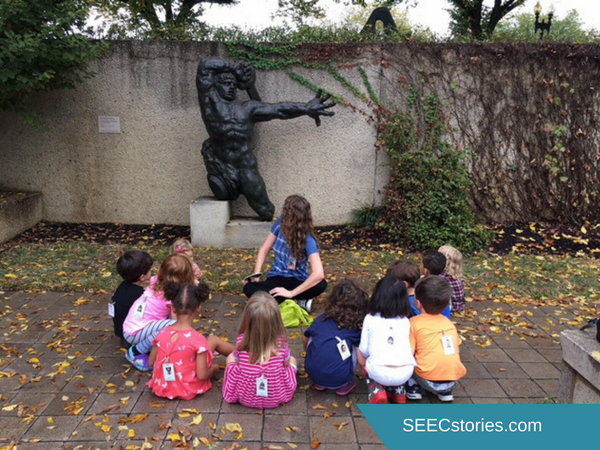
SEECstories.com (5)The Secretary’s comments made me think more about the role museums can play in supporting a young child’s civic education. When I look specifically at SEEC, I see our school and programs as supporting a child’s understanding of democracy via museums in three ways.  One of those ways, is asking them to understand the importance of objects from other cultures or historical periods. Many don’t see young children as capable of this type of perspective-taking, but with the right approach, young children can develop this type of understanding and empathy. One of the ways SEEC educators manage this is by taking what is familiar to children and applying it to the unfamiliar. Consider the collection of footwear on display at the Smithsonian Castle from the National Museum of the American Indian. The shoes, at first glance, may feel strange to a young child living in contemporary American society, but an educator can encourage a child to think beyond their own experiences by beginning with what they do know. A faculty member might inquire: “Why do we wear shoes? When do we wear certain types of shoes?,  How do shoes help us?.” By applying these answers to the American Indian collection, children begin to see the many things we, humans, have in common. At the same time, a child are also able to acknowledge and celebrate the differences they observe. This type of lesson, especially if repeated, makes a lasting impression. We might be different, but those differences can be celebrated. It also underlines how we are part of one human family who shares many commonalities.

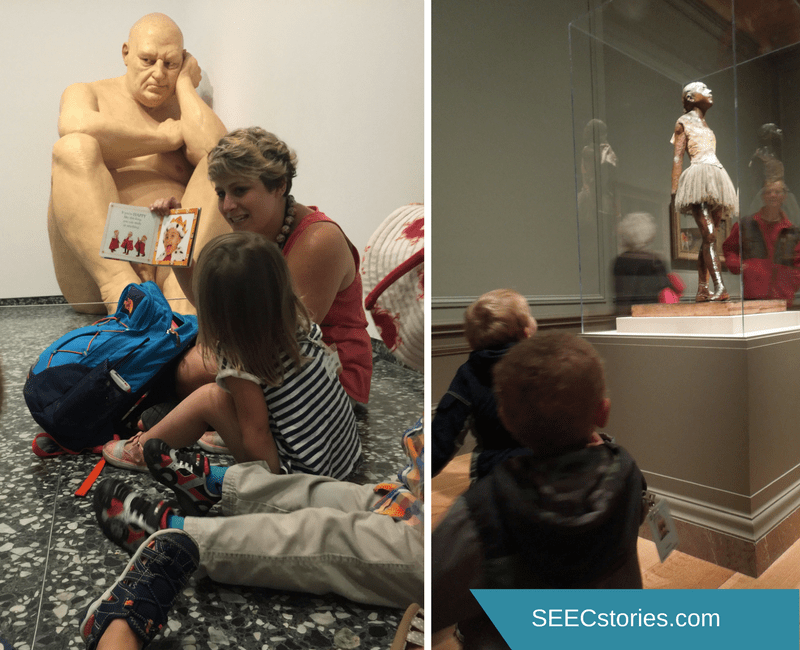
SEECstories.com (1)Secondly, young children who consistently spend time in museums can begin to understand and appreciate the role museums can play in learning, exploring, and questioning. During a recent conversation with a SEEC educator, he shared with me that in his Pre-K classroom children are routinely encouraged to ask questions and look for answers. He tell his class, that he, himself, doesn’t always have the answers and encourages them to seek answers via trusted resources. The children in this classroom have created a shortlist of “go to” places where they can get trusted answers. Of course, at the the top of this list is the museum.  For our SEEC students who have spent much of their young lives in these institutions, they understand how museums provide not simply information, but concrete manifestations of this knowledge. Consider the toddler who is learning about colors and visits the Hirshhorn Museum and Sculpture Garden. His knowledge is expanded by exploring the artworks and seeing the many different hues of blue. Similarly, consider the kindergartner who is learning about Rosa Parks and after viewing her portrait by Marshall D. Rumbaugh at the National Portrait Gallery. Through age-appropriate conversation, she can gain deeper insight into Parks’ role in the Montgomery Bus Boycott. Both children are learning that the museum is a place where they can turn to for both factual information and for viewpoints other than their own.

SEECstories.com (3)Finally, the very nature of how we teach at SEEC (and I think you could say this is true for many museum and classroom educators) reaffirms trust in democratic discourse. SEEC lessons often begin with a question and are composed around a conversation. For example, we might pose a scientific question like, “Why do cars have wheels?” or something more abstract like, “How do you think the woman in the painting feels?.” By simply engaging young children in conversation we are helping them to develop socially and emotionally. By framing these conversations within a museum, we can also encourage children to see the institution as a place in which dialogue is part of the experience. Within that dialogue, educators can facilitate conversations that encourage children to listen to and respect the ideas of others – something which will hopefully cultivate a generation of leaders who can engage in conversations resulting in positive democratic change.

SEECstories.com (2)As early childhood educators, whether in the classroom or the museum, we have a unique opportunity to frame the museum as a place where children can acquire knowledge throughout their life. Museum education is so much more than learning a new fact. It is a place where people of all ages can apply new information in a way that helps them value different perspectives and understand the ideas of others. While SEEC is uniquely situated to achieve this as a school on the Smithsonian campus, all schools and museums can support these democratic values. Classroom faculty can engage in conversations at their schools utilizing museum objects as a focal point via online resources. Museum educators can cultivate educational experiences that are friendly to all families and and frame developmentally appropriate experiences that support young children as capable learners. If we can support learning in this open-ended way, museums can and will remains stalwarts of democracy.


References

Skorton, David J. “How Do We Restore Trust in Our Democracies?” Smithsonian.com, Smithsonian Institution, 12 Mar. 2018, http://www.smithsonianmag.com/smithsonian-institution/how-do-we-restore-trust-our-democracies-museums-can-be-starting-point-180968448/#FsSTi0ZDsl6qSVV0.99.
Guiding the Development of Positive Body Images in Young Children

This blog is authored by museum Museum and Early Learning Specialist, Brooke Shoemaker. Brooke has been at SEEC since 2011, and holds a BA in Theatre Performance from the University of Maryland with a minor in Human Development, and a M.Ed. in Early Childhood Education form Towson University.  Brooke loves bringing traditional gallery spaces to life with young children through playful theatrical techniques.

Did you know that 30 million people in the United States suffer from an eating disorder during their lifetime? I am just one of these 30 million people, and over the last five years I’ve been on a personal journey to a feeling of self-worth that is not dependent on my appearance. About six years ago I developed anorexia at a time in my life when I felt like I couldn’t control many things, but I could control whether I went to the gym and “ate healthy”. I began to tie my success and worthiness to numbers: the number of miles I ran, the number of calories consumed in a day, and the number on the scale. I realized fairly quickly that my exercise and eating habits had veered away from healthy and had become obsessive and restrictive, and sought help from professionals, family, and friends. While I never thought that I would be dealing with this in my late twenties, the road to recovery from my eating disorder has led me to reflect deeply on body image, relationships with food, self-worth, and where it all begins.

Do you remember when you first had a sense of your body and what it could do? How old were you? Did you have positive or negative feelings toward your body? Children begin to develop their identities at a very young age, and this includes body image. A 2010 study found that almost a third of children age five to six would prefer a body that is thinner than their current size. Five and six. Think about that. What have children been exposed to, or influenced by, that leads them to these feelings of body dissatisfaction? My personal experience has led me to reflect on strategies adults can utilize to help foster a positive body image and healthy relationship with food in young children so that we can hopefully guide the next generation to feel positive about their bodies. Please note that body image and disordered eating are very complex issues, and there’s no set of circumstances to prevent or ensure they occur, however these tips are a step in the right direction.

SEECstories.com (8).png

Reflect on how you Talk about your Body and Relationship with Food

Expressing dissatisfaction with your own body or food habits can affect children’s body image and relationship with food. This was illustrated to me clearly when I overheard a four-year-old say, “When your stomach sticks out you need to exercise, that’s what my mom does.” I’m sure that the child’s mother would never say anything negative about her daughter’s body, but children absorb these messages from adults, and what happens if this child observes her own stomach sticking out? Will she conclude that she must work out until she reaches a certain standard of acceptability? Children learn from what others do and say, and negative comments about our own bodies are no exception. By contrast, modeling body comfort encourages children to have acceptance and appreciation for their bodies. For example, “Exercising made my body feel really good and now I have more energy”, or after coming back from a long walk: “Wow, thank you feet! You helped me walk such a long way today.” If negative body talk is ingrained in your everyday language, Dove has some great tips in recognizing and curbing it.

Recognizing Biases

We all have biases, but recognizing our negative biases regarding body image and food is the first step in countering those biases and ensuring that we don’t pass them on to children. During my own recovery, I’ve recognized how many “should” and “should not” beliefs I held about my body and food. Try to catch yourself when you think or say something about your body or food and question why you think that. If you’re not sure where to begin, try taking the Weight Implicit Association Test from Harvard’s Project Implicit. The results might surprise you and spur your reflection.

Commenting on Children’s Appearance

While I don’t remember any of my early childhood teachers commenting on my appearance, I do remember multiple teachers in middle and high school making comments about my lanky frame. One high school teacher made a comment that I must not eat very much because I was so skinny. Other teachers made comments about how thin I was. I’m sure these teachers believed their comments were innocuous. Upon reflection, however, I see how these comments began to ingrain themselves into my identity. Being skinny was part of who I was, and what I was recognized for, so what happens if I lose that identity?

When I started this journey, I became more aware of the way I talked to children about their appearance. As an early childhood educator, I knew that I often commented on children’s bodies in terms of their function. For example, “Your feet help you run on the playground” or “Your stomach breaks down your food, which gives you energy.” However, I started to notice that I also often remarked on children’s clothes, partly because I really did enjoyed the pattern, colors, or designs of their clothes, and partly because it’s an easy and quick way to engage with a child. But what did the children learn when I remarked on their clothing, often as soon as they arrived at school? Probably that their clothing and appearance is important and garners approval. Children’s identities should be built on their inner qualities, not their outer appearance, which changes by the day. I now immediately recognize when I say something about a child’s clothing, and instead follow up with a comment about them as a person, not their appearance.

3

Celebrating the Body

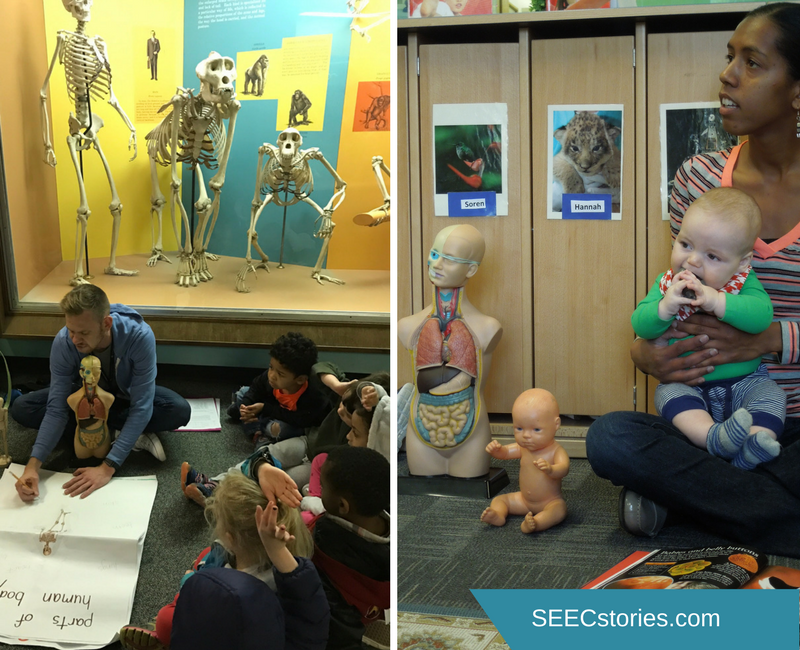
Our bodies are amazing! They hold intricate systems that help us do things like running, jumping, dancing, climbing, hugging, and more. At SEEC we follow an emergent curriculum, but embarking on a Human Body unit is a common occurrence in our classrooms. Young children’s bodies develop so many new skills in such a short amount of time, from growing teeth and chewing, to crawling, to running, to controlling bowel movements. There are many exciting milestones. Children are often curious about this and want to learn more, which has led to lessons about blood, hair, and more. Learning about the body creates an appreciation, respect, and love for all it can do.

4

Identity Work That Goes Beyond the Physical Characteristics

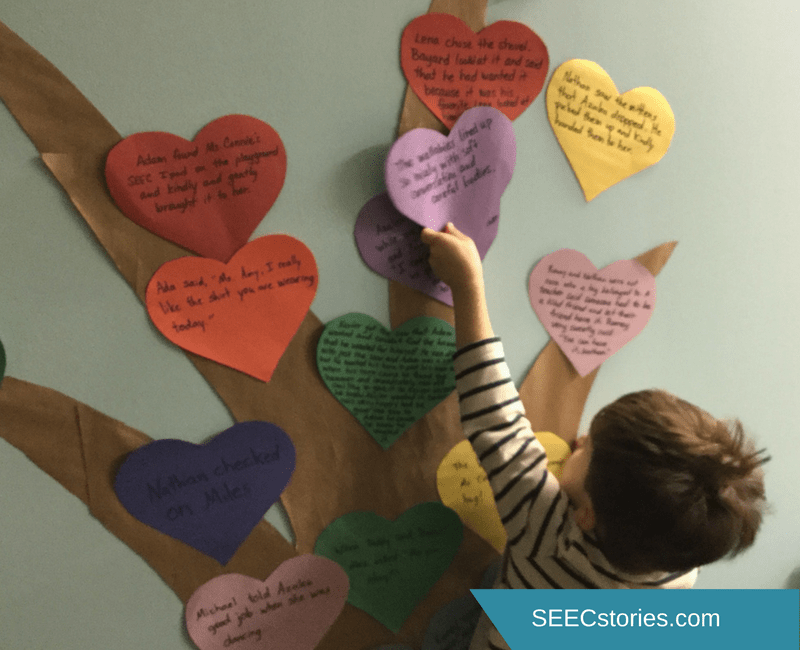
A common topic explored in our classrooms is “All About Me” which encourages children to think about their identity. While we focus in part on outward appearances, we also delve deeper into what makes each of us, “us.” We value those traits and preferences that make us each unique, and those that make us similar. Some of this work happens at the start of a new school year when teachers and children are getting to know each other. We share favorite things and talk about our home and family lives. However, this topic of building our identities does not end in September. Our classes explore this topic through all of their units. For example, during a unit on sports, our preschoolers considered the character traits athletes must have including perseverance, teamwork, and integrity. The class discussed how each child also had these traits and how they help us as people. Another way to value children’s characteristics throughout the year is making note of their actions that exhibit these traits and celebrating them. For example, one of our three-year-old classes has a paper tree in which they add notes to the tree limbs to recognize moments that exhibit character traits. Children are able to celebrate the fact that they are kind, helpful, persistent, brave, etc., which builds their sense of identity.

2

Discussing Media Influences

Even if all the adults in a child’s life speak positively about their and other people’s bodies, we unfortunately cannot escape the media. Children receive messages from books, TV, games, advertisements, and even politicians. Although we cannot control the media, we can have conversations with children that combat stereotypes and negative body talk.

In addition to conversations, adults can provide positive media, such as images and books, that represent the world around them with bodies of all shapes and sizes. At SEEC, we are lucky to be surrounded by the amazing collections of the Smithsonian, including artwork and objects that showcase variety in bodies. However, even if you’re not located near the Smithsonian or other such resources, you can access them online via Smithsonian’s Learning Lab. I’ve created a collection of artwork and objects from the Smithsonian and beyond that reflect a variety of bodies that can be used with young children in the home or school.


As educators, parents, caregivers, grandparents, older siblings, etc., we have the big and important job to guide young children as they are beginning their own journey with developing their self-worth and body image. With this foundation, when children get older and encounter negative body stereotypes and talk, they will have the tools to think critically and reject it.

Changes: Talking with Young Children about Death

This blog is authored by our Director of Infant and Toddler Programs, Melody Passemante Powell. Melody graduated from James Madison University with a BS in Early Childhood Education and earned her MEd in Education Management from Strayer University. She has been working with and for young children for nearly two decades in a variety of roles. In her down time, she enjoys having fun with her two-year-old daughter, wife, and dog Jack.

TRIGGER WARNING: This blog explores the ways in which young children process death and how adults can support them through such a difficult time. The author reflects on her own experience with the death of her mother at a young age and may be triggering to some.


As the philosopher Heraclitus so aptly stated, change is the only constant. Some changes are simple and easy to adapt to, while others might be more complex and can evoke mixed emotions. As our previous blog explored, moving to a new house, welcoming a new sibling, or starting at a new school are changes that would likely cause feelings of nervousness mixed with excitement. Then there are other changes that are incredibly hard and complicated to adapt to, like death. Unlike many other changes in life, death is one change that is often very hard to talk about because it is such a big and complex concept that even many adults have a hard time processing. It can be even more daunting to be tasked with talking to children about death, especially when we ourselves may be dealing with the situation, and potentially grieving at the same time.

SEECstories.com (4).png

I have always felt drawn to this topic because I have a unique perspective as I lost someone very close to me when I was a young child. I went back and forth about sharing my personal experience, not because I have trouble sharing, but because I worried about making others uncomfortable. As I processed these feelings, I realized they were connected to a norm in my culture: to avoid making others feel sad and uncomfortable. I decided that sharing my experience felt relevant and important. Although like most stories associated with death, it may be hard to read.

SEECstories.com (5)

When I was three, my mother died. The situation was even more complicated by the fact that my mother died by suicide. On the day that it happened I had been to play therapy in the morning, where my therapist had told me my mother might try to kill herself again. Unfortunately my mother had tried before and I was aware since I was in the house. On the day my mother died, my Grandma had been tasked with telling me what had happened. After school my Grandma held me on her lap and asked if I had remembered my therapist telling me my mother might try to kill herself again. She let me know that sadly she did today and she died. My Grandma told me that my mother loved me very much, but that she was very sick. She stressed that she had needed grownup help but sadly even that wasn’t enough. My Grandma answered all my questions succinctly without elaboration and took her lead from me.

Later at home in a room of adults I said something to the effect of, “I am sad that mommy killed herself.” My family replied that they were all sad too. I was given space to process and while I do recall being sad, I also remember having a pretty solid understanding that this was permanent and I would not be seeing my mother anymore, likely because this is what I was told. I wasn’t confused because even though it was a very complex concept to grasp, I was given honest, age-appropriate answers about what was going on. My questions were welcomed and I was given a safe space to talk through anything I was feeling or wondering about.

I recognize that my experience is not the same as any other child going through the difficult change of losing someone close to them. Death and grief are deeply personal topics, often connected to our cultures and belief systems. Even within cultures, no two people experience death and grief in the exact same ways. So how do you talk to children about death? Of course it will depend on your personal beliefs, but here are some tips based on my experience, what we know about child development and how young children understand the world around them.

Be honest

Although it can be incredibly hard, being honest with children helps to avoid any confusion. Often what children think about in their own heads may be worse than the actual situation. It is hard to know exactly what to say because every child and situation is different, but here are a few examples of wording you could use in various situations:

Death of an older person or pet: “Sometimes very old living things, people and animals, die because they are very old and their bodies have worn out.”

Sudden death due to illness: “Sometimes people who seem healthy get sick very suddenly. It doesn’t happen very often, but it does happen sometimes.”

Sudden death due to accident: “Our bodies are very strong but there are some things that can hurt our bodies so badly that we die.”

These phrases would be used within a larger, ongoing conversation, but might be helpful as a starting point for honest, age appropriate communication. Young children are better able to understand complex topics when they are able to make personal connections to things in their life. It can be helpful to reference something they are already familiar with to make a comparison such as a plant that was old and died, a pet that died, or a character in a book or movie.

Welcome questions and follow the child’s lead

2

Children are curious by nature, working to understand the world around them. Young children think in concrete terms, so it is best to use clear language and avoid euphemisms that may cause confusion. Phrases like “her body stopped working” or for a child a little older, “her heart stopped pumping blood through her body to keep her alive” are concrete and honest. Phrases like “he is sleeping forever” and “he is up in the clouds now” can cause confusion for children because they will take these literally. Children might worry they may never wake up if they go to sleep. It is normal that children might become nervous or fearful in general when learning about and processing a complex topic like death. When answering questions, be honest, but avoid elaborating unnecessarily. We might think that children need lots of information or we are being dishonest by withholding, but in this case sometime less is more.

Talk about how you are feeling

Everyone grieves in different ways, and talking about your feelings when you are grieving may not be the way you process your emotions, but talking with young children about our feelings is critical for young children. A good rule of thumb is to find times to simply narrate out loud about your feelings. For example, “I am feeling sad about our dog Francis dying. Sometimes when I feel sad, I cry with someone. Other times I just want to be alone.” Mentioning that people grieve in different ways, and even the same person can work through grief in a variety of ways helps children feel safe to feel whatever it is they might be feeling, and safe to talk about those feelings if they wish to. Although it can be difficult at times, not saying anything sends a powerful message to young children that these topics are taboo, and not to be discussed.  over time children begin to make their own assumptions about death and grieving, which may or may not be true. Children as young as infants use social referencing, looking to those they trust in uncertain situations to decide how to act and feel. Showing children that having feelings is a normal, human process, is incredibly important. Some cultures are often taught to suppress emotions, and many children think that crying or feeling sad is not okay, when actually these feelings and expressions are completely normal and healthy ways of coping.

Validate the child’s feelings

www.SEECstories.com (6).png

Validation goes hand in hand with talking about our own feelings. When a child has been sent the message from the important adults in his or her life that grieving, and expressing feelings is okay, they will likely feel safe to express their own feelings. There are no right or wrong feelings and there are no right or wrong ways to process complex situations like death. Remind yourself and your child that grief is a non-linear process. Some days we might feel okay, even happy, and other days we might find it unmanageable to get out of bed.

None of this is easy, especially if you have to talk with a young child when you yourself might be grieving. My personal silver lining from my experience with my mother’s death, is that I am able to remember how I felt when I was younger, and to be able to say that when given honest information, and a safe supportive space to work through their feelings, young children can be quite capable of processing big changes like death. Of course as an adult dealing with these topics when we ourselves are stricken with grief is easier said than done. Remember that you are not alone in dealing with this and there are lots of resources out there to use as support.

Resources:

Related Articles & Book Reviews:

Dealing with Death from the Fred Rogers Company

How to Talk to Kids about Death from the Child Development Institute

Saying Goodbye: Talking to Kids about Death by Christina Frank 

5 Books to Help Kids Understand Death by Heather Feldstein

Top 10 children’s books on death and bereavement by Holly Webb

64 Children’s Book to Talk about Death and Grief from What’s Your Grief?

Books to Help You Explain Death to Children from Aha! Parenting

Books:

1.png

In a Nutshell by Joseph Anthony – This book is about the life of a tree, and the ways it changes, grows and impacts the nature and earth around it, even after it grows old and dies. This book is more abstract and does not deal with the death of a person or a pet. It is a good conversation starter, and a good reference point to look back to when the time comes that you do need to talk about the death of someone or something close to you and your child. The images are beautiful and very eye catching.

A Mama for Owen by Marion Dane Bauer – Luckily, I have not had to talk with my two year old about the loss of someone we know yet, but I know the time will eventually come. We have a lovely book called “A Mama for Owen” and in the story a baby hippo, Owen, is separated from his mother during a tsunami and he is understandably sad. Eventually he is rescued by humans who take him to a zoo, and he bonds with a very old turtle named Mzee, who basically takes Owen in as his own. My daughter talks frequently about this book. “Owen no Mama” she says in a sad tone, “Owen sad”. I will ask her what happens next, and she enthusiastically says, “Finds turtle Mama! Owen happy!”

No Matter What by Debi Mori – My daughter loves this book as well. This is great book to reinforce that our love for our children persists, no matter what. Dealing with death and loss is hard, and it is important that children are sent the message that they are safe and loved even when things are sad, scary, and confusing.

Book Club: Free to Learn

For our most recent book club we read and discussed Free to Learn: Why Unleashing the Instinct to Play Will Make Our Children Happier, More Self-Reliant, and Better Students for Life by Peter Gray. We were initially drawn to this book because of how it embraced play and we were excited to read, learn, and discuss teaching methods that are not often embraced by the public schools. Our book club meeting was lively and you can find a recap of our discussion below.

51UmYPiSXHL._SX326_BO1,204,203,200_

Trustful Parenting vs. Trustful Teaching

Gray describes trustful parenting as the belief that “children’s instincts can be trusted, that children who are allowed to follow their own wills will learn what they need to learn and will naturally begin to contribute … when they have the skills and maturity to do so” (26). He explains that this style of parenting has deep roots in human history and was used by our hunter-gather ancestors whose children were “allowed to spend most of their time playing and exploring freely” (28). Gray traces the decline of trustful parenting to the decline of neighborhood playgroups and the rise of fears about safety and future job employment opportunities for their children as well as the role of schools (213 – 218). Gray advocated for a resurgence of trustful parenting and argued that considering alternative schools might be a necessary step to becoming a trustful parent (226-227).

Since trustful parenting and the education system are seemingly at odds with one another. We decided to look critically at the parenting philosophy and see how if it could be adapted to a teaching philosophy that we could embrace at SEEC. In some ways, it was easy for our SEEC educators to say that they were on board with a trustful teaching philosophy. We fully embrace the importance of learning through play and exploration and believe in child-directed learning. We hesitantly agreed to the children’s use (or at least being exposed to) of adult tools, even the dangerous ones, because we believe that children learn through objects. At school, we are comfortable with children taking risks, while as educators we simultaneously try to minimize hazards. This balance between risk and hazards was what Gray was describing when he explained that children are trusted “to have enough sense to not hurt themselves” with “some limits”, such as the “poison-tipped darts or arrows (that) are kept well out of small children’s reach” (29).

There were reasons that we had difficulties embracing the philosophy of trustful parenting and therefore were unable to adequately adapt it. In many ways, being a teacher and trying to impart knowledge on a child goes against the philosophy of trustful parenting. As educators, we all felt that a crucial part of our jobs is to impart knowledge. This means that while being receptive and responsive to the children, we make lesson plans with the goal of opening their eyes to new things. We actively monitor our children to make sure that they are meeting developmental milestones and try to seek out ways to encourage growth in areas that children are not mastering by themselves. While we trust children to learn, we also hope that our children will trust us as teachers to help guide them.

SEECstories.com (4)

Rethinking Shame and Discipline

While Gray mostly focused on shame used as a tool against older children, we found that this argument could be applicable to the field of early childhood education. Gray explains that using shame as a tool to entice children to perform better actually causes an increase in cheating (73). While young children are unable to cheat, they are able to lie and we know that children are much more likely to lie about a situation if they are worried that they will disappoint us. For this reason, we decided that it is crucial to look at how we are treating children when we are disciplining or redirecting their behavior.

At SEEC, we never purposefully shame children into changing their behavior. But, we wondered if there were times when we might have been shaming unknowingly. While having this discussion, we came to another question, “What is the difference between correcting and shaming?” We decided that at least one key component of trying to change a problem behavior without shaming was to describe why that behavior cannot be allowed to continue. Rather than saying “Don’t do that!”, we should say “When you hit, it hurts my body” or ask an older child to explain why that behavior cannot continue by asking them “Is that hurting someone?”. These are pillars of SEEC’s behavior management philosophy and we feel comfortable using them. After reading Free to Learn and thinking deeply about the role of shame in discipline, we left the discussion unable to draw a distinct line between correcting and shaming. In the end, we decided that we all needed to go back to our practices and be mindful of this topic.

SEECstories.com (2)

Alternative Schools

Much of Free to Learn is a description and study of the Sudbury Valley School. Gray explains that to “visualize the Sudbury Valley School, you have to set aside all of your notions of what traditional schools look like, including your notions of what progressive versions of traditional schools look like” (88). We found this statement to be true. Sudbury valley is indeed “something entirely different” (88). The Sudbury Valley School is founded on the belief that the students, as a democracy, run the school and are in charge of their education. Staff members, which there are very few of, are not called teachers “because they recognize that students learn more from one another” (90 – 91) and must be reelected by the students yearly to keep their positions (90). Children are able to explore the entire campus whenever they want, do not have grades or tests, and do not have to join a single class. The principle tenet of the Sudbury Valley School is that “each person is responsible for his or her own education” (91).

In some ways, the Sudbury Valley School was almost impossible to compare to other schools. As a group we found this both frustrating and enlightening. It was frustrating because so many of the practices highlighted seemed impossible to adapt to other schools, particularly public schools. We discussed how some public schools want to be progressive, but testing and pressure make it impossible. The pressure on schools, teachers, and students is so overwhelming that no one is willing to experiment or try new educational methods. This problem also extends past discouraging teachers from experimenting with new educational methods. It was recently discovered that D.C. public schools graduated more than 900 students who had not earned their graduation last year. With this need to push children through the school system, rather than considering their needs, how can schools be expected to take a gamble and embrace such extreme teaching alternatives?

SEECstories.com (1)

Ways to Incorporate Ideas at SEEC

 At SEEC, we are lucky to be able to discuss concepts, adapt them, and implement them in our own ways. Even though our student population is under the age of six, we value their voices. Students as young as two years old regularly hold votes about what the class should learn about next. At the beginning of the school year, our four-year-old classes create a class contract, which explains the rules of the room, and the teachers and students sign it. We are able to embrace democracy within limits and still give each child a voice.

We believe that children are constantly learning from each other. Rather than try to solve disputes, we give children the words to create their own solutions. For example, if two children are fighting over a shovel, we could say, “It is Sally’s turn for five minutes and then it is Jose’s turn for five minutes”. Rather than forcing a teacher directed solution in that manner, we say “I see there is problem here. What should we do to fix it?” The children may very well choose a five minute on, five minute off solution, or they may decide that Jose should play with it because he is wearing blue shoes and the shovel is also blue. So long as both children agree, a SEEC teacher will happily accept this solution. We believe that when children are given the freedom to learn from each other, they learn critical thinking and real life skills. Our goal is to help children discover these skills and grow to love learning.

While we were unable to incorporate all the things that Gray advocated for in Free to Learn, we were able to have a vibrant discussion on the book. In the end, we valued Gray’s embrace of learning through play but advocated that thoughtful educators can have a meaningful place in a young child’s learning.

Celebrating our Faculty

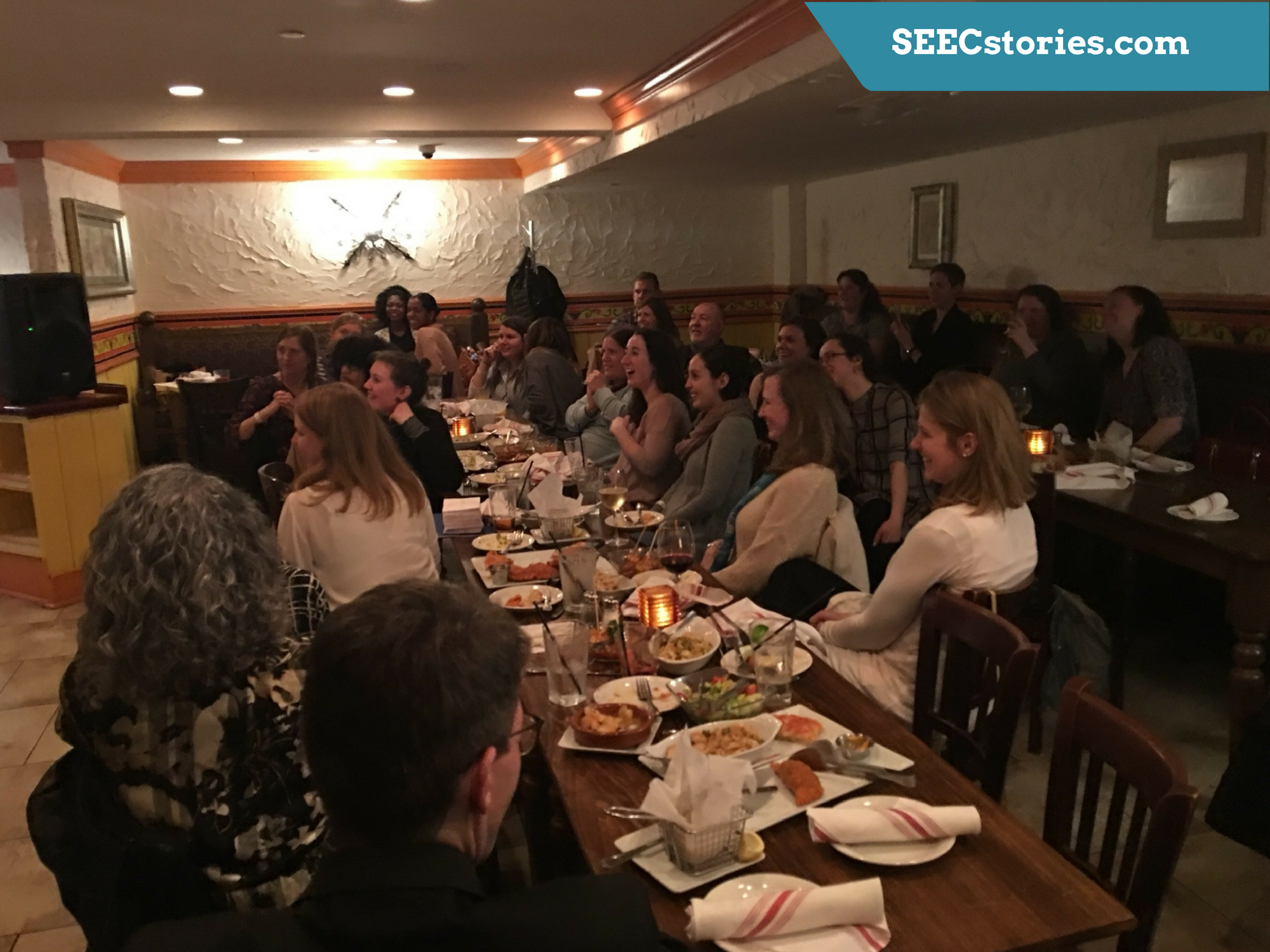
Every year, SEEC hosts a dinner in honor of its educators. This annual event takes place at a local restaurant where we enjoy food, drink, and each other’s company. In addition to the  festivities, we also use a portion of the evening to honor our faculty. This year, our center directors took a moment to individually recognize each of SEEC’s educators. Though our administrative team feels that SEEC is an amazing school because of its unique approach to learning and location on the Smithsonian campus, they also know that at the heart of this school are the amazing individuals who spend their days loving, teaching, and nurturing our students.

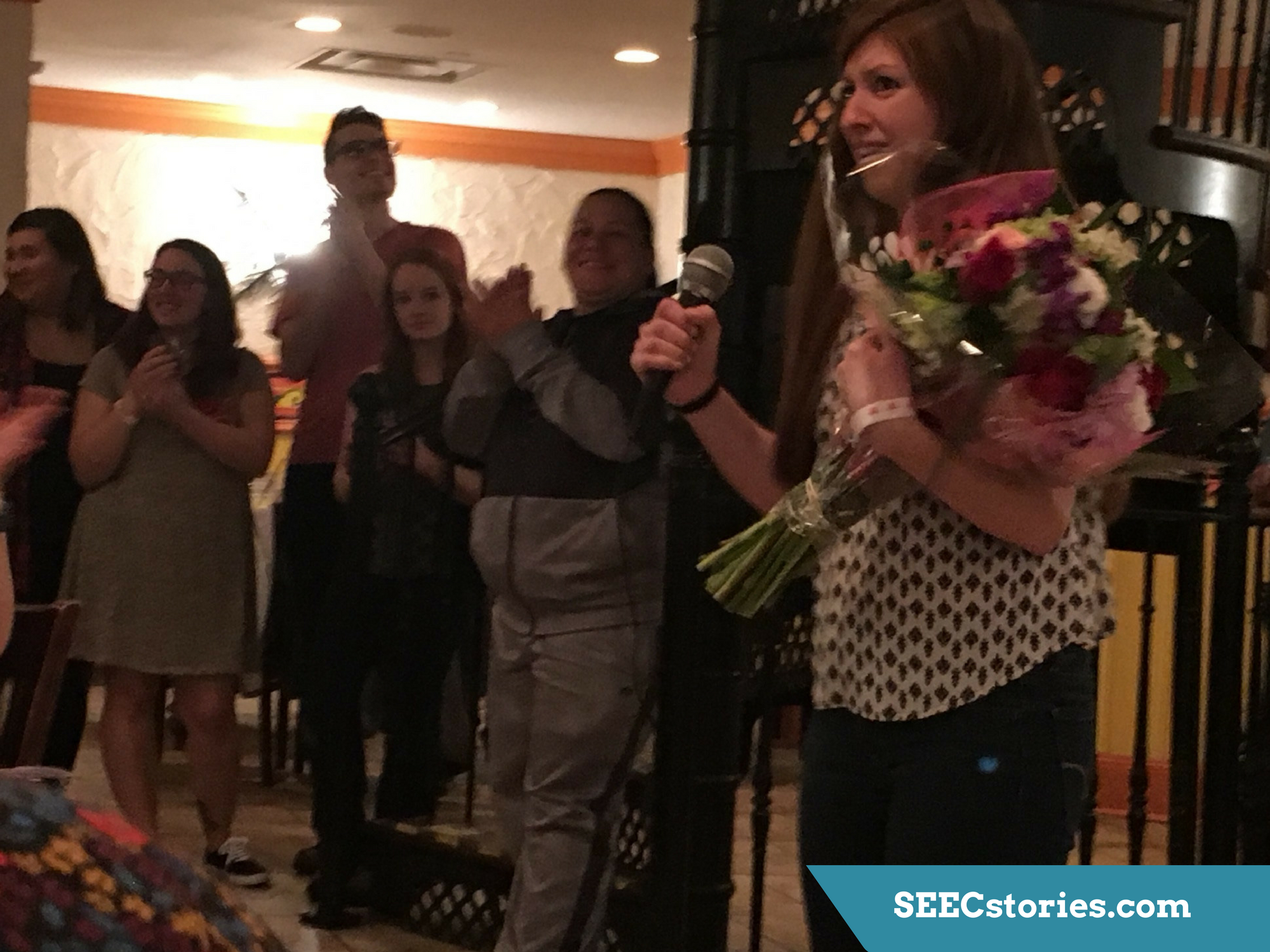
Once we concluded sharing about our team as a whole, a few special educators were singled out for their work. We began by recognizing Jessie Miller, the recipient of the Diane Homiak award. This award is a long-standing tradition at SEEC that recognizes the commitment, creativity, and contributions of a stellar educator. Jessie is an educator in one of our Pre-K 4 classrooms and has been teaching at SEEC since 2012.  She is originally from Norfolk, VA and completed her Master’s in Early Childhood Education at George Mason University in 2015. In numerous nominations from both current and former parents, as well as her colleagues, Jessie was singled out for the creativity she brings to the learning experiences she creates, her boundless enthusiasm and energy, her caring nature, and her ability to tap into the innate curiosity of her students in meaningful ways.

SEEC also  recognizes educators from each of its three centers who are team players. These educators were selected for their willingness to lend a hand, positive spirit, and for contributing to a strong sense of community.  Support educator, Dana Brightful was honored for her work at our preschool location at the American History Museum. Dana realized her passion for teaching young children while in college and has been part of the SEEC family since 2005. Silvana Oderisi, kindergarten teacher, was acknowledged for her work at one of our Natural History locations. Before joining SEEC, Silvana completed her Bachelors in French from George Mason University and taught as a Corps Member of Teach for America. Finally, an entire team from one of our infant classrooms was awarded the team player award for our second Natural History location: Rosalie Reyes, Morgan Powell, and Mallory Messersmith. This threesome truly exemplifies the spirit of SEEC.

All in all, we had more than 30 different educators that were nominated by families and peers this year. It was a difficult decision, but we are so proud of our team and are thrilled to be able to honor their hard work and dedication.

SEEC Shares: Tiny Sculptures

SEECstories.com (1)

At SEEC, one of our core teaching philosophies is using the museums to enhance our lessons and foster curiosity. Upon hearing about a school inside the Smithsonian, many people are excited and want to know more about our practices. Other people react differently, thinking “that’s great, but I will never be able to recreate that in my classroom or at home”. We actively disagree with this assumption and argue that teachers, caregivers, and parents can bring their children out into the community to engage in object based learning. we understand that for some these community visits are not always easy to implement. For this reason, we decided that we should offer ways for parents, caregivers, and teachers to create SEEC-like spaces and activities that do not involve leaving your classroom or house. Our new blog series “SEEC Shares” aims to be a place that anyone working with young children can visit and be inspired to take ideas to mold them to fit their own needs.

SEECstories.com (2)

This week’s “SEEC Shares” highlights a class that taught toddlers about sculptures. This particular class was one of our recent Toddler Trailblazers Family Workshops. On the weekends we open our doors to families who come into our classrooms for play-based exploration before heading out on a museum visit with the class. For this Tiny Sculptures lesson, we transformed the classroom to allow for a wide variety of sculpture-based play and then visited Untitled (1976) by Alexander Calder and then Circle I, Circle II, and Circle III by David Smith at the National Gallery of Art. Below you will see some of the many ways that we created experiences to allow the toddler class to explore and create their own sculptures. Hopefully you will find these ideas inspiring.

Classroom & Activities Setup

Straw Sculptures on a Light Table

SEECstories.com (1)

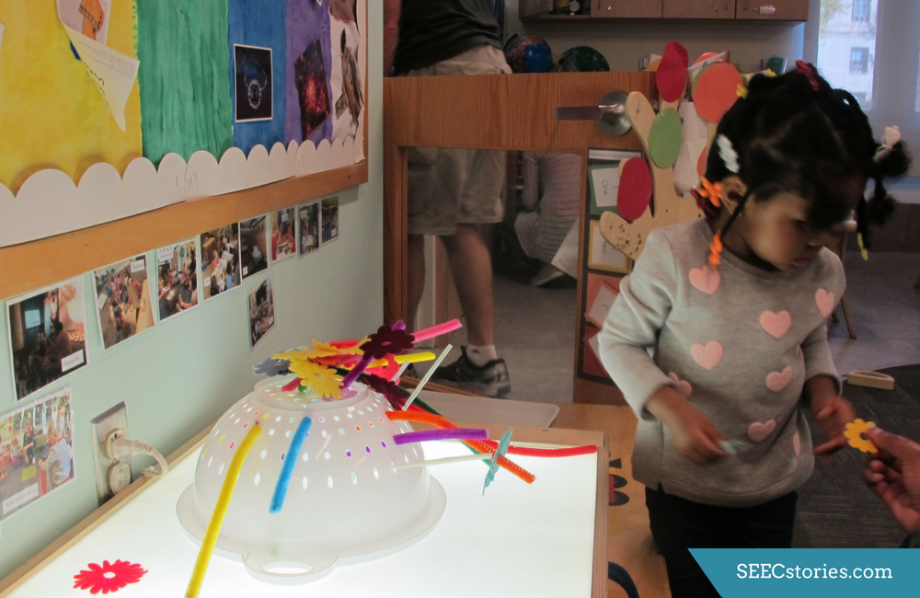
For this activity, we put a colander upside down on a light table. The light table helped highlight the holes through which the children could stick the pipe cleaners and straws. As an added feature to the sculpture, we found felt flowers that we had previously made using a die cutting machine and felt.

SEECstories.com (4)

Since this was a standing activity, children could freely enter and leave the activity without having to seat themselves in a chair. The freedom of standing can help children tap into their creative side. Additionally, putting the pipe cleaners and straws through the colander holes was challenging and provided children with the opportunity to work on their fine motor skills.

Playdough Creations

SEECstories.com (2)

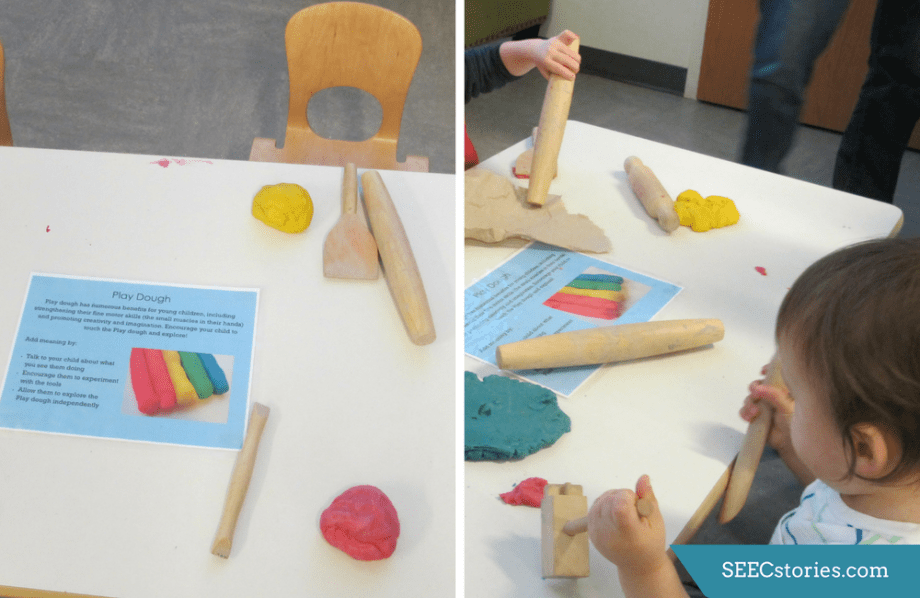
For our playdough station, we used assorted colors of homemade playdough. Often when we first introduce playdough to young children, we do not give them any tools to use. This encourages the children to practice pinching and molding the clay with their fingers, which is crucial to development. For this project, we chose to give the children tools that sculptors would use when working with clay.

Wooden Blocks, Magna-Tiles, and Tegu

SEECstories.com (5)

We created a block station that was tucked away in a corner. Children were able to create their own block sculptures without fear of someone knocking it over. Mixing the different types of blocks, including wooden and magna-tiles, allowed the children to create in new and unexpected ways.

 Loose Parts

SEECstories.com (3)

At the center of the room was a large station that was composed of loose parts. Before the lesson we gathered blocks of different shapes and sizes. Since blocks that link with one and another are not technically loose parts, we were careful to make sure that none of the blocks in the loose part area connected with one another either through magnets or through linking mechanisms like legos. We also cut up pool noodles, found cardboard tubes of various sizes, and added scarves to our loose part collection.

SEECstories.com (6)

To make our loose part area interesting and to hopefully spark creativity, we added materials that we thought the children would never have had a chance to experience before. We filled nylon socks with rice to make a unique form of bean bags and put out a large, white, stretchy tube to manipulate and explore. We also tried to display the loose parts in a way that showed that we valued these pieces without defining what they were or how they should be used.

Found Object Art

SEECstories.com

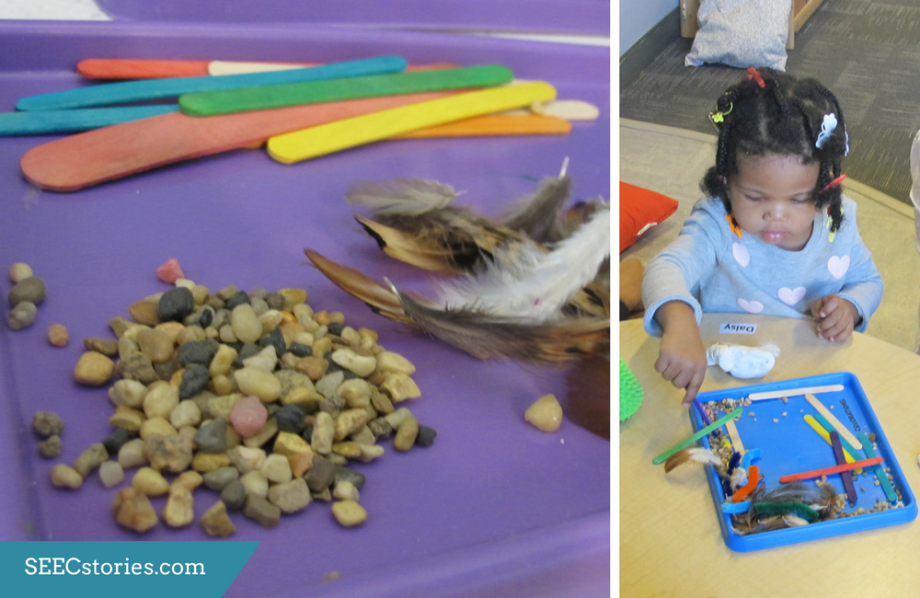
To finish up the classroom part of the class, the toddlers were encouraged to create their own art using colored popsicle sticks, rocks and pebbles, and feathers. This activity allowed the toddlers and parents to reflect on what art is and what defines a sculpture. For this project, no directions were given. Children were able to be inspired purely by the materials and create truly process-based art.

We hope that you found this “SEEC Shares” inspirational and are equipped to create your own tiny sculptures activity. For more ideas check out our Pinterest Boards on Toddler and Twos Classroom, Activities from SEEC, Environments, and Learning as a Family.


Teacher Feature: Infant Class Explores Animals

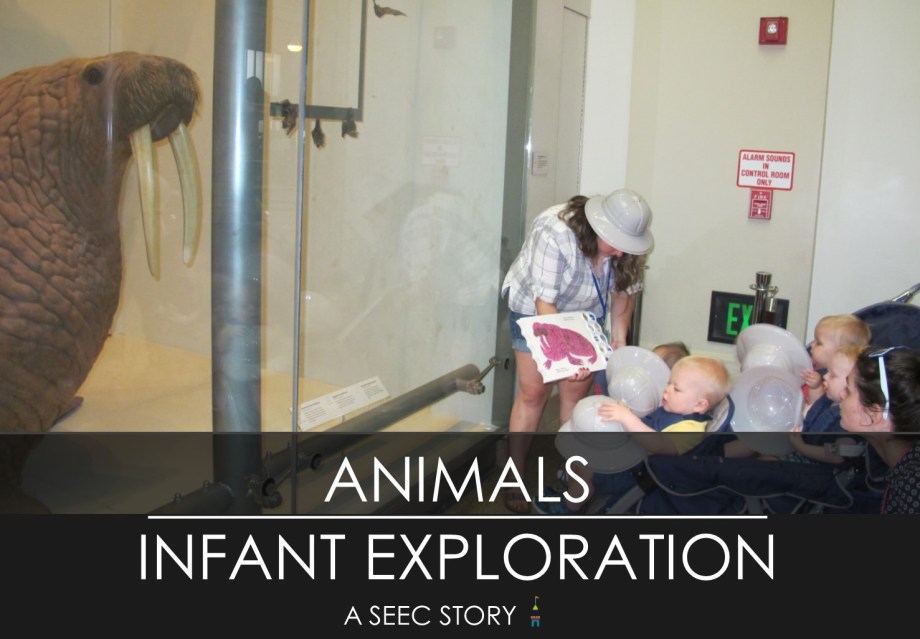
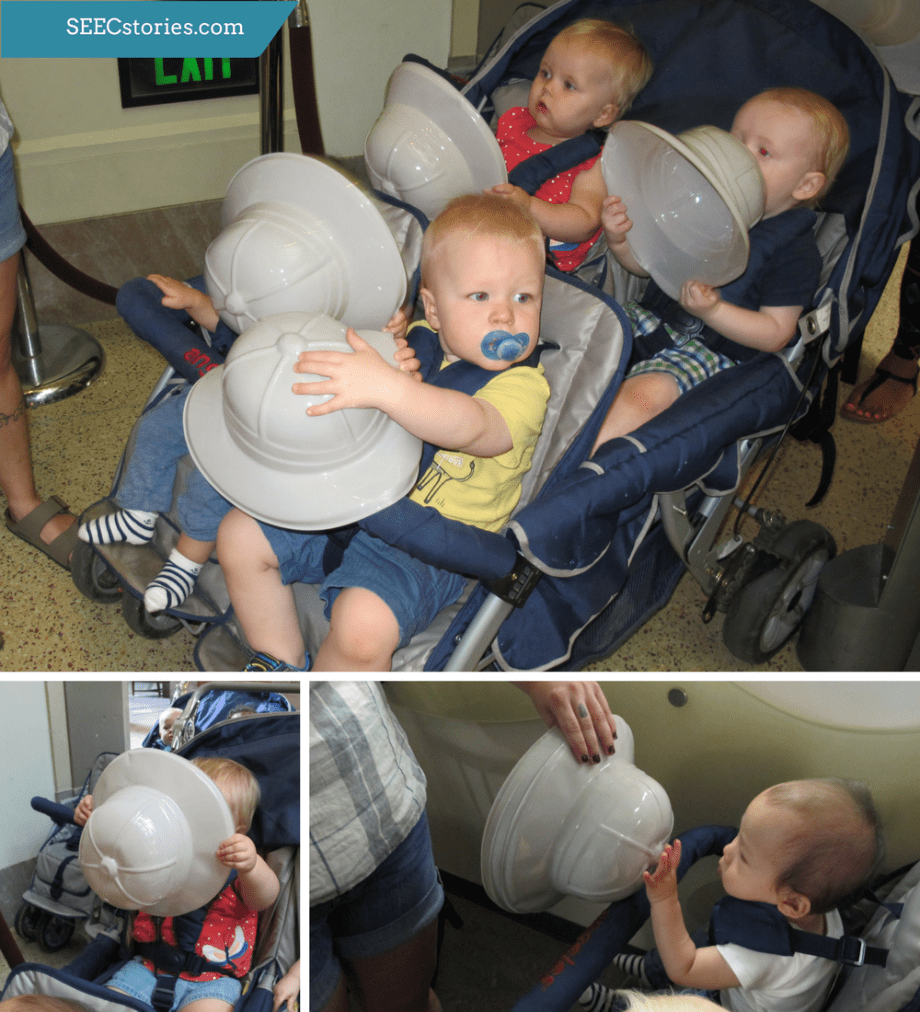
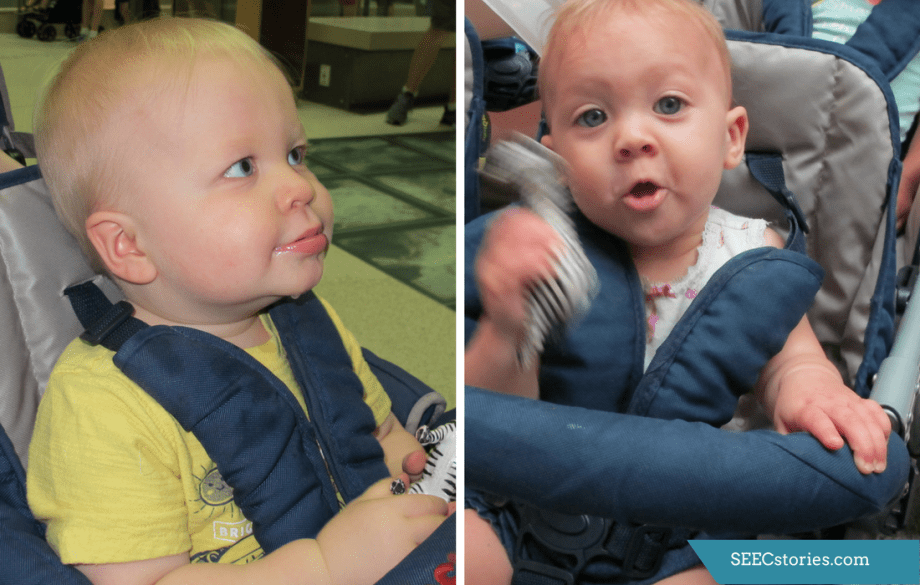
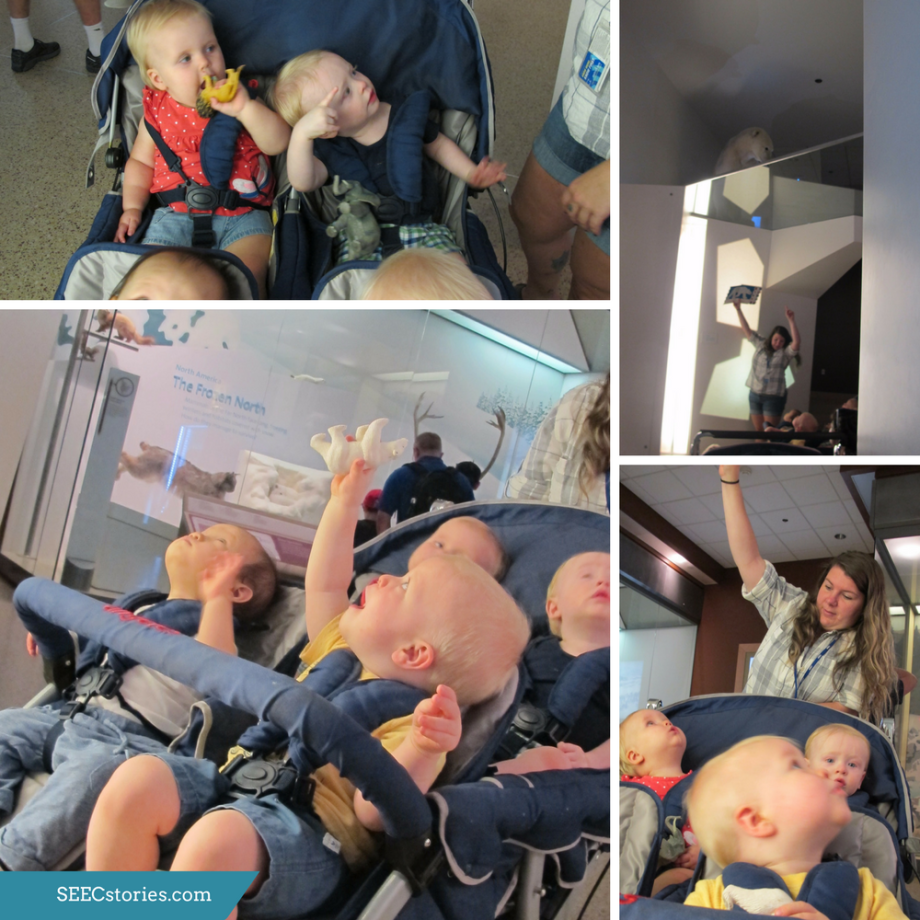
This week’s teacher feature highlights an infant class’s adventure to the Kenneth E. Behring Family Hall of Mammals at the National Museum of Natural History. The teachers, Erica Collins, Katherine Schoonover, and Noel Ulmer, paired the museum excursion with the book “Polar Bear, Polar Bear, What do you Hear?” by Bill Martin Jr. and Eric Carle. While this experience was carefully planned and curated by the teachers, the infants’ interests ultimately determined which animals the class focused on. By intentionally responding to their class’s cues, the teachers allowed the infants to lead the lesson based on individual interests. Below you will find images from the day as well as a reflection from the teachers.

 Cover Photo


SEECstories.com (1)

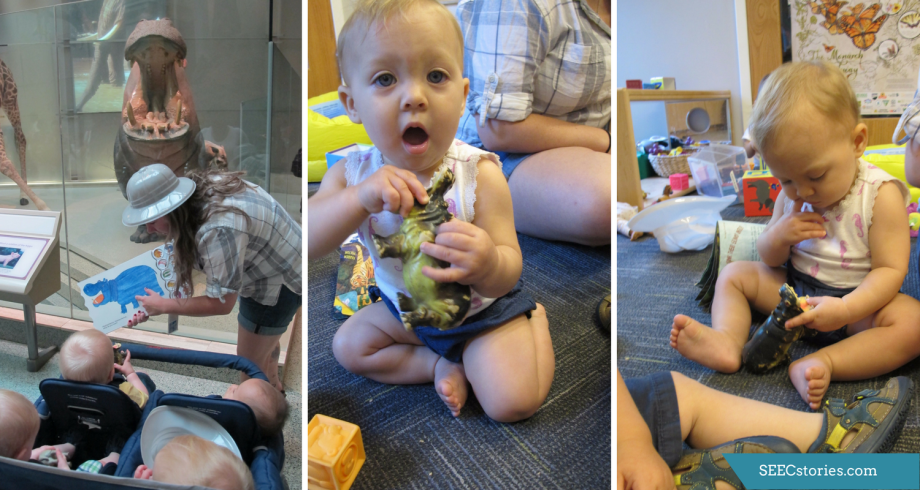
To start their adventure, the teachers passed out safari hats. Each child was given the opportunity to touch and explore the hats. Many tried putting the hats on, taking the hats off, and even experimented with covering their eyes with the hats. In addition to something new to hold, the hats also served as a transitional object to ease the move from the classroom and to the mammal hall.

SEECstories.com

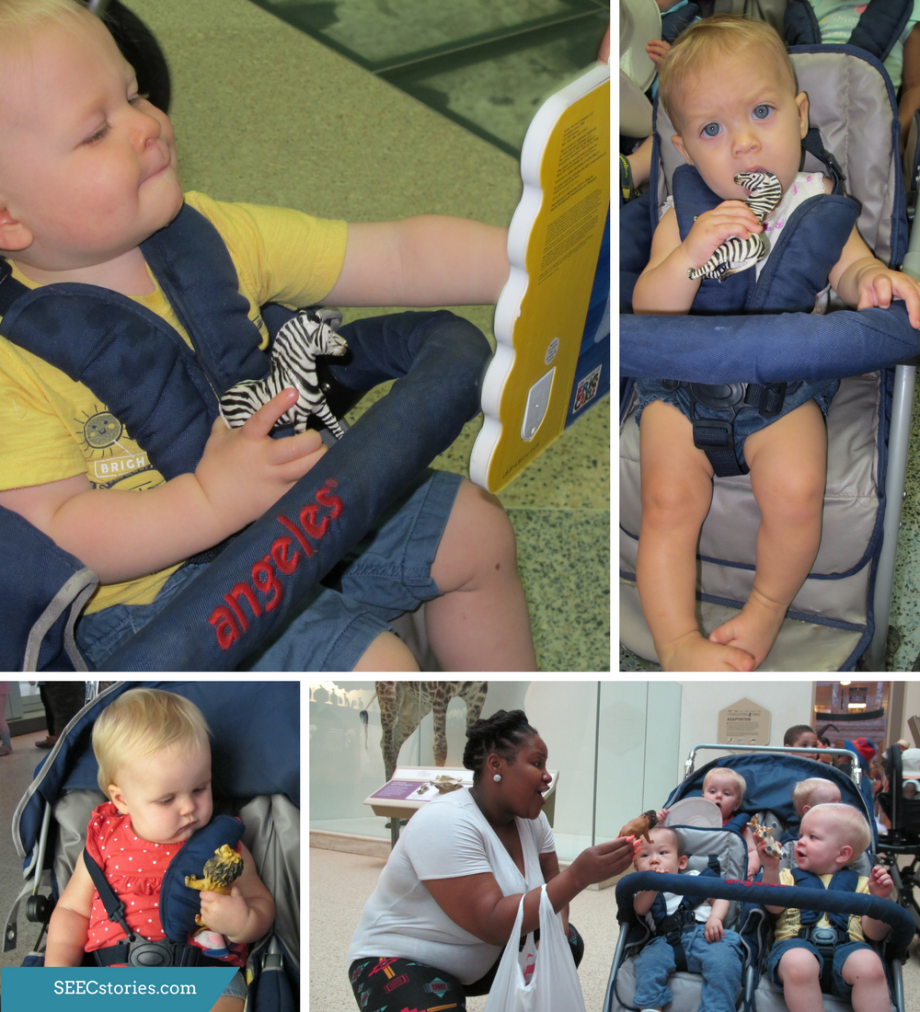
While in the mammal hall, the children were able to hold animal figurines that matched the animals that they saw in the mammal hall and in the book Polar Bear, Polar Bear, What do you hear? These animals helped the teachers personalize the lesson as they could take note of which animal each child was most interested in based on the animal that the children chose to hold.

SEECstories.com (2)

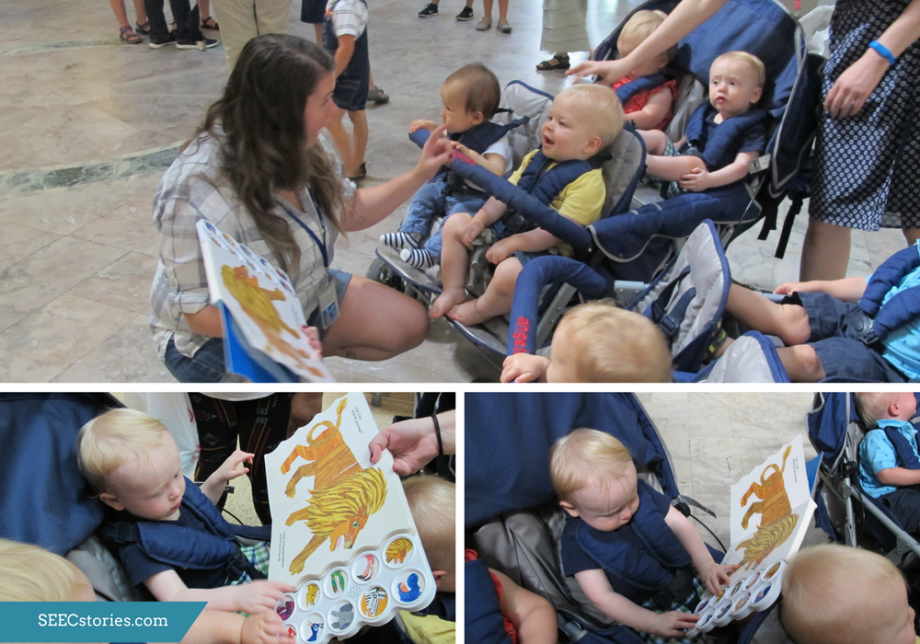
For these young children, the book itself was an object. They were excited to be able to touch, hold, explore, and even push buttons to make noise. The book, which the class had been reading regularly, helped bridge the gap from the familiar to the unfamiliar large animals.

SEECstories.com (4)

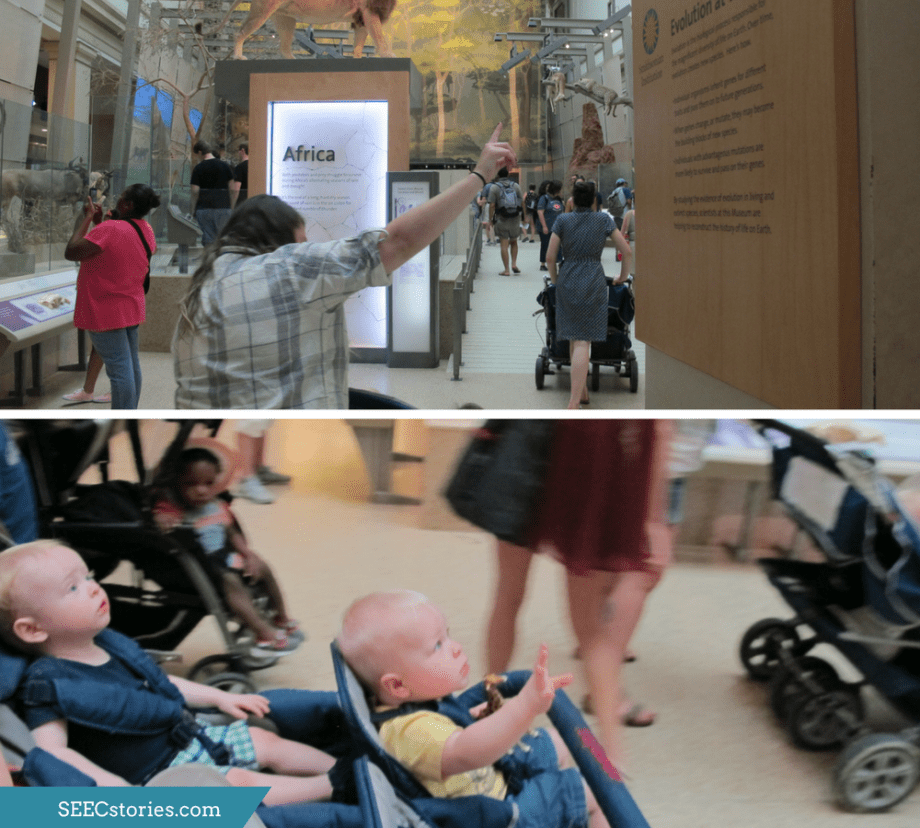
Most of the children in this class are preverbal, but this does not mean that they are unable to communicate. In fact, the infants use their physical activity to communicate by pointing and making gestures. The teachers were careful to narrate everything they saw and also communicated with gestures while paying careful attention to the children.

SEECstories.com (6)

Another way the teachers were responsive to the class was by rotating who held the book Polar Bear, Polar Bear, What do you Hear? If a child expressed interest in looking closer at the book, the teachers would bring the book over to that child. If that child wanted to hold the book and explore it on his or her own, the teachers responded to the wants and needs of the individual by giving the child the opportunity to hold the book on his or her own while the rest of the class observed some of the mammals.

SEECstories.com (8)

The book, Polar Bear, Polar Bear, What do you Hear?, focuses on the sounds that the different animals make and young children love experimenting with the different sounds they can make. This makes for a perfect pair. While in the mammal hall, the children attempted to mimic the sounds that different animals make.

SEECstories.com (7)

The last stop on their adventure was to see the polar bear, which is on display up high. The children were captivated by the polar bear and craned their necks upward to get a better view.

Untitled design (1)

Back in the classroom, the teachers were able to continue assessing which animals the children wanted to explore further. The children gravitated towards certain animals. In the picture above, you can see one child actively exploring the teeth of the hippopotamus, which she had seen earlier in the mammal hall, and comparing them to her own teeth.


A reflection from Erica, Katherine, and Noel:

Preparation

We began learning about animals by exploring the different ways they look, sound, and move. This topic started to emerge within our classroom when the students began to recognize animals and mimicked the sounds animals make to let us know that they had noticed a specific animal. We wanted to show our class these animals up close and personal and to relate them to the books we see them in, the songs we sing about them, and the images of different mammals we encounter every day. Choosing to go to the mammal hall made the most sense since the animals there are so lifelike, other than they don’t make noise, but luckily the students helped us with that. We took safari hats with us to wear as we searched for our favorite animals and the animals mentioned in the book Polar Bear Polar Bear What Do You Hear? We wanted the students to come away from the lesson having made the connections between what they saw and heard in one of their favorite books to the size and shape of the animals in the mammal hall. In preparation for this lesson, we did many different kinds of movement in the classroom to mimic animal movements and often demonstrated the sounds these animals make.

Lesson

The most effective part of our lesson was showing the students the connection between the animals on the page and the animals in the mammal hall. Creating space for the students to get a sense of how big the animals are helped to expand this topic. Viewing the images of animals on a page, then seeing them in person, and then still being able to connect to the of sound of animals is pretty significant. Our time spent preparing in the classroom and going over the different animals made the lesson smoother. Rather than overwhelming the children with all the massive animals, we gave them time to adjust to each animal. Some students even had favorites, which we had planned to focus on. We were surprised to see which students were really engaged as we went through the mammal hall. Some students, who we had expected to be very vocal because they growl and make lion noises all day, were relatively quiet. We think they saw how lifelike and big a real lion was when we got up close and they were so entranced that they stopped growling and making noise which none of us expected to happen.

Reflection

Avoiding crowds is always something that is hard to manage, especially in the mammal hall, because it attracts so many people. The book we brought with us also had buttons for each animal to make noise, but it was so crowded that it was hard to hear at times. Luckily, our class had been pushing these buttons for weeks, so they were still able to make the connection even without us using the sounds in the book. After completing our safari hunt through the mammal hall, we continued to look at different animal books, wear our safari hats, and make observations about different animals.

If we were to do this lesson again, we would spend more time discussing all types of animals rather than just mammals. We would also focus on what makes different animals distinct from each other. We believe that looking at more types of animals (reptiles, birds, etc.) would not have hindered the students’ exploration of the mammals, but rather it would have opened up the topic to more discussion and learning.


Teacher Feature: Toddler Class Explores Sailors

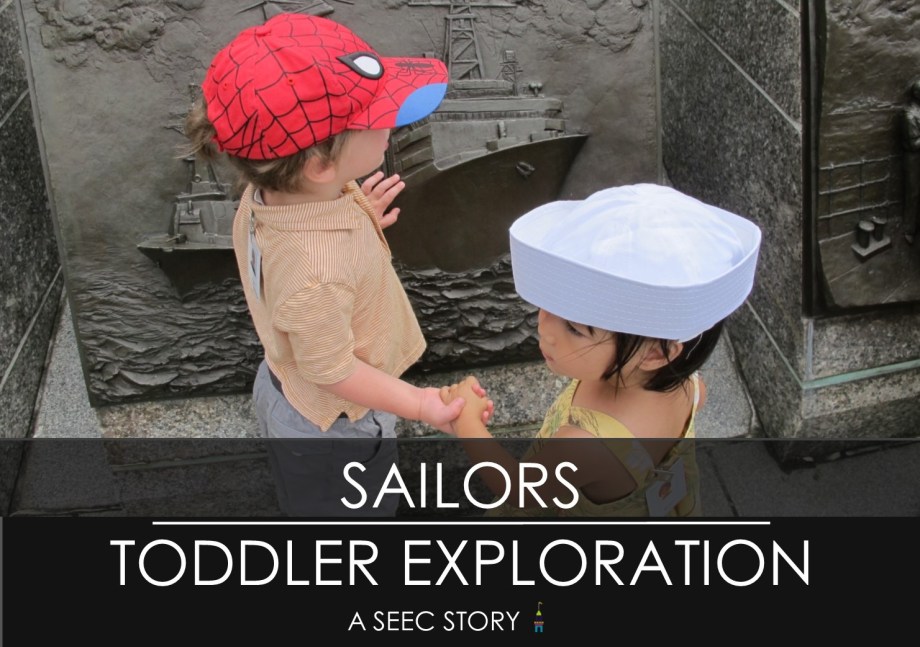
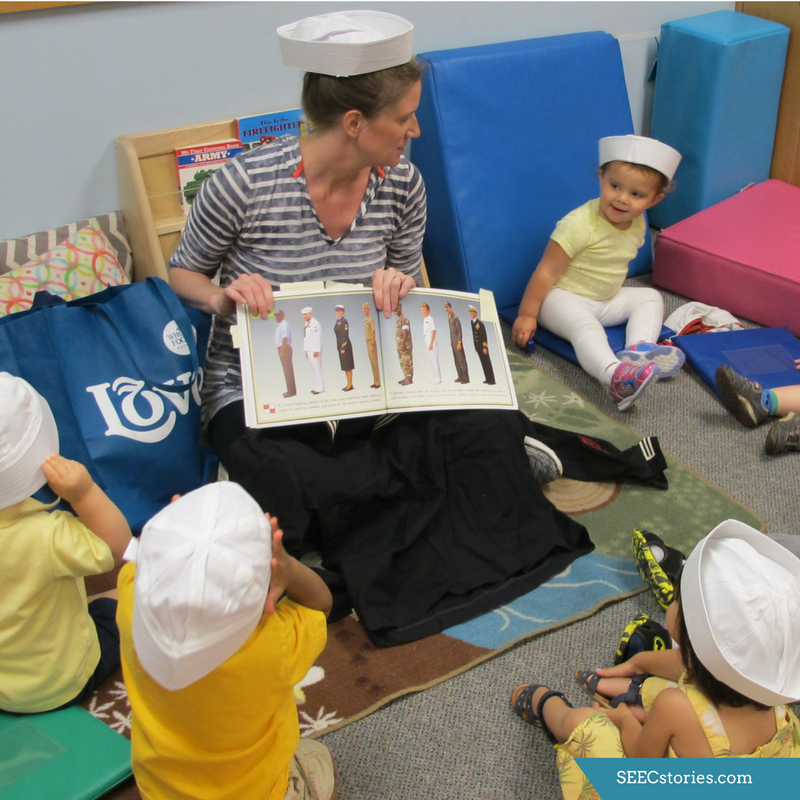
It’s teacher feature Thursday and this week we are featuring a lesson from one of our toddler rooms. The class visited the United States Navy Memorial to learn about sailors, which was part of their unit exploring heroes. The class began with a circle in the classroom where the teachers, Maya Alston, Erica Collins, and Elizabeth Kubba, introduced vocabulary and ideas about sailors. The class then walked to the United States Navy Memorial where they further explored these ideas while looking at The Lone Sailor statue, 26 high-relief panels that show elements of Navy life, and the signals flags. Below you will find images from the lesson as well as a reflection from Maya, Erica, and Elizabeth.

Cover Photo_Toucans

Here are some images from the lesson:

SEECstories.com

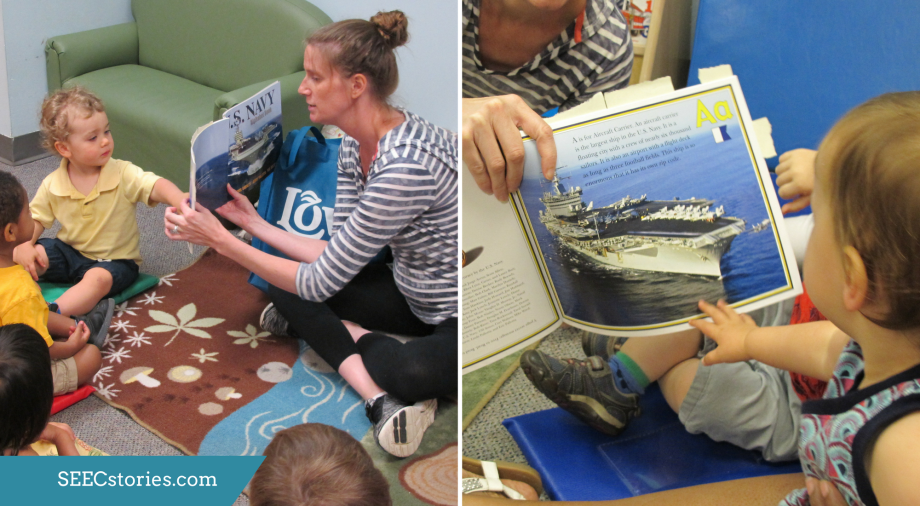
The lesson began with a classroom circle where Elizabeth read US Navy Alphabet Book by Jerry Pallotta (Author), Sammie Garnett (Author), and Rob Bolster (Illustrator). This toddler class’ interaction with the book was unique in that the children were encouraged to touch the pages. After Elizabeth read a page, she would pause and go around the circle giving each child the opportunity to reach out and touch images in the book. Sometimes she would guide them by asking “Can you find the boat?” and at other times she would narrate what they were drawn to, “Oh, you found the sailor’s hat!” This technique helped the class connect to the book, stay engaged, and ultimately built pre-literacy skills.

SEECstories.com (1)

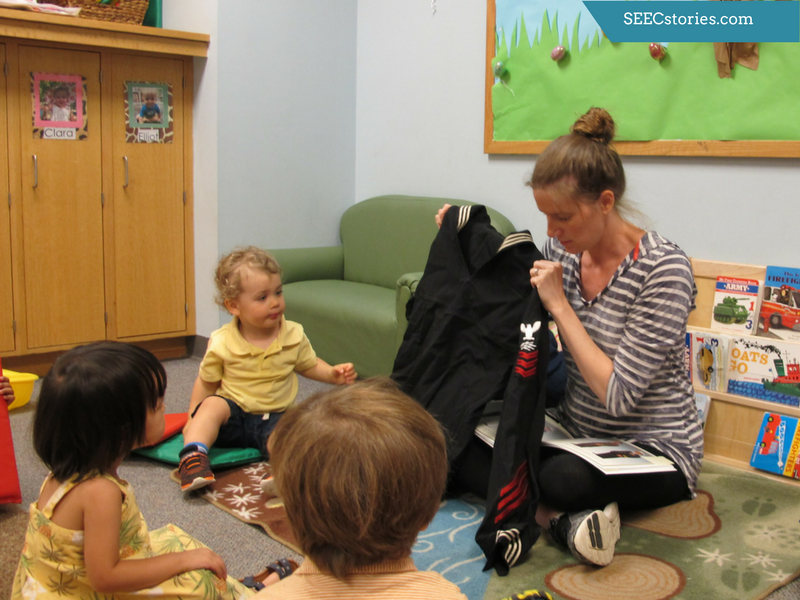
In addition to the book, the class had the opportunity to explore objects during the classroom circle, such as a Navy uniform. The class not only looked at, but also touched the uniform. This helped them build a deeper understanding of the uniform so they could relate it back to the book they had just read and later to The Lone Sailor statue at the United States Navy Memorial.

SEECstories.com (2)

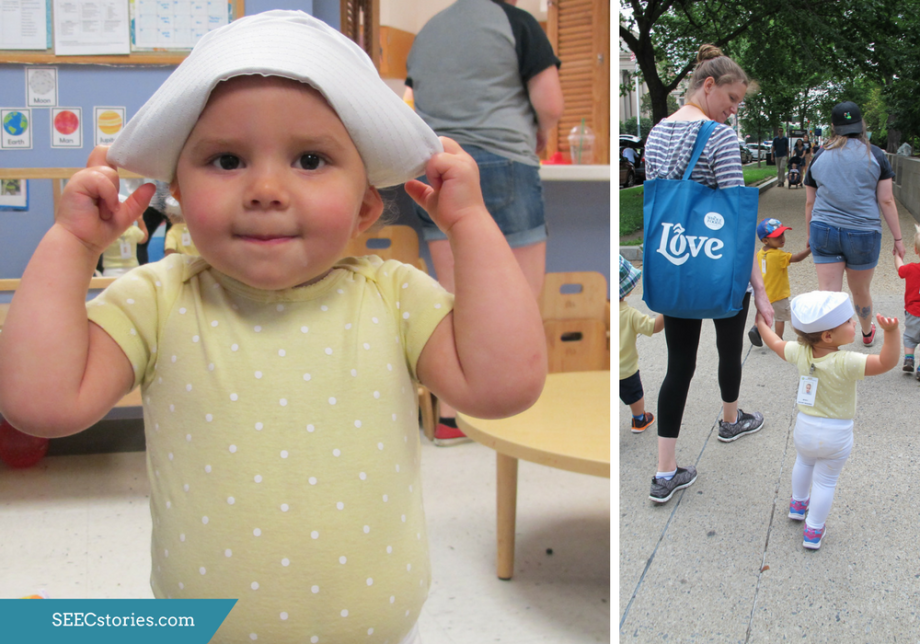
Each child was given a white child-sized Navy hat, which they could play with during the lesson. Elizabeth passed out the hats when she got to the page on Navy uniforms and then allowed the children to interact with the hats for the rest of the lesson. Passing out the hats in the middle of the story helped to re-engage the class with the circle and refocused their attention.
SEECstories.c

After circle, the class was given the opportunity to play more freely with the hats. They explored flipping them upside down and pulling the brims over their eyes. As the class was getting ready to leave, Maya, Erica, and Elizabeth gave each child a choice, they could either wear their normal sunhat outside or they could wear the Navy hat. Some children chose their normal hats and some chose the Navy hats. Giving toddlers a choice between two things can help ease anxiety around a transition, can help build their own autonomy, and can also help develop their communication skills.

SEECstories.com (3)

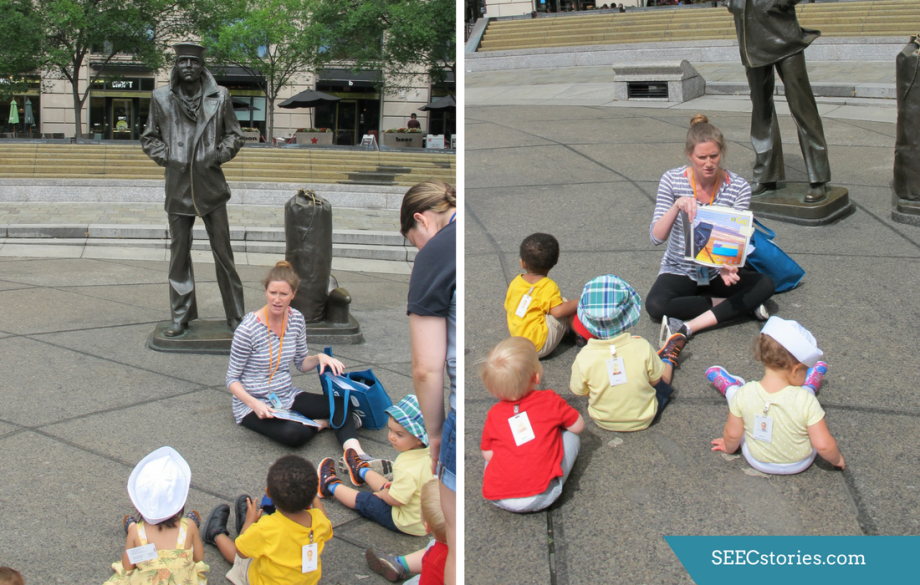
Once the class arrived at the United States Navy Memorial, they gathered around The Lone Sailor Statue. In order to orient the class, Elizabeth showed images from the US Navy Alphabet Book. This helped to build connections between activities they had done in the classroom and being at the Navy Memorial. The teachers then asked the class a series of both open-ended and guiding questions including “What do you see?”, “What could his job be?”, “What can you find?”, “Can you find his hat?”

SEECstories.com (4)

While class was talking about the things that they saw, one child pointed out the flags. The teachers commented that the flags on the mast looked similar to the some of the flags in the book. Since there was clearly an interest in the flags, Maya, Elizabeth, and Erica made a point of bringing the class closer so they could get a better look.

SEECstories.com (5)

While looking at The Lone Sailor, Maya, Erica, and Elizabeth pointed out the uniform and explained that it is one way to identify him as a sailor.  They noted the hat and compared the sailor hat to the ones on the children’s heads. They then encouraged the class to take a closer look. Some of the children chose to interact with The Lone Sailor statue. One even gave him a hug around the leg.

SEECstories.c (1)

The class then walked around the rest of the memorial, which included 26 bronze sculptures. Each sculpture offered many opportunities for discussion. The teachers followed the children’s lead. If a child pointed to something, the teacher would make a remark. Sometimes the teachers simply narrated what the child was doing. Other times the teachers asked questions like “How would you feel on a boat?” or “What do you think she is doing?”

SEECstories.c (2)

While the whole class explored the bronze sculptures at the same time, each child was allowed to move and explore at his or her own pace. It was clear that some children found certain elements of the bronze statues more captivating than others. When a child found something that drew her or his attention (like the chain above), that child was permitted to take the time he or she needed to explore before moving on to the next statue. Splitting the children into three groups, one group for each teacher, helped to make this possible.

A reflection from Maya, Erica, and Elizabeth:

Our toddlers seem to love superheroes. They often have Batman, Superman, Spiderman, Captain America, and Wonder Woman logos on the hats atop their heads, the shirts covering their bellies, and the shoes on their feet. In addition to these fantasy superheroes, our toddlers also spend a lot of time playing with firetrucks, marveling at sirens of ambulances and police cars, and giving a cheerful high five to the security officers who work in our museums.  We noticed these interests and decided to build a unit around the real-life superheroes in our community. Our goal was to help our class to grasp the idea of what being a superhero really is (someone who helps and protects others), to be able to recognize key characteristics of these community superheroes (uniforms, modes of transportation, etc.) and some of the ways these superheroes help and protect us (what do they actually do). During this unit we studied firefighters, military service members, doctors, nurses, park rangers, and the United States Park Police. Here, we will dive more deeply into one specific lesson, our lesson on sailors in the United States Navy.

For this lesson, we chose to visit the United States Navy Memorial. At the memorial, there is a large bronze statue called The Lone Sailor and multiple smaller scene sculptures depicting the history of the Navy. We knew these would be great for our toddlers to visit because the sculptures are easy to see and, even better, can be touched! We wanted the children to be able to recognize key features of a sailor’s uniform, the sailor’s hat, and their modes of transportation including ships, boats, submarines, and airplanes. We did a little research prior to the lesson by exploring the Navy Memorial website, reading the US Navy Alphabet Book, and speaking with a fellow teacher whose husband was in the Navy. Based on this research, we decided what characteristics of Navy sailors we wanted to focus on with the children during our classroom circle time and our community visit.

During the classroom circle time, we first read through parts of the US Navy Alphabet Book that we felt were developmentally appropriate for our age group, and highlighted the features we knew the children would see on the visit. We also allowed them to touch the images in the book. We often allow the children to touch objects in the books we read as it helps to focus their toddler wiggles. It also gives us the chance to assess if we are making the literacy connections between the word the toddlers hear and the object itself. We then showed the children two genuine Navy uniforms. We asked them to tell us what colors and other features they noticed. Answers we heard included “blue”, “white”, and “bird”.  After that, we brought out a sailor hat that they could take turns passing around the circle, which allowed them to gain a more concrete connection to the object and give them the opportunity to work on developing the social-emotional skill of taking turns. After taking turns passing the sailor’s hat, the children were ecstatic to find out that they were all getting their own sailor hats to wear on our visit!

While walking to the memorial, we modeled our thinking and wondered out loud about where we might find a sailor, how a sailor might look, and how to know if we found one. Once there, the toddlers quickly pointed out that the sailor hat on The Lone Sailor statue matched the hats their heads. We sat down in front of the statue and pulled out the US Navy Alphabet Book once more. We pointed to the objects we were seeing at the memorial that were also in the book. We asked open-ended questions including “What do you see?”, “What do you think his job is?”, and “What can you find?” Asking these questions prompted the children to look carefully at all the features of the large memorial space. One child proudly proclaimed that he had found flags that matched the flags in our book. When we could tell our toddlers were ready to move their bodies and explore more of the space, we walked them around to the smaller sculptures that were right at their eye level. This was one of the best parts of the lesson because it combined movement, careful looking, and touching. Because of this, the children spent quite a bit of time at each sculpture. They would point to features they recognized and often would name them as well. An added bonus was that it had rained earlier that day, so the boats and other features of the sculptures were wet. This really helped to make the connection that sailors are often on or near water. The children were able to put their fingers in small puddles of water that had collected on the statues and see droplets falling from the sailors’ bodies. If we redid this lesson on a sunny day, I would plan to bring water with us and use a spray bottle to talk about how water can sprays onto the boat as the sailors travel.

Overall, this lesson seemed to be a great success. We put the sailor hats out as choices in the classroom and noted that the children kept revisiting them over the next couple of weeks. We also put out My First Counting Book: Navy by Cindy Entin, which was a board book that the children could explore independently. These two things showed us that the children enjoyed learning about the sailors and helped to reinforce the connections over a long period of time. When doing this lesson in the future, we would like to add a water table with boats and submarines as an extension. We believe this extension would be especially effective because it would help the class connect the idea of water and sailors and connect well to the visit to the Navy Memorial.

Technology at SEEC

These days, technology is at the forefront of everyone’s mind. If we look at Forbes’ list of billionaires, one is struck by a preponderance of tech-savvy figures like Mark Zuckerberg, Jeff Bezos, and of course Bill Gates. It is no surprise that technology is now part of almost every facet of our lives, including education.  For those of you who were born in the 70’s and 80’s, you can probably remember lugging home a stack of books and covering them with paper bags. These days, things have changed. As a parent of two, I can’t think of a single instance when my children brought home a text book. For many of America’s schools the text book has been supplanted by tech (it bears noting that this is likely not the case for all schools, and that broader access to technology could help contribute to closing the achievement gap.[i]).  It begs the question, how is tech being used within the educational landscape? And, as both educator and parent, how do I discern between what is worthwhile and what is not?

Tech2

This question is even further muddied when one considers the early childhood audience. The American Association of Pediatrics writes:

For children younger than 2 years, evidence for benefits of media is still limited, adult interaction with the child during media use is crucial, and there continues to be evidence of harm from excessive digital media use, as described later in this statement. [ii]

For preschoolers, AAP states there is some evidence that well-produced apps can help children build literacy skills. The dilemma is that not all apps are created equal, and many of the products categorized today as “educational” do not adhere to strong educational standards. Moreover, many of these apps do not take into consideration one of the most important factors in successful early tech experiences – interactivity. Adult interaction with a child while using technology can make a significant difference in whether a tech experience provides any benefits for young children.[iii]  Having an adult present AND engaged in the activity has many added benefits. Adults can enhance the experience in a variety of ways. For example, they can narrate the experience, thus building vocabulary and helping the child process the information. They can model how to use the device and application, they can model a growth mindset, and they can help children practice executive function skills like patience and problem-solving. Adults can also ask meaningful questions that reflect the child’s interests, and that are open-ended to allow practice in critical thinking. Ultimately, having the adult present can tailor the experience for the child and turn a passive exercise into an active one.

Tech_1

This PreK-3 class considers the height of Mayan pyramids using a combo of tech, literature, inquiry, and objects.

Similarly, making tech part of a well-balanced activity “diet” makes it more likely to be effective.[iv] Young children require a variety of experiences to facilitate their growth and development. At SEEC, our educational approach is varied. Our classrooms incorporate a variety of pedagogical approaches that meet the child where he/she is: object-based, STEM, play, inquiry, Reggio-inspired, tactile, experiential. For us, adding tech is a natural extension of these approaches, one that almost always includes an educator and is a part of a much larger whole.

As educators, we have especially welcomed the inclusion of videos and recordings. Having such resources available while in a museum setting have proven invaluable. Now when we go to the bird hall at the Natural History Museum, we don’t just look at the birds and feel examples of feathers, we also listen to different bird calls. Or when we head over to see the Freer and Sackler’s Shiva Nataraja, we can also show children videos of contemporary religious festivals in India. Our iPads are also tools for STEM learning. In an ideal world, educators have the time and resources to set up an experiment like, ‘what floats and what sinks?’. But what if you have a question like, “Do polar bears communicate?”  Technology can help us answer that question in a way that is robust and concrete – both particularly important for young learners. For example, when preparing a lesson on this very topic I came across this resource that plays the different sounds polar bears make.

Tech3

Those teachers aren’t ON their phones, they are USING their phones so their infant class can listen to Michael Jackson.

Finally, the very acts of asking questions and searching for answers are ones that are particularly important to SEEC. When we use an emergent curriculum, we pay particularly close attention to what our students are doing and asking. With access to tech, we are able to take their questions and explore answers in a multi-dimensional way. We can model for children the choices we make in using reliable sources, how to collect and synthesize information, and most importantly, we can demonstrate that we, the educators, don’t have all the answers.

Our hope is that in coming months, we will continue to collect information about how tech is being used in our classrooms and share that with our audiences. As always, we are welcome your input and ideas too.

[i] “Technology Can Improve Achievement Gaps, Improve Learning.” Stanford Graduate School of Education. Stanford University, September 10, 2014. Web. July 3, 2017.

https://ed.stanford.edu/news/technology-can-close-achievement-gaps-and-improve-learning-outcomes

[ii] “Media and Young Minds.” AAP News. American Association of Pediatrics, November 2016. Web. July 3, 2017.

http://pediatrics.aappublications.org/content/138/5/e20162591

[iii]  “Guiding Principles for Use of Technology with Early Learners.” Office of Educational Technology. U.S. Department of Education, Web. July 3, 2017.

https://tech.ed.gov/earlylearning/principles/

[iv]  “Technology and Interactive Media as Tools in Early Childhood Programs Serving Children from Birth through Age 8.” National Association for the Education of Young Children, Fred Rogers Center for Early Learning, and Children’s Media at Saint Vincent College, National Association for the Education of Young Children, Web. July 3, 2017. p.7

http://www.naeyc.org/files/naeyc/PS_technology_WEB.pdf

Teacher Feature: Toddlers Explore Karaoke

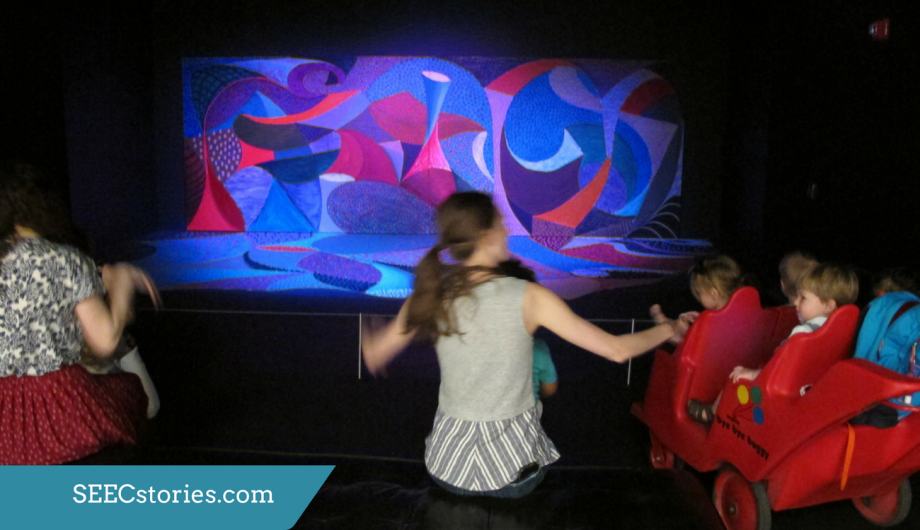
Today’s Teacher Feature highlights the Dragonflies, a toddler class. The teachers, Lauren Bundy, Katherine Custer, and Emily Romig choose to explore karaoke. The class visited David Hockney’s Snail Space at the Smithsonian American Art Museum and later that afternoon had a karaoke party in their classroom. See below for pictures highlighting the lesson and for a reflection from the teachers.

Cover Photo

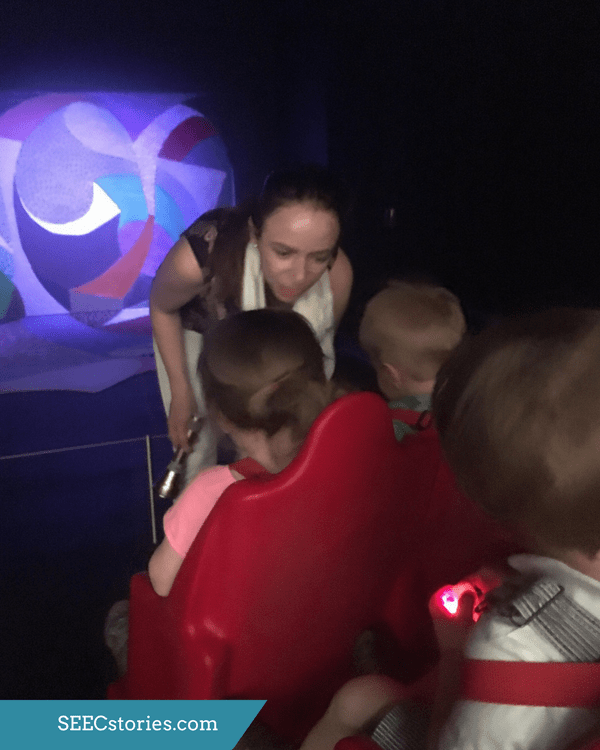
The teachers knew that they wanted to teach their class about karaoke but were initially unable to think of an object that would help support their lesson. They thought about seeing a microphone as an object but decided that simply seeing a microphone might not provide the type of experience that they were hoping for their class. After brainstorming, the teachers decided to bring their toddler class to see David Hockney’s Snail Space at the Smithsonian American Art Museum. The teachers believed that they could use the light, colors, intimacy of space, and stage like atmosphere to draw connections to karaoke.

SEECstories.com (1)

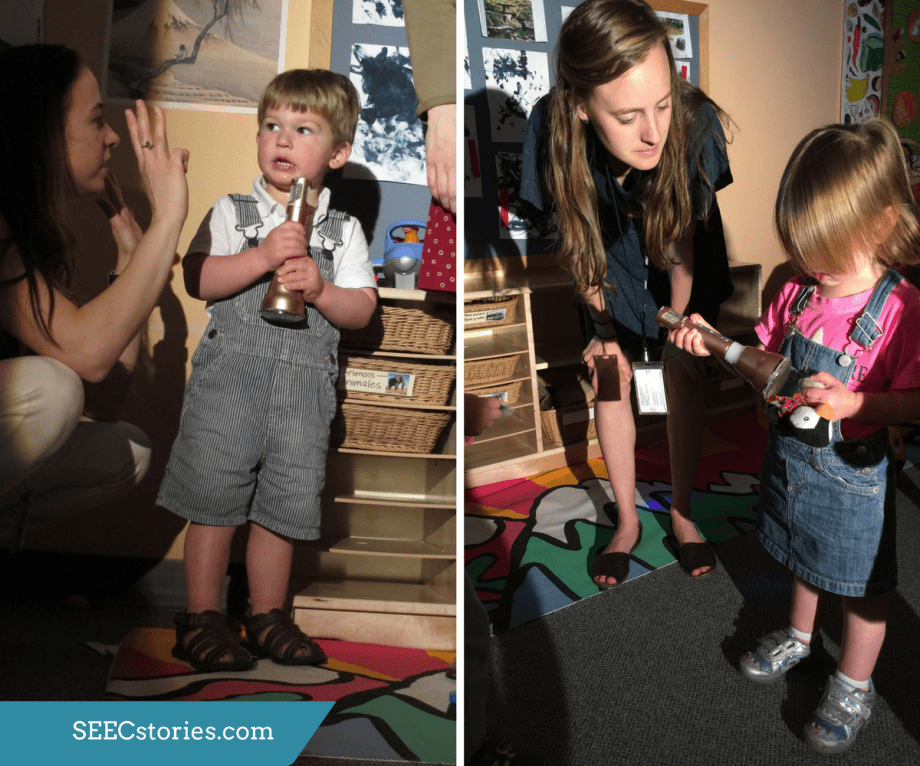
The teachers did not ignore the importance of a microphone for karaoke. Lauren Bundy choose to bring a microphone as an object to explore while the class was experiencing Snail Space. Lauren gave each child in her class the opportunity to speak into the microphone and hear how their voice changed.

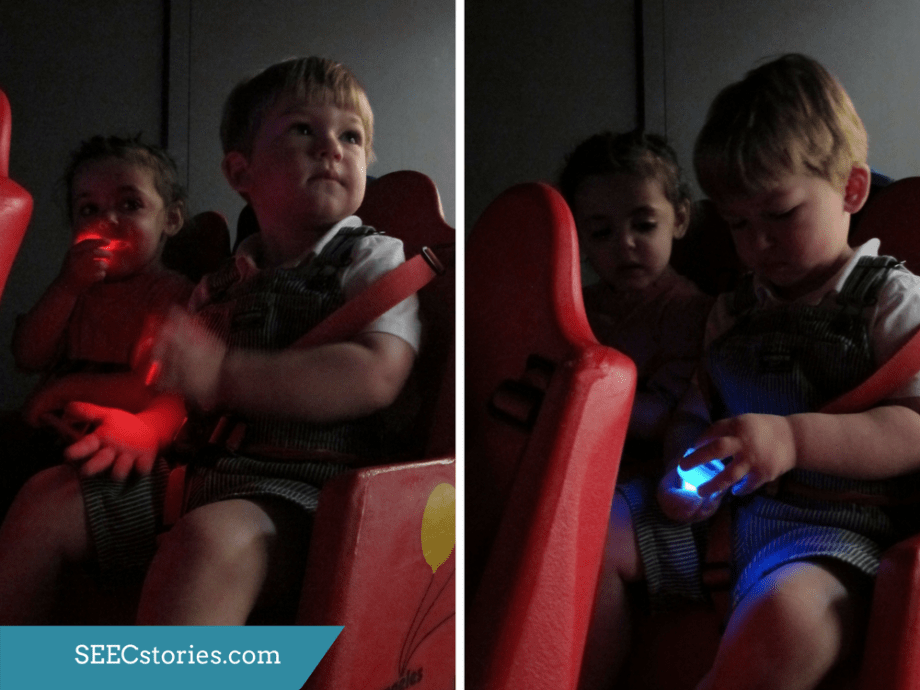
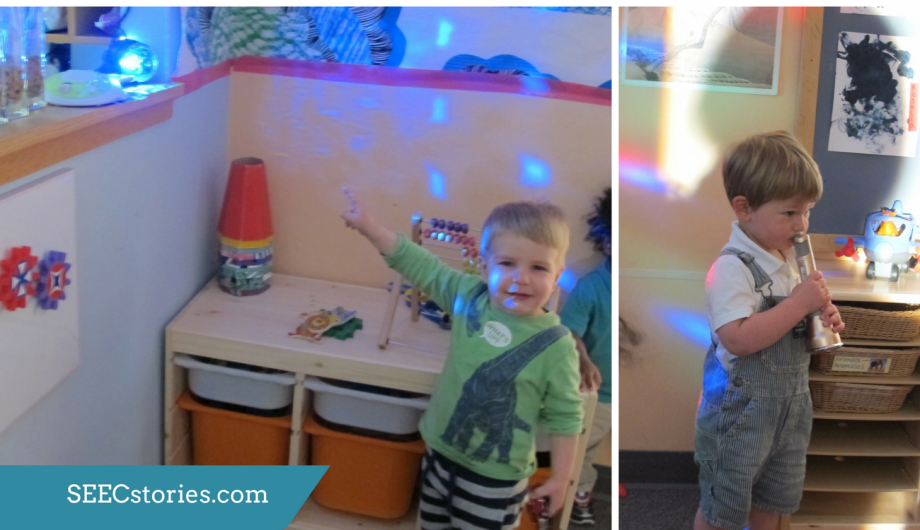
SEECstories.com (2)Light was another topic that the teachers were hoping to explore with their class since karaoke performances often involve a light show. As part of the instillation of Snail Space color changing lights are projected onto the two canvas’ and floor space design. In addition to experiencing the light that is part of the performance of Snail Space, the teachers brought battery powered tea lights to allow the children to explore and manipulate their own light.
SEECstories.com (3)

While experiencing Snail Space, the toddler teachers sang some of their class’s favorite songs and used the stage like atmosphere of the installation to discuss the experience of performing karaoke.

SEECstories.com (5)

Back in their classroom, the toddlers were able to put on their own karaoke show. The teachers transformed their classroom by setting up an overhead projector as a spotlight and used a color changing light. They used speakers to play their class’s favorite tunes and gave the children a chance to perform with a microphone.

SEECstories.com (4)

While experiencing karaoke, the toddlers also participated in social-emotional learning. There was only one microphone which meant that the toddlers had to practice taking turns. In order to help facilitate taking turns, the Dragonfly teachers gave the children verbal and nonverbal warnings to help the children be more fully aware of when their turn was over.SEECstories.com (6)

The Dragonflies karaoke party was tons of fun! Each child was able to experience the joy of choosing their favorite song and performing it in front of their friends.

Reflections from Lauren:

How did this topic emerge?

After a week of lessons that involved visiting Yayoi Kusama’s Infinity Mirrors at the Hirshhorn Museum and picnicking under the blossoming cherry trees by the Tidal Basin, a theme started to emerge that would become our next unit of study: Japan! We were excited about the topic because learning about another country can offer our toddlers a great variety of experiences to explore. So far, we have ventured into topics such as sushi, tea, koinobori (carp streamers), ink wash art, and now karaoke! We had a hunch that the Dragonflies would be interested in karaoke because they dance and sing all the time in the class – with or without music.

What topics were explored?

Our learning objectives were to talk about how karaoke originated from Japan and how it can not only be an exciting activity but a way to unwind as well. The week before, we had taught the Dragonflies about rock gardens, raking sand, and plants. We talked about how these activities could be “relaxing” and that idea really stuck with the Dragonflies. They would start to talk about how they “relaxed” at home by looking at a “book” or sitting in a “rocking chair.” Since this idea of finding a way to emotionally wind down had already permeated the class, we were able to connect it to the topic of karaoke.

To connect this topic to Japanese karaoke, we talked about how there are people in Japan who work very hard at their jobs and after a long week, they might perform karaoke with their close friends. We talked about how karaoke is one way to relax after working really hard. When we had our karaoke party with the Dragonflies, we did it at the end of our school day. Since then we have returned to it again and again in the afternoons. The Dragonflies loved karaoke!

How is this a developmentally appropriate practice?

Singing and dancing play an important role in toddler development. It helps the Dragonflies to learn social emotional skills like turn taking and listening to each other. They are learning cognitive skills by noticing the patterns and sequences of songs. They are developing their language skills as they sing new words. And they are also developing their physical skills as they dance to the new music.

What was our museum visit and object?

As for the visit, we decided to see David Hockney’s Snail Space at the Smithsonian American Art Museum. We choose this work of art because it gives a sense of space that is meant for a performance. We could have gone the route of visiting an exhibit that featured a microphone, but we decided that the object of a microphone on view might be too small of a feature to warrant enough attention from the toddlers. So why not visit a more immersive space, which is set up almost like a stage, and bring our own microphone?

In addition, David Hockney’s Snail Space is an intimate and secluded area compared to the large galleries that we often find ourselves in. We were able to connect the physical space of Snail Space to the tradition of Japanese karaoke. In Japan, it is customary to preform karaoke in a small private room often called a karaoke box in front of your close friends. The intimacy of the actual space in Snail Space draws parallels to what one might experience if they go to a karaoke box in Japan. Since our class were the only people in the space, the Dragonflies had the added bonus of experiencing it with some of their closest friends.

How did the lesson reach the objectives and expand the topic?

We actually had two separate lessons on karaoke that day. One being the museum visit in the morning, the other being the actual karaoke party in the afternoon. At the museum visit we talked about how the art space was like a stage and we asked the Dragonflies about the different colors they saw in the lights. We then gave each Dragonfly a tea light that they could turn on and off and watch it change colors just like in the art piece. We also brought the microphone so the Dragonflies could hear their voices amplified in the space.

There were a few hiccups in the museum visit. The first was that a fire alarm went off in the museum and so we had to exit. (Just to clarify, we were there before the museum actually opened, so the alarm was most likely a test.) Another oops was when one of the Dragonflies dropped their tea light and it rolled onto the art on the other side of the barrier.

At the karaoke party in the afternoon, the Dragonflies had a blast. We turned off the lights, used an overhead projector as a spot light, and then turned on the disco lights. We had compiled a list of the Dragonflies favorite songs with the help of parents. The Dragonflies then took turns singing their favorite song, while the others got to dance to the music.